



PASSIVE VOICE II
2
Active Voice Use
There are two different voices: Active and
Passive.
The active voice is more common and used.
It indicates that the subject of the verb is
acting.
Because the subject does or "acts upon"
the verb in such sentences, the sentences
are said to be in the active voice.
3
Example:
My dog ate my English homework
In this sentence My dog is the one that
performs the action of eating my English
homework. It is more important.
4
Passive Voice Use
The passive voice is used when we focus on
the action and who or what is performing
the action is not important or not known.
The subject and object flip-flop. The subject
becomes the passive recipient of the action.
Because the subject is being "acted upon"
(or is passive), such sentences are said to be I
in the passive voice.
5
Example:
My English homework was eaten.
In this sentence My English homework
which was eaten is more important. What
eat it is not important.
6
How can we turn active
sentences into passive?
7
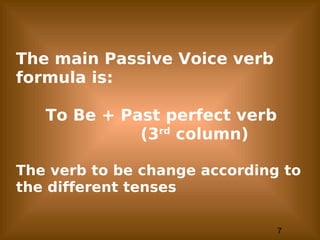
The main Passive Voice verb
formula is:
To Be + Past perfect verb
(3rd
column)
The verb to be change according to
the different tenses
8
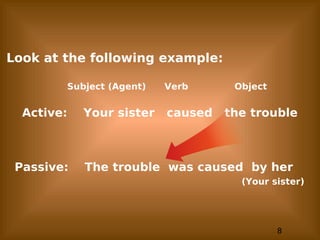
Look at the following example:
Subject (Agent) Verb Object
Active: Your sister caused the trouble
Passive: The trouble was caused by her
(Your sister)
9
What happens with the other tenses?
10
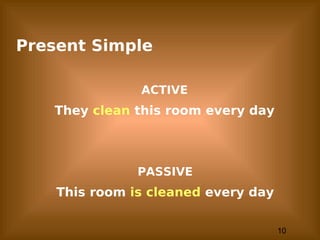
Present Simple
ACTIVE
They clean this room every day
PASSIVE
This room is cleaned every day
11
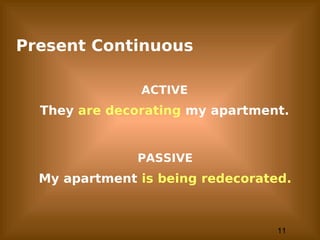
Present Continuous
ACTIVE
They are decorating my apartment.
PASSIVE
My apartment is being redecorated.
12
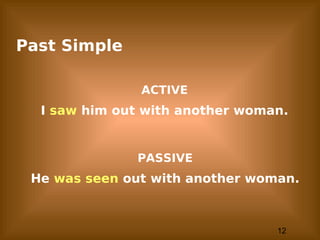
Past Simple
ACTIVE
I saw him out with another woman.
PASSIVE
He was seen out with another woman.
13
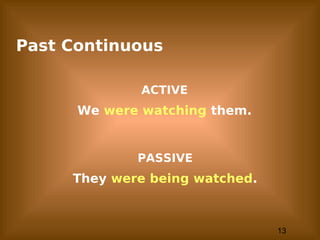
Past Continuous
ACTIVE
We were watching them.
PASSIVE
They were being watched.
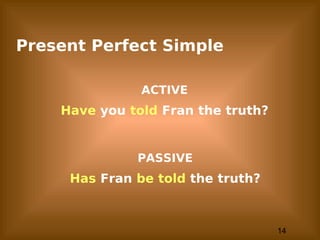
14
Present Perfect Simple
ACTIVE
Have you told Fran the truth?
PASSIVE
Has Fran be told the truth?
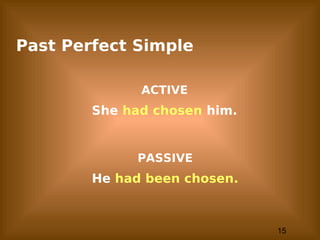
15
Past Perfect Simple
ACTIVE
She had chosen him.
PASSIVE
He had been chosen.
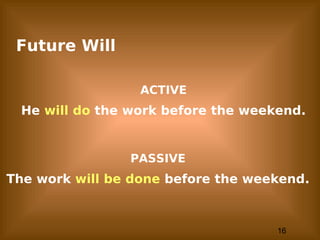
16
Future Will
ACTIVE
He will do the work before the weekend.
PASSIVE
The work will be done before the weekend.
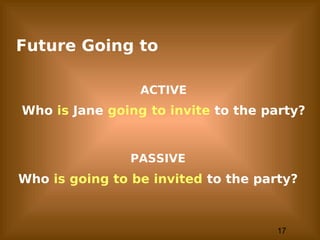
17
Future Going to
ACTIVE
Who is Jane going to invite to the party?
PASSIVE
Who is going to be invited to the party?
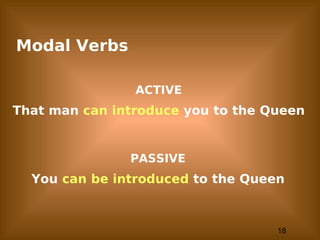
18
Modal Verbs
ACTIVE
That man can introduce you to the Queen
PASSIVE
You can be introduced to the Queen
19
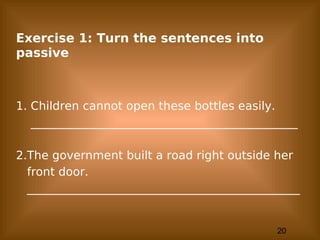
20
Exercise 1: Turn the sentences into
passive
1. Children cannot open these bottles easily.
______________________________________________
2.The government built a road right outside her
front door.
_______________________________________________
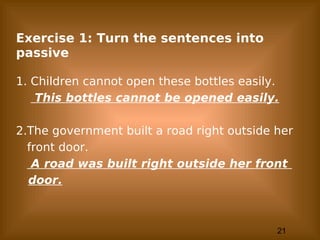
21
Exercise 1: Turn the sentences into
passive
1. Children cannot open these bottles easily.
This bottles cannot be opened easily.
2.The government built a road right outside her
front door.
A road was built right outside her front
door.
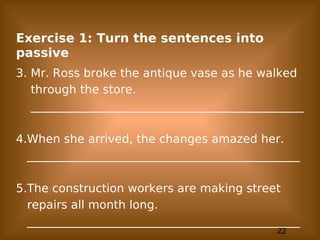
22
Exercise 1: Turn the sentences into
passive
3. Mr. Ross broke the antique vase as he walked
through the store.
_______________________________________________
4.When she arrived, the changes amazed her.
_______________________________________________
5.The construction workers are making street
repairs all month long.
_______________________________________________
23
Exercise 1: Turn the sentences into
passive
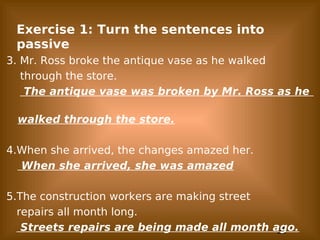
3. Mr. Ross broke the antique vase as he walked
through the store.
The antique vase was broken by Mr. Ross as he
walked through the store.
4.When she arrived, the changes amazed her.
When she arrived, she was amazed
5.The construction workers are making street
repairs all month long.
Streets repairs are being made all month ago.
24
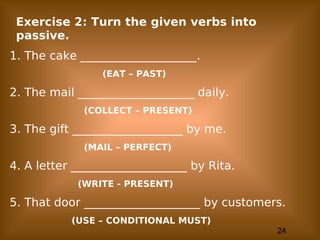
Exercise 2: Turn the given verbs into
passive.
1. The cake ____________________.
(EAT – PAST)
2. The mail ____________________ daily.
(COLLECT – PRESENT)
3. The gift ___________________ by me.
(MAIL – PERFECT)
4. A letter ____________________ by Rita.
(WRITE - PRESENT)
5. That door ____________________ by customers.
(USE – CONDITIONAL MUST)
25
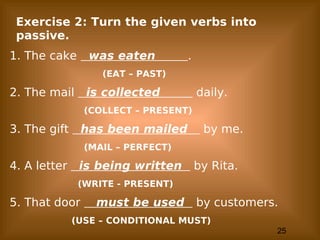
Exercise 2: Turn the given verbs into
passive.
1. The cake was eaten .
(EAT – PAST)
2. The mail is collected daily.
(COLLECT – PRESENT)
3. The gift has been mailed by me.
(MAIL – PERFECT)
4. A letter is being written by Rita.
(WRITE - PRESENT)
5. That door must be used by customers.
(USE – CONDITIONAL MUST)
26
This material was
created by
Teacher Danitza Lazcano Flores
Teacher of English
Master in Education
and
Educational Counselor

Passive Voice II

  • 1.
  • 2.
    2 Active Voice Use Thereare two different voices: Active and Passive. The active voice is more common and used. It indicates that the subject of the verb is acting. Because the subject does or "acts upon" the verb in such sentences, the sentences are said to be in the active voice.
  • 3.
    3 Example: My dog atemy English homework In this sentence My dog is the one that performs the action of eating my English homework. It is more important.
  • 4.
    4 Passive Voice Use Thepassive voice is used when we focus on the action and who or what is performing the action is not important or not known. The subject and object flip-flop. The subject becomes the passive recipient of the action. Because the subject is being "acted upon" (or is passive), such sentences are said to be I in the passive voice.
  • 5.
    5 Example: My English homeworkwas eaten. In this sentence My English homework which was eaten is more important. What eat it is not important.
  • 6.
    6 How can weturn active sentences into passive?
  • 7.
    7 The main PassiveVoice verb formula is: To Be + Past perfect verb (3rd column) The verb to be change according to the different tenses
  • 8.
    8 Look at thefollowing example: Subject (Agent) Verb Object Active: Your sister caused the trouble Passive: The trouble was caused by her (Your sister)
  • 9.
    9 What happens withthe other tenses?
  • 10.
    10 Present Simple ACTIVE They cleanthis room every day PASSIVE This room is cleaned every day
  • 11.
    11 Present Continuous ACTIVE They aredecorating my apartment. PASSIVE My apartment is being redecorated.
  • 12.
    12 Past Simple ACTIVE I sawhim out with another woman. PASSIVE He was seen out with another woman.
  • 13.
    13 Past Continuous ACTIVE We werewatching them. PASSIVE They were being watched.
  • 14.
    14 Present Perfect Simple ACTIVE Haveyou told Fran the truth? PASSIVE Has Fran be told the truth?
  • 15.
    15 Past Perfect Simple ACTIVE Shehad chosen him. PASSIVE He had been chosen.
  • 16.
    16 Future Will ACTIVE He willdo the work before the weekend. PASSIVE The work will be done before the weekend.
  • 17.
    17 Future Going to ACTIVE Whois Jane going to invite to the party? PASSIVE Who is going to be invited to the party?
  • 18.
    18 Modal Verbs ACTIVE That mancan introduce you to the Queen PASSIVE You can be introduced to the Queen
  • 19.
  • 20.
    20 Exercise 1: Turnthe sentences into passive 1. Children cannot open these bottles easily. ______________________________________________ 2.The government built a road right outside her front door. _______________________________________________
  • 21.
    21 Exercise 1: Turnthe sentences into passive 1. Children cannot open these bottles easily. This bottles cannot be opened easily. 2.The government built a road right outside her front door. A road was built right outside her front door.
  • 22.
    22 Exercise 1: Turnthe sentences into passive 3. Mr. Ross broke the antique vase as he walked through the store. _______________________________________________ 4.When she arrived, the changes amazed her. _______________________________________________ 5.The construction workers are making street repairs all month long. _______________________________________________
  • 23.
    23 Exercise 1: Turnthe sentences into passive 3. Mr. Ross broke the antique vase as he walked through the store. The antique vase was broken by Mr. Ross as he walked through the store. 4.When she arrived, the changes amazed her. When she arrived, she was amazed 5.The construction workers are making street repairs all month long. Streets repairs are being made all month ago.
  • 24.
    24 Exercise 2: Turnthe given verbs into passive. 1. The cake ____________________. (EAT – PAST) 2. The mail ____________________ daily. (COLLECT – PRESENT) 3. The gift ___________________ by me. (MAIL – PERFECT) 4. A letter ____________________ by Rita. (WRITE - PRESENT) 5. That door ____________________ by customers. (USE – CONDITIONAL MUST)
  • 25.
    25 Exercise 2: Turnthe given verbs into passive. 1. The cake was eaten . (EAT – PAST) 2. The mail is collected daily. (COLLECT – PRESENT) 3. The gift has been mailed by me. (MAIL – PERFECT) 4. A letter is being written by Rita. (WRITE - PRESENT) 5. That door must be used by customers. (USE – CONDITIONAL MUST)
  • 26.
    26 This material was createdby Teacher Danitza Lazcano Flores Teacher of English Master in Education and Educational Counselor