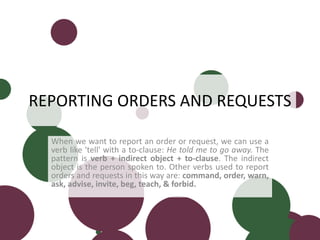
REPORTING ORDERS AND REQUESTS
When we want to report an order or request, we can use a
verb like 'tell' with a to-clause: He told me to go away. The
pattern is verb + indirect object + to-clause. The indirect
object is the person spoken to. Other verbs used to report
orders and requests in this way are: command, order, warn,
ask, advise, invite, beg, teach, & forbid.
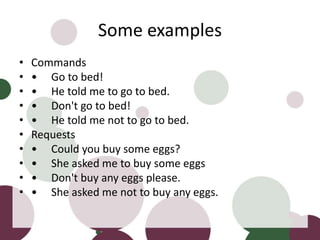
Some examples
• Commands
• • Go to bed!
• • He told me to go to bed.
• • Don't go to bed!
• • He told me not to go to bed.
• Requests
• • Could you buy some eggs?
• • She asked me to buy some eggs
• • Don't buy any eggs please.
• • She asked me not to buy any eggs.
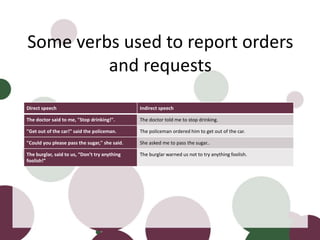
Some verbs used to report orders
and requests
Direct speech Indirect speech
The doctor said to me, "Stop drinking!". The doctor told me to stop drinking.
"Get out of the car!" said the policeman. The policeman ordered him to get out of the car.
"Could you please pass the sugar," she said. She asked me to pass the sugar..
The burglar, said to us, “Don’t try anything
foolish!”
The burglar warned us not to try anything foolish.
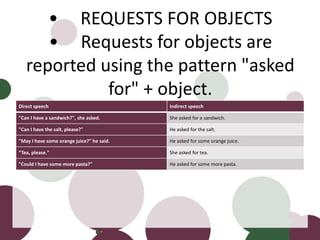
• REQUESTS FOR OBJECTS
• Requests for objects are
reported using the pattern "asked
for" + object.
Direct speech Indirect speech
"Can I have a sandwich?", she asked. She asked for a sandwich.
"Can I have the salt, please?" He asked for the salt.
"May I have some orange juice?" he said. He asked for some orange juice.
“Tea, please." She asked for tea.
"Could I have some more pasta?" He asked for some more pasta.
• •
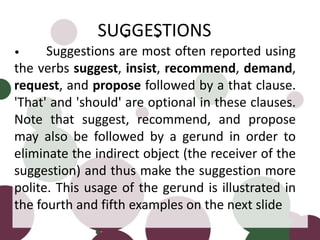
• Suggestions are most often reported using
the verbs suggest, insist, recommend, demand,
request, and propose followed by a that clause.
'That' and 'should' are optional in these clauses.
Note that suggest, recommend, and propose
may also be followed by a gerund in order to
eliminate the indirect object (the receiver of the
suggestion) and thus make the suggestion more
polite. This usage of the gerund is illustrated in
the fourth and fifth examples on the next slide
SUGGESTIONS
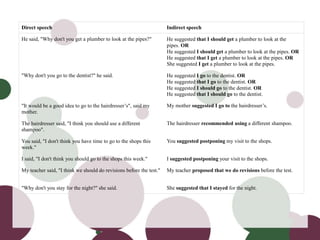
Direct speech Indirect speech
He said, "Why don't you get a plumber to look at the pipes?" He suggested that I should get a plumber to look at the
pipes. OR
He suggested I should get a plumber to look at the pipes. OR
He suggested that I get a plumber to look at the pipes. OR
She suggested I get a plumber to look at the pipes.
"Why don't you go to the dentist?" he said. He suggested I go to the dentist. OR
He suggested that I go to the dentist. OR
He suggested I should go to the dentist. OR
He suggested that I should go to the dentist.
"It would be a good idea to go to the hairdresser’s", said my
mother.
My mother suggested I go to the hairdresser’s.
The hairdresser said, "I think you should use a different
shampoo".
The hairdresser recommended using a different shampoo.
You said, "I don't think you have time to go to the shops this
week."
You suggested postponing my visit to the shops.
I said, "I don't think you should go to the shops this week." I suggested postponing your visit to the shops.
My teacher said, "I think we should do revisions before the test." My teacher proposed that we do revisions before the test.
"Why don't you stay for the night?" she said. She suggested that I stayed for the night.

Reporting orders and requests

  • 1.
    REPORTING ORDERS ANDREQUESTS When we want to report an order or request, we can use a verb like 'tell' with a to-clause: He told me to go away. The pattern is verb + indirect object + to-clause. The indirect object is the person spoken to. Other verbs used to report orders and requests in this way are: command, order, warn, ask, advise, invite, beg, teach, & forbid.
  • 2.
    Some examples • Commands •• Go to bed! • • He told me to go to bed. • • Don't go to bed! • • He told me not to go to bed. • Requests • • Could you buy some eggs? • • She asked me to buy some eggs • • Don't buy any eggs please. • • She asked me not to buy any eggs.
  • 3.
    Some verbs usedto report orders and requests Direct speech Indirect speech The doctor said to me, "Stop drinking!". The doctor told me to stop drinking. "Get out of the car!" said the policeman. The policeman ordered him to get out of the car. "Could you please pass the sugar," she said. She asked me to pass the sugar.. The burglar, said to us, “Don’t try anything foolish!” The burglar warned us not to try anything foolish.
  • 4.
    • REQUESTS FOROBJECTS • Requests for objects are reported using the pattern "asked for" + object. Direct speech Indirect speech "Can I have a sandwich?", she asked. She asked for a sandwich. "Can I have the salt, please?" He asked for the salt. "May I have some orange juice?" he said. He asked for some orange juice. “Tea, please." She asked for tea. "Could I have some more pasta?" He asked for some more pasta.
  • 5.
    • • • Suggestionsare most often reported using the verbs suggest, insist, recommend, demand, request, and propose followed by a that clause. 'That' and 'should' are optional in these clauses. Note that suggest, recommend, and propose may also be followed by a gerund in order to eliminate the indirect object (the receiver of the suggestion) and thus make the suggestion more polite. This usage of the gerund is illustrated in the fourth and fifth examples on the next slide SUGGESTIONS
  • 6.
    Direct speech Indirectspeech He said, "Why don't you get a plumber to look at the pipes?" He suggested that I should get a plumber to look at the pipes. OR He suggested I should get a plumber to look at the pipes. OR He suggested that I get a plumber to look at the pipes. OR She suggested I get a plumber to look at the pipes. "Why don't you go to the dentist?" he said. He suggested I go to the dentist. OR He suggested that I go to the dentist. OR He suggested I should go to the dentist. OR He suggested that I should go to the dentist. "It would be a good idea to go to the hairdresser’s", said my mother. My mother suggested I go to the hairdresser’s. The hairdresser said, "I think you should use a different shampoo". The hairdresser recommended using a different shampoo. You said, "I don't think you have time to go to the shops this week." You suggested postponing my visit to the shops. I said, "I don't think you should go to the shops this week." I suggested postponing your visit to the shops. My teacher said, "I think we should do revisions before the test." My teacher proposed that we do revisions before the test. "Why don't you stay for the night?" she said. She suggested that I stayed for the night.