The causative is a common
structure in English.
It is used when one thing or
person causes another thing or
person to do something.
There are two basic causative
structures.
One is like an active, and the other
is like a passive.
These examples use the causative verb "have":
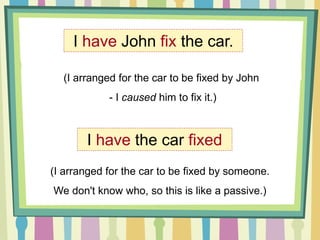
I have John fix the car.
(I arranged for the car to be fixed by John
- I caused him to fix it.)
I have the car fixed
(I arranged for the car to be fixed by someone.
We don't know who, so this is like a passive.)
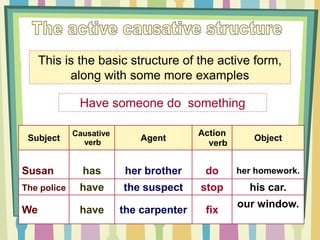
This is the basic structure of the active form,
along with some more examples
Subject
Causative
verb
Agent
Action
verb
Object
Susan has her brother do her homework.
The police have the suspect stop his car.
We have the carpenter fix
our window.
Have someone do something
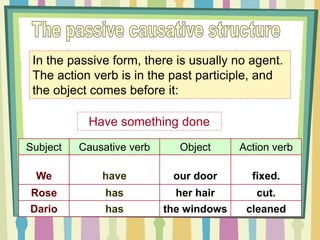
In the passive form, there is usually no agent.
The action verb is in the past participle, and
the object comes before it:
Subject Causative verb Object Action verb
We have our door fixed.
Rose has her hair cut.
Dario has the windows cleaned
Have something done
There many other verbs that can be used with causatives.
In the active form, some of these verbs require the action
verb to have "to" before it. These are some examples of the
most common causative verbs.
Verb Meaning
Form of
Action Verb Examples
make
force,
compel
plain form
- The robbers made us lie on the floor.
[No passive form]
get
same as
"have"
"to" form
- I got Jane to pick me up in the car.
- She got her hair cut.
let allow plain form
- I'll let you borrow my bike.
[No passive form]

- causatives.ppt

  • 2.
    The causative isa common structure in English. It is used when one thing or person causes another thing or person to do something.
  • 3.
    There are twobasic causative structures. One is like an active, and the other is like a passive. These examples use the causative verb "have":
  • 4.
    I have Johnfix the car. (I arranged for the car to be fixed by John - I caused him to fix it.) I have the car fixed (I arranged for the car to be fixed by someone. We don't know who, so this is like a passive.)
  • 5.
    This is thebasic structure of the active form, along with some more examples Subject Causative verb Agent Action verb Object Susan has her brother do her homework. The police have the suspect stop his car. We have the carpenter fix our window. Have someone do something
  • 6.
    In the passiveform, there is usually no agent. The action verb is in the past participle, and the object comes before it: Subject Causative verb Object Action verb We have our door fixed. Rose has her hair cut. Dario has the windows cleaned Have something done
  • 7.
    There many otherverbs that can be used with causatives. In the active form, some of these verbs require the action verb to have "to" before it. These are some examples of the most common causative verbs. Verb Meaning Form of Action Verb Examples make force, compel plain form - The robbers made us lie on the floor. [No passive form] get same as "have" "to" form - I got Jane to pick me up in the car. - She got her hair cut. let allow plain form - I'll let you borrow my bike. [No passive form]