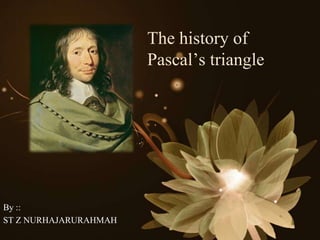
The history of
Pascal’s triangle
By ::
ST Z NURHAJARURAHMAH
One of the most interesting
Number Patterns is Pascal's
Triangle (named after Blaise Pascal,
a famous French Mathematician
and Philosopher).
In mathematics, Pasc
al's triangle is
a triangular
array of
the binomial
What is the
Pascal
triangle ???
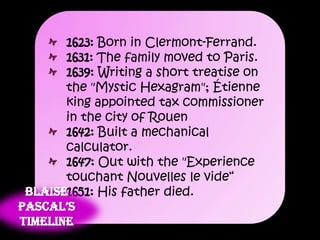
1623: Born in Clermont-Ferrand.
1631: The family moved to Paris.
1639: Writing a short treatise on
the "Mystic Hexagram"; Étienne
king appointed tax commissioner
in the city of Rouen
1642: Built a mechanical
calculator.
1647: Out with the "Experience
touchant Nouvelles le vide“
1651: His father died.Blaise
Pascal’s
timeline
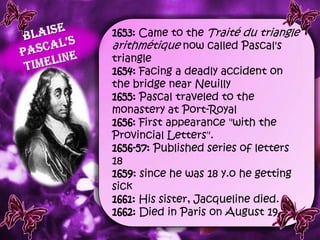
1653: Came to the Traité du triangle
arithmétique now called Pascal's
triangle
1654: Facing a deadly accident on
the bridge near Neuilly
1655: Pascal traveled to the
monastery at Port-Royal
1656: First appearance "with the
Provincial Letters".
1656-57: Published series of letters
18
1659: since he was 18 y.o he getting
sick
1661: His sister, Jacqueline died.
1662: Died in Paris on August 19.
Finding the shortest
path from a location that
has a lot of ramifications
Knowing the number of
Association Part Of A
set of
11n of Pascal triangle
In binomial Newton
Fibonacci sequenc3
The
application
s of Pascal
triangle
Focusing on the history and construction of Pascal’s
Triangle, as well as on its patterns and applications in
several areas of mathematics, I hope to have conveyed to
you some of the most interesting and useful pieces of
information known about the triangle. Yet, “we have only
scratched the surface of the iceberg” (Neff 46). I extend
an invitation to you to begin or continue to search for the
unknown secrets lying behind the infinite set of numbers
in Pascal’s magnificent triangle.
CONCLUTIONS
tHe End.
Thank you.
Blaise Pascal –
Le couer a ses raison ne connait point
In mathematics and
computing,
a triangular
array of numbers,
polynomials, or the
like, is a doubly
indexed sequence in
which each row is only
as long as the row's
In Mathematics, binomial
coefficients are a
family of
positive integers that
occur as coefficient in
the binomial theorem.

Segitiga pascal

  • 1.
    The history of Pascal’striangle By :: ST Z NURHAJARURAHMAH
  • 3.
    One of themost interesting Number Patterns is Pascal's Triangle (named after Blaise Pascal, a famous French Mathematician and Philosopher). In mathematics, Pasc al's triangle is a triangular array of the binomial What is the Pascal triangle ???
  • 4.
    1623: Born inClermont-Ferrand. 1631: The family moved to Paris. 1639: Writing a short treatise on the "Mystic Hexagram"; Étienne king appointed tax commissioner in the city of Rouen 1642: Built a mechanical calculator. 1647: Out with the "Experience touchant Nouvelles le vide“ 1651: His father died.Blaise Pascal’s timeline
  • 5.
    1653: Came tothe Traité du triangle arithmétique now called Pascal's triangle 1654: Facing a deadly accident on the bridge near Neuilly 1655: Pascal traveled to the monastery at Port-Royal 1656: First appearance "with the Provincial Letters". 1656-57: Published series of letters 18 1659: since he was 18 y.o he getting sick 1661: His sister, Jacqueline died. 1662: Died in Paris on August 19.
  • 8.
    Finding the shortest pathfrom a location that has a lot of ramifications Knowing the number of Association Part Of A set of 11n of Pascal triangle In binomial Newton Fibonacci sequenc3 The application s of Pascal triangle
  • 9.
    Focusing on thehistory and construction of Pascal’s Triangle, as well as on its patterns and applications in several areas of mathematics, I hope to have conveyed to you some of the most interesting and useful pieces of information known about the triangle. Yet, “we have only scratched the surface of the iceberg” (Neff 46). I extend an invitation to you to begin or continue to search for the unknown secrets lying behind the infinite set of numbers in Pascal’s magnificent triangle. CONCLUTIONS
  • 10.
    tHe End. Thank you. BlaisePascal – Le couer a ses raison ne connait point
  • 11.
    In mathematics and computing, atriangular array of numbers, polynomials, or the like, is a doubly indexed sequence in which each row is only as long as the row's
  • 12.
    In Mathematics, binomial coefficientsare a family of positive integers that occur as coefficient in the binomial theorem.