




Performance,
Stability & Control
Harold Hannon
Sr. Software Architect, SoftLayer
100kservers
24kcustomers
23million domains
13 data centers
16 network POPs
20Gb fiber interconnects
Global Footprint
• Performance
• Stability
• Control
On the agenda today
The 3 V’s
Test Cases
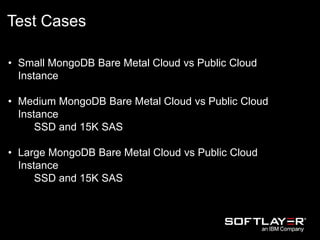
• Small MongoDB Bare Metal Cloud vs Public Cloud
Instance
• Medium MongoDB Bare Metal Cloud vs Public Cloud
Instance
SSD and 15K SAS
• Large MongoDB Bare Metal Cloud vs Public Cloud
Instance
SSD and 15K SAS
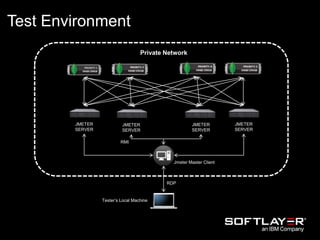
Private Network
JMETER
SERVER
JMETER
SERVER
JMETER
SERVER
JMETER
SERVER
RMI
Jmeter Master Client
RDP
Tester’s Local Machine
Test Environment
Beware The “Best Case Test Case”
1 8 5 8 1 7 . 6
1 9 0 5 2 5 . 4
1 8 7 8 8 2 . 2
1 9 1 1 0 1 . 8
1 8 4 4 0 8 . 8
1 8 8 1 3 5 . 4
1 8 7 0 8 0 . 6
1 8 6 3 4 3 . 4
1 9 1 8 9 9 . 6
1 8 7 7 3 6 . 6
1 8 8 9 7 8 . 8
1 8 7 4 4 0
1 8 6 9 5 0 . 4
1 8 7 6 2 3
1 8 7 7 8 3 . 8
1 8 7 7 7 5 . 8
1 9 2 8 0 6 . 8
1 8 6 6 4 3 . 2

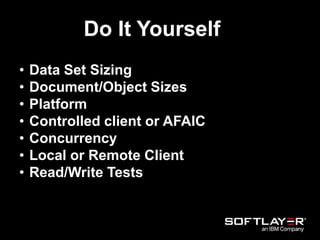
Do It Yourself
• Data Set Sizing
• Document/Object Sizes
• Platform
• Controlled client or AFAIC
• Concurrency
• Local or Remote Client
• Read/Write Tests
JS Benchmarking Harness
• Available on 10Gen website
• Baseline performance tool
• benchrun executable
• Create javascript test case
• Run from mongo command
db.foo.drop();
db.foo.insert( { _id : 1 } )
ops = [{op: "findOne", ns: "test.foo", query: {_id: 1}},
{op: "update", ns: "test.foo", query: {_id: 1}, update: {$inc: {x: 1}}}]
for ( var x = 1; x <= 128; x *= 2) {
res = benchRun( {
parallel : x ,
seconds : 5 ,
ops : ops
} );
print( "threads: " + x + "t queries/sec: " + res.query );
}
Quick Example
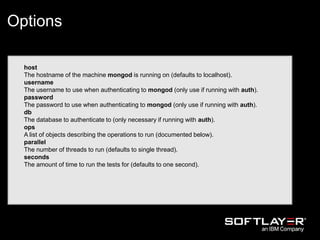
host
The hostname of the machine mongod is running on (defaults to localhost).
username
The username to use when authenticating to mongod (only use if running with auth).
password
The password to use when authenticating to mongod (only use if running with auth).
db
The database to authenticate to (only necessary if running with auth).
ops
A list of objects describing the operations to run (documented below).
parallel
The number of threads to run (defaults to single thread).
seconds
The amount of time to run the tests for (defaults to one second).
Options
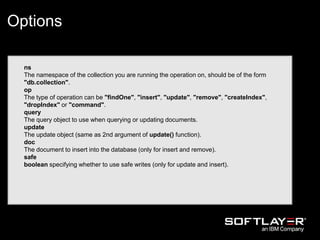
ns
The namespace of the collection you are running the operation on, should be of the form
"db.collection".
op
The type of operation can be "findOne", "insert", "update", "remove", "createIndex",
"dropIndex" or "command".
query
The query object to use when querying or updating documents.
update
The update object (same as 2nd argument of update() function).
doc
The document to insert into the database (only for insert and remove).
safe
boolean specifying whether to use safe writes (only for update and insert).
Options
{ "#RAND_INT" : [ min , max , <multiplier> ] }
[ 0 , 10 , 4 ] would produce random numbers between 0 and 10 and then multiply by 4.
{ "#RAND_STRING" : [ length ] }
[ 3 ] would produce a string of 3 random characters.
var complexDoc3 = { info: "#RAND_STRING": [30] } }
var complexDoc3 = { info: { inner_field: { "#RAND_STRING": [30] } } }
Dynamic Values
Lots of them here:
https://github.com/mongodb/mongo/tree/master/jstests
Example Scripts
Read Only Test
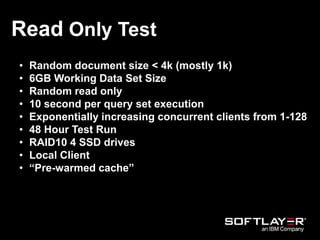
• Random document size < 4k (mostly 1k)
• 6GB Working Data Set Size
• Random read only
• 10 second per query set execution
• Exponentially increasing concurrent clients from 1-128
• 48 Hour Test Run
• RAID10 4 SSD drives
• Local Client
• “Pre-warmed cache”
The Results
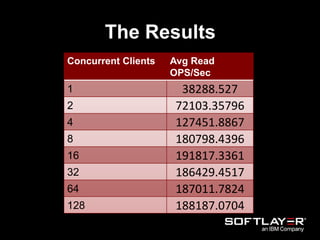
Concurrent Clients Avg Read
OPS/Sec
1 38288.527
2 72103.35796
4 127451.8867
8 180798.4396
16 191817.3361
32 186429.4517
64 187011.7824
128 188187.0704
Performance
Small Test
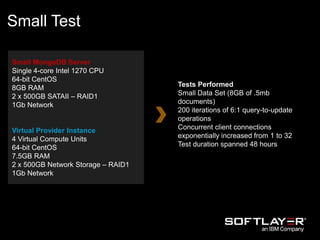
Small MongoDB Server
Single 4-core Intel 1270 CPU
64-bit CentOS
8GB RAM
2 x 500GB SATAII – RAID1
1Gb Network
Virtual Provider Instance
4 Virtual Compute Units
64-bit CentOS
7.5GB RAM
2 x 500GB Network Storage – RAID1
1Gb Network
Tests Performed
Small Data Set (8GB of .5mb
documents)
200 iterations of 6:1 query-to-update
operations
Concurrent client connections
exponentially increased from 1 to 32
Test duration spanned 48 hours
Small Test
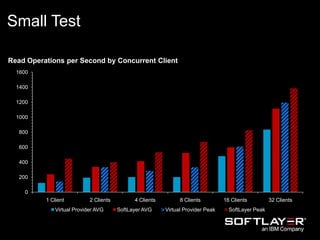
Read Operations per Second by Concurrent Client
0
200
400
600
800
1000
1200
1400
1600
1 Client 2 Clients 4 Clients 8 Clients 16 Clients 32 Clients
Virtual Provider AVG SoftLayer AVG Virtual Provider Peak SoftLayer Peak
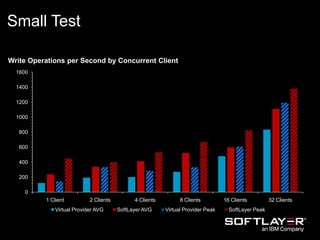
Write Operations per Second by Concurrent Client
Small Test
0
200
400
600
800
1000
1200
1400
1600
1 Client 2 Clients 4 Clients 8 Clients 16 Clients 32 Clients
Virtual Provider AVG SoftLayer AVG Virtual Provider Peak SoftLayer Peak
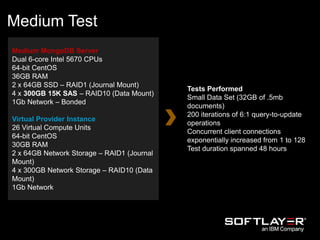
Medium Test
Medium MongoDB Server
Dual 6-core Intel 5670 CPUs
64-bit CentOS
36GB RAM
2 x 64GB SSD – RAID1 (Journal Mount)
4 x 300GB 15K SAS – RAID10 (Data Mount)
1Gb Network – Bonded
Virtual Provider Instance
26 Virtual Compute Units
64-bit CentOS
30GB RAM
2 x 64GB Network Storage – RAID1 (Journal
Mount)
4 x 300GB Network Storage – RAID10 (Data
Mount)
1Gb Network
Tests Performed
Small Data Set (32GB of .5mb
documents)
200 iterations of 6:1 query-to-update
operations
Concurrent client connections
exponentially increased from 1 to 128
Test duration spanned 48 hours
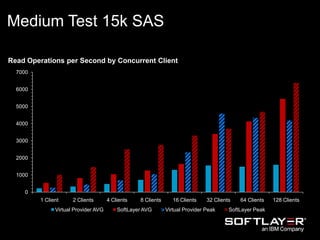
Medium Test 15k SAS
Read Operations per Second by Concurrent Client
0
1000
2000
3000
4000
5000
6000
7000
1 Client 2 Clients 4 Clients 8 Clients 16 Clients 32 Clients 64 Clients 128 Clients
Virtual Provider AVG SoftLayer AVG Virtual Provider Peak SoftLayer Peak
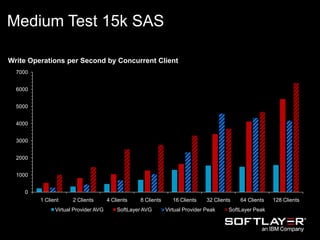
Medium Test 15k SAS
Write Operations per Second by Concurrent Client
0
1000
2000
3000
4000
5000
6000
7000
1 Client 2 Clients 4 Clients 8 Clients 16 Clients 32 Clients 64 Clients 128 Clients
Virtual Provider AVG SoftLayer AVG Virtual Provider Peak SoftLayer Peak
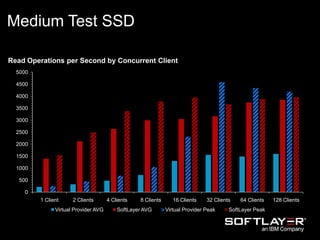
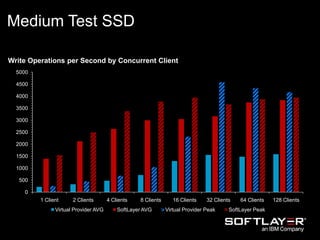
Medium Test SSD
Read Operations per Second by Concurrent Client
0
500
1000
1500
2000
2500
3000
3500
4000
4500
5000
1 Client 2 Clients 4 Clients 8 Clients 16 Clients 32 Clients 64 Clients 128 Clients
Virtual Provider AVG SoftLayer AVG Virtual Provider Peak SoftLayer Peak
Medium Test SSD
Write Operations per Second by Concurrent Client
0
500
1000
1500
2000
2500
3000
3500
4000
4500
5000
1 Client 2 Clients 4 Clients 8 Clients 16 Clients 32 Clients 64 Clients 128 Clients
Virtual Provider AVG SoftLayer AVG Virtual Provider Peak SoftLayer Peak
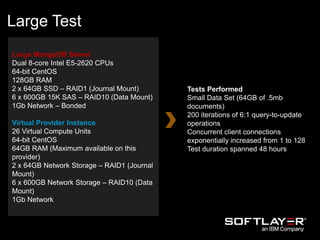
Large Test
Large MongoDB Server
Dual 8-core Intel E5-2620 CPUs
64-bit CentOS
128GB RAM
2 x 64GB SSD – RAID1 (Journal Mount)
6 x 600GB 15K SAS – RAID10 (Data Mount)
1Gb Network – Bonded
Virtual Provider Instance
26 Virtual Compute Units
64-bit CentOS
64GB RAM (Maximum available on this
provider)
2 x 64GB Network Storage – RAID1 (Journal
Mount)
6 x 600GB Network Storage – RAID10 (Data
Mount)
1Gb Network
Tests Performed
Small Data Set (64GB of .5mb
documents)
200 iterations of 6:1 query-to-update
operations
Concurrent client connections
exponentially increased from 1 to 128
Test duration spanned 48 hours
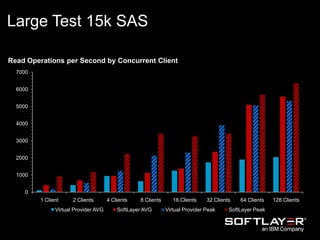
Large Test 15k SAS
Read Operations per Second by Concurrent Client
0
1000
2000
3000
4000
5000
6000
7000
1 Client 2 Clients 4 Clients 8 Clients 16 Clients 32 Clients 64 Clients 128 Clients
Virtual Provider AVG SoftLayer AVG Virtual Provider Peak SoftLayer Peak
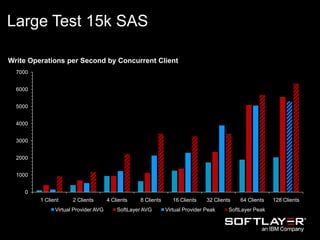
Large Test 15k SAS
Write Operations per Second by Concurrent Client
0
1000
2000
3000
4000
5000
6000
7000
1 Client 2 Clients 4 Clients 8 Clients 16 Clients 32 Clients 64 Clients 128 Clients
Virtual Provider AVG SoftLayer AVG Virtual Provider Peak SoftLayer Peak
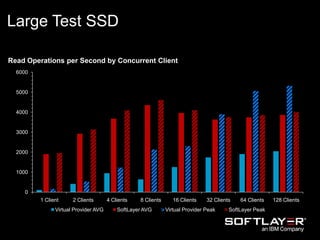
Large Test SSD
Read Operations per Second by Concurrent Client
0
1000
2000
3000
4000
5000
6000
1 Client 2 Clients 4 Clients 8 Clients 16 Clients 32 Clients 64 Clients 128 Clients
Virtual Provider AVG SoftLayer AVG Virtual Provider Peak SoftLayer Peak
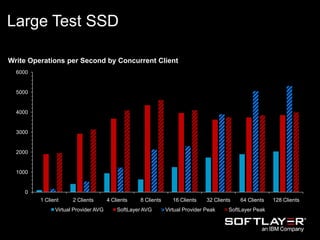
Large Test SSD
Write Operations per Second by Concurrent Client
0
1000
2000
3000
4000
5000
6000
1 Client 2 Clients 4 Clients 8 Clients 16 Clients 32 Clients 64 Clients 128 Clients
Virtual Provider AVG SoftLayer AVG Virtual Provider Peak SoftLayer Peak
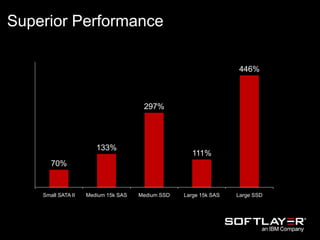
Superior Performance
70%
133%
297%
111%
446%
Small SATA II Medium 15k SAS Medium SSD Large 15k SAS Large SSD
Stability
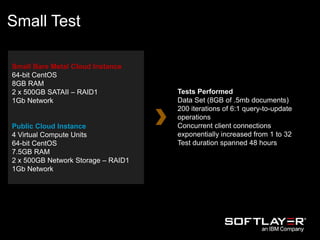
Small Test
Small Bare Metal Cloud Instance
64-bit CentOS
8GB RAM
2 x 500GB SATAII – RAID1
1Gb Network
Public Cloud Instance
4 Virtual Compute Units
64-bit CentOS
7.5GB RAM
2 x 500GB Network Storage – RAID1
1Gb Network
Tests Performed
Data Set (8GB of .5mb documents)
200 iterations of 6:1 query-to-update
operations
Concurrent client connections
exponentially increased from 1 to 32
Test duration spanned 48 hours
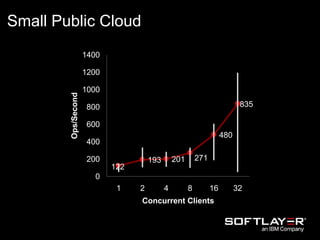
122
193 201 271
480
835
0
200
400
600
800
1000
1200
1400
1 2 4 8 16 32
Ops/Second
Concurrent Clients
Small Public Cloud
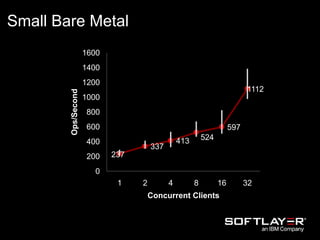
237
337
413 524
597
1112
0
200
400
600
800
1000
1200
1400
1600
1 2 4 8 16 32
Ops/Second
Concurrent Clients
Small Bare Metal
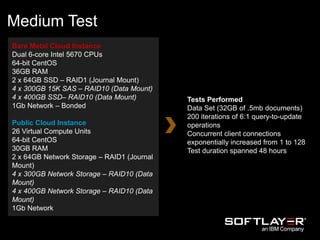
Medium Test
Bare Metal Cloud Instance
Dual 6-core Intel 5670 CPUs
64-bit CentOS
36GB RAM
2 x 64GB SSD – RAID1 (Journal Mount)
4 x 300GB 15K SAS – RAID10 (Data Mount)
4 x 400GB SSD– RAID10 (Data Mount)
1Gb Network – Bonded
Public Cloud Instance
26 Virtual Compute Units
64-bit CentOS
30GB RAM
2 x 64GB Network Storage – RAID1 (Journal
Mount)
4 x 300GB Network Storage – RAID10 (Data
Mount)
4 x 400GB Network Storage – RAID10 (Data
Mount)
1Gb Network
Tests Performed
Data Set (32GB of .5mb documents)
200 iterations of 6:1 query-to-update
operations
Concurrent client connections
exponentially increased from 1 to 128
Test duration spanned 48 hours
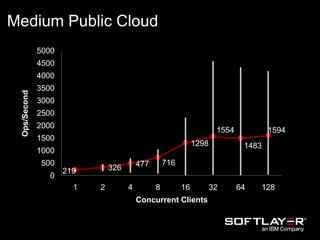
219 326 477 716
1298
1554
1483
1594
0
500
1000
1500
2000
2500
3000
3500
4000
4500
5000
1 2 4 8 16 32 64 128
Ops/Second
Concurrent Clients
Medium Public Cloud
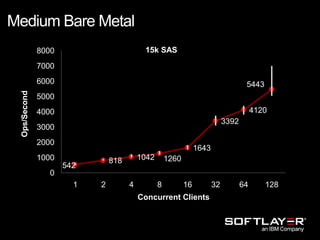
542
818 1042 1260
1643
3392
4120
5443
0
1000
2000
3000
4000
5000
6000
7000
8000
1 2 4 8 16 32 64 128
Ops/Second
Concurrent Clients
15k SAS
Medium Bare Metal
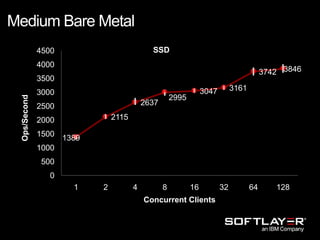
1389
2115
2637
2995
3047 3161
3742 3846
0
500
1000
1500
2000
2500
3000
3500
4000
4500
1 2 4 8 16 32 64 128
Ops/Second
Concurrent Clients
SSD
Medium Bare Metal
Large Test
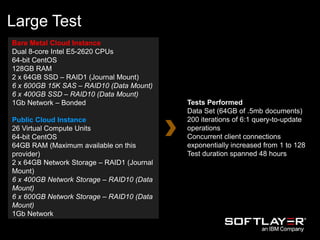
Bare Metal Cloud Instance
Dual 8-core Intel E5-2620 CPUs
64-bit CentOS
128GB RAM
2 x 64GB SSD – RAID1 (Journal Mount)
6 x 600GB 15K SAS – RAID10 (Data Mount)
6 x 400GB SSD – RAID10 (Data Mount)
1Gb Network – Bonded
Public Cloud Instance
26 Virtual Compute Units
64-bit CentOS
64GB RAM (Maximum available on this
provider)
2 x 64GB Network Storage – RAID1 (Journal
Mount)
6 x 400GB Network Storage – RAID10 (Data
Mount)
6 x 600GB Network Storage – RAID10 (Data
Mount)
1Gb Network
Tests Performed
Data Set (64GB of .5mb documents)
200 iterations of 6:1 query-to-update
operations
Concurrent client connections
exponentially increased from 1 to 128
Test duration spanned 48 hours
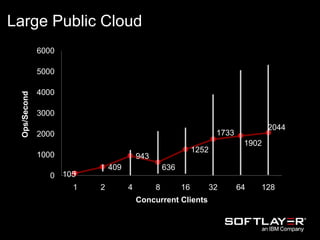
105
409
943
636
1252
1733
1902
2044
0
1000
2000
3000
4000
5000
6000
1 2 4 8 16 32 64 128
Ops/Second
Concurrent Clients
Large Public Cloud
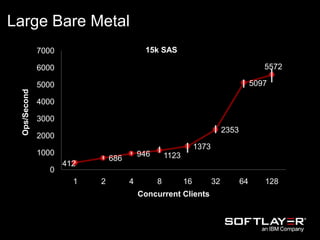
412
686
946 1123
1373
2353
5097
5572
0
1000
2000
3000
4000
5000
6000
7000
1 2 4 8 16 32 64 128
Ops/Second
Concurrent Clients
15k SAS
Large Bare Metal
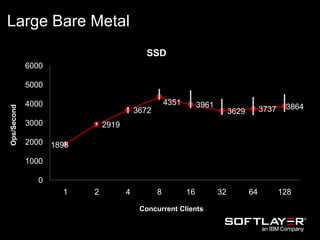
1898
2919
3672
4351 3961
3629 3737 3864
0
1000
2000
3000
4000
5000
6000
1 2 4 8 16 32 64 128
Ops/Second
Concurrent Clients
SSD
Large Bare Metal
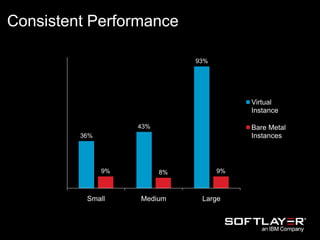
Consistent Performance
36%
43%
93%
9% 8% 9%
Small Medium Large
Virtual
Instance
Bare Metal
Instances
Control
The Dream
Virtual Instance
Striped Network
Attached Virtual
Volumes
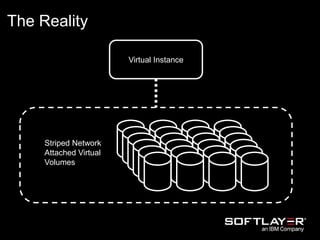
The Reality
Cluster
Virtual Instance
Striped Network
Attached Virtual
Volumes
Virtual Instance
Striped Network
Attached Virtual
Volumes
Virtual Instance
Striped Network
Attached Virtual
Volumes
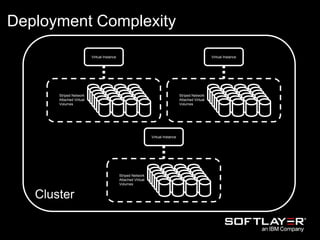
Deployment Complexity
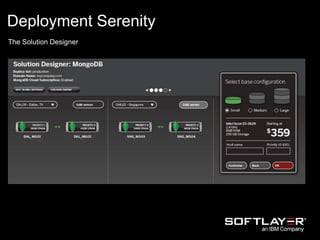
The Solution Designer
Deployment Serenity
Big Data Solutions
• Bare Metal Servers for Better Performance
Your big data solution can now have the power of bare metal and the ease of the
cloud. Our bare-metal servers are all available in real-time with no downtime via our
portal or API, so you don’t have to sacrifice agility for performance.
• MongoDB Best Practices
The configurations have been optimized based on 10gen and SoftLayer’s
insight, expertise and experience and provide an idea database environment.
• Full Access and Control
You get the total access and control of your complete MongoDB solution, including
total utilization of your hardware, total say in where your servers and replica sets are
deployed, and the ability to further customize it to any specification or requirement.
• Easy Design and Provisioning
Our configuration tool makes it easy to design and deploy complete customized
MongoDB architectures.
“We have over two terabytes of raw event data coming in every day ... Struq has been
able to process over 95 percent of requests in fewer than 30 milliseconds”
- Aaron McKee
CTO, Struq
Customer Feedback
• Bare Metal Cloud can be leveraged to simplify
deployments
• Bare Metal has a significant performance
superiority/consistency over Public Cloud
• Public Cloud is best suited for Dev/POC or when running
data sets in memory only
Summary
www.softlayer.com
blog @ http://sftlyr.com/bdperf
More Information

Partner Webinar: MongoDB and Softlayer on Bare Metal: Stability, Performance, and Control

  • 1.
    Performance, Stability & Control HaroldHannon Sr. Software Architect, SoftLayer
  • 2.
  • 3.
    13 data centers 16network POPs 20Gb fiber interconnects Global Footprint
  • 4.
    • Performance • Stability •Control On the agenda today
  • 5.
  • 6.
    Test Cases • SmallMongoDB Bare Metal Cloud vs Public Cloud Instance • Medium MongoDB Bare Metal Cloud vs Public Cloud Instance SSD and 15K SAS • Large MongoDB Bare Metal Cloud vs Public Cloud Instance SSD and 15K SAS
  • 7.
  • 8.
    Beware The “BestCase Test Case” 1 8 5 8 1 7 . 6 1 9 0 5 2 5 . 4 1 8 7 8 8 2 . 2 1 9 1 1 0 1 . 8 1 8 4 4 0 8 . 8 1 8 8 1 3 5 . 4 1 8 7 0 8 0 . 6 1 8 6 3 4 3 . 4 1 9 1 8 9 9 . 6 1 8 7 7 3 6 . 6 1 8 8 9 7 8 . 8 1 8 7 4 4 0 1 8 6 9 5 0 . 4 1 8 7 6 2 3 1 8 7 7 8 3 . 8 1 8 7 7 7 5 . 8 1 9 2 8 0 6 . 8 1 8 6 6 4 3 . 2 
  • 9.
    Do It Yourself •Data Set Sizing • Document/Object Sizes • Platform • Controlled client or AFAIC • Concurrency • Local or Remote Client • Read/Write Tests
  • 10.
    JS Benchmarking Harness •Available on 10Gen website • Baseline performance tool • benchrun executable • Create javascript test case • Run from mongo command
  • 11.
    db.foo.drop(); db.foo.insert( { _id: 1 } ) ops = [{op: "findOne", ns: "test.foo", query: {_id: 1}}, {op: "update", ns: "test.foo", query: {_id: 1}, update: {$inc: {x: 1}}}] for ( var x = 1; x <= 128; x *= 2) { res = benchRun( { parallel : x , seconds : 5 , ops : ops } ); print( "threads: " + x + "t queries/sec: " + res.query ); } Quick Example
  • 12.
    host The hostname ofthe machine mongod is running on (defaults to localhost). username The username to use when authenticating to mongod (only use if running with auth). password The password to use when authenticating to mongod (only use if running with auth). db The database to authenticate to (only necessary if running with auth). ops A list of objects describing the operations to run (documented below). parallel The number of threads to run (defaults to single thread). seconds The amount of time to run the tests for (defaults to one second). Options
  • 13.
    ns The namespace ofthe collection you are running the operation on, should be of the form "db.collection". op The type of operation can be "findOne", "insert", "update", "remove", "createIndex", "dropIndex" or "command". query The query object to use when querying or updating documents. update The update object (same as 2nd argument of update() function). doc The document to insert into the database (only for insert and remove). safe boolean specifying whether to use safe writes (only for update and insert). Options
  • 14.
    { "#RAND_INT" :[ min , max , <multiplier> ] } [ 0 , 10 , 4 ] would produce random numbers between 0 and 10 and then multiply by 4. { "#RAND_STRING" : [ length ] } [ 3 ] would produce a string of 3 random characters. var complexDoc3 = { info: "#RAND_STRING": [30] } } var complexDoc3 = { info: { inner_field: { "#RAND_STRING": [30] } } } Dynamic Values
  • 15.
    Lots of themhere: https://github.com/mongodb/mongo/tree/master/jstests Example Scripts
  • 16.
    Read Only Test •Random document size < 4k (mostly 1k) • 6GB Working Data Set Size • Random read only • 10 second per query set execution • Exponentially increasing concurrent clients from 1-128 • 48 Hour Test Run • RAID10 4 SSD drives • Local Client • “Pre-warmed cache”
  • 17.
    The Results Concurrent ClientsAvg Read OPS/Sec 1 38288.527 2 72103.35796 4 127451.8867 8 180798.4396 16 191817.3361 32 186429.4517 64 187011.7824 128 188187.0704
  • 18.
  • 19.
    Small Test Small MongoDBServer Single 4-core Intel 1270 CPU 64-bit CentOS 8GB RAM 2 x 500GB SATAII – RAID1 1Gb Network Virtual Provider Instance 4 Virtual Compute Units 64-bit CentOS 7.5GB RAM 2 x 500GB Network Storage – RAID1 1Gb Network Tests Performed Small Data Set (8GB of .5mb documents) 200 iterations of 6:1 query-to-update operations Concurrent client connections exponentially increased from 1 to 32 Test duration spanned 48 hours
  • 20.
    Small Test Read Operationsper Second by Concurrent Client 0 200 400 600 800 1000 1200 1400 1600 1 Client 2 Clients 4 Clients 8 Clients 16 Clients 32 Clients Virtual Provider AVG SoftLayer AVG Virtual Provider Peak SoftLayer Peak
  • 21.
    Write Operations perSecond by Concurrent Client Small Test 0 200 400 600 800 1000 1200 1400 1600 1 Client 2 Clients 4 Clients 8 Clients 16 Clients 32 Clients Virtual Provider AVG SoftLayer AVG Virtual Provider Peak SoftLayer Peak
  • 22.
    Medium Test Medium MongoDBServer Dual 6-core Intel 5670 CPUs 64-bit CentOS 36GB RAM 2 x 64GB SSD – RAID1 (Journal Mount) 4 x 300GB 15K SAS – RAID10 (Data Mount) 1Gb Network – Bonded Virtual Provider Instance 26 Virtual Compute Units 64-bit CentOS 30GB RAM 2 x 64GB Network Storage – RAID1 (Journal Mount) 4 x 300GB Network Storage – RAID10 (Data Mount) 1Gb Network Tests Performed Small Data Set (32GB of .5mb documents) 200 iterations of 6:1 query-to-update operations Concurrent client connections exponentially increased from 1 to 128 Test duration spanned 48 hours
  • 23.
    Medium Test 15kSAS Read Operations per Second by Concurrent Client 0 1000 2000 3000 4000 5000 6000 7000 1 Client 2 Clients 4 Clients 8 Clients 16 Clients 32 Clients 64 Clients 128 Clients Virtual Provider AVG SoftLayer AVG Virtual Provider Peak SoftLayer Peak
  • 24.
    Medium Test 15kSAS Write Operations per Second by Concurrent Client 0 1000 2000 3000 4000 5000 6000 7000 1 Client 2 Clients 4 Clients 8 Clients 16 Clients 32 Clients 64 Clients 128 Clients Virtual Provider AVG SoftLayer AVG Virtual Provider Peak SoftLayer Peak
  • 25.
    Medium Test SSD ReadOperations per Second by Concurrent Client 0 500 1000 1500 2000 2500 3000 3500 4000 4500 5000 1 Client 2 Clients 4 Clients 8 Clients 16 Clients 32 Clients 64 Clients 128 Clients Virtual Provider AVG SoftLayer AVG Virtual Provider Peak SoftLayer Peak
  • 26.
    Medium Test SSD WriteOperations per Second by Concurrent Client 0 500 1000 1500 2000 2500 3000 3500 4000 4500 5000 1 Client 2 Clients 4 Clients 8 Clients 16 Clients 32 Clients 64 Clients 128 Clients Virtual Provider AVG SoftLayer AVG Virtual Provider Peak SoftLayer Peak
  • 27.
    Large Test Large MongoDBServer Dual 8-core Intel E5-2620 CPUs 64-bit CentOS 128GB RAM 2 x 64GB SSD – RAID1 (Journal Mount) 6 x 600GB 15K SAS – RAID10 (Data Mount) 1Gb Network – Bonded Virtual Provider Instance 26 Virtual Compute Units 64-bit CentOS 64GB RAM (Maximum available on this provider) 2 x 64GB Network Storage – RAID1 (Journal Mount) 6 x 600GB Network Storage – RAID10 (Data Mount) 1Gb Network Tests Performed Small Data Set (64GB of .5mb documents) 200 iterations of 6:1 query-to-update operations Concurrent client connections exponentially increased from 1 to 128 Test duration spanned 48 hours
  • 28.
    Large Test 15kSAS Read Operations per Second by Concurrent Client 0 1000 2000 3000 4000 5000 6000 7000 1 Client 2 Clients 4 Clients 8 Clients 16 Clients 32 Clients 64 Clients 128 Clients Virtual Provider AVG SoftLayer AVG Virtual Provider Peak SoftLayer Peak
  • 29.
    Large Test 15kSAS Write Operations per Second by Concurrent Client 0 1000 2000 3000 4000 5000 6000 7000 1 Client 2 Clients 4 Clients 8 Clients 16 Clients 32 Clients 64 Clients 128 Clients Virtual Provider AVG SoftLayer AVG Virtual Provider Peak SoftLayer Peak
  • 30.
    Large Test SSD ReadOperations per Second by Concurrent Client 0 1000 2000 3000 4000 5000 6000 1 Client 2 Clients 4 Clients 8 Clients 16 Clients 32 Clients 64 Clients 128 Clients Virtual Provider AVG SoftLayer AVG Virtual Provider Peak SoftLayer Peak
  • 31.
    Large Test SSD WriteOperations per Second by Concurrent Client 0 1000 2000 3000 4000 5000 6000 1 Client 2 Clients 4 Clients 8 Clients 16 Clients 32 Clients 64 Clients 128 Clients Virtual Provider AVG SoftLayer AVG Virtual Provider Peak SoftLayer Peak
  • 32.
    Superior Performance 70% 133% 297% 111% 446% Small SATAII Medium 15k SAS Medium SSD Large 15k SAS Large SSD
  • 33.
  • 34.
    Small Test Small BareMetal Cloud Instance 64-bit CentOS 8GB RAM 2 x 500GB SATAII – RAID1 1Gb Network Public Cloud Instance 4 Virtual Compute Units 64-bit CentOS 7.5GB RAM 2 x 500GB Network Storage – RAID1 1Gb Network Tests Performed Data Set (8GB of .5mb documents) 200 iterations of 6:1 query-to-update operations Concurrent client connections exponentially increased from 1 to 32 Test duration spanned 48 hours
  • 35.
    122 193 201 271 480 835 0 200 400 600 800 1000 1200 1400 12 4 8 16 32 Ops/Second Concurrent Clients Small Public Cloud
  • 36.
    237 337 413 524 597 1112 0 200 400 600 800 1000 1200 1400 1600 1 24 8 16 32 Ops/Second Concurrent Clients Small Bare Metal
  • 37.
    Medium Test Bare MetalCloud Instance Dual 6-core Intel 5670 CPUs 64-bit CentOS 36GB RAM 2 x 64GB SSD – RAID1 (Journal Mount) 4 x 300GB 15K SAS – RAID10 (Data Mount) 4 x 400GB SSD– RAID10 (Data Mount) 1Gb Network – Bonded Public Cloud Instance 26 Virtual Compute Units 64-bit CentOS 30GB RAM 2 x 64GB Network Storage – RAID1 (Journal Mount) 4 x 300GB Network Storage – RAID10 (Data Mount) 4 x 400GB Network Storage – RAID10 (Data Mount) 1Gb Network Tests Performed Data Set (32GB of .5mb documents) 200 iterations of 6:1 query-to-update operations Concurrent client connections exponentially increased from 1 to 128 Test duration spanned 48 hours
  • 38.
    219 326 477716 1298 1554 1483 1594 0 500 1000 1500 2000 2500 3000 3500 4000 4500 5000 1 2 4 8 16 32 64 128 Ops/Second Concurrent Clients Medium Public Cloud
  • 39.
    542 818 1042 1260 1643 3392 4120 5443 0 1000 2000 3000 4000 5000 6000 7000 8000 12 4 8 16 32 64 128 Ops/Second Concurrent Clients 15k SAS Medium Bare Metal
  • 40.
    1389 2115 2637 2995 3047 3161 3742 3846 0 500 1000 1500 2000 2500 3000 3500 4000 4500 12 4 8 16 32 64 128 Ops/Second Concurrent Clients SSD Medium Bare Metal
  • 41.
    Large Test Bare MetalCloud Instance Dual 8-core Intel E5-2620 CPUs 64-bit CentOS 128GB RAM 2 x 64GB SSD – RAID1 (Journal Mount) 6 x 600GB 15K SAS – RAID10 (Data Mount) 6 x 400GB SSD – RAID10 (Data Mount) 1Gb Network – Bonded Public Cloud Instance 26 Virtual Compute Units 64-bit CentOS 64GB RAM (Maximum available on this provider) 2 x 64GB Network Storage – RAID1 (Journal Mount) 6 x 400GB Network Storage – RAID10 (Data Mount) 6 x 600GB Network Storage – RAID10 (Data Mount) 1Gb Network Tests Performed Data Set (64GB of .5mb documents) 200 iterations of 6:1 query-to-update operations Concurrent client connections exponentially increased from 1 to 128 Test duration spanned 48 hours
  • 42.
    105 409 943 636 1252 1733 1902 2044 0 1000 2000 3000 4000 5000 6000 1 2 48 16 32 64 128 Ops/Second Concurrent Clients Large Public Cloud
  • 43.
    412 686 946 1123 1373 2353 5097 5572 0 1000 2000 3000 4000 5000 6000 7000 1 24 8 16 32 64 128 Ops/Second Concurrent Clients 15k SAS Large Bare Metal
  • 44.
    1898 2919 3672 4351 3961 3629 37373864 0 1000 2000 3000 4000 5000 6000 1 2 4 8 16 32 64 128 Ops/Second Concurrent Clients SSD Large Bare Metal
  • 45.
    Consistent Performance 36% 43% 93% 9% 8%9% Small Medium Large Virtual Instance Bare Metal Instances
  • 46.
  • 47.
  • 48.
    Virtual Instance Striped Network AttachedVirtual Volumes The Reality
  • 49.
    Cluster Virtual Instance Striped Network AttachedVirtual Volumes Virtual Instance Striped Network Attached Virtual Volumes Virtual Instance Striped Network Attached Virtual Volumes Deployment Complexity
  • 50.
  • 51.
    Big Data Solutions •Bare Metal Servers for Better Performance Your big data solution can now have the power of bare metal and the ease of the cloud. Our bare-metal servers are all available in real-time with no downtime via our portal or API, so you don’t have to sacrifice agility for performance. • MongoDB Best Practices The configurations have been optimized based on 10gen and SoftLayer’s insight, expertise and experience and provide an idea database environment. • Full Access and Control You get the total access and control of your complete MongoDB solution, including total utilization of your hardware, total say in where your servers and replica sets are deployed, and the ability to further customize it to any specification or requirement. • Easy Design and Provisioning Our configuration tool makes it easy to design and deploy complete customized MongoDB architectures.
  • 52.
    “We have overtwo terabytes of raw event data coming in every day ... Struq has been able to process over 95 percent of requests in fewer than 30 milliseconds” - Aaron McKee CTO, Struq Customer Feedback
  • 53.
    • Bare MetalCloud can be leveraged to simplify deployments • Bare Metal has a significant performance superiority/consistency over Public Cloud • Public Cloud is best suited for Dev/POC or when running data sets in memory only Summary
  • 54.

Editor's Notes

  • #3 Softlayer?
  • #6 So here is our one and only obligatory analyst slide I promiseThink in terms of the 3 V’s Gartner definedThere are lots of 4th V’s (Value, Veracity, etc.) But really these apply to all data right? These 3 are at the coreAlso for our discussion today we are mostly going to be focused on Volume and Velocity (Variety is a given for us)These are important to consider when we start talking about how we want to deploy our solutionHow much and How fast is our data going to come at us?
  • #9 Numbers with no context are not very useful
  • #17 This is the ACTUAL test for that crazy number from before. Notice it has been heavily designed to produce a falsely high number. Not very useful.
  • #18 These were the results
  • #33 Numbers speak for themselvesYou take the overall average consistent performance + the consistencyCoupled with the ease of deployment
  • #36 The numbers are average read operations per second with writes occurring as well. The vertical white lines represent variance in that data. This slide and the other public cloud ones show that the variance in the data is HUGE. This means the platform is unstable under load and cannot give you a reliable predictable deployment
  • #46 Numbers speak for themselvesYou take the overall average consistent performance + the consistencyCoupled with the ease of deployment
  • #48 When we talk about a public cloud deployment everyone has this dream of just right clicking and “adding new” and everything is perfect
  • #49 Although at first things seem simple scaling on multi tenant (especially with NAS) gets trickyIn this case this is a SINGLE instance of a Mongo Node (This is one node, most deployments are going to have 3 or more of these)In order to achieve desired performance you have to raid network volumes and attach them to virtual instancesThis still doesn’t solve shared I/O deviation issues it just smears them so they may not spike as drastically
  • #50 It gets even crazier when you do highly available deploymentsStriped volumes (sometimes up to 10) attachedSo you can see that as you scale on a NAS Virtual environment You start to see when you look at this picture that your simple Virtualized environment has suddenly started to get very complexIf you are an engineer that believes in keeping things simple to avoid issues, this sort of thing keeps you up at nightBoth complexity and cost can start to spiral beyond what you may have anticipated
  • #51 The goal is to capture the ease of virtual deploymentConfigure complex cluster environmentsAllow for rapid deployment
  • #53 Highlight the 95% as further evidence of our extreme superiority in consistent performance.
  • #55 Thank you for your time, I hope you found this helpful QuestionsBlog