Gnocchi
Numbers
Benchmarking 2.1.x
Test Configuration
- 3 physical hosts
- CentOS 7.2.1511
- 24 physical cores (hyperthreaded), 256 GB memory
- 25 - 1TB disks, 10K RPM
- PostgreSQL 9.2.15 (single node)
- Shared with ceph and compute service
- Default everything, except 300 connections vs 100(default)
- Ceph 10.2.1 (3 nodes, 1 monitoring, 2 OSD)
- 20 OSDs (1 TB disk), Journals share same disk, 1 replica, 512 placement groups
- OSD nodes shared with (idle) compute service
- Gnocchi Master (~ June 3rd, 2016)
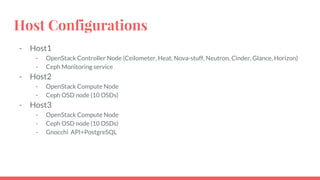
Host Configurations
- Host1
- OpenStack Controller Node (Ceilometer, Heat, Nova-stuff, Neutron, Cinder, Glance, Horizon)
- Ceph Monitoring service
- Host2
- OpenStack Compute Node
- Ceph OSD node (10 OSDs)
- Host3
- OpenStack Compute Node
- Ceph OSD node (10 OSDs)
- Gnocchi API+PostgreSQL
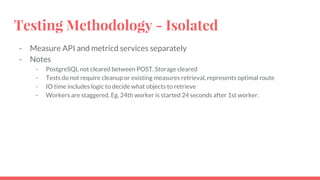
Testing Methodology - Isolated
- Measure API and metricd services separately
- Notes
- PostgreSQL not cleared between POST. Storage cleared
- Tests do not require cleanup or existing measures retrieval, represents optimal route
- IO time includes logic to decide what objects to retrieve
- Workers are staggered. Eg. 24th worker is started 24 seconds after 1st worker.
api tests
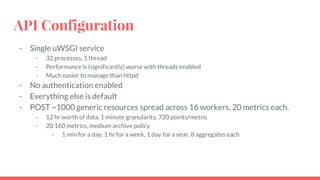
API Configuration
- Single uWSGI service
- 32 processes, 1 thread
- Performance is (significantly) worse with threads enabled
- Much easier to manage than httpd
- No authentication enabled
- Everything else is default
- POST ~1000 generic resources spread across 16 workers, 20 metrics each.
- 12 hr worth of data, 1 minute granularity, 720 points/metric
- 20 160 metrics, medium archive policy
- 1 min for a day, 1 hr for a week, 1 day for a year, 8 aggregates each
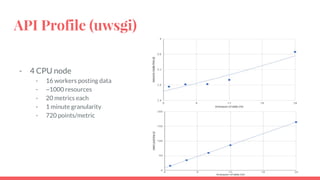
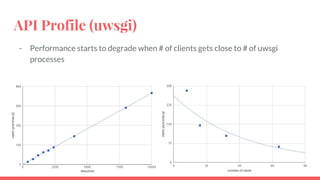
API Profile (uwsgi)
- 4 CPU node
- 16 workers posting data
- ~1000 resources
- 20 metrics each
- 1 minute granularity
- 720 points/metric
API Profile (uwsgi)
- Performance starts to degrade when # of clients gets close to # of uwsgi
processes
metricd tests
metricd Configuration
- 1 to 3 metricd daemons
- Deployed on separate physical nodes
- 24 workers each with 1 aggregation worker
- Redis 3.0.6 to manage coordination
- metric_processing_delay set to 1 (essentially no delay)
- Everything else is default
- Gnocchi pool is always empty to begin
- Working against 1000 resources in backlog, start 1|2|3 metricd services
- Analyze results from 5 of 24 workers.
Single MetricD service (ceph)
- Deployed on host1
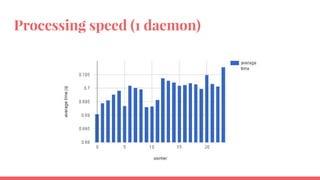
- Injection time (time to process measures in backlog) - ~ 633 seconds
- Per metric injection - avg=0.69s, min=0.49s, max=2.08, stdev=0.16
- Average IO time - ~30% of _add_measures()
- Overhead - ~5.5%
- job/data retrievals, building/storing backlog timeseries, no ops, etc…
- Time from first read to last write vs time spent in _add_measures()
- Overhead looping through each granularity/aggregate - ~2.6%
- Time difference between all _add_measures() time vs mapping function
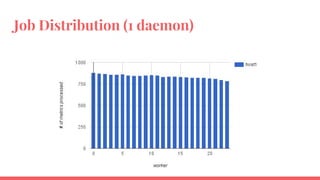
Job Distribution (1 daemon)
Processing speed (1 daemon)
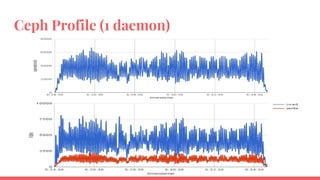
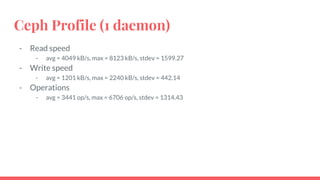
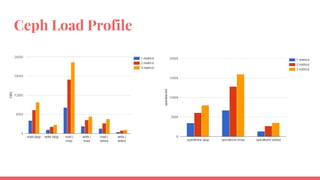
Ceph Profile (1 daemon)
- Read speed
- avg = 4049 kB/s, max = 8123 kB/s, stdev = 1599.27
- Write speed
- avg = 1201 kB/s, max = 2240 kB/s, stdev = 442.14
- Operations
- avg = 3441 op/s, max = 6706 op/s, stdev = 1314.43
2 MetricD services (ceph)
- Deployed on host1 and host2
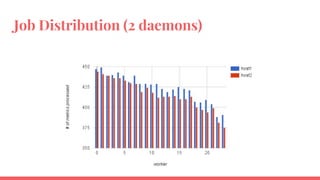
- Injection time - ~ 358 seconds
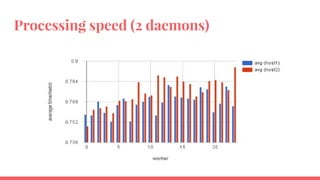
- Per metric injection - avg=0.768s, min=0.44s, max=3.35s, stdev=0.239
- Average IO time - ~36.8% of _add_measures()
- ~34.3% on controller node service
- Overhead - ~6.5%
- Overhead looping through each granularity/aggregate - ~2.5%
Job Distribution (2 daemons)
Processing speed (2 daemons)
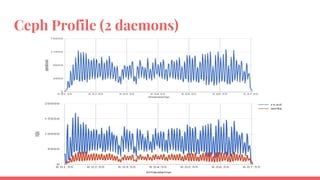
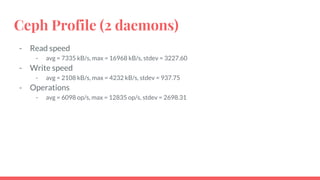
Ceph Profile (2 daemons)
- Read speed
- avg = 7335 kB/s, max = 16968 kB/s, stdev = 3227.60
- Write speed
- avg = 2108 kB/s, max = 4232 kB/s, stdev = 937.75
- Operations
- avg = 6098 op/s, max = 12835 op/s, stdev = 2698.31
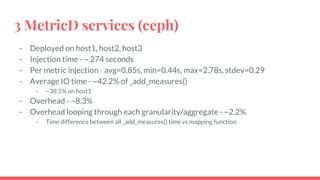
3 MetricD services (ceph)
- Deployed on host1, host2, host3
- Injection time - ~ 274 seconds
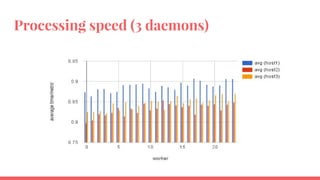
- Per metric injection - avg=0.85s, min=0.44s, max=2.78s, stdev=0.29
- Average IO time - ~42.2% of _add_measures()
- ~38.5% on host1
- Overhead - ~8.3%
- Overhead looping through each granularity/aggregate - ~2.2%
- Time difference between all _add_measures() time vs mapping function
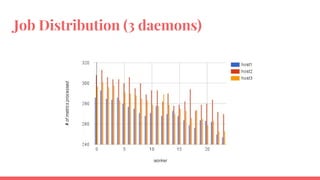
Job Distribution (3 daemons)
Processing speed (3 daemons)
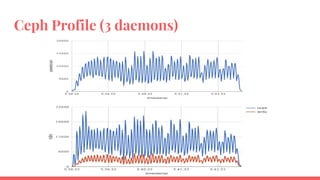
Ceph Profile (3 daemons)
- Read speed
- avg = 9841 kB/s, max = 22373 kB/s, stdev = 4577.64
- Write speed
- avg = 2735 kB/s, max = 5370 kB/s, stdev = 1162.23
- Operations
- avg = 8000 op/s, max = 15935 op/s, stdev = 3518.21
Ceph Load Profile
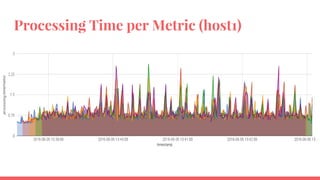
Processing Time per Metric (host1)
‘real world’ tests
api + metricd together
Testing Methodology
- Start 3 metricd services - 24 workers each
- POST 1000 generic resources spread across 20 workers, 20 metrics each.
- POST Every 10 minutes
- 1 minute granularity, 10 points/metric/request
- 20 160 metrics, medium archive policy
- 1 min for a day, 1 hr for a week, 1 day for a year, 8 aggregates each
Batch1 metricd details
- POST time - avg=31.31s, stdev=0.61
- Injection time - ~ 197 seconds
- Host1
- Per metric injection - avg=0.599s, min=0.236s, max=4.418s, stdev=0.359
- Average IO time - ~67.8% of _add_measures()
- Overhead - ~17.3% (~15.8% minus all IO once metric locked)
- Host2
- Per metric injection - avg=0.587s, min=0.252s, max=4.454s, stdev=0.352
- Average IO time - ~67.4% of _add_measures()
- Overhead - ~15.4% (~14% minus all IO once metric locked)
- Host3
- Per metric injection - avg=0.602s, min=0.233s, max=4.484s, stdev=0.359
- Average IO time - ~67.7% of _add_measures()
- Overhead - ~15.2% (~13.8% minus all IO once metric locked)
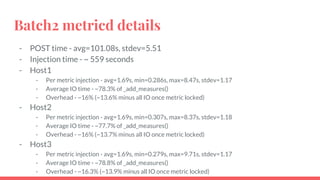
Batch2 metricd details
- POST time - avg=101.08s, stdev=5.51
- Injection time - ~ 559 seconds
- Host1
- Per metric injection - avg=1.69s, min=0.286s, max=8.47s, stdev=1.17
- Average IO time - ~78.3% of _add_measures()
- Overhead - ~16% (~13.6% minus all IO once metric locked)
- Host2
- Per metric injection - avg=1.69s, min=0.307s, max=8.37s, stdev=1.18
- Average IO time - ~77.7% of _add_measures()
- Overhead - ~16% (~13.7% minus all IO once metric locked)
- Host3
- Per metric injection - avg=1.69s, min=0.279s, max=9.71s, stdev=1.17
- Average IO time - ~78.8% of _add_measures()
- Overhead - ~16.3% (~13.9% minus all IO once metric locked)
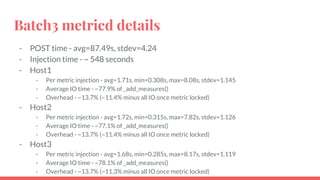
Batch3 metricd details
- POST time - avg=87.49s, stdev=4.24
- Injection time - ~ 548 seconds
- Host1
- Per metric injection - avg=1.71s, min=0.308s, max=8.08s, stdev=1.145
- Average IO time - ~77.9% of _add_measures()
- Overhead - ~13.7% (~11.4% minus all IO once metric locked)
- Host2
- Per metric injection - avg=1.72s, min=0.315s, max=7.82s, stdev=1.126
- Average IO time - ~77.1% of _add_measures()
- Overhead - ~13.7% (~11.4% minus all IO once metric locked)
- Host3
- Per metric injection - avg=1.68s, min=0.285s, max=8.17s, stdev=1.119
- Average IO time - ~78.1% of _add_measures()
- Overhead - ~13.7% (~11.3% minus all IO once metric locked)
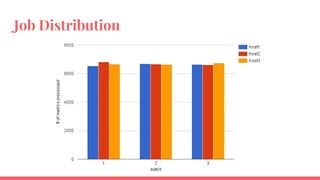
Job Distribution
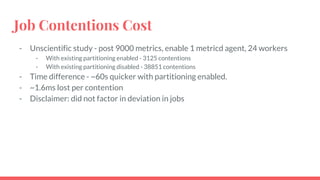
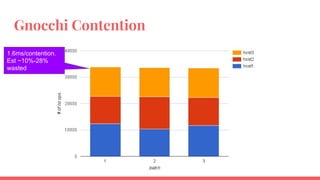
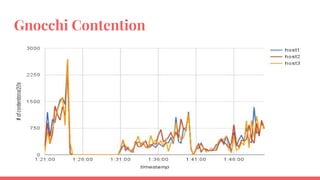
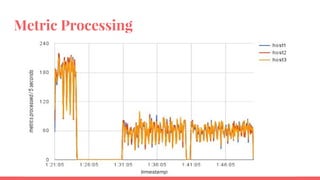
Job Contentions Cost
- Unscientific study - post 9000 metrics, enable 1 metricd agent, 24 workers
- With existing partitioning enabled - 3125 contentions
- With existing partitioning disabled - 38851 contentions
- Time difference - ~60s quicker with partitioning enabled.
- ~1.6ms lost per contention
- Disclaimer: did not factor in deviation in jobs
Gnocchi Contention
1.6ms/contention.
Est ~10%-28%
wasted
Gnocchi Contention
Metric Processing
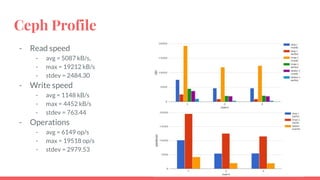
Ceph Profile
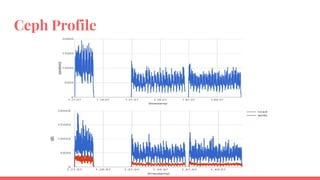
Ceph Profile
- Read speed
- avg = 5087 kB/s,
- max = 19212 kB/s
- stdev = 2484.30
- Write speed
- avg = 1148 kB/s
- max = 4452 kB/s
- stdev = 763.44
- Operations
- avg = 6149 op/s
- max = 19518 op/s
- stdev = 2979.53
Things to investigate...
- Why does Ceph op/s and IO performance oscillate
- Why is the initial write so much faster than subsequent writes
- Measures the effects of a LARGE backlog
- IO jumps nearly 3x after first batch, but Gnocchi update & resampling of
timeseries jumps up ~2x even though it should just have to aggregate the same
number of points as first.
- Officially show gnocchi/python is slower with threads (even with high IO)
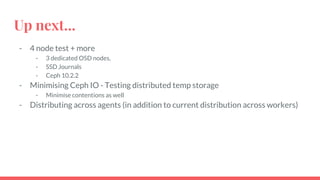
Up next...
- 4 node test + more
- 3 dedicated OSD nodes,
- SSD Journals
- Ceph 10.2.2
- Minimising Ceph IO - Testing distributed temp storage
- Minimise contentions as well
- Distributing across agents (in addition to current distribution across workers)
thanks
gord[at]live.ca
irc: gordc

Gnocchi Profiling 2.1.x

  • 1.
  • 2.
    Test Configuration - 3physical hosts - CentOS 7.2.1511 - 24 physical cores (hyperthreaded), 256 GB memory - 25 - 1TB disks, 10K RPM - PostgreSQL 9.2.15 (single node) - Shared with ceph and compute service - Default everything, except 300 connections vs 100(default) - Ceph 10.2.1 (3 nodes, 1 monitoring, 2 OSD) - 20 OSDs (1 TB disk), Journals share same disk, 1 replica, 512 placement groups - OSD nodes shared with (idle) compute service - Gnocchi Master (~ June 3rd, 2016)
  • 3.
    Host Configurations - Host1 -OpenStack Controller Node (Ceilometer, Heat, Nova-stuff, Neutron, Cinder, Glance, Horizon) - Ceph Monitoring service - Host2 - OpenStack Compute Node - Ceph OSD node (10 OSDs) - Host3 - OpenStack Compute Node - Ceph OSD node (10 OSDs) - Gnocchi API+PostgreSQL
  • 4.
    Testing Methodology -Isolated - Measure API and metricd services separately - Notes - PostgreSQL not cleared between POST. Storage cleared - Tests do not require cleanup or existing measures retrieval, represents optimal route - IO time includes logic to decide what objects to retrieve - Workers are staggered. Eg. 24th worker is started 24 seconds after 1st worker.
  • 5.
  • 6.
    API Configuration - SingleuWSGI service - 32 processes, 1 thread - Performance is (significantly) worse with threads enabled - Much easier to manage than httpd - No authentication enabled - Everything else is default - POST ~1000 generic resources spread across 16 workers, 20 metrics each. - 12 hr worth of data, 1 minute granularity, 720 points/metric - 20 160 metrics, medium archive policy - 1 min for a day, 1 hr for a week, 1 day for a year, 8 aggregates each
  • 7.
    API Profile (uwsgi) -4 CPU node - 16 workers posting data - ~1000 resources - 20 metrics each - 1 minute granularity - 720 points/metric
  • 8.
    API Profile (uwsgi) -Performance starts to degrade when # of clients gets close to # of uwsgi processes
  • 9.
  • 10.
    metricd Configuration - 1to 3 metricd daemons - Deployed on separate physical nodes - 24 workers each with 1 aggregation worker - Redis 3.0.6 to manage coordination - metric_processing_delay set to 1 (essentially no delay) - Everything else is default - Gnocchi pool is always empty to begin - Working against 1000 resources in backlog, start 1|2|3 metricd services - Analyze results from 5 of 24 workers.
  • 11.
    Single MetricD service(ceph) - Deployed on host1 - Injection time (time to process measures in backlog) - ~ 633 seconds - Per metric injection - avg=0.69s, min=0.49s, max=2.08, stdev=0.16 - Average IO time - ~30% of _add_measures() - Overhead - ~5.5% - job/data retrievals, building/storing backlog timeseries, no ops, etc… - Time from first read to last write vs time spent in _add_measures() - Overhead looping through each granularity/aggregate - ~2.6% - Time difference between all _add_measures() time vs mapping function
  • 12.
  • 13.
  • 14.
  • 15.
    Ceph Profile (1daemon) - Read speed - avg = 4049 kB/s, max = 8123 kB/s, stdev = 1599.27 - Write speed - avg = 1201 kB/s, max = 2240 kB/s, stdev = 442.14 - Operations - avg = 3441 op/s, max = 6706 op/s, stdev = 1314.43
  • 16.
    2 MetricD services(ceph) - Deployed on host1 and host2 - Injection time - ~ 358 seconds - Per metric injection - avg=0.768s, min=0.44s, max=3.35s, stdev=0.239 - Average IO time - ~36.8% of _add_measures() - ~34.3% on controller node service - Overhead - ~6.5% - Overhead looping through each granularity/aggregate - ~2.5%
  • 17.
  • 18.
  • 19.
  • 20.
    Ceph Profile (2daemons) - Read speed - avg = 7335 kB/s, max = 16968 kB/s, stdev = 3227.60 - Write speed - avg = 2108 kB/s, max = 4232 kB/s, stdev = 937.75 - Operations - avg = 6098 op/s, max = 12835 op/s, stdev = 2698.31
  • 21.
    3 MetricD services(ceph) - Deployed on host1, host2, host3 - Injection time - ~ 274 seconds - Per metric injection - avg=0.85s, min=0.44s, max=2.78s, stdev=0.29 - Average IO time - ~42.2% of _add_measures() - ~38.5% on host1 - Overhead - ~8.3% - Overhead looping through each granularity/aggregate - ~2.2% - Time difference between all _add_measures() time vs mapping function
  • 22.
  • 23.
  • 24.
  • 25.
    Ceph Profile (3daemons) - Read speed - avg = 9841 kB/s, max = 22373 kB/s, stdev = 4577.64 - Write speed - avg = 2735 kB/s, max = 5370 kB/s, stdev = 1162.23 - Operations - avg = 8000 op/s, max = 15935 op/s, stdev = 3518.21
  • 26.
  • 27.
    Processing Time perMetric (host1)
  • 28.
    ‘real world’ tests api+ metricd together
  • 29.
    Testing Methodology - Start3 metricd services - 24 workers each - POST 1000 generic resources spread across 20 workers, 20 metrics each. - POST Every 10 minutes - 1 minute granularity, 10 points/metric/request - 20 160 metrics, medium archive policy - 1 min for a day, 1 hr for a week, 1 day for a year, 8 aggregates each
  • 30.
    Batch1 metricd details -POST time - avg=31.31s, stdev=0.61 - Injection time - ~ 197 seconds - Host1 - Per metric injection - avg=0.599s, min=0.236s, max=4.418s, stdev=0.359 - Average IO time - ~67.8% of _add_measures() - Overhead - ~17.3% (~15.8% minus all IO once metric locked) - Host2 - Per metric injection - avg=0.587s, min=0.252s, max=4.454s, stdev=0.352 - Average IO time - ~67.4% of _add_measures() - Overhead - ~15.4% (~14% minus all IO once metric locked) - Host3 - Per metric injection - avg=0.602s, min=0.233s, max=4.484s, stdev=0.359 - Average IO time - ~67.7% of _add_measures() - Overhead - ~15.2% (~13.8% minus all IO once metric locked)
  • 31.
    Batch2 metricd details -POST time - avg=101.08s, stdev=5.51 - Injection time - ~ 559 seconds - Host1 - Per metric injection - avg=1.69s, min=0.286s, max=8.47s, stdev=1.17 - Average IO time - ~78.3% of _add_measures() - Overhead - ~16% (~13.6% minus all IO once metric locked) - Host2 - Per metric injection - avg=1.69s, min=0.307s, max=8.37s, stdev=1.18 - Average IO time - ~77.7% of _add_measures() - Overhead - ~16% (~13.7% minus all IO once metric locked) - Host3 - Per metric injection - avg=1.69s, min=0.279s, max=9.71s, stdev=1.17 - Average IO time - ~78.8% of _add_measures() - Overhead - ~16.3% (~13.9% minus all IO once metric locked)
  • 32.
    Batch3 metricd details -POST time - avg=87.49s, stdev=4.24 - Injection time - ~ 548 seconds - Host1 - Per metric injection - avg=1.71s, min=0.308s, max=8.08s, stdev=1.145 - Average IO time - ~77.9% of _add_measures() - Overhead - ~13.7% (~11.4% minus all IO once metric locked) - Host2 - Per metric injection - avg=1.72s, min=0.315s, max=7.82s, stdev=1.126 - Average IO time - ~77.1% of _add_measures() - Overhead - ~13.7% (~11.4% minus all IO once metric locked) - Host3 - Per metric injection - avg=1.68s, min=0.285s, max=8.17s, stdev=1.119 - Average IO time - ~78.1% of _add_measures() - Overhead - ~13.7% (~11.3% minus all IO once metric locked)
  • 33.
  • 34.
    Job Contentions Cost -Unscientific study - post 9000 metrics, enable 1 metricd agent, 24 workers - With existing partitioning enabled - 3125 contentions - With existing partitioning disabled - 38851 contentions - Time difference - ~60s quicker with partitioning enabled. - ~1.6ms lost per contention - Disclaimer: did not factor in deviation in jobs
  • 35.
  • 36.
  • 37.
  • 38.
  • 39.
    Ceph Profile - Readspeed - avg = 5087 kB/s, - max = 19212 kB/s - stdev = 2484.30 - Write speed - avg = 1148 kB/s - max = 4452 kB/s - stdev = 763.44 - Operations - avg = 6149 op/s - max = 19518 op/s - stdev = 2979.53
  • 40.
    Things to investigate... -Why does Ceph op/s and IO performance oscillate - Why is the initial write so much faster than subsequent writes - Measures the effects of a LARGE backlog - IO jumps nearly 3x after first batch, but Gnocchi update & resampling of timeseries jumps up ~2x even though it should just have to aggregate the same number of points as first. - Officially show gnocchi/python is slower with threads (even with high IO)
  • 41.
    Up next... - 4node test + more - 3 dedicated OSD nodes, - SSD Journals - Ceph 10.2.2 - Minimising Ceph IO - Testing distributed temp storage - Minimise contentions as well - Distributing across agents (in addition to current distribution across workers)
  • 42.