© 2015 IBM Corporation
SoftLayer Object
Storage Overview
Ann Corrao, Distinguished Engineer
Michael Fork, SoftLayer Storage Product Manager
Agenda
• What is Object Storage?
• Demand Drivers
• Comparison of Block, File, and Object
• What it is … and is not
• What are common use cases?
• Social / Mobile App Storage
• Analytics Data Store
• Offsite Backup / Archive
• NAS Filer Consolidation
• What are some enabling technologies?
• Storage Gateways
• Aspera
• What does SoftLayer offer for Object Storage?
• Locations
• Features
• Pricing
1
Agenda
• What is Object Storage?
• Demand Drivers
• Comparison of Block, File, and Object
• What it is … and is not
• What are common use cases?
• Social / Mobile App Storage
• Analytics Data Store
• Offsite Backup / Archive
• NAS Filer Consolidation
• Enabling Technologies
• Storage Gateways
• Aspera
• What does SoftLayer offer for Object Storage?
• Features
• Locations
• Pricing
2
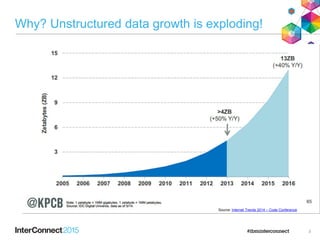
Why? Unstructured data growth is exploding!
3
Source: Internet Trends 2014 – Code Conference
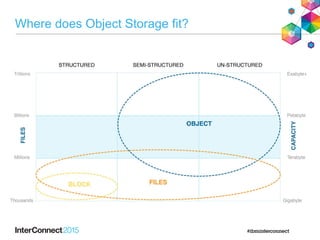
Where does Object Storage fit?
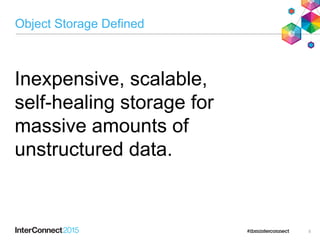
Object Storage Defined
5
Inexpensive, scalable,
self-healing storage for
massive amounts of
unstructured data.
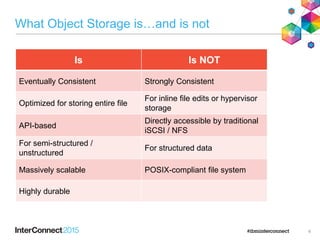
What Object Storage is…and is not
6
Is Is NOT
Eventually Consistent Strongly Consistent
Optimized for storing entire file
For inline file edits or hypervisor
storage
API-based
Directly accessible by traditional
iSCSI / NFS
For semi-structured /
unstructured
For structured data
Massively scalable POSIX-compliant file system
Highly durable
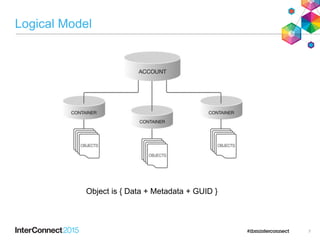
Logical Model
7
Object is { Data + Metadata + GUID }
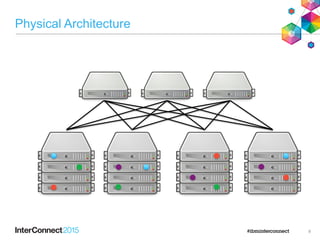
Physical Architecture
8
Agenda
• What is Object Storage?
• Demand Drivers
• Comparison of Block, File, and Object
• What it is … and is not
• What are common use cases?
• Social / Mobile App Storage
• Analytics Data Store
• Offsite Backup / Archive
• NAS Filer Consolidation
• What are some enabling technologies?
• Storage Gateways
• Aspera
• What does SoftLayer offer for Object Storage?
• Features
• Locations
• Pricing
9
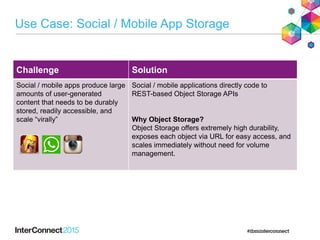
Use Case: Social / Mobile App Storage
Challenge Solution
Social / mobile apps produce large
amounts of user-generated
content that needs to be durably
stored, readily accessible, and
scale “virally”
Social / mobile applications directly code to
REST-based Object Storage APIs
Why Object Storage?
Object Storage offers extremely high durability,
exposes each object via URL for easy access, and
scales immediately without need for volume
management.
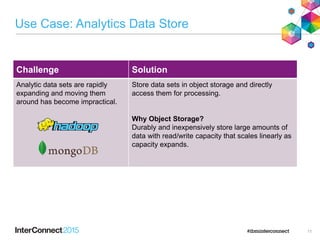
Challenge Solution
Analytic data sets are rapidly
expanding and moving them
around has become impractical.
Store data sets in object storage and directly
access them for processing.
Why Object Storage?
Durably and inexpensively store large amounts of
data with read/write capacity that scales linearly as
capacity expands.
Use Case: Analytics Data Store
11
Challenge Solution
Need to inexpensively and durably
store / archive data off-site for
business continuity or disaster
recovery purposes.
Leverage “Storage Gateway” for iSCSI / NFS
interface on object store or use backup solution
with direct integration.
Why Object Storage?
Object Storage offers high durability at low price
point. Public service provider alleviates need for a
second data center.
Use Case: Offsite Backup / Archive
Use Case: NAS Filer Consolidation
Challenge Solution
Many small storage “islands”
across remote / branch offices
that are expensive, difficult to
manage, and difficult to backup.
Object Storage-enabled software solution offering
centralized management and local caching to
improve access times.
Why Object Storage?
Object Storage eliminates islands by enabling
centralized data management at high durability and
a low price point.
Agenda
• What is Object Storage?
• Demand Drivers
• Comparison of Block, File, and Object
• What it is … and is not
• What are common use cases?
• Social / Mobile App Storage
• Analytics Data Store
• Offsite Backup / Archive
• NAS Filer Consolidation
• What are some enabling technologies?
• Storage Gateways
• Aspera
• What does SoftLayer offer for Object Storage?
• Features
• Locations
• Pricing
14
Storage Gateways: Legacy Connectivity
15
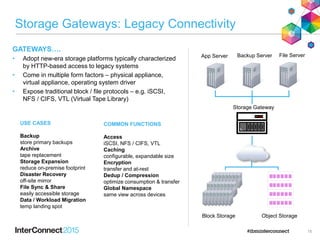
GATEWAYS….
• Adopt new-era storage platforms typically characterized
by HTTP-based access to legacy systems
• Come in multiple form factors – physical appliance,
virtual appliance, operating system driver
• Expose traditional block / file protocols – e.g. iSCSI,
NFS / CIFS, VTL (Virtual Tape Library)
App Server Backup Server File Server
Storage Gateway
Block Storage Object Storage
USE CASES
Backup
store primary backups
Archive
tape replacement
Storage Expansion
reduce on-premise footprint
Disaster Recovery
off-site mirror
File Sync & Share
easily accessible storage
Data / Workload Migration
temp landing spot
COMMON FUNCTIONS
Access
iSCSI, NFS / CIFS, VTL
Caching
configurable, expandable size
Encryption
transfer and at-rest
Dedup / Compression
optimize consumption & transfer
Global Namespace
same view across devices
Aspera: High-Speed File Transfer
Aspera On Demand
“Direct to object storage”
capability, which tightly
integrates FASP transfers with
the native object storage APIs,
enables users to securely
move their data directly into
cloud-based object storage at
line-speed from any Aspera
Client over wide area
networks.
16
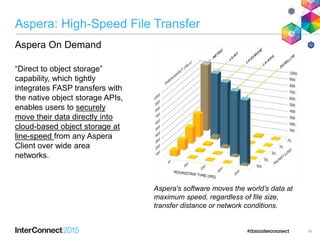
Aspera's software moves the world’s data at
maximum speed, regardless of file size,
transfer distance or network conditions.
Agenda
• What is Object Storage?
• Demand Drivers
• Comparison of Block, File, and Object
• What it is … and is not
• What are common use cases?
• Social / Mobile App Storage
• Analytics Data Store
• Offsite Backup / Archive
• NAS Filer Consolidation
• What are some enabling technologies?
• Storage Gateways
• Aspera
• What does SoftLayer offer for Object Storage?
• Features
• Locations
• Pricing
17
SoftLayer Object Storage Features
• Built on open standards –
OpenStack Swift
• CDN Integration
• API, Web Portal, and Mobile
Application control
• Metadata indexing and search
• Built-in SFTP access
• Free inbound transfer, private
network access, and API operations
18
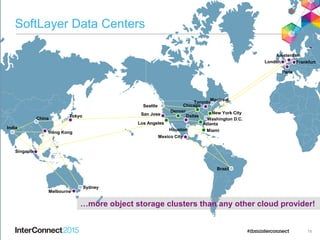
SoftLayer Data Centers
19
India
China
Tokyo
Hong Kong
Singapore
Melbourne
Seattle
San Jose
Los Angeles
Mexico City
Denver
Chicago
Dallas
Houston
Toronto
Montreal
Brazil
New York City
Washington D.C.
Miami
Frankfurt
Amsterdam
Paris
Sydney
Atlanta
London
…more object storage clusters than any other cloud provider!
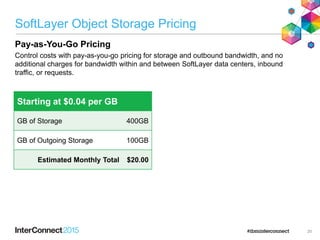
SoftLayer Object Storage Pricing
Pay-as-You-Go Pricing
Control costs with pay-as-you-go pricing for storage and outbound bandwidth, and no
additional charges for bandwidth within and between SoftLayer data centers, inbound
traffic, or requests.
20
Starting at $0.04 per GB
GB of Storage 400GB
GB of Outgoing Storage 100GB
Estimated Monthly Total $20.00
Agenda
• What is Object Storage?
• What it is … and is not
• Comparison of Block, File, and Object
• Demand Drivers
• What are common use cases?
• Social / Mobile App Storage
• Analytics Data Store
• Offsite Backup / Archive
• NAS Filer Consolidation
• What are some enabling technologies?
• Storage Gateways
• Aspera
• What does SoftLayer offer for Object Storage?
• Locations
• Features
• Pricing
21
Notices and Disclaimers
Copyright © 2015 by International Business Machines Corporation (IBM). No part of this document may be reproduced or
transmitted in any form without written permission from IBM.
U.S. Government Users Restricted Rights - Use, duplication or disclosure restricted by GSA ADP Schedule Contract with
IBM.
Information in these presentations (including information relating to products that have not yet been announced by IBM) has been
reviewed for accuracy as of the date of initial publication and could include unintentional technical or typographical errors. IBM
shall have no responsibility to update this information. THIS DOCUMENT IS DISTRIBUTED "AS IS" WITHOUT ANY WARRANTY,
EITHER EXPRESS OR IMPLIED. IN NO EVENT SHALL IBM BE LIABLE FOR ANY DAMAGE ARISING FROM THE USE OF
THIS INFORMATION, INCLUDING BUT NOT LIMITED TO, LOSS OF DATA, BUSINESS INTERRUPTION, LOSS OF PROFIT
OR LOSS OF OPPORTUNITY. IBM products and services are warranted according to the terms and conditions of the
agreements under which they are provided.
Any statements regarding IBM's future direction, intent or product plans are subject to change or withdrawal without
notice.
Performance data contained herein was generally obtained in a controlled, isolated environments. Customer examples are
presented as illustrations of how those customers have used IBM products and the results they may have achieved. Actual
performance, cost, savings or other results in other operating environments may vary.
References in this document to IBM products, programs, or services does not imply that IBM intends to make such products,
programs or services available in all countries in which IBM operates or does business.
Workshops, sessions and associated materials may have been prepared by independent session speakers, and do not
necessarily reflect the views of IBM. All materials and discussions are provided for informational purposes only, and are neither
intended to, nor shall constitute legal or other guidance or advice to any individual participant or their specific situation.
It is the customer’s responsibility to insure its own compliance with legal requirements and to obtain advice of competent legal
counsel as to the identification and interpretation of any relevant laws and regulatory requirements that may affect the customer’s
business and any actions the customer may need to take to comply with such laws. IBM does not provide legal advice or
represent or warrant that its services or products will ensure that the customer is in compliance with any law.
Notices and Disclaimers (con’t)
Information concerning non-IBM products was obtained from the suppliers of those products, their published
announcements or other publicly available sources. IBM has not tested those products in connection with this
publication and cannot confirm the accuracy of performance, compatibility or any other claims related to non-IBM
products. Questions on the capabilities of non-IBM products should be addressed to the suppliers of those products.
IBM does not warrant the quality of any third-party products, or the ability of any such third-party products to
interoperate with IBM’s products. IBM EXPRESSLY DISCLAIMS ALL WARRANTIES, EXPRESSED OR IMPLIED,
INCLUDING BUT NOT LIMITED TO, THE IMPLIED WARRANTIES OF MERCHANTABILITY AND FITNESS FOR A
PARTICULAR PURPOSE.
The provision of the information contained herein is not intended to, and does not, grant any right or license under any
IBM patents, copyrights, trademarks or other intellectual property right.
• IBM, the IBM logo, ibm.com, Bluemix, Blueworks Live, CICS, Clearcase, DOORS®, Enterprise Document
Management System™, Global Business Services ®, Global Technology Services ®, Information on Demand,
ILOG, Maximo®, MQIntegrator®, MQSeries®, Netcool®, OMEGAMON, OpenPower, PureAnalytics™,
PureApplication®, pureCluster™, PureCoverage®, PureData®, PureExperience®, PureFlex®, pureQuery®,
pureScale®, PureSystems®, QRadar®, Rational®, Rhapsody®, SoDA, SPSS, StoredIQ, Tivoli®, Trusteer®,
urban{code}®, Watson, WebSphere®, Worklight®, X-Force® and System z® Z/OS, are trademarks of
International Business Machines Corporation, registered in many jurisdictions worldwide. Other product and
service names might be trademarks of IBM or other companies. A current list of IBM trademarks is available on
the Web at "Copyright and trademark information" at: www.ibm.com/legal/copytrade.shtml.
Thank You
Your Feedback is
Important!
Access the InterConnect 2015
Conference CONNECT Attendee
Portal to complete your session
surveys from your smartphone,
laptop or conference kiosk.

SoftLayer Object Storage Overview

  • 1.
    © 2015 IBMCorporation SoftLayer Object Storage Overview Ann Corrao, Distinguished Engineer Michael Fork, SoftLayer Storage Product Manager
  • 2.
    Agenda • What isObject Storage? • Demand Drivers • Comparison of Block, File, and Object • What it is … and is not • What are common use cases? • Social / Mobile App Storage • Analytics Data Store • Offsite Backup / Archive • NAS Filer Consolidation • What are some enabling technologies? • Storage Gateways • Aspera • What does SoftLayer offer for Object Storage? • Locations • Features • Pricing 1
  • 3.
    Agenda • What isObject Storage? • Demand Drivers • Comparison of Block, File, and Object • What it is … and is not • What are common use cases? • Social / Mobile App Storage • Analytics Data Store • Offsite Backup / Archive • NAS Filer Consolidation • Enabling Technologies • Storage Gateways • Aspera • What does SoftLayer offer for Object Storage? • Features • Locations • Pricing 2
  • 4.
    Why? Unstructured datagrowth is exploding! 3 Source: Internet Trends 2014 – Code Conference
  • 5.
    Where does ObjectStorage fit?
  • 6.
    Object Storage Defined 5 Inexpensive,scalable, self-healing storage for massive amounts of unstructured data.
  • 7.
    What Object Storageis…and is not 6 Is Is NOT Eventually Consistent Strongly Consistent Optimized for storing entire file For inline file edits or hypervisor storage API-based Directly accessible by traditional iSCSI / NFS For semi-structured / unstructured For structured data Massively scalable POSIX-compliant file system Highly durable
  • 8.
    Logical Model 7 Object is{ Data + Metadata + GUID }
  • 9.
  • 10.
    Agenda • What isObject Storage? • Demand Drivers • Comparison of Block, File, and Object • What it is … and is not • What are common use cases? • Social / Mobile App Storage • Analytics Data Store • Offsite Backup / Archive • NAS Filer Consolidation • What are some enabling technologies? • Storage Gateways • Aspera • What does SoftLayer offer for Object Storage? • Features • Locations • Pricing 9
  • 11.
    Use Case: Social/ Mobile App Storage Challenge Solution Social / mobile apps produce large amounts of user-generated content that needs to be durably stored, readily accessible, and scale “virally” Social / mobile applications directly code to REST-based Object Storage APIs Why Object Storage? Object Storage offers extremely high durability, exposes each object via URL for easy access, and scales immediately without need for volume management.
  • 12.
    Challenge Solution Analytic datasets are rapidly expanding and moving them around has become impractical. Store data sets in object storage and directly access them for processing. Why Object Storage? Durably and inexpensively store large amounts of data with read/write capacity that scales linearly as capacity expands. Use Case: Analytics Data Store 11
  • 13.
    Challenge Solution Need toinexpensively and durably store / archive data off-site for business continuity or disaster recovery purposes. Leverage “Storage Gateway” for iSCSI / NFS interface on object store or use backup solution with direct integration. Why Object Storage? Object Storage offers high durability at low price point. Public service provider alleviates need for a second data center. Use Case: Offsite Backup / Archive
  • 14.
    Use Case: NASFiler Consolidation Challenge Solution Many small storage “islands” across remote / branch offices that are expensive, difficult to manage, and difficult to backup. Object Storage-enabled software solution offering centralized management and local caching to improve access times. Why Object Storage? Object Storage eliminates islands by enabling centralized data management at high durability and a low price point.
  • 15.
    Agenda • What isObject Storage? • Demand Drivers • Comparison of Block, File, and Object • What it is … and is not • What are common use cases? • Social / Mobile App Storage • Analytics Data Store • Offsite Backup / Archive • NAS Filer Consolidation • What are some enabling technologies? • Storage Gateways • Aspera • What does SoftLayer offer for Object Storage? • Features • Locations • Pricing 14
  • 16.
    Storage Gateways: LegacyConnectivity 15 GATEWAYS…. • Adopt new-era storage platforms typically characterized by HTTP-based access to legacy systems • Come in multiple form factors – physical appliance, virtual appliance, operating system driver • Expose traditional block / file protocols – e.g. iSCSI, NFS / CIFS, VTL (Virtual Tape Library) App Server Backup Server File Server Storage Gateway Block Storage Object Storage USE CASES Backup store primary backups Archive tape replacement Storage Expansion reduce on-premise footprint Disaster Recovery off-site mirror File Sync & Share easily accessible storage Data / Workload Migration temp landing spot COMMON FUNCTIONS Access iSCSI, NFS / CIFS, VTL Caching configurable, expandable size Encryption transfer and at-rest Dedup / Compression optimize consumption & transfer Global Namespace same view across devices
  • 17.
    Aspera: High-Speed FileTransfer Aspera On Demand “Direct to object storage” capability, which tightly integrates FASP transfers with the native object storage APIs, enables users to securely move their data directly into cloud-based object storage at line-speed from any Aspera Client over wide area networks. 16 Aspera's software moves the world’s data at maximum speed, regardless of file size, transfer distance or network conditions.
  • 18.
    Agenda • What isObject Storage? • Demand Drivers • Comparison of Block, File, and Object • What it is … and is not • What are common use cases? • Social / Mobile App Storage • Analytics Data Store • Offsite Backup / Archive • NAS Filer Consolidation • What are some enabling technologies? • Storage Gateways • Aspera • What does SoftLayer offer for Object Storage? • Features • Locations • Pricing 17
  • 19.
    SoftLayer Object StorageFeatures • Built on open standards – OpenStack Swift • CDN Integration • API, Web Portal, and Mobile Application control • Metadata indexing and search • Built-in SFTP access • Free inbound transfer, private network access, and API operations 18
  • 20.
    SoftLayer Data Centers 19 India China Tokyo HongKong Singapore Melbourne Seattle San Jose Los Angeles Mexico City Denver Chicago Dallas Houston Toronto Montreal Brazil New York City Washington D.C. Miami Frankfurt Amsterdam Paris Sydney Atlanta London …more object storage clusters than any other cloud provider!
  • 21.
    SoftLayer Object StoragePricing Pay-as-You-Go Pricing Control costs with pay-as-you-go pricing for storage and outbound bandwidth, and no additional charges for bandwidth within and between SoftLayer data centers, inbound traffic, or requests. 20 Starting at $0.04 per GB GB of Storage 400GB GB of Outgoing Storage 100GB Estimated Monthly Total $20.00
  • 22.
    Agenda • What isObject Storage? • What it is … and is not • Comparison of Block, File, and Object • Demand Drivers • What are common use cases? • Social / Mobile App Storage • Analytics Data Store • Offsite Backup / Archive • NAS Filer Consolidation • What are some enabling technologies? • Storage Gateways • Aspera • What does SoftLayer offer for Object Storage? • Locations • Features • Pricing 21
  • 23.
    Notices and Disclaimers Copyright© 2015 by International Business Machines Corporation (IBM). No part of this document may be reproduced or transmitted in any form without written permission from IBM. U.S. Government Users Restricted Rights - Use, duplication or disclosure restricted by GSA ADP Schedule Contract with IBM. Information in these presentations (including information relating to products that have not yet been announced by IBM) has been reviewed for accuracy as of the date of initial publication and could include unintentional technical or typographical errors. IBM shall have no responsibility to update this information. THIS DOCUMENT IS DISTRIBUTED "AS IS" WITHOUT ANY WARRANTY, EITHER EXPRESS OR IMPLIED. IN NO EVENT SHALL IBM BE LIABLE FOR ANY DAMAGE ARISING FROM THE USE OF THIS INFORMATION, INCLUDING BUT NOT LIMITED TO, LOSS OF DATA, BUSINESS INTERRUPTION, LOSS OF PROFIT OR LOSS OF OPPORTUNITY. IBM products and services are warranted according to the terms and conditions of the agreements under which they are provided. Any statements regarding IBM's future direction, intent or product plans are subject to change or withdrawal without notice. Performance data contained herein was generally obtained in a controlled, isolated environments. Customer examples are presented as illustrations of how those customers have used IBM products and the results they may have achieved. Actual performance, cost, savings or other results in other operating environments may vary. References in this document to IBM products, programs, or services does not imply that IBM intends to make such products, programs or services available in all countries in which IBM operates or does business. Workshops, sessions and associated materials may have been prepared by independent session speakers, and do not necessarily reflect the views of IBM. All materials and discussions are provided for informational purposes only, and are neither intended to, nor shall constitute legal or other guidance or advice to any individual participant or their specific situation. It is the customer’s responsibility to insure its own compliance with legal requirements and to obtain advice of competent legal counsel as to the identification and interpretation of any relevant laws and regulatory requirements that may affect the customer’s business and any actions the customer may need to take to comply with such laws. IBM does not provide legal advice or represent or warrant that its services or products will ensure that the customer is in compliance with any law.
  • 24.
    Notices and Disclaimers(con’t) Information concerning non-IBM products was obtained from the suppliers of those products, their published announcements or other publicly available sources. IBM has not tested those products in connection with this publication and cannot confirm the accuracy of performance, compatibility or any other claims related to non-IBM products. Questions on the capabilities of non-IBM products should be addressed to the suppliers of those products. IBM does not warrant the quality of any third-party products, or the ability of any such third-party products to interoperate with IBM’s products. IBM EXPRESSLY DISCLAIMS ALL WARRANTIES, EXPRESSED OR IMPLIED, INCLUDING BUT NOT LIMITED TO, THE IMPLIED WARRANTIES OF MERCHANTABILITY AND FITNESS FOR A PARTICULAR PURPOSE. The provision of the information contained herein is not intended to, and does not, grant any right or license under any IBM patents, copyrights, trademarks or other intellectual property right. • IBM, the IBM logo, ibm.com, Bluemix, Blueworks Live, CICS, Clearcase, DOORS®, Enterprise Document Management System™, Global Business Services ®, Global Technology Services ®, Information on Demand, ILOG, Maximo®, MQIntegrator®, MQSeries®, Netcool®, OMEGAMON, OpenPower, PureAnalytics™, PureApplication®, pureCluster™, PureCoverage®, PureData®, PureExperience®, PureFlex®, pureQuery®, pureScale®, PureSystems®, QRadar®, Rational®, Rhapsody®, SoDA, SPSS, StoredIQ, Tivoli®, Trusteer®, urban{code}®, Watson, WebSphere®, Worklight®, X-Force® and System z® Z/OS, are trademarks of International Business Machines Corporation, registered in many jurisdictions worldwide. Other product and service names might be trademarks of IBM or other companies. A current list of IBM trademarks is available on the Web at "Copyright and trademark information" at: www.ibm.com/legal/copytrade.shtml.
  • 25.
    Thank You Your Feedbackis Important! Access the InterConnect 2015 Conference CONNECT Attendee Portal to complete your session surveys from your smartphone, laptop or conference kiosk.