

MongoDB 
Scalability and Agility 
Chris.Biow@MongoDB.com
Data Challenge 
“I want my data...” 
• Now 
• Secure 
• All varieties 
• Fast and interactive 
• Scalable to “Big” 
• Agile to develop and deploy operationally 
• Cloud and edge 
2 
iStock licensed (pixelfit)
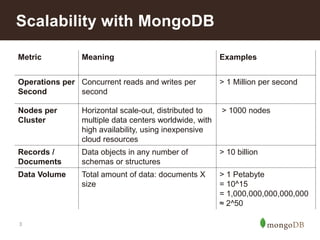
Scalability with MongoDB 
Metric Meaning Examples 
Operations per 
Second 
3 
Concurrent reads and writes per 
second 
> 1 Million per second 
Nodes per 
Cluster 
Horizontal scale-out, distributed to 
multiple data centers worldwide, with 
high availability, using inexpensive 
cloud resources 
> 1000 nodes 
Records / 
Documents 
Data objects in any number of 
schemas or structures 
> 10 billion 
Data Volume Total amount of data: documents X 
size 
> 1 Petabyte 
= 10^15 
= 1,000,000,000,000,000 
≈ 2^50
Key Differentiation
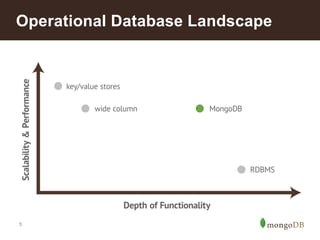
Operational Database Landscape 
5
Document Data Model 
Relational MongoDB 
6 
{ 
first_name: ‘Paul’, 
surname: ‘Miller’, 
city: ‘London’, 
location: 
[45.123,47.232], 
cars: [ 
{ model: ‘Bentley’, 
year: 1973, 
value: 100000, … }, 
{ model: ‘Rolls Royce’, 
year: 1965, 
value: 330000, … } 
} 
}
Documents are Rich Data Structures 
7 
{ 
first_name: ‘Paul’, 
surname: ‘Miller’, 
cell: ‘+447557505611’ 
city: ‘London’, 
location: [45.123,47.232], 
Profession: [banking, finance, trader], 
cars: [ 
{ model: ‘Bentley’, 
year: 1973, 
value: 100000, … }, 
{ model: ‘Rolls Royce’, 
year: 1965, 
value: 330000, … } 
} 
} 
Fields can contain an array of 
sub-documents 
Fields 
Typed field values 
Fields can 
contain arrays
Document Model Benefits 
• Agility and flexibility 
8 
– Data model supports business change 
– Rapidly iterate to meet new requirements 
• Intuitive, natural data representation 
– Eliminates ORM layer 
– Developers are more productive 
• Reduces the need for joins, disk seeks 
– Programming is more simple 
– Performance delivered at scale
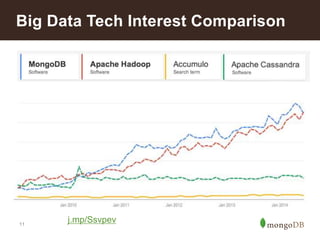
Big Data Tech Interest Comparison 
11 
j.mp/Ssvpev
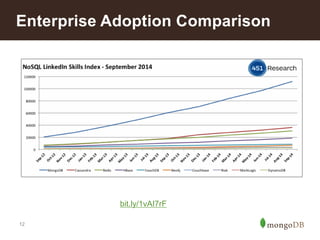
Enterprise Adoption Comparison 
12 
bit.ly/1vAI7rF
Architecture for 
Availability & Scalability
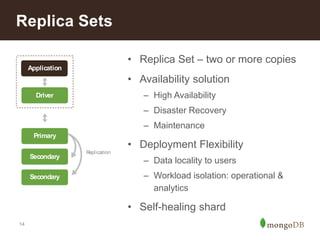
Replica Sets 
14 
• Replica Set – two or more copies 
• Availability solution 
– High Availability 
– Disaster Recovery 
– Maintenance 
• Deployment Flexibility 
– Data locality to users 
– Workload isolation: operational & 
analytics 
• Self-healing shard 
Application 
Driver 
Primary 
Secondary 
Secondary 
Repl ication
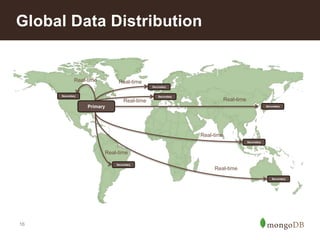
Global Data Distribution 
16 
Real-time 
Real-time Real-time 
Real-time 
Real-time 
Real-time 
Real-time 
Primary 
Secondary 
Secondary 
Secondary 
Secondary 
Secondary 
Secondary 
Secondary
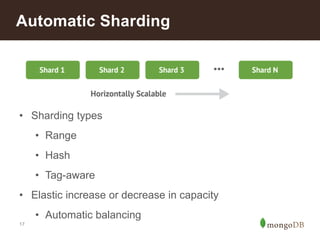
Automatic Sharding 
• Sharding types 
17 
• Range 
• Hash 
• Tag-aware 
• Elastic increase or decrease in capacity 
• Automatic balancing
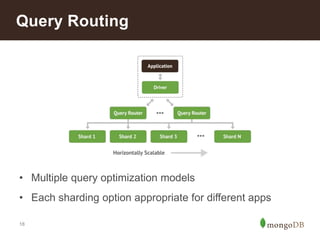
Query Routing 
• Multiple query optimization models 
• Each sharding option appropriate for different apps 
18
Performance
Drag Strip: 
straight ahead, quarter-mile, stop 
20
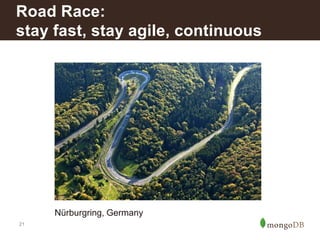
Road Race: 
stay fast, stay agile, continuous 
21 
Nürburgring, Germany
MongoDB at Scale
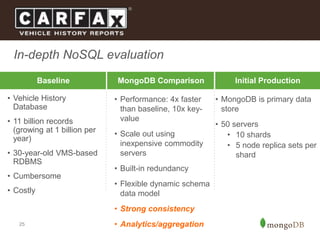
CarFax 
• Large data set 
24
25 
Baseline MongoDB Comparison Initial Production 
• Vehicle History 
Database 
• 11 billion records 
(growing at 1 billion per 
year) 
• 30-year-old VMS-based 
RDBMS 
• Cumbersome 
• Costly 
• Performance: 4x faster 
than baseline, 10x key-value 
• Scale out using 
inexpensive commodity 
servers 
• Built-in redundancy 
• Flexible dynamic schema 
data model 
• Strong consistency 
• Analytics/aggregation 
• MongoDB is primary data 
store 
• 50 servers 
• 10 shards 
• 5 node replica sets per 
shard 
In-depth NoSQL evaluation
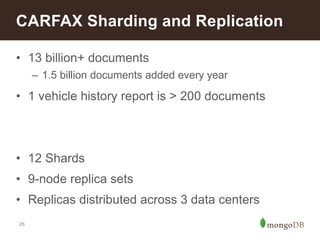
CARFAX Sharding and Replication 
• 13 billion+ documents 
26 
– 1.5 billion documents added every year 
• 1 vehicle history report is > 200 documents 
• 12 Shards 
• 9-node replica sets 
• Replicas distributed across 3 data centers
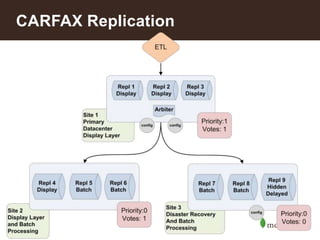
CARFAX Replication 
27
28
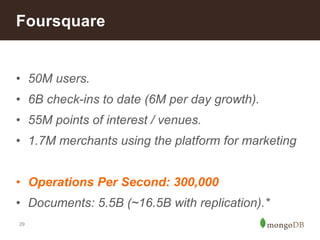
Foursquare 
• 50M users. 
• 6B check-ins to date (6M per day growth). 
• 55M points of interest / venues. 
• 1.7M merchants using the platform for marketing 
• Operations Per Second: 300,000 
• Documents: 5.5B (~16.5B with replication).* 
29
Foursquare clusters 
• 11 MongoDB clusters 
30 
– 8 are sharded 
• Largest cluster for check-ins 
• 15 shards (check ins) 
• Shard key user_id
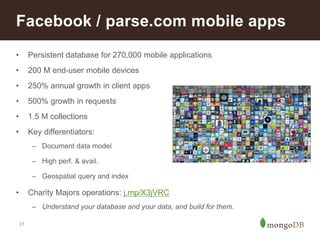
Facebook / parse.com mobile apps 
• Persistent database for 270,000 mobile applications 
• 200 M end-user mobile devices 
• 250% annual growth in client apps 
• 500% growth in requests 
• 1.5 M collections 
• Key differentiators: 
31 
– Document data model 
– High perf. & avail. 
– Geospatial query and index 
• Charity Majors operations: j.mp/X3jVRC 
– Understand your database and your data, and build for them.
Scalability Exercises in the Cloud 
with Amazon Web Services
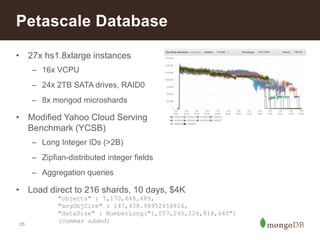
Petascale Database 
• 27x hs1.8xlarge instances 
35 
– 16x VCPU 
– 24x 2TB SATA drives, RAID0 
– 8x mongod microshards 
• Modified Yahoo Cloud Serving 
Benchmark (YCSB) 
– Long Integer IDs (>2B) 
– Zipfian-distributed integer fields 
– Aggregation queries 
• Load direct to 216 shards, 10 days, $4K 
"objects" : 7,170,648,489, 
"avgObjSize" : 147,438.99952658816, 
"dataSize" : NumberLong("1,057,240,224,818,640") 
(commas added)
CGroup Memory Segregation 
for DB in `seq 0 3`; do 
sudo cgcreate  
-a mongodb:mongodb  
-t mongodb:mongodb  
-g memory:mongodb$D 
sudo echo 48G >  
/sys/fs/cgroup/memory/mongodb$D/memory.limit_in_bytes 
cgexec  
-g memory:mongodb$DB  
numactl –interleave=all  
mongod –-config ~/mongod$DB.conf 
done
Megawrite Ingest 
• Ingest 250-byte stock quotes at 2M/s 
• Concurrently run 5 QPS, subsecond/indexed response on 
37 
timeStamp, accountId, instrumentId, systemKey 
• 5x r3.4xlarge 
– 16x VCPU, 1x 320GB SSD, 122GB RAM, 16x mongod 
– 2.1M insert/second direct to shards 
• 16x c3.8xlarge 
– 32x VCPU, 2x 320GB SSD, 60GB RAM, 16x mongod, 4x mongos 
– 2.1M insert/second via mongos
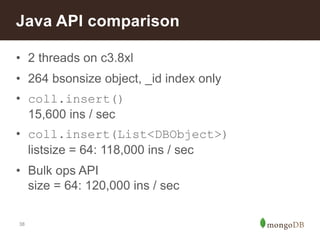
Java API comparison 
• 2 threads on c3.8xl 
• 264 bsonsize object, _id index only 
• coll.insert() 
38 
15,600 ins / sec 
• coll.insert(List<DBObject>) 
listsize = 64: 118,000 ins / sec 
• Bulk ops API 
size = 64: 120,000 ins / sec
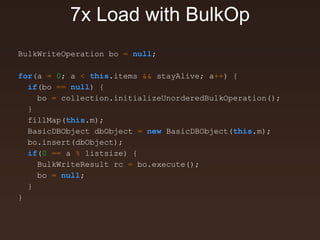
BulkWriteOperation bo = null; 
for(a = 0; a < this.items && stayAlive; a++) { 
if(bo == null) { 
bo = collection.initializeUnorderedBulkOperation(); 
} 
fillMap(this.m); 
BasicDBObject dbObject = new BasicDBObject(this.m); 
bo.insert(dbObject); 
if(0 == a % listsize) { 
BulkWriteResult rc = bo.execute(); 
bo = null; 
} 
} 
7x Load with BulkOp
How do I Pick A Shard Key?
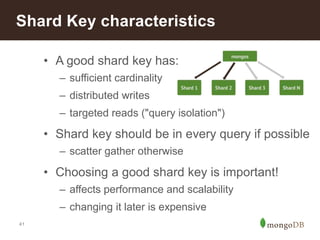
Shard Key characteristics 
41 
• A good shard key has: 
– sufficient cardinality 
– distributed writes 
– targeted reads ("query isolation") 
• Shard key should be in every query if possible 
– scatter gather otherwise 
• Choosing a good shard key is important! 
– affects performance and scalability 
– changing it later is expensive
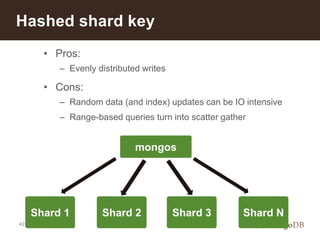
Hashed shard key 
42 
• Pros: 
– Evenly distributed writes 
• Cons: 
– Random data (and index) updates can be IO intensive 
– Range-based queries turn into scatter gather 
Shard 1 
mongos 
Shard 2 Shard 3 Shard N
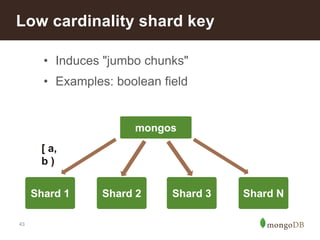
Low cardinality shard key 
43 
• Induces "jumbo chunks" 
• Examples: boolean field 
Shard 1 
mongos 
Shard 2 Shard 3 Shard N 
[ a, 
b )
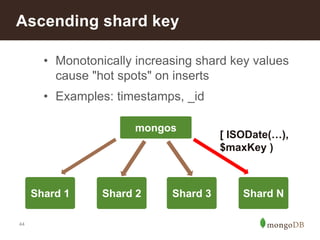
Ascending shard key 
44 
• Monotonically increasing shard key values 
cause "hot spots" on inserts 
• Examples: timestamps, _id 
Shard 1 
mongos 
[ ISODate(…), 
$maxKey ) 
Shard 2 Shard 3 Shard N
Ensuring Success with 
High Scalability
Success Factors 
• Storage: random seeks (IOPS) 
• RAM: working set based on query patterns 
• Query: indexing 
• Delete: most expensive operation 
• Real-time vs. bulk operations 
• Continuity: HA, DR, backup, restore 
• Agile process: iterate by powers of 4 
• Sharding: shard key and strategy 
• Resources: don’t go it alone! 
46

Agility and Scalability with MongoDB

  • 1.
    MongoDB Scalability andAgility Chris.Biow@MongoDB.com
  • 2.
    Data Challenge “Iwant my data...” • Now • Secure • All varieties • Fast and interactive • Scalable to “Big” • Agile to develop and deploy operationally • Cloud and edge 2 iStock licensed (pixelfit)
  • 3.
    Scalability with MongoDB Metric Meaning Examples Operations per Second 3 Concurrent reads and writes per second > 1 Million per second Nodes per Cluster Horizontal scale-out, distributed to multiple data centers worldwide, with high availability, using inexpensive cloud resources > 1000 nodes Records / Documents Data objects in any number of schemas or structures > 10 billion Data Volume Total amount of data: documents X size > 1 Petabyte = 10^15 = 1,000,000,000,000,000 ≈ 2^50
  • 4.
  • 5.
  • 6.
    Document Data Model Relational MongoDB 6 { first_name: ‘Paul’, surname: ‘Miller’, city: ‘London’, location: [45.123,47.232], cars: [ { model: ‘Bentley’, year: 1973, value: 100000, … }, { model: ‘Rolls Royce’, year: 1965, value: 330000, … } } }
  • 7.
    Documents are RichData Structures 7 { first_name: ‘Paul’, surname: ‘Miller’, cell: ‘+447557505611’ city: ‘London’, location: [45.123,47.232], Profession: [banking, finance, trader], cars: [ { model: ‘Bentley’, year: 1973, value: 100000, … }, { model: ‘Rolls Royce’, year: 1965, value: 330000, … } } } Fields can contain an array of sub-documents Fields Typed field values Fields can contain arrays
  • 8.
    Document Model Benefits • Agility and flexibility 8 – Data model supports business change – Rapidly iterate to meet new requirements • Intuitive, natural data representation – Eliminates ORM layer – Developers are more productive • Reduces the need for joins, disk seeks – Programming is more simple – Performance delivered at scale
  • 9.
    Big Data TechInterest Comparison 11 j.mp/Ssvpev
  • 10.
  • 11.
  • 12.
    Replica Sets 14 • Replica Set – two or more copies • Availability solution – High Availability – Disaster Recovery – Maintenance • Deployment Flexibility – Data locality to users – Workload isolation: operational & analytics • Self-healing shard Application Driver Primary Secondary Secondary Repl ication
  • 13.
    Global Data Distribution 16 Real-time Real-time Real-time Real-time Real-time Real-time Real-time Primary Secondary Secondary Secondary Secondary Secondary Secondary Secondary
  • 14.
    Automatic Sharding •Sharding types 17 • Range • Hash • Tag-aware • Elastic increase or decrease in capacity • Automatic balancing
  • 15.
    Query Routing •Multiple query optimization models • Each sharding option appropriate for different apps 18
  • 16.
  • 17.
    Drag Strip: straightahead, quarter-mile, stop 20
  • 18.
    Road Race: stayfast, stay agile, continuous 21 Nürburgring, Germany
  • 19.
  • 20.
    CarFax • Largedata set 24
  • 21.
    25 Baseline MongoDBComparison Initial Production • Vehicle History Database • 11 billion records (growing at 1 billion per year) • 30-year-old VMS-based RDBMS • Cumbersome • Costly • Performance: 4x faster than baseline, 10x key-value • Scale out using inexpensive commodity servers • Built-in redundancy • Flexible dynamic schema data model • Strong consistency • Analytics/aggregation • MongoDB is primary data store • 50 servers • 10 shards • 5 node replica sets per shard In-depth NoSQL evaluation
  • 22.
    CARFAX Sharding andReplication • 13 billion+ documents 26 – 1.5 billion documents added every year • 1 vehicle history report is > 200 documents • 12 Shards • 9-node replica sets • Replicas distributed across 3 data centers
  • 23.
  • 24.
  • 25.
    Foursquare • 50Musers. • 6B check-ins to date (6M per day growth). • 55M points of interest / venues. • 1.7M merchants using the platform for marketing • Operations Per Second: 300,000 • Documents: 5.5B (~16.5B with replication).* 29
  • 26.
    Foursquare clusters •11 MongoDB clusters 30 – 8 are sharded • Largest cluster for check-ins • 15 shards (check ins) • Shard key user_id
  • 27.
    Facebook / parse.commobile apps • Persistent database for 270,000 mobile applications • 200 M end-user mobile devices • 250% annual growth in client apps • 500% growth in requests • 1.5 M collections • Key differentiators: 31 – Document data model – High perf. & avail. – Geospatial query and index • Charity Majors operations: j.mp/X3jVRC – Understand your database and your data, and build for them.
  • 29.
    Scalability Exercises inthe Cloud with Amazon Web Services
  • 30.
    Petascale Database •27x hs1.8xlarge instances 35 – 16x VCPU – 24x 2TB SATA drives, RAID0 – 8x mongod microshards • Modified Yahoo Cloud Serving Benchmark (YCSB) – Long Integer IDs (>2B) – Zipfian-distributed integer fields – Aggregation queries • Load direct to 216 shards, 10 days, $4K "objects" : 7,170,648,489, "avgObjSize" : 147,438.99952658816, "dataSize" : NumberLong("1,057,240,224,818,640") (commas added)
  • 31.
    CGroup Memory Segregation for DB in `seq 0 3`; do sudo cgcreate -a mongodb:mongodb -t mongodb:mongodb -g memory:mongodb$D sudo echo 48G > /sys/fs/cgroup/memory/mongodb$D/memory.limit_in_bytes cgexec -g memory:mongodb$DB numactl –interleave=all mongod –-config ~/mongod$DB.conf done
  • 32.
    Megawrite Ingest •Ingest 250-byte stock quotes at 2M/s • Concurrently run 5 QPS, subsecond/indexed response on 37 timeStamp, accountId, instrumentId, systemKey • 5x r3.4xlarge – 16x VCPU, 1x 320GB SSD, 122GB RAM, 16x mongod – 2.1M insert/second direct to shards • 16x c3.8xlarge – 32x VCPU, 2x 320GB SSD, 60GB RAM, 16x mongod, 4x mongos – 2.1M insert/second via mongos
  • 33.
    Java API comparison • 2 threads on c3.8xl • 264 bsonsize object, _id index only • coll.insert() 38 15,600 ins / sec • coll.insert(List<DBObject>) listsize = 64: 118,000 ins / sec • Bulk ops API size = 64: 120,000 ins / sec
  • 34.
    BulkWriteOperation bo =null; for(a = 0; a < this.items && stayAlive; a++) { if(bo == null) { bo = collection.initializeUnorderedBulkOperation(); } fillMap(this.m); BasicDBObject dbObject = new BasicDBObject(this.m); bo.insert(dbObject); if(0 == a % listsize) { BulkWriteResult rc = bo.execute(); bo = null; } } 7x Load with BulkOp
  • 35.
    How do IPick A Shard Key?
  • 36.
    Shard Key characteristics 41 • A good shard key has: – sufficient cardinality – distributed writes – targeted reads ("query isolation") • Shard key should be in every query if possible – scatter gather otherwise • Choosing a good shard key is important! – affects performance and scalability – changing it later is expensive
  • 37.
    Hashed shard key 42 • Pros: – Evenly distributed writes • Cons: – Random data (and index) updates can be IO intensive – Range-based queries turn into scatter gather Shard 1 mongos Shard 2 Shard 3 Shard N
  • 38.
    Low cardinality shardkey 43 • Induces "jumbo chunks" • Examples: boolean field Shard 1 mongos Shard 2 Shard 3 Shard N [ a, b )
  • 39.
    Ascending shard key 44 • Monotonically increasing shard key values cause "hot spots" on inserts • Examples: timestamps, _id Shard 1 mongos [ ISODate(…), $maxKey ) Shard 2 Shard 3 Shard N
  • 40.
    Ensuring Success with High Scalability
  • 41.
    Success Factors •Storage: random seeks (IOPS) • RAM: working set based on query patterns • Query: indexing • Delete: most expensive operation • Real-time vs. bulk operations • Continuity: HA, DR, backup, restore • Agile process: iterate by powers of 4 • Sharding: shard key and strategy • Resources: don’t go it alone! 46