Various Image Formats
•
•
•
•
•

TIFF
JPEG
GIF
PNG
EXIF

Designed By :

SAKET GUPTA
Email : saketgupta786@gmail.com
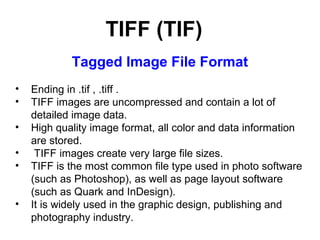
TIFF (TIF)
Tagged Image File Format
•
•
•
•
•
•

Ending in .tif , .tiff .
TIFF images are uncompressed and contain a lot of
detailed image data.
High quality image format, all color and data information
are stored.
TIFF images create very large file sizes.
TIFF is the most common file type used in photo software
(such as Photoshop), as well as page layout software
(such as Quark and InDesign).
It is widely used in the graphic design, publishing and
photography industry.
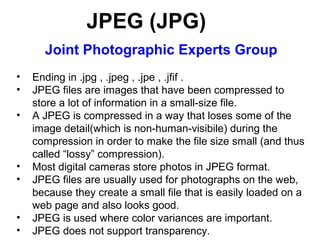
JPEG (JPG)
Joint Photographic Experts Group
•
•
•

•
•
•
•

Ending in .jpg , .jpeg , .jpe , .jfif .
JPEG files are images that have been compressed to
store a lot of information in a small-size file.
A JPEG is compressed in a way that loses some of the
image detail(which is non-human-visibile) during the
compression in order to make the file size small (and thus
called “lossy” compression).
Most digital cameras store photos in JPEG format.
JPEG files are usually used for photographs on the web,
because they create a small file that is easily loaded on a
web page and also looks good.
JPEG is used where color variances are important.
JPEG does not support transparency.
GIF
Graphics Interchange Format
•
•
•
•
•
•

Ending in .gif .
The compression is lossless (no detail is lost in the
compression, but the file can’t be made as clear as a
JPEG).
GIF has an extremely limited color range. It reduces the
number of colors in an image to 256.
Due to limited colors it is never used for photography.
GIF has the unique ability to display a sequence of
images, similar to videos, called an animated GIF.
GIF can be used effectively for limited-color images, such
as logos and graphs, or for images where transparency is
important.
PNG
Portable Network Graphics
•
•
•
•
•
•

Ending in .png .
It is an alternative to the GIF. It allow for 5 to 25 percent
greater compression than GIF, and with a wider range of
colors.
It is used almost exclusively for web images.
For photographs, PNG is not as good as JPEG.
But for images with some text, or line art, it’s better,
because the images look less “bitmappy.”
When you take a screenshot, the resulting image is
stored by default as PNG because most screenshots are
a mix of images and text.
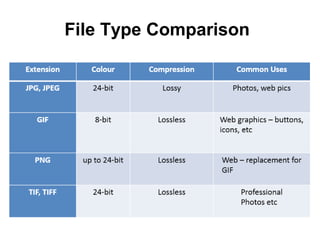
File Type Comparison
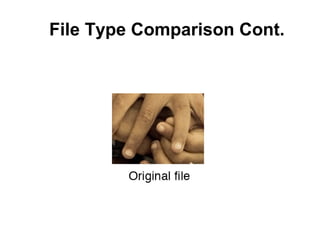
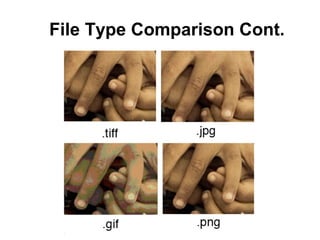
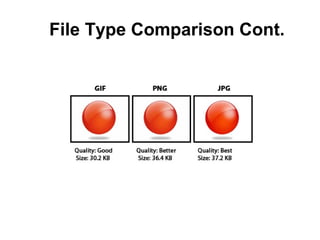
File Type Comparison Cont.
EXIF
Exchangeable Image File Format
•
•
•

 EXIF is a variation of JPEG, used by almost all digital 
cameras to record extra interchange information to image 
files as they are taken.
The type of information stored in a file varies by camera 
model.
These information can include :
 date and time a photo was taken.
Resolution.
camera settings used for the shot.
color information.
whether or not the flash was fired.
shutter speed.
name of the camera owner etc.

Image formats

  • 1.
  • 2.
    TIFF (TIF) Tagged ImageFile Format • • • • • • Ending in .tif , .tiff . TIFF images are uncompressed and contain a lot of detailed image data. High quality image format, all color and data information are stored. TIFF images create very large file sizes. TIFF is the most common file type used in photo software (such as Photoshop), as well as page layout software (such as Quark and InDesign). It is widely used in the graphic design, publishing and photography industry.
  • 3.
    JPEG (JPG) Joint PhotographicExperts Group • • • • • • • Ending in .jpg , .jpeg , .jpe , .jfif . JPEG files are images that have been compressed to store a lot of information in a small-size file. A JPEG is compressed in a way that loses some of the image detail(which is non-human-visibile) during the compression in order to make the file size small (and thus called “lossy” compression). Most digital cameras store photos in JPEG format. JPEG files are usually used for photographs on the web, because they create a small file that is easily loaded on a web page and also looks good. JPEG is used where color variances are important. JPEG does not support transparency.
  • 4.
    GIF Graphics Interchange Format • • • • • • Endingin .gif . The compression is lossless (no detail is lost in the compression, but the file can’t be made as clear as a JPEG). GIF has an extremely limited color range. It reduces the number of colors in an image to 256. Due to limited colors it is never used for photography. GIF has the unique ability to display a sequence of images, similar to videos, called an animated GIF. GIF can be used effectively for limited-color images, such as logos and graphs, or for images where transparency is important.
  • 5.
    PNG Portable Network Graphics • • • • • • Endingin .png . It is an alternative to the GIF. It allow for 5 to 25 percent greater compression than GIF, and with a wider range of colors. It is used almost exclusively for web images. For photographs, PNG is not as good as JPEG. But for images with some text, or line art, it’s better, because the images look less “bitmappy.” When you take a screenshot, the resulting image is stored by default as PNG because most screenshots are a mix of images and text.
  • 6.
  • 7.
  • 8.
  • 9.
  • 10.
    EXIF Exchangeable Image FileFormat • • •  EXIF is a variation of JPEG, used by almost all digital  cameras to record extra interchange information to image  files as they are taken. The type of information stored in a file varies by camera  model. These information can include :  date and time a photo was taken. Resolution. camera settings used for the shot. color information. whether or not the flash was fired. shutter speed. name of the camera owner etc.