In the Fullness of
Time

(Book 1)
Unit IV : St. John’s Gospel
• Leon Morris says in his Commentary on
  John: "John is like a pool, in which a
  child may wade and an elephant may
  swim. It is most simple and profound; it
  is for the beginner in the faith and for
  the mature Christian. Its appeal is
  immediate and never-failing."
Author
• St. John the Beloved Disciple
• St. John 21:24
• Disciple whom Jesus loves (13:23; 19:26;
  20:2; 21:7; 21:20)
• St. John’s name is never mentioned.
• Probably written 90-100 AD
St. John
• One of the sons of Zebedee and Salome (St. Matt
  27:56; St. Mark 15:40)
• One of the Three (Sts. Peter, James and John)
• John the son of Thunder; Boanerges - sons of thunder
  (St. Mk 3:16-17 cf. St. Lk 9:54)
• Initially a disciple of St. John the Baptist
• Entrusted with care of St. Mary (St. Jn 19:26-27)
• Lead the church in Ephesus
• Emperor Domition – cast out to Patmos
• Returned to Ephesus where he wrote the Gospel and
  letters.
• 5 of 27 by St. John
• Called St. John the Theologian because mystery of
  incarnation explained – St. John 1:14
Aim of the Evangelist
• But these are written that you may (come to)
  believe that Jesus is the Messiah, the Son
  of God, and that through this belief you may
  have life in his name. St. John 20:31
• Critical of Jewish authorities
• Against the disciples of St. John the Baptist
  (St. Jn 3:30; Acts 18:25-19:7; modern day
  Mandeans)
• Mystery religions –
• Gnostic – gnosis (wisdom);
• Incarnation – flesh (not docetic) “My Lord
  and my God” (20:28)
Main Themes
• life - used 36 times. More than any other book.
• Witness - used 47 times. Only 4 times in synoptics
  combined. (remember the story of the man born
  blind)
• Believe - used 98 times.
• world - used 78 times.
• love, truth, light, darkness, bread, water, shepherd,
  door,
• “I am”, “signs”
• Opposites - light/darkness (1:4; 3:19; 8:12; 11:9;
  12:35, 46); truth/falsehood (8:44); life/death (5:24;
  11:25); above/below (8:23); freedom/slavery (8:33,
  36).
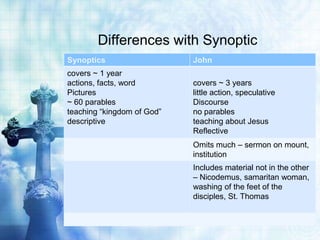
Differences with Synoptic
Synoptics                   John
covers ~ 1 year
actions, facts, word        covers ~ 3 years
Pictures                    little action, speculative
~ 60 parables               Discourse
teaching “kingdom of God”   no parables
descriptive                 teaching about Jesus
                            Reflective
                            Omits much – sermon on mount,
                            institution
                            Includes material not in the other
                            – Nicodemus, samaritan woman,
                            washing of the feet of the
                            disciples, St. Thomas
Outline of Gospel
• 1:1-18 Prologue
• 1:19-12:50 : Part I – The book of signs
   – The Word reveals himself to the world and the
     world rejects him (7 signs)
   – Initial days of revelation (1:19-2:11)
   – First and second miracle in Cana (2-4);
     (cleansing temple; Nicodemus; Samaritan
     woman)
   – OT Feasts and their replacement (5-10)
       • Sabbath – (5)
       • Passover – the Bread of life (6)
       • Tabernacles – source of living water (7:37-
          38)
       • Dedication – 10:22-42 – (Jesus is
          consecrated – read on Hudos Etho)
   – Raising of Lazarus and the after math
Outline (continued)
• Part II : Book of Glory (13-20)
   – “To those who accept him, the Word shows his
     glory by returning to the Father in death,
     resurrection and ascension.” (Brown, pg. 334)
   – Last Supper and Jesus’ Last Discourse (13-17)
       • Last Supper - 13
       • Last Discourse (14-17)
           – Part 1 – ch. 14
           – Part 2 – 15-16 vine, world’s hatred,
             Paraclete
           – Part 3 – 17 High Priestly Prayer
   – Passion and death (18-19)
   – Resurrection 20:1-29 (2 at tomb; 2 at room)
• Epilogue : 21:1-25 Galilean resurrection
  appearances
The word became Flesh (John 1:1-14) Prologue

         •   Logos is God and Creator (1-5)
         •   Baptist’s status and Mission (6-8)
         •   Coming of the Logos (9-13)
         •   Word made Flesh and plan of Salvation
             (14-18)
         •   One incarnate nature of God the word – St.
             Cyril (that exalted and veritable tower of knowledge, who
             expounded the doctrine of the incarnation of God the Word, our
             Lord Jesus Christ, declaring and showing clearly that he became
             incarnate; vachanamaya deyvam sareeriayi theernu ennu
             nammude karthavesu masihayadu)
7 I AM ("Before Abraham was, I Am” John 8:58)
1.   I am the ____ of life. He who comes to me will never be hungry. (John
     6:35)
2.   I am the ____ of the world. Whoever follows me will never walk in
     darkness. (John 8:12)
3.   I am the ____; whoever enters through me will be saved. (John 10:9)
4.   I am the good ____. The good ____ lays down his life for the sheep.
     (John 10:10)
5.   I am the ____ and the life. He who believes in me will live, even
     though he dies. (John 11:25)
6.   I am the ____ and the truth and the life. No one comes to the Father
     except through me. (John 14:6)
7.   I am the true ____, and my Father is the gardener. (John 15:1)
                         •    Bread
                         •    Light
                         •    Door
                         •    Shepherd
                         •    Resurrection
                         •    Way
                         •    Vine
Seven Signs and their meaning

1.    Turning water into wine (Jn 2:1-11)
                 Transformation made by Christ
2.    Curing the son of the official (4:43-54)
                 Cures by Faith
3.    Curing the Paralytic (5:2-9) on Sabbath
                 Restores the lost power of mankind
4.    Feeding of the Five Thousand(6:4-13)
                 Bread of Life who sustains us
5.    Walks on Water (6:16-21)
                 Christ is our guide
6.    Curing the Man born blind (9:1-7)
                 Christ is the light of the world
7.    Raising Lazarus (11:1-44)
                 resurrection and life
*not including the miraculous catch in Galilee
Signs and their significane
• John makes it clear that many more signs
  were done (20:30)
• Point to who Christ is
• Accompanied by long discourse
The Upper Room discourse
• Last Supper in St. John is not Passover meal
  but the day before Passover
   – JOHN 13:1 Now before the Feast of the Passover
   – JOHN 13:21 Judas "Buy those things we need for
     the Feast,
   – JOHN 18:28 Then they led Jesus from Caiaphas to
     the Praetorium, and it was early morning. But they
     themselves did not go into the Praetorium, lest they
     should be defiled, but that they might eat the
     Passover. (NKJV)
• Jesus is crucified as the passover lamb in
  preparation for passover.
• Christ is the lamb of God
Upper Room discourse
• Ch. 13 – Last Supper (washing of the feet
  of the disciples)
• Ch. 14 – Christ’s death and coming again
   – I will not leave you orphans (14:18)
   – Promise of H. Spirit - 14:26
• Ch. 15-16 – Relationship btwn Christ and
  his disciples
   – Vine
• Ch. 17 – High Priestly Prayer –
   – Prays for himself v. 1-5
   – Prays for apostles v. 6-19
   – Prays for universal church v. 20-26
Holy Spirit (Paraclete)
   •    Jesus promises the Paraclete as the
       Presence of God or as a replacement from
       Jesus upon his departure. The Paraclete is
       modeled on Jesus :
       –   1. Both are sent / come from the Father (3:16-17; 14:26)
       –   2. Holy (6:39; 14:26)
       –   3. Truth (14:6; 14:17)
       –   4. Teacher (13:13-14; 14:26)
       –   5. Bears witness and reveals (4:25-26; 15:26-27)
       –   6. Convince and convict the world (1:12; 16:8-12)

   • Paraclete continues the revelation of God
     begun in the incarnation (16:14; 14:26; 16:13,
     15).
Sacramental Teachings of St. John
             •   Grace through physical universe (Christ
                 foundation – John 1:14)
             •   Baptism (3:3 conv with Nicodemas)
             •   Qurbana (6:25-58) “Except you eat the
                 flesh of the Son of man and drink his
                 blood, you have no life in you” (6:53)

Part02

  • 1.
    In the Fullnessof Time (Book 1)
  • 2.
    Unit IV :St. John’s Gospel • Leon Morris says in his Commentary on John: "John is like a pool, in which a child may wade and an elephant may swim. It is most simple and profound; it is for the beginner in the faith and for the mature Christian. Its appeal is immediate and never-failing."
  • 3.
    Author • St. Johnthe Beloved Disciple • St. John 21:24 • Disciple whom Jesus loves (13:23; 19:26; 20:2; 21:7; 21:20) • St. John’s name is never mentioned. • Probably written 90-100 AD
  • 4.
    St. John • Oneof the sons of Zebedee and Salome (St. Matt 27:56; St. Mark 15:40) • One of the Three (Sts. Peter, James and John) • John the son of Thunder; Boanerges - sons of thunder (St. Mk 3:16-17 cf. St. Lk 9:54) • Initially a disciple of St. John the Baptist • Entrusted with care of St. Mary (St. Jn 19:26-27) • Lead the church in Ephesus • Emperor Domition – cast out to Patmos • Returned to Ephesus where he wrote the Gospel and letters. • 5 of 27 by St. John • Called St. John the Theologian because mystery of incarnation explained – St. John 1:14
  • 5.
    Aim of theEvangelist • But these are written that you may (come to) believe that Jesus is the Messiah, the Son of God, and that through this belief you may have life in his name. St. John 20:31 • Critical of Jewish authorities • Against the disciples of St. John the Baptist (St. Jn 3:30; Acts 18:25-19:7; modern day Mandeans) • Mystery religions – • Gnostic – gnosis (wisdom); • Incarnation – flesh (not docetic) “My Lord and my God” (20:28)
  • 6.
    Main Themes • life- used 36 times. More than any other book. • Witness - used 47 times. Only 4 times in synoptics combined. (remember the story of the man born blind) • Believe - used 98 times. • world - used 78 times. • love, truth, light, darkness, bread, water, shepherd, door, • “I am”, “signs” • Opposites - light/darkness (1:4; 3:19; 8:12; 11:9; 12:35, 46); truth/falsehood (8:44); life/death (5:24; 11:25); above/below (8:23); freedom/slavery (8:33, 36).
  • 7.
    Differences with Synoptic Synoptics John covers ~ 1 year actions, facts, word covers ~ 3 years Pictures little action, speculative ~ 60 parables Discourse teaching “kingdom of God” no parables descriptive teaching about Jesus Reflective Omits much – sermon on mount, institution Includes material not in the other – Nicodemus, samaritan woman, washing of the feet of the disciples, St. Thomas
  • 8.
    Outline of Gospel •1:1-18 Prologue • 1:19-12:50 : Part I – The book of signs – The Word reveals himself to the world and the world rejects him (7 signs) – Initial days of revelation (1:19-2:11) – First and second miracle in Cana (2-4); (cleansing temple; Nicodemus; Samaritan woman) – OT Feasts and their replacement (5-10) • Sabbath – (5) • Passover – the Bread of life (6) • Tabernacles – source of living water (7:37- 38) • Dedication – 10:22-42 – (Jesus is consecrated – read on Hudos Etho) – Raising of Lazarus and the after math
  • 9.
    Outline (continued) • PartII : Book of Glory (13-20) – “To those who accept him, the Word shows his glory by returning to the Father in death, resurrection and ascension.” (Brown, pg. 334) – Last Supper and Jesus’ Last Discourse (13-17) • Last Supper - 13 • Last Discourse (14-17) – Part 1 – ch. 14 – Part 2 – 15-16 vine, world’s hatred, Paraclete – Part 3 – 17 High Priestly Prayer – Passion and death (18-19) – Resurrection 20:1-29 (2 at tomb; 2 at room) • Epilogue : 21:1-25 Galilean resurrection appearances
  • 10.
    The word becameFlesh (John 1:1-14) Prologue • Logos is God and Creator (1-5) • Baptist’s status and Mission (6-8) • Coming of the Logos (9-13) • Word made Flesh and plan of Salvation (14-18) • One incarnate nature of God the word – St. Cyril (that exalted and veritable tower of knowledge, who expounded the doctrine of the incarnation of God the Word, our Lord Jesus Christ, declaring and showing clearly that he became incarnate; vachanamaya deyvam sareeriayi theernu ennu nammude karthavesu masihayadu)
  • 11.
    7 I AM("Before Abraham was, I Am” John 8:58) 1. I am the ____ of life. He who comes to me will never be hungry. (John 6:35) 2. I am the ____ of the world. Whoever follows me will never walk in darkness. (John 8:12) 3. I am the ____; whoever enters through me will be saved. (John 10:9) 4. I am the good ____. The good ____ lays down his life for the sheep. (John 10:10) 5. I am the ____ and the life. He who believes in me will live, even though he dies. (John 11:25) 6. I am the ____ and the truth and the life. No one comes to the Father except through me. (John 14:6) 7. I am the true ____, and my Father is the gardener. (John 15:1) • Bread • Light • Door • Shepherd • Resurrection • Way • Vine
  • 12.
    Seven Signs andtheir meaning 1. Turning water into wine (Jn 2:1-11) Transformation made by Christ 2. Curing the son of the official (4:43-54) Cures by Faith 3. Curing the Paralytic (5:2-9) on Sabbath Restores the lost power of mankind 4. Feeding of the Five Thousand(6:4-13) Bread of Life who sustains us 5. Walks on Water (6:16-21) Christ is our guide 6. Curing the Man born blind (9:1-7) Christ is the light of the world 7. Raising Lazarus (11:1-44) resurrection and life *not including the miraculous catch in Galilee
  • 13.
    Signs and theirsignificane • John makes it clear that many more signs were done (20:30) • Point to who Christ is • Accompanied by long discourse
  • 14.
    The Upper Roomdiscourse • Last Supper in St. John is not Passover meal but the day before Passover – JOHN 13:1 Now before the Feast of the Passover – JOHN 13:21 Judas "Buy those things we need for the Feast, – JOHN 18:28 Then they led Jesus from Caiaphas to the Praetorium, and it was early morning. But they themselves did not go into the Praetorium, lest they should be defiled, but that they might eat the Passover. (NKJV) • Jesus is crucified as the passover lamb in preparation for passover. • Christ is the lamb of God
  • 15.
    Upper Room discourse •Ch. 13 – Last Supper (washing of the feet of the disciples) • Ch. 14 – Christ’s death and coming again – I will not leave you orphans (14:18) – Promise of H. Spirit - 14:26 • Ch. 15-16 – Relationship btwn Christ and his disciples – Vine • Ch. 17 – High Priestly Prayer – – Prays for himself v. 1-5 – Prays for apostles v. 6-19 – Prays for universal church v. 20-26
  • 16.
    Holy Spirit (Paraclete) • Jesus promises the Paraclete as the Presence of God or as a replacement from Jesus upon his departure. The Paraclete is modeled on Jesus : – 1. Both are sent / come from the Father (3:16-17; 14:26) – 2. Holy (6:39; 14:26) – 3. Truth (14:6; 14:17) – 4. Teacher (13:13-14; 14:26) – 5. Bears witness and reveals (4:25-26; 15:26-27) – 6. Convince and convict the world (1:12; 16:8-12) • Paraclete continues the revelation of God begun in the incarnation (16:14; 14:26; 16:13, 15).
  • 17.
    Sacramental Teachings ofSt. John • Grace through physical universe (Christ foundation – John 1:14) • Baptism (3:3 conv with Nicodemas) • Qurbana (6:25-58) “Except you eat the flesh of the Son of man and drink his blood, you have no life in you” (6:53)