Foundations (Year Two)


“Encountering the New Testament”


   Session #3. Encountering
            ACTS
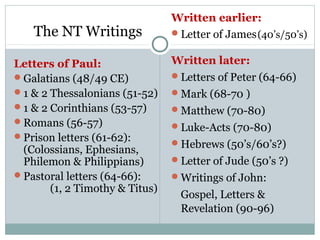
Written earlier:
    The NT Writings             Letter of James (40’s/50’s)


Letters of Paul:                Written later:
Galatians (48/49 CE)           Letters of Peter (64-66)
1 & 2 Thessalonians (51-52)    Mark (68-70 )
1 & 2 Corinthians (53-57)      Matthew (70-80)
Romans (56-57)                 Luke-Acts (70-80)
Prison letters (61-62):
                                Hebrews (50’s/60’s?)
 (Colossians, Ephesians,
 Philemon & Philippians)        Letter of Jude (50’s ?)
Pastoral letters (64-66):      Writings of John:
       (1, 2 Timothy & Titus)
                                 Gospel, Letters &
                                 Revelation (90-96)
“The spreading flame”

- the message of the book of ACTS
The author

Luke, the historian

Luke, the theologian

Luke, the evangelist

Luke, the missionary
The book
Compiled over many months (even years)

Written in Greek (for primarily Greek
 speaking world)
Possibly written (compiled) from Rome

Later designated, simply “ACTS”

A second volume (LUKE-ACTS)
Luke’s purpose – a reminder

“In my former book… I wrote
 about all that Jesus began to do
 and to teach until the day he was
 taken up to heaven” (Acts 1:1-2)
(see Luke 1:1-4)
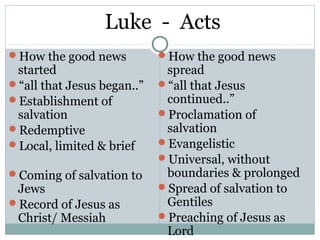
Luke - Acts
How the good news          How the good news
 started                     spread
“all that Jesus began..”   “all that Jesus
Establishment of            continued..”
 salvation                  Proclamation of
Redemptive                  salvation
Local, limited & brief     Evangelistic
                            Universal, without
Coming of salvation to      boundaries & prolonged
 Jews                       Spread of salvation to
Record of Jesus as          Gentiles
 Christ/ Messiah            Preaching of Jesus as
                             Lord
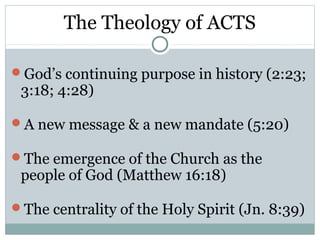
The Theology of ACTS

God’s continuing purpose in history (2:23;
 3:18; 4:28)

A new message & a new mandate (5:20)

The emergence of the Church as the
 people of God (Matthew 16:18)

The centrality of the Holy Spirit (Jn. 8:39)
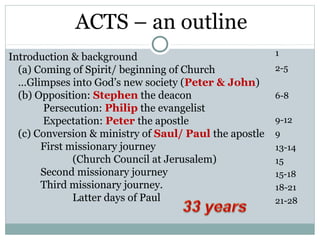
ACTS – an outline
Introduction & background                               1
  (a) Coming of Spirit/ beginning of Church             2-5
  …Glimpses into God’s new society (Peter & John)
  (b) Opposition: Stephen the deacon                    6-8
        Persecution: Philip the evangelist
       Expectation: Peter the apostle                   9-12
  (c) Conversion & ministry of Saul/ Paul the apostle   9
       First missionary journey                         13-14
              (Church Council at Jerusalem)             15
       Second missionary journey                        15-18
       Third missionary journey.                        18-21
              Latter days of Paul                       21-28
ACTS 1


Waiting & Expectation
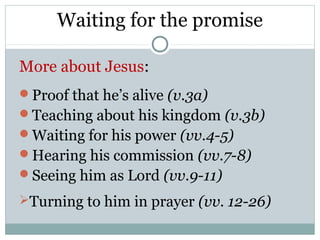
Waiting for the promise

More about Jesus:
Proof that he’s alive (v.3a)
Teaching about his kingdom (v.3b)
Waiting for his power (vv.4-5)
Hearing his commission (vv.7-8)
Seeing him as Lord (vv.9-11)

Turning to him in prayer (vv. 12-26)
Proof that he’s alive

“After his suffering, he presented
 himself to them and gave many
 convincing proofs that he was
 alive.” (cf. 1 Cor. 15:3-8)
   “witnesses of his resurrection”
     (1:22; 4:2, 33; 17:18; 24:21)
Teaching about his kingdom

“He appeared to them over a period
 of forty days and spoke about the
 kingdom of God.”
(cf. Daniel 2:44; Isaiah 2:1-5; Ezekiel 7:24ff.
     - Matt.3:17; Mark 1:15; Luke 4:18-19)

          “The now & the not yet”
Waiting for his power

On one occasion, while he was eating with
 them, he gave them this command: “Do not
 leave Jerusalem, but wait for the gift my
 Father promised, which you have heard me
 speak about. For John baptized with water,
 but in a few days you will be baptized
 with the Holy Spirit”… and you will
 receive power when the Holy Spirit comes
 on you.

(cf. Luke 24:49; Jn. 14:15-27; 15:26-27; 16:5-16)
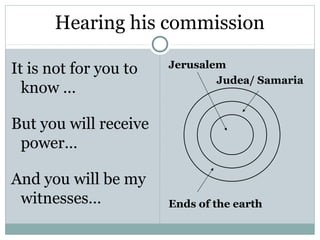
Hearing his commission

                       Jerusalem
It is not for you to
                               Judea/ Samaria
  know …

But you will receive
 power…

And you will be my
 witnesses…            Ends of the earth
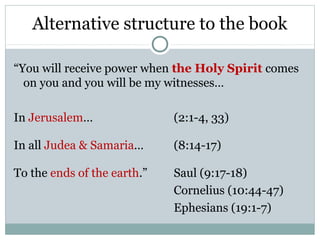
Alternative structure to the book

“You will receive power when the Holy Spirit comes
  on you and you will be my witnesses…

In Jerusalem…                (2:1-4, 33)

In all Judea & Samaria…      (8:14-17)

To the ends of the earth.”   Saul (9:17-18)
                             Cornelius (10:44-47)
                             Ephesians (19:1-7)
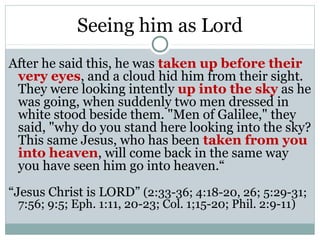
Seeing him as Lord
After he said this, he was taken up before their
 very eyes, and a cloud hid him from their sight.
 They were looking intently up into the sky as he
 was going, when suddenly two men dressed in
 white stood beside them. "Men of Galilee," they
 said, "why do you stand here looking into the sky?
 This same Jesus, who has been taken from you
 into heaven, will come back in the same way
 you have seen him go into heaven.“
“Jesus Christ is LORD” (2:33-36; 4:18-20, 26; 5:29-31;
 7:56; 9:5; Eph. 1:11, 20-23; Col. 1;15-20; Phil. 2:9-11)
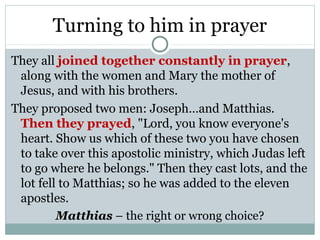
Turning to him in prayer
They all joined together constantly in prayer,
 along with the women and Mary the mother of
 Jesus, and with his brothers.
They proposed two men: Joseph…and Matthias.
 Then they prayed, "Lord, you know everyone's
 heart. Show us which of these two you have chosen
 to take over this apostolic ministry, which Judas left
 to go where he belongs." Then they cast lots, and the
 lot fell to Matthias; so he was added to the eleven
 apostles.
         Matthias – the right or wrong choice?
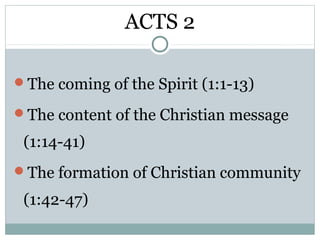
ACTS 2

The coming of the Spirit (1:1-13)

The content of the Christian message

 (1:14-41)
The formation of Christian community

 (1:42-47)
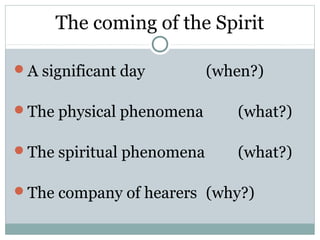
The coming of the Spirit

A significant day         (when?)

The physical phenomena       (what?)

The spiritual phenomena      (what?)

The company of hearers (why?)
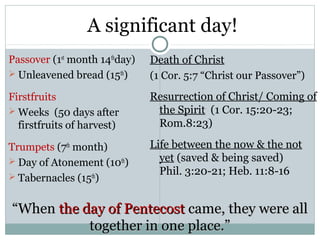
A significant day!
Passover (1st month 14thday)   Death of Christ
 Unleavened bread (15th)      (1 Cor. 5:7 “Christ our Passover”)

Firstfruits                    Resurrection of Christ/ Coming of
 Weeks (50 days after          the Spirit (1 Cor. 15:20-23;
  firstfruits of harvest)       Rom.8:23)

Trumpets (7th month)           Life between the now & the not
 Day of Atonement (10th)        yet (saved & being saved)
 Tabernacles (15th)
                                 Phil. 3:20-21; Heb. 11:8-16


“When the day of Pentecost came, they were all
           together in one place.”
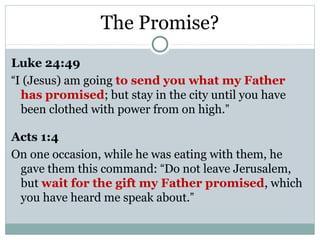
The Promise?
Luke 24:49
“I (Jesus) am going to send you what my Father
  has promised; but stay in the city until you have
  been clothed with power from on high.”

Acts 1:4
On one occasion, while he was eating with them, he
 gave them this command: “Do not leave Jerusalem,
 but wait for the gift my Father promised, which
 you have heard me speak about.”
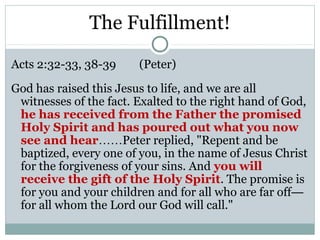
The Fulfillment!

Acts 2:32-33, 38-39     (Peter)

God has raised this Jesus to life, and we are all
 witnesses of the fact. Exalted to the right hand of God,
 he has received from the Father the promised
 Holy Spirit and has poured out what you now
 see and hear……Peter replied, "Repent and be
 baptized, every one of you, in the name of Jesus Christ
 for the forgiveness of your sins. And you will
 receive the gift of the Holy Spirit. The promise is
 for you and your children and for all who are far off—
 for all whom the Lord our God will call."
Galatians 3:14    (Paul)
He redeemed us in order that the blessing given to
 Abraham might come to the Gentiles through Jesus
 Christ, so that by faith we might receive the
 promise of the Spirit.
Ephesians 1:13
And you also were included in Christ when you heard
 the word of truth, the gospel of your salvation.
 Having believed, you were marked in him with a seal,
 the promised Holy Spirit.
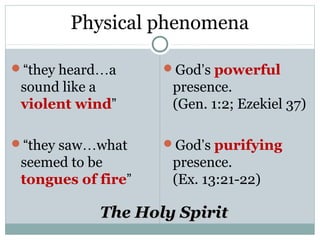
Physical phenomena

“they heard…a      God’s powerful
 sound like a        presence.
 violent wind”       (Gen. 1:2; Ezekiel 37)

“they saw…what     God’s purifying
 seemed to be        presence.
 tongues of fire”    (Ex. 13:21-22)

            The Holy Spirit
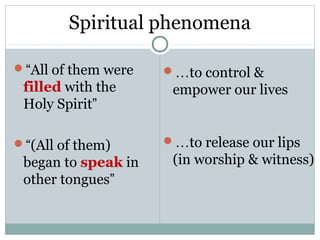
Spiritual phenomena

“All of them were   …to control &
 filled with the      empower our lives
 Holy Spirit”

“(All of them)      …to release our lips
 began to speak in    (in worship & witness)
 other tongues”
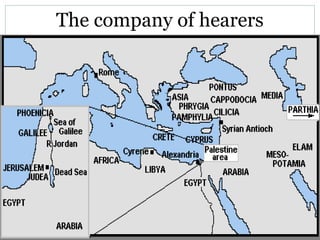
The company of hearers
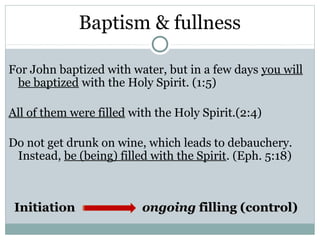
Baptism & fullness

For John baptized with water, but in a few days you will
 be baptized with the Holy Spirit. (1:5)

All of them were filled with the Holy Spirit.(2:4)

Do not get drunk on wine, which leads to debauchery.
 Instead, be (being) filled with the Spirit. (Eph. 5:18)


 Initiation               ongoing filling (control)
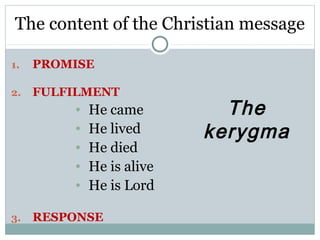
The content of the Christian message

1.   PROMISE

2.   FULFILMENT
         •   He came         The
         •   He lived      kerygma
         •   He died
         •   He is alive
         •   He is Lord

3.   RESPONSE
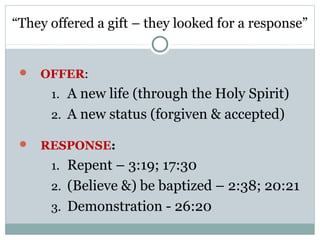
“They offered a gift – they looked for a response”


    OFFER:
      1. A new life (through the Holy Spirit)
      2. A new status (forgiven & accepted)

    RESPONSE:
      1. Repent – 3:19; 17:30
      2. (Believe &) be baptized – 2:38; 20:21
      3. Demonstration - 26:20
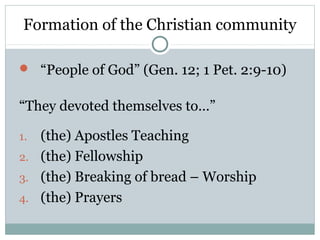
Formation of the Christian community

 “People of God” (Gen. 12; 1 Pet. 2:9-10)


“They devoted themselves to…”

1. (the) Apostles Teaching
2. (the) Fellowship
3. (the) Breaking of bread – Worship
4. (the) Prayers
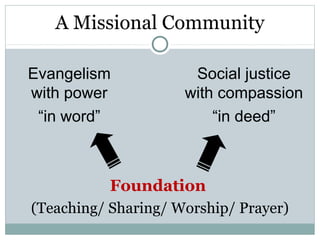
A Missional Community

Evangelism            Social justice
with power           with compassion
 “in word”               “in deed”


           Foundation
(Teaching/ Sharing/ Worship/ Prayer)
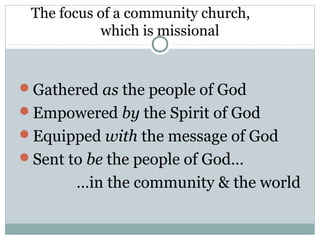
The focus of a community church,
           which is missional


Gathered as the people of God
Empowered by the Spirit of God
Equipped with the message of God
Sent to be the people of God…
       …in the community & the world
ACTS 3

A community of word & power

  The ongoing ministry of Jesus
      through his followers
 (“The ACTS of the APOSTLES”)
ACTS 1:1-2

“In my former book… I wrote about all that Jesus
  began to do and to teach until the day he was taken
  up to heaven…”
JOHN 14:12-14

“I tell you the truth, anyone who has faith in me will
  do what I have been doing. He will do even greater
  things than these, because I am going to the Father.
  And I will do whatever you ask in my name, so that
  the Son may bring glory to the Father. You may ask
  me for anything in my name, and I will do it.”
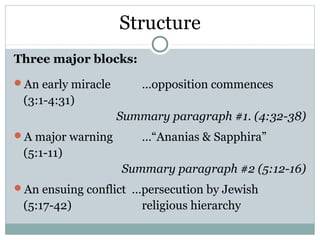
Structure
Three major blocks:
An early miracle       …opposition commences
 (3:1-4:31)
                    Summary paragraph #1. (4:32-38)
A major warning        …“Ananias & Sapphira”
 (5:1-11)
                    Summary paragraph #2 (5:12-16)
An ensuing conflict …persecution by Jewish
 (5:17-42)              religious hierarchy
What precisely did Jesus do?

A reminder:
“Jesus of Nazareth was a man
 accredited by God to you by
 miracles, wonders and signs,
 which God did among you through
 him.” (Acts 2:22)
Isaiah 61/ Luke 4
“The Spirit of the Lord is on me,
      because he has anointed me
            to announce good news to the poor.
      He has sent me to
            proclaim to the prisoners - freedom
                  and to the blind - recovery of sight
            to release the oppressed – into freedom,
            to proclaim the year of the Lord's favor”
The ministry of Jesus (Lk. 4:40-44)

Word               Deed

Teaching           Healing &
                     deliverance
Revelation by      Actions of the
 the Spirit          Spirit
Parable            Miracle
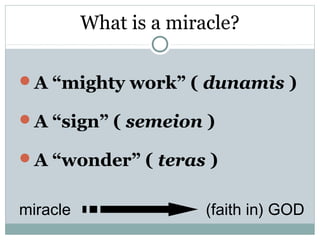
What is a miracle?

A “mighty work” ( dunamis )

A “sign” ( semeion )

A “wonder” ( teras )


miracle                 (faith in) GOD
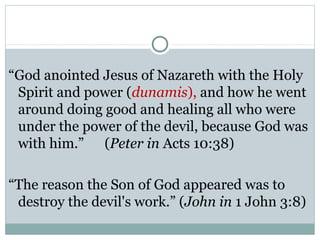
“God anointed Jesus of Nazareth with the Holy
 Spirit and power (dunamis), and how he went
 around doing good and healing all who were
 under the power of the devil, because God was
 with him.” (Peter in Acts 10:38)

“The reason the Son of God appeared was to
 destroy the devil's work.” (John in 1 John 3:8)
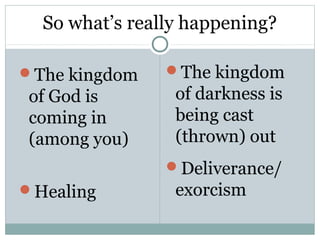
So what’s really happening?

The kingdom    The kingdom
of God is        of darkness is
coming in        being cast
(among you)      (thrown) out
                Deliverance/
Healing         exorcism
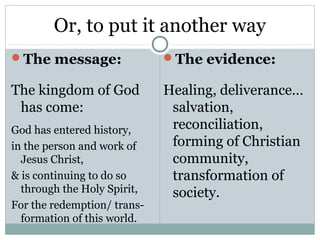
Or, to put it another way
The message:                The evidence:

The kingdom of God           Healing, deliverance…
 has come:                    salvation,
God has entered history,      reconciliation,
in the person and work of     forming of Christian
  Jesus Christ,               community,
& is continuing to do so      transformation of
  through the Holy Spirit,    society.
For the redemption/ trans-
  formation of this world.
Christians - Power to heal?


“Everyone was filled with awe, and
 many wonders and miraculous signs
 were done by the apostles.”
       (Summary by Peter, Acts 2:43)
Remember their experience with Jesus

"When Jesus had called the Twelve together,
 he gave them power and authority to drive
 out all demons and to cure diseases, and he
 sent them out (two by two) to preach the
 kingdom of God and to heal the sick...So they
 set out and went from village to village,
 preaching the gospel and healing people
 everywhere."
     Luke 9:1-6 (cf. Mark 6, Matthew 10)
A specific example (Acts 3)


The location & setting


The (actual) miracle


The reactions
Reactions…

Faithful preaching of the message

Opposition from religious hierarchy

Great stimulation to prayer

Christians living in the fear of God

Compassionate generousity and miraculous
 ministry “in the name of Jesus”
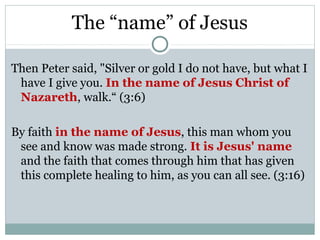
The “name” of Jesus

Then Peter said, "Silver or gold I do not have, but what I
 have I give you. In the name of Jesus Christ of
 Nazareth, walk.“ (3:6)

By faith in the name of Jesus, this man whom you
 see and know was made strong. It is Jesus' name
 and the faith that comes through him that has given
 this complete healing to him, as you can all see. (3:16)
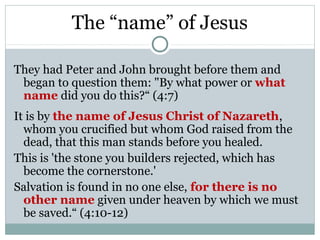
The “name” of Jesus

They had Peter and John brought before them and
 began to question them: "By what power or what
 name did you do this?“ (4:7)
It is by the name of Jesus Christ of Nazareth,
  whom you crucified but whom God raised from the
  dead, that this man stands before you healed.
This is 'the stone you builders rejected, which has
  become the cornerstone.'
Salvation is found in no one else, for there is no
  other name given under heaven by which we must
  be saved.“ (4:10-12)
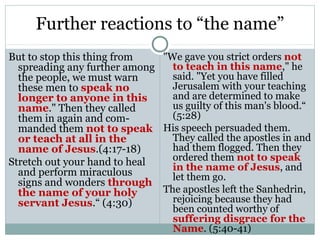
Further reactions to “the name”
But to stop this thing from   "We gave you strict orders not
  spreading any further among   to teach in this name," he
  the people, we must warn      said. "Yet you have filled
  these men to speak no         Jerusalem with your teaching
  longer to anyone in this      and are determined to make
  name." Then they called       us guilty of this man's blood.“
  them in again and com-        (5:28)
  manded them not to speak His speech persuaded them.
  or teach at all in the        They called the apostles in and
  name of Jesus.(4:17-18)       had them flogged. Then they
Stretch out your hand to heal   ordered them not to speak
                                in the name of Jesus, and
  and perform miraculous        let them go.
  signs and wonders through
  the name of your holy       The apostles left the Sanhedrin,
  servant Jesus.“ (4:30)        rejoicing because they had
                                been counted worthy of
                                suffering disgrace for the
                                Name. (5:40-41)
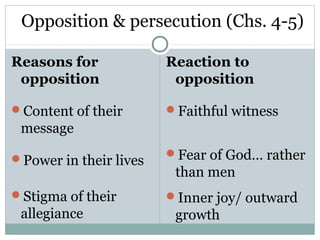
Opposition & persecution (Chs. 4-5)

Reasons for             Reaction to
 opposition              opposition

Content of their       Faithful witness
 message

Power in their lives   Fear of God… rather
                         than men
Stigma of their        Inner joy/ outward
 allegiance              growth
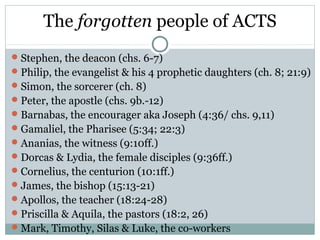
The forgotten people of ACTS
 Stephen, the deacon (chs. 6-7)
 Philip, the evangelist & his 4 prophetic daughters (ch. 8; 21:9)
 Simon, the sorcerer (ch. 8)
 Peter, the apostle (chs. 9b.-12)
 Barnabas, the encourager aka Joseph (4:36/ chs. 9,11)
 Gamaliel, the Pharisee (5:34; 22:3)
 Ananias, the witness (9:10ff.)
 Dorcas & Lydia, the female disciples (9:36ff.)
 Cornelius, the centurion (10:1ff.)
 James, the bishop (15:13-21)
 Apollos, the teacher (18:24-28)
 Priscilla & Aquila, the pastors (18:2, 26)
 Mark, Timothy, Silas & Luke, the co-workers
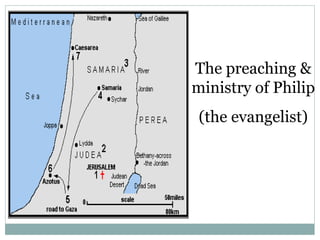
The preaching &
ministry of Philip
 (the evangelist)
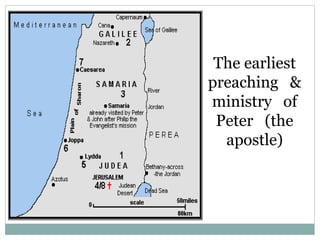
The earliest
preaching &
ministry of
 Peter (the
  apostle)
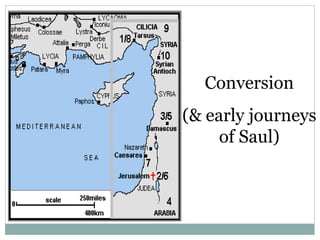
Conversion
(& early journeys
     of Saul)
Paul: The missionary
Paul’s three (post-conversion) convictions:

1.   His whole previous way of life lay under the
     rebuke of God (Phil. 3:4-11)
2. The Jesus whom he had been persecuting
     was the Son of God, truly alive and in
     ultimate control (1 Cor. 15; Col. 1:15-20)
3. He (Paul) had been called to take this
     message to the world (Gal. 1:1, 13-17)
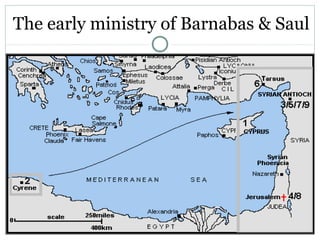
The early ministry of Barnabas & Saul
Antioch: The missionary church

They were a…

1. Worshipping church

2. Waiting church

3. Willing church       (Ch. 13:1-3)
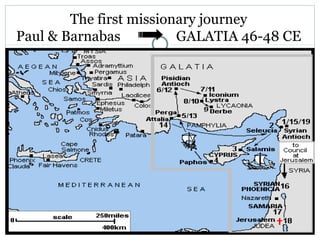
The first missionary journey
Paul & Barnabas          GALATIA 46-48 CE
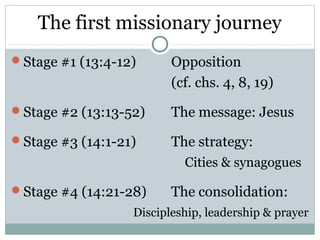
The first missionary journey
Stage #1 (13:4-12)      Opposition
                         (cf. chs. 4, 8, 19)
Stage #2 (13:13-52)     The message: Jesus
Stage #3 (14:1-21)      The strategy:
                           Cities & synagogues

Stage #4 (14:21-28)     The consolidation:
                  Discipleship, leadership & prayer
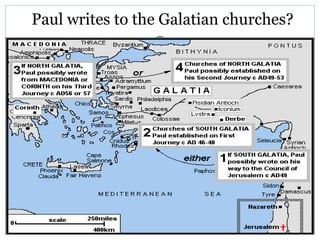
Paul writes to the Galatian churches?
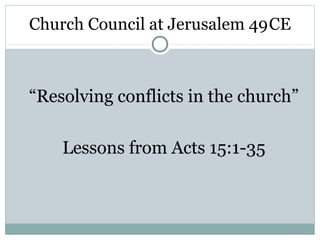
Church Council at Jerusalem 49 CE


“Resolving conflicts in the church”

    Lessons from Acts 15:1-35
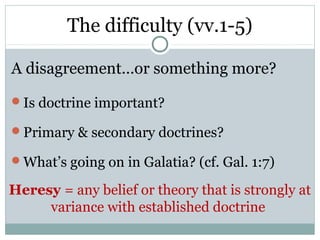
The difficulty (vv.1-5)

A disagreement…or something more?
Is doctrine important?

Primary & secondary doctrines?

What’s going on in Galatia? (cf. Gal. 1:7)

Heresy = any belief or theory that is strongly at
     variance with established doctrine
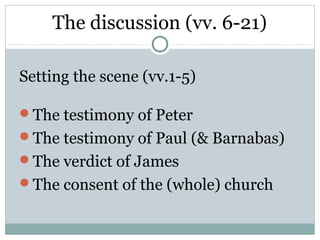
The discussion (vv. 6-21)

Setting the scene (vv.1-5)

The testimony of Peter
The testimony of Paul (& Barnabas)
The verdict of James
The consent of the (whole) church
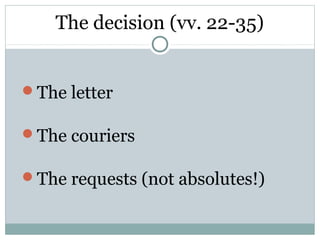
The decision (vv. 22-35)


The letter

The couriers

The requests (not absolutes!)
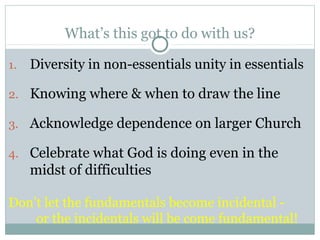
What’s this got to do with us?

1.   Diversity in non-essentials unity in essentials

2. Knowing where & when to draw the line

3. Acknowledge dependence on larger Church

4. Celebrate what God is doing even in the
     midst of difficulties

Don’t let the fundamentals become incidental -
    or the incidentals will be come fundamental!
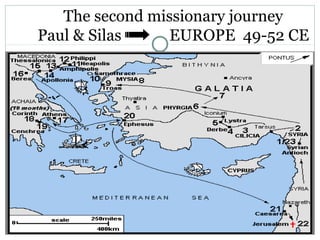
The second missionary journey
Paul & Silas     EUROPE 49-52 CE
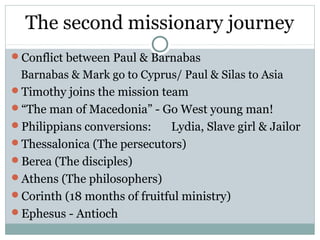
The second missionary journey
Conflict between Paul & Barnabas
 Barnabas & Mark go to Cyprus/ Paul & Silas to Asia
Timothy joins the mission team
“The man of Macedonia” - Go West young man!
Philippians conversions:    Lydia, Slave girl & Jailor
Thessalonica (The persecutors)
Berea (The disciples)
Athens (The philosophers)
Corinth (18 months of fruitful ministry)
Ephesus - Antioch
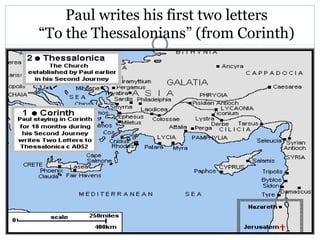
Paul writes his first two letters
“To the Thessalonians” (from Corinth)
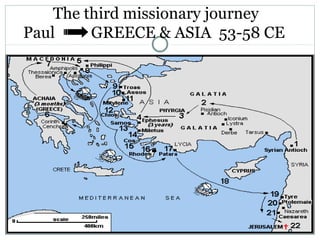
The third missionary journey
Paul     GREECE & ASIA 53-58 CE
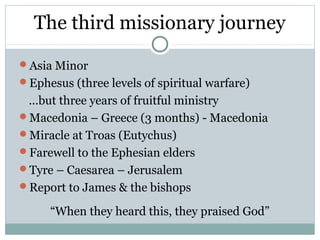
The third missionary journey
Asia Minor
Ephesus (three levels of spiritual warfare)
 …but three years of fruitful ministry
Macedonia – Greece (3 months) - Macedonia
Miracle at Troas (Eutychus)
Farewell to the Ephesian elders
Tyre – Caesarea – Jerusalem
Report to James & the bishops

     “When they heard this, they praised God”
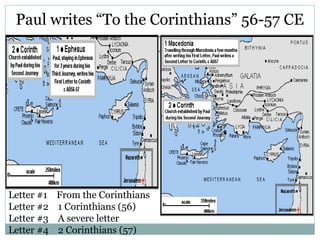
Paul writes “To the Corinthians” 56-57 CE


Letter #1   From the Corinthians
Letter #2   1 Corinthians (56)
Letter #3   A severe letter
Letter #4   2 Corinthians (57)
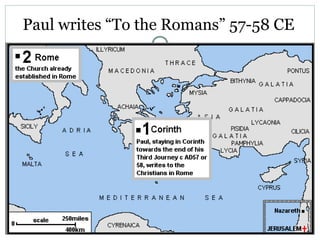
Paul writes “To the Romans” 57-58 CE
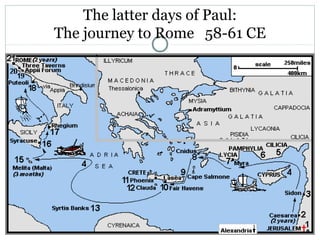
The latter days of Paul:
The journey to Rome 58-61 CE
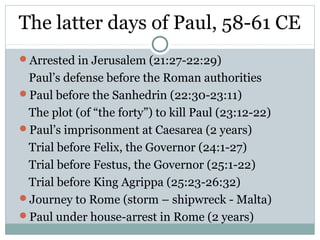
The latter days of Paul, 58-61 CE
Arrested in Jerusalem (21:27-22:29)
 Paul’s defense before the Roman authorities
Paul before the Sanhedrin (22:30-23:11)
 The plot (of “the forty”) to kill Paul (23:12-22)
Paul’s imprisonment at Caesarea (2 years)
 Trial before Felix, the Governor (24:1-27)
 Trial before Festus, the Governor (25:1-22)
 Trial before King Agrippa (25:23-26:32)
Journey to Rome (storm – shipwreck - Malta)
Paul under house-arrest in Rome (2 years)
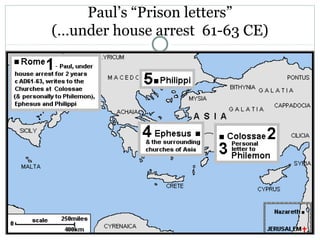
Paul’s “Prison letters”
(…under house arrest 61-63 CE)
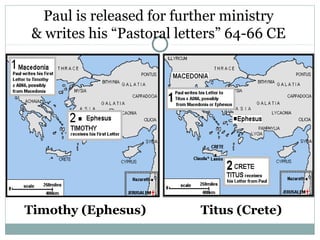
Paul is released for further ministry
& writes his “Pastoral letters” 64-66 CE


Timothy (Ephesus)         Titus (Crete)
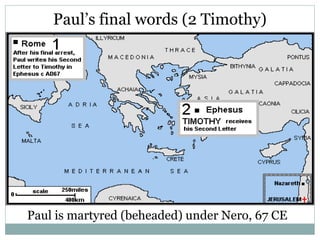
Paul’s final words (2 Timothy)


Paul is martyred (beheaded) under Nero, 67 CE

NT Session 3 Acts

  • 1.
    Foundations (Year Two) “Encounteringthe New Testament” Session #3. Encountering ACTS
  • 2.
    Written earlier: The NT Writings Letter of James (40’s/50’s) Letters of Paul: Written later: Galatians (48/49 CE) Letters of Peter (64-66) 1 & 2 Thessalonians (51-52) Mark (68-70 ) 1 & 2 Corinthians (53-57) Matthew (70-80) Romans (56-57) Luke-Acts (70-80) Prison letters (61-62): Hebrews (50’s/60’s?) (Colossians, Ephesians, Philemon & Philippians) Letter of Jude (50’s ?) Pastoral letters (64-66): Writings of John: (1, 2 Timothy & Titus) Gospel, Letters & Revelation (90-96)
  • 3.
    “The spreading flame” -the message of the book of ACTS
  • 4.
    The author Luke, thehistorian Luke, the theologian Luke, the evangelist Luke, the missionary
  • 5.
    The book Compiled overmany months (even years) Written in Greek (for primarily Greek speaking world) Possibly written (compiled) from Rome Later designated, simply “ACTS” A second volume (LUKE-ACTS)
  • 6.
    Luke’s purpose –a reminder “In my former book… I wrote about all that Jesus began to do and to teach until the day he was taken up to heaven” (Acts 1:1-2) (see Luke 1:1-4)
  • 7.
    Luke - Acts Howthe good news How the good news started spread “all that Jesus began..” “all that Jesus Establishment of continued..” salvation Proclamation of Redemptive salvation Local, limited & brief Evangelistic Universal, without Coming of salvation to boundaries & prolonged Jews Spread of salvation to Record of Jesus as Gentiles Christ/ Messiah Preaching of Jesus as Lord
  • 8.
    The Theology ofACTS God’s continuing purpose in history (2:23; 3:18; 4:28) A new message & a new mandate (5:20) The emergence of the Church as the people of God (Matthew 16:18) The centrality of the Holy Spirit (Jn. 8:39)
  • 9.
    ACTS – anoutline Introduction & background 1 (a) Coming of Spirit/ beginning of Church 2-5 …Glimpses into God’s new society (Peter & John) (b) Opposition: Stephen the deacon 6-8 Persecution: Philip the evangelist Expectation: Peter the apostle 9-12 (c) Conversion & ministry of Saul/ Paul the apostle 9 First missionary journey 13-14 (Church Council at Jerusalem) 15 Second missionary journey 15-18 Third missionary journey. 18-21 Latter days of Paul 21-28
  • 10.
    ACTS 1 Waiting &Expectation
  • 11.
    Waiting for thepromise More about Jesus: Proof that he’s alive (v.3a) Teaching about his kingdom (v.3b) Waiting for his power (vv.4-5) Hearing his commission (vv.7-8) Seeing him as Lord (vv.9-11) Turning to him in prayer (vv. 12-26)
  • 12.
    Proof that he’salive “After his suffering, he presented himself to them and gave many convincing proofs that he was alive.” (cf. 1 Cor. 15:3-8) “witnesses of his resurrection” (1:22; 4:2, 33; 17:18; 24:21)
  • 13.
    Teaching about hiskingdom “He appeared to them over a period of forty days and spoke about the kingdom of God.” (cf. Daniel 2:44; Isaiah 2:1-5; Ezekiel 7:24ff. - Matt.3:17; Mark 1:15; Luke 4:18-19) “The now & the not yet”
  • 14.
    Waiting for hispower On one occasion, while he was eating with them, he gave them this command: “Do not leave Jerusalem, but wait for the gift my Father promised, which you have heard me speak about. For John baptized with water, but in a few days you will be baptized with the Holy Spirit”… and you will receive power when the Holy Spirit comes on you. (cf. Luke 24:49; Jn. 14:15-27; 15:26-27; 16:5-16)
  • 15.
    Hearing his commission Jerusalem It is not for you to Judea/ Samaria know … But you will receive power… And you will be my witnesses… Ends of the earth
  • 16.
    Alternative structure tothe book “You will receive power when the Holy Spirit comes on you and you will be my witnesses… In Jerusalem… (2:1-4, 33) In all Judea & Samaria… (8:14-17) To the ends of the earth.” Saul (9:17-18) Cornelius (10:44-47) Ephesians (19:1-7)
  • 17.
    Seeing him asLord After he said this, he was taken up before their very eyes, and a cloud hid him from their sight. They were looking intently up into the sky as he was going, when suddenly two men dressed in white stood beside them. "Men of Galilee," they said, "why do you stand here looking into the sky? This same Jesus, who has been taken from you into heaven, will come back in the same way you have seen him go into heaven.“ “Jesus Christ is LORD” (2:33-36; 4:18-20, 26; 5:29-31; 7:56; 9:5; Eph. 1:11, 20-23; Col. 1;15-20; Phil. 2:9-11)
  • 18.
    Turning to himin prayer They all joined together constantly in prayer, along with the women and Mary the mother of Jesus, and with his brothers. They proposed two men: Joseph…and Matthias. Then they prayed, "Lord, you know everyone's heart. Show us which of these two you have chosen to take over this apostolic ministry, which Judas left to go where he belongs." Then they cast lots, and the lot fell to Matthias; so he was added to the eleven apostles. Matthias – the right or wrong choice?
  • 19.
    ACTS 2 The comingof the Spirit (1:1-13) The content of the Christian message (1:14-41) The formation of Christian community (1:42-47)
  • 20.
    The coming ofthe Spirit A significant day (when?) The physical phenomena (what?) The spiritual phenomena (what?) The company of hearers (why?)
  • 21.
    A significant day! Passover(1st month 14thday) Death of Christ  Unleavened bread (15th) (1 Cor. 5:7 “Christ our Passover”) Firstfruits Resurrection of Christ/ Coming of  Weeks (50 days after the Spirit (1 Cor. 15:20-23; firstfruits of harvest) Rom.8:23) Trumpets (7th month) Life between the now & the not  Day of Atonement (10th) yet (saved & being saved)  Tabernacles (15th) Phil. 3:20-21; Heb. 11:8-16 “When the day of Pentecost came, they were all together in one place.”
  • 22.
    The Promise? Luke 24:49 “I(Jesus) am going to send you what my Father has promised; but stay in the city until you have been clothed with power from on high.” Acts 1:4 On one occasion, while he was eating with them, he gave them this command: “Do not leave Jerusalem, but wait for the gift my Father promised, which you have heard me speak about.”
  • 23.
    The Fulfillment! Acts 2:32-33,38-39 (Peter) God has raised this Jesus to life, and we are all witnesses of the fact. Exalted to the right hand of God, he has received from the Father the promised Holy Spirit and has poured out what you now see and hear……Peter replied, "Repent and be baptized, every one of you, in the name of Jesus Christ for the forgiveness of your sins. And you will receive the gift of the Holy Spirit. The promise is for you and your children and for all who are far off— for all whom the Lord our God will call."
  • 24.
    Galatians 3:14 (Paul) He redeemed us in order that the blessing given to Abraham might come to the Gentiles through Jesus Christ, so that by faith we might receive the promise of the Spirit. Ephesians 1:13 And you also were included in Christ when you heard the word of truth, the gospel of your salvation. Having believed, you were marked in him with a seal, the promised Holy Spirit.
  • 25.
    Physical phenomena “they heard…a God’s powerful sound like a presence. violent wind” (Gen. 1:2; Ezekiel 37) “they saw…what God’s purifying seemed to be presence. tongues of fire” (Ex. 13:21-22) The Holy Spirit
  • 26.
    Spiritual phenomena “All ofthem were …to control & filled with the empower our lives Holy Spirit” “(All of them) …to release our lips began to speak in (in worship & witness) other tongues”
  • 27.
  • 28.
    Baptism & fullness ForJohn baptized with water, but in a few days you will be baptized with the Holy Spirit. (1:5) All of them were filled with the Holy Spirit.(2:4) Do not get drunk on wine, which leads to debauchery. Instead, be (being) filled with the Spirit. (Eph. 5:18) Initiation ongoing filling (control)
  • 29.
    The content ofthe Christian message 1. PROMISE 2. FULFILMENT • He came The • He lived kerygma • He died • He is alive • He is Lord 3. RESPONSE
  • 30.
    “They offered agift – they looked for a response”  OFFER: 1. A new life (through the Holy Spirit) 2. A new status (forgiven & accepted)  RESPONSE: 1. Repent – 3:19; 17:30 2. (Believe &) be baptized – 2:38; 20:21 3. Demonstration - 26:20
  • 31.
    Formation of theChristian community  “People of God” (Gen. 12; 1 Pet. 2:9-10) “They devoted themselves to…” 1. (the) Apostles Teaching 2. (the) Fellowship 3. (the) Breaking of bread – Worship 4. (the) Prayers
  • 32.
    A Missional Community Evangelism Social justice with power with compassion “in word” “in deed” Foundation (Teaching/ Sharing/ Worship/ Prayer)
  • 33.
    The focus ofa community church, which is missional Gathered as the people of God Empowered by the Spirit of God Equipped with the message of God Sent to be the people of God… …in the community & the world
  • 34.
    ACTS 3 A communityof word & power The ongoing ministry of Jesus through his followers (“The ACTS of the APOSTLES”)
  • 35.
    ACTS 1:1-2 “In myformer book… I wrote about all that Jesus began to do and to teach until the day he was taken up to heaven…” JOHN 14:12-14 “I tell you the truth, anyone who has faith in me will do what I have been doing. He will do even greater things than these, because I am going to the Father. And I will do whatever you ask in my name, so that the Son may bring glory to the Father. You may ask me for anything in my name, and I will do it.”
  • 36.
    Structure Three major blocks: Anearly miracle …opposition commences (3:1-4:31) Summary paragraph #1. (4:32-38) A major warning …“Ananias & Sapphira” (5:1-11) Summary paragraph #2 (5:12-16) An ensuing conflict …persecution by Jewish (5:17-42) religious hierarchy
  • 37.
    What precisely didJesus do? A reminder: “Jesus of Nazareth was a man accredited by God to you by miracles, wonders and signs, which God did among you through him.” (Acts 2:22)
  • 38.
    Isaiah 61/ Luke4 “The Spirit of the Lord is on me, because he has anointed me to announce good news to the poor. He has sent me to proclaim to the prisoners - freedom and to the blind - recovery of sight to release the oppressed – into freedom, to proclaim the year of the Lord's favor”
  • 39.
    The ministry ofJesus (Lk. 4:40-44) Word Deed Teaching Healing & deliverance Revelation by Actions of the the Spirit Spirit Parable Miracle
  • 40.
    What is amiracle? A “mighty work” ( dunamis ) A “sign” ( semeion ) A “wonder” ( teras ) miracle (faith in) GOD
  • 41.
    “God anointed Jesusof Nazareth with the Holy Spirit and power (dunamis), and how he went around doing good and healing all who were under the power of the devil, because God was with him.” (Peter in Acts 10:38) “The reason the Son of God appeared was to destroy the devil's work.” (John in 1 John 3:8)
  • 42.
    So what’s reallyhappening? The kingdom The kingdom of God is of darkness is coming in being cast (among you) (thrown) out Deliverance/ Healing exorcism
  • 43.
    Or, to putit another way The message: The evidence: The kingdom of God Healing, deliverance… has come: salvation, God has entered history, reconciliation, in the person and work of forming of Christian Jesus Christ, community, & is continuing to do so transformation of through the Holy Spirit, society. For the redemption/ trans- formation of this world.
  • 44.
    Christians - Powerto heal? “Everyone was filled with awe, and many wonders and miraculous signs were done by the apostles.” (Summary by Peter, Acts 2:43)
  • 45.
    Remember their experiencewith Jesus "When Jesus had called the Twelve together, he gave them power and authority to drive out all demons and to cure diseases, and he sent them out (two by two) to preach the kingdom of God and to heal the sick...So they set out and went from village to village, preaching the gospel and healing people everywhere." Luke 9:1-6 (cf. Mark 6, Matthew 10)
  • 46.
    A specific example(Acts 3) The location & setting The (actual) miracle The reactions
  • 47.
    Reactions… Faithful preaching ofthe message Opposition from religious hierarchy Great stimulation to prayer Christians living in the fear of God Compassionate generousity and miraculous ministry “in the name of Jesus”
  • 48.
    The “name” ofJesus Then Peter said, "Silver or gold I do not have, but what I have I give you. In the name of Jesus Christ of Nazareth, walk.“ (3:6) By faith in the name of Jesus, this man whom you see and know was made strong. It is Jesus' name and the faith that comes through him that has given this complete healing to him, as you can all see. (3:16)
  • 49.
    The “name” ofJesus They had Peter and John brought before them and began to question them: "By what power or what name did you do this?“ (4:7) It is by the name of Jesus Christ of Nazareth, whom you crucified but whom God raised from the dead, that this man stands before you healed. This is 'the stone you builders rejected, which has become the cornerstone.' Salvation is found in no one else, for there is no other name given under heaven by which we must be saved.“ (4:10-12)
  • 50.
    Further reactions to“the name” But to stop this thing from "We gave you strict orders not spreading any further among to teach in this name," he the people, we must warn said. "Yet you have filled these men to speak no Jerusalem with your teaching longer to anyone in this and are determined to make name." Then they called us guilty of this man's blood.“ them in again and com- (5:28) manded them not to speak His speech persuaded them. or teach at all in the They called the apostles in and name of Jesus.(4:17-18) had them flogged. Then they Stretch out your hand to heal ordered them not to speak in the name of Jesus, and and perform miraculous let them go. signs and wonders through the name of your holy The apostles left the Sanhedrin, servant Jesus.“ (4:30) rejoicing because they had been counted worthy of suffering disgrace for the Name. (5:40-41)
  • 51.
    Opposition & persecution(Chs. 4-5) Reasons for Reaction to opposition opposition Content of their Faithful witness message Power in their lives Fear of God… rather than men Stigma of their Inner joy/ outward allegiance growth
  • 52.
    The forgotten peopleof ACTS  Stephen, the deacon (chs. 6-7)  Philip, the evangelist & his 4 prophetic daughters (ch. 8; 21:9)  Simon, the sorcerer (ch. 8)  Peter, the apostle (chs. 9b.-12)  Barnabas, the encourager aka Joseph (4:36/ chs. 9,11)  Gamaliel, the Pharisee (5:34; 22:3)  Ananias, the witness (9:10ff.)  Dorcas & Lydia, the female disciples (9:36ff.)  Cornelius, the centurion (10:1ff.)  James, the bishop (15:13-21)  Apollos, the teacher (18:24-28)  Priscilla & Aquila, the pastors (18:2, 26)  Mark, Timothy, Silas & Luke, the co-workers
  • 53.
    The preaching & ministryof Philip (the evangelist)
  • 54.
    The earliest preaching & ministryof Peter (the apostle)
  • 55.
  • 56.
    Paul: The missionary Paul’sthree (post-conversion) convictions: 1. His whole previous way of life lay under the rebuke of God (Phil. 3:4-11) 2. The Jesus whom he had been persecuting was the Son of God, truly alive and in ultimate control (1 Cor. 15; Col. 1:15-20) 3. He (Paul) had been called to take this message to the world (Gal. 1:1, 13-17)
  • 57.
    The early ministryof Barnabas & Saul
  • 58.
    Antioch: The missionarychurch They were a… 1. Worshipping church 2. Waiting church 3. Willing church (Ch. 13:1-3)
  • 59.
    The first missionaryjourney Paul & Barnabas GALATIA 46-48 CE
  • 60.
    The first missionaryjourney Stage #1 (13:4-12) Opposition (cf. chs. 4, 8, 19) Stage #2 (13:13-52) The message: Jesus Stage #3 (14:1-21) The strategy: Cities & synagogues Stage #4 (14:21-28) The consolidation: Discipleship, leadership & prayer
  • 61.
    Paul writes tothe Galatian churches?
  • 62.
    Church Council atJerusalem 49 CE “Resolving conflicts in the church” Lessons from Acts 15:1-35
  • 63.
    The difficulty (vv.1-5) Adisagreement…or something more? Is doctrine important? Primary & secondary doctrines? What’s going on in Galatia? (cf. Gal. 1:7) Heresy = any belief or theory that is strongly at variance with established doctrine
  • 64.
    The discussion (vv.6-21) Setting the scene (vv.1-5) The testimony of Peter The testimony of Paul (& Barnabas) The verdict of James The consent of the (whole) church
  • 65.
    The decision (vv.22-35) The letter The couriers The requests (not absolutes!)
  • 66.
    What’s this gotto do with us? 1. Diversity in non-essentials unity in essentials 2. Knowing where & when to draw the line 3. Acknowledge dependence on larger Church 4. Celebrate what God is doing even in the midst of difficulties Don’t let the fundamentals become incidental - or the incidentals will be come fundamental!
  • 67.
    The second missionaryjourney Paul & Silas EUROPE 49-52 CE
  • 68.
    The second missionaryjourney Conflict between Paul & Barnabas Barnabas & Mark go to Cyprus/ Paul & Silas to Asia Timothy joins the mission team “The man of Macedonia” - Go West young man! Philippians conversions: Lydia, Slave girl & Jailor Thessalonica (The persecutors) Berea (The disciples) Athens (The philosophers) Corinth (18 months of fruitful ministry) Ephesus - Antioch
  • 69.
    Paul writes hisfirst two letters “To the Thessalonians” (from Corinth)
  • 70.
    The third missionaryjourney Paul GREECE & ASIA 53-58 CE
  • 71.
    The third missionaryjourney Asia Minor Ephesus (three levels of spiritual warfare) …but three years of fruitful ministry Macedonia – Greece (3 months) - Macedonia Miracle at Troas (Eutychus) Farewell to the Ephesian elders Tyre – Caesarea – Jerusalem Report to James & the bishops “When they heard this, they praised God”
  • 72.
    Paul writes “Tothe Corinthians” 56-57 CE Letter #1 From the Corinthians Letter #2 1 Corinthians (56) Letter #3 A severe letter Letter #4 2 Corinthians (57)
  • 73.
    Paul writes “Tothe Romans” 57-58 CE
  • 74.
    The latter daysof Paul: The journey to Rome 58-61 CE
  • 75.
    The latter daysof Paul, 58-61 CE Arrested in Jerusalem (21:27-22:29) Paul’s defense before the Roman authorities Paul before the Sanhedrin (22:30-23:11) The plot (of “the forty”) to kill Paul (23:12-22) Paul’s imprisonment at Caesarea (2 years) Trial before Felix, the Governor (24:1-27) Trial before Festus, the Governor (25:1-22) Trial before King Agrippa (25:23-26:32) Journey to Rome (storm – shipwreck - Malta) Paul under house-arrest in Rome (2 years)
  • 76.
  • 77.
    Paul is releasedfor further ministry & writes his “Pastoral letters” 64-66 CE Timothy (Ephesus) Titus (Crete)
  • 78.
    Paul’s final words(2 Timothy) Paul is martyred (beheaded) under Nero, 67 CE