OVERVIEW
1) Concept of Curriculum
2) Types of Curriculum
1) Official 2) Formal 3) Informal
3) Factors Influencing Curriculum Change
• Technological Development
• Current Needs/Security
• Government Policies
• Culture
• Knowledge development and its importance
Dr. Chin Mei Chin 2018
RECAP
What do you understand by the word “Curriculum”?
Etymology:
Classical Latin
Currere = to run
Curriculum = fast chariot / running / course (race course)
Curriculum encompasses all planned and unplanned experiences that
is provided in an education institution like school, institute,
polytechnic, college, university, etc.
Curriculum is a framework that shapes and guides the teaching
learning process.
Curriculum is a kind of road map that is given to teachers to follow
through.
Difference between Syllabus and Curriculum
A syllabus (Greek word) is your guide to a course/subject and what will be expected
of you in the course/subject.
Refer to your RMK
Generally, it includes a description of the:
topics covered, rationale, objectives, learning outcomes, required texts, policies,
rules and regulations, and a schedule of assignments.
Curriculum has a wider scope which covers the knowledge, attitude,
behaviour, manner, performance and skills that are imparted or inculcated
in a student.
It refers to a more comprehensive educational package involving the
conceptualization, planning, designing and detailing of a comprehensive
learning program in schools.
A subject syllabus is a unit of the curriculum.
Dr. Chin Mei Chin 2018
According to Assoc. Prof. Suseela and Prof. MacBeath
of the Commonwealth Education Trust:
• Curriculum is a plan of action for learning.
• It is a formal written document that systematically describes the course
of study that is appropriate with the educational level.
• It includes all the different subjects, courses, learning objectives, skills,
knowledge and values that need to be instilled in students.
• It consists of the content learning outcomes or experiences and
evaluation formats and procedures.
Source: https://www.coursera.org/learn/teacher-curriculum/lecture/E3qXv/lecture-1-the-concept-of-curriculum
What are the Characteristics of a Curriculum?
EXAMPLE:
The
National Curriculum
in Malaysia
Dr. Chin Mei Chin 2018
• The Malaysian national education system is built with a
mission to serve the needs of the nation.
• The needs of the nation and how they will be achieved
are found in the Education Act 1996 (Act 550).
• The Education Act 1996 describes the national education
system and national policy on education based on the
National Philosophy of Education.
• The Education Act 1996 stipulates that primary schools
under the national education system must use the
national curriculum for primary schools.
Source: http://www.espact.com.my
Dr. Chin Mei Chin 2018
“The National Curriculum is an educational
programme that includes
curriculum and co-curricular activities
which encompasses all the
knowledge, skills, norms,
values, cultural elements and beliefs
to help develop a pupil fully with respect to the
physical, spiritual, mental and emotional aspects
as well as to inculcate and develop desirable
moral values and to transmit knowledge.”
Education Act 1996
[ Education (National Curriculum) Regulation 1997 ]
Dr. Chin Mei Chin 2018
29 August 2018:
Educational Professionalism Seminar for Young Teachers
Dr. Maszlee: Character Building to Complement
3R Learning in Primary Schools
Education Minister Dr Maszlee Malik wants teachers to play a pivotal role in
inculcating good values in students in addition to teaching them the 3Rs (reading,
writing and arithmetic).
He said good values will become the fourth R in the system for character building
(manusiawi) which should begin from primary school.
"In some countries, such as Finland for instance, it is a crime for teachers to even
conduct exams from primary to Form Three. This is because this period is used to
build the characters of the students," Dr Maszlee said.
Source: https://www.thestar.com.my/news/nation/2018/08/29/maszlee-character-building-to-complement-3r-learning-in-primary-schools/#M2CCjJqBuLFfUY5W.99
WHY is Character Building emphasised?
Dr. Chin Mei Chin 2018
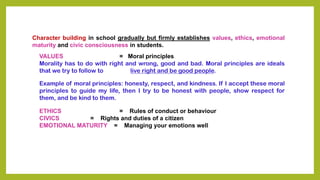
Character building in school gradually but firmly establishes values, ethics, emotional
maturity and civic consciousness in students.
VALUES = Moral principles
Morality has to do with right and wrong, good and bad. Moral principles are ideals
that we try to follow to live right and be good people.
Example of moral principles: honesty, respect, and kindness. If I accept these moral
principles to guide my life, then I try to be honest with people, show respect for
them, and be kind to them.
ETHICS = Rules of conduct or behaviour
CIVICS = Rights and duties of a citizen
EMOTIONAL MATURITY = Managing your emotions well
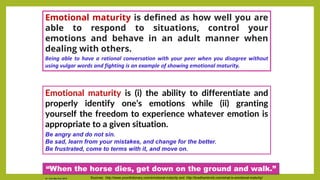
Emotional maturity is (i) the ability to differentiate and
properly identify one’s emotions while (ii) granting
yourself the freedom to experience whatever emotion is
appropriate to a given situation.
Be angry and do not sin.
Be sad, learn from your mistakes, and change for the better.
Be frustrated, come to terms with it, and move on.
Sources: http://www.yourdictionary.com/emotional-maturity and http://bradhambrick.com/what-is-emotional-maturity/
Emotional maturity is defined as how well you are
able to respond to situations, control your
emotions and behave in an adult manner when
dealing with others.
Being able to have a rational conversation with your peer when you disagree without
using vulgar words and fighting is an example of showing emotional maturity.
“When the horse dies, get down on the ground and walk.”
Dr. Chin Mei Chin 2018
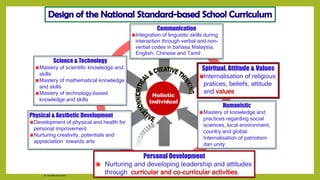
Holistic
Individual
Communication
Integration of linguistic skills during
interaction through verbal and non-
verbal codes in bahasa Malaysia,
English, Chinese and Tamil
Science & Technology
Mastery of scientific knowledge and
skills
Mastery of mathematical knowledge
and skills
Mastery of technology-based
knowledge and skills
Spiritual, Attitude & Values
Internalisation of religious
pratices, beliefs, attitude
and values
Physical & Aesthetic Development
Development of physical and health for
personal improvement
Nurturing creativity, potentials and
appreciation towards arts
Humanistic
Mastery of knowledge and
practices regarding social
sciences, local environment,
country and global.
Internalisation of patriotism
dan unity
Personal Development
Nurturing and developing leadership and attitudes
through curricular and co-curricular activities
Dr. Chin Mei Chin 2018
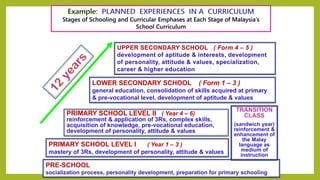
PRE-SCHOOL
socialization process, personality development, preparation for primary schooling
PRIMARY SCHOOL LEVEL II ( Year 4 – 6)
reinforcement & application of 3Rs, complex skills,
acquisition of knowledge, pre-vocational education,
development of personality, attitude & values
LOWER SECONDARY SCHOOL ( Form 1 – 3 )
general education, consolidation of skills acquired at primary
& pre-vocational level, development of aptitude & values
TRANSITION
CLASS
(sandwich year)
reinforcement &
enhancement of
the Malay
language as
medium of
instruction
PRIMARY SCHOOL LEVEL I ( Year 1 – 3 )
mastery of 3Rs, development of personality, attitude & values
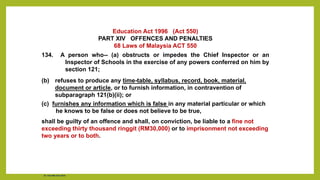
Education Act 1996 (Act 550)
PART XIV OFFENCES AND PENALTIES
68 Laws of Malaysia ACT 550
134. A person who-- (a) obstructs or impedes the Chief Inspector or an
Inspector of Schools in the exercise of any powers conferred on him by
section 121;
(b) refuses to produce any time-table, syllabus, record, book, material,
document or article, or to furnish information, in contravention of
subparagraph 121(b)(ii); or
(c) furnishes any information which is false in any material particular or which
he knows to be false or does not believe to be true,
shall be guilty of an offence and shall, on conviction, be liable to a fine not
exceeding thirty thousand ringgit (RM30,000) or to imprisonment not exceeding
two years or to both.
Dr. Chin Mei Chin 2018
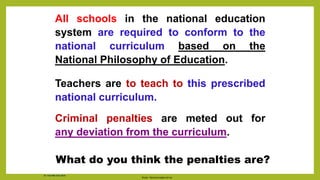
All schools in the national education
system are required to conform to the
national curriculum based on the
National Philosophy of Education.
Teachers are to teach to this prescribed
national curriculum.
Criminal penalties are meted out for
any deviation from the curriculum.
Source: http://www.espact.com.my
What do you think the penalties are?
Dr. Chin Mei Chin 2018
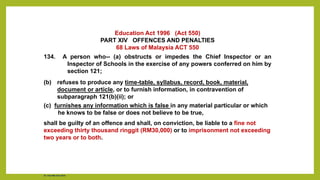
Education Act 1996 (Act 550)
PART XIV OFFENCES AND PENALTIES
68 Laws of Malaysia ACT 550
134. A person who-- (a) obstructs or impedes the Chief Inspector or an
Inspector of Schools in the exercise of any powers conferred on him by
section 121;
(b) refuses to produce any time-table, syllabus, record, book, material,
document or article, or to furnish information, in contravention of
subparagraph 121(b)(ii); or
(c) furnishes any information which is false in any material particular or which
he knows to be false or does not believe to be true,
shall be guilty of an offence and shall, on conviction, be liable to a fine not
exceeding thirty thousand ringgit (RM30,000) or to imprisonment not exceeding
two years or to both.
Dr. Chin Mei Chin 2018
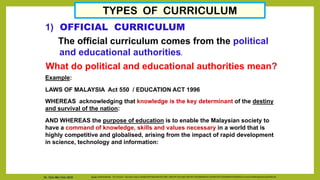
TYPES OF CURRICULUM
1) OFFICIAL CURRICULUM
The official curriculum comes from the political
and educational authorities.
What do political and educational authorities mean?
Example:
LAWS OF MALAYSIA Act 550 / EDUCATION ACT 1996
WHEREAS acknowledging that knowledge is the key determinant of the destiny
and survival of the nation:
AND WHEREAS the purpose of education is to enable the Malaysian society to
have a command of knowledge, skills and values necessary in a world that is
highly competitive and globalised, arising from the impact of rapid development
in science, technology and information:
Source: Cecilia Braslavsky. The Curriculum. http://www.unhas.ac.id/hasbi/LKPP/Hasbi-KBK-SOFTSKILL-UNISTAFF-SCL/Hasbi-UNISTAFF-DOCUMEN/MODUL%20UNISTAFF%20SURABAYA%202006/QTL/curriculum%20development/cecilia%20e.pdf
Dr. Chin Mei Chin 2018
Laws of Malaysia ACT 550/ Education ACT 1996
AND WHEREAS education plays a vital role in
achieving the country's vision of attaining the status
of a fully developed nation in terms of
economic development, social justice, and spiritual,
moral and ethical strength, towards creating a society
that is united, democratic, liberal and dynamic:
AND WHEREAS it is the mission to develop a world-
class quality education system which will realise the
full potential of the individual and fulfill the aspiration
of the Malaysian nation:
AND WHEREAS the National Education Policy is
based on the National Philosophy of Education …
Source: Cecilia Braslavsky. The Curriculum. http://www.unhas.ac.id/hasbi/LKPP/Hasbi-KBK-SOFTSKILL-UNISTAFF-SCL/Hasbi-UNISTAFF-DOCUMEN/MODUL%20UNISTAFF%20SURABAYA%202006/QTL/curriculum%20development/cecilia%20e.pdf
OFFICIAL CURRICULUM (cont’d)
Dr. Chin Mei Chin 2018
Laws of Malaysia ACT 550/ Education ACT 1996
AND WHEREAS the above policy is to be
executed through a national system of
education which provides for the national
language to be the main medium of instruction,
a National Curriculum and common
examinations; the education provided being
varied and comprehensive in scope and which
will satisfy the needs of the nation as well as
promote national unity through cultural, social,
economic and political development in
accordance with the principles of Rukunegara.
OFFICIAL CURRICULUM (cont’d)
Dr. Chin Mei Chin 2018
Laws of Malaysia ACT 550/ Education ACT 1996
AND WHEREAS it is considered desirable that
regard shall be had, so far as is compatible with
that policy, with the provision of efficient
instruction and with the avoidance of
unreasonable public expenditure, to the general
principle that pupils are to be educated in
accordance with the wishes of their parents ….
OFFICIAL CURRICULUM (cont’d)
In Malaysia, the official curriculum is
the National Curriculum
as specified by the Ministry of Education
(MOE).
Dr. Chin Mei Chin 2018
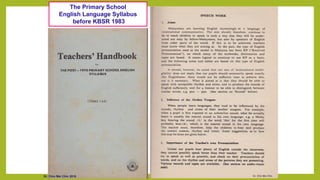
The Primary School
English Language Syllabus
before KBSR 1983
Dr. Chin Mei Chin
Dr. Chin Mei Chin 2018
Dr. Chin Mei Chin
Dr. Chin Mei Chin 2018
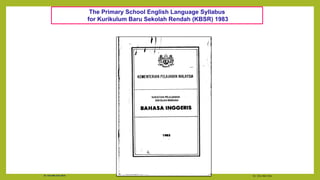
The Primary School English Language Syllabus
for Kurikulum Baru Sekolah Rendah (KBSR) 1983
Dr. Chin Mei Chin 2018
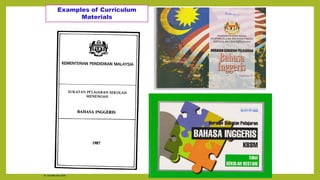
Examples of Curriculum
Materials
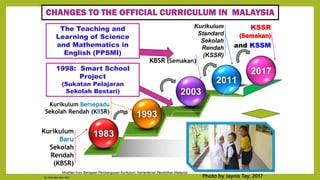
1983
1993
2003
2011
•Kurikulum
Baru
Sekolah
Rendah
(KBSR)
• Kurikulum Bersepadu
Sekolah Rendah (KBSR)
• Kurikulum
Standard
Sekolah
Rendah
(KSSR)
• KBSR (Semakan)
Photo by Jaynis Tay, 2017
The Teaching and
Learning of Science
and Mathematics in
English (PPSMI)
1998: Smart School
Project
(Sukatan Pelajaran
Sekolah Bestari)
Modified from Bahagian Pembangunan Kurikulum, Kementerian Pendidikan Malaysia
Dr. Chin Mei Chin 2017
• KSSR
(Semakan)
•and KSSM
2017
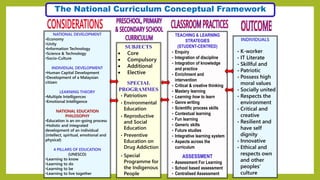
The National Curriculum Conceptual Framework
NATIONAL DEVELOPMENT
•Economy
•Unity
•Information Technology
•Science & Technology
•Socio-Culture
INDIVIDUAL DEVELOPMENT
•Human Capital Development
•Development of a Malaysian
citizen
LEARNING THEORY
•Multiple Intelligences
•Emotional Intelligence
NATIONAL EDUCATION
PHILOSOPHY
•Education is an on-going process
•Holistic and integrated
development of an individual
(intellect, spiritual, emotional and
physical)
4 PILLARS OF EDUCATION
(UNESCO)
•Learning to know
•Learning to do
•Learning to be
•Learning to live together
SUBJECTS
• Core
• Compulsory
• Additional
• Elective
SPECIAL
PROGRAMMES
• Patriotism
• Environmental
Education
• Reproductive
and Social
Education
• Preventive
Education on
Drug Addiction
• Special
Programme for
the Indigenous
People
TEACHING & LEARNING
STRATEGIES
(STUDENT-CENTRED)
• Enquiry
• Integration of discipline
• Integration of knowledge
and practice
• Enrichment and
intervention
• Critical & creative thinking
• Mastery learning
• Learning how to learn
• Genre writing
• Scientific process skills
• Contextual learning
• Fun learning
• Generic skills
• Future studies
• Integrative learning system
• Aspects across the
curriculum
ASSESSMENT
• Assessment For Learning
• School based assessment
• Centralised Assessment
INDIVIDUALS
• K-worker
• IT Literate
• Skillful and
• Patriotic
• Possess high
moral values
• Socially united
• Respects the
environment
• Critical and
creative
• Resilient and
have self
dignity
• Innovative
• Ethical and
respects own
and other
peoples’
culture
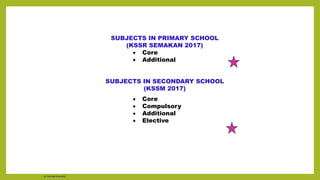
SUBJECTS IN PRIMARY SCHOOL
(KSSR SEMAKAN 2017)
• Core
• Additional
SUBJECTS IN SECONDARY SCHOOL
(KSSM 2017)
• Core
• Compulsory
• Additional
• Elective
Dr. Chin Mei Chin 2018
2) FORMAL CURRICULUM
WILSON (2005):
The formal curriculum is simply that which is written as part of formal
instruction of schooling experiences.
It may refer to a curriculum document, texts, films, and supportive teaching
materials that are overtly chosen to support the intentional instructional
agenda of a school.
Thus, the overt curriculum is usually confined to those written
understandings and directions formally designated and reviewed by
administrators, curriculum directors and teachers, often collectively.
The formal curriculum therefore embodies the
learning activities that are planned, organized
and implemented within regular school hours.
Source: https://www.ukessays.com/essays/education/differentiate-among-the-formal-informal-and-hidden-curriculum-education-essay|date=November 2013
Dr. Chin Mei Chin 2018
2) FORMAL CURRICULUM
Commonwealth Education Trust:
The formal curriculum is given to teachers to
follow in teaching.
Example: The contents of the subject of
Mathematics is explicitly described, outlined in
the form of syllabus/document/guidelines. It
contains the objectives, the subject matter,
learning experiences, teaching techniques,
assessment suggestions, and the reading
materials.
This is part of a formal curriculum that is
provided or pre-packaged and given to
teachers.
Sources: https://www.coursera.org/learn/teacher-curriculum/lecture/E3qXv/lecture-1-the-concept-of-curriculum
Dr. Chin Mei Chin 2018
2) FORMAL CURRICULUM
UNESCO, 2010
The formal curriculum is the
planned programme of objectives,
content, learning experiences, resources
and assessment offered by a school.
It is sometimes called the
‘official curriculum’.
Sources: http://www.unesco.org/education/tlsf/mods/theme_a/popups/mod05t01s01.html
Dr. Chin Mei Chin 2018
Larry Cuban (1995):
"The official curriculum is what the education
authorities set forth in curricular frameworks and
courses of study. They expect teachers to teach it;
they assume students will learn it.”
Source: http://curriculum.lexington4.net/
The taught curriculum is what teachers, working alone
in their rooms, actually choose to teach. It is the
curriculum that teachers actually deliver.
Their choices depend on their knowledge of the subject,
their experiences in teaching the content, their affection
or dislike for topics, and their attitudes toward the
students they face daily. They teach what they want to
teach or what they are comfortable with teaching.
2) FORMAL CURRICULUM
But do they?
Dr. Chin Mei Chin 2018
3) INFORMAL CURRICULUM
Informal curriculum is beyond the formal curriculum.
This very much involves student participation in
extracurricular activities or co-curricular activities, like
clubs, uniform units, subject-specific societies, and so
on, which help students understand different aspects that
they are learning in the formal curriculum.
Example: Values taught formally in Moral Education such
as diligence, patience and respect for others will come
through very naturally, via informal curriculum, when
students interact with each other in club meetings, scout
activities, etc.
https://www.coursera.org/learn/teacher-curriculum/lecture/YbAbW/lecture-2-aspects-of-curriculum
The informal curriculum also refers to the
learning experiences gathered from outside agencies
such as parents, peers, media and community.
Source: https://www.ukessays.com/essays/education/differentiate-among-the-formal-informal-and-hidden-curriculum-education-essay|date=November 2013
Dr. Chin Mei Chin 2018
According to Eliot Eisner:
There exists Implicit Curriculum, which is very much related to hidden
curriculum. But yet, it differs slightly in some ways.
Implicit curriculum is intended curriculum.
It extends to what happens in a classroom and gets displayed in a very subtle
manner, but has a powerful impact on student learning.
Eisner said that the furniture, the murals, the pin-ups, the whole environment
that is created in a classroom has an impact on student learning.
They do not come out formally, but it is there all the time and which has very
powerful impact on students.
https://www.coursera.org/learn/teacher-curriculum/lecture/YbAbW/lecture-2-aspects-of-curriculum
3) INFORMAL CURRICULUM
Dr. Chin Mei Chin 2018
Sociologist Philip Jackson coined the term 'hidden curriculum' in 1968.
The hidden curriculum consists of the unspoken or unseen academic,
social, and cultural messages that are communicated to students while they
are in school.
Source: http://edglossary.org/hidden-curriculum/ https://www.ukessays.com/essays/education/differentiate-among-the-formal-informal-and-hidden-curriculum-education-essay|date=November 2013
3) INFORMAL CURRICULUM
The hidden curriculum is sometimes called the ‘unofficial curriculum’ – and
includes the lessons about
behaviour, personal relationships, the use of power and authority,
competition, sources of motivation and so on that students learn at school.
Example: A school with a comprehensive recycling policy communicate a
message to students about the importance of sustaining the ecology and
environment.
Source: http://www.unesco.org/education/tlsf/mods/theme_a/popups/mod05t01s01.html
Dr. Chin Mei Chin 2018
In other words, hidden curriculum refers to the unwritten, unofficial, and often
unintended lessons, values, and perspectives that students learn in school.
For example:
 What ideas and behaviours are considered acceptable or unacceptable
 How students should interact with teachers, other adults, and peers
The hidden curriculum is described as “hidden” because it is unseen and
usually unacknowledged or unexamined by students, educators, and the wider
community.
Source: http://edglossary.org/hidden-curriculum/
The hidden curriculum although unintended usually facilitates the
transmission of beliefs which affect how students make decisions regarding
their life.
https://www.ukessays.com/essays/education/differentiate-among-the-formal-informal-and-hidden-curriculum-education-essay|date=November 2013
Dr. Chin Mei Chin 2018
Did you acquire any Hidden Curriculum
after joining the EDU3093 Culture and
Learning course?
INFORMAL CURRICULUM (cont’d)
Dr. Chin Mei Chin 2018
• Honesty, politeness, discipline, respect, love,
sincerity, courtesy
• Give our best in completing our task or any
responsibility given to us
• Having a God-fearing spirit
• Respect for authority
• Being open-minded to the truth
• Time management and punctuality
• Not to cover up for friends if they are wrong
Values beneficial for self-development
were acquired from the course.
Dr. Chin Mei Chin 2018
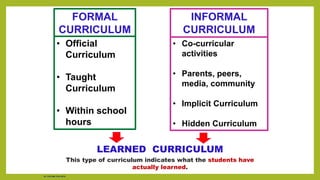
INFORMAL
CURRICULUM
FORMAL
CURRICULUM
• Official
Curriculum
• Taught
Curriculum
• Within school
hours
• Co-curricular
activities
• Parents, peers,
media, community
• Implicit Curriculum
• Hidden Curriculum
LEARNED CURRICULUM
This type of curriculum indicates what the students have
actually learned.
Dr. Chin Mei Chin 2018
The learned curriculum.
Beyond what test scores reveal about content learning, students also
learn many unspecified lessons embedded in the environment of the
classroom.
Depending on what the teacher models, the student will learn to
process information in particular ways and not in others.
They will learn when and when not to ask questions and how to act
attentive. They may imitate their teacher's attitudes. They learn about
respect for others from the teacher's own demonstration of respect or
lack thereof.
The learned curriculum is much more inclusive than the overtly taught
curriculum.
http://curriculum.lexington4.net/
Dr. Chin Mei Chin 2018
Curriculum is the total learning experience of students as indicated by the
different types of curriculum.
There is a significant gap between the taught curriculum and the learned
curriculum; students do not always learn what they are taught.
Several factors account for the gap: the teacher's failure to make the
curriculum meaningful and challenging or to monitor student learning; and the
students' low level of motivation, cognitive abilities, and short attention spans.
This idea points to the difference between the taught curriculum – the words,
ideas, themes, images, etc. that come out of the educator’s mouth – and the
learned curriculum – the words, ideas, themes, images etc. that make it into
the students’ minds and memories.
Sources: http://www.ascd.org/publications/curriculum-handbook/398/chapters/Thinking-About-Curriculum.aspx
http://simplyeducate.me/2015/01/07/seven-school-curriculum-types-and-their-classroom-implications/
https://teachingasianreligions.com/2013/12/21/the-taught-curriculum-and-the-learned-curriculum/
Dr. Chin Mei Chin 2018

Types of Curriculum

  • 1.
    OVERVIEW 1) Concept ofCurriculum 2) Types of Curriculum 1) Official 2) Formal 3) Informal 3) Factors Influencing Curriculum Change • Technological Development • Current Needs/Security • Government Policies • Culture • Knowledge development and its importance Dr. Chin Mei Chin 2018
  • 2.
    RECAP What do youunderstand by the word “Curriculum”? Etymology: Classical Latin Currere = to run Curriculum = fast chariot / running / course (race course) Curriculum encompasses all planned and unplanned experiences that is provided in an education institution like school, institute, polytechnic, college, university, etc. Curriculum is a framework that shapes and guides the teaching learning process. Curriculum is a kind of road map that is given to teachers to follow through.
  • 3.
    Difference between Syllabusand Curriculum A syllabus (Greek word) is your guide to a course/subject and what will be expected of you in the course/subject. Refer to your RMK Generally, it includes a description of the: topics covered, rationale, objectives, learning outcomes, required texts, policies, rules and regulations, and a schedule of assignments. Curriculum has a wider scope which covers the knowledge, attitude, behaviour, manner, performance and skills that are imparted or inculcated in a student. It refers to a more comprehensive educational package involving the conceptualization, planning, designing and detailing of a comprehensive learning program in schools. A subject syllabus is a unit of the curriculum.
  • 4.
    Dr. Chin MeiChin 2018 According to Assoc. Prof. Suseela and Prof. MacBeath of the Commonwealth Education Trust: • Curriculum is a plan of action for learning. • It is a formal written document that systematically describes the course of study that is appropriate with the educational level. • It includes all the different subjects, courses, learning objectives, skills, knowledge and values that need to be instilled in students. • It consists of the content learning outcomes or experiences and evaluation formats and procedures. Source: https://www.coursera.org/learn/teacher-curriculum/lecture/E3qXv/lecture-1-the-concept-of-curriculum What are the Characteristics of a Curriculum?
  • 5.
  • 6.
    • The Malaysiannational education system is built with a mission to serve the needs of the nation. • The needs of the nation and how they will be achieved are found in the Education Act 1996 (Act 550). • The Education Act 1996 describes the national education system and national policy on education based on the National Philosophy of Education. • The Education Act 1996 stipulates that primary schools under the national education system must use the national curriculum for primary schools. Source: http://www.espact.com.my Dr. Chin Mei Chin 2018
  • 7.
    “The National Curriculumis an educational programme that includes curriculum and co-curricular activities which encompasses all the knowledge, skills, norms, values, cultural elements and beliefs to help develop a pupil fully with respect to the physical, spiritual, mental and emotional aspects as well as to inculcate and develop desirable moral values and to transmit knowledge.” Education Act 1996 [ Education (National Curriculum) Regulation 1997 ] Dr. Chin Mei Chin 2018
  • 8.
    29 August 2018: EducationalProfessionalism Seminar for Young Teachers Dr. Maszlee: Character Building to Complement 3R Learning in Primary Schools Education Minister Dr Maszlee Malik wants teachers to play a pivotal role in inculcating good values in students in addition to teaching them the 3Rs (reading, writing and arithmetic). He said good values will become the fourth R in the system for character building (manusiawi) which should begin from primary school. "In some countries, such as Finland for instance, it is a crime for teachers to even conduct exams from primary to Form Three. This is because this period is used to build the characters of the students," Dr Maszlee said. Source: https://www.thestar.com.my/news/nation/2018/08/29/maszlee-character-building-to-complement-3r-learning-in-primary-schools/#M2CCjJqBuLFfUY5W.99 WHY is Character Building emphasised? Dr. Chin Mei Chin 2018
  • 9.
    Character building inschool gradually but firmly establishes values, ethics, emotional maturity and civic consciousness in students. VALUES = Moral principles Morality has to do with right and wrong, good and bad. Moral principles are ideals that we try to follow to live right and be good people. Example of moral principles: honesty, respect, and kindness. If I accept these moral principles to guide my life, then I try to be honest with people, show respect for them, and be kind to them. ETHICS = Rules of conduct or behaviour CIVICS = Rights and duties of a citizen EMOTIONAL MATURITY = Managing your emotions well
  • 10.
    Emotional maturity is(i) the ability to differentiate and properly identify one’s emotions while (ii) granting yourself the freedom to experience whatever emotion is appropriate to a given situation. Be angry and do not sin. Be sad, learn from your mistakes, and change for the better. Be frustrated, come to terms with it, and move on. Sources: http://www.yourdictionary.com/emotional-maturity and http://bradhambrick.com/what-is-emotional-maturity/ Emotional maturity is defined as how well you are able to respond to situations, control your emotions and behave in an adult manner when dealing with others. Being able to have a rational conversation with your peer when you disagree without using vulgar words and fighting is an example of showing emotional maturity. “When the horse dies, get down on the ground and walk.” Dr. Chin Mei Chin 2018
  • 11.
    Holistic Individual Communication Integration of linguisticskills during interaction through verbal and non- verbal codes in bahasa Malaysia, English, Chinese and Tamil Science & Technology Mastery of scientific knowledge and skills Mastery of mathematical knowledge and skills Mastery of technology-based knowledge and skills Spiritual, Attitude & Values Internalisation of religious pratices, beliefs, attitude and values Physical & Aesthetic Development Development of physical and health for personal improvement Nurturing creativity, potentials and appreciation towards arts Humanistic Mastery of knowledge and practices regarding social sciences, local environment, country and global. Internalisation of patriotism dan unity Personal Development Nurturing and developing leadership and attitudes through curricular and co-curricular activities Dr. Chin Mei Chin 2018
  • 12.
    PRE-SCHOOL socialization process, personalitydevelopment, preparation for primary schooling PRIMARY SCHOOL LEVEL II ( Year 4 – 6) reinforcement & application of 3Rs, complex skills, acquisition of knowledge, pre-vocational education, development of personality, attitude & values LOWER SECONDARY SCHOOL ( Form 1 – 3 ) general education, consolidation of skills acquired at primary & pre-vocational level, development of aptitude & values TRANSITION CLASS (sandwich year) reinforcement & enhancement of the Malay language as medium of instruction PRIMARY SCHOOL LEVEL I ( Year 1 – 3 ) mastery of 3Rs, development of personality, attitude & values
  • 13.
    Education Act 1996(Act 550) PART XIV OFFENCES AND PENALTIES 68 Laws of Malaysia ACT 550 134. A person who-- (a) obstructs or impedes the Chief Inspector or an Inspector of Schools in the exercise of any powers conferred on him by section 121; (b) refuses to produce any time-table, syllabus, record, book, material, document or article, or to furnish information, in contravention of subparagraph 121(b)(ii); or (c) furnishes any information which is false in any material particular or which he knows to be false or does not believe to be true, shall be guilty of an offence and shall, on conviction, be liable to a fine not exceeding thirty thousand ringgit (RM30,000) or to imprisonment not exceeding two years or to both. Dr. Chin Mei Chin 2018
  • 14.
    All schools inthe national education system are required to conform to the national curriculum based on the National Philosophy of Education. Teachers are to teach to this prescribed national curriculum. Criminal penalties are meted out for any deviation from the curriculum. Source: http://www.espact.com.my What do you think the penalties are? Dr. Chin Mei Chin 2018
  • 15.
    Education Act 1996(Act 550) PART XIV OFFENCES AND PENALTIES 68 Laws of Malaysia ACT 550 134. A person who-- (a) obstructs or impedes the Chief Inspector or an Inspector of Schools in the exercise of any powers conferred on him by section 121; (b) refuses to produce any time-table, syllabus, record, book, material, document or article, or to furnish information, in contravention of subparagraph 121(b)(ii); or (c) furnishes any information which is false in any material particular or which he knows to be false or does not believe to be true, shall be guilty of an offence and shall, on conviction, be liable to a fine not exceeding thirty thousand ringgit (RM30,000) or to imprisonment not exceeding two years or to both. Dr. Chin Mei Chin 2018
  • 16.
    TYPES OF CURRICULUM 1)OFFICIAL CURRICULUM The official curriculum comes from the political and educational authorities. What do political and educational authorities mean? Example: LAWS OF MALAYSIA Act 550 / EDUCATION ACT 1996 WHEREAS acknowledging that knowledge is the key determinant of the destiny and survival of the nation: AND WHEREAS the purpose of education is to enable the Malaysian society to have a command of knowledge, skills and values necessary in a world that is highly competitive and globalised, arising from the impact of rapid development in science, technology and information: Source: Cecilia Braslavsky. The Curriculum. http://www.unhas.ac.id/hasbi/LKPP/Hasbi-KBK-SOFTSKILL-UNISTAFF-SCL/Hasbi-UNISTAFF-DOCUMEN/MODUL%20UNISTAFF%20SURABAYA%202006/QTL/curriculum%20development/cecilia%20e.pdf Dr. Chin Mei Chin 2018
  • 17.
    Laws of MalaysiaACT 550/ Education ACT 1996 AND WHEREAS education plays a vital role in achieving the country's vision of attaining the status of a fully developed nation in terms of economic development, social justice, and spiritual, moral and ethical strength, towards creating a society that is united, democratic, liberal and dynamic: AND WHEREAS it is the mission to develop a world- class quality education system which will realise the full potential of the individual and fulfill the aspiration of the Malaysian nation: AND WHEREAS the National Education Policy is based on the National Philosophy of Education … Source: Cecilia Braslavsky. The Curriculum. http://www.unhas.ac.id/hasbi/LKPP/Hasbi-KBK-SOFTSKILL-UNISTAFF-SCL/Hasbi-UNISTAFF-DOCUMEN/MODUL%20UNISTAFF%20SURABAYA%202006/QTL/curriculum%20development/cecilia%20e.pdf OFFICIAL CURRICULUM (cont’d) Dr. Chin Mei Chin 2018
  • 18.
    Laws of MalaysiaACT 550/ Education ACT 1996 AND WHEREAS the above policy is to be executed through a national system of education which provides for the national language to be the main medium of instruction, a National Curriculum and common examinations; the education provided being varied and comprehensive in scope and which will satisfy the needs of the nation as well as promote national unity through cultural, social, economic and political development in accordance with the principles of Rukunegara. OFFICIAL CURRICULUM (cont’d) Dr. Chin Mei Chin 2018
  • 19.
    Laws of MalaysiaACT 550/ Education ACT 1996 AND WHEREAS it is considered desirable that regard shall be had, so far as is compatible with that policy, with the provision of efficient instruction and with the avoidance of unreasonable public expenditure, to the general principle that pupils are to be educated in accordance with the wishes of their parents …. OFFICIAL CURRICULUM (cont’d) In Malaysia, the official curriculum is the National Curriculum as specified by the Ministry of Education (MOE). Dr. Chin Mei Chin 2018
  • 20.
    The Primary School EnglishLanguage Syllabus before KBSR 1983 Dr. Chin Mei Chin Dr. Chin Mei Chin 2018
  • 21.
    Dr. Chin MeiChin Dr. Chin Mei Chin 2018 The Primary School English Language Syllabus for Kurikulum Baru Sekolah Rendah (KBSR) 1983
  • 22.
    Dr. Chin MeiChin 2018 Examples of Curriculum Materials
  • 23.
    1983 1993 2003 2011 •Kurikulum Baru Sekolah Rendah (KBSR) • Kurikulum Bersepadu SekolahRendah (KBSR) • Kurikulum Standard Sekolah Rendah (KSSR) • KBSR (Semakan) Photo by Jaynis Tay, 2017 The Teaching and Learning of Science and Mathematics in English (PPSMI) 1998: Smart School Project (Sukatan Pelajaran Sekolah Bestari) Modified from Bahagian Pembangunan Kurikulum, Kementerian Pendidikan Malaysia Dr. Chin Mei Chin 2017 • KSSR (Semakan) •and KSSM 2017
  • 24.
    The National CurriculumConceptual Framework NATIONAL DEVELOPMENT •Economy •Unity •Information Technology •Science & Technology •Socio-Culture INDIVIDUAL DEVELOPMENT •Human Capital Development •Development of a Malaysian citizen LEARNING THEORY •Multiple Intelligences •Emotional Intelligence NATIONAL EDUCATION PHILOSOPHY •Education is an on-going process •Holistic and integrated development of an individual (intellect, spiritual, emotional and physical) 4 PILLARS OF EDUCATION (UNESCO) •Learning to know •Learning to do •Learning to be •Learning to live together SUBJECTS • Core • Compulsory • Additional • Elective SPECIAL PROGRAMMES • Patriotism • Environmental Education • Reproductive and Social Education • Preventive Education on Drug Addiction • Special Programme for the Indigenous People TEACHING & LEARNING STRATEGIES (STUDENT-CENTRED) • Enquiry • Integration of discipline • Integration of knowledge and practice • Enrichment and intervention • Critical & creative thinking • Mastery learning • Learning how to learn • Genre writing • Scientific process skills • Contextual learning • Fun learning • Generic skills • Future studies • Integrative learning system • Aspects across the curriculum ASSESSMENT • Assessment For Learning • School based assessment • Centralised Assessment INDIVIDUALS • K-worker • IT Literate • Skillful and • Patriotic • Possess high moral values • Socially united • Respects the environment • Critical and creative • Resilient and have self dignity • Innovative • Ethical and respects own and other peoples’ culture
  • 25.
    SUBJECTS IN PRIMARYSCHOOL (KSSR SEMAKAN 2017) • Core • Additional SUBJECTS IN SECONDARY SCHOOL (KSSM 2017) • Core • Compulsory • Additional • Elective Dr. Chin Mei Chin 2018
  • 26.
    2) FORMAL CURRICULUM WILSON(2005): The formal curriculum is simply that which is written as part of formal instruction of schooling experiences. It may refer to a curriculum document, texts, films, and supportive teaching materials that are overtly chosen to support the intentional instructional agenda of a school. Thus, the overt curriculum is usually confined to those written understandings and directions formally designated and reviewed by administrators, curriculum directors and teachers, often collectively. The formal curriculum therefore embodies the learning activities that are planned, organized and implemented within regular school hours. Source: https://www.ukessays.com/essays/education/differentiate-among-the-formal-informal-and-hidden-curriculum-education-essay|date=November 2013 Dr. Chin Mei Chin 2018
  • 27.
    2) FORMAL CURRICULUM CommonwealthEducation Trust: The formal curriculum is given to teachers to follow in teaching. Example: The contents of the subject of Mathematics is explicitly described, outlined in the form of syllabus/document/guidelines. It contains the objectives, the subject matter, learning experiences, teaching techniques, assessment suggestions, and the reading materials. This is part of a formal curriculum that is provided or pre-packaged and given to teachers. Sources: https://www.coursera.org/learn/teacher-curriculum/lecture/E3qXv/lecture-1-the-concept-of-curriculum Dr. Chin Mei Chin 2018
  • 28.
    2) FORMAL CURRICULUM UNESCO,2010 The formal curriculum is the planned programme of objectives, content, learning experiences, resources and assessment offered by a school. It is sometimes called the ‘official curriculum’. Sources: http://www.unesco.org/education/tlsf/mods/theme_a/popups/mod05t01s01.html Dr. Chin Mei Chin 2018
  • 29.
    Larry Cuban (1995): "Theofficial curriculum is what the education authorities set forth in curricular frameworks and courses of study. They expect teachers to teach it; they assume students will learn it.” Source: http://curriculum.lexington4.net/ The taught curriculum is what teachers, working alone in their rooms, actually choose to teach. It is the curriculum that teachers actually deliver. Their choices depend on their knowledge of the subject, their experiences in teaching the content, their affection or dislike for topics, and their attitudes toward the students they face daily. They teach what they want to teach or what they are comfortable with teaching. 2) FORMAL CURRICULUM But do they? Dr. Chin Mei Chin 2018
  • 30.
    3) INFORMAL CURRICULUM Informalcurriculum is beyond the formal curriculum. This very much involves student participation in extracurricular activities or co-curricular activities, like clubs, uniform units, subject-specific societies, and so on, which help students understand different aspects that they are learning in the formal curriculum. Example: Values taught formally in Moral Education such as diligence, patience and respect for others will come through very naturally, via informal curriculum, when students interact with each other in club meetings, scout activities, etc. https://www.coursera.org/learn/teacher-curriculum/lecture/YbAbW/lecture-2-aspects-of-curriculum The informal curriculum also refers to the learning experiences gathered from outside agencies such as parents, peers, media and community. Source: https://www.ukessays.com/essays/education/differentiate-among-the-formal-informal-and-hidden-curriculum-education-essay|date=November 2013 Dr. Chin Mei Chin 2018
  • 31.
    According to EliotEisner: There exists Implicit Curriculum, which is very much related to hidden curriculum. But yet, it differs slightly in some ways. Implicit curriculum is intended curriculum. It extends to what happens in a classroom and gets displayed in a very subtle manner, but has a powerful impact on student learning. Eisner said that the furniture, the murals, the pin-ups, the whole environment that is created in a classroom has an impact on student learning. They do not come out formally, but it is there all the time and which has very powerful impact on students. https://www.coursera.org/learn/teacher-curriculum/lecture/YbAbW/lecture-2-aspects-of-curriculum 3) INFORMAL CURRICULUM Dr. Chin Mei Chin 2018
  • 32.
    Sociologist Philip Jacksoncoined the term 'hidden curriculum' in 1968. The hidden curriculum consists of the unspoken or unseen academic, social, and cultural messages that are communicated to students while they are in school. Source: http://edglossary.org/hidden-curriculum/ https://www.ukessays.com/essays/education/differentiate-among-the-formal-informal-and-hidden-curriculum-education-essay|date=November 2013 3) INFORMAL CURRICULUM The hidden curriculum is sometimes called the ‘unofficial curriculum’ – and includes the lessons about behaviour, personal relationships, the use of power and authority, competition, sources of motivation and so on that students learn at school. Example: A school with a comprehensive recycling policy communicate a message to students about the importance of sustaining the ecology and environment. Source: http://www.unesco.org/education/tlsf/mods/theme_a/popups/mod05t01s01.html Dr. Chin Mei Chin 2018
  • 33.
    In other words,hidden curriculum refers to the unwritten, unofficial, and often unintended lessons, values, and perspectives that students learn in school. For example:  What ideas and behaviours are considered acceptable or unacceptable  How students should interact with teachers, other adults, and peers The hidden curriculum is described as “hidden” because it is unseen and usually unacknowledged or unexamined by students, educators, and the wider community. Source: http://edglossary.org/hidden-curriculum/ The hidden curriculum although unintended usually facilitates the transmission of beliefs which affect how students make decisions regarding their life. https://www.ukessays.com/essays/education/differentiate-among-the-formal-informal-and-hidden-curriculum-education-essay|date=November 2013 Dr. Chin Mei Chin 2018
  • 34.
    Did you acquireany Hidden Curriculum after joining the EDU3093 Culture and Learning course? INFORMAL CURRICULUM (cont’d) Dr. Chin Mei Chin 2018
  • 35.
    • Honesty, politeness,discipline, respect, love, sincerity, courtesy • Give our best in completing our task or any responsibility given to us • Having a God-fearing spirit • Respect for authority • Being open-minded to the truth • Time management and punctuality • Not to cover up for friends if they are wrong Values beneficial for self-development were acquired from the course. Dr. Chin Mei Chin 2018
  • 36.
    INFORMAL CURRICULUM FORMAL CURRICULUM • Official Curriculum • Taught Curriculum •Within school hours • Co-curricular activities • Parents, peers, media, community • Implicit Curriculum • Hidden Curriculum LEARNED CURRICULUM This type of curriculum indicates what the students have actually learned. Dr. Chin Mei Chin 2018
  • 37.
    The learned curriculum. Beyondwhat test scores reveal about content learning, students also learn many unspecified lessons embedded in the environment of the classroom. Depending on what the teacher models, the student will learn to process information in particular ways and not in others. They will learn when and when not to ask questions and how to act attentive. They may imitate their teacher's attitudes. They learn about respect for others from the teacher's own demonstration of respect or lack thereof. The learned curriculum is much more inclusive than the overtly taught curriculum. http://curriculum.lexington4.net/ Dr. Chin Mei Chin 2018
  • 38.
    Curriculum is thetotal learning experience of students as indicated by the different types of curriculum. There is a significant gap between the taught curriculum and the learned curriculum; students do not always learn what they are taught. Several factors account for the gap: the teacher's failure to make the curriculum meaningful and challenging or to monitor student learning; and the students' low level of motivation, cognitive abilities, and short attention spans. This idea points to the difference between the taught curriculum – the words, ideas, themes, images, etc. that come out of the educator’s mouth – and the learned curriculum – the words, ideas, themes, images etc. that make it into the students’ minds and memories. Sources: http://www.ascd.org/publications/curriculum-handbook/398/chapters/Thinking-About-Curriculum.aspx http://simplyeducate.me/2015/01/07/seven-school-curriculum-types-and-their-classroom-implications/ https://teachingasianreligions.com/2013/12/21/the-taught-curriculum-and-the-learned-curriculum/ Dr. Chin Mei Chin 2018