Paris Agreement and the NAP
process
Global Capacity Development Workshop: Integrating Agriculture in National Adaptation Plans
5-7 April 2016, Rome, Italy
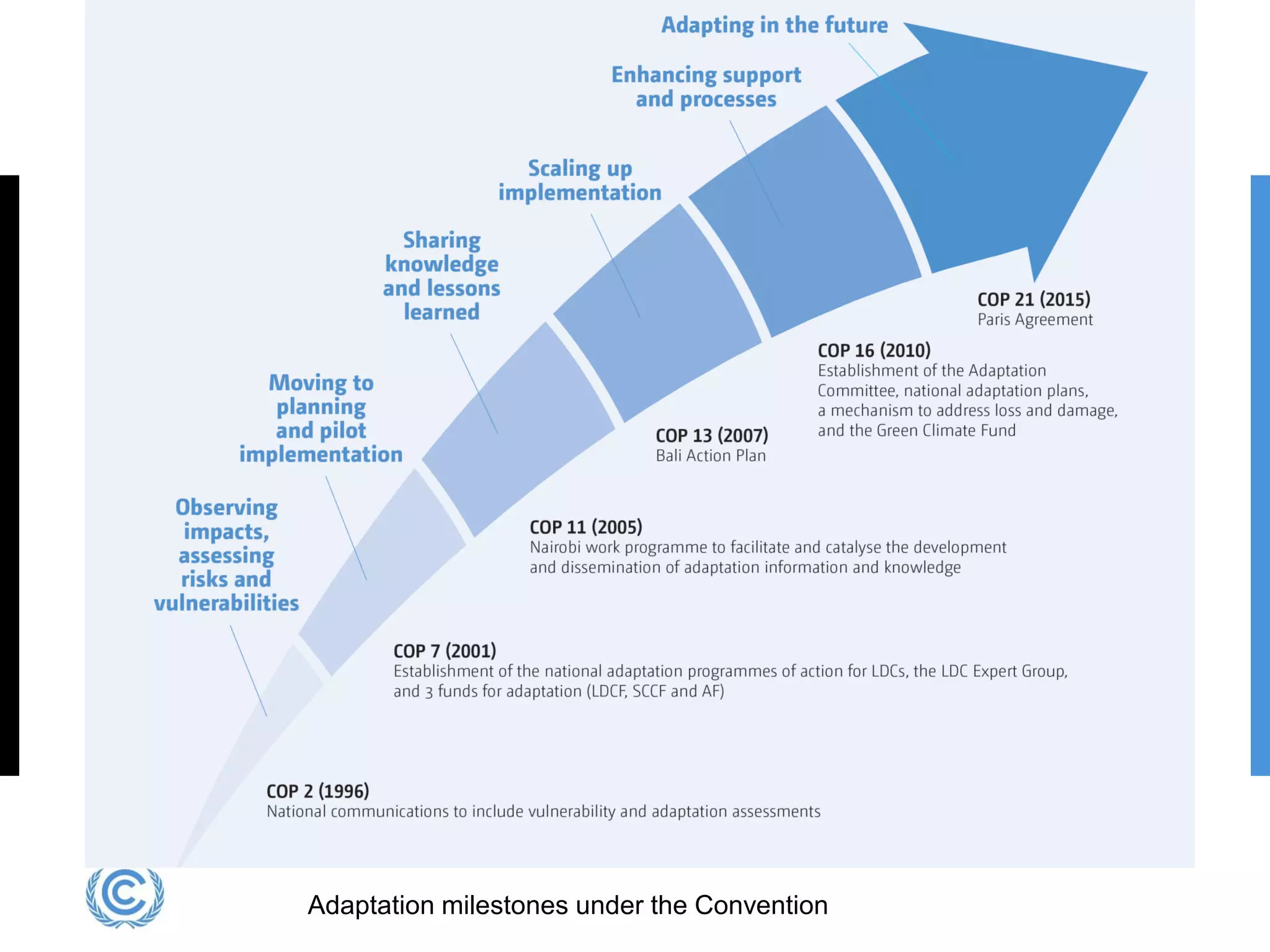
Adaptation milestones under the Convention
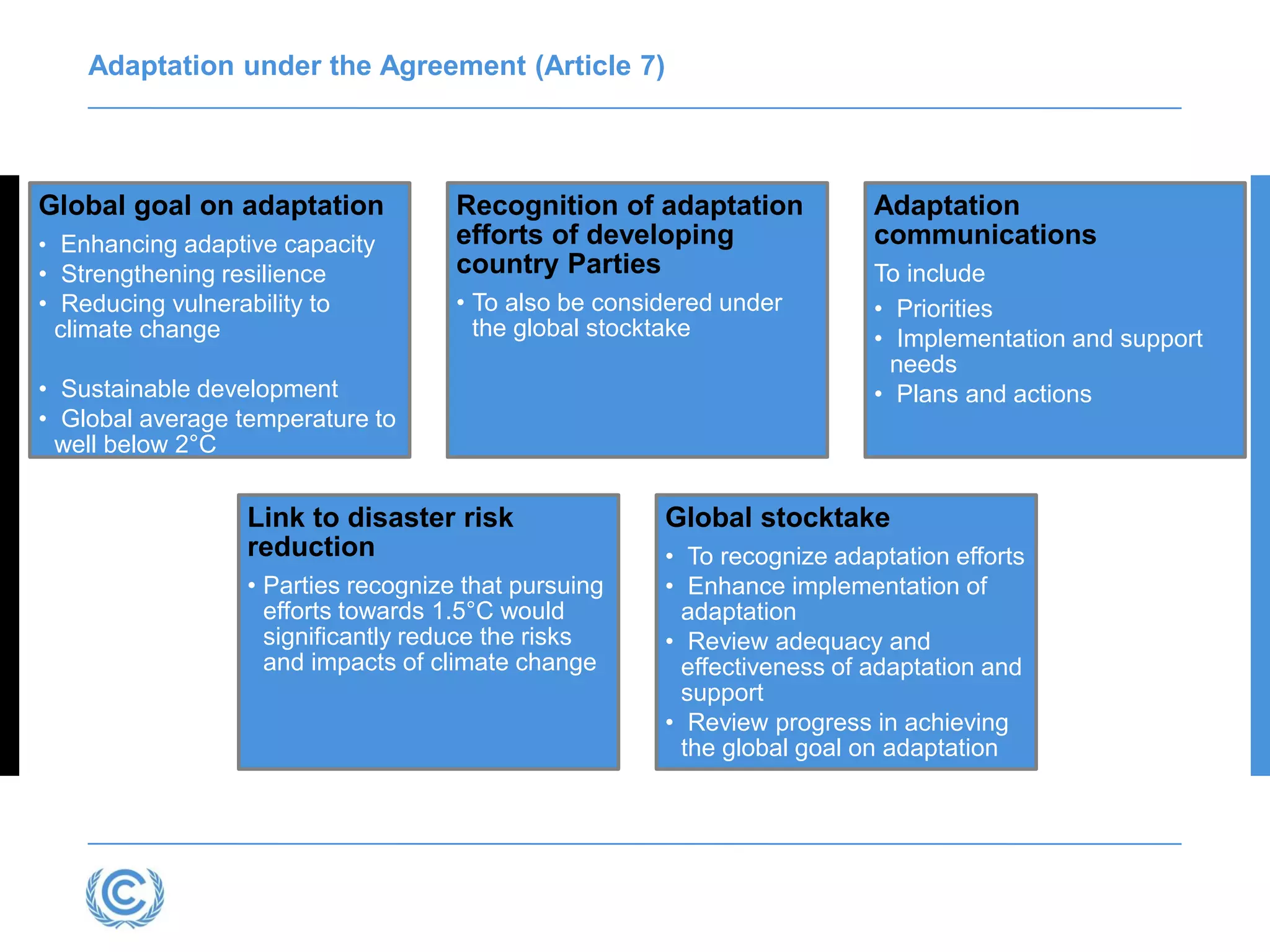
Adaptation under the Agreement (Article 7)
Global goal on adaptation
• Enhancing adaptive capacity
• Strengthening resilience
• Reducing vulnerability to
climate change
• Sustainable development
• Global average temperature to
well below 2°C
Recognition of adaptation
efforts of developing
country Parties
• To also be considered under
the global stocktake
Adaptation
communications
To include
• Priorities
• Implementation and support
needs
• Plans and actions
Link to disaster risk
reduction
• Parties recognize that pursuing
efforts towards 1.5°C would
significantly reduce the risks
and impacts of climate change
Global stocktake
• To recognize adaptation efforts
• Enhance implementation of
adaptation
• Review adequacy and
effectiveness of adaptation and
support
• Review progress in achieving
the global goal on adaptation
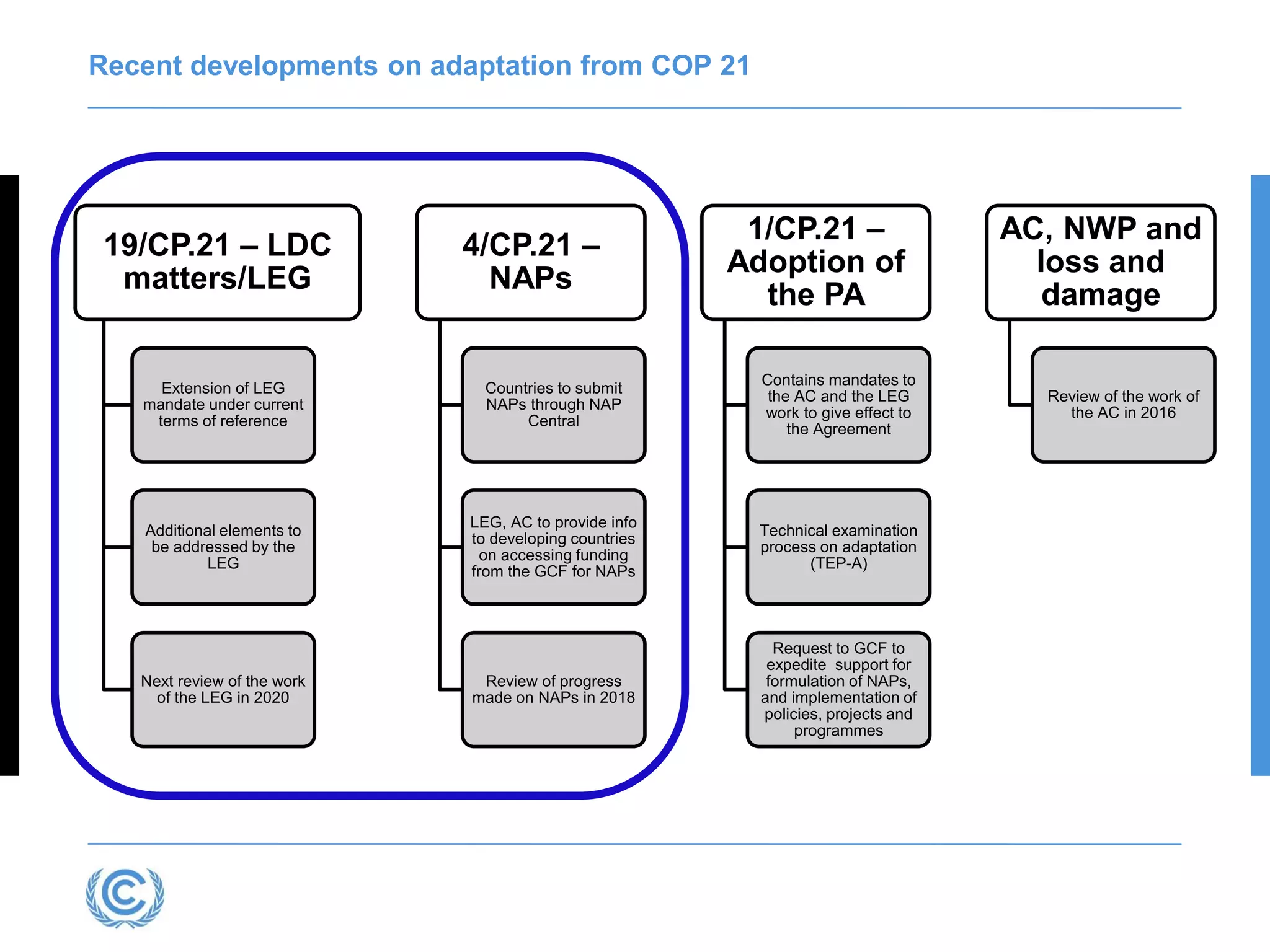
Recent developments on adaptation from COP 21
19/CP.21 – LDC
matters/LEG
Extension of LEG
mandate under current
terms of reference
Additional elements to
be addressed by the
LEG
Next review of the work
of the LEG in 2020
4/CP.21 –
NAPs
Countries to submit
NAPs through NAP
Central
LEG, AC to provide info
to developing countries
on accessing funding
from the GCF for NAPs
Review of progress
made on NAPs in 2018
1/CP.21 –
Adoption of
the PA
Contains mandates to
the AC and the LEG
work to give effect to
the Agreement
Technical examination
process on adaptation
(TEP-A)
Request to GCF to
expedite support for
formulation of NAPs,
and implementation of
policies, projects and
programmes
AC, NWP and
loss and
damage
Review of the work of
the AC in 2016
A focus on NAPs
National adaptation plans
Established under the CAF (decision 1/CP.16, paras 15 to 18)
As a process to enable LDCs to formulate and implement NAPs,
building upon their experience in preparing and implementing NAPAs,
as a means of identifying medium- and long-term adaptation needs
and developing and implementing strategies and programmes to
address those needs. Other developing country Parties are invited to
employ the modalities formulated to support the NAPs.
Objectives of the NAP process (decision 5/CP.17) are:
a) To reduce vulnerability to the impacts of climate change, by
building adaptive capacity and resilience;
b) To facilitate the integration of climate change adaptation,
in a coherent manner, into relevant new and existing policies,
programmes and activities, in particular development planning
processes and strategies, within all relevant sectors and at
different levels, as appropriate.
Global goal on adaptation
…enhancing adaptive capacity, strengthening
resilience and reducing vulnerability to climate
change, with a view to contributing to sustainable
development and ensuring an adequate adaptation
response in the context of the temperature goal.
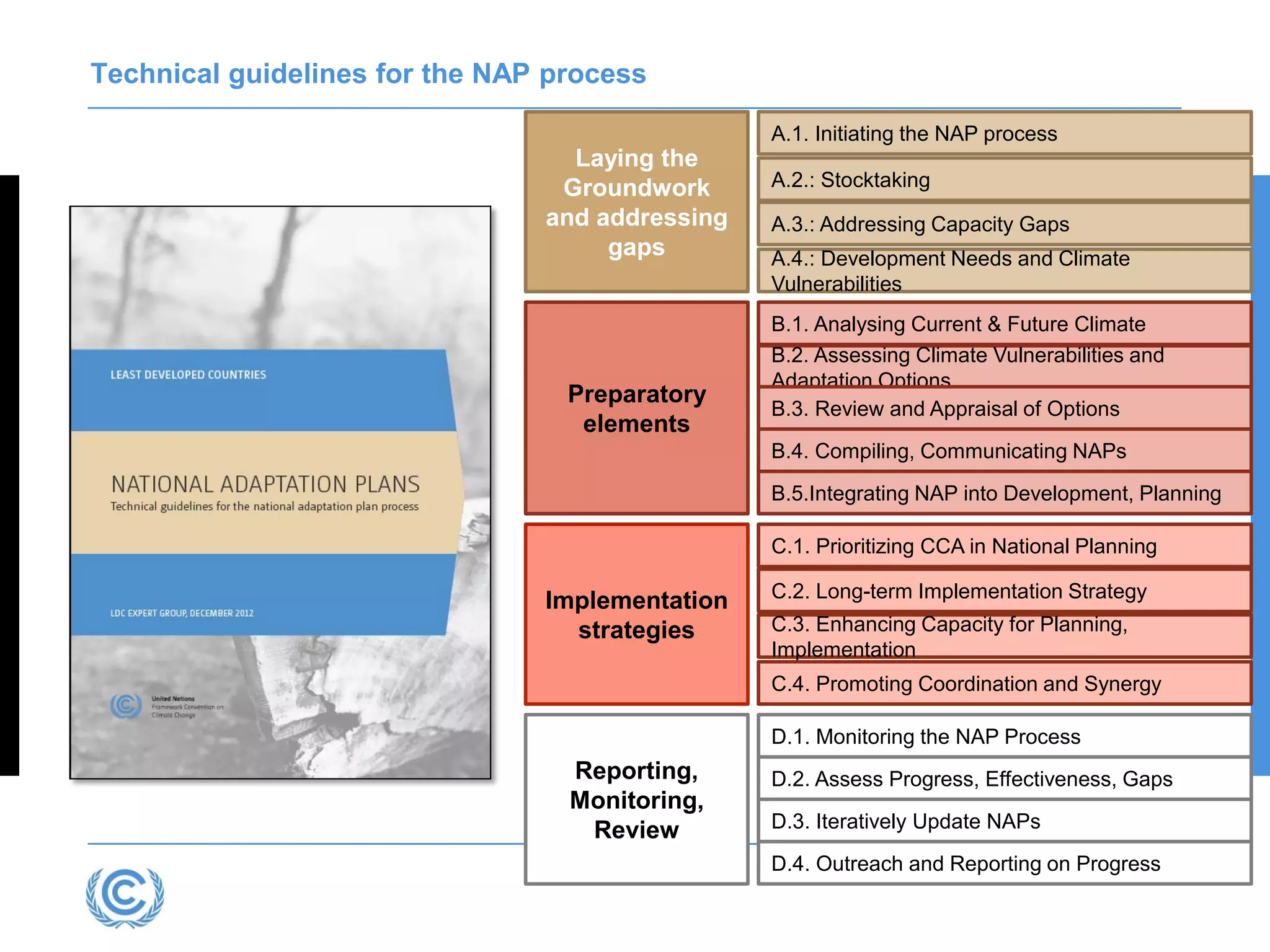
Technical guidelines for the NAP process
Laying the
Groundwork
and addressing
gaps
Preparatory
elements
Implementation
strategies
Reporting,
Monitoring,
Review
A.1. Initiating the NAP process
A.2.: Stocktaking
A.3.: Addressing Capacity Gaps
A.4.: Development Needs and Climate
Vulnerabilities
B.1. Analysing Current & Future Climate
B.2. Assessing Climate Vulnerabilities and
Adaptation Options
B.3. Review and Appraisal of Options
B.4. Compiling, Communicating NAPs
B.5.Integrating NAP into Development, Planning
C.1. Prioritizing CCA in National Planning
C.2. Long-term Implementation Strategy
C.3. Enhancing Capacity for Planning,
Implementation
C.4. Promoting Coordination and Synergy
D.1. Monitoring the NAP Process
D.2. Assess Progress, Effectiveness, Gaps
D.3. Iteratively Update NAPs
D.4. Outreach and Reporting on Progress
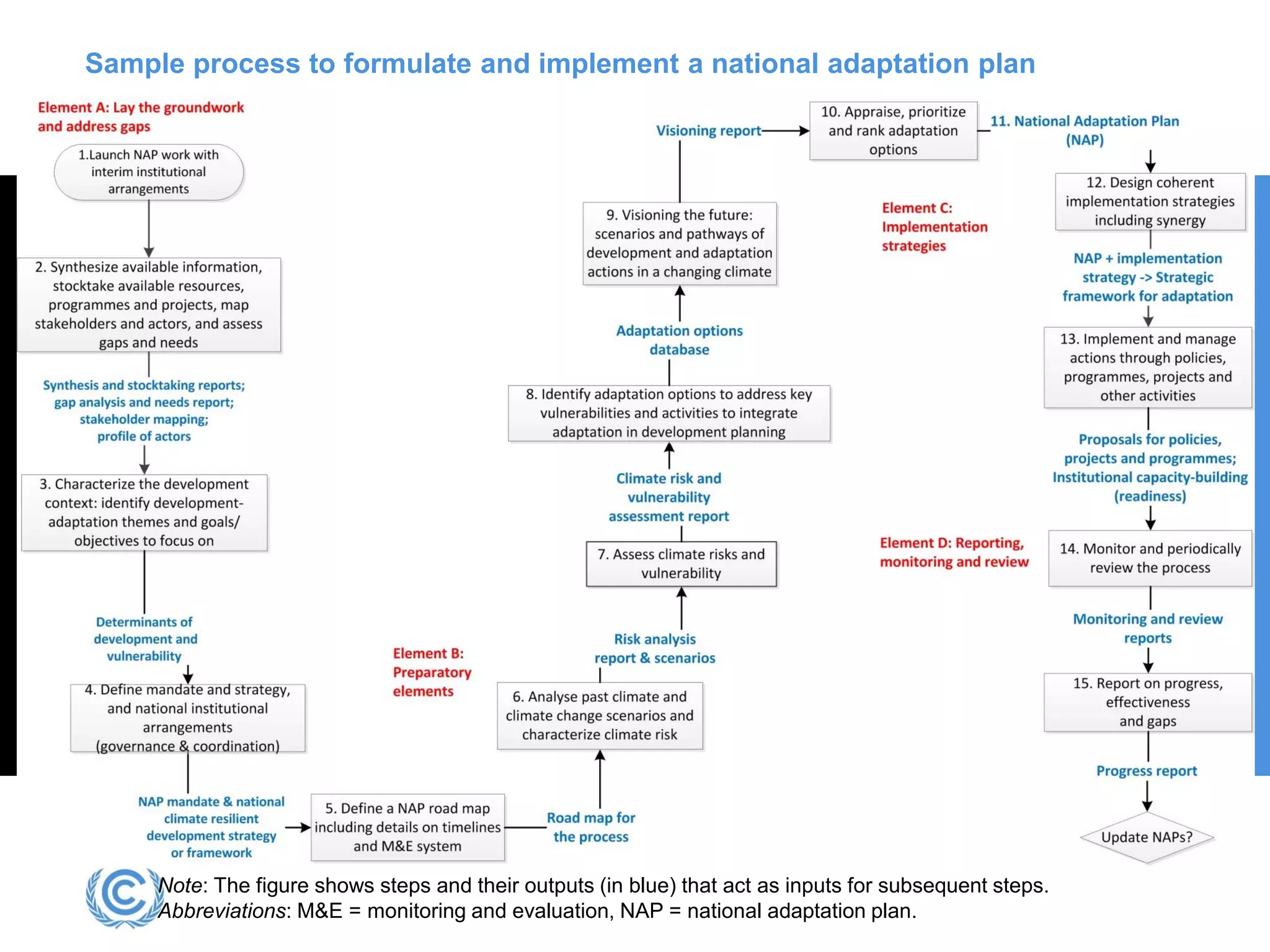
Note: The figure shows steps and their outputs (in blue) that act as inputs for subsequent steps.
Abbreviations: M&E = monitoring and evaluation, NAP = national adaptation plan.
Sample process to formulate and implement a national adaptation plan
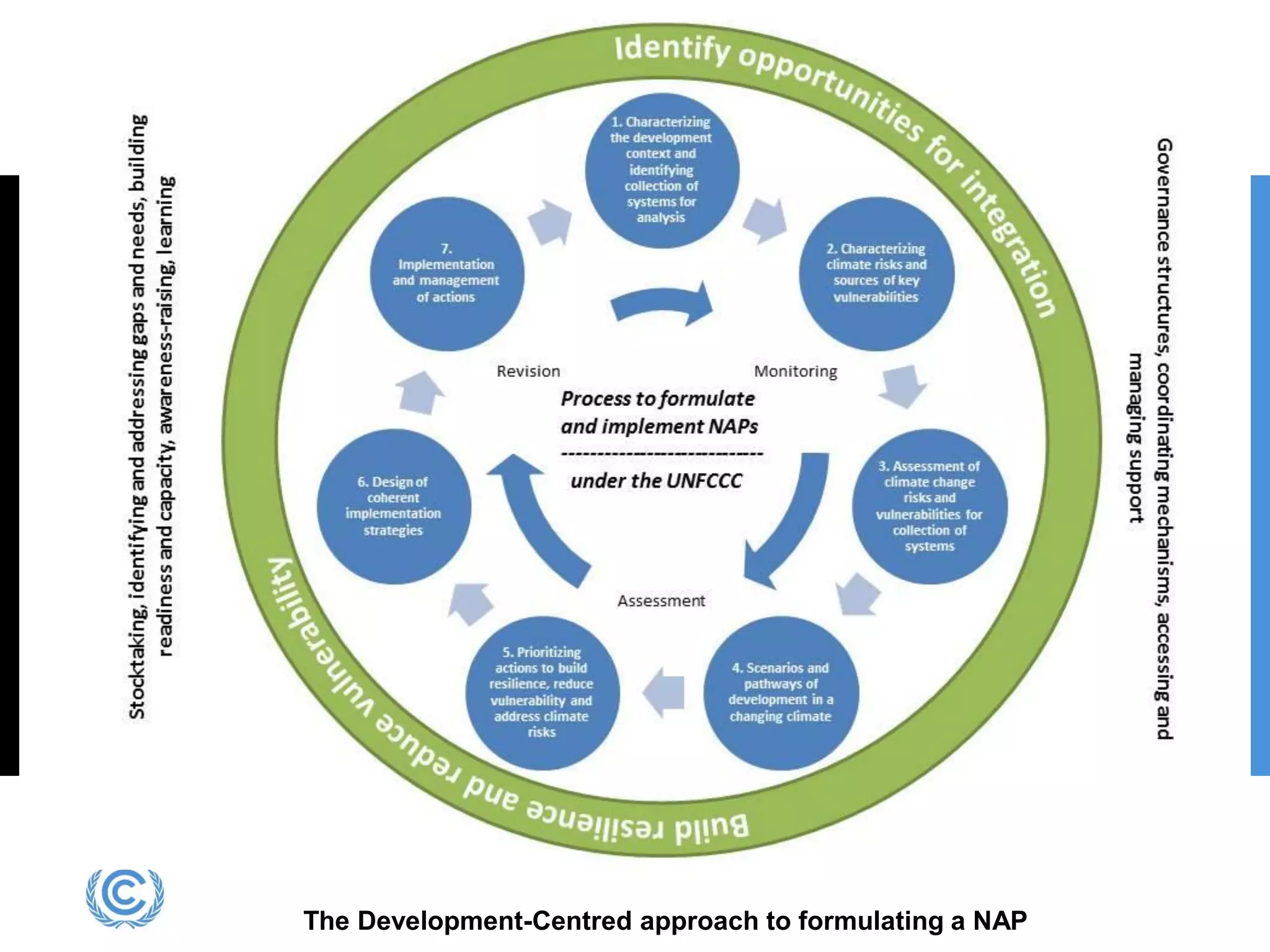
The Development-Centred approach to formulating a NAP
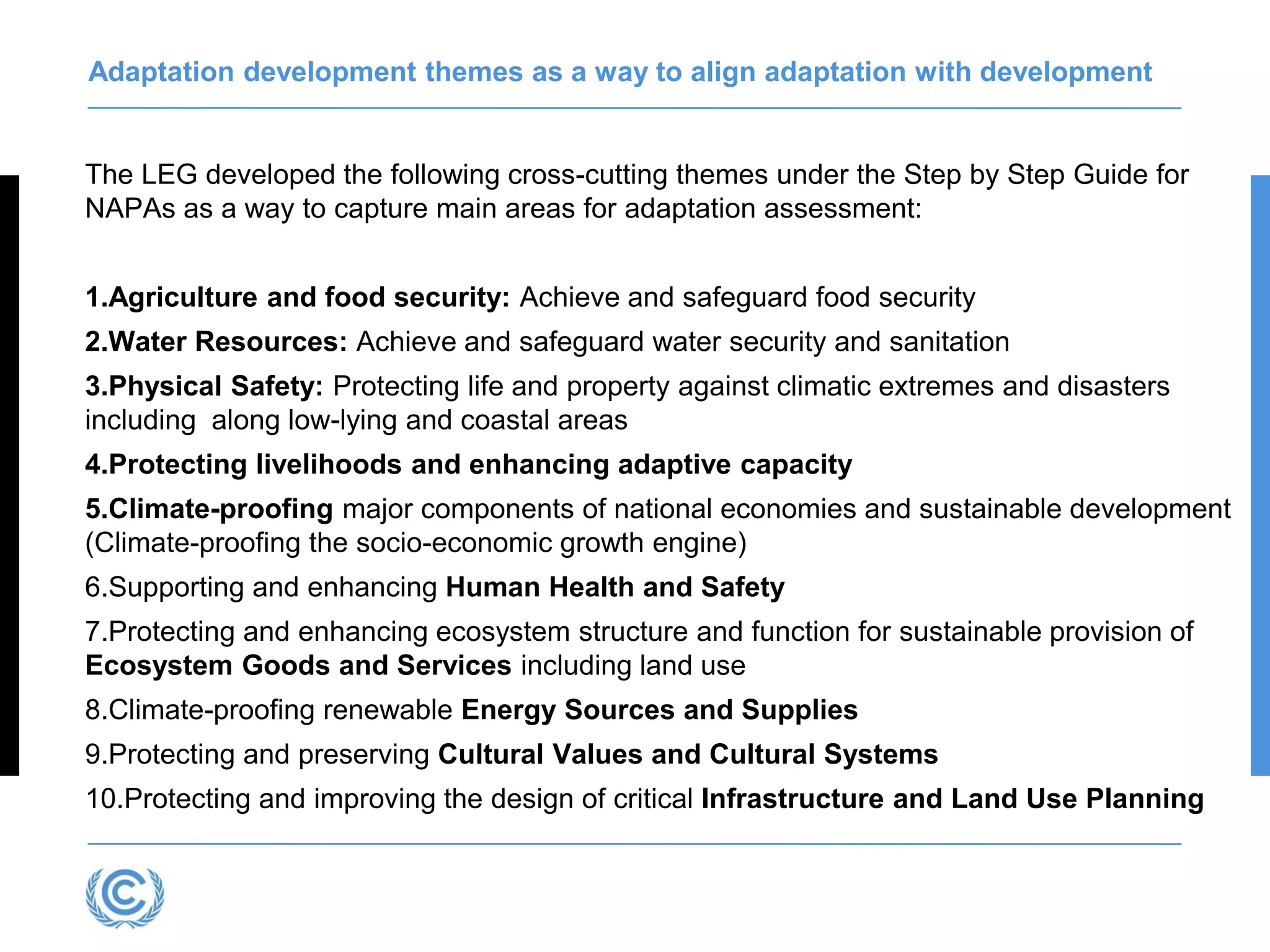
Adaptation development themes as a way to align adaptation with development
The LEG developed the following cross-cutting themes under the Step by Step Guide for
NAPAs as a way to capture main areas for adaptation assessment:
1.Agriculture and food security: Achieve and safeguard food security
2.Water Resources: Achieve and safeguard water security and sanitation
3.Physical Safety: Protecting life and property against climatic extremes and disasters
including along low-lying and coastal areas
4.Protecting livelihoods and enhancing adaptive capacity
5.Climate-proofing major components of national economies and sustainable development
(Climate-proofing the socio-economic growth engine)
6.Supporting and enhancing Human Health and Safety
7.Protecting and enhancing ecosystem structure and function for sustainable provision of
Ecosystem Goods and Services including land use
8.Climate-proofing renewable Energy Sources and Supplies
9.Protecting and preserving Cultural Values and Cultural Systems
10.Protecting and improving the design of critical Infrastructure and Land Use Planning
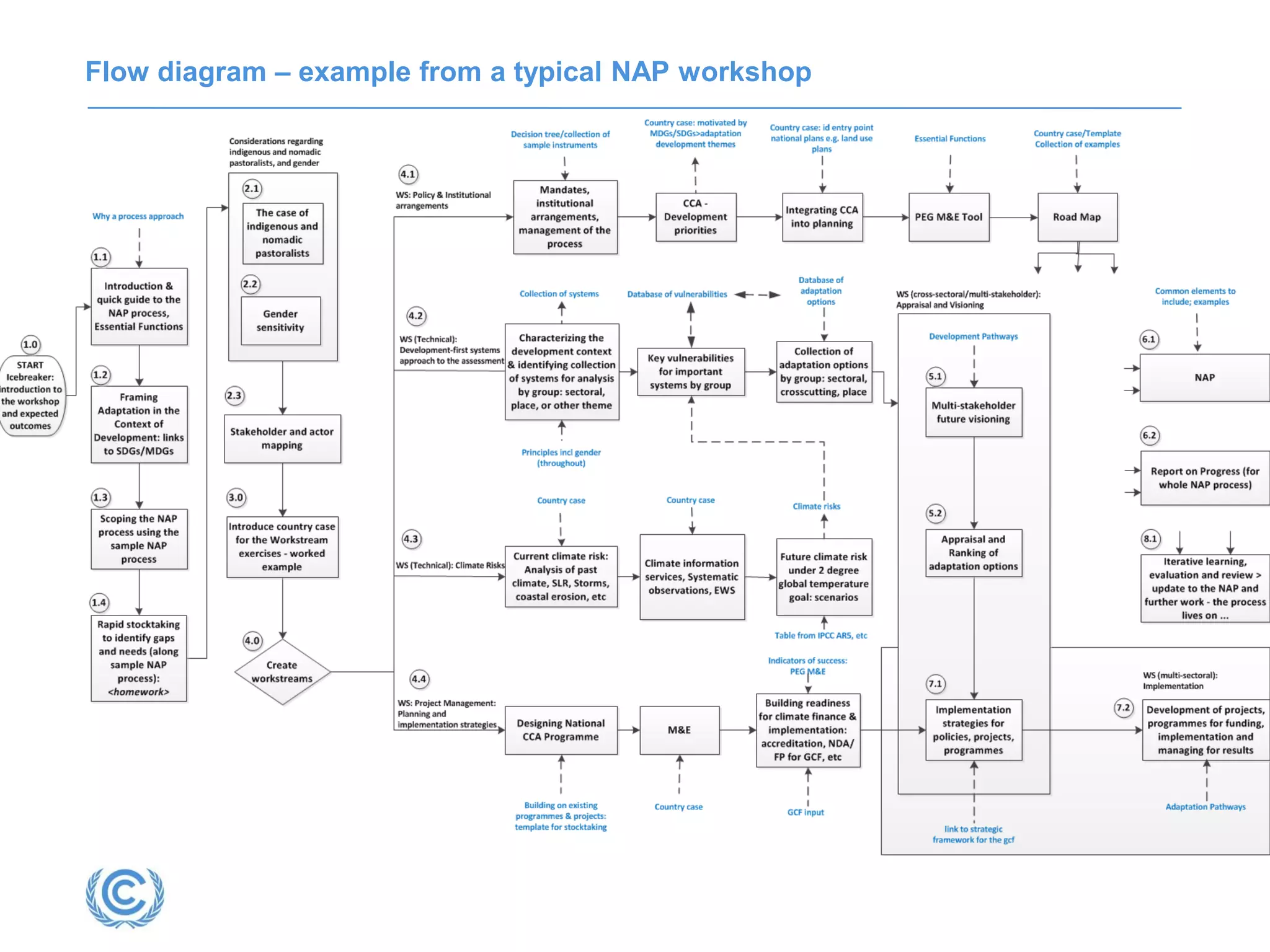
Flow diagram – example from a typical NAP workshop
Elements from Paris Outcome with specific links to NAPs
• Clear link to funding - The COP requested the Green Climate
Fund to expedite support for the least developed countries and
other developing country Parties for the formulation of national
adaptation plans, consistent with decisions 1/CP.16 and 5/CP.17,
and for the subsequent implementation of policies, projects and
programmes identified by them; (paragraph 47, Decision 1/CP.21)
• Global adaptation goal coherent with objectives of NAP process
• Link to sustainable development goals through objective b of
the process (integration)
• Global temperature goal of <2C
• implication on assessment, instead of focusing on a full
range of scenarios
• More of a policy directive and not to be confused with the
view of the scientists
Available support for NAPs
I. Technical support
– The LDC Expert Group (LEG)
– The Adaptation Committee
– Global support programmes
– Global/regional networks and centres
II. Financial support
– The Global Environment Facility (GEF) through the LDCF
and SCCF
– The Green Climate Fund (GCF) through the readiness and
the projects and programmes stream
– Funding from bilateral and multilateral agencies
LEG Support
Vision for adaptation in the LDCs with the supporting role of the
LEG
By 2020 the LDCs have achieved demonstrable results towards building
adaptive capacity, strengthening resilience and reducing vulnerability to
climate change – they have formulated robust/quality National Adaptation
Plans and are implementing priority adaptation needs identified by them
with funding from the GCF, and other sources, and they have a well-
structured adaptation planning process in place
Impacts reflecting long-term success of the work of the LEG in supporting
adaptation in the LDCs: 1/2
• Policy makers in the LDCs are motivated to take steps towards the
achievement of the global adaptation goal through National Adaptation
Plans by 2018-20 as they implement the Paris Agreement
• LDCs have put in place the essential functions (structures and
systems) at national levels for ensuring a successful process to
formulate and implement NAPs
• The process established to underpin the formulation and
implementation of National Adaptation Plans is functioning smoothly
and contributing to the iterative identification of adaptation needs and
options and is supporting successful implementation of adaptation
actions
• National Adaptation Plans are formulated by 2018 and latest 2020
Impacts reflecting long-term success of the work of the LEG in supporting
adaptation in the LDCs: 2/2
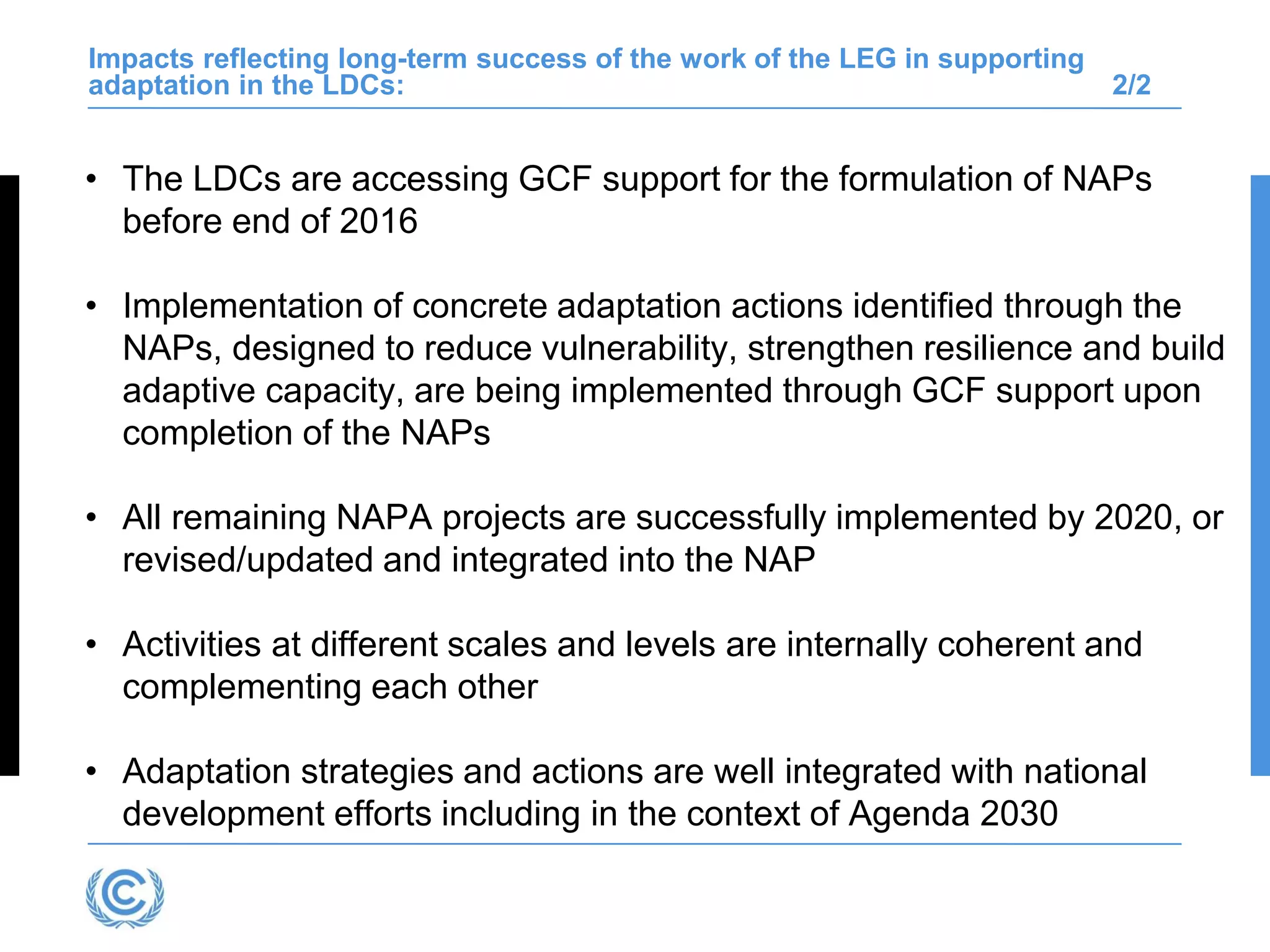
• The LDCs are accessing GCF support for the formulation of NAPs
before end of 2016
• Implementation of concrete adaptation actions identified through the
NAPs, designed to reduce vulnerability, strengthen resilience and build
adaptive capacity, are being implemented through GCF support upon
completion of the NAPs
• All remaining NAPA projects are successfully implemented by 2020, or
revised/updated and integrated into the NAP
• Activities at different scales and levels are internally coherent and
complementing each other
• Adaptation strategies and actions are well integrated with national
development efforts including in the context of Agenda 2030
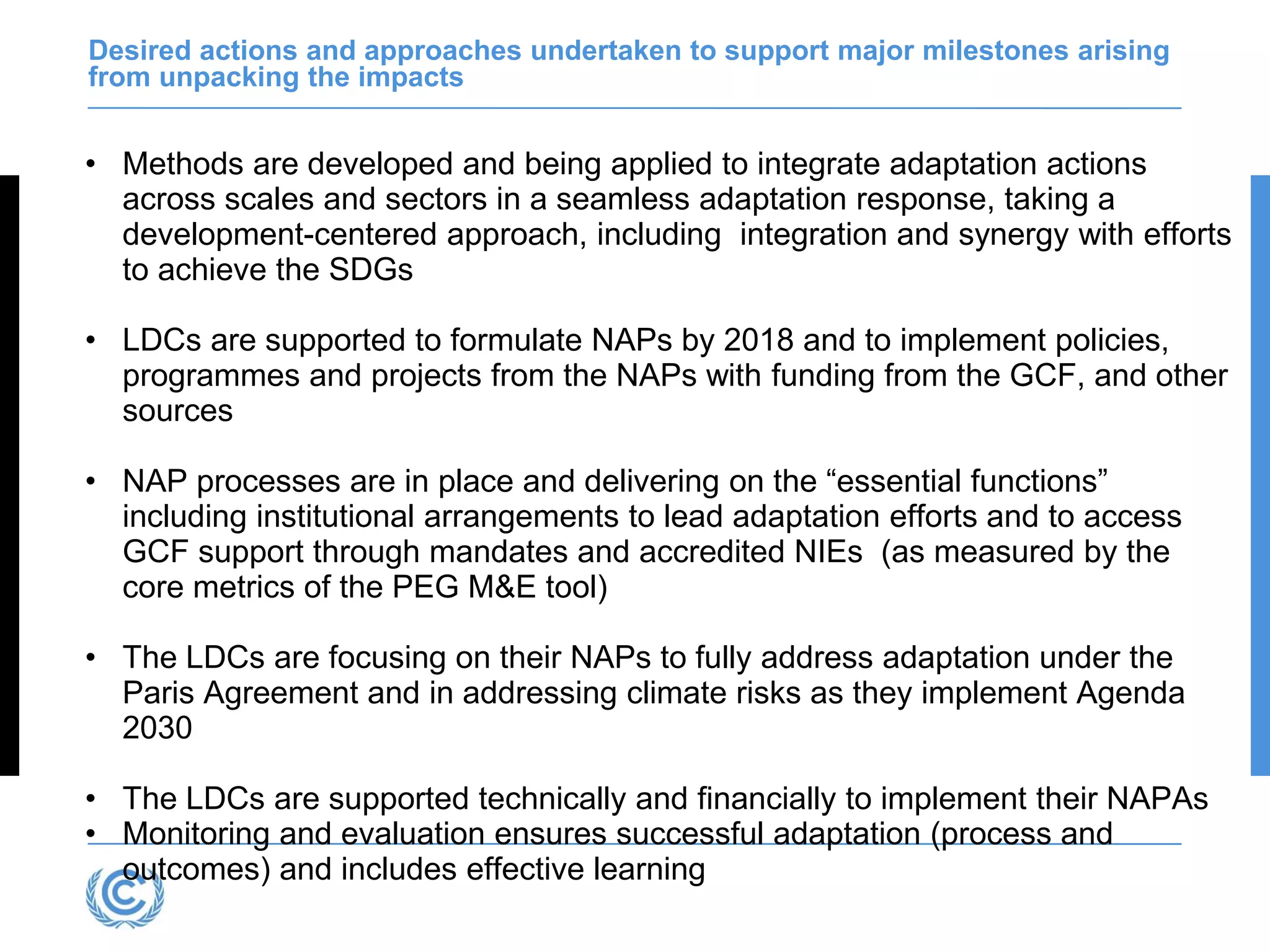
Desired actions and approaches undertaken to support major milestones arising
from unpacking the impacts
• Methods are developed and being applied to integrate adaptation actions
across scales and sectors in a seamless adaptation response, taking a
development-centered approach, including integration and synergy with efforts
to achieve the SDGs
• LDCs are supported to formulate NAPs by 2018 and to implement policies,
programmes and projects from the NAPs with funding from the GCF, and other
sources
• NAP processes are in place and delivering on the “essential functions”
including institutional arrangements to lead adaptation efforts and to access
GCF support through mandates and accredited NIEs (as measured by the
core metrics of the PEG M&E tool)
• The LDCs are focusing on their NAPs to fully address adaptation under the
Paris Agreement and in addressing climate risks as they implement Agenda
2030
• The LDCs are supported technically and financially to implement their NAPAs
• Monitoring and evaluation ensures successful adaptation (process and
outcomes) and includes effective learning
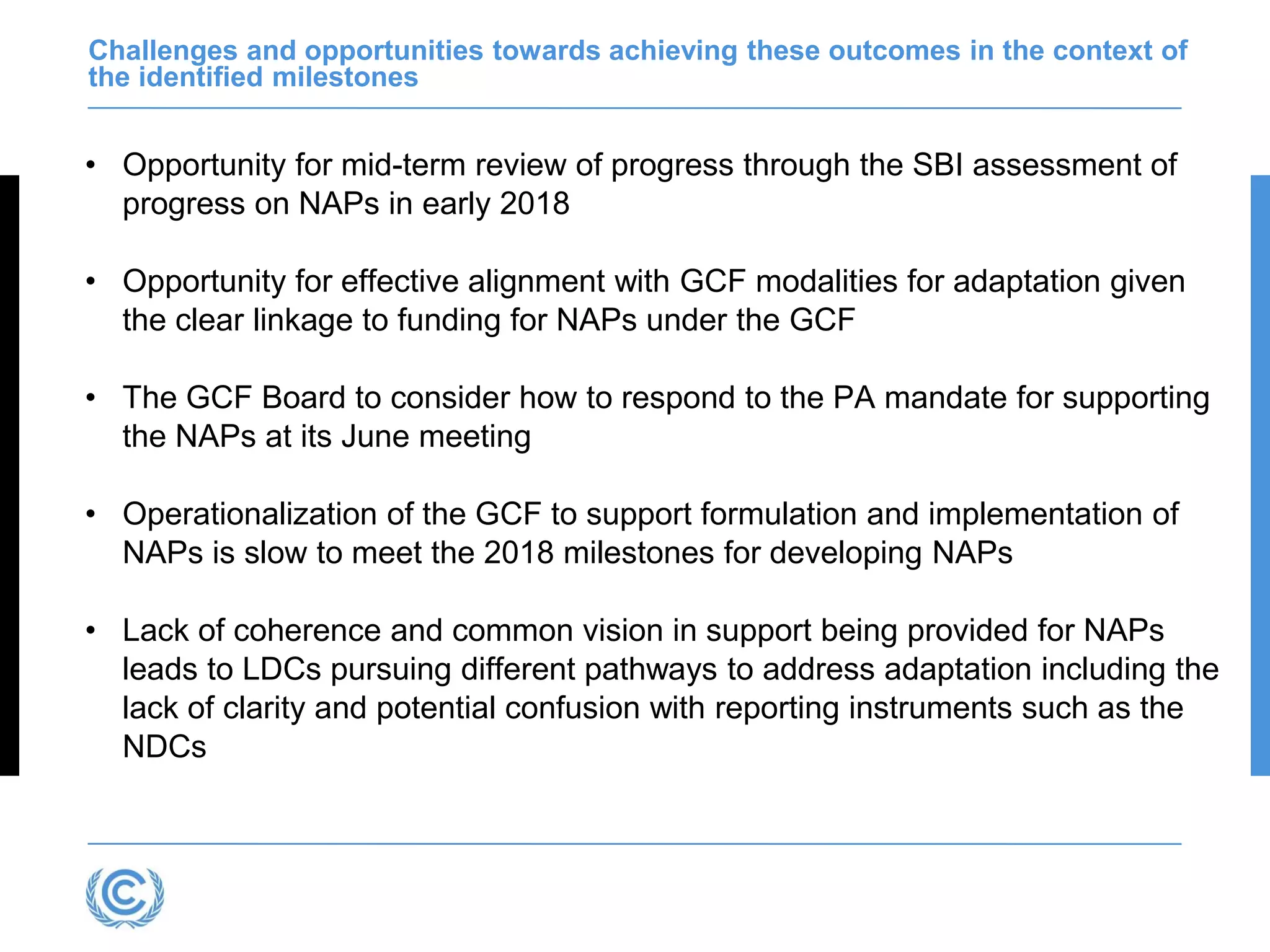
Challenges and opportunities towards achieving these outcomes in the context of
the identified milestones
• Opportunity for mid-term review of progress through the SBI assessment of
progress on NAPs in early 2018
• Opportunity for effective alignment with GCF modalities for adaptation given
the clear linkage to funding for NAPs under the GCF
• The GCF Board to consider how to respond to the PA mandate for supporting
the NAPs at its June meeting
• Operationalization of the GCF to support formulation and implementation of
NAPs is slow to meet the 2018 milestones for developing NAPs
• Lack of coherence and common vision in support being provided for NAPs
leads to LDCs pursuing different pathways to address adaptation including the
lack of clarity and potential confusion with reporting instruments such as the
NDCs
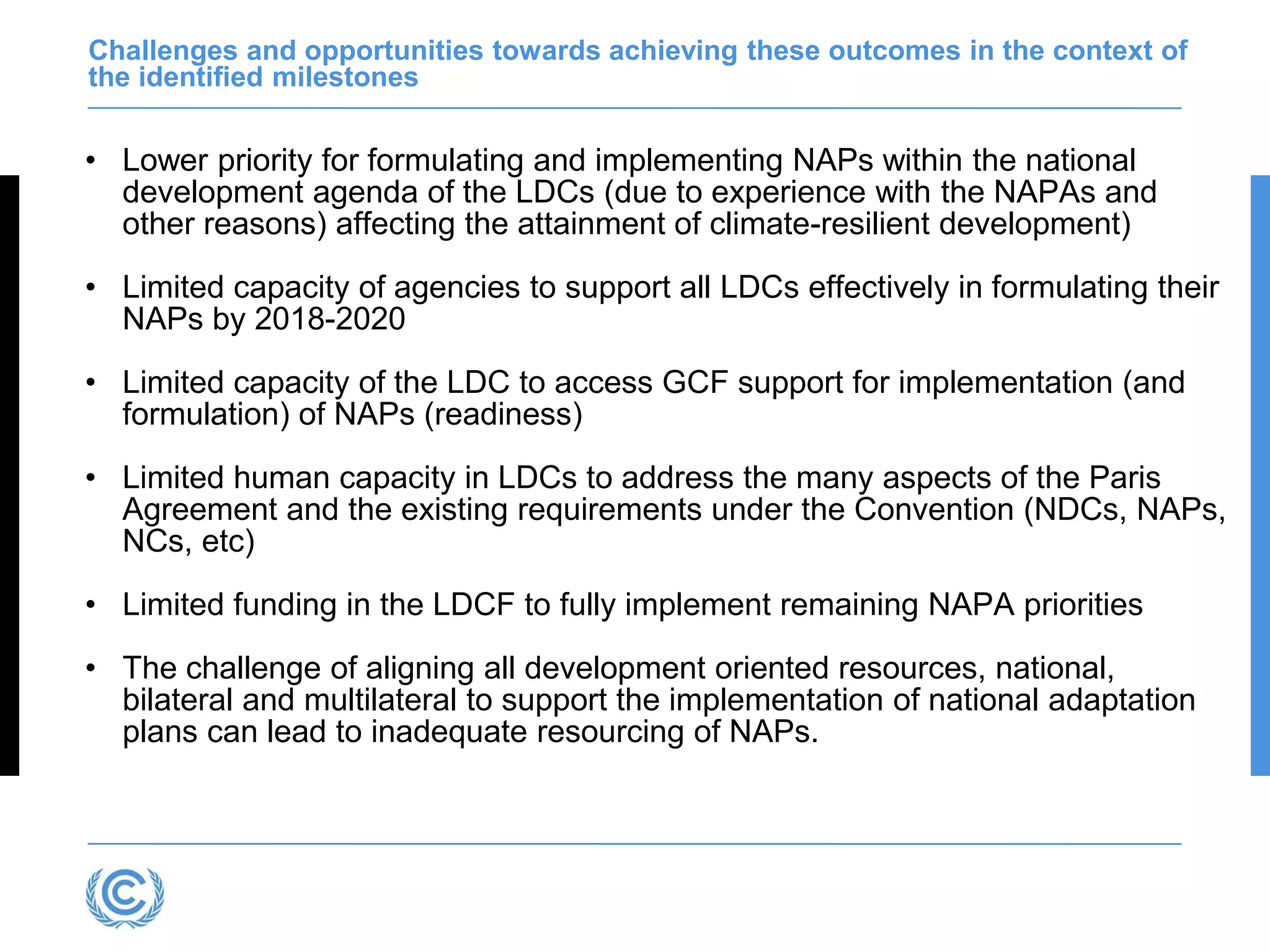
Challenges and opportunities towards achieving these outcomes in the context of
the identified milestones
• Lower priority for formulating and implementing NAPs within the national
development agenda of the LDCs (due to experience with the NAPAs and
other reasons) affecting the attainment of climate-resilient development)
• Limited capacity of agencies to support all LDCs effectively in formulating their
NAPs by 2018-2020
• Limited capacity of the LDC to access GCF support for implementation (and
formulation) of NAPs (readiness)
• Limited human capacity in LDCs to address the many aspects of the Paris
Agreement and the existing requirements under the Convention (NDCs, NAPs,
NCs, etc)
• Limited funding in the LDCF to fully implement remaining NAPA priorities
• The challenge of aligning all development oriented resources, national,
bilateral and multilateral to support the implementation of national adaptation
plans can lead to inadequate resourcing of NAPs.
For more information
Join The Adaptation Exchange on Facebook
http://www.facebook.com/The.Adaptation.Exchange
http://unfccc.int/6057

Paris Agreement and the NAP process Global Capacity Development

  • 1.
    Paris Agreement andthe NAP process Global Capacity Development Workshop: Integrating Agriculture in National Adaptation Plans 5-7 April 2016, Rome, Italy
  • 2.
  • 3.
    Adaptation under theAgreement (Article 7) Global goal on adaptation • Enhancing adaptive capacity • Strengthening resilience • Reducing vulnerability to climate change • Sustainable development • Global average temperature to well below 2°C Recognition of adaptation efforts of developing country Parties • To also be considered under the global stocktake Adaptation communications To include • Priorities • Implementation and support needs • Plans and actions Link to disaster risk reduction • Parties recognize that pursuing efforts towards 1.5°C would significantly reduce the risks and impacts of climate change Global stocktake • To recognize adaptation efforts • Enhance implementation of adaptation • Review adequacy and effectiveness of adaptation and support • Review progress in achieving the global goal on adaptation
  • 4.
    Recent developments onadaptation from COP 21 19/CP.21 – LDC matters/LEG Extension of LEG mandate under current terms of reference Additional elements to be addressed by the LEG Next review of the work of the LEG in 2020 4/CP.21 – NAPs Countries to submit NAPs through NAP Central LEG, AC to provide info to developing countries on accessing funding from the GCF for NAPs Review of progress made on NAPs in 2018 1/CP.21 – Adoption of the PA Contains mandates to the AC and the LEG work to give effect to the Agreement Technical examination process on adaptation (TEP-A) Request to GCF to expedite support for formulation of NAPs, and implementation of policies, projects and programmes AC, NWP and loss and damage Review of the work of the AC in 2016
  • 5.
  • 6.
    National adaptation plans Establishedunder the CAF (decision 1/CP.16, paras 15 to 18) As a process to enable LDCs to formulate and implement NAPs, building upon their experience in preparing and implementing NAPAs, as a means of identifying medium- and long-term adaptation needs and developing and implementing strategies and programmes to address those needs. Other developing country Parties are invited to employ the modalities formulated to support the NAPs. Objectives of the NAP process (decision 5/CP.17) are: a) To reduce vulnerability to the impacts of climate change, by building adaptive capacity and resilience; b) To facilitate the integration of climate change adaptation, in a coherent manner, into relevant new and existing policies, programmes and activities, in particular development planning processes and strategies, within all relevant sectors and at different levels, as appropriate.
  • 7.
    Global goal onadaptation …enhancing adaptive capacity, strengthening resilience and reducing vulnerability to climate change, with a view to contributing to sustainable development and ensuring an adequate adaptation response in the context of the temperature goal.
  • 8.
    Technical guidelines forthe NAP process Laying the Groundwork and addressing gaps Preparatory elements Implementation strategies Reporting, Monitoring, Review A.1. Initiating the NAP process A.2.: Stocktaking A.3.: Addressing Capacity Gaps A.4.: Development Needs and Climate Vulnerabilities B.1. Analysing Current & Future Climate B.2. Assessing Climate Vulnerabilities and Adaptation Options B.3. Review and Appraisal of Options B.4. Compiling, Communicating NAPs B.5.Integrating NAP into Development, Planning C.1. Prioritizing CCA in National Planning C.2. Long-term Implementation Strategy C.3. Enhancing Capacity for Planning, Implementation C.4. Promoting Coordination and Synergy D.1. Monitoring the NAP Process D.2. Assess Progress, Effectiveness, Gaps D.3. Iteratively Update NAPs D.4. Outreach and Reporting on Progress
  • 9.
    Note: The figureshows steps and their outputs (in blue) that act as inputs for subsequent steps. Abbreviations: M&E = monitoring and evaluation, NAP = national adaptation plan. Sample process to formulate and implement a national adaptation plan
  • 10.
  • 11.
    Adaptation development themesas a way to align adaptation with development The LEG developed the following cross-cutting themes under the Step by Step Guide for NAPAs as a way to capture main areas for adaptation assessment: 1.Agriculture and food security: Achieve and safeguard food security 2.Water Resources: Achieve and safeguard water security and sanitation 3.Physical Safety: Protecting life and property against climatic extremes and disasters including along low-lying and coastal areas 4.Protecting livelihoods and enhancing adaptive capacity 5.Climate-proofing major components of national economies and sustainable development (Climate-proofing the socio-economic growth engine) 6.Supporting and enhancing Human Health and Safety 7.Protecting and enhancing ecosystem structure and function for sustainable provision of Ecosystem Goods and Services including land use 8.Climate-proofing renewable Energy Sources and Supplies 9.Protecting and preserving Cultural Values and Cultural Systems 10.Protecting and improving the design of critical Infrastructure and Land Use Planning
  • 12.
    Flow diagram –example from a typical NAP workshop
  • 13.
    Elements from ParisOutcome with specific links to NAPs • Clear link to funding - The COP requested the Green Climate Fund to expedite support for the least developed countries and other developing country Parties for the formulation of national adaptation plans, consistent with decisions 1/CP.16 and 5/CP.17, and for the subsequent implementation of policies, projects and programmes identified by them; (paragraph 47, Decision 1/CP.21) • Global adaptation goal coherent with objectives of NAP process • Link to sustainable development goals through objective b of the process (integration) • Global temperature goal of <2C • implication on assessment, instead of focusing on a full range of scenarios • More of a policy directive and not to be confused with the view of the scientists
  • 14.
    Available support forNAPs I. Technical support – The LDC Expert Group (LEG) – The Adaptation Committee – Global support programmes – Global/regional networks and centres II. Financial support – The Global Environment Facility (GEF) through the LDCF and SCCF – The Green Climate Fund (GCF) through the readiness and the projects and programmes stream – Funding from bilateral and multilateral agencies
  • 15.
    LEG Support Vision foradaptation in the LDCs with the supporting role of the LEG By 2020 the LDCs have achieved demonstrable results towards building adaptive capacity, strengthening resilience and reducing vulnerability to climate change – they have formulated robust/quality National Adaptation Plans and are implementing priority adaptation needs identified by them with funding from the GCF, and other sources, and they have a well- structured adaptation planning process in place
  • 16.
    Impacts reflecting long-termsuccess of the work of the LEG in supporting adaptation in the LDCs: 1/2 • Policy makers in the LDCs are motivated to take steps towards the achievement of the global adaptation goal through National Adaptation Plans by 2018-20 as they implement the Paris Agreement • LDCs have put in place the essential functions (structures and systems) at national levels for ensuring a successful process to formulate and implement NAPs • The process established to underpin the formulation and implementation of National Adaptation Plans is functioning smoothly and contributing to the iterative identification of adaptation needs and options and is supporting successful implementation of adaptation actions • National Adaptation Plans are formulated by 2018 and latest 2020
  • 17.
    Impacts reflecting long-termsuccess of the work of the LEG in supporting adaptation in the LDCs: 2/2 • The LDCs are accessing GCF support for the formulation of NAPs before end of 2016 • Implementation of concrete adaptation actions identified through the NAPs, designed to reduce vulnerability, strengthen resilience and build adaptive capacity, are being implemented through GCF support upon completion of the NAPs • All remaining NAPA projects are successfully implemented by 2020, or revised/updated and integrated into the NAP • Activities at different scales and levels are internally coherent and complementing each other • Adaptation strategies and actions are well integrated with national development efforts including in the context of Agenda 2030
  • 18.
    Desired actions andapproaches undertaken to support major milestones arising from unpacking the impacts • Methods are developed and being applied to integrate adaptation actions across scales and sectors in a seamless adaptation response, taking a development-centered approach, including integration and synergy with efforts to achieve the SDGs • LDCs are supported to formulate NAPs by 2018 and to implement policies, programmes and projects from the NAPs with funding from the GCF, and other sources • NAP processes are in place and delivering on the “essential functions” including institutional arrangements to lead adaptation efforts and to access GCF support through mandates and accredited NIEs (as measured by the core metrics of the PEG M&E tool) • The LDCs are focusing on their NAPs to fully address adaptation under the Paris Agreement and in addressing climate risks as they implement Agenda 2030 • The LDCs are supported technically and financially to implement their NAPAs • Monitoring and evaluation ensures successful adaptation (process and outcomes) and includes effective learning
  • 19.
    Challenges and opportunitiestowards achieving these outcomes in the context of the identified milestones • Opportunity for mid-term review of progress through the SBI assessment of progress on NAPs in early 2018 • Opportunity for effective alignment with GCF modalities for adaptation given the clear linkage to funding for NAPs under the GCF • The GCF Board to consider how to respond to the PA mandate for supporting the NAPs at its June meeting • Operationalization of the GCF to support formulation and implementation of NAPs is slow to meet the 2018 milestones for developing NAPs • Lack of coherence and common vision in support being provided for NAPs leads to LDCs pursuing different pathways to address adaptation including the lack of clarity and potential confusion with reporting instruments such as the NDCs
  • 20.
    Challenges and opportunitiestowards achieving these outcomes in the context of the identified milestones • Lower priority for formulating and implementing NAPs within the national development agenda of the LDCs (due to experience with the NAPAs and other reasons) affecting the attainment of climate-resilient development) • Limited capacity of agencies to support all LDCs effectively in formulating their NAPs by 2018-2020 • Limited capacity of the LDC to access GCF support for implementation (and formulation) of NAPs (readiness) • Limited human capacity in LDCs to address the many aspects of the Paris Agreement and the existing requirements under the Convention (NDCs, NAPs, NCs, etc) • Limited funding in the LDCF to fully implement remaining NAPA priorities • The challenge of aligning all development oriented resources, national, bilateral and multilateral to support the implementation of national adaptation plans can lead to inadequate resourcing of NAPs.
  • 21.
    For more information JoinThe Adaptation Exchange on Facebook http://www.facebook.com/The.Adaptation.Exchange http://unfccc.int/6057