How do we
 support parents
to help their kids
 with homework
 and other home
     literacy
    activities?
When considering homework…
• Provide Guidelines

• Be Explicit

• Offer Workshops
Provide guidelines, not expectations
Why Guidelines?
      “Guidelines or Options suggest a voluntary
process, that parents have choices in what they
will or will not do.
Expectations, however, indicate teachers expect
parents to do certain things, meaning that if
parents don’t do those things—they or their
children may be judged poorly”
(Vatterott, 2009, p. 49-50).
Be Explicit

Many educators provide parents
with rushed advice, simply
because they have not clarified
the assignments and how
parents can support students
(Musti-Rao & Cartledge, 2004).
Provide explicit explanations of recurring
homework assignments, and invite parents to
seek clarifications about assignments.
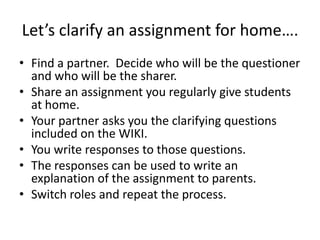
Let’s clarify an assignment for home….
• Find a partner. Decide who will be the questioner
  and who will be the sharer.
• Share an assignment you regularly give students
  at home.
• Your partner asks you the clarifying questions
  included on the WIKI.
• You write responses to those questions.
• The responses can be used to write an
  explanation of the assignment to parents.
• Switch roles and repeat the process.
Offer a Workshop
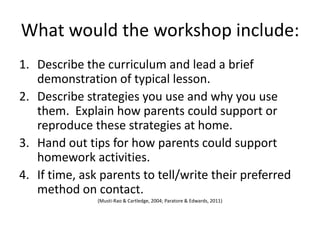
What would the workshop include:
1. Describe the curriculum and lead a brief
   demonstration of typical lesson.
2. Describe strategies you use and why you use
   them. Explain how parents could support or
   reproduce these strategies at home.
3. Hand out tips for how parents could support
   homework activities.
4. If time, ask parents to tell/write their preferred
   method on contact.
               (Musti-Rao & Cartledge, 2004; Paratore & Edwards, 2011)
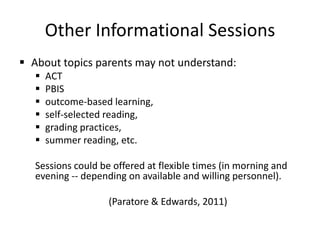
Other Informational Sessions
 About topics parents may not understand:
      ACT
      PBIS
      outcome-based learning,
      self-selected reading,
      grading practices,
      summer reading, etc.

   Sessions could be offered at flexible times (in morning and
   evening -- depending on available and willing personnel).

                    (Paratore & Edwards, 2011)
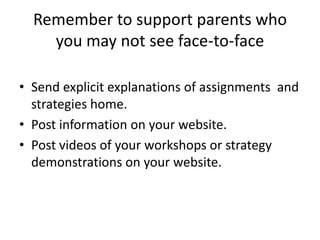
Remember to support parents who
    you may not see face-to-face

• Send explicit explanations of assignments and
  strategies home.
• Post information on your website.
• Post videos of your workshops or strategy
  demonstrations on your website.
References
Musti-Rao, S., & Cartledge, G. (2004). Making home an advantage in the
        prevention of reading failure: Strategies for collaborating with
        parents in urban schools. Preventing School Failure, 48(4). 15-21.
Paratore, J. R., & Edwards, P. A. (2011). Parent-teacher partnerships that make
         a difference in children's literacy achievement. In L. M. Morrow & L.
         B. Gambrell (Eds.), Best practices in literacy instruction. (pp. 436-
         454). New York, NY: The Guilford Press.

Vatterott, C. (2009). Rethinking homework: Best practices that support diverse
         needs. Alexandria, VA: ASCD.

Vatterott, C. (2012, October). "Coeducation": Negotiating a new
         parent-school relationship. Poster session presented at the
         Association for Supervision and Curriculum Development Fall
         Conference, Atlanta, GA.

Parents3

  • 1.
    How do we support parents to help their kids with homework and other home literacy activities?
  • 2.
    When considering homework… •Provide Guidelines • Be Explicit • Offer Workshops
  • 3.
  • 4.
    Why Guidelines? “Guidelines or Options suggest a voluntary process, that parents have choices in what they will or will not do. Expectations, however, indicate teachers expect parents to do certain things, meaning that if parents don’t do those things—they or their children may be judged poorly” (Vatterott, 2009, p. 49-50).
  • 5.
    Be Explicit Many educatorsprovide parents with rushed advice, simply because they have not clarified the assignments and how parents can support students (Musti-Rao & Cartledge, 2004).
  • 6.
    Provide explicit explanationsof recurring homework assignments, and invite parents to seek clarifications about assignments.
  • 7.
    Let’s clarify anassignment for home…. • Find a partner. Decide who will be the questioner and who will be the sharer. • Share an assignment you regularly give students at home. • Your partner asks you the clarifying questions included on the WIKI. • You write responses to those questions. • The responses can be used to write an explanation of the assignment to parents. • Switch roles and repeat the process.
  • 8.
  • 9.
    What would theworkshop include: 1. Describe the curriculum and lead a brief demonstration of typical lesson. 2. Describe strategies you use and why you use them. Explain how parents could support or reproduce these strategies at home. 3. Hand out tips for how parents could support homework activities. 4. If time, ask parents to tell/write their preferred method on contact. (Musti-Rao & Cartledge, 2004; Paratore & Edwards, 2011)
  • 10.
    Other Informational Sessions About topics parents may not understand:  ACT  PBIS  outcome-based learning,  self-selected reading,  grading practices,  summer reading, etc. Sessions could be offered at flexible times (in morning and evening -- depending on available and willing personnel). (Paratore & Edwards, 2011)
  • 11.
    Remember to supportparents who you may not see face-to-face • Send explicit explanations of assignments and strategies home. • Post information on your website. • Post videos of your workshops or strategy demonstrations on your website.
  • 12.
    References Musti-Rao, S., &Cartledge, G. (2004). Making home an advantage in the prevention of reading failure: Strategies for collaborating with parents in urban schools. Preventing School Failure, 48(4). 15-21. Paratore, J. R., & Edwards, P. A. (2011). Parent-teacher partnerships that make a difference in children's literacy achievement. In L. M. Morrow & L. B. Gambrell (Eds.), Best practices in literacy instruction. (pp. 436- 454). New York, NY: The Guilford Press. Vatterott, C. (2009). Rethinking homework: Best practices that support diverse needs. Alexandria, VA: ASCD. Vatterott, C. (2012, October). "Coeducation": Negotiating a new parent-school relationship. Poster session presented at the Association for Supervision and Curriculum Development Fall Conference, Atlanta, GA.