Julie Maimes, Buncombe County Early College
julie.maimes@bcsemail.org
Kenny McKee, Buncombe County Schools
kenny.mckee@bcsemail.org
Twitter: @kennycmckee
 Powerful Teaching and Learning
 Ready for College
Participants will:
1) Understand the value of literacy scaffolding and instruction in
the classroom.
2) Acquire practical strategies that can be easily implemented.
3) Learn how to formatively assess students’ mastery of content
and language.
4) Determine strategies that support students reaching Common
Core Literacy Standards for science.
http://www.polleverywhere.com/multiple_choice_polls/k0HSYC9FcMGwG7v
• Equality
• Choice
• Voice
• Reflection
• Dialogue
• Praxis
• Reciprocity
"The goal is to gradually release the
responsibility of strategic processing too
students...so they are using the strategy
independently..." (Almasi & Hart, 2011,
p. 269).
Instructional practices that foster deep learning
require transformation of ideas "in the mind
and on paper" -- not the transmission of
ideas (Fisher, Schell, & Frey, 2004).
"Mastery of technical language has long been
recognized as a predictor of success in any
field" (Fisher & Frey, 2012, p. 38).
"Typically, the words and concepts
students absorb and use as they listen
and talk are the foundation for what they
will read and write later" (Bromley, 2007,
p. 529).
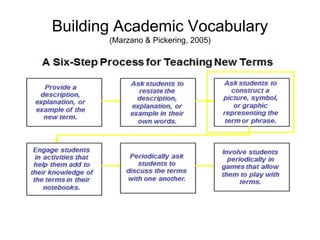
Building Academic Vocabulary
(Marzano & Pickering, 2005)
Which of these steps do you consistently
employ and how?
Which do you believe you could employ more
consistently?
It is difficult to know students' thinking unless
they show their thinking through speaking,
writing, and action. (Harvey & Goudvis,
2007).
Give One-Get One
"A ________ is different from a __________
because....
*proton/neutron
*terrestrial planet/jovial planet
*plant cell/animal cell
I hypothesize that ....
Based upon the results of the experiment, I
infer that...
I believe the variable of ___________ will result
in....
 Teacher to Student (Modeling Questioning
Strategies)
 Student to Student
• Headbands
• Memory Match
• Definition Fishin’
• Charades
• Scattergories
• Mile-a-Minute
* astronomy
* geology
* biology
* physics
* chemistry
* anatomy
* environmental science
• Paideia/Socratic Seminars
• Dump and Clump
• Critical Friends Protocols (Save the Last Word
for Me, Text Rendering)
• Trading Cards
• Prompts for Eliciting Thinking
http://www.paideia.org/for-teachers/materials-to-download/
INSERT
(Interactive Note-taking System for Effective
Reading and Thinking)
? -- Questions
C -- Connections
! -- Surprising Ideas
+ -- Important Ideas
$2 Summary is a concrete way to help students
focus on the gist of a text.
Use the summary box in the INSERT form the
collectively develop a summary statement.
You cannot spend more than $2. Each word
costs 20 cents.
• Sharing Reading Purpose
• Literacy Roles
• Jigsaw
• Reading and Analyzing "Authentic" Texts
• $2 Summary/Don’t Bounce the Check
• Foldables
 Writing format used to foster college-
readiness skills in all disciplines
 Developed by teachers at Kings Mountain
High School
 Received from Elizabeth Wiggs at Lee Early
College (Sanford, NC)
 TOPIC
 POINT
 EXAMPLE
 QUOTATION
 ELABORATION
 ANALYSIS
Read Learn Write
Assessment Vocabulary Understand
Speak Teach Think
Junk Food -- Writing Activity
• Sentence frames
• Whiteboard meetings
• Edmodo/Discussion Boards/Blogs
• Cornell research note-taking
• Pro-Con T-Charts/Take a Stand
Start, Stop, Continue
What will you start doing?
What will you stop doing?
What will you continue doing?
Almasi, J. F., & Hart, S. J. (2011). Best practices in comprehension
instruction. In L. M. Morrow & L. B. Gambrell (Eds.). Best practices
in literacy instruction (p. 250-275). New York, NY: The Guilford
Press.
Bromley, K. (2007). Nine things every teacher should know about words and
vocabulary instruction. Journal of Adolescent & Adult Literacy,
50(7), 529-537.
Fisher, D., & Frey, N. (2012) Improving adolescent literacy: Content area
strategies that work. (3rd ed.). Boston, MA: Pearson.
Fisher, D., Schell, E., & Frey, N. (2004). "In the mind and on the paper":
Teaching students to transform (and own) texts. The Social Studies
Review, 26-31.
Harvey, S., & Goudvis, A. (2007). Strategies that work: Teaching
comprehension for understanding and engagement. (2nd ed.).
Portland, ME: Stenhouse Publishers.
Knight, J. (2007). Instructional coaching: A partnership approach to
improving instruction. Thousand Oaks, CA: Corwin.
Marzano, R. J., & Pickering, D. J. (2005). Building academic vocabulary:
Teachers' manual. Alexandria, VA: ASCD.
National Paideia Center. (2013). Seminar lesson plans. Retrieved from
http://www.paideia.org/for-teachers/materials-to-download/

Nurturing Scientific Readers, Writers, and Speakers

  • 1.
    Julie Maimes, BuncombeCounty Early College julie.maimes@bcsemail.org Kenny McKee, Buncombe County Schools kenny.mckee@bcsemail.org Twitter: @kennycmckee
  • 2.
     Powerful Teachingand Learning  Ready for College
  • 3.
    Participants will: 1) Understandthe value of literacy scaffolding and instruction in the classroom. 2) Acquire practical strategies that can be easily implemented. 3) Learn how to formatively assess students’ mastery of content and language. 4) Determine strategies that support students reaching Common Core Literacy Standards for science.
  • 4.
  • 5.
    • Equality • Choice •Voice • Reflection • Dialogue • Praxis • Reciprocity
  • 6.
    "The goal isto gradually release the responsibility of strategic processing too students...so they are using the strategy independently..." (Almasi & Hart, 2011, p. 269). Instructional practices that foster deep learning require transformation of ideas "in the mind and on paper" -- not the transmission of ideas (Fisher, Schell, & Frey, 2004).
  • 7.
    "Mastery of technicallanguage has long been recognized as a predictor of success in any field" (Fisher & Frey, 2012, p. 38). "Typically, the words and concepts students absorb and use as they listen and talk are the foundation for what they will read and write later" (Bromley, 2007, p. 529).
  • 8.
  • 9.
    Which of thesesteps do you consistently employ and how? Which do you believe you could employ more consistently?
  • 10.
    It is difficultto know students' thinking unless they show their thinking through speaking, writing, and action. (Harvey & Goudvis, 2007).
  • 11.
  • 12.
    "A ________ isdifferent from a __________ because.... *proton/neutron *terrestrial planet/jovial planet *plant cell/animal cell
  • 13.
    I hypothesize that.... Based upon the results of the experiment, I infer that... I believe the variable of ___________ will result in....
  • 14.
     Teacher toStudent (Modeling Questioning Strategies)  Student to Student
  • 15.
    • Headbands • MemoryMatch • Definition Fishin’ • Charades • Scattergories • Mile-a-Minute
  • 17.
    * astronomy * geology *biology * physics * chemistry * anatomy * environmental science
  • 18.
    • Paideia/Socratic Seminars •Dump and Clump • Critical Friends Protocols (Save the Last Word for Me, Text Rendering) • Trading Cards • Prompts for Eliciting Thinking
  • 20.
  • 21.
    INSERT (Interactive Note-taking Systemfor Effective Reading and Thinking)
  • 22.
    ? -- Questions C-- Connections ! -- Surprising Ideas + -- Important Ideas
  • 23.
    $2 Summary isa concrete way to help students focus on the gist of a text. Use the summary box in the INSERT form the collectively develop a summary statement. You cannot spend more than $2. Each word costs 20 cents.
  • 24.
    • Sharing ReadingPurpose • Literacy Roles • Jigsaw • Reading and Analyzing "Authentic" Texts • $2 Summary/Don’t Bounce the Check • Foldables
  • 26.
     Writing formatused to foster college- readiness skills in all disciplines  Developed by teachers at Kings Mountain High School  Received from Elizabeth Wiggs at Lee Early College (Sanford, NC)
  • 27.
     TOPIC  POINT EXAMPLE  QUOTATION  ELABORATION  ANALYSIS
  • 28.
    Read Learn Write AssessmentVocabulary Understand Speak Teach Think
  • 29.
    Junk Food --Writing Activity
  • 30.
    • Sentence frames •Whiteboard meetings • Edmodo/Discussion Boards/Blogs • Cornell research note-taking • Pro-Con T-Charts/Take a Stand
  • 31.
    Start, Stop, Continue Whatwill you start doing? What will you stop doing? What will you continue doing?
  • 32.
    Almasi, J. F.,& Hart, S. J. (2011). Best practices in comprehension instruction. In L. M. Morrow & L. B. Gambrell (Eds.). Best practices in literacy instruction (p. 250-275). New York, NY: The Guilford Press. Bromley, K. (2007). Nine things every teacher should know about words and vocabulary instruction. Journal of Adolescent & Adult Literacy, 50(7), 529-537. Fisher, D., & Frey, N. (2012) Improving adolescent literacy: Content area strategies that work. (3rd ed.). Boston, MA: Pearson. Fisher, D., Schell, E., & Frey, N. (2004). "In the mind and on the paper": Teaching students to transform (and own) texts. The Social Studies Review, 26-31.
  • 33.
    Harvey, S., &Goudvis, A. (2007). Strategies that work: Teaching comprehension for understanding and engagement. (2nd ed.). Portland, ME: Stenhouse Publishers. Knight, J. (2007). Instructional coaching: A partnership approach to improving instruction. Thousand Oaks, CA: Corwin. Marzano, R. J., & Pickering, D. J. (2005). Building academic vocabulary: Teachers' manual. Alexandria, VA: ASCD. National Paideia Center. (2013). Seminar lesson plans. Retrieved from http://www.paideia.org/for-teachers/materials-to-download/