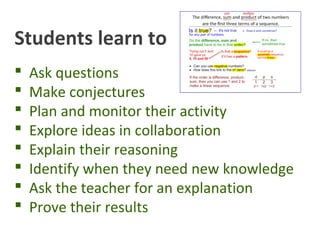
Students learn to
 Ask questions
 Make conjectures
 Plan and monitor their activity
 Explore ideas in collaboration
 Explain their reasoning
 Identify when they need new knowledge
 Ask the teacher for an explanation
 Prove their results
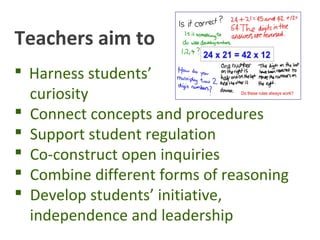
Teachers aim to
 Harness students’
curiosity
 Connect concepts and procedures
 Support student regulation
 Co-construct open inquiries
 Combine different forms of reasoning
 Develop students’ initiative,
independence and leadership
Why Inquiry Maths?
Curricular aims
Reason mathematically by following a line
of enquiry (National Curriculum, England)
Construct viable arguments and critique the reasoning of others (Common Core
MP3, USA)
Develop confident, creative users and communicators of mathematics, able
to investigate (F-10 Curriculum, Australia)
Employ inductive reasoning, making generalizations based on specific
findings from their investigations.... Use deductive reasoning to assess the
validity of conjectures and to formulate proofs (Ontario Curriculum, Canada)
Encourage students to develop independence and to take responsibility for
their own learning (IB PYP) and to become creative, critical and reflective
thinkers (IB MYP)
Develop thinking; use symbols; manage self; relate to others; participate and
contribute (Key Competencies, New Zealand Curriculum)
What is on the site?
 Inquiry prompts for
topics related to the
maths curriculum (suitable for students aged 11-16)
 Notes and resources for each inquiry
 A guide to Inquiry Maths lessons
 Suggestions for creating your own prompt
 Regulatory cards to help students direct
lessons
 Articles and posts on Inquiry Maths

Inquiry maths introduction

  • 1.
    Students learn to Ask questions  Make conjectures  Plan and monitor their activity  Explore ideas in collaboration  Explain their reasoning  Identify when they need new knowledge  Ask the teacher for an explanation  Prove their results
  • 2.
    Teachers aim to Harness students’ curiosity  Connect concepts and procedures  Support student regulation  Co-construct open inquiries  Combine different forms of reasoning  Develop students’ initiative, independence and leadership
  • 3.
    Why Inquiry Maths? Curricularaims Reason mathematically by following a line of enquiry (National Curriculum, England) Construct viable arguments and critique the reasoning of others (Common Core MP3, USA) Develop confident, creative users and communicators of mathematics, able to investigate (F-10 Curriculum, Australia) Employ inductive reasoning, making generalizations based on specific findings from their investigations.... Use deductive reasoning to assess the validity of conjectures and to formulate proofs (Ontario Curriculum, Canada) Encourage students to develop independence and to take responsibility for their own learning (IB PYP) and to become creative, critical and reflective thinkers (IB MYP) Develop thinking; use symbols; manage self; relate to others; participate and contribute (Key Competencies, New Zealand Curriculum)
  • 4.
    What is onthe site?  Inquiry prompts for topics related to the maths curriculum (suitable for students aged 11-16)  Notes and resources for each inquiry  A guide to Inquiry Maths lessons  Suggestions for creating your own prompt  Regulatory cards to help students direct lessons  Articles and posts on Inquiry Maths