Introduction
Larry A. Doxtater
AET / 531
Schalette Gudger
3 Sep 2013
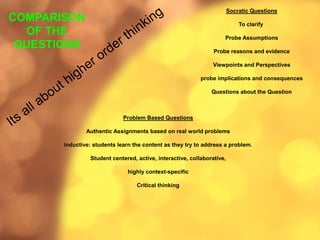
COMPARISON
OF THE
QUESTIONS
Problem Based Questions
Authentic Assignments based on real world problems
inductive: students learn the content as they try to address a problem.
Student centered, active, interactive, collaborative,
highly context-specific
Critical thinking
Socratic Questions
To clarify
Probe Assumptions
Probe reasons and evidence
Viewpoints and Perspectives
probe implications and consequences
Questions about the Question
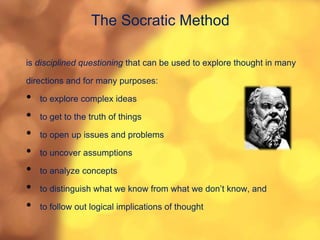
The Socratic Method
is disciplined questioning that can be used to explore thought in many
directions and for many purposes:
• to explore complex ideas
• to get to the truth of things
• to open up issues and problems
• to uncover assumptions
• to analyze concepts
• to distinguish what we know from what we don’t know, and
• to follow out logical implications of thought
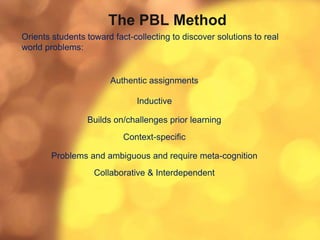
The PBL Method
Orients students toward fact-collecting to discover solutions to real
world problems:
Authentic assignments
Inductive
Builds on/challenges prior learning
Context-specific
Problems and ambiguous and require meta-cognition
Collaborative & Interdependent
ANALYSIS &
CHALLENGES Socratic Questions
• Fact and Opinion.
• Opportunity to exercise critical
thinking of Student's prior
knowledge.
• Facilitator’s role is to steer
learners in the right direction.
• Questions should challenge
student’s misconceptions and
cognitive state.
Problem Based Questions
• Facilitators empower students to
become self-directed and independent
learners.
• Better long-term knowledge retention
for PBL students.
• Potential to structure knowledge so
that acquisition and recall are
optimized.
• Valid acceptable measures of the
outcome can be difficult.
PBL &
SOCRATIC
QUESTIONS
SUPPORT
INDEPENDENT
LEARNING
Questioning.
Thinking.
Understanding.
IT HAS TO MEAN MORE THAT GETTING THE CORRECT ANSWER
Self-manage.
Motivation and volition in initiating and maintaining my efforts.
Set my learning goals and decide what I want to learn.
Awareness of my responsibility to make my learning meaningful.
Challenging task.
SELF-DIRECTED
LEARNING
My Five Questions
1. Are mobile learning devices a good choice for your classroom? Why or why not?
2. Mobile learning devices can provide many benefits to your curriculum, but there are
challenges that you need to consider when implementing them in the classroom. What are
those challenges?
3. Mobile learning devices can also provide many benefits what might some benefits be of
having them in the classroom?
4. What types of technological integration tools are available and how can they improve
learning in the classroom?
5. Problem based learning is designed for students to solve real world issues. What types of
learning behaviors occur when using this technique.
Your Questions
Conclusion
References
Bernadette, G., (2010) Problem Based Learning, the Socratic Method and Semiotic Mediation – A Case Study. Retrieved from
https://www.scss.tcd.ie/postgraduate/msctl/current/Dissertations/MScTL_Bernadette%20Garry.pdf
Gallow, D., (n.d) Problem based learning faculty institute: What is Problem-Based Learning?
Retrieved from http://www.pbl.uci.edu/whatispbl.html
UMICH.edu. (n.d.) Problem solving: The six types of problem solving questions. Retrieved from
http://www.umich.edu/~elements/probsolv/strategy/cthinking.htm
Ornstein, A. C. (1988, February). Questioning: The essence of good teaching—part II. . Retrieved
http://www.sagepub.com/upm-data/6605_walsh_ch_1.pdffrom

Socrative PBL Presentation Week 6 AET 531

  • 1.
    Introduction Larry A. Doxtater AET/ 531 Schalette Gudger 3 Sep 2013
  • 2.
    COMPARISON OF THE QUESTIONS Problem BasedQuestions Authentic Assignments based on real world problems inductive: students learn the content as they try to address a problem. Student centered, active, interactive, collaborative, highly context-specific Critical thinking Socratic Questions To clarify Probe Assumptions Probe reasons and evidence Viewpoints and Perspectives probe implications and consequences Questions about the Question
  • 3.
    The Socratic Method isdisciplined questioning that can be used to explore thought in many directions and for many purposes: • to explore complex ideas • to get to the truth of things • to open up issues and problems • to uncover assumptions • to analyze concepts • to distinguish what we know from what we don’t know, and • to follow out logical implications of thought
  • 5.
    The PBL Method Orientsstudents toward fact-collecting to discover solutions to real world problems: Authentic assignments Inductive Builds on/challenges prior learning Context-specific Problems and ambiguous and require meta-cognition Collaborative & Interdependent
  • 7.
    ANALYSIS & CHALLENGES SocraticQuestions • Fact and Opinion. • Opportunity to exercise critical thinking of Student's prior knowledge. • Facilitator’s role is to steer learners in the right direction. • Questions should challenge student’s misconceptions and cognitive state. Problem Based Questions • Facilitators empower students to become self-directed and independent learners. • Better long-term knowledge retention for PBL students. • Potential to structure knowledge so that acquisition and recall are optimized. • Valid acceptable measures of the outcome can be difficult.
  • 8.
  • 9.
    Self-manage. Motivation and volitionin initiating and maintaining my efforts. Set my learning goals and decide what I want to learn. Awareness of my responsibility to make my learning meaningful. Challenging task. SELF-DIRECTED LEARNING
  • 10.
    My Five Questions 1.Are mobile learning devices a good choice for your classroom? Why or why not? 2. Mobile learning devices can provide many benefits to your curriculum, but there are challenges that you need to consider when implementing them in the classroom. What are those challenges? 3. Mobile learning devices can also provide many benefits what might some benefits be of having them in the classroom? 4. What types of technological integration tools are available and how can they improve learning in the classroom? 5. Problem based learning is designed for students to solve real world issues. What types of learning behaviors occur when using this technique.
  • 11.
  • 12.
    References Bernadette, G., (2010)Problem Based Learning, the Socratic Method and Semiotic Mediation – A Case Study. Retrieved from https://www.scss.tcd.ie/postgraduate/msctl/current/Dissertations/MScTL_Bernadette%20Garry.pdf Gallow, D., (n.d) Problem based learning faculty institute: What is Problem-Based Learning? Retrieved from http://www.pbl.uci.edu/whatispbl.html UMICH.edu. (n.d.) Problem solving: The six types of problem solving questions. Retrieved from http://www.umich.edu/~elements/probsolv/strategy/cthinking.htm Ornstein, A. C. (1988, February). Questioning: The essence of good teaching—part II. . Retrieved http://www.sagepub.com/upm-data/6605_walsh_ch_1.pdffrom

Editor's Notes

  • #4 The aim of Socratic questioning is to pursue ideas, problems, analyze, ascertain what learners know and or they do not know, of follow logical implications of thinking. Let’s take a look at a video that demonstrates this process very well. This setting is a first year law school where the instructor facilitates Socratic questioning to allow students to dig beyond a correct answer but to realize that there is much more to learning than a single right solution.