Stephanie Kibler
EDU 650
September 30, 2013
Elements of Effective Lesson
Design
One of the most important elements in effective
lesson design is writing good learning objectives.
An effective lesson design is well organized.
The designed plan connects to the lives of the
students.
 The desired outcomes of the lesson should be
clear to everyone involved.
Effective lesson design involves careful
integration of goals, objectives and assessments.
Learning Objectives
 A well written learning objective should describe a
learning outcome (where do you want to the
student to go)
 The learning objective should determine acceptable
evidence of mastery (Am I there?).
 The learning objective should help plan learning
experiences and teaching.
Sample Learning Objective
Learning Objective 4th
Grade ELA: Students
demonstrate understanding of a text or texts by
working together to identify and ask significant
questions to clarify various points of view.
The learning objective above pulls together the
needed elements for an effective learning
objective. Students are made aware of what they
are to do or know after the lesson.
Common Pitfalls
Busy Work: "hands-
on without being minds-
on." (Newman, 2013).
Cramming: Teachers focus on
covering the entire textbook without a
clear purpose (Newman, 2013).
Common Mistakes
Dr. Bob Kizlik gives us five common mistakes
in writing lesson plans.
 The objective of the lesson does not specify what the student will
actually do that can be observed.
 The lesson assessment is disconnected from the behavior indicated in
the objective.
 The materials specified in the lesson are extraneous to the actual
described learning activities
 The instruction in which the teacher will engage is not efficient for the
level of intended student learning.
 The student activities described in the lesson plan do not contribute in a
direct and effective way to the lesson objective.
www.ydae.purdue.edu/.../FiveCommonMistakesinWritingLessonPlans.do..
Avoiding the Pitfalls
Teachers need to design a rich learning
environment by:
•Understanding where they need to go,
•Understanding what they need to learn,
and finally,
•Working backwards in planning applicable
activities.
What Is the Common Core?
“The Common Core State Standards provide a
consistent, clear understanding of what students are
expected to learn so teachers and parents know what
they need to do to help them. The standards are
designed to be robust and relevant to the real world,
reflecting the knowledge and skills that our young
people need for success in college and careers. With
American students fully prepared for the future, our
communities will be best positioned to compete
successfully in the global economy" (Common Core
State Standards).
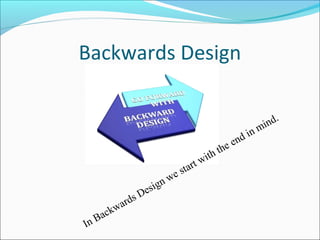
Backwards Design
In Backwards Design we start with the end in mind.
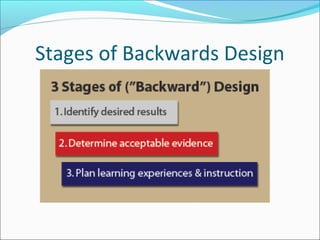
Stages of Backwards Design
Common Core and Backwards
Design
http://www.youtube.com/watch?v=HAoZkKG2vhM
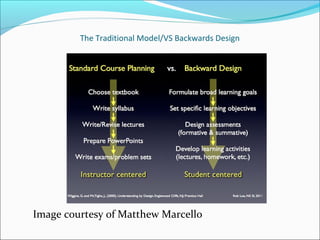
The Traditional Model/VS Backwards Design
Image courtesy of Matthew Marcello
Backwards Design Activity:
Step 1—Desired Results: students will
understand that:
Reading a wide range of print and non-print materials
from a variety of sources (internet, web quests, I-
Pads) builds an understanding of texts, of themselves,
and of different cultures.
Different purposes to read include: reading to acquire
new information and reading for personal fulfillment.
The use of a variety of comprehension strategies
greatly enhances understanding of text.
Backwards Design Activity:
Step 1—Desired Results:
Essential Questions
What do good readers do every time they read?
How and why do good readers use prior knowledge?
How and why do good readers ask questions about
the text while reading?
How and why do good readers learn ways to ask
themselves good questions?
Backwards Design Activity:
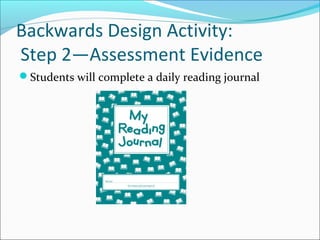
Step 2—Assessment Evidence
Students will complete a daily reading journal
Backwards Design Activity:
Step 3—Learning Plan
Take class to school library.
Have students pick a book to read from the library.
After students have returned to class have them talk
to their neighbor about the reason they picked that
particular book.
Ask students to share with entire group what the
outcome of their story is based on the cover art.
Resources
http://literacy.kent.edu/Oasis/Pubs/0400-17.pdf
http://www.p21.org/storage/documents/P21CommonCoreToolkit.pdf
www.ydae.purdue.edu/.../FiveCommonMistakesinWritingLessonPl
ans.do
http://grantwiggins.files.wordpress.com/2012/09/mctighe_wiggins_fin
al_common_core_standards.pdf
http://www.nyas.org/Events/Detail.aspx?cid=01557b97-39c7-4ca3-
8d0e-9fc7251c8cef
Newman, R. (2013). Teaching and learning in the 21st century:
Connecting the dots. San Diego, CA: Bridgepoint Education, Inc.

Effective lessonplanninganddesign

  • 1.
  • 2.
    Elements of EffectiveLesson Design One of the most important elements in effective lesson design is writing good learning objectives. An effective lesson design is well organized. The designed plan connects to the lives of the students.  The desired outcomes of the lesson should be clear to everyone involved. Effective lesson design involves careful integration of goals, objectives and assessments.
  • 3.
    Learning Objectives  Awell written learning objective should describe a learning outcome (where do you want to the student to go)  The learning objective should determine acceptable evidence of mastery (Am I there?).  The learning objective should help plan learning experiences and teaching.
  • 4.
    Sample Learning Objective LearningObjective 4th Grade ELA: Students demonstrate understanding of a text or texts by working together to identify and ask significant questions to clarify various points of view. The learning objective above pulls together the needed elements for an effective learning objective. Students are made aware of what they are to do or know after the lesson.
  • 5.
    Common Pitfalls Busy Work:"hands- on without being minds- on." (Newman, 2013). Cramming: Teachers focus on covering the entire textbook without a clear purpose (Newman, 2013).
  • 6.
    Common Mistakes Dr. BobKizlik gives us five common mistakes in writing lesson plans.  The objective of the lesson does not specify what the student will actually do that can be observed.  The lesson assessment is disconnected from the behavior indicated in the objective.  The materials specified in the lesson are extraneous to the actual described learning activities  The instruction in which the teacher will engage is not efficient for the level of intended student learning.  The student activities described in the lesson plan do not contribute in a direct and effective way to the lesson objective. www.ydae.purdue.edu/.../FiveCommonMistakesinWritingLessonPlans.do..
  • 7.
    Avoiding the Pitfalls Teachersneed to design a rich learning environment by: •Understanding where they need to go, •Understanding what they need to learn, and finally, •Working backwards in planning applicable activities.
  • 8.
    What Is theCommon Core? “The Common Core State Standards provide a consistent, clear understanding of what students are expected to learn so teachers and parents know what they need to do to help them. The standards are designed to be robust and relevant to the real world, reflecting the knowledge and skills that our young people need for success in college and careers. With American students fully prepared for the future, our communities will be best positioned to compete successfully in the global economy" (Common Core State Standards).
  • 9.
    Backwards Design In BackwardsDesign we start with the end in mind.
  • 10.
  • 11.
    Common Core andBackwards Design http://www.youtube.com/watch?v=HAoZkKG2vhM
  • 12.
    The Traditional Model/VSBackwards Design Image courtesy of Matthew Marcello
  • 13.
    Backwards Design Activity: Step1—Desired Results: students will understand that: Reading a wide range of print and non-print materials from a variety of sources (internet, web quests, I- Pads) builds an understanding of texts, of themselves, and of different cultures. Different purposes to read include: reading to acquire new information and reading for personal fulfillment. The use of a variety of comprehension strategies greatly enhances understanding of text.
  • 14.
    Backwards Design Activity: Step1—Desired Results: Essential Questions What do good readers do every time they read? How and why do good readers use prior knowledge? How and why do good readers ask questions about the text while reading? How and why do good readers learn ways to ask themselves good questions?
  • 15.
    Backwards Design Activity: Step2—Assessment Evidence Students will complete a daily reading journal
  • 16.
    Backwards Design Activity: Step3—Learning Plan Take class to school library. Have students pick a book to read from the library. After students have returned to class have them talk to their neighbor about the reason they picked that particular book. Ask students to share with entire group what the outcome of their story is based on the cover art.
  • 17.