Parenteral Controlled Drug Delivery Systems
INTRODUCTION
PARENTERAL CDDS
SOLUTIONS
COARSE DISPERSIONS
NANOPARTICLES
MICROPARTICLES
RESEALED ERYTHROCYTES
CONCLUSION
Parenteral Controlled Drug Delivery Systems
PRESENTATION OUTLINE
IMPLANTS
INTRODUCTION
Parenteral Controlled Drug Delivery Systems
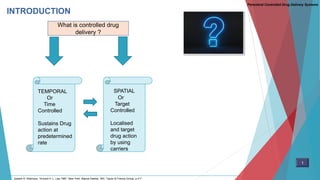
What is controlled drug
delivery ?
TEMPORAL
Or
Time
Controlled
Sustains Drug
action at
predetermined
rate
SPATIAL
Or
Target
Controlled
Localised
and target
drug action
by using
carriers
1
Joseph R. Robinson. Vincent H. L. Lee.1987. New York: Marcel Dekker, INC. Taylor & Francis Group. p 4-7
Parenteral Controlled Drug Delivery Systems
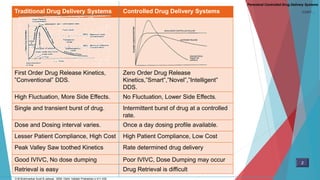
CONT…Traditional Drug Delivery Systems Controlled Drug Delivery Systems
First Order Drug Release Kinetics,
”Conventional” DDS.
Zero Order Drug Release
Kinetics,”Smart”,”Novel”,”Intelligent”
DDS.
High Fluctuation, More Side Effects. No Fluctuation, Lower Side Effects.
Single and transient burst of drug. Intermittent burst of drug at a controlled
rate.
Dose and Dosing interval varies. Once a day dosing profile available.
Lesser Patient Compliance, High Cost High Patient Compliance, Low Cost
Peak Valley Saw toothed Kinetics Rate determined drug delivery
Good IVIVC, No dose dumping Poor IVIVC, Dose Dumping may occur
Retrieval is easy Drug Retrieval is difficult
D.M Brahmankar.Sunil B.Jaiswal . 2009. Delhi: Vallabh Prakashan p 411-430
2
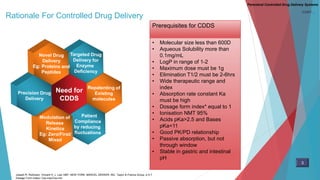
Rationale For Controlled Drug Delivery
Parenteral Controlled Drug Delivery Systems
CONT…
Need for
CDDS
• Molecular size less than 600D
• Aqueous Solubility more than
0.1mg/mL
• LogP in range of 1-2
• Maximum dose must be 1g
• Elimination T1/2 must be 2-6hrs
• Wide therapeutic range and
index
• Absorption rate constant Ka
must be high
• Dosage form index* equal to 1
• Ionisation NMT 95%
• Acids pKa>2.5 and Bases
pKa<11
• Good PK/PD relationship
• Passive absorption, but not
through window
• Stable in gastric and intestinal
pH
Prerequisites for CDDS
Joseph R. Robinson. Vincent H. L. Lee.1987. NEW YORK: MARCEL DEKKER, INC. Taylor & Francis Group. p 4-7
Dosage Form index= Css,max/Css,min
3
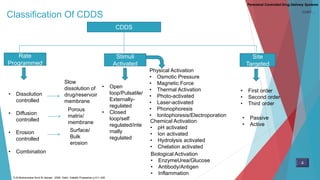
Classification Of CDDS
Parenteral Controlled Drug Delivery Systems
CDDS
Rate
Programmed
• Dissolution
controlled
• Diffusion
controlled
• Erosion
controlled
• Combination
Slow
dissolution of
drug/reservoir
membrane
Porous
matrix/
membrane
Surface/
Bulk
erosion
Stimuli
Activated
• Open
loop/Pulsatile/
Externally-
regulated
• Closed
loop/self
regulated/inte
rnally
regulated
Physical Activation
• Osmotic Pressure
• Magnetic Force
• Thermal Activation
• Photo-activated
• Laser-activated
• Phonophoresis
• Iontophoresis/Electroporation
Site
Targeted
• First order
• Second order
• Third order
• Passive
• Active
Chemical Activation
• pH activated
• Ion activated
• Hydrolysis activated
• Chelation activated
Biological Activation
• EnzymeUrea/Glucose
• Antibody/Antigen
• Inflammation
D.M Brahmankar.Sunil B.Jaiswal . 2009. Delhi: Vallabh Prakashan p 411-430
4
CONT…
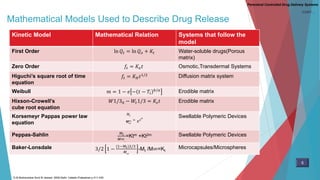
Mathematical Models Used to Describe Drug Release
Kinetic Model Mathematical Relation Systems that follow the
model
First Order ln 𝑄𝑡 = ln 𝑄 𝑜 + 𝐾𝑡 Water-soluble drugs(Porous
matrix)
Zero Order 𝑓𝑡 = 𝐾𝑜 𝑡 Osmotic,Transdermal Systems
Higuchi’s square root of time
equation
𝑓𝑡 = 𝐾 𝐻 𝑡1/2 Diffusion matrix system
Weibull 𝑚 = 1 − 𝑒 − 𝑡 − 𝑇𝑖
𝑏/𝑎 Erodible matrix
Hixson-Crowell’s
cube root equation
𝑊1/30 − 𝑊𝑡1/3 = 𝐾𝑠 𝑡 Erodible matrix
Korsemeyr Pappas power law
equation
𝑀𝑡
𝑀∞
= 𝐾 𝑡
𝑛 Swellable Polymeric Devices
Peppas-Sahlin 𝑀𝑡
𝑀∞_
=Ktm +Kt2m Swellable Polymeric Devices
Baker-Lonsdale 3/2 1 −
(1−𝑀𝑡)2/3
𝑀∞
-Mt /M∞=Kt
Microcapsules/Microspheres
Parenteral Controlled Drug Delivery Systems
5
D.M Brahmankar.Sunil B.Jaiswal .2009.Delhi: Vallabh Prakashan p 411-430
CONT…
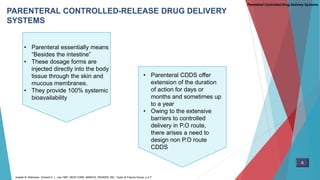
PARENTERAL CONTROLLED-RELEASE DRUG DELIVERY
SYSTEMS
• Parenteral CDDS offer
extension of the duration
of action for days or
months and sometimes up
to a year
• Owing to the extensive
barriers to controlled
delivery in P.O route,
there arises a need to
design non P.O route
CDDS
Parenteral Controlled Drug Delivery Systems
6
Joseph R. Robinson. Vincent H. L. Lee.1987. NEW YORK: MARCEL DEKKER, INC. Taylor & Francis Group. p 4-7
• Parenteral essentially means
“Besides the intestine”
• These dosage forms are
injected directly into the body
tissue through the skin and
mucous membranes.
• They provide 100% systemic
bioavailability
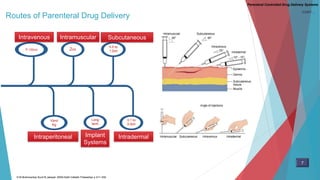
Routes of Parenteral Drug Delivery
>100ml 2ml
0.5 to
1.5ml
10ml/
Kg
Long
term
0.1 to
0.5ml
Intraperitoneal Intradermal
Intravenous Intramuscular Subcutaneous
Implant
Systems
Parenteral Controlled Drug Delivery Systems
7
D.M Brahmankar.Sunil B.Jaiswal .2009.Delhi:Vallabh Prakashan p 411-430
CONT…
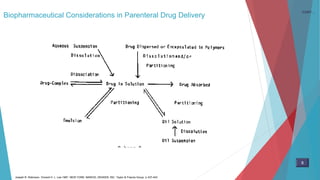
Biopharmaceutical Considerations in Parenteral Drug Delivery
8
Joseph R. Robinson. Vincent H. L. Lee.1987. NEW YORK: MARCEL DEKKER, INC. Taylor & Francis Group. p 437-443
CONT…
Parenteral Controlled Drug Delivery Systems
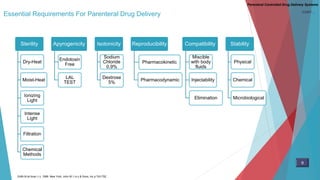
Essential Requirements For Parenteral Drug Delivery
Sterility
Dry-Heat
Moist-Heat
Ionizing
Light
Intense
Light
Filtration
Chemical
Methods
Apyrogenicity
Endotoxin
Free
LAL
TEST
Isotonicity
Sodium
Chloride
0.9%
Dextrose
5%
Reproducibility
Pharmacokinetic
Pharmacodynamic
Compatibility
Miscible
with body
fluids
Injectability
Elimination
Stability
Physical
Chemical
Microbiological
9
CONT…
Edith M at hiow i t z. 1999. New York: John W i l e y & Sons, Inc p 743-752
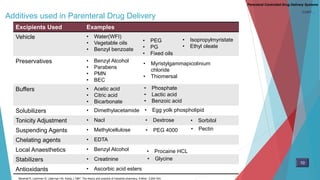
Additives used in Parenteral Drug Delivery
Excipients Used Examples
Vehicle • Water(WFI)
• Vegetable oils
• Benzyl benzoate
Preservatives • Benzyl Alcohol
• Parabens
• PMN
• BEC
Buffers • Acetic acid
• Citric acid
• Bicarbonate
Solubilizers • Dimethylacetamide
Tonicity Adjustment • Nacl
Suspending Agents • Methylcellulose
Chelating agents • EDTA
Local Anaesthetics • Benzyl Alcohol
Stabilizers • Creatinine
Antioxidants • Ascorbic acid esters
• PEG
• PG
• Fixed oils
• Phosphate
• Lactic acid
• Benzoic acid
• Isopropylmyristate
• Ethyl oleate
• Myristylgammapicolinium
chloride
• Thiomersal
• Egg yolk phospholipid
• Dextrose • Sorbitol
• PEG 4000 • Pectin
• Procaine HCL
• Glycine
Parenteral Controlled Drug Delivery Systems
10
CONT…
Marshall K, Lachman N, Liberman HA, Kanig J 1987. The theory and practice of industrial pharmacy. Edition 3:293-343.
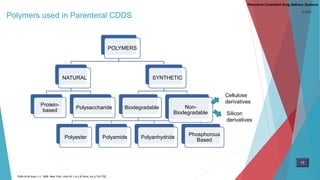
Polymers used in Parenteral CDDS
Parenteral Controlled Drug Delivery Systems
POLYMERS
NATURAL
Protein-
based
Polysaccharide
SYNTHETIC
Biodegradable
Polyester Polyamide Polyanhydride
Phosphorous
Based
Non-
Biodegradable
Cellulose
derivatives
Silicon
derivatives
11
CONT…
Edith M at hiow i t z. 1999. New York: John W i l e y & Sons, Inc p 743-752
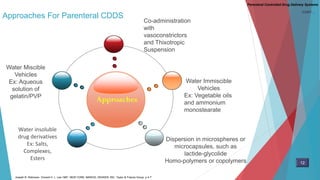
Approaches For Parenteral CDDS
Approaches
Water Miscible
Vehicles
Ex: Aqueous
solution of
gelatin/PVP
Water Immiscible
Vehicles
Ex: Vegetable oils
and ammonium
monostearate
Water insoluble
drug derivatives
Ex: Salts,
Complexes,
Esters
Dispersion in microspheres or
microcapsules, such as
lactide-glycolide
Homo-polymers or copolymers
Co-administration
with
vasoconstrictors
and Thixotropic
Suspension
Parenteral Controlled Drug Delivery Systems
12
Joseph R. Robinson. Vincent H. L. Lee.1987. NEW YORK: MARCEL DEKKER, INC. Taylor & Francis Group. p 4-7
CONT…
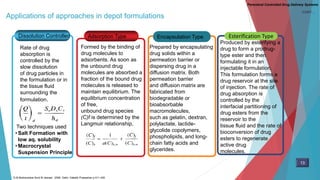
Applications of approaches in depot formulations
Adsorption TypeDissolution Controlled Encapsulation Type Esterification Type
Rate of drug
absorption is
controlled by the
slow dissolution
of drug particles in
the formulation or in
the tissue fluid
surrounding the
formulation.
Two techniques used
• Salt Formation with
low aq. solubility
• Macrocrystal
Suspension Principle
Formed by the binding of
drug molecules to
adsorbents. As soon as
the unbound drug
molecules are absorbed a
fraction of the bound drug
molecules is released to
maintain equilibrium. The
equilibrium concentration
of free,
unbound drug species
(C)f is determined by the
Langmuir relationship,
Prepared by encapsulating
drug solids within a
permeation barrier or
dispersing drug in a
diffusion matrix. Both
permeation barrier
and diffusion matrix are
fabricated from
biodegradable or
bioabsorbable
macromolecules,
such as gelatin, dextran,
polylactate, lactide-
glycolide copolymers,
phospholipids, and long-
chain fatty acids and
glycerides.
Produced by esterifying a
drug to form a prodrug-
type ester and then
formulating it in an
injectable formulation.
This formulation forms a
drug reservoir at the site
of injection. The rate of
drug absorption is
controlled by the
interfacial partitioning of
drug esters from the
reservoir to the
tissue fluid and the rate of
bioconversion of drug
esters to regenerate
active drug
molecules.
Parenteral Controlled Drug Delivery Systems
13
D.M Brahmankar.Sunil B.Jaiswal . 2009. Delhi: Vallabh Prakashan p 411-430
CONT…
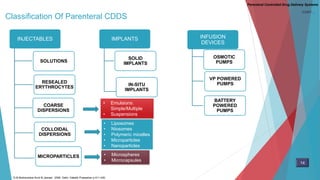
Classification Of Parenteral CDDS
Parenteral Controlled Drug Delivery Systems
INJECTABLES
SOLUTIONS
RESEALED
ERYTHROCYTES
COARSE
DISPERSIONS
COLLOIDAL
DISPERSIONS
MICROPARTICLES
IMPLANTS
SOLID
IMPLANTS
IN-SITU
IMPLANTS
INFUSION
DEVICES
OSMOTIC
PUMPS
VP POWERED
PUMPS
BATTERY
POWERED
PUMPS
• Liposomes
• Niosomes
• Polymeric micelles
• Microparticles
• Nanoparticles
• Microspheres
• Microcapsules
• Emulsions:
Simple/Multiple
• Suspensions
14
D.M Brahmankar.Sunil B.Jaiswal . 2009. Delhi: Vallabh Prakashan p 411-430,
CONT…
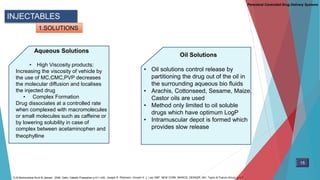
INJECTABLES
Parenteral Controlled Drug Delivery Systems
1.SOLUTIONS
Aqueous Solutions
• High Viscosity products:
Increasing the viscosity of vehicle by
the use of MC,CMC,PVP decreases
the molecular diffusion and localises
the injected drug
• Complex Formation
Drug dissociates at a controlled rate
when complexed with macromolecules
or small molecules such as caffeine or
by lowering solubility in case of
complex between acetaminophen and
theophylline
15
D.M Brahmankar.Sunil B.Jaiswal . 2009. Delhi: Vallabh Prakashan p 411-430, Joseph R. Robinson. Vincent H. L. Lee.1987. NEW YORK: MARCEL DEKKER, INC. Taylor & Francis Group. p 4-7
Oil Solutions
• Oil solutions control release by
partitioning the drug out of the oil in
the surrounding aqueous bio fluids
• Arachis, Cottonseed, Sesame, Maize,
Castor oils are used
• Method only limited to oil soluble
drugs which have optimum LogP
• Intramuscular depot is formed which
provides slow release
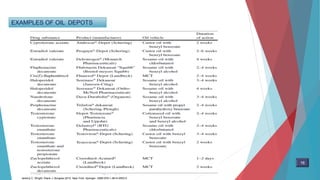
EXAMPLES OF OIL DEPOTS
Jeremy C. Wright. Diane J. Burgess.2012. New York: Springer. ISBN 978-1-4614-0553-5
16
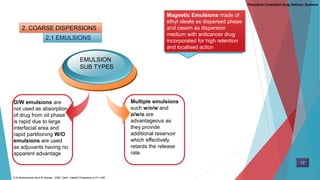
2. COARSE DISPERSIONS
2.1 EMULSIONS
O/W emulsions are
not used as absorption
of drug from oil phase
is rapid due to large
interfacial area and
rapid partitioning W/O
emulsions are used
as adjuvants having no
apparent advantage
Multiple emulsions
such w/o/w and
o/w/o are
advantageous as
they provide
additional reservoir
which effectively
retards the release
rate.
EMULSION
SUB TYPES
Magnetic Emulsions made of
ethyl oleate as dispersed phase
and casein as dispersion
medium with anticancer drug
incorporated for high retention
and localised action
Parenteral Controlled Drug Delivery Systems
17
D.M Brahmankar.Sunil B.Jaiswal . 2009. Delhi: Vallabh Prakashan p 411-430
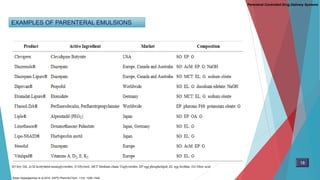
EXAMPLES OF PARENTERAL EMULSIONS
Ketan Hippalgaonkar.et al.2010. AAPS PharmSciTech. 11(4): 1526–1540.
Parenteral Controlled Drug Delivery Systems
18
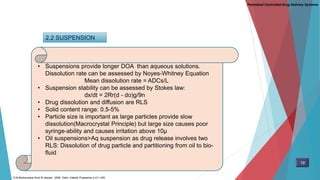
2.2 SUSPENSION
• Suspensions provide longer DOA than aqueous solutions.
Dissolution rate can be assessed by Noyes-Whitney Equation
Mean dissolution rate = ADCs/L
• Suspension stability can be assessed by Stokes law:
dx/dt = 2Rr(d - do)g/9n
• Drug dissolution and diffusion are RLS
• Solid content range: 0.5-5%
• Particle size is important as large particles provide slow
dissolution(Macrocrystal Principle) but large size causes poor
syringe-ability and causes irritation above 10µ
• Oil suspensions>Aq suspension as drug release involves two
RLS: Dissolution of drug particle and partitioning from oil to bio-
fluid
Parenteral Controlled Drug Delivery Systems
19
D.M Brahmankar.Sunil B.Jaiswal . 2009. Delhi: Vallabh Prakashan p 411-430
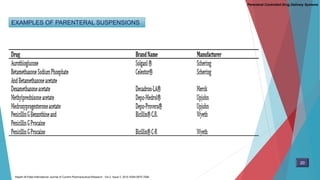
EXAMPLES OF PARENTERAL SUSPENSIONS
Rajesh M.Patel.International Journal of Current Pharmaceutical Research . Vol 2, Issue 3, 2010 ISSN-0975-7066
Parenteral Controlled Drug Delivery Systems
20
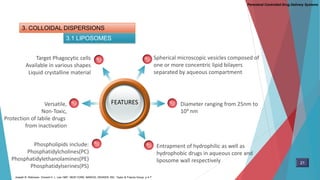
3. COLLOIDAL DISPERSIONS
3.1 LIPOSOMES
FEATURES
Target Phagocytic cells
Available in various shapes
Liquid crystalline material
Diameter ranging from 25nm to
104 nm
Entrapment of hydrophilic as well as
hydrophobic drugs in aqueous core and
liposome wall respectively
Versatile,
Non-Toxic,
Protection of labile drugs
from inactivation
Phospholipids include:
Phosphatidylcholines(PC)
Phosphatidylethanolamines(PE)
Phosphatidylserines(PS)
Spherical microscopic vesicles composed of
one or more concentric lipid bilayers
separated by aqueous compartment
Parenteral Controlled Drug Delivery Systems
21
Joseph R. Robinson. Vincent H. L. Lee.1987. NEW YORK: MARCEL DEKKER, INC. Taylor & Francis Group. p 4-7
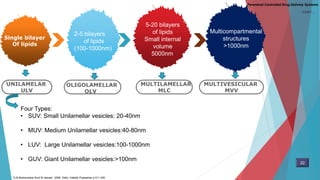
Four Types:
• SUV: Small Unilamellar vesicles: 20-40nm
• MUV: Medium Unilamellar vesicles:40-80nm
• LUV: Large Unilamellar vesicles:100-1000nm
• GUV: Giant Unilamellar vesicles:>100nm
UNILAMELAR
ULV
Single bilayer
Of lipids
Text in here
MULTILAMELLAR
MLC
MULTIVESICULAR
MVV
2-5 bilayers
of lipids
(100-1000nm)
5-20 bilayers
of lipids
Small internal
volume
5000nm
Multicompartmental
structures
>1000nm
OLIGOLAMELLAR
OLV
Parenteral Controlled Drug Delivery Systems
22
D.M Brahmankar.Sunil B.Jaiswal . 2009. Delhi: Vallabh Prakashan p 411-430
CONT…
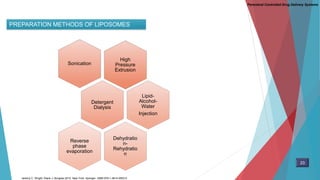
High
Pressure
Extrusion
Sonication
Detergent
Dialysis
Lipid-
Alcohol-
Water
Injection
Dehydratio
n-
Rehydratio
n
Reverse
phase
evaporation
PREPARATION METHODS OF LIPOSOMES
Parenteral Controlled Drug Delivery Systems
23
Jeremy C. Wright. Diane J. Burgess.2012. New York: Springer. ISBN 978-1-4614-0553-5
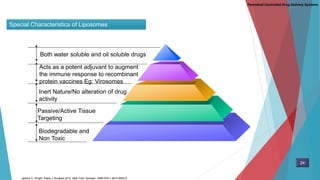
Special Characteristics of Liposomes
Acts as a potent adjuvant to augment
the immune response to recombinant
protein vaccines Eg: Virosomes
Biodegradable and
Non Toxic
Inert Nature/No alteration of drug
activity
Passive/Active Tissue
Targeting
Both water soluble and oil soluble drugs
Parenteral Controlled Drug Delivery Systems
24
Jeremy C. Wright. Diane J. Burgess.2012. New York: Springer. ISBN 978-1-4614-0553-5
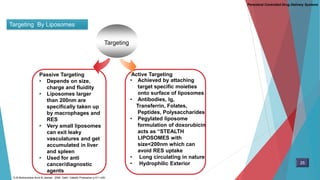
Targeting By Liposomes
Targeting
Passive Targeting
• Depends on size,
charge and fluidity
• Liposomes larger
than 200nm are
specifically taken up
by macrophages and
RES
• Very small liposomes
can exit leaky
vasculatures and get
accumulated in liver
and spleen
• Used for anti
cancer/diagnostic
agents
• Achieved by attaching
target specific moieties
onto surface of liposomes
• Antibodies, Ig,
Transferrin, Folates,
Peptides, Polysaccharides
• Pegylated liposome
formulation of doxorubicin
acts as “STEALTH
LIPOSOMES with
size<200nm which can
avoid RES uptake
• Long circulating in nature
• Hydrophilic Exterior
Active Targeting
Parenteral Controlled Drug Delivery Systems
25
D.M Brahmankar.Sunil B.Jaiswal . 2009. Delhi: Vallabh Prakashan p 411-430,
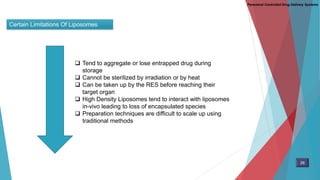
Certain Limitations Of Liposomes
 Tend to aggregate or lose entrapped drug during
storage
 Cannot be sterilized by irradiation or by heat
 Can be taken up by the RES before reaching their
target organ
 High Density Liposomes tend to interact with liposomes
in-vivo leading to loss of encapsulated species
 Preparation techniques are difficult to scale up using
traditional methods
Parenteral Controlled Drug Delivery Systems
26
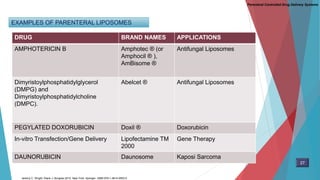
EXAMPLES OF PARENTERAL LIPOSOMES
DRUG BRAND NAMES APPLICATIONS
AMPHOTERICIN B Amphotec ® (or
Amphocil ® ),
AmBisome ®
Antifungal Liposomes
Dimyristoylphosphatidylglycerol
(DMPG) and
Dimyristoylphosphatidylcholine
(DMPC).
Abelcet ® Antifungal Liposomes
PEGYLATED DOXORUBICIN Doxil ® Doxorubicin
In-vitro Transfection/Gene Delivery Lipofectamine TM
2000
Gene Therapy
DAUNORUBICIN Daunosome Kaposi Sarcoma
27
Parenteral Controlled Drug Delivery Systems
Jeremy C. Wright. Diane J. Burgess.2012. New York: Springer. ISBN 978-1-4614-0553-5
3. COLLOIDAL DISPERSIONS
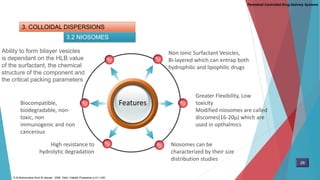
3.2 NIOSOMES
Parenteral Controlled Drug Delivery Systems
Features
Non ionic Surfactant Vesicles,
Bi-layered which can entrap both
hydrophilic and lipophilic drugs
Ability to form bilayer vesicles
is dependant on the HLB value
of the surfactant, the chemical
structure of the component and
the critical packing parameters
Niosomes can be
characterized by their size
distribution studies
Biocompatible,
biodegradable, non-
toxic, non
immunogenic and non
cancerous
High resistance to
hydrolytic degradation
Greater Flexibility, Low
toxicity
Modified niosomes are called
discomes(16-20µ) which are
used in opthalmics
28
D.M Brahmankar.Sunil B.Jaiswal . 2009. Delhi: Vallabh Prakashan p 411-430,
From
Proniosome
Transmembrane
pH Gradient
Microfluidization
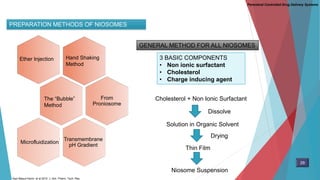
PREPARATION METHODS OF NIOSOMES
Ether Injection Hand Shaking
Method
The “Bubble”
Method
GENERAL METHOD FOR ALL NIOSOMES
3 BASIC COMPONENTS
• Non ionic surfactant
• Cholesterol
• Charge inducing agent
Cholesterol + Non Ionic Surfactant
Solution in Organic Solvent
Dissolve
Thin Film
Drying
Niosome Suspension
Parenteral Controlled Drug Delivery Systems
29
Kazi Masud Karim. et al.2010. J. Adv. Pharm. Tech. Res.
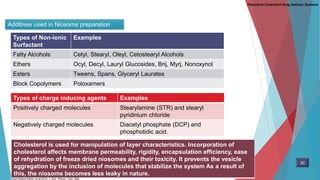
Additives used in Niosome preparation
Types of Non-ionic
Surfactant
Examples
Fatty Alcohols Cetyl, Stearyl, Oleyl, Cetostearyl Alcohols
Ethers Ocyl, Decyl, Lauryl Glucosides, Brij, Myrj, Nonoxynol
Esters Tweens, Spans, Glyceryl Laurates
Block Copolymers Poloxamers
Types of charge inducing agents Examples
Positively charged molecules Stearylamine (STR) and stearyl
pyridinium chloride
Negatively charged molecules Diacetyl phosphate (DCP) and
phosphotidic acid.
Cholesterol is used for manipulation of layer characteristics. Incorporation of
cholesterol affects membrane permeability, rigidity, encapsulation efficiency, ease
of rehydration of freeze dried niosomes and their toxicity. It prevents the vesicle
aggregation by the inclusion of molecules that stabilize the system As a result of
this, the niosome becomes less leaky in nature.
Parenteral Controlled Drug Delivery Systems
30
Kazi Masud Karim. et al.2010. J. Adv. Pharm. Tech. Res.
3. COLLOIDAL DISPERSIONS
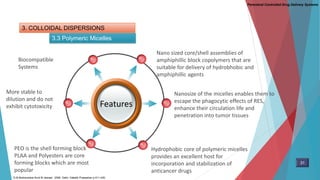
3.3 Polymeric Micelles
Parenteral Controlled Drug Delivery Systems
Features
Nano sized core/shell assemblies of
amphiphillic block copolymers that are
suitable for delivery of hydrobhobic and
amphiphillic agents
Nanosize of the micelles enables them to
escape the phagocytic effects of RES,
enhance their circulation life and
penetration into tumor tissues
Hydrophobic core of polymeric micelles
provides an excellent host for
incorporation and stabilization of
anticancer drugs
PEO is the shell forming block
PLAA and Polyesters are core
forming blocks which are most
popular
More stable to
dilution and do not
exhibit cytotoxicity
Biocompatible
Systems
31
D.M Brahmankar.Sunil B.Jaiswal . 2009. Delhi: Vallabh Prakashan p 411-430,
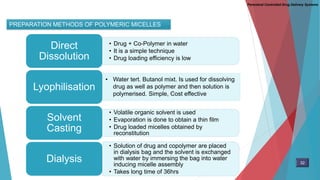
PREPARATION METHODS OF POLYMERIC MICELLES
• Drug + Co-Polymer in water
• It is a simple technique
• Drug loading efficiency is low
Direct
Dissolution
Lyophilisation
• Volatile organic solvent is used
• Evaporation is done to obtain a thin film
• Drug loaded micelles obtained by
reconstitution
Solvent
Casting
• Solution of drug and copolymer are placed
in dialysis bag and the solvent is exchanged
with water by immersing the bag into water
inducing micelle assembly
• Takes long time of 36hrs
Dialysis
• Water tert. Butanol mixt. Is used for dissolving
drug as well as polymer and then solution is
polymerised. Simple, Cost effective
Parenteral Controlled Drug Delivery Systems
32
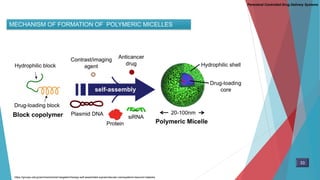
MECHANISM OF FORMATION OF POLYMERIC MICELLES
33
Parenteral Controlled Drug Delivery Systems
https://groups.oist.jp/ami/event/smart-targeted-therapy-self-assembled-supramolecular-nanosystems-kazunori-kataoka
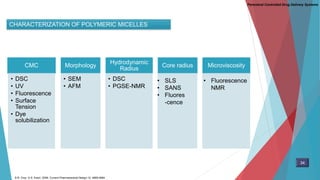
CHARACTERIZATION OF POLYMERIC MICELLES
CMC
• DSC
• UV
• Fluorescence
• Surface
Tension
• Dye
solubilization
Morphology
• SEM
• AFM
Hydrodynamic
Radius
Radius• DSC
• PGSE-NMR
Core radius Microviscosity
• SLS
• SANS
• Fluores
-cence
• Fluorescence
NMR
Parenteral Controlled Drug Delivery Systems
34
S.R. Croy. G.S. Kwon. 2006. Current Pharmaceutical Design.12, 4669-4684
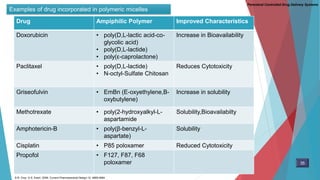
Drug Ampiphilic Polymer Improved Characteristics
Doxorubicin • poly(D,L-lactic acid-co-
glycolic acid)
• poly(D,L-lactide)
• poly(ε-caprolactone)
Increase in Bioavailability
Paclitaxel • poly(D,L-lactide)
• N-octyl-Sulfate Chitosan
Reduces Cytotoxicity
Griseofulvin • EmBn (E-oxyethylene,B-
oxybutylene)
Increase in solubility
Methotrexate • poly(2-hydroxyalkyl-L-
aspartamide
Solubility,Bioavailabilty
Amphotericin-B • poly(β-benzyl-L-
aspartate)
Solubility
Cisplatin • P85 poloxamer Reduced Cytotoxicity
Propofol • F127, F87, F68
poloxamer
Parenteral Controlled Drug Delivery Systems
Examples of drug incorporated in polymeric micelles
35
S.R. Croy. G.S. Kwon. 2006. Current Pharmaceutical Design.12, 4669-4684
Parenteral Controlled Drug Delivery Systems
3. COLLOIDAL DISPERSIONS
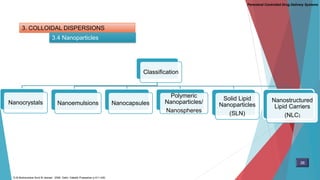
3.4 Nanoparticles
Classification
Nanocrystals Nanoemulsions Nanocapsules
Polymeric
Nanoparticles/
Nanospheres
Solid Lipid
Nanoparticles
(SLN)
Nanostructured
Lipid Carriers
(NLC)
D.M Brahmankar.Sunil B.Jaiswal . 2009. Delhi: Vallabh Prakashan p 411-430,
36
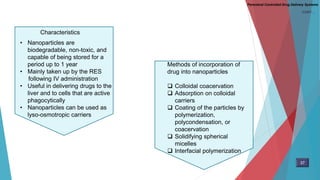
• Nanoparticles are
biodegradable, non-toxic, and
capable of being stored for a
period up to 1 year
• Mainly taken up by the RES
following IV administration
• Useful in delivering drugs to the
liver and to cells that are active
phagocytically
• Nanoparticles can be used as
lyso-osmotropic carriers
Methods of incorporation of
drug into nanoparticles
 Colloidal coacervation
 Adsorption on colloidal
carriers
 Coating of the particles by
polymerization,
polycondensation, or
coacervation
 Solidifying spherical
micelles
 Interfacial polymerization
Characteristics
37
Parenteral Controlled Drug Delivery Systems
CONT…
Parenteral Controlled Drug Delivery Systems
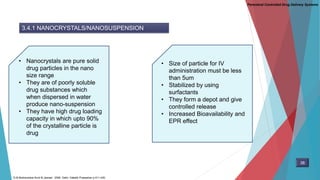
3.4.1 NANOCRYSTALS/NANOSUSPENSION
• Nanocrystals are pure solid
drug particles in the nano
size range
• They are of poorly soluble
drug substances which
when dispersed in water
produce nano-suspension
• They have high drug loading
capacity in which upto 90%
of the crystalline particle is
drug
• Size of particle for IV
administration must be less
than 5um
• Stabilized by using
surfactants
• They form a depot and give
controlled release
• Increased Bioavailability and
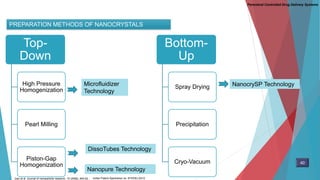
EPR effect
38
D.M Brahmankar.Sunil B.Jaiswal . 2009. Delhi: Vallabh Prakashan p 411-430,
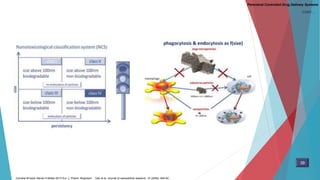
39
Cornelia M.Keck Rainer H.Müller.2013 Eur. J. Pharm. Biopharm Gao et al. Journal of nanoparticle research, 10 (2008), 845-62 ,
CONT…
Parenteral Controlled Drug Delivery Systems
PREPARATION METHODS OF NANOCRYSTALS
Top-
Down
High Pressure
Homogenization
Pearl Milling
Piston-Gap
Homogenization
Bottom-
Up
Spray Drying
Precipitation
Cryo-Vacuum
Microfluidizer
Technology
Nanopure Technology
DissoTubes Technology
NanocrySP Technology
40
Gao et al. Journal of nanoparticle research, 10 (2008), 845-62 , Indian Patent Application no. 674/DEL/2012
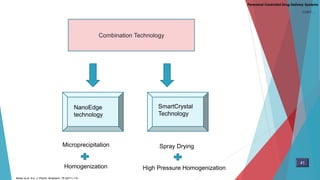
Parenteral Controlled Drug Delivery Systems
Combination Technology
NanoEdge
technology
SmartCrystal
Technology
Microprecipitation
Homogenization
Spray Drying
High Pressure Homogenization
Muller et al. Eur. J. Pharm. Biopharm, 78 (2011) 1-9
CONT…
41
Parenteral Controlled Drug Delivery Systems
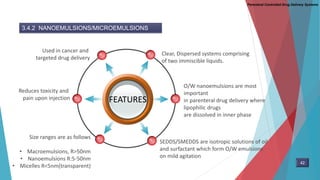
3.4.2 NANOEMULSIONS/MICROEMULSIONS
FEATURES
Clear, Dispersed systems comprising
of two immiscible liquids.
Used in cancer and
targeted drug delivery
O/W nanoemulsions are most
important
in parenteral drug delivery where
lipophilic drugs
are dissolved in inner phase
SEDDS/SMEDDS are isotropic solutions of oil
and surfactant which form O/W emulsions
on mild agitation
Reduces toxicity and
pain upon injection
Size ranges are as follows
• Macroemulsions, R>50nm
• Nanoemulsions R:5-50nm
• Micelles R<5nm(transparent)
42
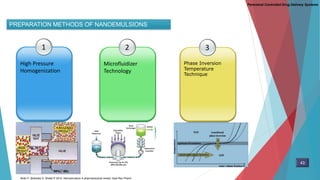
PREPARATION METHODS OF NANOEMULSIONS
1
High Pressure
Homogenization
2
Microfluidizer
Technology
3
Phase Inversion
Temperature
Technique
43
Parenteral Controlled Drug Delivery Systems
Shah P, Bhalodia D, Shelat P.2010. Nanoemulsion A pharmaceutical review. Syst Rev Pharm
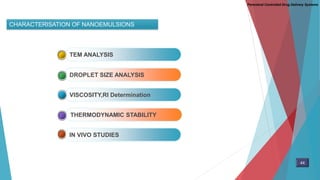
CHARACTERISATION OF NANOEMULSIONS
IN VIVO STUDIES
THERMODYNAMIC STABILITY
VISCOSITY,RI Determination
DROPLET SIZE ANALYSIS
TEM ANALYSIS
44
Parenteral Controlled Drug Delivery Systems
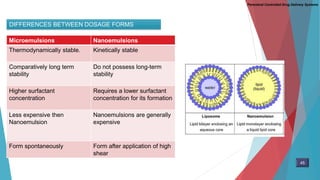
Microemulsions Nanoemulsions
Thermodynamically stable. Kinetically stable
Comparatively long term
stability
Do not possess long-term
stability
Higher surfactant
concentration
Requires a lower surfactant
concentration for its formation
Less expensive then
Nanoemulsion
Nanoemulsions are generally
expensive
Form spontaneously Form after application of high
shear
DIFFERENCES BETWEEN DOSAGE FORMS
45
Parenteral Controlled Drug Delivery Systems
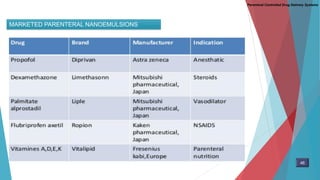
MARKETED PARENTERAL NANOEMULSIONS
46
Parenteral Controlled Drug Delivery Systems
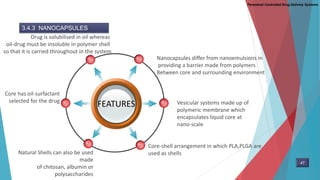
3.4.3 NANOCAPSULES
FEATURES
Nanocapsules differ from nanoemulsions in
providing a barrier made from polymers
Between core and surrounding environment
Drug is solubilised in oil whereas
oil-drug must be insoluble in polymer shell
so that it is carried throughout in the system
Core-shell arrangement in which PLA,PLGA are
used as shells
Core has oil-surfactant
selected for the drug
Natural Shells can also be used
made
of chitosan, albumin or
polysaccharides
Vesicular systems made up of
polymeric membrane which
encapsulates liquid core at
nano-scale
47
Parenteral Controlled Drug Delivery Systems
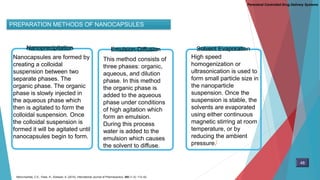
PREPARATION METHODS OF NANOCAPSULES
.
Nanocapsules are formed by
creating a colloidal
suspension between two
separate phases. The
organic phase. The organic
phase is slowly injected in
the aqueous phase which
then is agitated to form the
colloidal suspension. Once
the colloidal suspension is
formed it will be agitated until
nanocapsules begin to form.
Nanoprecipitation Emulsion-Diffusion Solvent Evaporation
This method consists of
three phases: organic,
aqueous, and dilution
phase. In this method
the organic phase is
added to the aqueous
phase under conditions
of high agitation which
form an emulsion.
During this process
water is added to the
emulsion which causes
the solvent to diffuse.
High speed
homogenization or
ultrasonication is used to
form small particle size in
the nanoparticle
suspension. Once the
suspension is stable, the
solvents are evaporated
using either continuous
magnetic stirring at room
temperature, or by
reducing the ambient
pressure.[
48
Mora-Huertas, C.E.; Fessi, H.; Elaissari, A. (2010). International Journal of Pharmaceutics. 385 (1–2): 113–42.
Parenteral Controlled Drug Delivery Systems
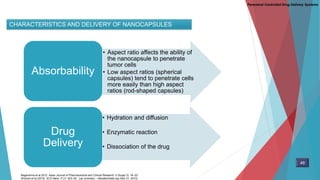
CHARACTERISTICS AND DELIVERY OF NANOCAPSULES
• Aspect ratio affects the ability of
the nanocapsule to penetrate
tumor cells
• Low aspect ratios (spherical
capsules) tend to penetrate cells
more easily than high aspect
ratios (rod-shaped capsules)
Absorbability
• Hydration and diffusion
• Enzymatic reaction
• Dissociation of the drug
Drug
Delivery
49
Nagavarma.et al.2012. Asian Journal of Pharmaceutical and Clinical Research. 5 (Suppl 3): 16–23.
Shimoni.et al.(2013). ACS Nano. 7 (1): 522–30.. Lay summary – Nanotechweb.org (Dec 21, 2012).
Parenteral Controlled Drug Delivery Systems
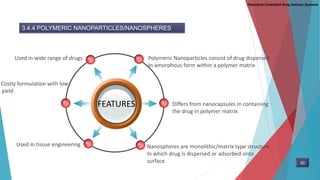
3.4.4 POLYMERIC NANOPARTICLES/NANOSPHERES
FEATURES
Polymeric Nanoparticles consist of drug dispersed
In amorphous form within a polymer matrix
Used in wide range of drugs
Differs from nanocapsules in containing
the drug in polymer matrix
Nanospheres are monolithic/matrix type structure
In which drug is dispersed or adsorbed onto
surface
Costly formulation with low
yield
Used in tissue engineering
50
Parenteral Controlled Drug Delivery Systems
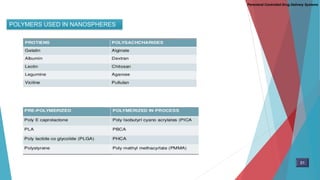
POLYMERS USED IN NANOSPHERES
51
Parenteral Controlled Drug Delivery Systems
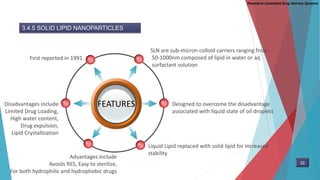
3.4.5 SOLID LIPID NANOPARTICLES
FEATURES
SLN are sub-micron colloid carriers ranging from
50-1000nm composed of lipid in water or aq
surfactant solution
First reported in 1991
Designed to overcome the disadvantage
associated with liquid state of oil droplets
Liquid Lipid replaced with solid lipid for increased
stability
Disadvantages include
Limited Drug Loading,
High water content,
Drug expulsion,
Lipid Crystallization
Advantages include
Avoids RES, Easy to sterilize,
For both hydrophilic and hydrophobic drugs
52
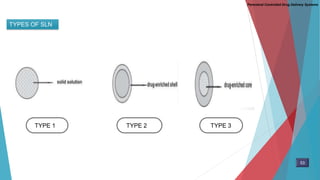
TYPES OF SLN
TYPE 1 TYPE 3TYPE 2
53
Parenteral Controlled Drug Delivery Systems
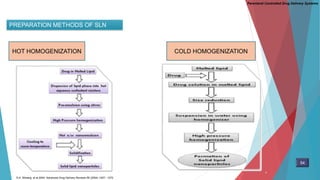
PREPARATION METHODS OF SLN
HOT HOMOGENIZATION COLD HOMOGENIZATION
54
S.A. Wissing. et al.2004. Advanced Drug Delivery Reviews 56 (2004) 1257– 1272
Parenteral Controlled Drug Delivery Systems
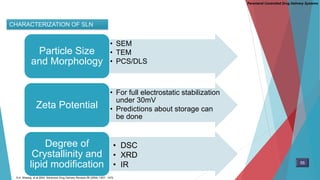
CHARACTERIZATION OF SLN
• SEM
• TEM
• PCS/DLS
Particle Size
and Morphology
• For full electrostatic stabilization
under 30mV
• Predictions about storage can
be done
Zeta Potential
Degree of
Crystallinity and
lipid modification
• DSC
• XRD
• IR 55
S.A. Wissing. et al.2004. Advanced Drug Delivery Reviews 56 (2004) 1257– 1272
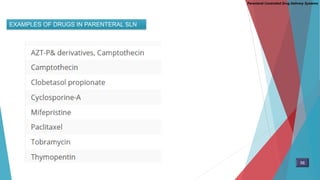
EXAMPLES OF DRUGS IN PARENTERAL SLN
Parenteral Controlled Drug Delivery Systems
56
Parenteral Controlled Drug Delivery Systems
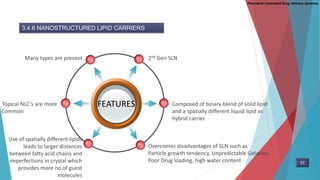
3.4.6 NANOSTRUCTURED LIPID CARRIERS
FEATURES
2nd Gen SLNMany types are present
Composed of binary blend of solid lipid
and a spatially different liquid lipid as
hybrid carrier
Overcomes disadvantages of SLN such as
Particle growth tendency, Unpredictable Gelation,
Poor Drug loading, high water content
Topical NLC’s are more
Common
Use of spatially different lipids
leads to larger distances
between fatty acid chains and
imperfections in crystal which
provides more no of guest
molecules
57
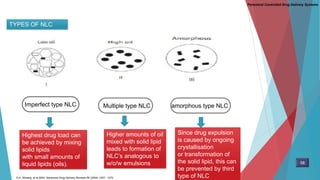
TYPES OF NLC
Multiple type NLC
Text in here Text in here
Imperfect type NLC amorphous type NLC
Highest drug load can
be achieved by mixing
solid lipids
with small amounts of
liquid lipids (oils).
Since drug expulsion
is caused by ongoing
crystallisation
or transformation of
the solid lipid, this can
be prevented by third
type of NLC
Higher amounts of oil
mixed with solid lipid
leads to formation of
NLC’s analogous to
w/o/w emulsions 58
Parenteral Controlled Drug Delivery Systems
S.A. Wissing. et al.2004. Advanced Drug Delivery Reviews 56 (2004) 1257– 1272
Parenteral Controlled Drug Delivery Systems
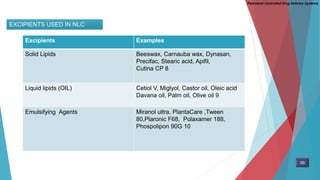
EXCIPIENTS USED IN NLC
Excipients Examples
Solid Lipids Beeswax, Carnauba wax, Dynasan,
Precifac, Stearic acid, Apifil,
Cutina CP 8
Liquid lipids (OIL) Cetiol V, Miglyol, Castor oil, Oleic acid
Davana oil, Palm oil, Olive oil 9
Emulsifying Agents Miranol ultra, PlantaCare ,Tween
80,Plaronic F68, Polaxamer 188,
Phospolipon 90G 10
59
Parenteral Controlled Drug Delivery Systems
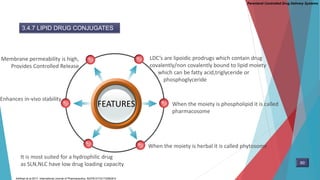
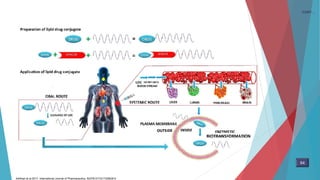
3.4.7 LIPID DRUG CONJUGATES
FEATURES
LDC’s are lipoidic prodrugs which contain drug
covalently/non covalently bound to lipid moiety
which can be fatty acid,triglyceride or
phosphoglyceride
Membrane permeability is high,
Provides Controlled Release
When the moiety is phospholipid it is called
pharmacosome
When the moiety is herbal it is called phytosome
It is most suited for a hydrophilic drug
as SLN,NLC have low drug loading capacity
Enhances in-vivo stability
60
Adhikari et al.2017. International Journal of Pharmaceutics. S0378-5173(17)30638-5
Parenteral Controlled Drug Delivery Systems
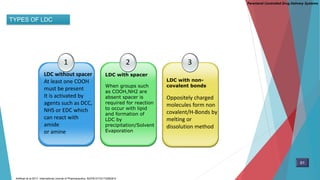
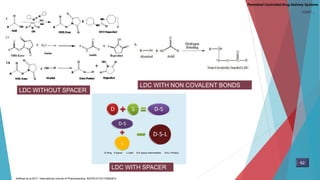
TYPES OF LDC
2
LDC with spacer
When groups such
as COOH,NH2 are
absent spacer is
required for reaction
to occur with lipid
and formation of
LDC by
precipitation/Solvent
Evaporation
3
LDC with non-
covalent bonds
Oppositely charged
molecules form non
covalent/H-Bonds by
melting or
dissolution method
1
LDC without spacer
At least one COOH
must be present
It is activated by
agents such as DCC,
NHS or EDC which
can react with
amide
or amine
61
Adhikari et al.2017. International Journal of Pharmaceutics. S0378-5173(17)30638-5
62
Parenteral Controlled Drug Delivery Systems
Adhikari et al.2017. International Journal of Pharmaceutics. S0378-5173(17)30638-5
CONT…
LDC WITHOUT SPACER
LDC WITH NON COVALENT BONDS
LDC WITH SPACER
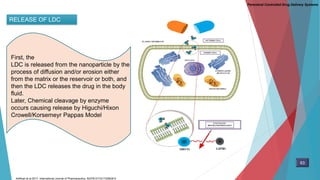
RELEASE OF LDC
First, the
LDC is released from the nanoparticle by the
process of diffusion and/or erosion either
from the matrix or the reservoir or both, and
then the LDC releases the drug in the body
fluid.
Later, Chemical cleavage by enzyme
occurs causing release by Higuchi/Hixon
Crowell/Korsemeyr Pappas Model
63
Parenteral Controlled Drug Delivery Systems
Adhikari et al.2017. International Journal of Pharmaceutics. S0378-5173(17)30638-5
64
Adhikari et al.2017. International Journal of Pharmaceutics. S0378-5173(17)30638-5
CONT…
Parenteral Controlled Drug Delivery Systems
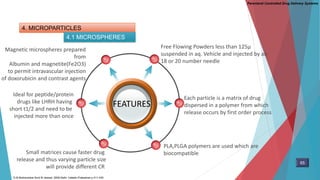
4. MICROPARTICLES
4.1 MICROSPHERES
FEATURES
Free Flowing Powders less than 125µ
suspended in aq. Vehicle and injected by an
18 or 20 number needle
Magnetic microspheres prepared
from
Albumin and magnetite(Fe2O3)
to permit intravascular injection
of doxorubicin and contrast agents
Each particle is a matrix of drug
dispersed in a polymer from which
release occurs by first order process
PLA,PLGA polymers are used which are
biocompatible
Ideal for peptide/protein
drugs like LHRH having
short t1/2 and need to be
injected more than once
Small matrices cause faster drug
release and thus varying particle size
will provide different CR
65
D.M Brahmankar.Sunil B.Jaiswal .2009.Delhi: Vallabh Prakashan p 411-430
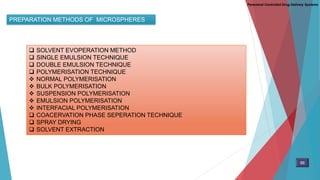
PREPARATION METHODS OF MICROSPHERES
 SOLVENT EVOPERATION METHOD
 SINGLE EMULSION TECHNIQUE
 DOUBLE EMULSION TECHNIQUE
 POLYMERISATION TECHNIQUE
 NORMAL POLYMERISATION
 BULK POLYMERISATION
 SUSPENSION POLYMERISATION
 EMULSION POLYMERISATION
 INTERFACIAL POLYMERISATION
 COACERVATION PHASE SEPERATION TECHNIQUE
 SPRAY DRYING
 SOLVENT EXTRACTION
66
Parenteral Controlled Drug Delivery Systems
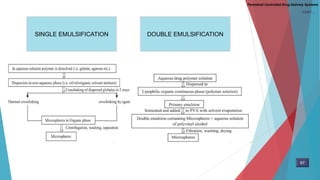
SINGLE EMULSIFICATION DOUBLE EMULSIFICATION
67
Parenteral Controlled Drug Delivery Systems
CONT…
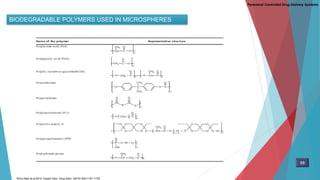
BIODEGRADABLE POLYMERS USED IN MICROSPHERES
68
Parenteral Controlled Drug Delivery Systems
Shirui Mao et al.2012. Expert Opin. Drug Deliv. (2012) 9(9):1161-1176
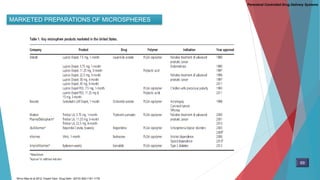
MARKETED PREPARATIONS OF MICROSPHERES
69
Parenteral Controlled Drug Delivery Systems
Shirui Mao et al.2012. Expert Opin. Drug Deliv. (2012) 9(9):1161-1176
4.2 MICROCAPSULES
• Differ from microspheres in that the drug is
centrally located within the polymeric shell
of finite thickness and release is controlled
by diffusion/dissolution or both
• Release rate is Zero order for
microcapsules with thick walls
• Steroids, Peptides, Anti-neoplastic drugs
are parenterally administered
70
Parenteral Controlled Drug Delivery Systems
PROCESSES USED FOR PREPARATION OF MICROCAPSULES
TYPE A PROCESSES(Capsule
formation occurs entirely in a liquid
stirred tank or tubular reactor)
TYPE B PROCESSES(Capsule
formation occurs because a coating
is sprayed onto liquid surface/solid
core dispersed in vacuum)
COMPLEX COACERVATION SPRAY DRYING
POLYMER-POLYMER
INCOMPATIBILITY
FLUIDIZED BED COATING
INTERFACIAL POLYMERIZATION AT
LIQ-LIQ and SOLID-LIQUID
INTERFACE
INTERFACIAL POLYMERIZATION AT
SOLID-GAS or LIQ-GAS INTERFACE
IN-SITU POLYMERIZATION CENTRIFUGAL EXTRUSION
SOLVENT EVAPORATION EXTRUSION or SPRAYING INTO
DESOLVATION BATH
SUBMERGED NOZZLE EXTRUSION ROTATIONAL SUSPENSION
SEPERATION (SPINNING DISK)
71
Parenteral Controlled Drug Delivery Systems
5. RESEALED ERYTHROCYTES
FEATURES
Drug is loaded into body’s own RBC and used as
CDDS
Circulation throughout the body
Fully Biodegradable, Biocompatible, Non
Immunogenic
Longer life span in circulation when compared to other
Synthetic carrier systems
RES Organ Targeting
Large amount of drug is carried
72
Parenteral Controlled Drug Delivery Systems
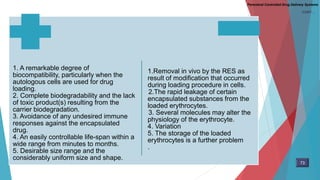
1. A remarkable degree of
biocompatibility, particularly when the
autologous cells are used for drug
loading.
2. Complete biodegradability and the lack
of toxic product(s) resulting from the
carrier biodegradation.
3. Avoidance of any undesired immune
responses against the encapsulated
drug.
4. An easily controllable life-span within a
wide range from minutes to months.
5. Desirable size range and the
considerably uniform size and shape.
1.Removal in vivo by the RES as
result of modification that occurred
during loading procedure in cells.
2.The rapid leakage of certain
encapsulated substances from the
loaded erythrocytes.
3. Several molecules may alter the
physiology of the erythrocyte.
4. Variation
5. The storage of the loaded
erythrocytes is a further problem
.
73
Parenteral Controlled Drug Delivery Systems
CONT…
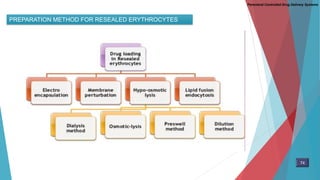
PREPARATION METHOD FOR RESEALED ERYTHROCYTES
Parenteral Controlled Drug Delivery Systems
74
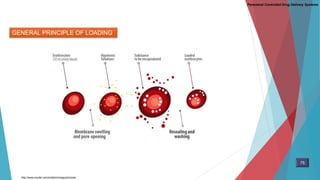
GENERAL PRINCIPLE OF LOADING
Parenteral Controlled Drug Delivery Systems
http://www.erydel.com/en/technology/principle
75
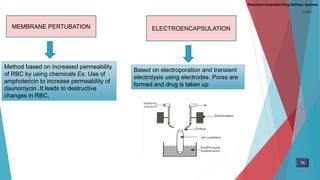
MEMBRANE PERTUBATION
Method based on increased permeability
of RBC by using chemicals Ex: Use of
amphotericin to increase permeability of
daunomycin .It leads to destructive
changes in RBC.
ELECTROENCAPSULATION
Based on electroporation and transient
electrolysis using electrodes. Pores are
formed and drug is taken up
Parenteral Controlled Drug Delivery Systems
CONT…
76
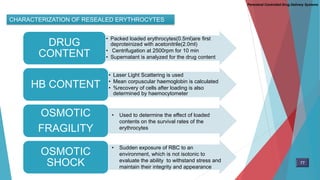
CHARACTERIZATION OF RESEALED ERYTHROCYTES
• Packed loaded erythrocytes(0.5ml)are first
deproteinized with acetonitrile(2.0ml)
• Centrifugation at 2500rpm for 10 min
• Supernatant is analyzed for the drug content
DRUG
CONTENT
• Laser Light Scattering is used
• Mean corpuscular haemoglobin is calculated
• %recovery of cells after loading is also
determined by haemocytometer
HB CONTENT
OSMOTIC
FRAGILITY
OSMOTIC
SHOCK
• Used to determine the effect of loaded
contents on the survival rates of the
erythrocytes
• Sudden exposure of RBC to an
environment, which is not isotonic to
evaluate the ability to withstand stress and
maintain their integrity and appearance
Parenteral Controlled Drug Delivery Systems
77
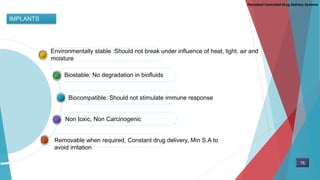
IMPLANTS
Non toxic, Non Carcinogenic
Biocompatible: Should not stimulate immune response
Biostable: No degradation in biofluids
Environmentally stable :Should not break under influence of heat, light, air and
moisture
Removable when required, Constant drug delivery, Min S.A to
avoid irritation
Parenteral Controlled Drug Delivery Systems
78
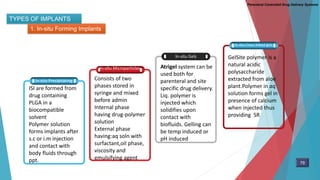
TYPES OF IMPLANTS
In-situ Microparticles
In-situ Gels
In-situ Precipitating
ISI are formed from
drug containing
PLGA in a
biocompatible
solvent
Polymer solution
forms implants after
s.c or i.m injection
and contact with
body fluids through
ppt.
Consists of two
phases stored in
syringe and mixed
before admin
Internal phase
having drug-polymer
solution
External phase
having:aq soln with
surfactant,oil phase,
viscosity and
emulsifying agent
Atrigel system can be
used both for
parenteral and site
specific drug delivery.
Liq. polymer is
injected which
solidifies upon
contact with
biofluids. Gelling can
be temp induced or
pH induced
1. In-situ Forming Implants
In-situ Cross linked gels
GelSite polymer is a
natural acidic
polysaccharide
extracted from aloe
plant.Polymer in aq
solution forms gel in
presence of calcium
when injected thus
providing SR
Parenteral Controlled Drug Delivery Systems
79
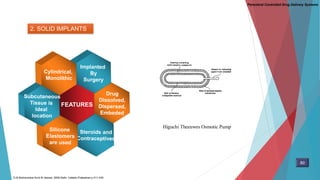
2. SOLID IMPLANTS
FEATURES
Parenteral Controlled Drug Delivery Systems
D.M Brahmankar.Sunil B.Jaiswal .2009.Delhi: Vallabh Prakashan p 411-430
80
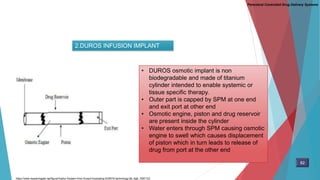
2.DUROS INFUSION IMPLANT
• DUROS osmotic implant is non
biodegradable and made of titanium
cylinder intended to enable systemic or
tissue specific therapy.
• Outer part is capped by SPM at one end
and exit port at other end
• Osmotic engine, piston and drug reservoir
are present inside the cylinder
• Water enters through SPM causing osmotic
engine to swell which causes displacement
of piston which in turn leads to release of
drug from port at the other end
Parenteral Controlled Drug Delivery Systems
https://www.researchgate.net/figure/Viadur-System-from-Durect-illustrating-DUROS-technology-80_fig6_7067123
82
3.INFUSION DEVICES
Osmotic Pressure Powered
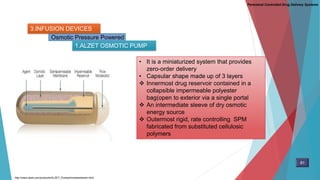
1.ALZET OSMOTIC PUMP
• It is a miniaturized system that provides
zero-order delivery
• Capsular shape made up of 3 layers
 Innermost drug reservoir contained in a
collapsible impermeable polyester
bag(open to exterior via a single portal
 An intermediate sleeve of dry osmotic
energy source
 Outermost rigid, rate controlling SPM
fabricated from substituted cellulosic
polymers
Parenteral Controlled Drug Delivery Systems
http://www.alzet.com/products/ALZET_Pumps/howdoesitwork.html
81
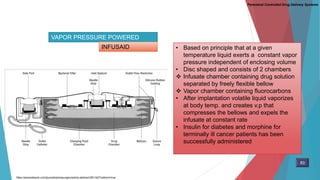
VAPOR PRESSURE POWERED
INFUSAID • Based on principle that at a given
temperature liquid exerts a constant vapor
pressure independent of enclosing volume
• Disc shaped and consists of 2 chambers
 Infusate chamber containing drug solution
separated by freely flexible bellow
 Vapor chamber containing fluorocarbons
• After implantation volatile liquid vaporizes
at body temp. and creates v.p that
compresses the bellows and expels the
infusate at constant rate
• Insulin for diabetes and morphine for
terminally ill cancer patients has been
successfully administered
Parenteral Controlled Drug Delivery Systems
https://jamanetwork.com/journals/jamasurgery/article-abstract/391162?redirect=true
83
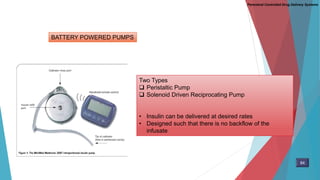
BATTERY POWERED PUMPS
Two Types
 Peristaltic Pump
 Solenoid Driven Reciprocating Pump
• Insulin can be delivered at desired rates
• Designed such that there is no backflow of the
infusate
Parenteral Controlled Drug Delivery Systems
84
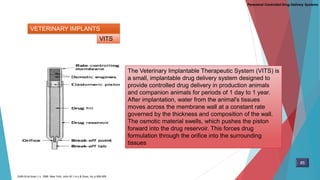
VETERINARY IMPLANTS
VITS
The Veterinary Implantable Therapeutic System (VITS) is
a small, implantable drug delivery system designed to
provide controlled drug delivery in production animals
and companion animals for periods of 1 day to 1 year.
After implantation, water from the animal's tissues
moves across the membrane wall at a constant rate
governed by the thickness and composition of the wall.
The osmotic material swells, which pushes the piston
forward into the drug reservoir. This forces drug
formulation through the orifice into the surrounding
tissues
Edith M at hiow i t z. 1999. New York: John W i l e y & Sons, Inc p 906-909
Parenteral Controlled Drug Delivery Systems
85
CONCLUSION
• Parenteral Drug Delivery is considered as a “to go” medication
for poorly bioavailable and narrow therapeutic index drugs.
Incorporation of controlled drug delivery by various methods as
described in the presentation gives us a dosage form which one
can rely upon
• Very few of the delivery systems can achieve targeted drug
delivery which has to be increased by knowing more about the
bio-phase and biochemical basis of diseases
• Peptide drugs as well as biologicals are mainly given by the IV
route. The area of CDDS in parenteral’s is a growing market as it
reduce the number of times one has to experience pain by
injections
• That said, one must not forget the exorbitant cost of these novel
drug delivery systems and the mass producibility issues which
should be the focus so that it is available for use by the common
man as well
Parenteral Controlled Drug Delivery Systems
86
PARENTERAL CONTROLLED DRUG DELIVERY SYSTEMS(INJECTABLES)

PARENTERAL CONTROLLED DRUG DELIVERY SYSTEMS(INJECTABLES)

  • 1.
  • 2.
    INTRODUCTION PARENTERAL CDDS SOLUTIONS COARSE DISPERSIONS NANOPARTICLES MICROPARTICLES RESEALEDERYTHROCYTES CONCLUSION Parenteral Controlled Drug Delivery Systems PRESENTATION OUTLINE IMPLANTS
  • 3.
    INTRODUCTION Parenteral Controlled DrugDelivery Systems What is controlled drug delivery ? TEMPORAL Or Time Controlled Sustains Drug action at predetermined rate SPATIAL Or Target Controlled Localised and target drug action by using carriers 1 Joseph R. Robinson. Vincent H. L. Lee.1987. New York: Marcel Dekker, INC. Taylor & Francis Group. p 4-7
  • 4.
    Parenteral Controlled DrugDelivery Systems CONT…Traditional Drug Delivery Systems Controlled Drug Delivery Systems First Order Drug Release Kinetics, ”Conventional” DDS. Zero Order Drug Release Kinetics,”Smart”,”Novel”,”Intelligent” DDS. High Fluctuation, More Side Effects. No Fluctuation, Lower Side Effects. Single and transient burst of drug. Intermittent burst of drug at a controlled rate. Dose and Dosing interval varies. Once a day dosing profile available. Lesser Patient Compliance, High Cost High Patient Compliance, Low Cost Peak Valley Saw toothed Kinetics Rate determined drug delivery Good IVIVC, No dose dumping Poor IVIVC, Dose Dumping may occur Retrieval is easy Drug Retrieval is difficult D.M Brahmankar.Sunil B.Jaiswal . 2009. Delhi: Vallabh Prakashan p 411-430 2
  • 5.
    Rationale For ControlledDrug Delivery Parenteral Controlled Drug Delivery Systems CONT… Need for CDDS • Molecular size less than 600D • Aqueous Solubility more than 0.1mg/mL • LogP in range of 1-2 • Maximum dose must be 1g • Elimination T1/2 must be 2-6hrs • Wide therapeutic range and index • Absorption rate constant Ka must be high • Dosage form index* equal to 1 • Ionisation NMT 95% • Acids pKa>2.5 and Bases pKa<11 • Good PK/PD relationship • Passive absorption, but not through window • Stable in gastric and intestinal pH Prerequisites for CDDS Joseph R. Robinson. Vincent H. L. Lee.1987. NEW YORK: MARCEL DEKKER, INC. Taylor & Francis Group. p 4-7 Dosage Form index= Css,max/Css,min 3
  • 6.
    Classification Of CDDS ParenteralControlled Drug Delivery Systems CDDS Rate Programmed • Dissolution controlled • Diffusion controlled • Erosion controlled • Combination Slow dissolution of drug/reservoir membrane Porous matrix/ membrane Surface/ Bulk erosion Stimuli Activated • Open loop/Pulsatile/ Externally- regulated • Closed loop/self regulated/inte rnally regulated Physical Activation • Osmotic Pressure • Magnetic Force • Thermal Activation • Photo-activated • Laser-activated • Phonophoresis • Iontophoresis/Electroporation Site Targeted • First order • Second order • Third order • Passive • Active Chemical Activation • pH activated • Ion activated • Hydrolysis activated • Chelation activated Biological Activation • EnzymeUrea/Glucose • Antibody/Antigen • Inflammation D.M Brahmankar.Sunil B.Jaiswal . 2009. Delhi: Vallabh Prakashan p 411-430 4 CONT…
  • 7.
    Mathematical Models Usedto Describe Drug Release Kinetic Model Mathematical Relation Systems that follow the model First Order ln 𝑄𝑡 = ln 𝑄 𝑜 + 𝐾𝑡 Water-soluble drugs(Porous matrix) Zero Order 𝑓𝑡 = 𝐾𝑜 𝑡 Osmotic,Transdermal Systems Higuchi’s square root of time equation 𝑓𝑡 = 𝐾 𝐻 𝑡1/2 Diffusion matrix system Weibull 𝑚 = 1 − 𝑒 − 𝑡 − 𝑇𝑖 𝑏/𝑎 Erodible matrix Hixson-Crowell’s cube root equation 𝑊1/30 − 𝑊𝑡1/3 = 𝐾𝑠 𝑡 Erodible matrix Korsemeyr Pappas power law equation 𝑀𝑡 𝑀∞ = 𝐾 𝑡 𝑛 Swellable Polymeric Devices Peppas-Sahlin 𝑀𝑡 𝑀∞_ =Ktm +Kt2m Swellable Polymeric Devices Baker-Lonsdale 3/2 1 − (1−𝑀𝑡)2/3 𝑀∞ -Mt /M∞=Kt Microcapsules/Microspheres Parenteral Controlled Drug Delivery Systems 5 D.M Brahmankar.Sunil B.Jaiswal .2009.Delhi: Vallabh Prakashan p 411-430 CONT…
  • 8.
    PARENTERAL CONTROLLED-RELEASE DRUGDELIVERY SYSTEMS • Parenteral CDDS offer extension of the duration of action for days or months and sometimes up to a year • Owing to the extensive barriers to controlled delivery in P.O route, there arises a need to design non P.O route CDDS Parenteral Controlled Drug Delivery Systems 6 Joseph R. Robinson. Vincent H. L. Lee.1987. NEW YORK: MARCEL DEKKER, INC. Taylor & Francis Group. p 4-7 • Parenteral essentially means “Besides the intestine” • These dosage forms are injected directly into the body tissue through the skin and mucous membranes. • They provide 100% systemic bioavailability
  • 9.
    Routes of ParenteralDrug Delivery >100ml 2ml 0.5 to 1.5ml 10ml/ Kg Long term 0.1 to 0.5ml Intraperitoneal Intradermal Intravenous Intramuscular Subcutaneous Implant Systems Parenteral Controlled Drug Delivery Systems 7 D.M Brahmankar.Sunil B.Jaiswal .2009.Delhi:Vallabh Prakashan p 411-430 CONT…
  • 10.
    Biopharmaceutical Considerations inParenteral Drug Delivery 8 Joseph R. Robinson. Vincent H. L. Lee.1987. NEW YORK: MARCEL DEKKER, INC. Taylor & Francis Group. p 437-443 CONT…
  • 11.
    Parenteral Controlled DrugDelivery Systems Essential Requirements For Parenteral Drug Delivery Sterility Dry-Heat Moist-Heat Ionizing Light Intense Light Filtration Chemical Methods Apyrogenicity Endotoxin Free LAL TEST Isotonicity Sodium Chloride 0.9% Dextrose 5% Reproducibility Pharmacokinetic Pharmacodynamic Compatibility Miscible with body fluids Injectability Elimination Stability Physical Chemical Microbiological 9 CONT… Edith M at hiow i t z. 1999. New York: John W i l e y & Sons, Inc p 743-752
  • 12.
    Additives used inParenteral Drug Delivery Excipients Used Examples Vehicle • Water(WFI) • Vegetable oils • Benzyl benzoate Preservatives • Benzyl Alcohol • Parabens • PMN • BEC Buffers • Acetic acid • Citric acid • Bicarbonate Solubilizers • Dimethylacetamide Tonicity Adjustment • Nacl Suspending Agents • Methylcellulose Chelating agents • EDTA Local Anaesthetics • Benzyl Alcohol Stabilizers • Creatinine Antioxidants • Ascorbic acid esters • PEG • PG • Fixed oils • Phosphate • Lactic acid • Benzoic acid • Isopropylmyristate • Ethyl oleate • Myristylgammapicolinium chloride • Thiomersal • Egg yolk phospholipid • Dextrose • Sorbitol • PEG 4000 • Pectin • Procaine HCL • Glycine Parenteral Controlled Drug Delivery Systems 10 CONT… Marshall K, Lachman N, Liberman HA, Kanig J 1987. The theory and practice of industrial pharmacy. Edition 3:293-343.
  • 13.
    Polymers used inParenteral CDDS Parenteral Controlled Drug Delivery Systems POLYMERS NATURAL Protein- based Polysaccharide SYNTHETIC Biodegradable Polyester Polyamide Polyanhydride Phosphorous Based Non- Biodegradable Cellulose derivatives Silicon derivatives 11 CONT… Edith M at hiow i t z. 1999. New York: John W i l e y & Sons, Inc p 743-752
  • 14.
    Approaches For ParenteralCDDS Approaches Water Miscible Vehicles Ex: Aqueous solution of gelatin/PVP Water Immiscible Vehicles Ex: Vegetable oils and ammonium monostearate Water insoluble drug derivatives Ex: Salts, Complexes, Esters Dispersion in microspheres or microcapsules, such as lactide-glycolide Homo-polymers or copolymers Co-administration with vasoconstrictors and Thixotropic Suspension Parenteral Controlled Drug Delivery Systems 12 Joseph R. Robinson. Vincent H. L. Lee.1987. NEW YORK: MARCEL DEKKER, INC. Taylor & Francis Group. p 4-7 CONT…
  • 15.
    Applications of approachesin depot formulations Adsorption TypeDissolution Controlled Encapsulation Type Esterification Type Rate of drug absorption is controlled by the slow dissolution of drug particles in the formulation or in the tissue fluid surrounding the formulation. Two techniques used • Salt Formation with low aq. solubility • Macrocrystal Suspension Principle Formed by the binding of drug molecules to adsorbents. As soon as the unbound drug molecules are absorbed a fraction of the bound drug molecules is released to maintain equilibrium. The equilibrium concentration of free, unbound drug species (C)f is determined by the Langmuir relationship, Prepared by encapsulating drug solids within a permeation barrier or dispersing drug in a diffusion matrix. Both permeation barrier and diffusion matrix are fabricated from biodegradable or bioabsorbable macromolecules, such as gelatin, dextran, polylactate, lactide- glycolide copolymers, phospholipids, and long- chain fatty acids and glycerides. Produced by esterifying a drug to form a prodrug- type ester and then formulating it in an injectable formulation. This formulation forms a drug reservoir at the site of injection. The rate of drug absorption is controlled by the interfacial partitioning of drug esters from the reservoir to the tissue fluid and the rate of bioconversion of drug esters to regenerate active drug molecules. Parenteral Controlled Drug Delivery Systems 13 D.M Brahmankar.Sunil B.Jaiswal . 2009. Delhi: Vallabh Prakashan p 411-430 CONT…
  • 16.
    Classification Of ParenteralCDDS Parenteral Controlled Drug Delivery Systems INJECTABLES SOLUTIONS RESEALED ERYTHROCYTES COARSE DISPERSIONS COLLOIDAL DISPERSIONS MICROPARTICLES IMPLANTS SOLID IMPLANTS IN-SITU IMPLANTS INFUSION DEVICES OSMOTIC PUMPS VP POWERED PUMPS BATTERY POWERED PUMPS • Liposomes • Niosomes • Polymeric micelles • Microparticles • Nanoparticles • Microspheres • Microcapsules • Emulsions: Simple/Multiple • Suspensions 14 D.M Brahmankar.Sunil B.Jaiswal . 2009. Delhi: Vallabh Prakashan p 411-430, CONT…
  • 17.
    INJECTABLES Parenteral Controlled DrugDelivery Systems 1.SOLUTIONS Aqueous Solutions • High Viscosity products: Increasing the viscosity of vehicle by the use of MC,CMC,PVP decreases the molecular diffusion and localises the injected drug • Complex Formation Drug dissociates at a controlled rate when complexed with macromolecules or small molecules such as caffeine or by lowering solubility in case of complex between acetaminophen and theophylline 15 D.M Brahmankar.Sunil B.Jaiswal . 2009. Delhi: Vallabh Prakashan p 411-430, Joseph R. Robinson. Vincent H. L. Lee.1987. NEW YORK: MARCEL DEKKER, INC. Taylor & Francis Group. p 4-7 Oil Solutions • Oil solutions control release by partitioning the drug out of the oil in the surrounding aqueous bio fluids • Arachis, Cottonseed, Sesame, Maize, Castor oils are used • Method only limited to oil soluble drugs which have optimum LogP • Intramuscular depot is formed which provides slow release
  • 18.
    EXAMPLES OF OILDEPOTS Jeremy C. Wright. Diane J. Burgess.2012. New York: Springer. ISBN 978-1-4614-0553-5 16
  • 19.
    2. COARSE DISPERSIONS 2.1EMULSIONS O/W emulsions are not used as absorption of drug from oil phase is rapid due to large interfacial area and rapid partitioning W/O emulsions are used as adjuvants having no apparent advantage Multiple emulsions such w/o/w and o/w/o are advantageous as they provide additional reservoir which effectively retards the release rate. EMULSION SUB TYPES Magnetic Emulsions made of ethyl oleate as dispersed phase and casein as dispersion medium with anticancer drug incorporated for high retention and localised action Parenteral Controlled Drug Delivery Systems 17 D.M Brahmankar.Sunil B.Jaiswal . 2009. Delhi: Vallabh Prakashan p 411-430
  • 20.
    EXAMPLES OF PARENTERALEMULSIONS Ketan Hippalgaonkar.et al.2010. AAPS PharmSciTech. 11(4): 1526–1540. Parenteral Controlled Drug Delivery Systems 18
  • 21.
    2.2 SUSPENSION • Suspensionsprovide longer DOA than aqueous solutions. Dissolution rate can be assessed by Noyes-Whitney Equation Mean dissolution rate = ADCs/L • Suspension stability can be assessed by Stokes law: dx/dt = 2Rr(d - do)g/9n • Drug dissolution and diffusion are RLS • Solid content range: 0.5-5% • Particle size is important as large particles provide slow dissolution(Macrocrystal Principle) but large size causes poor syringe-ability and causes irritation above 10µ • Oil suspensions>Aq suspension as drug release involves two RLS: Dissolution of drug particle and partitioning from oil to bio- fluid Parenteral Controlled Drug Delivery Systems 19 D.M Brahmankar.Sunil B.Jaiswal . 2009. Delhi: Vallabh Prakashan p 411-430
  • 22.
    EXAMPLES OF PARENTERALSUSPENSIONS Rajesh M.Patel.International Journal of Current Pharmaceutical Research . Vol 2, Issue 3, 2010 ISSN-0975-7066 Parenteral Controlled Drug Delivery Systems 20
  • 23.
    3. COLLOIDAL DISPERSIONS 3.1LIPOSOMES FEATURES Target Phagocytic cells Available in various shapes Liquid crystalline material Diameter ranging from 25nm to 104 nm Entrapment of hydrophilic as well as hydrophobic drugs in aqueous core and liposome wall respectively Versatile, Non-Toxic, Protection of labile drugs from inactivation Phospholipids include: Phosphatidylcholines(PC) Phosphatidylethanolamines(PE) Phosphatidylserines(PS) Spherical microscopic vesicles composed of one or more concentric lipid bilayers separated by aqueous compartment Parenteral Controlled Drug Delivery Systems 21 Joseph R. Robinson. Vincent H. L. Lee.1987. NEW YORK: MARCEL DEKKER, INC. Taylor & Francis Group. p 4-7
  • 24.
    Four Types: • SUV:Small Unilamellar vesicles: 20-40nm • MUV: Medium Unilamellar vesicles:40-80nm • LUV: Large Unilamellar vesicles:100-1000nm • GUV: Giant Unilamellar vesicles:>100nm UNILAMELAR ULV Single bilayer Of lipids Text in here MULTILAMELLAR MLC MULTIVESICULAR MVV 2-5 bilayers of lipids (100-1000nm) 5-20 bilayers of lipids Small internal volume 5000nm Multicompartmental structures >1000nm OLIGOLAMELLAR OLV Parenteral Controlled Drug Delivery Systems 22 D.M Brahmankar.Sunil B.Jaiswal . 2009. Delhi: Vallabh Prakashan p 411-430 CONT…
  • 25.
    High Pressure Extrusion Sonication Detergent Dialysis Lipid- Alcohol- Water Injection Dehydratio n- Rehydratio n Reverse phase evaporation PREPARATION METHODS OFLIPOSOMES Parenteral Controlled Drug Delivery Systems 23 Jeremy C. Wright. Diane J. Burgess.2012. New York: Springer. ISBN 978-1-4614-0553-5
  • 26.
    Special Characteristics ofLiposomes Acts as a potent adjuvant to augment the immune response to recombinant protein vaccines Eg: Virosomes Biodegradable and Non Toxic Inert Nature/No alteration of drug activity Passive/Active Tissue Targeting Both water soluble and oil soluble drugs Parenteral Controlled Drug Delivery Systems 24 Jeremy C. Wright. Diane J. Burgess.2012. New York: Springer. ISBN 978-1-4614-0553-5
  • 27.
    Targeting By Liposomes Targeting PassiveTargeting • Depends on size, charge and fluidity • Liposomes larger than 200nm are specifically taken up by macrophages and RES • Very small liposomes can exit leaky vasculatures and get accumulated in liver and spleen • Used for anti cancer/diagnostic agents • Achieved by attaching target specific moieties onto surface of liposomes • Antibodies, Ig, Transferrin, Folates, Peptides, Polysaccharides • Pegylated liposome formulation of doxorubicin acts as “STEALTH LIPOSOMES with size<200nm which can avoid RES uptake • Long circulating in nature • Hydrophilic Exterior Active Targeting Parenteral Controlled Drug Delivery Systems 25 D.M Brahmankar.Sunil B.Jaiswal . 2009. Delhi: Vallabh Prakashan p 411-430,
  • 28.
    Certain Limitations OfLiposomes  Tend to aggregate or lose entrapped drug during storage  Cannot be sterilized by irradiation or by heat  Can be taken up by the RES before reaching their target organ  High Density Liposomes tend to interact with liposomes in-vivo leading to loss of encapsulated species  Preparation techniques are difficult to scale up using traditional methods Parenteral Controlled Drug Delivery Systems 26
  • 29.
    EXAMPLES OF PARENTERALLIPOSOMES DRUG BRAND NAMES APPLICATIONS AMPHOTERICIN B Amphotec ® (or Amphocil ® ), AmBisome ® Antifungal Liposomes Dimyristoylphosphatidylglycerol (DMPG) and Dimyristoylphosphatidylcholine (DMPC). Abelcet ® Antifungal Liposomes PEGYLATED DOXORUBICIN Doxil ® Doxorubicin In-vitro Transfection/Gene Delivery Lipofectamine TM 2000 Gene Therapy DAUNORUBICIN Daunosome Kaposi Sarcoma 27 Parenteral Controlled Drug Delivery Systems Jeremy C. Wright. Diane J. Burgess.2012. New York: Springer. ISBN 978-1-4614-0553-5
  • 30.
    3. COLLOIDAL DISPERSIONS 3.2NIOSOMES Parenteral Controlled Drug Delivery Systems Features Non ionic Surfactant Vesicles, Bi-layered which can entrap both hydrophilic and lipophilic drugs Ability to form bilayer vesicles is dependant on the HLB value of the surfactant, the chemical structure of the component and the critical packing parameters Niosomes can be characterized by their size distribution studies Biocompatible, biodegradable, non- toxic, non immunogenic and non cancerous High resistance to hydrolytic degradation Greater Flexibility, Low toxicity Modified niosomes are called discomes(16-20µ) which are used in opthalmics 28 D.M Brahmankar.Sunil B.Jaiswal . 2009. Delhi: Vallabh Prakashan p 411-430,
  • 31.
    From Proniosome Transmembrane pH Gradient Microfluidization PREPARATION METHODSOF NIOSOMES Ether Injection Hand Shaking Method The “Bubble” Method GENERAL METHOD FOR ALL NIOSOMES 3 BASIC COMPONENTS • Non ionic surfactant • Cholesterol • Charge inducing agent Cholesterol + Non Ionic Surfactant Solution in Organic Solvent Dissolve Thin Film Drying Niosome Suspension Parenteral Controlled Drug Delivery Systems 29 Kazi Masud Karim. et al.2010. J. Adv. Pharm. Tech. Res.
  • 32.
    Additives used inNiosome preparation Types of Non-ionic Surfactant Examples Fatty Alcohols Cetyl, Stearyl, Oleyl, Cetostearyl Alcohols Ethers Ocyl, Decyl, Lauryl Glucosides, Brij, Myrj, Nonoxynol Esters Tweens, Spans, Glyceryl Laurates Block Copolymers Poloxamers Types of charge inducing agents Examples Positively charged molecules Stearylamine (STR) and stearyl pyridinium chloride Negatively charged molecules Diacetyl phosphate (DCP) and phosphotidic acid. Cholesterol is used for manipulation of layer characteristics. Incorporation of cholesterol affects membrane permeability, rigidity, encapsulation efficiency, ease of rehydration of freeze dried niosomes and their toxicity. It prevents the vesicle aggregation by the inclusion of molecules that stabilize the system As a result of this, the niosome becomes less leaky in nature. Parenteral Controlled Drug Delivery Systems 30 Kazi Masud Karim. et al.2010. J. Adv. Pharm. Tech. Res.
  • 33.
    3. COLLOIDAL DISPERSIONS 3.3Polymeric Micelles Parenteral Controlled Drug Delivery Systems Features Nano sized core/shell assemblies of amphiphillic block copolymers that are suitable for delivery of hydrobhobic and amphiphillic agents Nanosize of the micelles enables them to escape the phagocytic effects of RES, enhance their circulation life and penetration into tumor tissues Hydrophobic core of polymeric micelles provides an excellent host for incorporation and stabilization of anticancer drugs PEO is the shell forming block PLAA and Polyesters are core forming blocks which are most popular More stable to dilution and do not exhibit cytotoxicity Biocompatible Systems 31 D.M Brahmankar.Sunil B.Jaiswal . 2009. Delhi: Vallabh Prakashan p 411-430,
  • 34.
    PREPARATION METHODS OFPOLYMERIC MICELLES • Drug + Co-Polymer in water • It is a simple technique • Drug loading efficiency is low Direct Dissolution Lyophilisation • Volatile organic solvent is used • Evaporation is done to obtain a thin film • Drug loaded micelles obtained by reconstitution Solvent Casting • Solution of drug and copolymer are placed in dialysis bag and the solvent is exchanged with water by immersing the bag into water inducing micelle assembly • Takes long time of 36hrs Dialysis • Water tert. Butanol mixt. Is used for dissolving drug as well as polymer and then solution is polymerised. Simple, Cost effective Parenteral Controlled Drug Delivery Systems 32
  • 35.
    MECHANISM OF FORMATIONOF POLYMERIC MICELLES 33 Parenteral Controlled Drug Delivery Systems https://groups.oist.jp/ami/event/smart-targeted-therapy-self-assembled-supramolecular-nanosystems-kazunori-kataoka
  • 36.
    CHARACTERIZATION OF POLYMERICMICELLES CMC • DSC • UV • Fluorescence • Surface Tension • Dye solubilization Morphology • SEM • AFM Hydrodynamic Radius Radius• DSC • PGSE-NMR Core radius Microviscosity • SLS • SANS • Fluores -cence • Fluorescence NMR Parenteral Controlled Drug Delivery Systems 34 S.R. Croy. G.S. Kwon. 2006. Current Pharmaceutical Design.12, 4669-4684
  • 37.
    Drug Ampiphilic PolymerImproved Characteristics Doxorubicin • poly(D,L-lactic acid-co- glycolic acid) • poly(D,L-lactide) • poly(ε-caprolactone) Increase in Bioavailability Paclitaxel • poly(D,L-lactide) • N-octyl-Sulfate Chitosan Reduces Cytotoxicity Griseofulvin • EmBn (E-oxyethylene,B- oxybutylene) Increase in solubility Methotrexate • poly(2-hydroxyalkyl-L- aspartamide Solubility,Bioavailabilty Amphotericin-B • poly(β-benzyl-L- aspartate) Solubility Cisplatin • P85 poloxamer Reduced Cytotoxicity Propofol • F127, F87, F68 poloxamer Parenteral Controlled Drug Delivery Systems Examples of drug incorporated in polymeric micelles 35 S.R. Croy. G.S. Kwon. 2006. Current Pharmaceutical Design.12, 4669-4684
  • 38.
    Parenteral Controlled DrugDelivery Systems 3. COLLOIDAL DISPERSIONS 3.4 Nanoparticles Classification Nanocrystals Nanoemulsions Nanocapsules Polymeric Nanoparticles/ Nanospheres Solid Lipid Nanoparticles (SLN) Nanostructured Lipid Carriers (NLC) D.M Brahmankar.Sunil B.Jaiswal . 2009. Delhi: Vallabh Prakashan p 411-430, 36
  • 39.
    • Nanoparticles are biodegradable,non-toxic, and capable of being stored for a period up to 1 year • Mainly taken up by the RES following IV administration • Useful in delivering drugs to the liver and to cells that are active phagocytically • Nanoparticles can be used as lyso-osmotropic carriers Methods of incorporation of drug into nanoparticles  Colloidal coacervation  Adsorption on colloidal carriers  Coating of the particles by polymerization, polycondensation, or coacervation  Solidifying spherical micelles  Interfacial polymerization Characteristics 37 Parenteral Controlled Drug Delivery Systems CONT…
  • 40.
    Parenteral Controlled DrugDelivery Systems 3.4.1 NANOCRYSTALS/NANOSUSPENSION • Nanocrystals are pure solid drug particles in the nano size range • They are of poorly soluble drug substances which when dispersed in water produce nano-suspension • They have high drug loading capacity in which upto 90% of the crystalline particle is drug • Size of particle for IV administration must be less than 5um • Stabilized by using surfactants • They form a depot and give controlled release • Increased Bioavailability and EPR effect 38 D.M Brahmankar.Sunil B.Jaiswal . 2009. Delhi: Vallabh Prakashan p 411-430,
  • 41.
    39 Cornelia M.Keck RainerH.Müller.2013 Eur. J. Pharm. Biopharm Gao et al. Journal of nanoparticle research, 10 (2008), 845-62 , CONT… Parenteral Controlled Drug Delivery Systems
  • 42.
    Parenteral Controlled DrugDelivery Systems PREPARATION METHODS OF NANOCRYSTALS Top- Down High Pressure Homogenization Pearl Milling Piston-Gap Homogenization Bottom- Up Spray Drying Precipitation Cryo-Vacuum Microfluidizer Technology Nanopure Technology DissoTubes Technology NanocrySP Technology 40 Gao et al. Journal of nanoparticle research, 10 (2008), 845-62 , Indian Patent Application no. 674/DEL/2012
  • 43.
    Parenteral Controlled DrugDelivery Systems Combination Technology NanoEdge technology SmartCrystal Technology Microprecipitation Homogenization Spray Drying High Pressure Homogenization Muller et al. Eur. J. Pharm. Biopharm, 78 (2011) 1-9 CONT… 41
  • 44.
    Parenteral Controlled DrugDelivery Systems 3.4.2 NANOEMULSIONS/MICROEMULSIONS FEATURES Clear, Dispersed systems comprising of two immiscible liquids. Used in cancer and targeted drug delivery O/W nanoemulsions are most important in parenteral drug delivery where lipophilic drugs are dissolved in inner phase SEDDS/SMEDDS are isotropic solutions of oil and surfactant which form O/W emulsions on mild agitation Reduces toxicity and pain upon injection Size ranges are as follows • Macroemulsions, R>50nm • Nanoemulsions R:5-50nm • Micelles R<5nm(transparent) 42
  • 45.
    PREPARATION METHODS OFNANOEMULSIONS 1 High Pressure Homogenization 2 Microfluidizer Technology 3 Phase Inversion Temperature Technique 43 Parenteral Controlled Drug Delivery Systems Shah P, Bhalodia D, Shelat P.2010. Nanoemulsion A pharmaceutical review. Syst Rev Pharm
  • 46.
    CHARACTERISATION OF NANOEMULSIONS INVIVO STUDIES THERMODYNAMIC STABILITY VISCOSITY,RI Determination DROPLET SIZE ANALYSIS TEM ANALYSIS 44 Parenteral Controlled Drug Delivery Systems
  • 47.
    Parenteral Controlled DrugDelivery Systems Microemulsions Nanoemulsions Thermodynamically stable. Kinetically stable Comparatively long term stability Do not possess long-term stability Higher surfactant concentration Requires a lower surfactant concentration for its formation Less expensive then Nanoemulsion Nanoemulsions are generally expensive Form spontaneously Form after application of high shear DIFFERENCES BETWEEN DOSAGE FORMS 45
  • 48.
    Parenteral Controlled DrugDelivery Systems MARKETED PARENTERAL NANOEMULSIONS 46
  • 49.
    Parenteral Controlled DrugDelivery Systems 3.4.3 NANOCAPSULES FEATURES Nanocapsules differ from nanoemulsions in providing a barrier made from polymers Between core and surrounding environment Drug is solubilised in oil whereas oil-drug must be insoluble in polymer shell so that it is carried throughout in the system Core-shell arrangement in which PLA,PLGA are used as shells Core has oil-surfactant selected for the drug Natural Shells can also be used made of chitosan, albumin or polysaccharides Vesicular systems made up of polymeric membrane which encapsulates liquid core at nano-scale 47
  • 50.
    Parenteral Controlled DrugDelivery Systems PREPARATION METHODS OF NANOCAPSULES . Nanocapsules are formed by creating a colloidal suspension between two separate phases. The organic phase. The organic phase is slowly injected in the aqueous phase which then is agitated to form the colloidal suspension. Once the colloidal suspension is formed it will be agitated until nanocapsules begin to form. Nanoprecipitation Emulsion-Diffusion Solvent Evaporation This method consists of three phases: organic, aqueous, and dilution phase. In this method the organic phase is added to the aqueous phase under conditions of high agitation which form an emulsion. During this process water is added to the emulsion which causes the solvent to diffuse. High speed homogenization or ultrasonication is used to form small particle size in the nanoparticle suspension. Once the suspension is stable, the solvents are evaporated using either continuous magnetic stirring at room temperature, or by reducing the ambient pressure.[ 48 Mora-Huertas, C.E.; Fessi, H.; Elaissari, A. (2010). International Journal of Pharmaceutics. 385 (1–2): 113–42.
  • 51.
    Parenteral Controlled DrugDelivery Systems CHARACTERISTICS AND DELIVERY OF NANOCAPSULES • Aspect ratio affects the ability of the nanocapsule to penetrate tumor cells • Low aspect ratios (spherical capsules) tend to penetrate cells more easily than high aspect ratios (rod-shaped capsules) Absorbability • Hydration and diffusion • Enzymatic reaction • Dissociation of the drug Drug Delivery 49 Nagavarma.et al.2012. Asian Journal of Pharmaceutical and Clinical Research. 5 (Suppl 3): 16–23. Shimoni.et al.(2013). ACS Nano. 7 (1): 522–30.. Lay summary – Nanotechweb.org (Dec 21, 2012).
  • 52.
    Parenteral Controlled DrugDelivery Systems 3.4.4 POLYMERIC NANOPARTICLES/NANOSPHERES FEATURES Polymeric Nanoparticles consist of drug dispersed In amorphous form within a polymer matrix Used in wide range of drugs Differs from nanocapsules in containing the drug in polymer matrix Nanospheres are monolithic/matrix type structure In which drug is dispersed or adsorbed onto surface Costly formulation with low yield Used in tissue engineering 50
  • 53.
    Parenteral Controlled DrugDelivery Systems POLYMERS USED IN NANOSPHERES 51
  • 54.
    Parenteral Controlled DrugDelivery Systems 3.4.5 SOLID LIPID NANOPARTICLES FEATURES SLN are sub-micron colloid carriers ranging from 50-1000nm composed of lipid in water or aq surfactant solution First reported in 1991 Designed to overcome the disadvantage associated with liquid state of oil droplets Liquid Lipid replaced with solid lipid for increased stability Disadvantages include Limited Drug Loading, High water content, Drug expulsion, Lipid Crystallization Advantages include Avoids RES, Easy to sterilize, For both hydrophilic and hydrophobic drugs 52
  • 55.
    TYPES OF SLN TYPE1 TYPE 3TYPE 2 53 Parenteral Controlled Drug Delivery Systems
  • 56.
    Parenteral Controlled DrugDelivery Systems PREPARATION METHODS OF SLN HOT HOMOGENIZATION COLD HOMOGENIZATION 54 S.A. Wissing. et al.2004. Advanced Drug Delivery Reviews 56 (2004) 1257– 1272
  • 57.
    Parenteral Controlled DrugDelivery Systems CHARACTERIZATION OF SLN • SEM • TEM • PCS/DLS Particle Size and Morphology • For full electrostatic stabilization under 30mV • Predictions about storage can be done Zeta Potential Degree of Crystallinity and lipid modification • DSC • XRD • IR 55 S.A. Wissing. et al.2004. Advanced Drug Delivery Reviews 56 (2004) 1257– 1272
  • 58.
    EXAMPLES OF DRUGSIN PARENTERAL SLN Parenteral Controlled Drug Delivery Systems 56
  • 59.
    Parenteral Controlled DrugDelivery Systems 3.4.6 NANOSTRUCTURED LIPID CARRIERS FEATURES 2nd Gen SLNMany types are present Composed of binary blend of solid lipid and a spatially different liquid lipid as hybrid carrier Overcomes disadvantages of SLN such as Particle growth tendency, Unpredictable Gelation, Poor Drug loading, high water content Topical NLC’s are more Common Use of spatially different lipids leads to larger distances between fatty acid chains and imperfections in crystal which provides more no of guest molecules 57
  • 60.
    TYPES OF NLC Multipletype NLC Text in here Text in here Imperfect type NLC amorphous type NLC Highest drug load can be achieved by mixing solid lipids with small amounts of liquid lipids (oils). Since drug expulsion is caused by ongoing crystallisation or transformation of the solid lipid, this can be prevented by third type of NLC Higher amounts of oil mixed with solid lipid leads to formation of NLC’s analogous to w/o/w emulsions 58 Parenteral Controlled Drug Delivery Systems S.A. Wissing. et al.2004. Advanced Drug Delivery Reviews 56 (2004) 1257– 1272
  • 61.
    Parenteral Controlled DrugDelivery Systems EXCIPIENTS USED IN NLC Excipients Examples Solid Lipids Beeswax, Carnauba wax, Dynasan, Precifac, Stearic acid, Apifil, Cutina CP 8 Liquid lipids (OIL) Cetiol V, Miglyol, Castor oil, Oleic acid Davana oil, Palm oil, Olive oil 9 Emulsifying Agents Miranol ultra, PlantaCare ,Tween 80,Plaronic F68, Polaxamer 188, Phospolipon 90G 10 59
  • 62.
    Parenteral Controlled DrugDelivery Systems 3.4.7 LIPID DRUG CONJUGATES FEATURES LDC’s are lipoidic prodrugs which contain drug covalently/non covalently bound to lipid moiety which can be fatty acid,triglyceride or phosphoglyceride Membrane permeability is high, Provides Controlled Release When the moiety is phospholipid it is called pharmacosome When the moiety is herbal it is called phytosome It is most suited for a hydrophilic drug as SLN,NLC have low drug loading capacity Enhances in-vivo stability 60 Adhikari et al.2017. International Journal of Pharmaceutics. S0378-5173(17)30638-5
  • 63.
    Parenteral Controlled DrugDelivery Systems TYPES OF LDC 2 LDC with spacer When groups such as COOH,NH2 are absent spacer is required for reaction to occur with lipid and formation of LDC by precipitation/Solvent Evaporation 3 LDC with non- covalent bonds Oppositely charged molecules form non covalent/H-Bonds by melting or dissolution method 1 LDC without spacer At least one COOH must be present It is activated by agents such as DCC, NHS or EDC which can react with amide or amine 61 Adhikari et al.2017. International Journal of Pharmaceutics. S0378-5173(17)30638-5
  • 64.
    62 Parenteral Controlled DrugDelivery Systems Adhikari et al.2017. International Journal of Pharmaceutics. S0378-5173(17)30638-5 CONT… LDC WITHOUT SPACER LDC WITH NON COVALENT BONDS LDC WITH SPACER
  • 65.
    RELEASE OF LDC First,the LDC is released from the nanoparticle by the process of diffusion and/or erosion either from the matrix or the reservoir or both, and then the LDC releases the drug in the body fluid. Later, Chemical cleavage by enzyme occurs causing release by Higuchi/Hixon Crowell/Korsemeyr Pappas Model 63 Parenteral Controlled Drug Delivery Systems Adhikari et al.2017. International Journal of Pharmaceutics. S0378-5173(17)30638-5
  • 66.
    64 Adhikari et al.2017.International Journal of Pharmaceutics. S0378-5173(17)30638-5 CONT…
  • 67.
    Parenteral Controlled DrugDelivery Systems 4. MICROPARTICLES 4.1 MICROSPHERES FEATURES Free Flowing Powders less than 125µ suspended in aq. Vehicle and injected by an 18 or 20 number needle Magnetic microspheres prepared from Albumin and magnetite(Fe2O3) to permit intravascular injection of doxorubicin and contrast agents Each particle is a matrix of drug dispersed in a polymer from which release occurs by first order process PLA,PLGA polymers are used which are biocompatible Ideal for peptide/protein drugs like LHRH having short t1/2 and need to be injected more than once Small matrices cause faster drug release and thus varying particle size will provide different CR 65 D.M Brahmankar.Sunil B.Jaiswal .2009.Delhi: Vallabh Prakashan p 411-430
  • 68.
    PREPARATION METHODS OFMICROSPHERES  SOLVENT EVOPERATION METHOD  SINGLE EMULSION TECHNIQUE  DOUBLE EMULSION TECHNIQUE  POLYMERISATION TECHNIQUE  NORMAL POLYMERISATION  BULK POLYMERISATION  SUSPENSION POLYMERISATION  EMULSION POLYMERISATION  INTERFACIAL POLYMERISATION  COACERVATION PHASE SEPERATION TECHNIQUE  SPRAY DRYING  SOLVENT EXTRACTION 66 Parenteral Controlled Drug Delivery Systems
  • 69.
    SINGLE EMULSIFICATION DOUBLEEMULSIFICATION 67 Parenteral Controlled Drug Delivery Systems CONT…
  • 70.
    BIODEGRADABLE POLYMERS USEDIN MICROSPHERES 68 Parenteral Controlled Drug Delivery Systems Shirui Mao et al.2012. Expert Opin. Drug Deliv. (2012) 9(9):1161-1176
  • 71.
    MARKETED PREPARATIONS OFMICROSPHERES 69 Parenteral Controlled Drug Delivery Systems Shirui Mao et al.2012. Expert Opin. Drug Deliv. (2012) 9(9):1161-1176
  • 72.
    4.2 MICROCAPSULES • Differfrom microspheres in that the drug is centrally located within the polymeric shell of finite thickness and release is controlled by diffusion/dissolution or both • Release rate is Zero order for microcapsules with thick walls • Steroids, Peptides, Anti-neoplastic drugs are parenterally administered 70 Parenteral Controlled Drug Delivery Systems
  • 73.
    PROCESSES USED FORPREPARATION OF MICROCAPSULES TYPE A PROCESSES(Capsule formation occurs entirely in a liquid stirred tank or tubular reactor) TYPE B PROCESSES(Capsule formation occurs because a coating is sprayed onto liquid surface/solid core dispersed in vacuum) COMPLEX COACERVATION SPRAY DRYING POLYMER-POLYMER INCOMPATIBILITY FLUIDIZED BED COATING INTERFACIAL POLYMERIZATION AT LIQ-LIQ and SOLID-LIQUID INTERFACE INTERFACIAL POLYMERIZATION AT SOLID-GAS or LIQ-GAS INTERFACE IN-SITU POLYMERIZATION CENTRIFUGAL EXTRUSION SOLVENT EVAPORATION EXTRUSION or SPRAYING INTO DESOLVATION BATH SUBMERGED NOZZLE EXTRUSION ROTATIONAL SUSPENSION SEPERATION (SPINNING DISK) 71 Parenteral Controlled Drug Delivery Systems
  • 74.
    5. RESEALED ERYTHROCYTES FEATURES Drugis loaded into body’s own RBC and used as CDDS Circulation throughout the body Fully Biodegradable, Biocompatible, Non Immunogenic Longer life span in circulation when compared to other Synthetic carrier systems RES Organ Targeting Large amount of drug is carried 72 Parenteral Controlled Drug Delivery Systems
  • 75.
    1. A remarkabledegree of biocompatibility, particularly when the autologous cells are used for drug loading. 2. Complete biodegradability and the lack of toxic product(s) resulting from the carrier biodegradation. 3. Avoidance of any undesired immune responses against the encapsulated drug. 4. An easily controllable life-span within a wide range from minutes to months. 5. Desirable size range and the considerably uniform size and shape. 1.Removal in vivo by the RES as result of modification that occurred during loading procedure in cells. 2.The rapid leakage of certain encapsulated substances from the loaded erythrocytes. 3. Several molecules may alter the physiology of the erythrocyte. 4. Variation 5. The storage of the loaded erythrocytes is a further problem . 73 Parenteral Controlled Drug Delivery Systems CONT…
  • 76.
    PREPARATION METHOD FORRESEALED ERYTHROCYTES Parenteral Controlled Drug Delivery Systems 74
  • 77.
    GENERAL PRINCIPLE OFLOADING Parenteral Controlled Drug Delivery Systems http://www.erydel.com/en/technology/principle 75
  • 78.
    MEMBRANE PERTUBATION Method basedon increased permeability of RBC by using chemicals Ex: Use of amphotericin to increase permeability of daunomycin .It leads to destructive changes in RBC. ELECTROENCAPSULATION Based on electroporation and transient electrolysis using electrodes. Pores are formed and drug is taken up Parenteral Controlled Drug Delivery Systems CONT… 76
  • 79.
    CHARACTERIZATION OF RESEALEDERYTHROCYTES • Packed loaded erythrocytes(0.5ml)are first deproteinized with acetonitrile(2.0ml) • Centrifugation at 2500rpm for 10 min • Supernatant is analyzed for the drug content DRUG CONTENT • Laser Light Scattering is used • Mean corpuscular haemoglobin is calculated • %recovery of cells after loading is also determined by haemocytometer HB CONTENT OSMOTIC FRAGILITY OSMOTIC SHOCK • Used to determine the effect of loaded contents on the survival rates of the erythrocytes • Sudden exposure of RBC to an environment, which is not isotonic to evaluate the ability to withstand stress and maintain their integrity and appearance Parenteral Controlled Drug Delivery Systems 77
  • 80.
    IMPLANTS Non toxic, NonCarcinogenic Biocompatible: Should not stimulate immune response Biostable: No degradation in biofluids Environmentally stable :Should not break under influence of heat, light, air and moisture Removable when required, Constant drug delivery, Min S.A to avoid irritation Parenteral Controlled Drug Delivery Systems 78
  • 81.
    TYPES OF IMPLANTS In-situMicroparticles In-situ Gels In-situ Precipitating ISI are formed from drug containing PLGA in a biocompatible solvent Polymer solution forms implants after s.c or i.m injection and contact with body fluids through ppt. Consists of two phases stored in syringe and mixed before admin Internal phase having drug-polymer solution External phase having:aq soln with surfactant,oil phase, viscosity and emulsifying agent Atrigel system can be used both for parenteral and site specific drug delivery. Liq. polymer is injected which solidifies upon contact with biofluids. Gelling can be temp induced or pH induced 1. In-situ Forming Implants In-situ Cross linked gels GelSite polymer is a natural acidic polysaccharide extracted from aloe plant.Polymer in aq solution forms gel in presence of calcium when injected thus providing SR Parenteral Controlled Drug Delivery Systems 79
  • 82.
    2. SOLID IMPLANTS FEATURES ParenteralControlled Drug Delivery Systems D.M Brahmankar.Sunil B.Jaiswal .2009.Delhi: Vallabh Prakashan p 411-430 80
  • 83.
    2.DUROS INFUSION IMPLANT •DUROS osmotic implant is non biodegradable and made of titanium cylinder intended to enable systemic or tissue specific therapy. • Outer part is capped by SPM at one end and exit port at other end • Osmotic engine, piston and drug reservoir are present inside the cylinder • Water enters through SPM causing osmotic engine to swell which causes displacement of piston which in turn leads to release of drug from port at the other end Parenteral Controlled Drug Delivery Systems https://www.researchgate.net/figure/Viadur-System-from-Durect-illustrating-DUROS-technology-80_fig6_7067123 82
  • 84.
    3.INFUSION DEVICES Osmotic PressurePowered 1.ALZET OSMOTIC PUMP • It is a miniaturized system that provides zero-order delivery • Capsular shape made up of 3 layers  Innermost drug reservoir contained in a collapsible impermeable polyester bag(open to exterior via a single portal  An intermediate sleeve of dry osmotic energy source  Outermost rigid, rate controlling SPM fabricated from substituted cellulosic polymers Parenteral Controlled Drug Delivery Systems http://www.alzet.com/products/ALZET_Pumps/howdoesitwork.html 81
  • 85.
    VAPOR PRESSURE POWERED INFUSAID• Based on principle that at a given temperature liquid exerts a constant vapor pressure independent of enclosing volume • Disc shaped and consists of 2 chambers  Infusate chamber containing drug solution separated by freely flexible bellow  Vapor chamber containing fluorocarbons • After implantation volatile liquid vaporizes at body temp. and creates v.p that compresses the bellows and expels the infusate at constant rate • Insulin for diabetes and morphine for terminally ill cancer patients has been successfully administered Parenteral Controlled Drug Delivery Systems https://jamanetwork.com/journals/jamasurgery/article-abstract/391162?redirect=true 83
  • 86.
    BATTERY POWERED PUMPS TwoTypes  Peristaltic Pump  Solenoid Driven Reciprocating Pump • Insulin can be delivered at desired rates • Designed such that there is no backflow of the infusate Parenteral Controlled Drug Delivery Systems 84
  • 87.
    VETERINARY IMPLANTS VITS The VeterinaryImplantable Therapeutic System (VITS) is a small, implantable drug delivery system designed to provide controlled drug delivery in production animals and companion animals for periods of 1 day to 1 year. After implantation, water from the animal's tissues moves across the membrane wall at a constant rate governed by the thickness and composition of the wall. The osmotic material swells, which pushes the piston forward into the drug reservoir. This forces drug formulation through the orifice into the surrounding tissues Edith M at hiow i t z. 1999. New York: John W i l e y & Sons, Inc p 906-909 Parenteral Controlled Drug Delivery Systems 85
  • 88.
    CONCLUSION • Parenteral DrugDelivery is considered as a “to go” medication for poorly bioavailable and narrow therapeutic index drugs. Incorporation of controlled drug delivery by various methods as described in the presentation gives us a dosage form which one can rely upon • Very few of the delivery systems can achieve targeted drug delivery which has to be increased by knowing more about the bio-phase and biochemical basis of diseases • Peptide drugs as well as biologicals are mainly given by the IV route. The area of CDDS in parenteral’s is a growing market as it reduce the number of times one has to experience pain by injections • That said, one must not forget the exorbitant cost of these novel drug delivery systems and the mass producibility issues which should be the focus so that it is available for use by the common man as well Parenteral Controlled Drug Delivery Systems 86