Understanding the Evidence
Statement Tables for the PARCC
Summative Assessments in
Mathematics
1
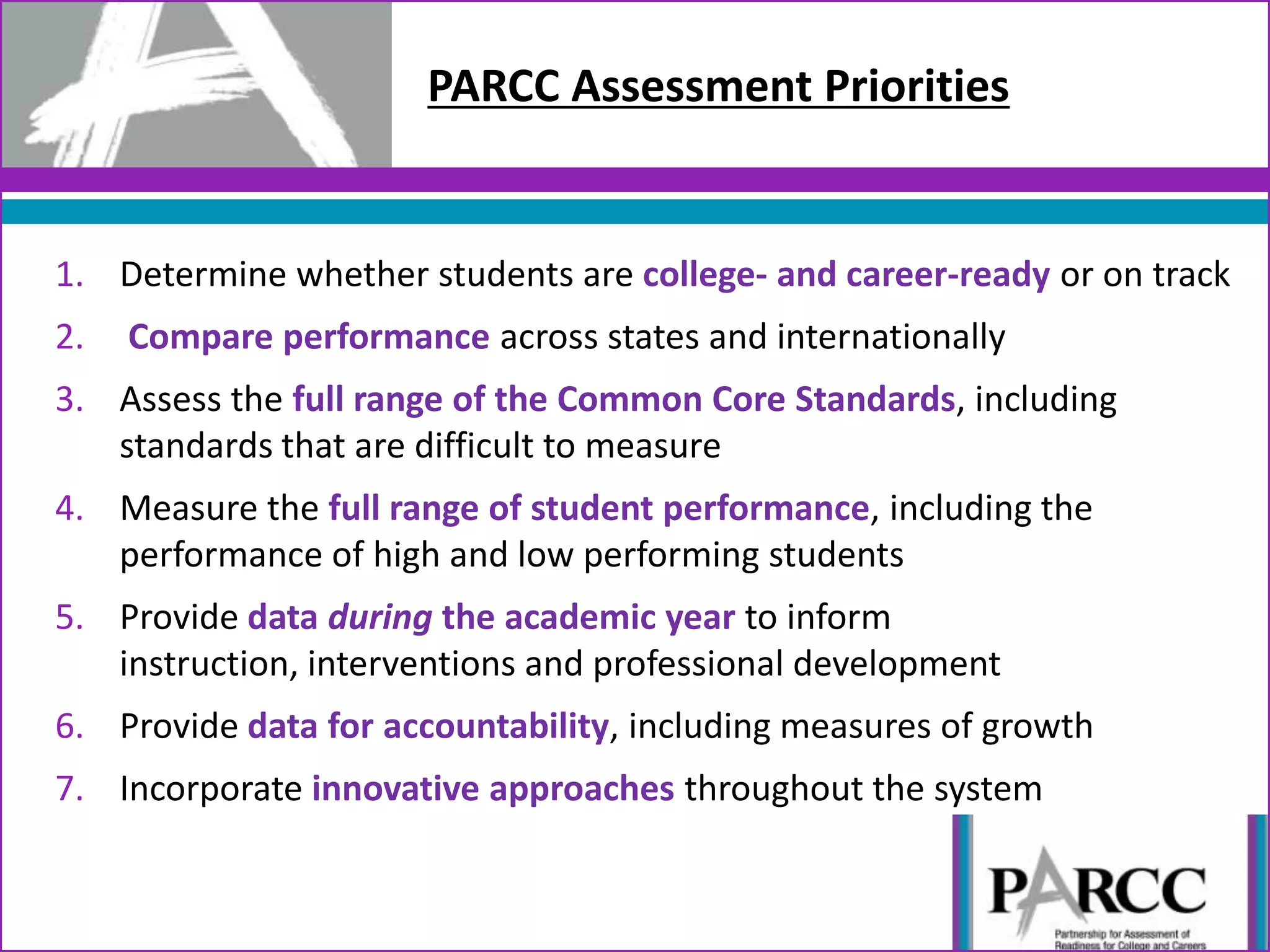
PARCC Assessment Priorities
1. Determine whether students are college- and career-ready or on track
2. Compare performance across states and internationally
3. Assess the full range of the Common Core Standards, including
standards that are difficult to measure
4. Measure the full range of student performance, including the
performance of high and low performing students
5. Provide data during the academic year to inform
instruction, interventions and professional development
6. Provide data for accountability, including measures of growth
7. Incorporate innovative approaches throughout the system
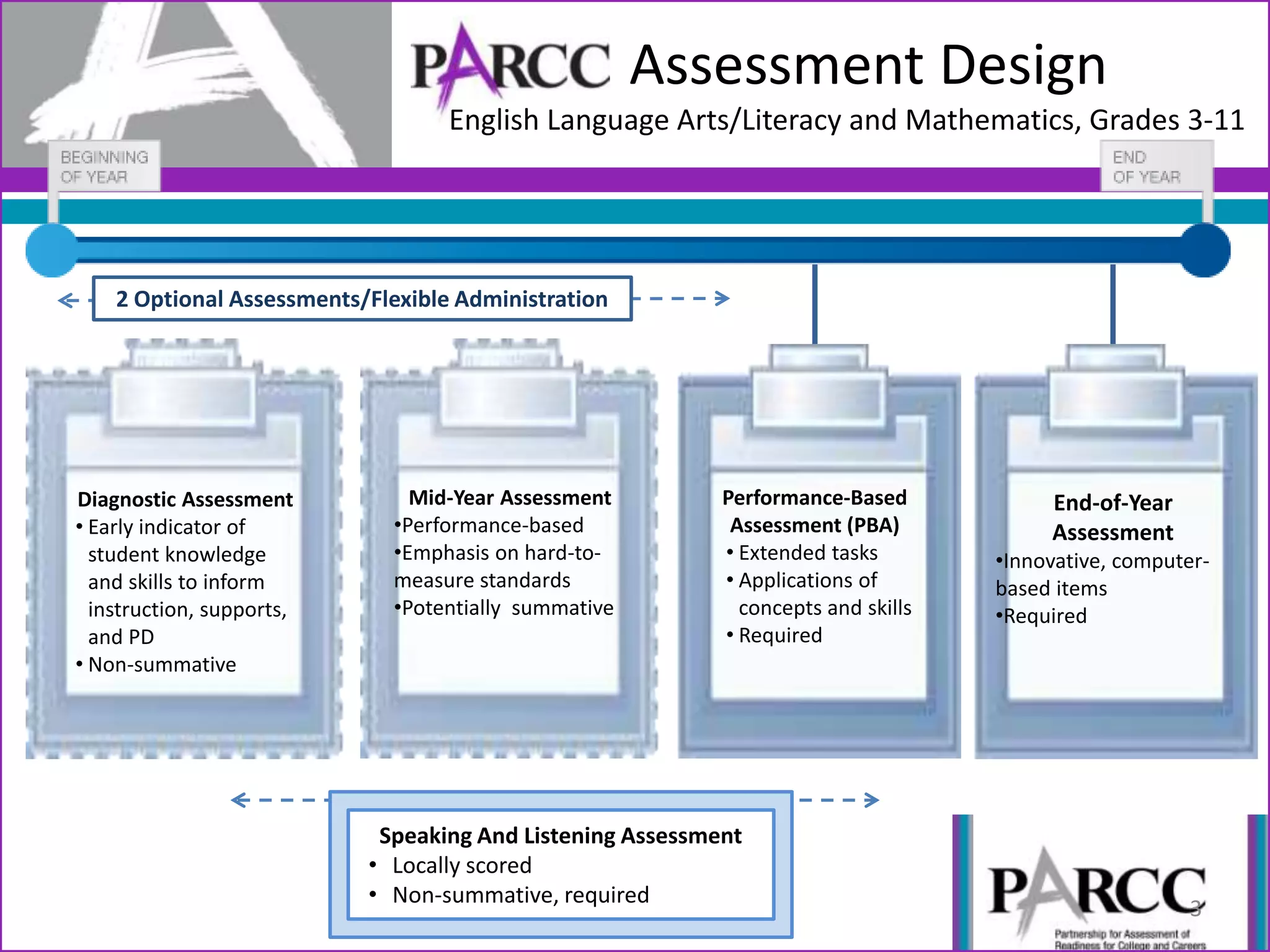
Assessment Design
English Language Arts/Literacy and Mathematics, Grades 3-11
End-of-Year
Assessment
•Innovative, computer-
based items
•Required
Performance-Based
Assessment (PBA)
• Extended tasks
• Applications of
concepts and skills
• Required
Diagnostic Assessment
• Early indicator of
student knowledge
and skills to inform
instruction, supports,
and PD
• Non-summative
2 Optional Assessments/Flexible Administration
Mid-Year Assessment
•Performance-based
•Emphasis on hard-to-
measure standards
•Potentially summative
3
Speaking And Listening Assessment
• Locally scored
• Non-summative, required
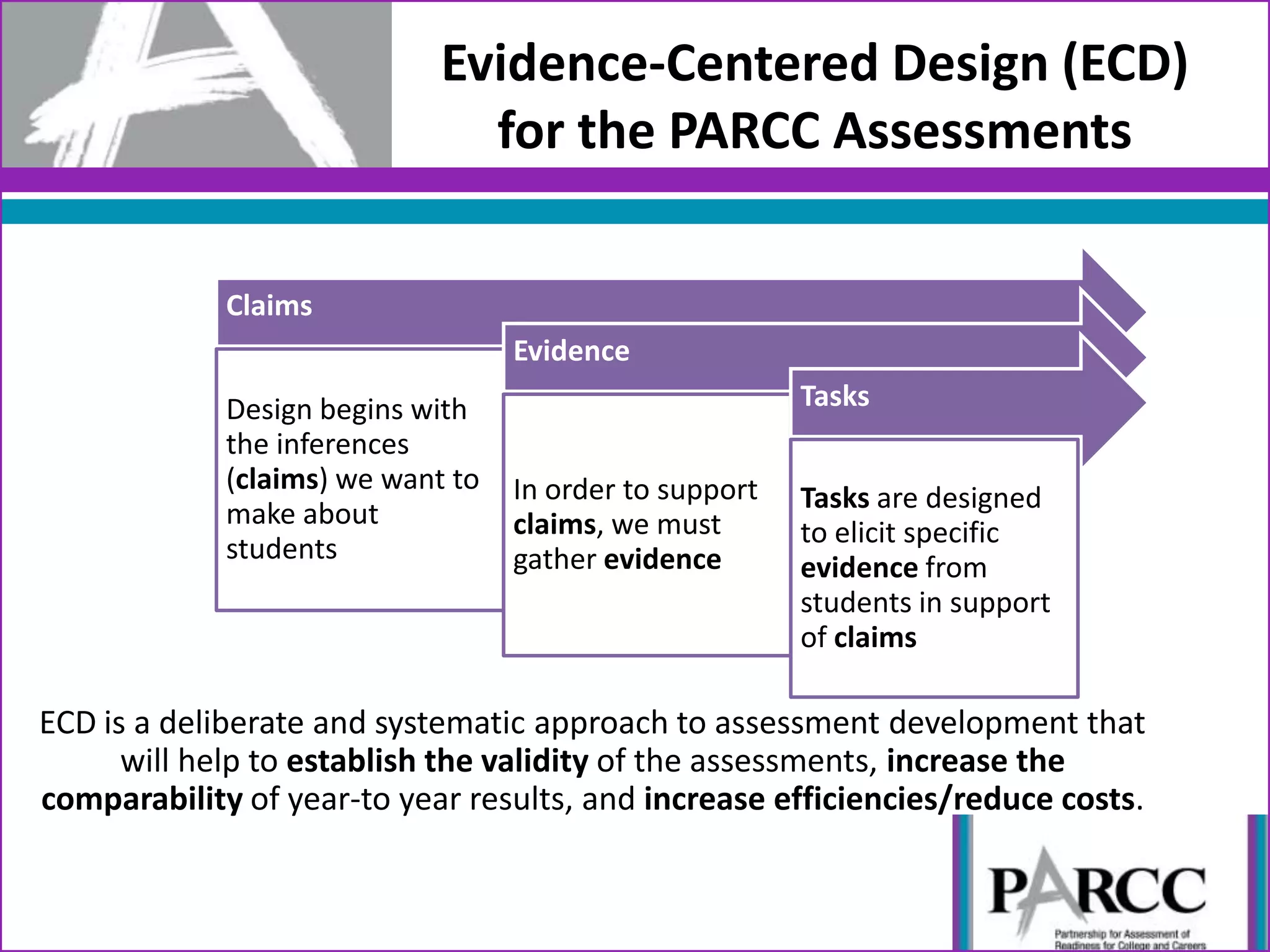
Evidence-Centered Design (ECD)
for the PARCC Assessments
Claims
Design begins with
the inferences
(claims) we want to
make about
students
Evidence
In order to support
claims, we must
gather evidence
Tasks
Tasks are designed
to elicit specific
evidence from
students in support
of claims
ECD is a deliberate and systematic approach to assessment development that
will help to establish the validity of the assessments, increase the
comparability of year-to year results, and increase efficiencies/reduce costs.
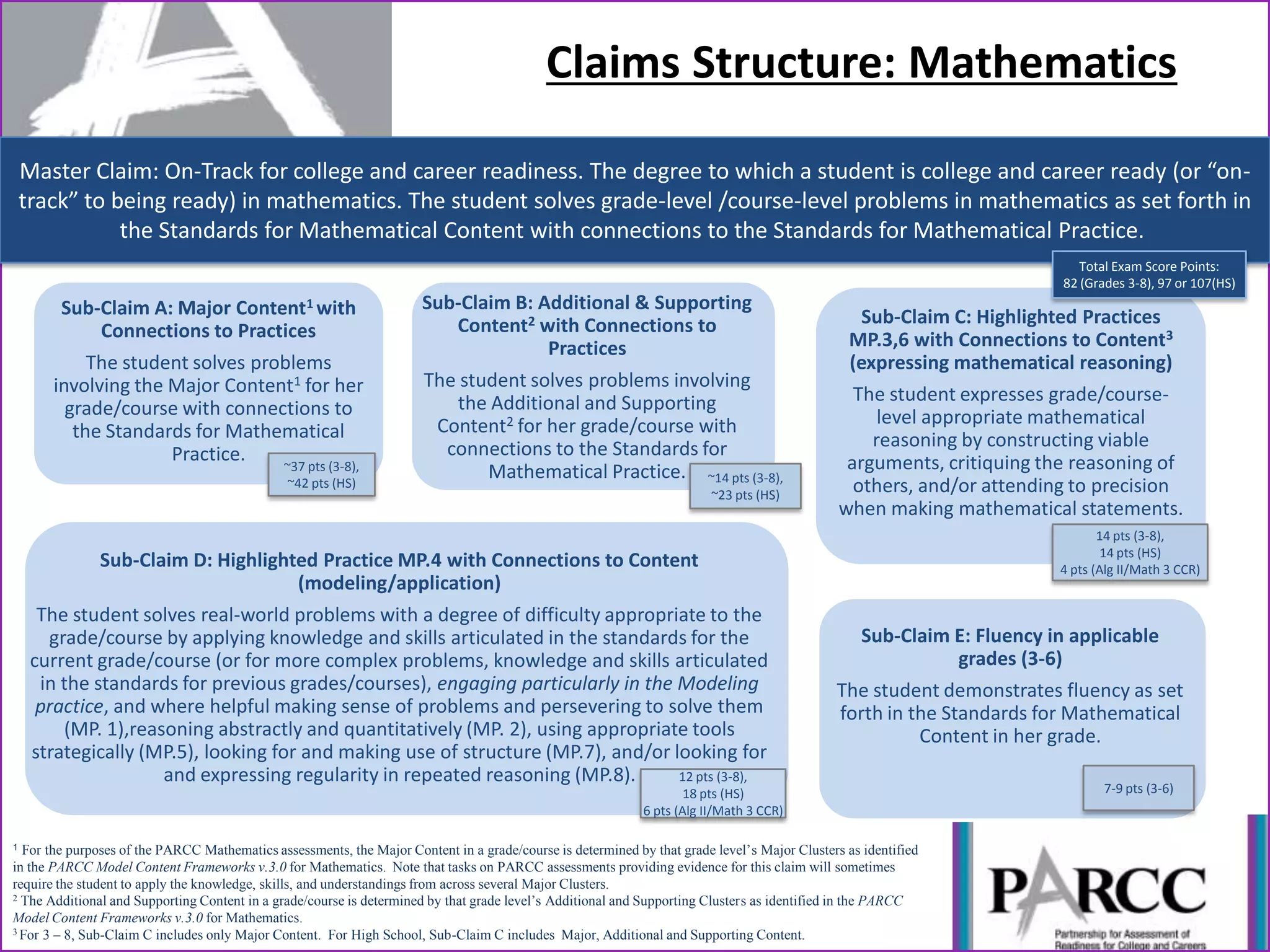
Master Claim: On-Track for college and career readiness. The degree to which a student is college and career ready (or “on-
track” to being ready) in mathematics. The student solves grade-level /course-level problems in mathematics as set forth in
the Standards for Mathematical Content with connections to the Standards for Mathematical Practice.
Sub-Claim A: Major Content1 with
Connections to Practices
The student solves problems
involving the Major Content1 for her
grade/course with connections to
the Standards for Mathematical
Practice.
Sub-Claim B: Additional & Supporting
Content2 with Connections to
Practices
The student solves problems involving
the Additional and Supporting
Content2 for her grade/course with
connections to the Standards for
Mathematical Practice.
Sub-Claim E: Fluency in applicable
grades (3-6)
The student demonstrates fluency as set
forth in the Standards for Mathematical
Content in her grade.
Claims Structure: Mathematics
Sub-Claim C: Highlighted Practices
MP.3,6 with Connections to Content3
(expressing mathematical reasoning)
The student expresses grade/course-
level appropriate mathematical
reasoning by constructing viable
arguments, critiquing the reasoning of
others, and/or attending to precision
when making mathematical statements.
Sub-Claim D: Highlighted Practice MP.4 with Connections to Content
(modeling/application)
The student solves real-world problems with a degree of difficulty appropriate to the
grade/course by applying knowledge and skills articulated in the standards for the
current grade/course (or for more complex problems, knowledge and skills articulated
in the standards for previous grades/courses), engaging particularly in the Modeling
practice, and where helpful making sense of problems and persevering to solve them
(MP. 1),reasoning abstractly and quantitatively (MP. 2), using appropriate tools
strategically (MP.5), looking for and making use of structure (MP.7), and/or looking for
and expressing regularity in repeated reasoning (MP.8).
Total Exam Score Points:
82 (Grades 3-8), 97 or 107(HS)
12 pts (3-8),
18 pts (HS)
6 pts (Alg II/Math 3 CCR)
~37 pts (3-8),
~42 pts (HS) ~14 pts (3-8),
~23 pts (HS)
14 pts (3-8),
14 pts (HS)
4 pts (Alg II/Math 3 CCR)
7-9 pts (3-6)
1 For the purposes of the PARCC Mathematics assessments, the Major Content in a grade/course is determined by that grade level’s Major Clusters as identified
in the PARCC Model Content Frameworks v.3.0 for Mathematics. Note that tasks on PARCC assessments providing evidence for this claim will sometimes
require the student to apply the knowledge, skills, and understandings from across several Major Clusters.
2 The Additional and Supporting Content in a grade/course is determined by that grade level’s Additional and Supporting Clusters as identified in the PARCC
Model Content Frameworks v.3.0 for Mathematics.
3 For 3 – 8, Sub-Claim C includes only Major Content. For High School, Sub-Claim C includes Major, Additional and Supporting Content.
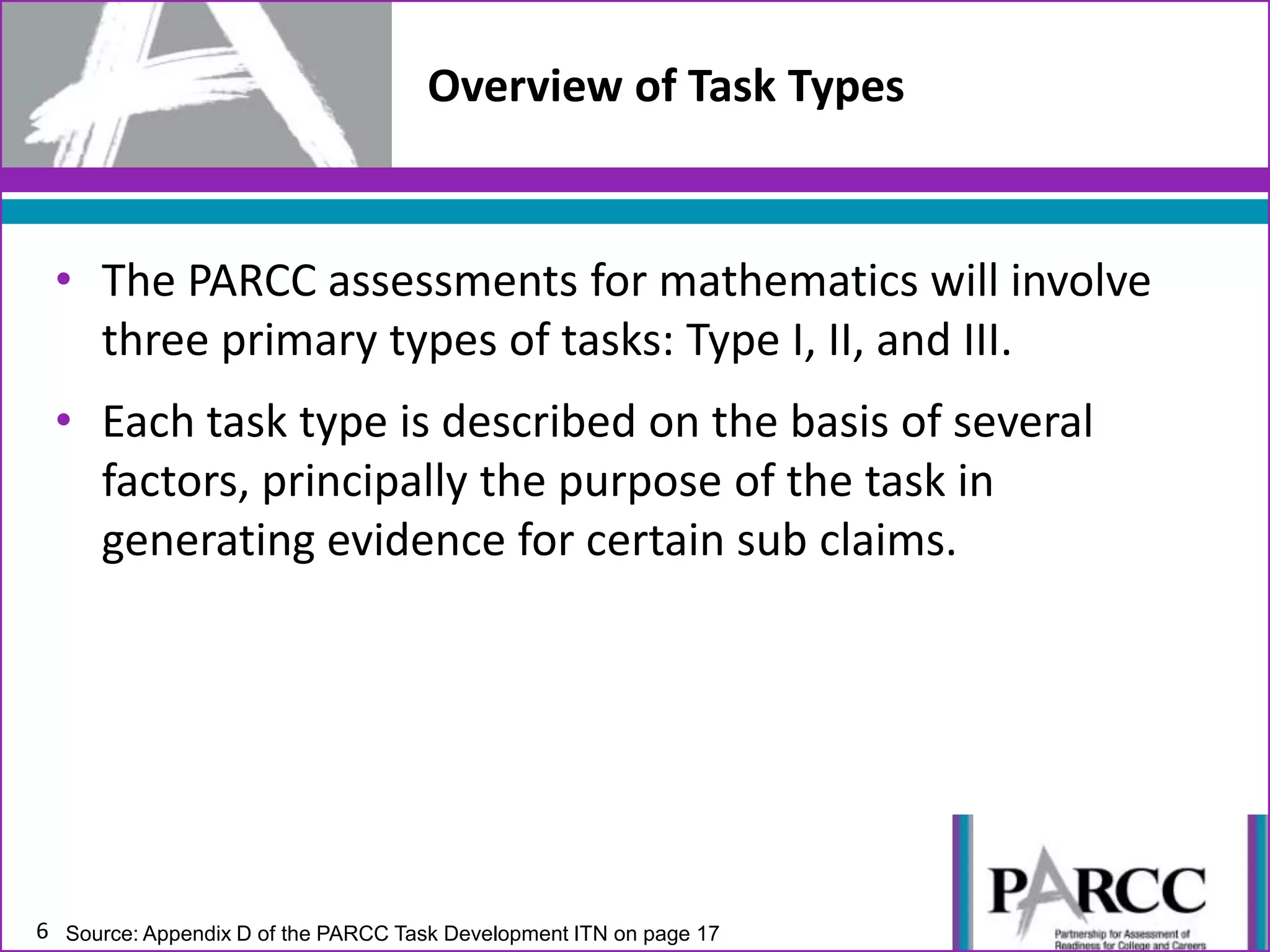
• The PARCC assessments for mathematics will involve
three primary types of tasks: Type I, II, and III.
• Each task type is described on the basis of several
factors, principally the purpose of the task in
generating evidence for certain sub claims.
6
Overview of Task Types
Source: Appendix D of the PARCC Task Development ITN on page 17
Overview of PARCC Mathematics Task
Types
7
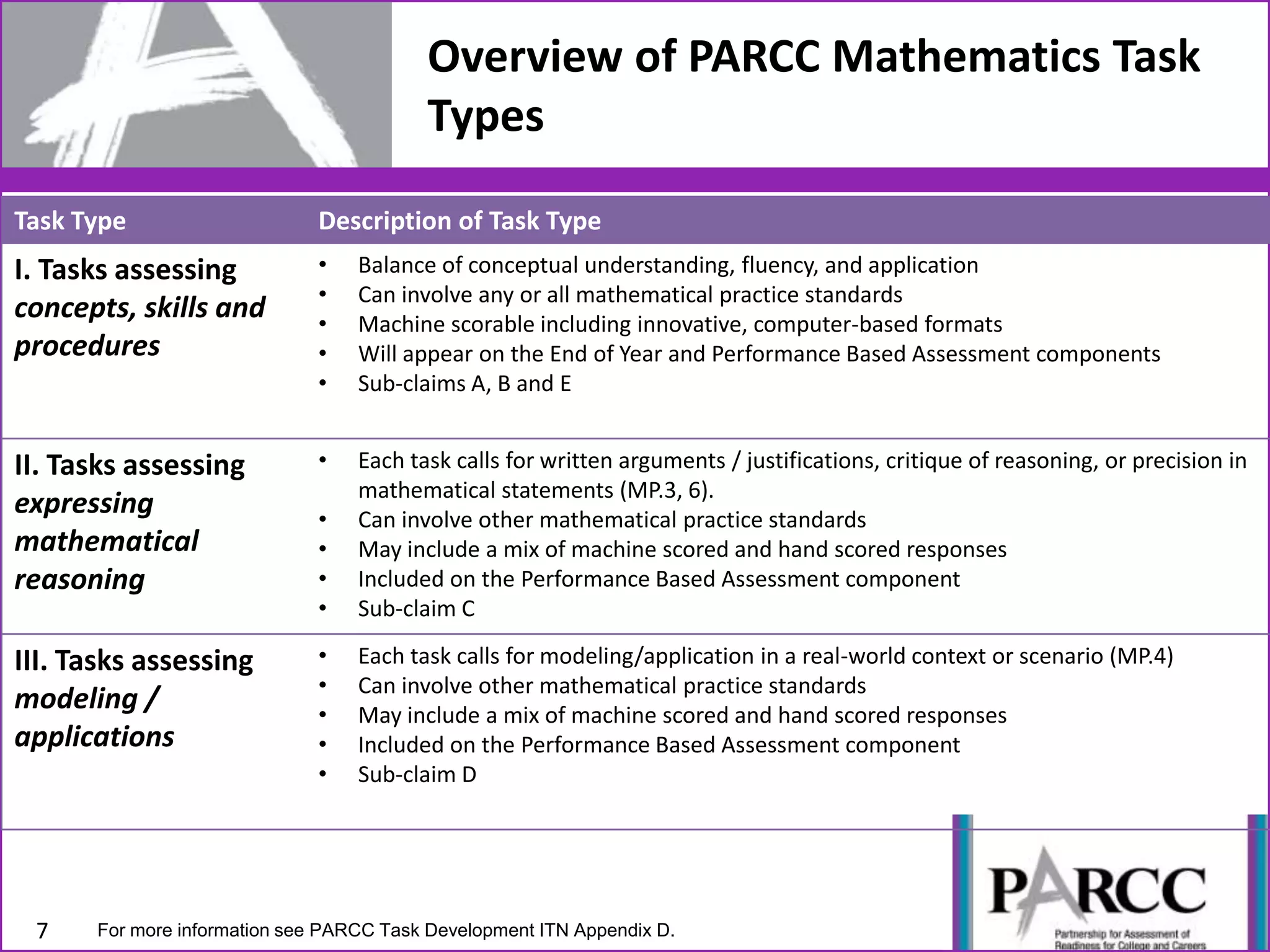
Task Type Description of Task Type
I. Tasks assessing
concepts, skills and
procedures
• Balance of conceptual understanding, fluency, and application
• Can involve any or all mathematical practice standards
• Machine scorable including innovative, computer-based formats
• Will appear on the End of Year and Performance Based Assessment components
• Sub-claims A, B and E
II. Tasks assessing
expressing
mathematical
reasoning
• Each task calls for written arguments / justifications, critique of reasoning, or precision in
mathematical statements (MP.3, 6).
• Can involve other mathematical practice standards
• May include a mix of machine scored and hand scored responses
• Included on the Performance Based Assessment component
• Sub-claim C
III. Tasks assessing
modeling /
applications
• Each task calls for modeling/application in a real-world context or scenario (MP.4)
• Can involve other mathematical practice standards
• May include a mix of machine scored and hand scored responses
• Included on the Performance Based Assessment component
• Sub-claim D
For more information see PARCC Task Development ITN Appendix D.
Design of PARCC Math Summative
Assessments
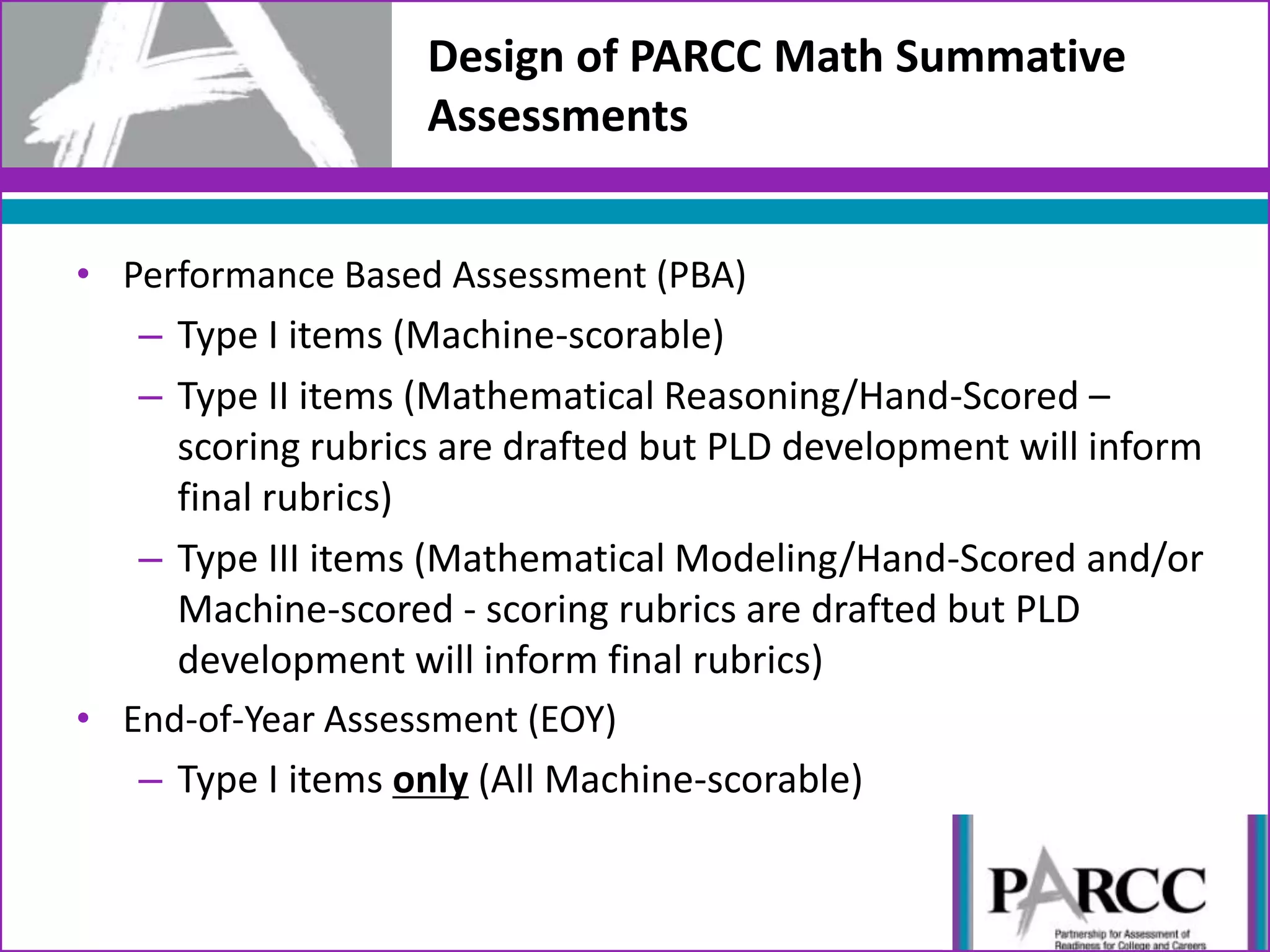
• Performance Based Assessment (PBA)
– Type I items (Machine-scorable)
– Type II items (Mathematical Reasoning/Hand-Scored –
scoring rubrics are drafted but PLD development will inform
final rubrics)
– Type III items (Mathematical Modeling/Hand-Scored and/or
Machine-scored - scoring rubrics are drafted but PLD
development will inform final rubrics)
• End-of-Year Assessment (EOY)
– Type I items only (All Machine-scorable)
Several types of evidence statements are being used to
describe what a task should be assessing, including:
1.Those using exact standards language
2.Those transparently derived from exact standards language, e.g.,
by splitting a content standard
3.Integrative evidence statements that express plausible direct
implications of the standards without going beyond the standards
to create new requirements
4.Sub-claim C & D evidence statements, which put MP.3, 4, 6 as
primary with connections to content
9
Evidence Statement Tables:
Types of Evidence Statements
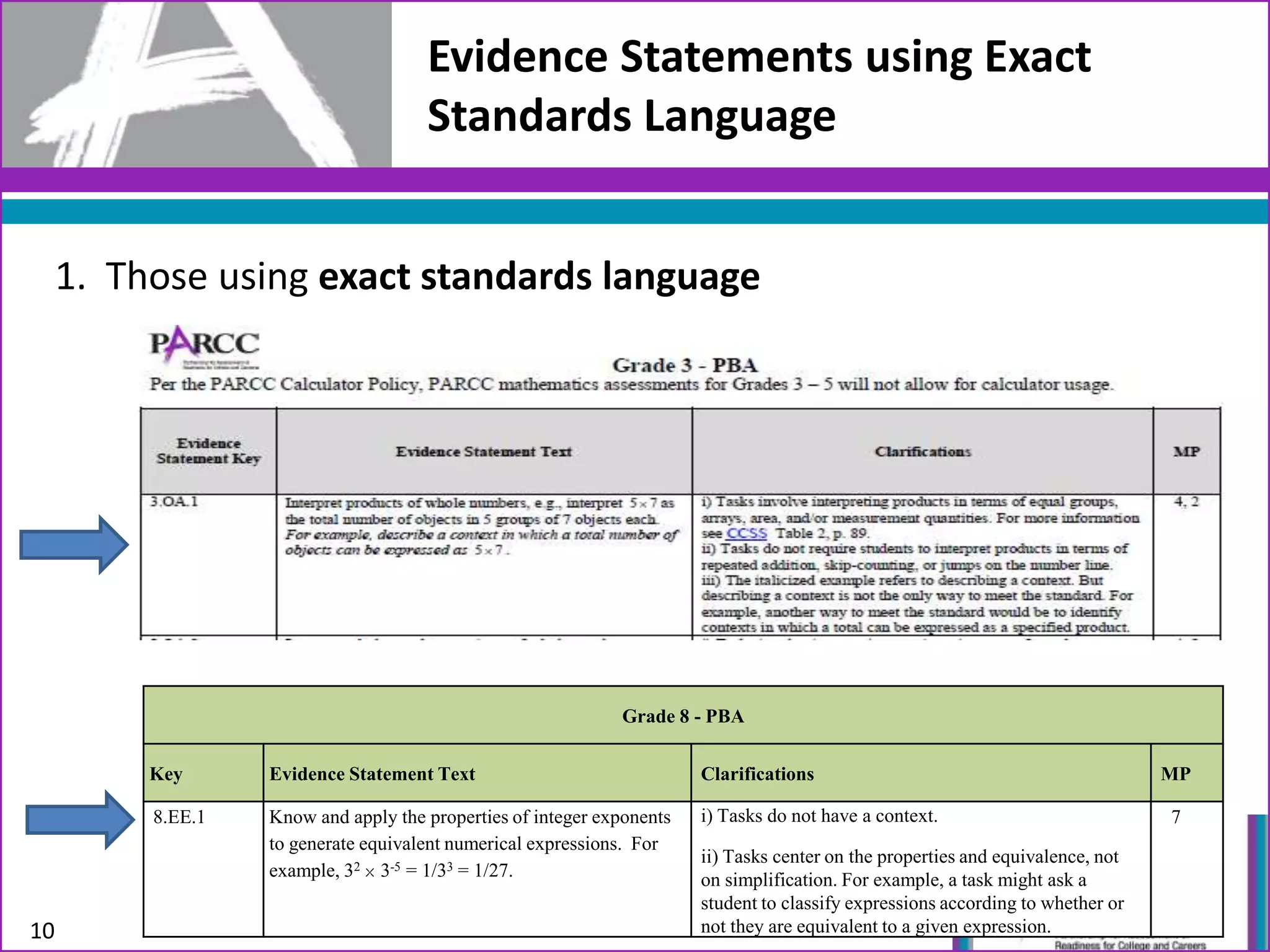
1. Those using exact standards language
10
Evidence Statements using Exact
Standards Language
Grade 8 - PBA
Key Evidence Statement Text Clarifications MP
8.EE.1 Know and apply the properties of integer exponents
to generate equivalent numerical expressions. For
example, 32 3-5 = 1/33 = 1/27.
i) Tasks do not have a context.
ii) Tasks center on the properties and equivalence, not
on simplification. For example, a task might ask a
student to classify expressions according to whether or
not they are equivalent to a given expression.
7
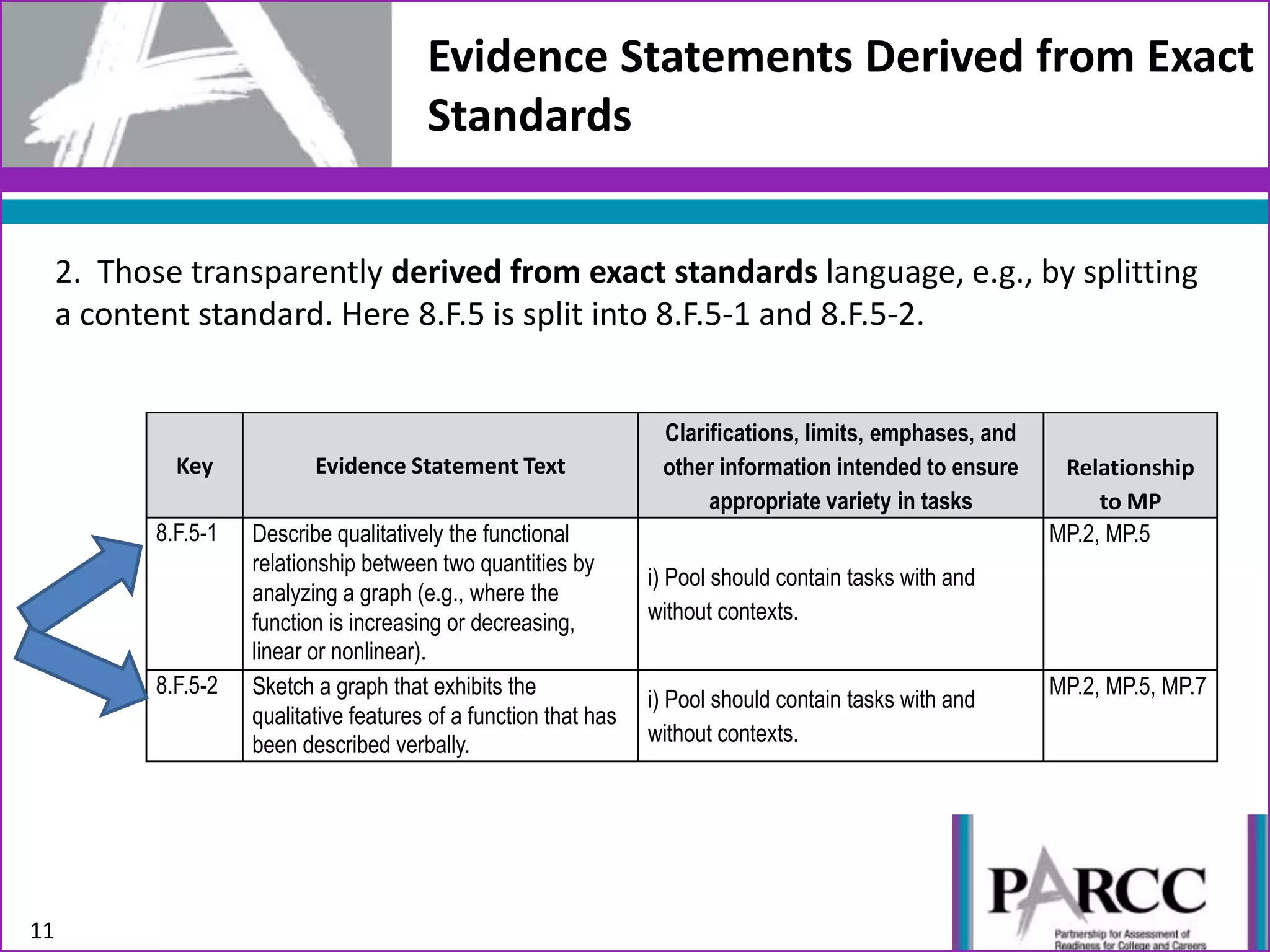
2. Those transparently derived from exact standards language, e.g., by splitting
a content standard. Here 8.F.5 is split into 8.F.5-1 and 8.F.5-2.
11
Evidence Statements Derived from Exact
Standards
Key Evidence Statement Text
Clarifications, limits, emphases, and
other information intended to ensure
appropriate variety in tasks
Relationship
to MP
8.F.5-1 Describe qualitatively the functional
relationship between two quantities by
analyzing a graph (e.g., where the
function is increasing or decreasing,
linear or nonlinear).
i) Pool should contain tasks with and
without contexts.
MP.2, MP.5
8.F.5-2 Sketch a graph that exhibits the
qualitative features of a function that has
been described verbally.
i) Pool should contain tasks with and
without contexts.
MP.2, MP.5, MP.7
Evidence Statements Derived from Exact
Standards
12
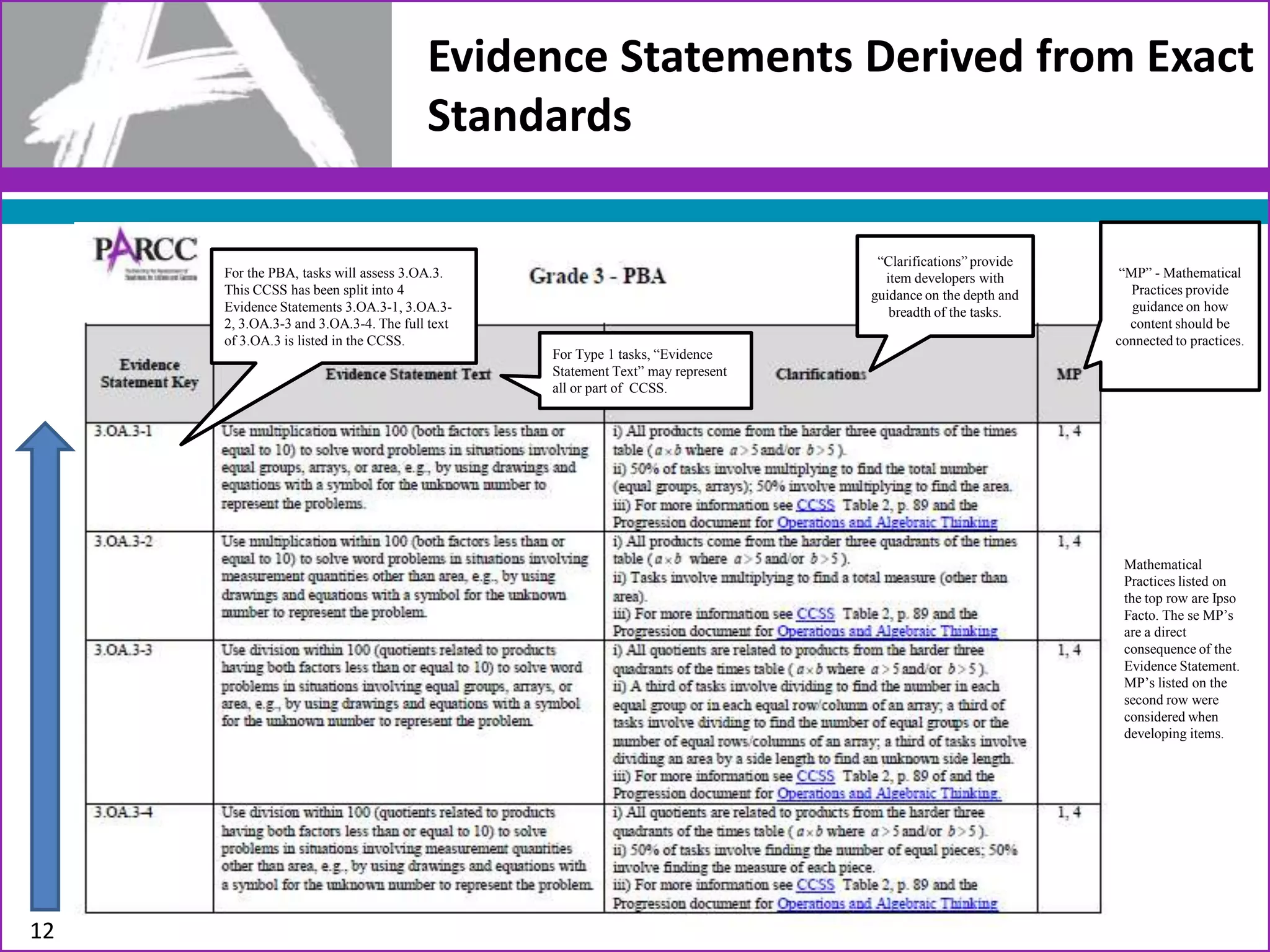
For the PBA, tasks will assess 3.OA.3.
This CCSS has been split into 4
Evidence Statements 3.OA.3-1, 3.OA.3-
2, 3.OA.3-3 and 3.OA.3-4. The full text
of 3.OA.3 is listed in the CCSS.
For Type 1 tasks, “Evidence
Statement Text” may represent
all or part of CCSS.
“Clarifications” provide
item developers with
guidance on the depth and
breadth of the tasks.
“MP” - Mathematical
Practices provide
guidance on how
content should be
connected to practices.
Mathematical
Practices listed on
the top row are Ipso
Facto. The se MP’s
are a direct
consequence of the
Evidence Statement.
MP’s listed on the
second row were
considered when
developing items.
Integrative Evidence Statements
13
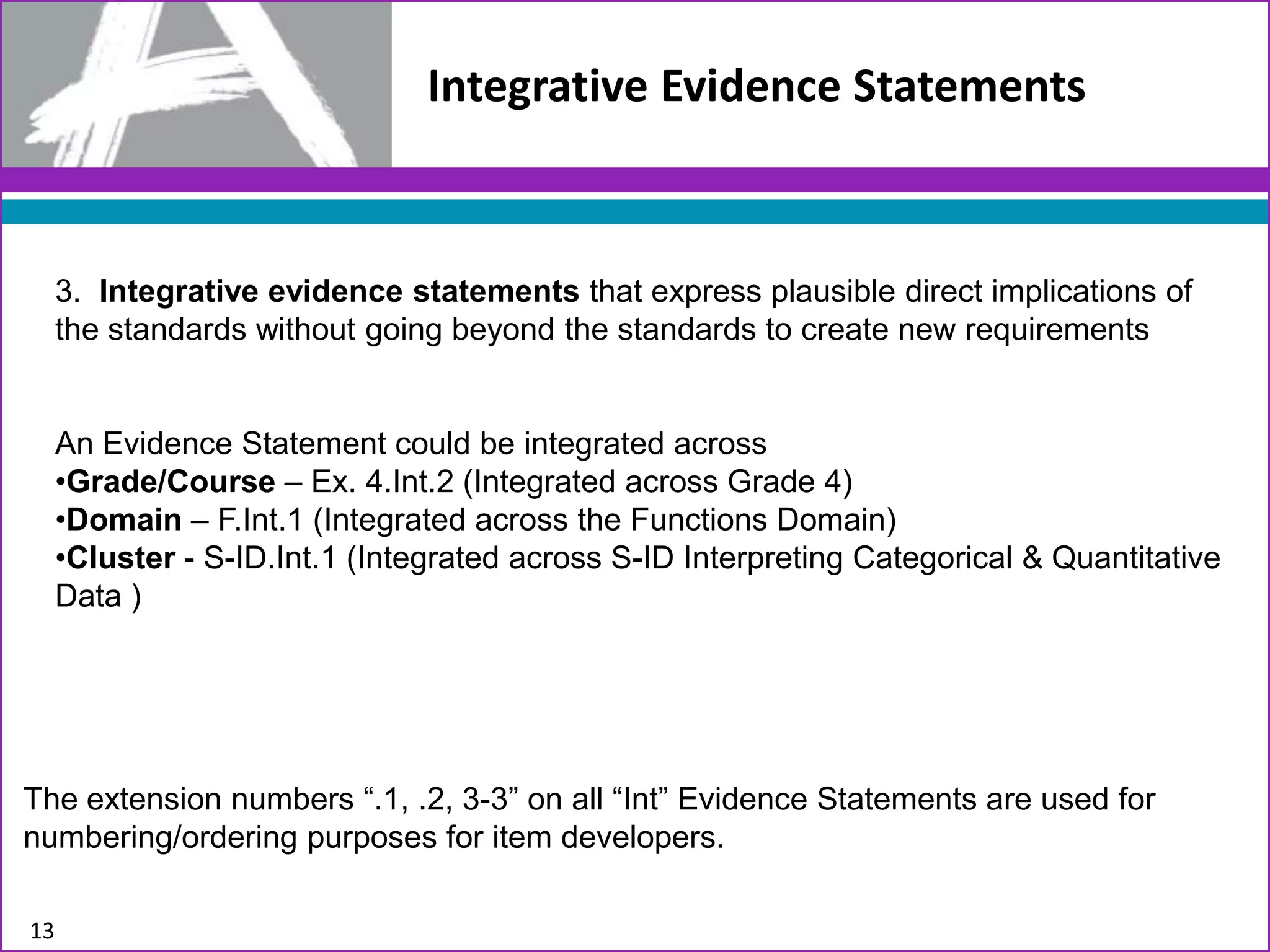
3. Integrative evidence statements that express plausible direct implications of
the standards without going beyond the standards to create new requirements
An Evidence Statement could be integrated across
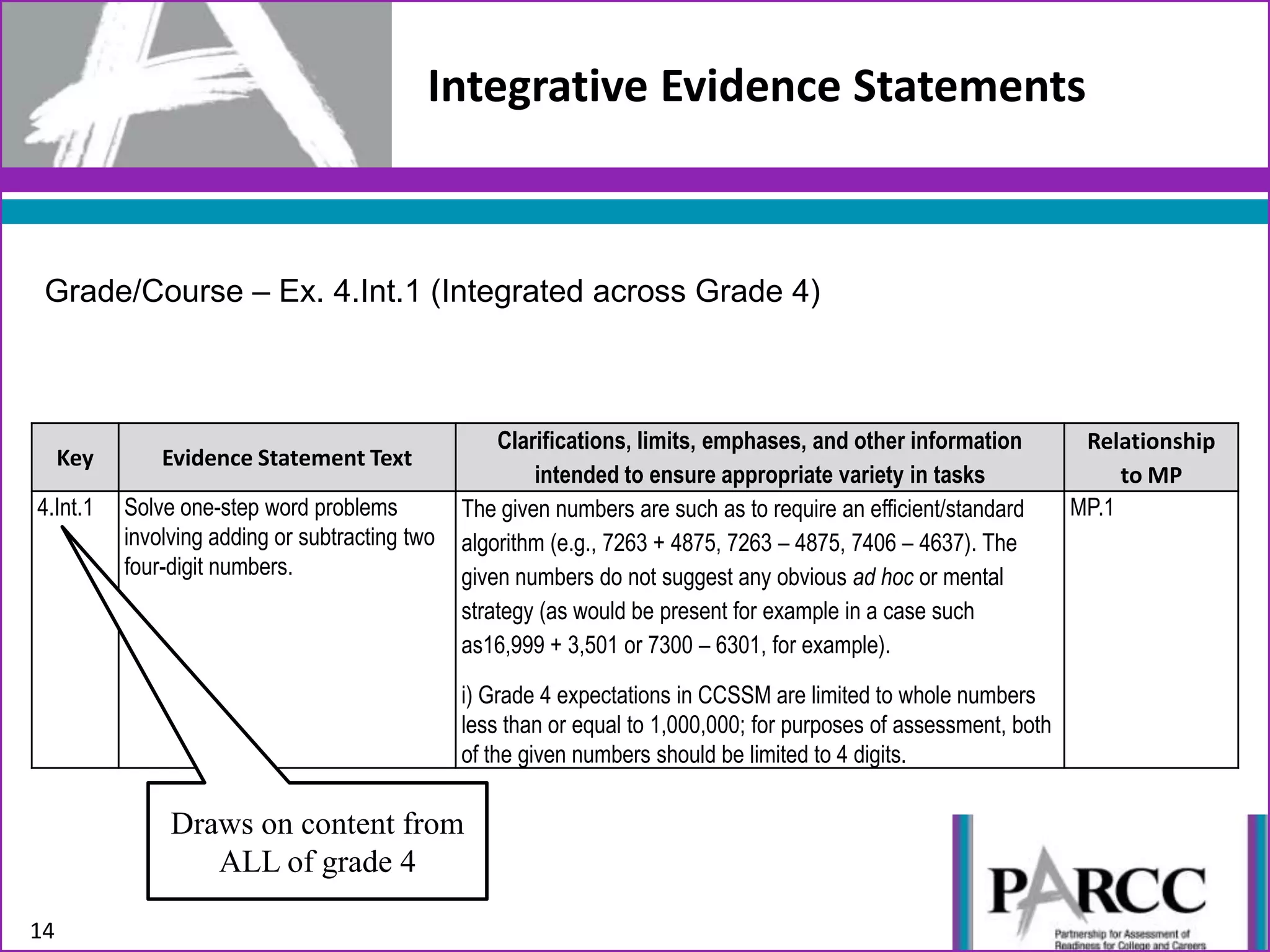
•Grade/Course – Ex. 4.Int.2 (Integrated across Grade 4)
•Domain – F.Int.1 (Integrated across the Functions Domain)
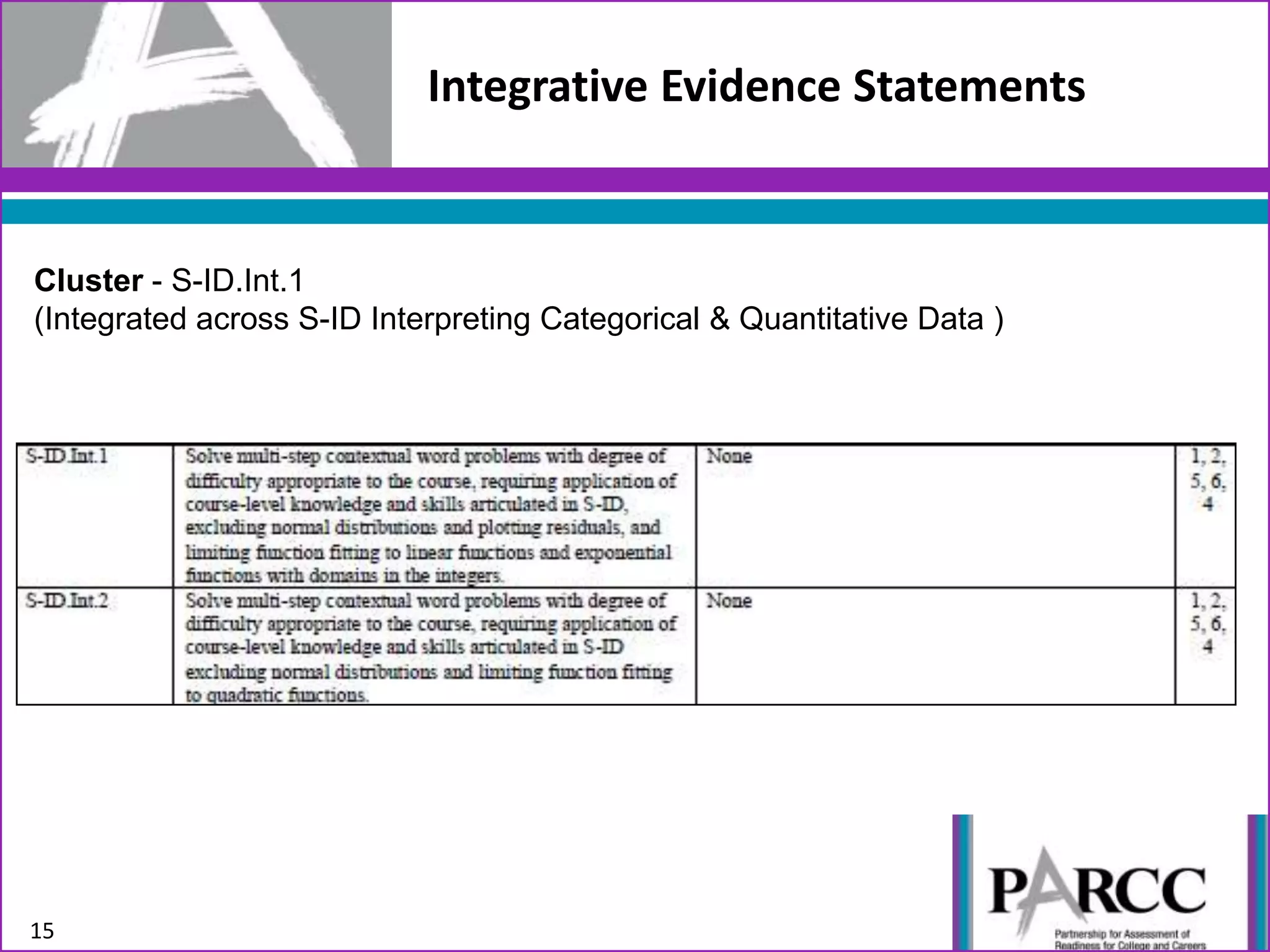
•Cluster - S-ID.Int.1 (Integrated across S-ID Interpreting Categorical & Quantitative
Data )
The extension numbers “.1, .2, 3-3” on all “Int” Evidence Statements are used for
numbering/ordering purposes for item developers.
14
Integrative Evidence Statements
Key Evidence Statement Text
Clarifications, limits, emphases, and other information
intended to ensure appropriate variety in tasks
Relationship
to MP
4.Int.1 Solve one-step word problems
involving adding or subtracting two
four-digit numbers.
The given numbers are such as to require an efficient/standard
algorithm (e.g., 7263 + 4875, 7263 – 4875, 7406 – 4637). The
given numbers do not suggest any obvious ad hoc or mental
strategy (as would be present for example in a case such
as16,999 + 3,501 or 7300 – 6301, for example).
i) Grade 4 expectations in CCSSM are limited to whole numbers
less than or equal to 1,000,000; for purposes of assessment, both
of the given numbers should be limited to 4 digits.
MP.1
Draws on content from
ALL of grade 4
Grade/Course – Ex. 4.Int.1 (Integrated across Grade 4)
Integrative Evidence Statements
15
Cluster - S-ID.Int.1
(Integrated across S-ID Interpreting Categorical & Quantitative Data )
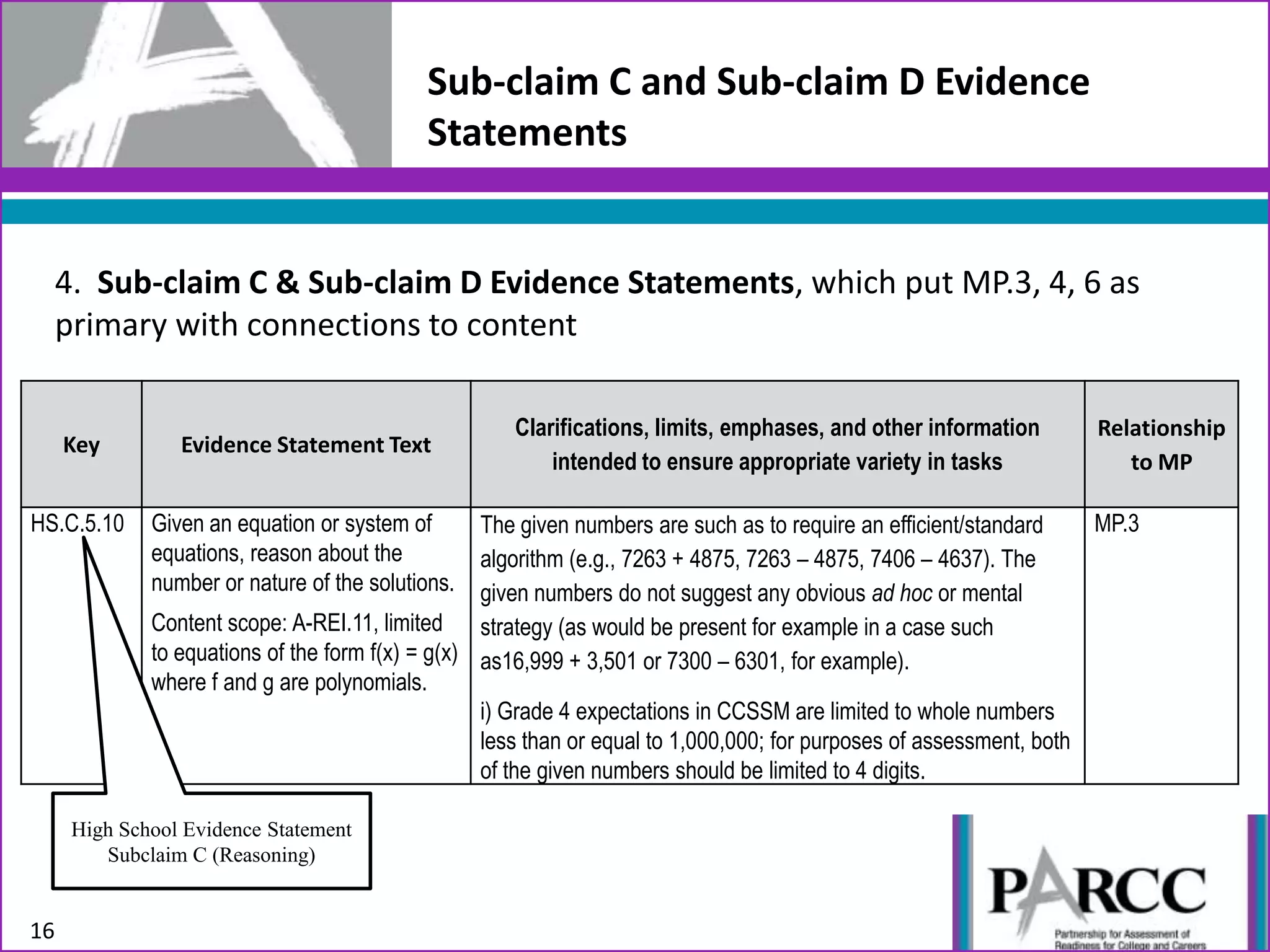
4. Sub-claim C & Sub-claim D Evidence Statements, which put MP.3, 4, 6 as
primary with connections to content
16
Sub-claim C and Sub-claim D Evidence
Statements
Key Evidence Statement Text
Clarifications, limits, emphases, and other information
intended to ensure appropriate variety in tasks
Relationship
to MP
HS.C.5.10 Given an equation or system of
equations, reason about the
number or nature of the solutions.
Content scope: A-REI.11, limited
to equations of the form f(x) = g(x)
where f and g are polynomials.
The given numbers are such as to require an efficient/standard
algorithm (e.g., 7263 + 4875, 7263 – 4875, 7406 – 4637). The
given numbers do not suggest any obvious ad hoc or mental
strategy (as would be present for example in a case such
as16,999 + 3,501 or 7300 – 6301, for example).
i) Grade 4 expectations in CCSSM are limited to whole numbers
less than or equal to 1,000,000; for purposes of assessment, both
of the given numbers should be limited to 4 digits.
MP.3
High School Evidence Statement
Subclaim C (Reasoning)
Sub-claim C and Sub-claim D Evidence
Statements
17
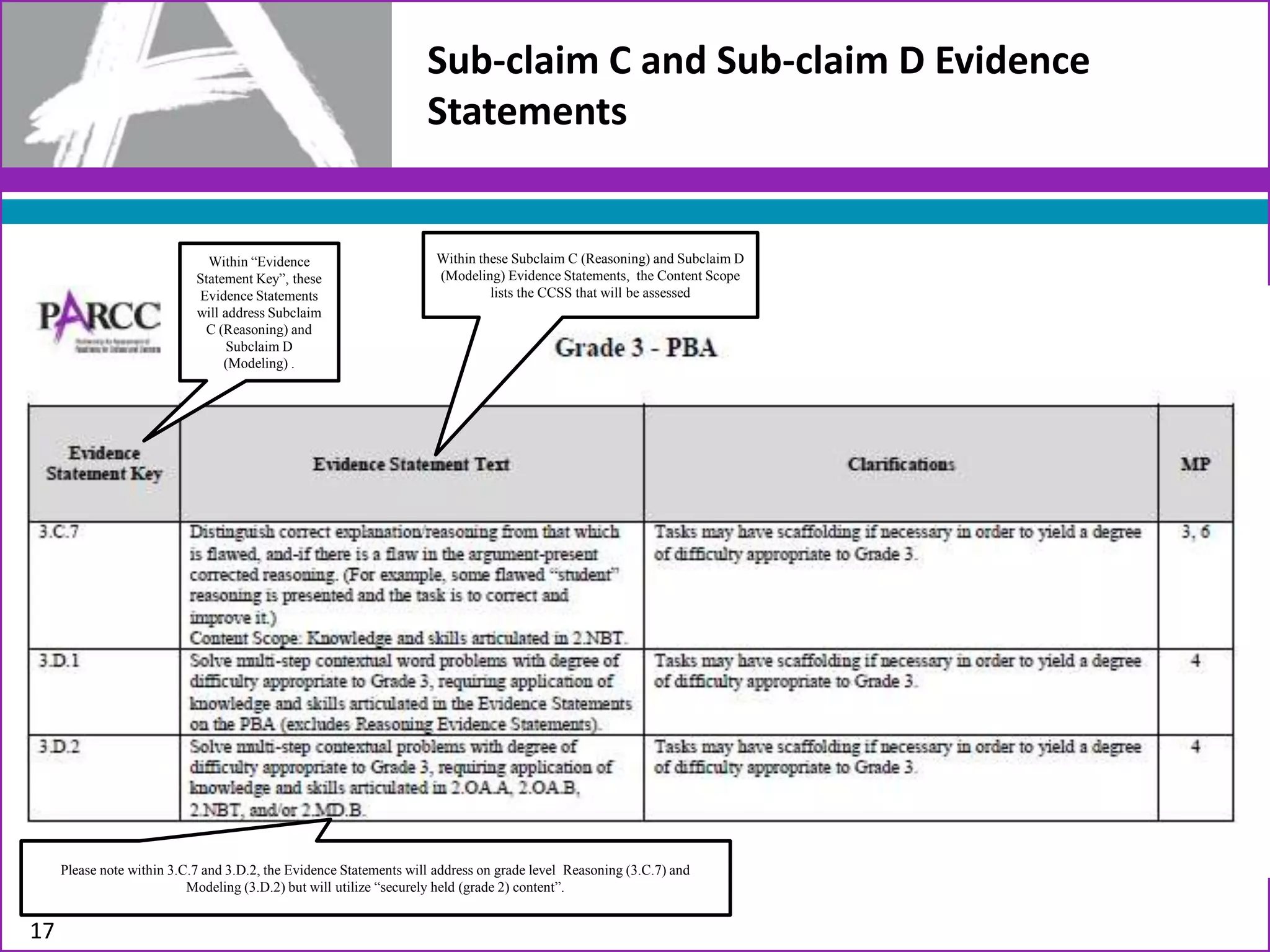
Within these Subclaim C (Reasoning) and Subclaim D
(Modeling) Evidence Statements, the Content Scope
lists the CCSS that will be assessed
Within “Evidence
Statement Key”, these
Evidence Statements
will address Subclaim
C (Reasoning) and
Subclaim D
(Modeling) .
Please note within 3.C.7 and 3.D.2, the Evidence Statements will address on grade level Reasoning (3.C.7) and
Modeling (3.D.2) but will utilize “securely held (grade 2) content”.
Resources
• Any publicly released assessment policies, item
prototypes, PARCC Model Content Frameworks, and other
valuable resources can be found at www.PARCConline.org
19
Thank You
Understanding the Blueprints for the PARCC
Summative Assessments in Mathematics

Parcc public blueprints narrated math 04262013

  • 1.
    Understanding the Evidence StatementTables for the PARCC Summative Assessments in Mathematics 1
  • 2.
    PARCC Assessment Priorities 1.Determine whether students are college- and career-ready or on track 2. Compare performance across states and internationally 3. Assess the full range of the Common Core Standards, including standards that are difficult to measure 4. Measure the full range of student performance, including the performance of high and low performing students 5. Provide data during the academic year to inform instruction, interventions and professional development 6. Provide data for accountability, including measures of growth 7. Incorporate innovative approaches throughout the system
  • 3.
    Assessment Design English LanguageArts/Literacy and Mathematics, Grades 3-11 End-of-Year Assessment •Innovative, computer- based items •Required Performance-Based Assessment (PBA) • Extended tasks • Applications of concepts and skills • Required Diagnostic Assessment • Early indicator of student knowledge and skills to inform instruction, supports, and PD • Non-summative 2 Optional Assessments/Flexible Administration Mid-Year Assessment •Performance-based •Emphasis on hard-to- measure standards •Potentially summative 3 Speaking And Listening Assessment • Locally scored • Non-summative, required
  • 4.
    Evidence-Centered Design (ECD) forthe PARCC Assessments Claims Design begins with the inferences (claims) we want to make about students Evidence In order to support claims, we must gather evidence Tasks Tasks are designed to elicit specific evidence from students in support of claims ECD is a deliberate and systematic approach to assessment development that will help to establish the validity of the assessments, increase the comparability of year-to year results, and increase efficiencies/reduce costs.
  • 5.
    Master Claim: On-Trackfor college and career readiness. The degree to which a student is college and career ready (or “on- track” to being ready) in mathematics. The student solves grade-level /course-level problems in mathematics as set forth in the Standards for Mathematical Content with connections to the Standards for Mathematical Practice. Sub-Claim A: Major Content1 with Connections to Practices The student solves problems involving the Major Content1 for her grade/course with connections to the Standards for Mathematical Practice. Sub-Claim B: Additional & Supporting Content2 with Connections to Practices The student solves problems involving the Additional and Supporting Content2 for her grade/course with connections to the Standards for Mathematical Practice. Sub-Claim E: Fluency in applicable grades (3-6) The student demonstrates fluency as set forth in the Standards for Mathematical Content in her grade. Claims Structure: Mathematics Sub-Claim C: Highlighted Practices MP.3,6 with Connections to Content3 (expressing mathematical reasoning) The student expresses grade/course- level appropriate mathematical reasoning by constructing viable arguments, critiquing the reasoning of others, and/or attending to precision when making mathematical statements. Sub-Claim D: Highlighted Practice MP.4 with Connections to Content (modeling/application) The student solves real-world problems with a degree of difficulty appropriate to the grade/course by applying knowledge and skills articulated in the standards for the current grade/course (or for more complex problems, knowledge and skills articulated in the standards for previous grades/courses), engaging particularly in the Modeling practice, and where helpful making sense of problems and persevering to solve them (MP. 1),reasoning abstractly and quantitatively (MP. 2), using appropriate tools strategically (MP.5), looking for and making use of structure (MP.7), and/or looking for and expressing regularity in repeated reasoning (MP.8). Total Exam Score Points: 82 (Grades 3-8), 97 or 107(HS) 12 pts (3-8), 18 pts (HS) 6 pts (Alg II/Math 3 CCR) ~37 pts (3-8), ~42 pts (HS) ~14 pts (3-8), ~23 pts (HS) 14 pts (3-8), 14 pts (HS) 4 pts (Alg II/Math 3 CCR) 7-9 pts (3-6) 1 For the purposes of the PARCC Mathematics assessments, the Major Content in a grade/course is determined by that grade level’s Major Clusters as identified in the PARCC Model Content Frameworks v.3.0 for Mathematics. Note that tasks on PARCC assessments providing evidence for this claim will sometimes require the student to apply the knowledge, skills, and understandings from across several Major Clusters. 2 The Additional and Supporting Content in a grade/course is determined by that grade level’s Additional and Supporting Clusters as identified in the PARCC Model Content Frameworks v.3.0 for Mathematics. 3 For 3 – 8, Sub-Claim C includes only Major Content. For High School, Sub-Claim C includes Major, Additional and Supporting Content.
  • 6.
    • The PARCCassessments for mathematics will involve three primary types of tasks: Type I, II, and III. • Each task type is described on the basis of several factors, principally the purpose of the task in generating evidence for certain sub claims. 6 Overview of Task Types Source: Appendix D of the PARCC Task Development ITN on page 17
  • 7.
    Overview of PARCCMathematics Task Types 7 Task Type Description of Task Type I. Tasks assessing concepts, skills and procedures • Balance of conceptual understanding, fluency, and application • Can involve any or all mathematical practice standards • Machine scorable including innovative, computer-based formats • Will appear on the End of Year and Performance Based Assessment components • Sub-claims A, B and E II. Tasks assessing expressing mathematical reasoning • Each task calls for written arguments / justifications, critique of reasoning, or precision in mathematical statements (MP.3, 6). • Can involve other mathematical practice standards • May include a mix of machine scored and hand scored responses • Included on the Performance Based Assessment component • Sub-claim C III. Tasks assessing modeling / applications • Each task calls for modeling/application in a real-world context or scenario (MP.4) • Can involve other mathematical practice standards • May include a mix of machine scored and hand scored responses • Included on the Performance Based Assessment component • Sub-claim D For more information see PARCC Task Development ITN Appendix D.
  • 8.
    Design of PARCCMath Summative Assessments • Performance Based Assessment (PBA) – Type I items (Machine-scorable) – Type II items (Mathematical Reasoning/Hand-Scored – scoring rubrics are drafted but PLD development will inform final rubrics) – Type III items (Mathematical Modeling/Hand-Scored and/or Machine-scored - scoring rubrics are drafted but PLD development will inform final rubrics) • End-of-Year Assessment (EOY) – Type I items only (All Machine-scorable)
  • 9.
    Several types ofevidence statements are being used to describe what a task should be assessing, including: 1.Those using exact standards language 2.Those transparently derived from exact standards language, e.g., by splitting a content standard 3.Integrative evidence statements that express plausible direct implications of the standards without going beyond the standards to create new requirements 4.Sub-claim C & D evidence statements, which put MP.3, 4, 6 as primary with connections to content 9 Evidence Statement Tables: Types of Evidence Statements
  • 10.
    1. Those usingexact standards language 10 Evidence Statements using Exact Standards Language Grade 8 - PBA Key Evidence Statement Text Clarifications MP 8.EE.1 Know and apply the properties of integer exponents to generate equivalent numerical expressions. For example, 32 3-5 = 1/33 = 1/27. i) Tasks do not have a context. ii) Tasks center on the properties and equivalence, not on simplification. For example, a task might ask a student to classify expressions according to whether or not they are equivalent to a given expression. 7
  • 11.
    2. Those transparentlyderived from exact standards language, e.g., by splitting a content standard. Here 8.F.5 is split into 8.F.5-1 and 8.F.5-2. 11 Evidence Statements Derived from Exact Standards Key Evidence Statement Text Clarifications, limits, emphases, and other information intended to ensure appropriate variety in tasks Relationship to MP 8.F.5-1 Describe qualitatively the functional relationship between two quantities by analyzing a graph (e.g., where the function is increasing or decreasing, linear or nonlinear). i) Pool should contain tasks with and without contexts. MP.2, MP.5 8.F.5-2 Sketch a graph that exhibits the qualitative features of a function that has been described verbally. i) Pool should contain tasks with and without contexts. MP.2, MP.5, MP.7
  • 12.
    Evidence Statements Derivedfrom Exact Standards 12 For the PBA, tasks will assess 3.OA.3. This CCSS has been split into 4 Evidence Statements 3.OA.3-1, 3.OA.3- 2, 3.OA.3-3 and 3.OA.3-4. The full text of 3.OA.3 is listed in the CCSS. For Type 1 tasks, “Evidence Statement Text” may represent all or part of CCSS. “Clarifications” provide item developers with guidance on the depth and breadth of the tasks. “MP” - Mathematical Practices provide guidance on how content should be connected to practices. Mathematical Practices listed on the top row are Ipso Facto. The se MP’s are a direct consequence of the Evidence Statement. MP’s listed on the second row were considered when developing items.
  • 13.
    Integrative Evidence Statements 13 3.Integrative evidence statements that express plausible direct implications of the standards without going beyond the standards to create new requirements An Evidence Statement could be integrated across •Grade/Course – Ex. 4.Int.2 (Integrated across Grade 4) •Domain – F.Int.1 (Integrated across the Functions Domain) •Cluster - S-ID.Int.1 (Integrated across S-ID Interpreting Categorical & Quantitative Data ) The extension numbers “.1, .2, 3-3” on all “Int” Evidence Statements are used for numbering/ordering purposes for item developers.
  • 14.
    14 Integrative Evidence Statements KeyEvidence Statement Text Clarifications, limits, emphases, and other information intended to ensure appropriate variety in tasks Relationship to MP 4.Int.1 Solve one-step word problems involving adding or subtracting two four-digit numbers. The given numbers are such as to require an efficient/standard algorithm (e.g., 7263 + 4875, 7263 – 4875, 7406 – 4637). The given numbers do not suggest any obvious ad hoc or mental strategy (as would be present for example in a case such as16,999 + 3,501 or 7300 – 6301, for example). i) Grade 4 expectations in CCSSM are limited to whole numbers less than or equal to 1,000,000; for purposes of assessment, both of the given numbers should be limited to 4 digits. MP.1 Draws on content from ALL of grade 4 Grade/Course – Ex. 4.Int.1 (Integrated across Grade 4)
  • 15.
    Integrative Evidence Statements 15 Cluster- S-ID.Int.1 (Integrated across S-ID Interpreting Categorical & Quantitative Data )
  • 16.
    4. Sub-claim C& Sub-claim D Evidence Statements, which put MP.3, 4, 6 as primary with connections to content 16 Sub-claim C and Sub-claim D Evidence Statements Key Evidence Statement Text Clarifications, limits, emphases, and other information intended to ensure appropriate variety in tasks Relationship to MP HS.C.5.10 Given an equation or system of equations, reason about the number or nature of the solutions. Content scope: A-REI.11, limited to equations of the form f(x) = g(x) where f and g are polynomials. The given numbers are such as to require an efficient/standard algorithm (e.g., 7263 + 4875, 7263 – 4875, 7406 – 4637). The given numbers do not suggest any obvious ad hoc or mental strategy (as would be present for example in a case such as16,999 + 3,501 or 7300 – 6301, for example). i) Grade 4 expectations in CCSSM are limited to whole numbers less than or equal to 1,000,000; for purposes of assessment, both of the given numbers should be limited to 4 digits. MP.3 High School Evidence Statement Subclaim C (Reasoning)
  • 17.
    Sub-claim C andSub-claim D Evidence Statements 17 Within these Subclaim C (Reasoning) and Subclaim D (Modeling) Evidence Statements, the Content Scope lists the CCSS that will be assessed Within “Evidence Statement Key”, these Evidence Statements will address Subclaim C (Reasoning) and Subclaim D (Modeling) . Please note within 3.C.7 and 3.D.2, the Evidence Statements will address on grade level Reasoning (3.C.7) and Modeling (3.D.2) but will utilize “securely held (grade 2) content”.
  • 18.
    Resources • Any publiclyreleased assessment policies, item prototypes, PARCC Model Content Frameworks, and other valuable resources can be found at www.PARCConline.org
  • 19.
    19 Thank You Understanding theBlueprints for the PARCC Summative Assessments in Mathematics

Editor's Notes

  • #2 Welcome to the Partnership for Assessment of Readiness for College and Careers (PARCC) . PARCC is a consortium of 22 states working together to develop a common set of K-12 assessments in English and mathematics anchored in what it takes to be ready for college and careers. Today’s webinar will focus on “Understanding the Evidence Statement Tables for the PARCC Summative Assessments in Mathematics”.
  • #3 The design of the PARCC assessment system is driven by these priorities. PARCC has begun to develop summative assessments for grades 3-8 and high school.
  • #4 PARCC states are developing an assessment system comprised of four components: a Diagnostic Assessment, Mid-Year Assessment, Performance Based Assessment and End-of-Year Assessment. Each component will be computer-delivered and will leverage technology to incorporate innovations.
  • #5 PARCC utilizes Evidence-Centered Design to inform the development of the summative assessments. ECD is a deliberate and systematic approach to assessment development that will help to establish the validityof the assessments, increase the comparability of year-to year results, and increase efficiencies/reduce costs. The Design begins with the inferences (claims) we want to make about students. In order to support claims, we must gather evidence. Tasks are then designed to elicit the specific evidence from students that supports the claims.
  • #6 Master Claim: Students Are “On Track” to College and Career Readiness This Master Claim reflects the overall goal of PARCC based on the Common Core State Standards and the PARCC Model Content Frameworks—to prepare students for college and careers, and specifically to ensure students have the skills and understandings required for success. The measure of progress towards this essential goal will be reflected by a student’s overall performance on the summative components (both the Performance-Based Assessment and End-of-Year Assessment) of the PARCC Assessment System.
  • #10 Evidence StatementsSeveral types of evidence statements are being used to describe what a task should be assessing, including:Those using exact standards languageThose transparently derived from exact standards language, e.g., by splitting a content standard (see 3.OA.3 (1-4) above)Integrative evidence statements that express plausible direct implications of the standards without going beyond the standards to create new requirementsSub-claim C & D evidence statements, which put MP.3, 4, 6 as primary with connections to content
  • #11 Under “Evidence Statement Text” 3.OA.1 and 8.EE.1 refer to exact standards language
  • #12 For reference:Text of 8.F.5: Describe qualitatively the functional relationship between two quantities by analyzing a graph (e.g.(for example), where the function is increasing or decreasing, linear or nonlinear). *** The second portion of the CCSS is captured in 8.F.5-2***Sketch a graph that exhibits the qualitative features of a function that has been described verbally.
  • #13 Mathematical Practices Mathematical Practices listed on the top row are Ipso Facto … The MP’s 1, 2 & 4 are a direct consequence of the Evidence Statement. MP’s listed on the second row should be considered when developing items.
  • #14 Grade/Course – Ex. 4.Int.1 or A.Int.1Domain - S-ID.Int.1Cluster - 8.EE.C.Int.1Of All of High School – HS-Int.3-3
  • #17 The Evidence States for Reasoning and Modeling (Sub-claims C and D) have a unique evidence statement key system. The first part (HS in this example) represents the grade level. The C or D represent the sub-claim. The 5.10 represents the internal numbering schema for this grade level and sub-claim and does not represent any numbering from the Common Core State Standard.
  • #20 Thank You