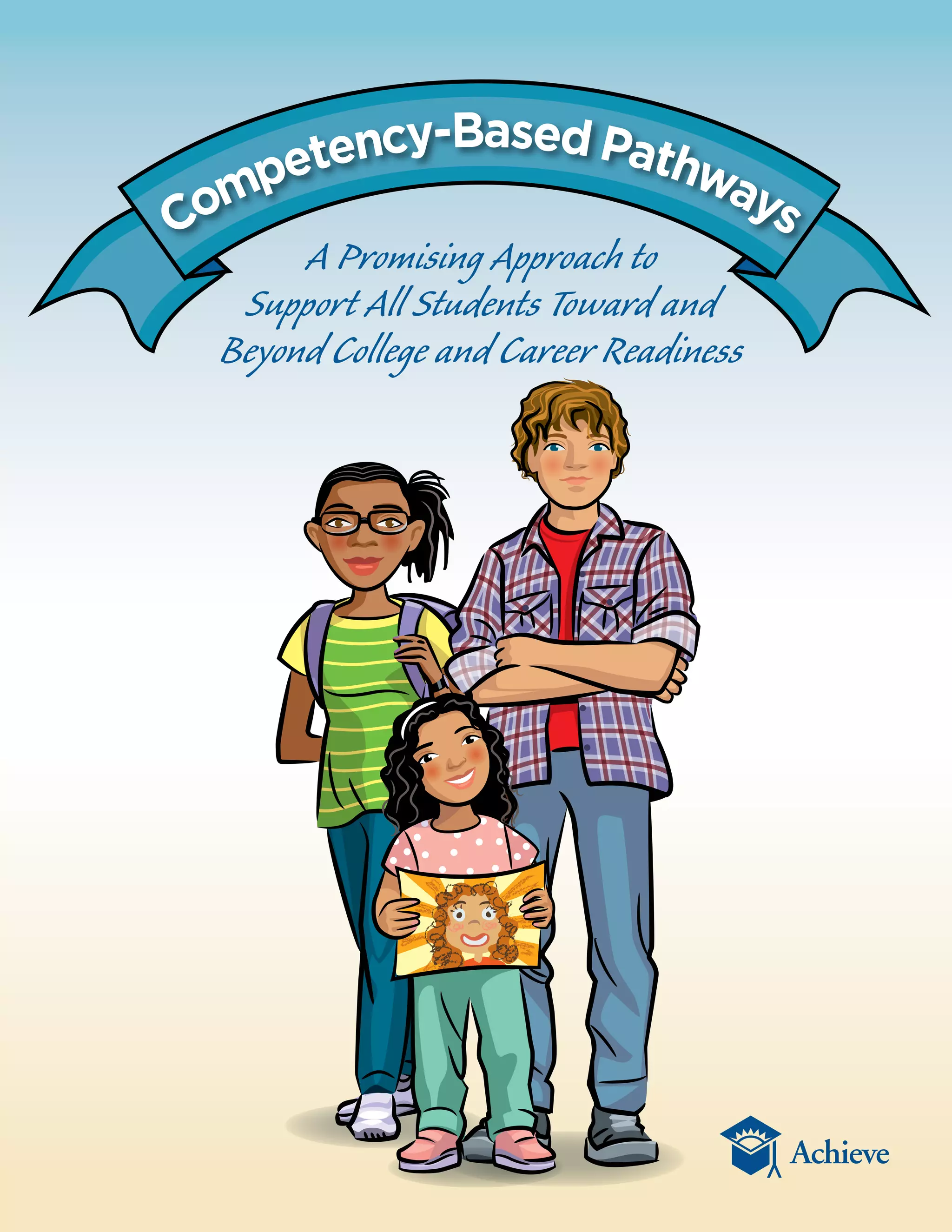
Competency-Based Pathways
A Promising Approach to
Support All Students Toward and
Beyond College and Career Readiness
CC BY-NC Achieve 2015. This work is licensed under the Creative Commons Attribution-NonCommercial 4.0
International License. To view a copy of this license, visit http://creativecommons.org/licenses/by-nc/4.0/
or send a letter to Creative Commons, PO Box 1866, Mountain View, CA 94042, USA.
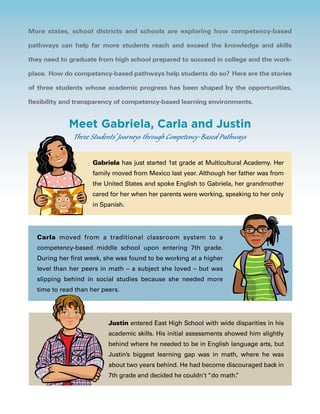
More states, school districts and schools are exploring how competency-based
pathways can help far more students reach and exceed the knowledge and skills
they need to graduate from high school prepared to succeed in college and the work-
place. How do competency-based pathways help students do so? Here are the stories
of three students whose academic progress has been shaped by the opportunities,
flexibility and transparency of competency-based learning environments.
Justin entered East High School with wide disparities in his
academic skills. His initial assessments showed him slightly
behind where he needed to be in English language arts, but
Justin’s biggest learning gap was in math, where he was
about two years behind. He had become discouraged back in
7th grade and decided he couldn’t “do math.”
Meet Gabriela, Carla and Justin
Three Students’ Journeys through Competency-Based Pathways
Gabriela has just started 1st grade at Multicultural Academy. Her
family moved from Mexico last year. Although her father was from
the United States and spoke English to Gabriela, her grandmother
cared for her when her parents were working, speaking to her only
in Spanish.
Carla moved from a traditional classroom system to a
competency-based middle school upon entering 7th grade.
During her first week, she was found to be working at a higher
level than her peers in math – a subject she loved – but was
slipping behind in social studies because she needed more
time to read than her peers.
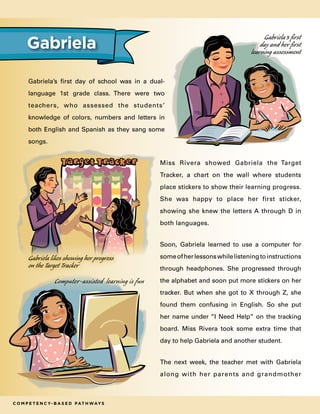
Gabriela’s first day of school was in a dual-
language 1st grade class. There were two
teachers, who assessed the students’
knowledge of colors, numbers and letters in
both English and Spanish as they sang some
songs.
Miss Rivera showed Gabriela the Target
Tracker, a chart on the wall where students
place stickers to show their learning progress.
She was happy to place her first sticker,
showing she knew the letters A through D in
both languages.
Soon, Gabriela learned to use a computer for
someofherlessonswhilelisteningtoinstructions
through headphones. She progressed through
the alphabet and soon put more stickers on her
tracker. But when she got to X through Z, she
found them confusing in English. So she put
her name under “I Need Help” on the tracking
board. Miss Rivera took some extra time that
day to help Gabriela and another student.
The next week, the teacher met with Gabriela
along with her parents and grandmother
Gabriela
Computer-assisted learning is fun
C o m p e t e n c y- B a s e d Pat h way s
Gabriela's first
day and her first
learning assessment
Gabriela likes showing her progress
on the Target Tracker
At Gabriela’s school, targeted learning levels or “teacher pace” equals two “levels” per
year. At the end of 1st grade, students should be at least at Level 2 in each subject, at the
end of 2nd grade, at Level 4 and so on to be on track to demonstrate college and career
readiness by the time they graduate. If they fall behind teacher pace in a subject they
get extra attention. But students are also encouraged to move on to higher levels or go
deeper into their learning as they demonstrate progress more quickly than others.
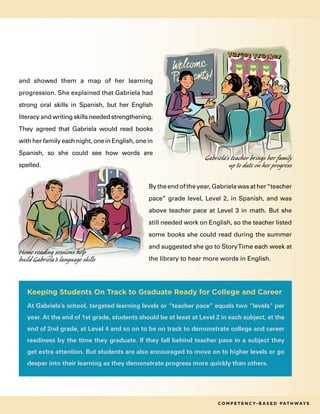
Gabriela’s teacher brings her family
up to date on her progress
and showed them a map of her learning
progression. She explained that Gabriela had
strong oral skills in Spanish, but her English
literacy and writing skills needed strengthening.
They agreed that Gabriela would read books
with her family each night, one in English, one in
Spanish, so she could see how words are
spelled.
Bytheendoftheyear,Gabrielawasather“teacher
pace” grade level, Level 2, in Spanish, and was
above teacher pace at Level 3 in math. But she
still needed work on English, so the teacher listed
some books she could read during the summer
and suggested she go to StoryTime each week at
the library to hear more words in English.
Keeping Students On Track to Graduate Ready for College and Career
C o m p e t e n c y- B a s e d Pat h way s
Home reading sessions help
build Gabriela's language skills
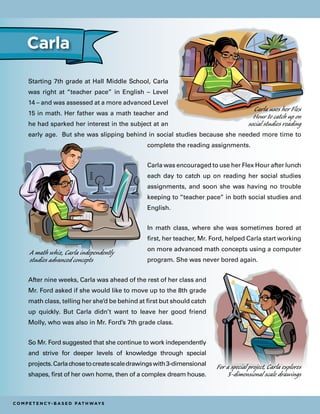
Starting 7th grade at Hall Middle School, Carla
was right at “teacher pace” in English – Level
14 – and was assessed at a more advanced Level
15 in math. Her father was a math teacher and
he had sparked her interest in the subject at an
early age. But she was slipping behind in social studies because she needed more time to
complete the reading assignments.
Carla was encouraged to use her Flex Hour after lunch
each day to catch up on reading her social studies
assignments, and soon she was having no trouble
keeping to “teacher pace” in both social studies and
English.
In math class, where she was sometimes bored at
first, her teacher, Mr. Ford, helped Carla start working
on more advanced math concepts using a computer
program. She was never bored again.
After nine weeks, Carla was ahead of the rest of her class and
Mr. Ford asked if she would like to move up to the 8th grade
math class, telling her she’d be behind at first but should catch
up quickly. But Carla didn’t want to leave her good friend
Molly, who was also in Mr. Ford’s 7th grade class.
So Mr. Ford suggested that she continue to work independently
and strive for deeper levels of knowledge through special
projects.Carlachosetocreatescaledrawingswith3-dimensional
shapes, first of her own home, then of a complex dream house.
C o m p e t e n c y- B a s e d Pat h way s
Carla
Carla uses her Flex
Hour to catch up on
social studies reading
For a special project, Carla explores
3-dimensional scale drawings
A math whiz, Carla independently
studies advanced concepts
Carla’s school uses a 1-4 scale to describe students’ progress toward meeting learning
standards. The scale helps students, parents and teachers all understand their depth of
learning. The highest category, 4, reflects knowledge utilization where students have shown
a thorough mastery of a subject including problem solving. The next category, 3, shows that
students can conduct analysis. Category 2 reflects comprehension and category 1 reflects
retrieval ability. In Carla’s school, students need to demonstrate that they have reached a 3
in a specified set of standards before they can move ahead to the next set.
Based on reviewing her work against a rubric, Mr. Ford
determined that she had achieved a 4 on the 4-point
proficiency scale and was now far ahead of her class
andonparwiththe8thgraders.Sointhenextsemester
she moved up to 8th grade math.
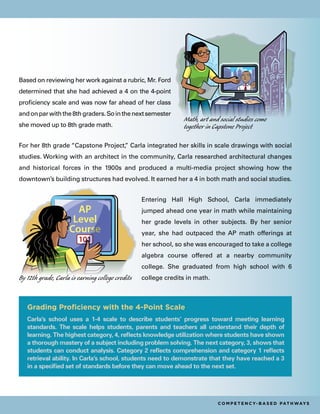
For her 8th grade “Capstone Project,” Carla integrated her skills in scale drawings with social
studies. Working with an architect in the community, Carla researched architectural changes
and historical forces in the 1900s and produced a multi-media project showing how the
downtown’s building structures had evolved. It earned her a 4 in both math and social studies.
Entering Hall High School, Carla immediately
jumped ahead one year in math while maintaining
her grade levels in other subjects. By her senior
year, she had outpaced the AP math offerings at
her school, so she was encouraged to take a college
algebra course offered at a nearby community
college. She graduated from high school with 6
college credits in math.
Grading Proficiency with the 4-Point Scale
C o m p e t e n c y- B a s e d Pat h way s
By 12th grade, Carla is earning college credits
Math, art and social studies come
together in Capstone Project
Justin
C o m p e t e n c y- B a s e d Pat h way s
When Justin entered East High School, his
assessment showed a wide range of ups and
downs in his academic skills – and his biggest
gap was in math, where, at Level 13, he was
about two years behind teacher pace for the 9th
grade.
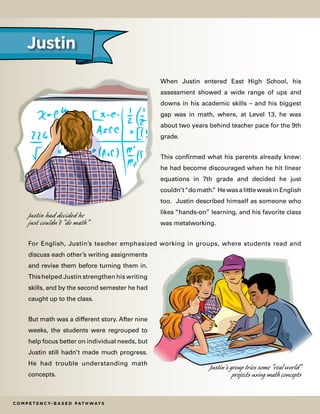
This confirmed what his parents already knew:
he had become discouraged when he hit linear
equations in 7th grade and decided he just
couldn’t“domath.” HewasalittleweakinEnglish
too. Justin described himself as someone who
likes “hands-on” learning, and his favorite class
was metalworking.
For English, Justin’s teacher emphasized working in groups, where students read and
discuss each other’s writing assignments
and revise them before turning them in.
Thishelped Justin strengthen his writing
skills, and by the second semester he had
caught up to the class.
But math was a different story. After nine
weeks, the students were regrouped to
help focus better on individual needs, but
Justin still hadn’t made much progress.
He had trouble understanding math
concepts.
Justin had decided he
just couldn't "do math"
Justin's group tries some "real world"
projects using math concepts
C o m p e t e n c y- B a s e d Pat h way s
His teacher, Mr. Patrick, tried a new
approach based on Justin’s hands-
on learning preference. He put him in
a special program with some other
students – and at first they didn’t even
do math. Mr. Patrick had them read a
section from a book explaining the
difference between a “growth mindset”
and a “fixed mindset,” then they started
a project to design a skate park. They
went on to several other “real world”
projects, as Mr. Patrick explained how they were actually using math skills learned in the
classroom to accomplish these tasks.
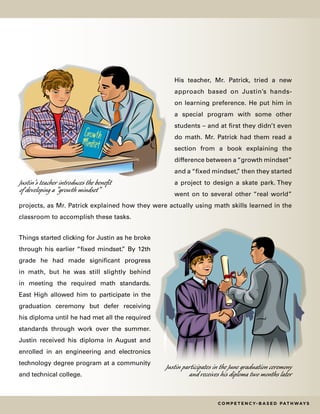
Things started clicking for Justin as he broke
through his earlier “fixed mindset.” By 12th
grade he had made significant progress
in math, but he was still slightly behind
in meeting the required math standards.
East High allowed him to participate in the
graduation ceremony but defer receiving
his diploma until he had met all the required
standards through work over the summer.
Justin received his diploma in August and
enrolled in an engineering and electronics
technology degree program at a community
and technical college.
Justin participates in the June graduation ceremony
and receives his diploma two months later
Justin's teacher introduces the benefit
of developing a "growth mindset"
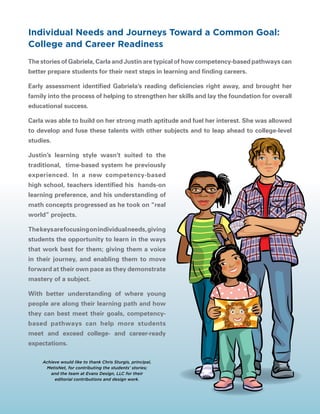
The stories of Gabriela, Carla and Justin are typical of how competency-based pathways can
better prepare students for their next steps in learning and finding careers.
Early assessment identified Gabriela’s reading deficiencies right away, and brought her
family into the process of helping to strengthen her skills and lay the foundation for overall
educational success.
Carla was able to build on her strong math aptitude and fuel her interest. She was allowed
to develop and fuse these talents with other subjects and to leap ahead to college-level
studies.
Justin’s learning style wasn’t suited to the
traditional, time-based system he previously
experienced. In a new competency-based
high school, teachers identified his hands-on
learning preference, and his understanding of
math concepts progressed as he took on “real
world” projects.
Thekeysarefocusingonindividualneeds,giving
students the opportunity to learn in the ways
that work best for them; giving them a voice
in their journey, and enabling them to move
forward at their own pace as they demonstrate
mastery of a subject.
With better understanding of where young
people are along their learning path and how
they can best meet their goals, competency-
based pathways can help more students
meet and exceed college- and career-ready
expectations.
Individual Needs and Journeys Toward a Common Goal:
College and Career Readiness
Achieve would like to thank Chris Sturgis, principal,
MetisNet, for contributing the students’ stories;
and the team at Evans Design, LLC for their
editorial contributions and design work.
www.achieve.org

Student Scenarios Infographic

  • 1.
    Competency-Based Pathways A PromisingApproach to Support All Students Toward and Beyond College and Career Readiness
  • 2.
    CC BY-NC Achieve2015. This work is licensed under the Creative Commons Attribution-NonCommercial 4.0 International License. To view a copy of this license, visit http://creativecommons.org/licenses/by-nc/4.0/ or send a letter to Creative Commons, PO Box 1866, Mountain View, CA 94042, USA.
  • 3.
    More states, schooldistricts and schools are exploring how competency-based pathways can help far more students reach and exceed the knowledge and skills they need to graduate from high school prepared to succeed in college and the work- place. How do competency-based pathways help students do so? Here are the stories of three students whose academic progress has been shaped by the opportunities, flexibility and transparency of competency-based learning environments. Justin entered East High School with wide disparities in his academic skills. His initial assessments showed him slightly behind where he needed to be in English language arts, but Justin’s biggest learning gap was in math, where he was about two years behind. He had become discouraged back in 7th grade and decided he couldn’t “do math.” Meet Gabriela, Carla and Justin Three Students’ Journeys through Competency-Based Pathways Gabriela has just started 1st grade at Multicultural Academy. Her family moved from Mexico last year. Although her father was from the United States and spoke English to Gabriela, her grandmother cared for her when her parents were working, speaking to her only in Spanish. Carla moved from a traditional classroom system to a competency-based middle school upon entering 7th grade. During her first week, she was found to be working at a higher level than her peers in math – a subject she loved – but was slipping behind in social studies because she needed more time to read than her peers.
  • 4.
    Gabriela’s first dayof school was in a dual- language 1st grade class. There were two teachers, who assessed the students’ knowledge of colors, numbers and letters in both English and Spanish as they sang some songs. Miss Rivera showed Gabriela the Target Tracker, a chart on the wall where students place stickers to show their learning progress. She was happy to place her first sticker, showing she knew the letters A through D in both languages. Soon, Gabriela learned to use a computer for someofherlessonswhilelisteningtoinstructions through headphones. She progressed through the alphabet and soon put more stickers on her tracker. But when she got to X through Z, she found them confusing in English. So she put her name under “I Need Help” on the tracking board. Miss Rivera took some extra time that day to help Gabriela and another student. The next week, the teacher met with Gabriela along with her parents and grandmother Gabriela Computer-assisted learning is fun C o m p e t e n c y- B a s e d Pat h way s Gabriela's first day and her first learning assessment Gabriela likes showing her progress on the Target Tracker
  • 5.
    At Gabriela’s school,targeted learning levels or “teacher pace” equals two “levels” per year. At the end of 1st grade, students should be at least at Level 2 in each subject, at the end of 2nd grade, at Level 4 and so on to be on track to demonstrate college and career readiness by the time they graduate. If they fall behind teacher pace in a subject they get extra attention. But students are also encouraged to move on to higher levels or go deeper into their learning as they demonstrate progress more quickly than others. Gabriela’s teacher brings her family up to date on her progress and showed them a map of her learning progression. She explained that Gabriela had strong oral skills in Spanish, but her English literacy and writing skills needed strengthening. They agreed that Gabriela would read books with her family each night, one in English, one in Spanish, so she could see how words are spelled. Bytheendoftheyear,Gabrielawasather“teacher pace” grade level, Level 2, in Spanish, and was above teacher pace at Level 3 in math. But she still needed work on English, so the teacher listed some books she could read during the summer and suggested she go to StoryTime each week at the library to hear more words in English. Keeping Students On Track to Graduate Ready for College and Career C o m p e t e n c y- B a s e d Pat h way s Home reading sessions help build Gabriela's language skills
  • 6.
    Starting 7th gradeat Hall Middle School, Carla was right at “teacher pace” in English – Level 14 – and was assessed at a more advanced Level 15 in math. Her father was a math teacher and he had sparked her interest in the subject at an early age. But she was slipping behind in social studies because she needed more time to complete the reading assignments. Carla was encouraged to use her Flex Hour after lunch each day to catch up on reading her social studies assignments, and soon she was having no trouble keeping to “teacher pace” in both social studies and English. In math class, where she was sometimes bored at first, her teacher, Mr. Ford, helped Carla start working on more advanced math concepts using a computer program. She was never bored again. After nine weeks, Carla was ahead of the rest of her class and Mr. Ford asked if she would like to move up to the 8th grade math class, telling her she’d be behind at first but should catch up quickly. But Carla didn’t want to leave her good friend Molly, who was also in Mr. Ford’s 7th grade class. So Mr. Ford suggested that she continue to work independently and strive for deeper levels of knowledge through special projects.Carlachosetocreatescaledrawingswith3-dimensional shapes, first of her own home, then of a complex dream house. C o m p e t e n c y- B a s e d Pat h way s Carla Carla uses her Flex Hour to catch up on social studies reading For a special project, Carla explores 3-dimensional scale drawings A math whiz, Carla independently studies advanced concepts
  • 7.
    Carla’s school usesa 1-4 scale to describe students’ progress toward meeting learning standards. The scale helps students, parents and teachers all understand their depth of learning. The highest category, 4, reflects knowledge utilization where students have shown a thorough mastery of a subject including problem solving. The next category, 3, shows that students can conduct analysis. Category 2 reflects comprehension and category 1 reflects retrieval ability. In Carla’s school, students need to demonstrate that they have reached a 3 in a specified set of standards before they can move ahead to the next set. Based on reviewing her work against a rubric, Mr. Ford determined that she had achieved a 4 on the 4-point proficiency scale and was now far ahead of her class andonparwiththe8thgraders.Sointhenextsemester she moved up to 8th grade math. For her 8th grade “Capstone Project,” Carla integrated her skills in scale drawings with social studies. Working with an architect in the community, Carla researched architectural changes and historical forces in the 1900s and produced a multi-media project showing how the downtown’s building structures had evolved. It earned her a 4 in both math and social studies. Entering Hall High School, Carla immediately jumped ahead one year in math while maintaining her grade levels in other subjects. By her senior year, she had outpaced the AP math offerings at her school, so she was encouraged to take a college algebra course offered at a nearby community college. She graduated from high school with 6 college credits in math. Grading Proficiency with the 4-Point Scale C o m p e t e n c y- B a s e d Pat h way s By 12th grade, Carla is earning college credits Math, art and social studies come together in Capstone Project
  • 8.
    Justin C o mp e t e n c y- B a s e d Pat h way s When Justin entered East High School, his assessment showed a wide range of ups and downs in his academic skills – and his biggest gap was in math, where, at Level 13, he was about two years behind teacher pace for the 9th grade. This confirmed what his parents already knew: he had become discouraged when he hit linear equations in 7th grade and decided he just couldn’t“domath.” HewasalittleweakinEnglish too. Justin described himself as someone who likes “hands-on” learning, and his favorite class was metalworking. For English, Justin’s teacher emphasized working in groups, where students read and discuss each other’s writing assignments and revise them before turning them in. Thishelped Justin strengthen his writing skills, and by the second semester he had caught up to the class. But math was a different story. After nine weeks, the students were regrouped to help focus better on individual needs, but Justin still hadn’t made much progress. He had trouble understanding math concepts. Justin had decided he just couldn't "do math" Justin's group tries some "real world" projects using math concepts
  • 9.
    C o mp e t e n c y- B a s e d Pat h way s His teacher, Mr. Patrick, tried a new approach based on Justin’s hands- on learning preference. He put him in a special program with some other students – and at first they didn’t even do math. Mr. Patrick had them read a section from a book explaining the difference between a “growth mindset” and a “fixed mindset,” then they started a project to design a skate park. They went on to several other “real world” projects, as Mr. Patrick explained how they were actually using math skills learned in the classroom to accomplish these tasks. Things started clicking for Justin as he broke through his earlier “fixed mindset.” By 12th grade he had made significant progress in math, but he was still slightly behind in meeting the required math standards. East High allowed him to participate in the graduation ceremony but defer receiving his diploma until he had met all the required standards through work over the summer. Justin received his diploma in August and enrolled in an engineering and electronics technology degree program at a community and technical college. Justin participates in the June graduation ceremony and receives his diploma two months later Justin's teacher introduces the benefit of developing a "growth mindset"
  • 10.
    The stories ofGabriela, Carla and Justin are typical of how competency-based pathways can better prepare students for their next steps in learning and finding careers. Early assessment identified Gabriela’s reading deficiencies right away, and brought her family into the process of helping to strengthen her skills and lay the foundation for overall educational success. Carla was able to build on her strong math aptitude and fuel her interest. She was allowed to develop and fuse these talents with other subjects and to leap ahead to college-level studies. Justin’s learning style wasn’t suited to the traditional, time-based system he previously experienced. In a new competency-based high school, teachers identified his hands-on learning preference, and his understanding of math concepts progressed as he took on “real world” projects. Thekeysarefocusingonindividualneeds,giving students the opportunity to learn in the ways that work best for them; giving them a voice in their journey, and enabling them to move forward at their own pace as they demonstrate mastery of a subject. With better understanding of where young people are along their learning path and how they can best meet their goals, competency- based pathways can help more students meet and exceed college- and career-ready expectations. Individual Needs and Journeys Toward a Common Goal: College and Career Readiness Achieve would like to thank Chris Sturgis, principal, MetisNet, for contributing the students’ stories; and the team at Evans Design, LLC for their editorial contributions and design work.
  • 12.