Advancing 
Competency-Based 
Pathways 
To College and Career 
Readiness 
March 19, 2014 | 3:00 – 4:00 pm
Presenters 
2 
State Leaders: 
Sharon Lee, Director of Multiple Pathways, Rhode Island Department of 
Education 
Paula Barney, Postsecondary and Workforce Readiness Specialist, Rhode 
Island Department of Education 
Oliver Grenham, Chief Academic Officer, Adams County School District 50, 
Colorado 
Elliott Asp, Special Assistant to the Commissioner, Colorado Department of 
Education 
Achieve: 
Anne Bowles, Senior Policy Associate 
Cory Curl, Senior Fellow for Assessment and Accountability
Agenda 
Introduction to the CBP state policy framework, developed through a working group 
of 11 states and 12 partner organizations (Cory Curl) 
Rhode Island’s efforts to work with a vision and strategy team to develop a 
framework to advance proficiency-based education (Sharon Lee and Paula 
Barney) 
Overview of why Adams County School District 50 in Colorado decided to move 
towards competency-based learning, and early successes, challenges and lessons 
learned in the areas of assessment, accountability and graduation requirements 
(Oliver Grenham) 
Colorado’s role in advancing competency-based pathways, with an eye toward 
state policy and implementation support (Elliott Asp) 
Q & A 
3
State Policy Framework 
4 
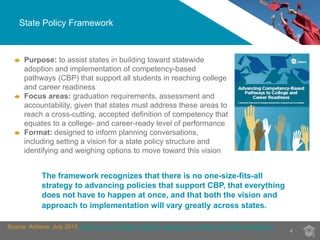
Purpose: to assist states in building toward statewide 
adoption and implementation of competency-based 
pathways (CBP) that support all students in reaching college 
and career readiness 
Focus areas: graduation requirements, assessment and 
accountability, given that states must address these areas to 
reach a cross-cutting, accepted definition of competency that 
equates to a college- and career-ready level of performance 
Format: designed to inform planning conversations, 
including setting a vision for a state policy structure and 
identifying and weighing options to move toward this vision 
The framework recognizes that there is no one-size-fits-all 
strategy to advancing policies that support CBP, that everything 
does not have to happen at once, and that both the vision and 
approach to implementation will vary greatly across states. 
Source: Achieve. July 2013. Advancing Competency-Based Pathways to College and Career Readiness
Definition of Competency-Based Pathways in 
the State Policy Framework 
Competency-based pathways can help all students reach college 
and career ready standards through the following strategies: 
Students advance upon demonstrated mastery 
Competencies include explicit, measurable, transferable learning 
objectives that empower students 
Assessment is meaningful and a positive learning experience for students 
Students receive rapid, differentiated support based on their individual 
learning needs 
Learning outcomes emphasize competencies that include application and 
creation of knowledge 
The process of reaching learning outcomes encourages students to 
develop skills and dispositions important for success in college, careers, 
and citizenship 
5 
Source: Adapted from Susan Patrick and Chris Sturgis, July 2011, Cracking the Code: Synchronizing Policy and Practice to 
Support Personalized Learning , iNACOL, http://www.inacol.org/research/docs/iNACOL_CrackingCode_full_report.pdf
About the State Policy Framework 
6 
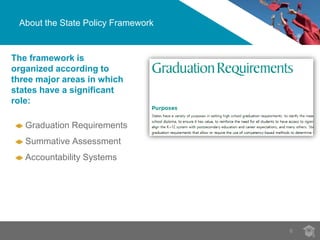
The framework is 
organized according to 
three major areas in which 
states have a significant 
role: 
Graduation Requirements 
Summative Assessment 
Accountability Systems
Cross-Cutting Elements 
7 
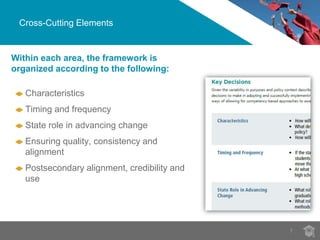
Within each area, the framework is 
organized according to the following: 
Characteristics 
Timing and frequency 
State role in advancing change 
Ensuring quality, consistency and 
alignment 
Postsecondary alignment, credibility and 
use
Categories 
8 
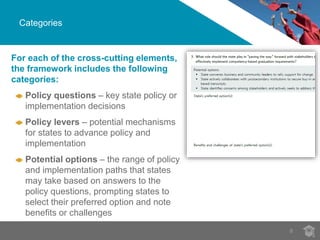
For each of the cross-cutting elements, 
the framework includes the following 
categories: 
Policy questions – key state policy or 
implementation decisions 
Policy levers – potential mechanisms 
for states to advance policy and 
implementation 
Potential options – the range of policy 
and implementation paths that states 
may take based on answers to the 
policy questions, prompting states to 
select their preferred option and note 
benefits or challenges
Achieve’s CBP State Partnership 
Achieve is providing targeted policy and implementation support to a group of states 
committed to advancing competency-based pathways (CBP) to college and career 
readiness for all students. The support is designed to complement and reinforce 
states’ overall plans to implement the Common Core State Standards (CCSS) and 
propel far more students to a college- and career-ready level of performance. 
States: Colorado, Connecticut, Delaware, Illinois, Kentucky, Maine, 
Michigan, New Hampshire, Ohio, Oklahoma, Oregon, Rhode Island and 
Vermont. 
Participating states commit to pursuing policy and implementation 
changes in graduation requirements, assessments and accountability. 
States need to address all three in order to reach a cross-cutting, 
accepted definition of competency (or depending on the state’s 
terminology, proficiency or mastery) that equates to a college- and career-ready 
level of performance. This is essential to ensure rigorous 
determinations of student competency on the CCSS and other college-and 
career-ready standards. 
9
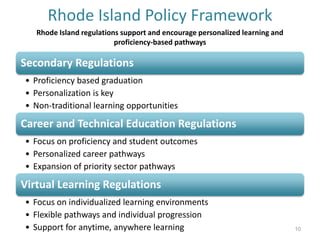
Rhode Island Policy Framework 
Rhode Island regulations support and encourage personalized learning and 
proficiency-based pathways 
Secondary Regulations 
• Proficiency based graduation 
• Personalization is key 
• Non-traditional learning opportunities 
Career and Technical Education Regulations 
• Focus on proficiency and student outcomes 
• Personalized career pathways 
• Expansion of priority sector pathways 
Virtual Learning Regulations 
• Focus on individualized learning environments 
• Flexible pathways and individual progression 
• Support for anytime, anywhere learning 10
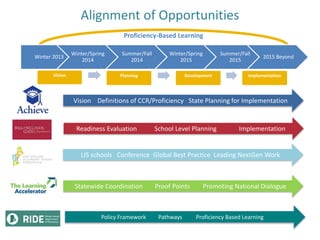
Alignment of Opportunities 
Proficiency-Based Learning 
Winter 2013 
Winter/Spring 
2014 
Summer/Fall 
2014 
Winter/Spring 
2015 
Summer/Fall 
2015 
2015 Beyond 
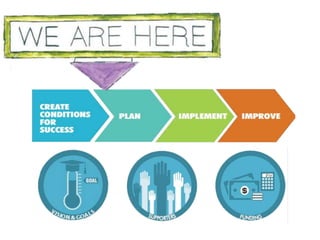
Vision Planning Development Implementation 
Vision Definitions of CCR/Proficiency State Planning for Implementation 
Readiness Evaluation School Level Planning Implementation 
LIS schools Conference Global Best Practice Leading NextGen Work 
Statewide Coordination Proof Points Promoting National Dialogue 
Policy Framework Pathways Proficiency Based Learning
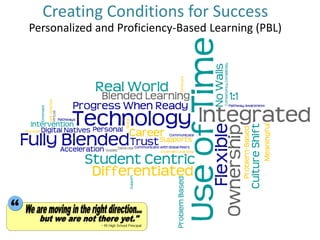
Creating Conditions for Success 
Personalized and Proficiency-Based Learning (PBL)
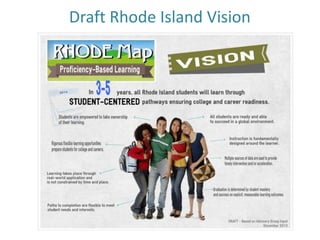
Draft Rhode Island Vision
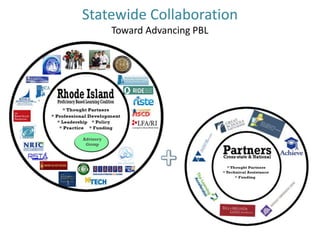
Statewide Collaboration 
Toward Advancing PBL
Developing a 
Competency Based System 
Adams County School District 50 
March 19, 2014
Overview 
• Who are we as a District? 
• What is our educational model for all 
learners? 
• What do the data say on our progress so far? 
• Focus of Improvement Strategies 
• Our challenges 
• Questions 
9/17/2014 9:02 PM 17
Who Are We? 
• Snapshot 
– 10,000 total students 
– 12 Elementary Schools 
– 3 Middle Schools 
– 2 High Schools (one alternative) 
– 1 Charter School 
– 1 Early Childhood Center 
– Day Treatment Program (ISC) 
18
Motivation for Systemic Change 
• Low static achievement 
• Persistent achievement gaps 
• Poor graduation rate 
• High post secondary remediation rate 
• Accredited as “Turnaround” 
• Increased learner challenges 
• Sought Comprehensive Appraisal for District 
Improvement (CADI) 
• State conversations about 21st Century Learning 
– SB07 -053 (Integrated P-16 Education System) 
– HB 07-1118 (HS Graduation Requirements) 
– SB 08-212 (CAP4K) 
• Moral Purpose “Proficiency for ALL”
What we needed… 
• Systemic approach that ensured 
continuous rigorous learning and 
demonstrated performance (proficient 
or better) within and across all schools 
from the time our learners first entered 
preschool through graduation.
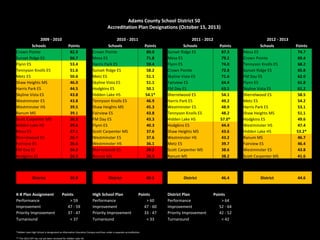
Adams County School District 50 
Accreditation Plan Designations (October 15, 2013) 
2009 - 2010 2010 - 2011 2011 - 2012 2012 - 2013 
Schools Points Schools Points Schools Points Schools Points 
Crown Pointe 82.0 Crown Pointe 80.0 Sunset Ridge ES 87.3 Mesa ES 74.7 
Sunset Ridge ES 66.7 Mesa ES 71.8 Mesa ES 79.2 Crown Pointe 69.4 
Flynn ES 53.4 Harris Park ES 59.4 Flynn ES 74.0 Tennyson Knolls ES 68.2 
Tennyson Knolls ES 51.6 Sunset Ridge ES 58.2 Crown Pointe 72.8 Sunset Ridge ES 65.8 
Metz ES 50.6 Metz ES 51.1 Skyline Vista ES 71.6 FM Day ES 62.0 
Shaw Heights MS 46.0 Skyline Vista ES 51.1 Fairview ES 64.4 Flynn ES 61.8 
Harris Park ES 44.5 Hodgkins ES 50.1 FM Day ES 63.5 Skyline Vista ES 61.2 
Skyline Vista ES 43.8 Hidden Lake HS 54.1* Sherrelwood ES 54.1 Sherrelwood ES 58.5 
Westminster ES 43.8 Tennyson Knolls ES 46.9 Harris Park ES 49.2 Metz ES 54.2 
Westminster HS 39.5 Shaw Heights MS 45.3 Westminster ES 48.9 Harris Park ES 53.1 
Ranum MS 39.1 Fairview ES 43.8 Tennyson Knolls ES 48.2 Shaw Heights MS 51.1 
Scott Carpenter MS 36.8 FM Day ES 43.3 Hidden Lake HS 57.0* Hodgkins ES 49.6 
Hidden Lake HS 29.6 Flynn ES 40.3 Hodgkins ES 44.4 Westminster HS 47.4 
Mesa ES 27.1 Scott Carpenter MS 37.6 Shaw Heights MS 43.6 Hidden Lake HS 53.2* 
Sherrelwood ES 26.7 Westminster ES 37.6 Westminster HS 43.2 Ranum MS 46.7 
Fairview ES 26.6 Westminster HS 36.1 Metz ES 39.7 Fairview ES 46.4 
FM Day ES 26.3 Sherrelwood ES 28.2 Scott Carpenter MS 38.6 Westminster ES 43.8 
Hodgkins ES 26.3 Ranum MS 26.3 Ranum MS 38.2 Scott Carpenter MS 41.6 
District 30.9 District 40.2 District 46.4 District 44.6 
K-8 Plan Assignment Points High School Plan Points District Plan Points 
Performance > 59 Performance > 60 Performance > 64 
Improvement 47 - 59 Improvement 47 - 60 Improvement 52 - 64 
Priority Improvement 37 - 47 Priority Improvement 33 - 47 Priority Improvement 42 - 52 
Turnaround < 37 Turnaround < 33 Turnaround < 42 
*Hidden Lake High School is designated an Alternative Education Campus and lives under a separate accreditation. 
** The 2013 SPF has not yet been received for Hidden Lake HS.
Improvement Strategies 
• Deepening competency based instructional 
practices 
• Restructuring to support P-20 education 
• Involving stakeholders differently 
• Focus on systemic leadership
Definition of a Learner-centered 
Classroom 
A true Learner-centered classroom is where “learners and 
teachers respond to and reflect on progress in order to build 
ownership and independence by involving teachers and other 
learners to become problems solvers, move through levels, meet 
their goals and figure out their own path to success; learners have 
the opportunity to make choices and demonstrate proficiency 
throughout the learner-centered classroom. 
Teachers instruct and guide individual learners, small groups, as 
well as the whole class to set high expectations for all learners 
and determine the most effective instructional strategies for each 
learner in the classroom.” 
- Developed by Adams County School District 50 teachers (2011)
Challenges… 
• Number of students not at expected academic 
level 
• Re-engineering for student learning 
• Transition from “seat-time” to a competency 
based learning system 
• Communication with Stakeholders 
• Resource Reallocation 
• Colorado Academic Standards 
• Use of Primary Resources 
• “Time-bound” High Stakes Assessment & 
Accountability Measures
Challenges… 
• Recording and Reporting 
• Special Populations 
• High School Transition 
• Integration with Other Districts, Colleges and 
Organizations 
• School Structures 
• Professional Development 
• Designing effective state policy frameworks 
• Competency Based Graduation Guidelines
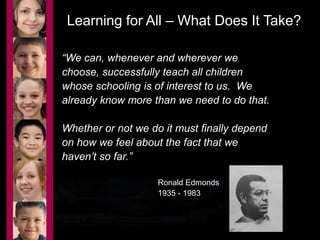
Learning for All – What Does It Take? 
“We can, whenever and wherever we 
choose, successfully teach all children 
whose schooling is of interest to us. We 
already know more than we need to do that. 
Whether or not we do it must finally depend 
on how we feel about the fact that we 
haven’t so far.” 
Ronald Edmonds 
1935 - 1983
Competency-Based Systems 
in Colorado 
Policy and Implementation Support 
Achieve CBS Webinar 
March 19, 2014
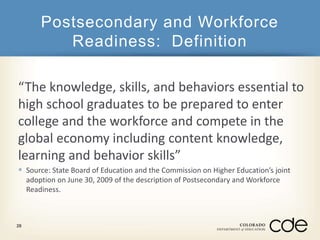
Postsecondary and Workforce 
Readiness: Definition 
“The knowledge, skills, and behaviors essential to 
high school graduates to be prepared to enter 
college and the workforce and compete in the 
global economy including content knowledge, 
learning and behavior skills” 
 Source: State Board of Education and the Commission on Higher Education’s joint 
adoption on June 30, 2009 of the description of Postsecondary and Workforce 
Readiness. 
28
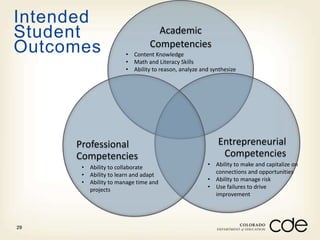
29 
Academic 
Competencies 
• Content Knowledge 
• Math and Literacy Skills 
• Ability to reason, analyze and synthesize 
Entrepreneurial 
Competencies 
Professional 
Competencies 
• Ability to collaborate 
• Ability to learn and adapt 
• Ability to manage time and 
projects 
• Ability to make and capitalize on 
connections and opportunities 
• Ability to manage risk 
• Use failures to drive 
improvement 
Intended 
Student 
Outcomes
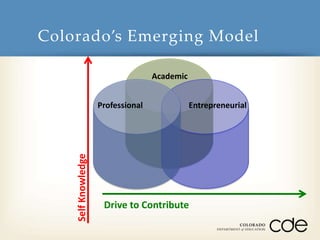
Colorado’s Emerging Model 
Academic 
Professional Entrepreneurial 
Drive to Contribute 
Self Knowledge
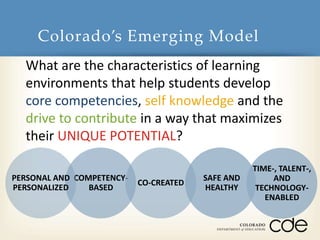
Colorado’s Emerging Model 
What are the characteristics of learning 
environments that help students develop 
core competencies, self knowledge and the 
drive to contribute in a way that maximizes 
their UNIQUE POTENTIAL? 
COMPETENCY-BASED 
SAFE AND 
HEALTHY 
PERSONAL AND 
PERSONALIZED 
CO-CREATED 
TIME-, TALENT-, 
AND 
TECHNOLOGY-ENABLED
Ecosystems for Exploration 
 Early Adopter Districts of Graduation Guidelines and 
supportive secondary initiatives 
 Turnaround Schools 
 Alternative Education Campuses 
 Charter Schools 
 Innovation Schools 
32
Graduation Guidelines 
 State statute requires the State Board of Education to adopt a 
set of guidelines for high school graduation by May 2013. Local 
school boards may use their own locally developed graduation 
requirements so long as they “meet or exceed” any minimum 
standards or core competencies/skills adopted by the State 
Board. 
33
Graduation Guidelines 
 The law outlines several considerations that the State Board 
must take into account when adopting a set of guidelines, 
including: 
 Alignment with the description of postsecondary and workforce 
readiness 
 Alignment with postsecondary academic admission standards 
 Recognition of multiple and diverse pathways to a diploma 
 Articulation through a standards-based education system 
 Attainment of skills necessary to succeed in the 21st century 
 Importance of academic and career planning 
34
Graduation Guidelines Goals 
 New expectations for a high school diploma, locally different 
35 
and guided by common menu. 
 Develop and identify areas of opportunity for students to 
explore and attain knowledge, skills, and abilities to be 
prepared for the day after high school . 
 Create and reinforce learning environments that reflect high 
expectations for all students to successfully earn a living 
wage and contribute to Colorado’s economy. 
 Educate students to be prepared to enter Colorado’s 
workforce with in-demand credentials and benchmarked to 
business, industry, and higher education standards.
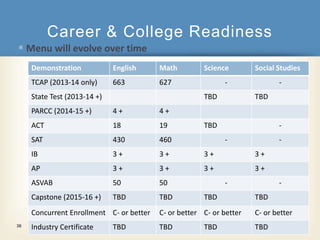
Career & College Readiness 
 Menu will evolve over time 
36 
Demonstration English Math Science Social Studies 
TCAP (2013-14 only) 663 627 - - 
State Test (2013-14 +) TBD TBD 
PARCC (2014-15 +) 4 + 4 + 
ACT 18 19 TBD - 
SAT 430 460 - - 
IB 3 + 3 + 3 + 3 + 
AP 3 + 3 + 3 + 3 + 
ASVAB 50 50 - - 
Capstone (2015-16 +) TBD TBD TBD TBD 
Concurrent Enrollment C- or better C- or better C- or better C- or better 
Industry Certificate TBD TBD TBD TBD
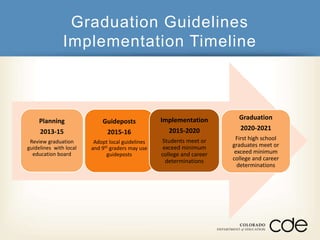
Graduation Guidelines 
Implementation Timeline 
Planning 
2013-15 
Review graduation 
guidelines with local 
education board 
Guideposts 
2015-16 
Adopt local guidelines 
and 9th graders may use 
guideposts 
Implementation 
2015-2020 
Students meet or 
exceed minimum 
college and career 
determinations 
Graduation 
2020-2021 
First high school 
graduates meet or 
exceed minimum 
college and career 
determinations
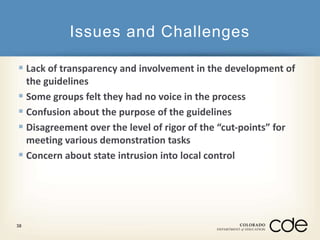
Issues and Challenges 
 Lack of transparency and involvement in the development of 
the guidelines 
 Some groups felt they had no voice in the process 
 Confusion about the purpose of the guidelines 
 Disagreement over the level of rigor of the “cut-points” for 
meeting various demonstration tasks 
 Concern about state intrusion into local control 
38
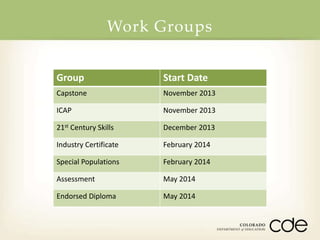
Work Groups 
Group Start Date 
Capstone November 2013 
ICAP November 2013 
21st Century Skills December 2013 
Industry Certificate February 2014 
Special Populations February 2014 
Assessment May 2014 
Endorsed Diploma May 2014
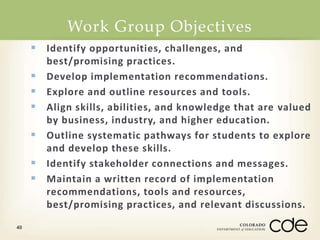
Work Group Objectives 
40 
 Identify opportunities, challenges, and 
best/promising practices. 
 Develop implementation recommendations. 
 Explore and outline resources and tools. 
 Align skills, abilities, and knowledge that are valued 
by business, industry, and higher education. 
 Outline systematic pathways for students to explore 
and develop these skills. 
 Identify stakeholder connections and messages. 
 Maintain a written record of implementation 
recommendations, tools and resources, 
best/promising practices, and relevant discussions.
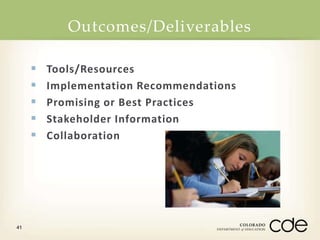
Outcomes/Deliverables 
41 
 Tools/Resources 
 Implementation Recommendations 
 Promising or Best Practices 
 Stakeholder Information 
 Collaboration
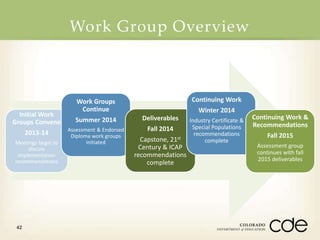
Work Group Overview 
Initial Work 
Groups Convene 
42 
2013-14 
Meetings begin to 
discuss 
implementation 
recommendations 
Work Groups 
Continue 
Summer 2014 
Assessment & Endorsed 
Diploma work groups 
initiated 
Deliverables 
Fall 2014 
Capstone, 21st 
Century & ICAP 
recommendations 
complete 
Continuing Work 
Winter 2014 
Industry Certificate & 
Special Populations 
recommendations 
complete 
Continuing Work & 
Recommendations 
Fall 2015 
Assessment group 
continues with fall 
2015 deliverables
Competency-Based Systems 
Network 
 Year-long study group made up of select districts who are 
implementing/investigating CBS that will examine issues such 
as: 
 The nature of a truly competency-based system 
Measurement approaches to a broad range of competencies 
 Systemic supports that are required to successfully implement CBS 
 Curriculum and instruction in a CB approach 
 Local and state policy frameworks that support CBS 
 “Deliverable” is new/shared knowledge across the state 
 Network will evolve to implementation support in year 2 
43
THANK YOU! 
44 
We look forward to continuing this discussion with you! 
Anne Bowles | abowles@achieve.org 
Cory Curl | ccurl@achieve.org
Advancing 
Competency-Based 
Pathways 
to College and Career 
Readiness 
March 19, 2014 | 3:00 – 4:00 pm

Advancing Competency-Based Pathways to College and Career Readiness

  • 1.
    Advancing Competency-Based Pathways To College and Career Readiness March 19, 2014 | 3:00 – 4:00 pm
  • 2.
    Presenters 2 StateLeaders: Sharon Lee, Director of Multiple Pathways, Rhode Island Department of Education Paula Barney, Postsecondary and Workforce Readiness Specialist, Rhode Island Department of Education Oliver Grenham, Chief Academic Officer, Adams County School District 50, Colorado Elliott Asp, Special Assistant to the Commissioner, Colorado Department of Education Achieve: Anne Bowles, Senior Policy Associate Cory Curl, Senior Fellow for Assessment and Accountability
  • 3.
    Agenda Introduction tothe CBP state policy framework, developed through a working group of 11 states and 12 partner organizations (Cory Curl) Rhode Island’s efforts to work with a vision and strategy team to develop a framework to advance proficiency-based education (Sharon Lee and Paula Barney) Overview of why Adams County School District 50 in Colorado decided to move towards competency-based learning, and early successes, challenges and lessons learned in the areas of assessment, accountability and graduation requirements (Oliver Grenham) Colorado’s role in advancing competency-based pathways, with an eye toward state policy and implementation support (Elliott Asp) Q & A 3
  • 4.
    State Policy Framework 4 Purpose: to assist states in building toward statewide adoption and implementation of competency-based pathways (CBP) that support all students in reaching college and career readiness Focus areas: graduation requirements, assessment and accountability, given that states must address these areas to reach a cross-cutting, accepted definition of competency that equates to a college- and career-ready level of performance Format: designed to inform planning conversations, including setting a vision for a state policy structure and identifying and weighing options to move toward this vision The framework recognizes that there is no one-size-fits-all strategy to advancing policies that support CBP, that everything does not have to happen at once, and that both the vision and approach to implementation will vary greatly across states. Source: Achieve. July 2013. Advancing Competency-Based Pathways to College and Career Readiness
  • 5.
    Definition of Competency-BasedPathways in the State Policy Framework Competency-based pathways can help all students reach college and career ready standards through the following strategies: Students advance upon demonstrated mastery Competencies include explicit, measurable, transferable learning objectives that empower students Assessment is meaningful and a positive learning experience for students Students receive rapid, differentiated support based on their individual learning needs Learning outcomes emphasize competencies that include application and creation of knowledge The process of reaching learning outcomes encourages students to develop skills and dispositions important for success in college, careers, and citizenship 5 Source: Adapted from Susan Patrick and Chris Sturgis, July 2011, Cracking the Code: Synchronizing Policy and Practice to Support Personalized Learning , iNACOL, http://www.inacol.org/research/docs/iNACOL_CrackingCode_full_report.pdf
  • 6.
    About the StatePolicy Framework 6 The framework is organized according to three major areas in which states have a significant role: Graduation Requirements Summative Assessment Accountability Systems
  • 7.
    Cross-Cutting Elements 7 Within each area, the framework is organized according to the following: Characteristics Timing and frequency State role in advancing change Ensuring quality, consistency and alignment Postsecondary alignment, credibility and use
  • 8.
    Categories 8 Foreach of the cross-cutting elements, the framework includes the following categories: Policy questions – key state policy or implementation decisions Policy levers – potential mechanisms for states to advance policy and implementation Potential options – the range of policy and implementation paths that states may take based on answers to the policy questions, prompting states to select their preferred option and note benefits or challenges
  • 9.
    Achieve’s CBP StatePartnership Achieve is providing targeted policy and implementation support to a group of states committed to advancing competency-based pathways (CBP) to college and career readiness for all students. The support is designed to complement and reinforce states’ overall plans to implement the Common Core State Standards (CCSS) and propel far more students to a college- and career-ready level of performance. States: Colorado, Connecticut, Delaware, Illinois, Kentucky, Maine, Michigan, New Hampshire, Ohio, Oklahoma, Oregon, Rhode Island and Vermont. Participating states commit to pursuing policy and implementation changes in graduation requirements, assessments and accountability. States need to address all three in order to reach a cross-cutting, accepted definition of competency (or depending on the state’s terminology, proficiency or mastery) that equates to a college- and career-ready level of performance. This is essential to ensure rigorous determinations of student competency on the CCSS and other college-and career-ready standards. 9
  • 10.
    Rhode Island PolicyFramework Rhode Island regulations support and encourage personalized learning and proficiency-based pathways Secondary Regulations • Proficiency based graduation • Personalization is key • Non-traditional learning opportunities Career and Technical Education Regulations • Focus on proficiency and student outcomes • Personalized career pathways • Expansion of priority sector pathways Virtual Learning Regulations • Focus on individualized learning environments • Flexible pathways and individual progression • Support for anytime, anywhere learning 10
  • 11.
    Alignment of Opportunities Proficiency-Based Learning Winter 2013 Winter/Spring 2014 Summer/Fall 2014 Winter/Spring 2015 Summer/Fall 2015 2015 Beyond Vision Planning Development Implementation Vision Definitions of CCR/Proficiency State Planning for Implementation Readiness Evaluation School Level Planning Implementation LIS schools Conference Global Best Practice Leading NextGen Work Statewide Coordination Proof Points Promoting National Dialogue Policy Framework Pathways Proficiency Based Learning
  • 13.
    Creating Conditions forSuccess Personalized and Proficiency-Based Learning (PBL)
  • 14.
  • 15.
  • 16.
    Developing a CompetencyBased System Adams County School District 50 March 19, 2014
  • 17.
    Overview • Whoare we as a District? • What is our educational model for all learners? • What do the data say on our progress so far? • Focus of Improvement Strategies • Our challenges • Questions 9/17/2014 9:02 PM 17
  • 18.
    Who Are We? • Snapshot – 10,000 total students – 12 Elementary Schools – 3 Middle Schools – 2 High Schools (one alternative) – 1 Charter School – 1 Early Childhood Center – Day Treatment Program (ISC) 18
  • 19.
    Motivation for SystemicChange • Low static achievement • Persistent achievement gaps • Poor graduation rate • High post secondary remediation rate • Accredited as “Turnaround” • Increased learner challenges • Sought Comprehensive Appraisal for District Improvement (CADI) • State conversations about 21st Century Learning – SB07 -053 (Integrated P-16 Education System) – HB 07-1118 (HS Graduation Requirements) – SB 08-212 (CAP4K) • Moral Purpose “Proficiency for ALL”
  • 20.
    What we needed… • Systemic approach that ensured continuous rigorous learning and demonstrated performance (proficient or better) within and across all schools from the time our learners first entered preschool through graduation.
  • 21.
    Adams County SchoolDistrict 50 Accreditation Plan Designations (October 15, 2013) 2009 - 2010 2010 - 2011 2011 - 2012 2012 - 2013 Schools Points Schools Points Schools Points Schools Points Crown Pointe 82.0 Crown Pointe 80.0 Sunset Ridge ES 87.3 Mesa ES 74.7 Sunset Ridge ES 66.7 Mesa ES 71.8 Mesa ES 79.2 Crown Pointe 69.4 Flynn ES 53.4 Harris Park ES 59.4 Flynn ES 74.0 Tennyson Knolls ES 68.2 Tennyson Knolls ES 51.6 Sunset Ridge ES 58.2 Crown Pointe 72.8 Sunset Ridge ES 65.8 Metz ES 50.6 Metz ES 51.1 Skyline Vista ES 71.6 FM Day ES 62.0 Shaw Heights MS 46.0 Skyline Vista ES 51.1 Fairview ES 64.4 Flynn ES 61.8 Harris Park ES 44.5 Hodgkins ES 50.1 FM Day ES 63.5 Skyline Vista ES 61.2 Skyline Vista ES 43.8 Hidden Lake HS 54.1* Sherrelwood ES 54.1 Sherrelwood ES 58.5 Westminster ES 43.8 Tennyson Knolls ES 46.9 Harris Park ES 49.2 Metz ES 54.2 Westminster HS 39.5 Shaw Heights MS 45.3 Westminster ES 48.9 Harris Park ES 53.1 Ranum MS 39.1 Fairview ES 43.8 Tennyson Knolls ES 48.2 Shaw Heights MS 51.1 Scott Carpenter MS 36.8 FM Day ES 43.3 Hidden Lake HS 57.0* Hodgkins ES 49.6 Hidden Lake HS 29.6 Flynn ES 40.3 Hodgkins ES 44.4 Westminster HS 47.4 Mesa ES 27.1 Scott Carpenter MS 37.6 Shaw Heights MS 43.6 Hidden Lake HS 53.2* Sherrelwood ES 26.7 Westminster ES 37.6 Westminster HS 43.2 Ranum MS 46.7 Fairview ES 26.6 Westminster HS 36.1 Metz ES 39.7 Fairview ES 46.4 FM Day ES 26.3 Sherrelwood ES 28.2 Scott Carpenter MS 38.6 Westminster ES 43.8 Hodgkins ES 26.3 Ranum MS 26.3 Ranum MS 38.2 Scott Carpenter MS 41.6 District 30.9 District 40.2 District 46.4 District 44.6 K-8 Plan Assignment Points High School Plan Points District Plan Points Performance > 59 Performance > 60 Performance > 64 Improvement 47 - 59 Improvement 47 - 60 Improvement 52 - 64 Priority Improvement 37 - 47 Priority Improvement 33 - 47 Priority Improvement 42 - 52 Turnaround < 37 Turnaround < 33 Turnaround < 42 *Hidden Lake High School is designated an Alternative Education Campus and lives under a separate accreditation. ** The 2013 SPF has not yet been received for Hidden Lake HS.
  • 22.
    Improvement Strategies •Deepening competency based instructional practices • Restructuring to support P-20 education • Involving stakeholders differently • Focus on systemic leadership
  • 23.
    Definition of aLearner-centered Classroom A true Learner-centered classroom is where “learners and teachers respond to and reflect on progress in order to build ownership and independence by involving teachers and other learners to become problems solvers, move through levels, meet their goals and figure out their own path to success; learners have the opportunity to make choices and demonstrate proficiency throughout the learner-centered classroom. Teachers instruct and guide individual learners, small groups, as well as the whole class to set high expectations for all learners and determine the most effective instructional strategies for each learner in the classroom.” - Developed by Adams County School District 50 teachers (2011)
  • 24.
    Challenges… • Numberof students not at expected academic level • Re-engineering for student learning • Transition from “seat-time” to a competency based learning system • Communication with Stakeholders • Resource Reallocation • Colorado Academic Standards • Use of Primary Resources • “Time-bound” High Stakes Assessment & Accountability Measures
  • 25.
    Challenges… • Recordingand Reporting • Special Populations • High School Transition • Integration with Other Districts, Colleges and Organizations • School Structures • Professional Development • Designing effective state policy frameworks • Competency Based Graduation Guidelines
  • 26.
    Learning for All– What Does It Take? “We can, whenever and wherever we choose, successfully teach all children whose schooling is of interest to us. We already know more than we need to do that. Whether or not we do it must finally depend on how we feel about the fact that we haven’t so far.” Ronald Edmonds 1935 - 1983
  • 27.
    Competency-Based Systems inColorado Policy and Implementation Support Achieve CBS Webinar March 19, 2014
  • 28.
    Postsecondary and Workforce Readiness: Definition “The knowledge, skills, and behaviors essential to high school graduates to be prepared to enter college and the workforce and compete in the global economy including content knowledge, learning and behavior skills”  Source: State Board of Education and the Commission on Higher Education’s joint adoption on June 30, 2009 of the description of Postsecondary and Workforce Readiness. 28
  • 29.
    29 Academic Competencies • Content Knowledge • Math and Literacy Skills • Ability to reason, analyze and synthesize Entrepreneurial Competencies Professional Competencies • Ability to collaborate • Ability to learn and adapt • Ability to manage time and projects • Ability to make and capitalize on connections and opportunities • Ability to manage risk • Use failures to drive improvement Intended Student Outcomes
  • 30.
    Colorado’s Emerging Model Academic Professional Entrepreneurial Drive to Contribute Self Knowledge
  • 31.
    Colorado’s Emerging Model What are the characteristics of learning environments that help students develop core competencies, self knowledge and the drive to contribute in a way that maximizes their UNIQUE POTENTIAL? COMPETENCY-BASED SAFE AND HEALTHY PERSONAL AND PERSONALIZED CO-CREATED TIME-, TALENT-, AND TECHNOLOGY-ENABLED
  • 32.
    Ecosystems for Exploration  Early Adopter Districts of Graduation Guidelines and supportive secondary initiatives  Turnaround Schools  Alternative Education Campuses  Charter Schools  Innovation Schools 32
  • 33.
    Graduation Guidelines State statute requires the State Board of Education to adopt a set of guidelines for high school graduation by May 2013. Local school boards may use their own locally developed graduation requirements so long as they “meet or exceed” any minimum standards or core competencies/skills adopted by the State Board. 33
  • 34.
    Graduation Guidelines The law outlines several considerations that the State Board must take into account when adopting a set of guidelines, including:  Alignment with the description of postsecondary and workforce readiness  Alignment with postsecondary academic admission standards  Recognition of multiple and diverse pathways to a diploma  Articulation through a standards-based education system  Attainment of skills necessary to succeed in the 21st century  Importance of academic and career planning 34
  • 35.
    Graduation Guidelines Goals  New expectations for a high school diploma, locally different 35 and guided by common menu.  Develop and identify areas of opportunity for students to explore and attain knowledge, skills, and abilities to be prepared for the day after high school .  Create and reinforce learning environments that reflect high expectations for all students to successfully earn a living wage and contribute to Colorado’s economy.  Educate students to be prepared to enter Colorado’s workforce with in-demand credentials and benchmarked to business, industry, and higher education standards.
  • 36.
    Career & CollegeReadiness  Menu will evolve over time 36 Demonstration English Math Science Social Studies TCAP (2013-14 only) 663 627 - - State Test (2013-14 +) TBD TBD PARCC (2014-15 +) 4 + 4 + ACT 18 19 TBD - SAT 430 460 - - IB 3 + 3 + 3 + 3 + AP 3 + 3 + 3 + 3 + ASVAB 50 50 - - Capstone (2015-16 +) TBD TBD TBD TBD Concurrent Enrollment C- or better C- or better C- or better C- or better Industry Certificate TBD TBD TBD TBD
  • 37.
    Graduation Guidelines ImplementationTimeline Planning 2013-15 Review graduation guidelines with local education board Guideposts 2015-16 Adopt local guidelines and 9th graders may use guideposts Implementation 2015-2020 Students meet or exceed minimum college and career determinations Graduation 2020-2021 First high school graduates meet or exceed minimum college and career determinations
  • 38.
    Issues and Challenges  Lack of transparency and involvement in the development of the guidelines  Some groups felt they had no voice in the process  Confusion about the purpose of the guidelines  Disagreement over the level of rigor of the “cut-points” for meeting various demonstration tasks  Concern about state intrusion into local control 38
  • 39.
    Work Groups GroupStart Date Capstone November 2013 ICAP November 2013 21st Century Skills December 2013 Industry Certificate February 2014 Special Populations February 2014 Assessment May 2014 Endorsed Diploma May 2014
  • 40.
    Work Group Objectives 40  Identify opportunities, challenges, and best/promising practices.  Develop implementation recommendations.  Explore and outline resources and tools.  Align skills, abilities, and knowledge that are valued by business, industry, and higher education.  Outline systematic pathways for students to explore and develop these skills.  Identify stakeholder connections and messages.  Maintain a written record of implementation recommendations, tools and resources, best/promising practices, and relevant discussions.
  • 41.
    Outcomes/Deliverables 41 Tools/Resources  Implementation Recommendations  Promising or Best Practices  Stakeholder Information  Collaboration
  • 42.
    Work Group Overview Initial Work Groups Convene 42 2013-14 Meetings begin to discuss implementation recommendations Work Groups Continue Summer 2014 Assessment & Endorsed Diploma work groups initiated Deliverables Fall 2014 Capstone, 21st Century & ICAP recommendations complete Continuing Work Winter 2014 Industry Certificate & Special Populations recommendations complete Continuing Work & Recommendations Fall 2015 Assessment group continues with fall 2015 deliverables
  • 43.
    Competency-Based Systems Network  Year-long study group made up of select districts who are implementing/investigating CBS that will examine issues such as:  The nature of a truly competency-based system Measurement approaches to a broad range of competencies  Systemic supports that are required to successfully implement CBS  Curriculum and instruction in a CB approach  Local and state policy frameworks that support CBS  “Deliverable” is new/shared knowledge across the state  Network will evolve to implementation support in year 2 43
  • 44.
    THANK YOU! 44 We look forward to continuing this discussion with you! Anne Bowles | abowles@achieve.org Cory Curl | ccurl@achieve.org
  • 45.
    Advancing Competency-Based Pathways to College and Career Readiness March 19, 2014 | 3:00 – 4:00 pm