Voter Perceptions: 
Common Core State 
Standards & Tests 
Project # 13480 
Key Findings From A National Survey of N=800 Voters. 
Conducted November 14-18, 2013; Margin of Error +3.5%.
2 
Perceptions of 
Public Education
3 
*Asked of N=397 registered voters. 
^Asked of N=403 registered voters. 
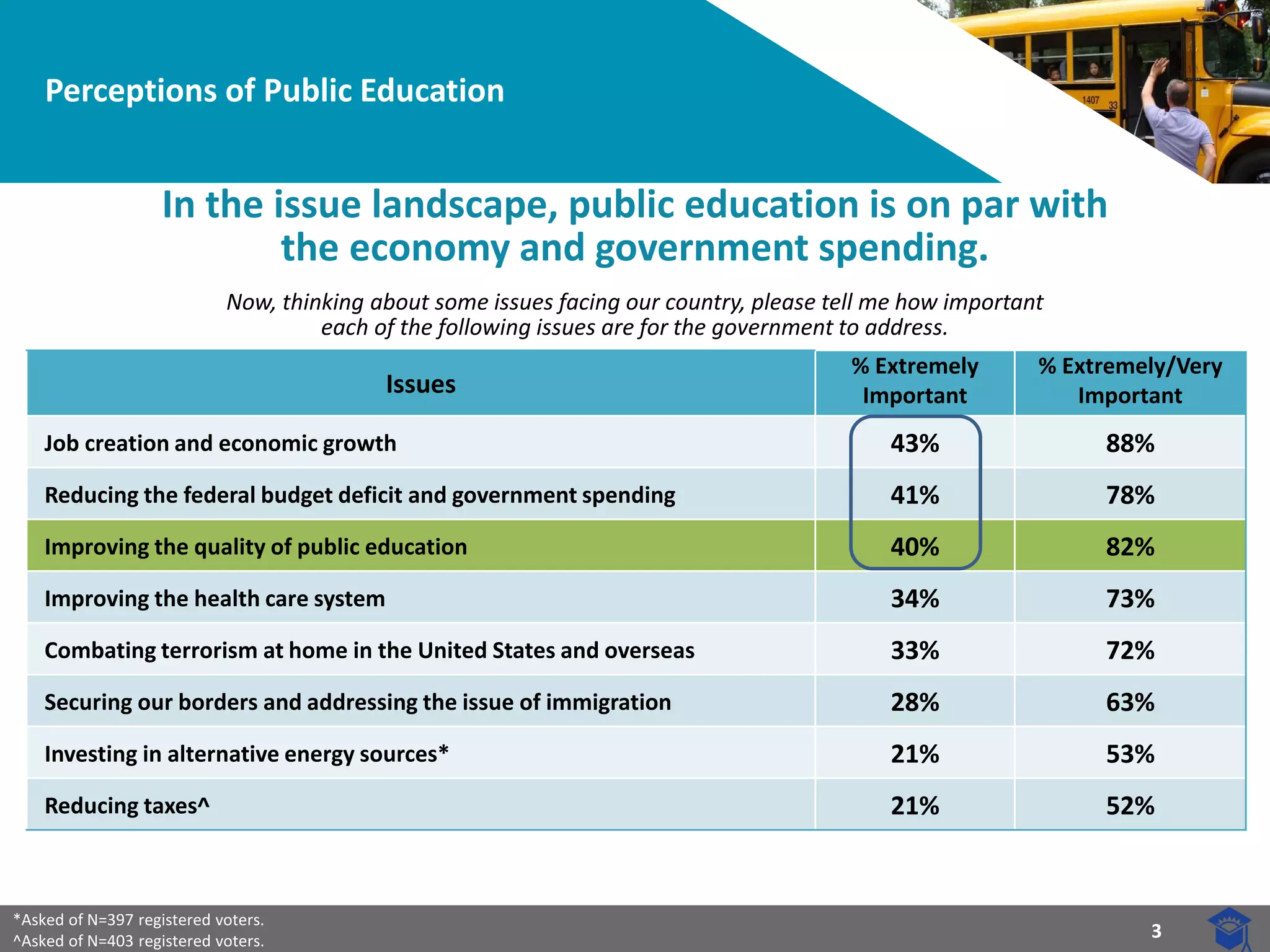
In the issue landscape, public education is on par with 
the economy and government spending. 
Perceptions of Public Education 
Now, thinking about some issues facing our country, please tell me how important 
each of the following issues are for the government to address. 
Issues 
% Extremely Important 
% Extremely/Very 
Important 
Job creation and economic growth 
43% 
88% 
Reducing the federal budget deficit and government spending 
41% 
78% 
Improving the quality of public education 
40% 
82% 
Improving the health care system 
34% 
73% 
Combating terrorism at home in the United States and overseas 
33% 
72% 
Securing our borders and addressing the issue of immigration 
28% 
63% 
Investing in alternative energy sources* 
21% 
53% 
Reducing taxes^ 
21% 
52%
4 
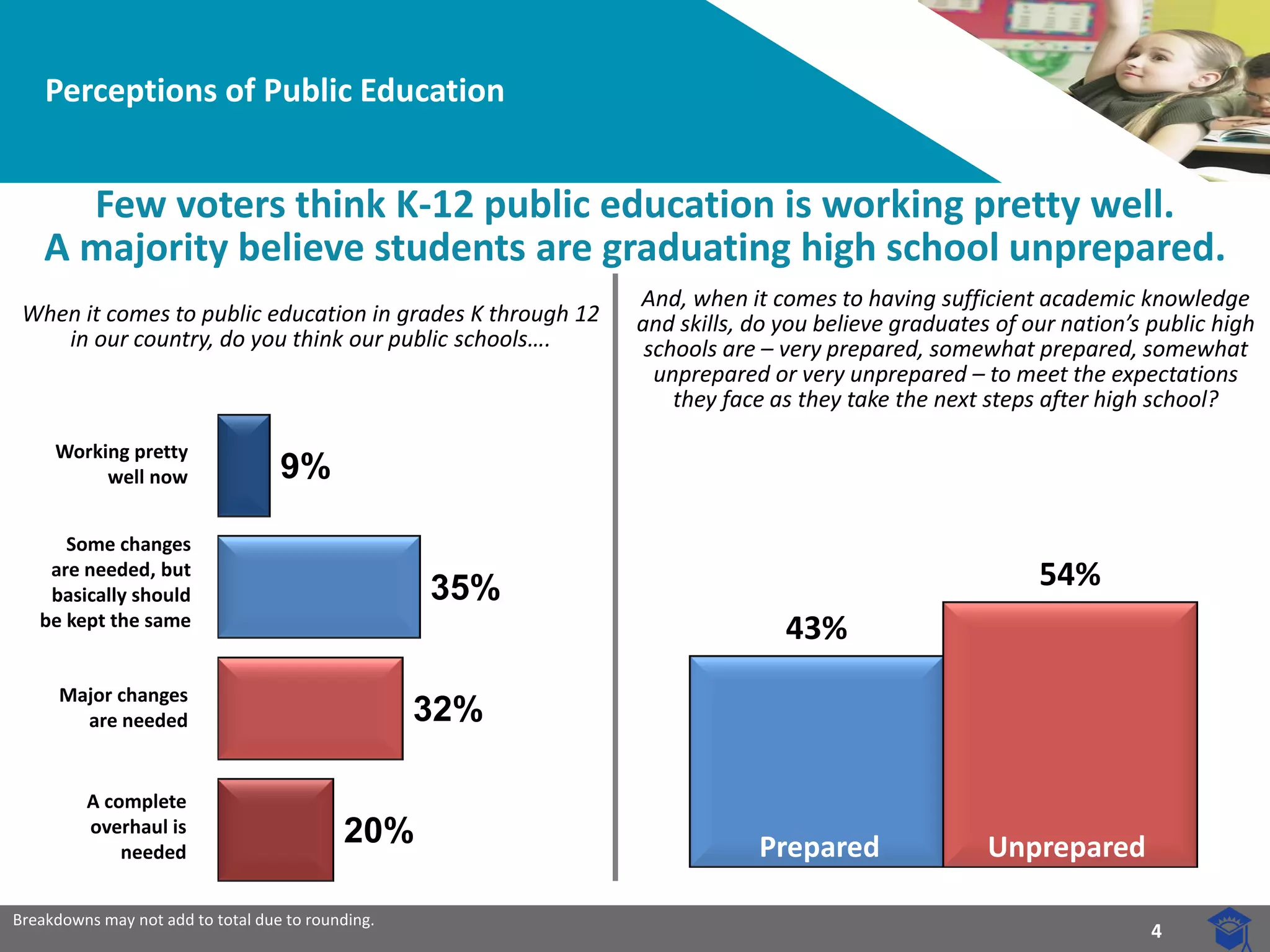
9% 
35% 
32% 
20% 
43% 
54% 
Working pretty well now 
A complete overhaul is needed 
Major changes are needed 
Some changes are needed, but basically should be kept the same 
Perceptions of Public Education 
Few voters think K-12 public education is working pretty well. 
A majority believe students are graduating high school unprepared. 
When it comes to public education in grades K through 12 in our country, do you think our public schools…. 
Breakdowns may not add to total due to rounding. 
And, when it comes to having sufficient academic knowledge and skills, do you believe graduates of our nation’s public high schools are – very prepared, somewhat prepared, somewhat unprepared or very unprepared – to meet the expectations they face as they take the next steps after high school? 
Prepared 
Unprepared
5 
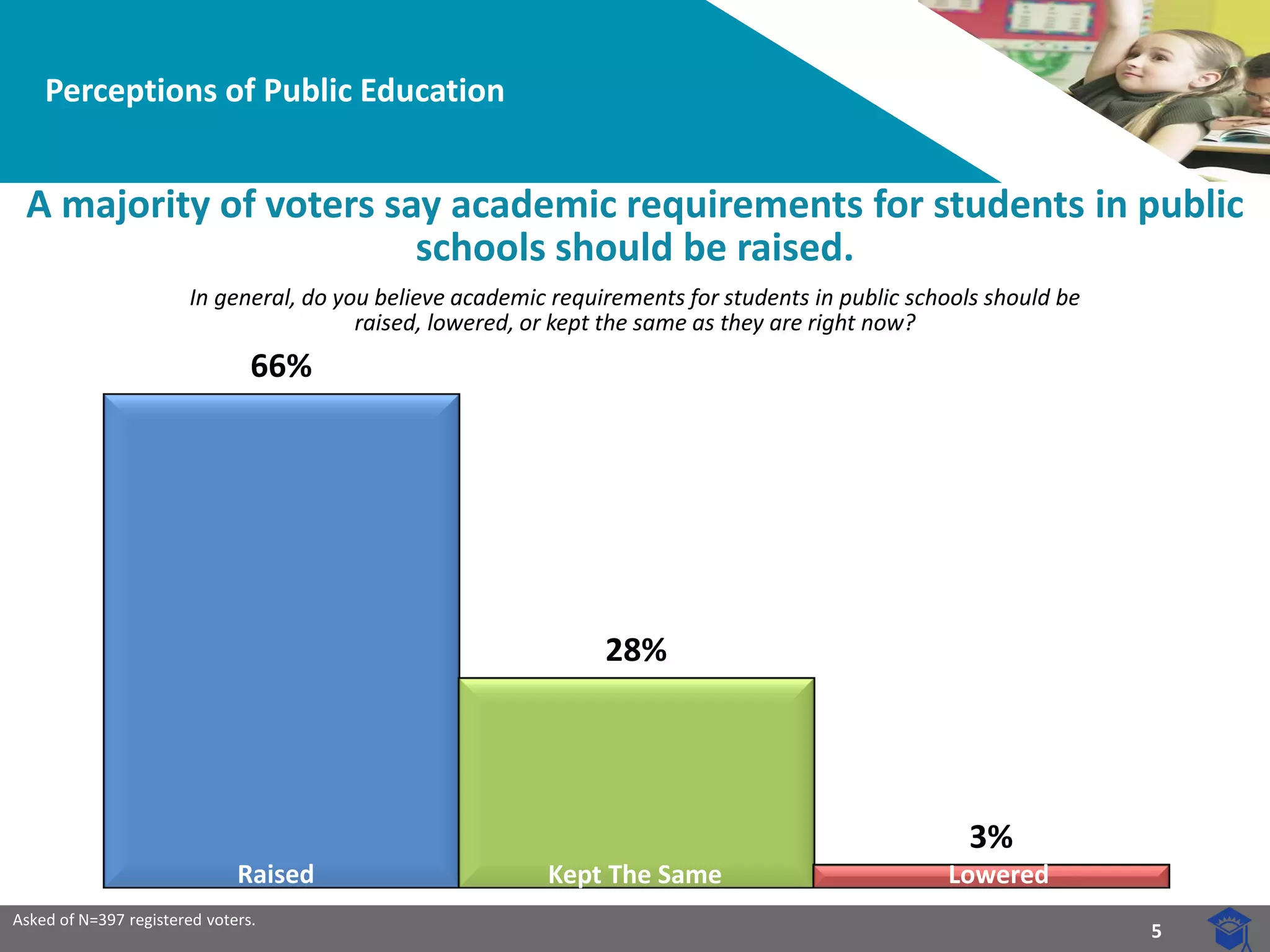
66% 
28% 
3% 
Perceptions of Public Education 
A majority of voters say academic requirements for students in public schools should be raised. 
Asked of N=397 registered voters. 
In general, do you believe academic requirements for students in public schools should be 
raised, lowered, or kept the same as they are right now? 
Raised 
Kept The Same 
Lowered
6 
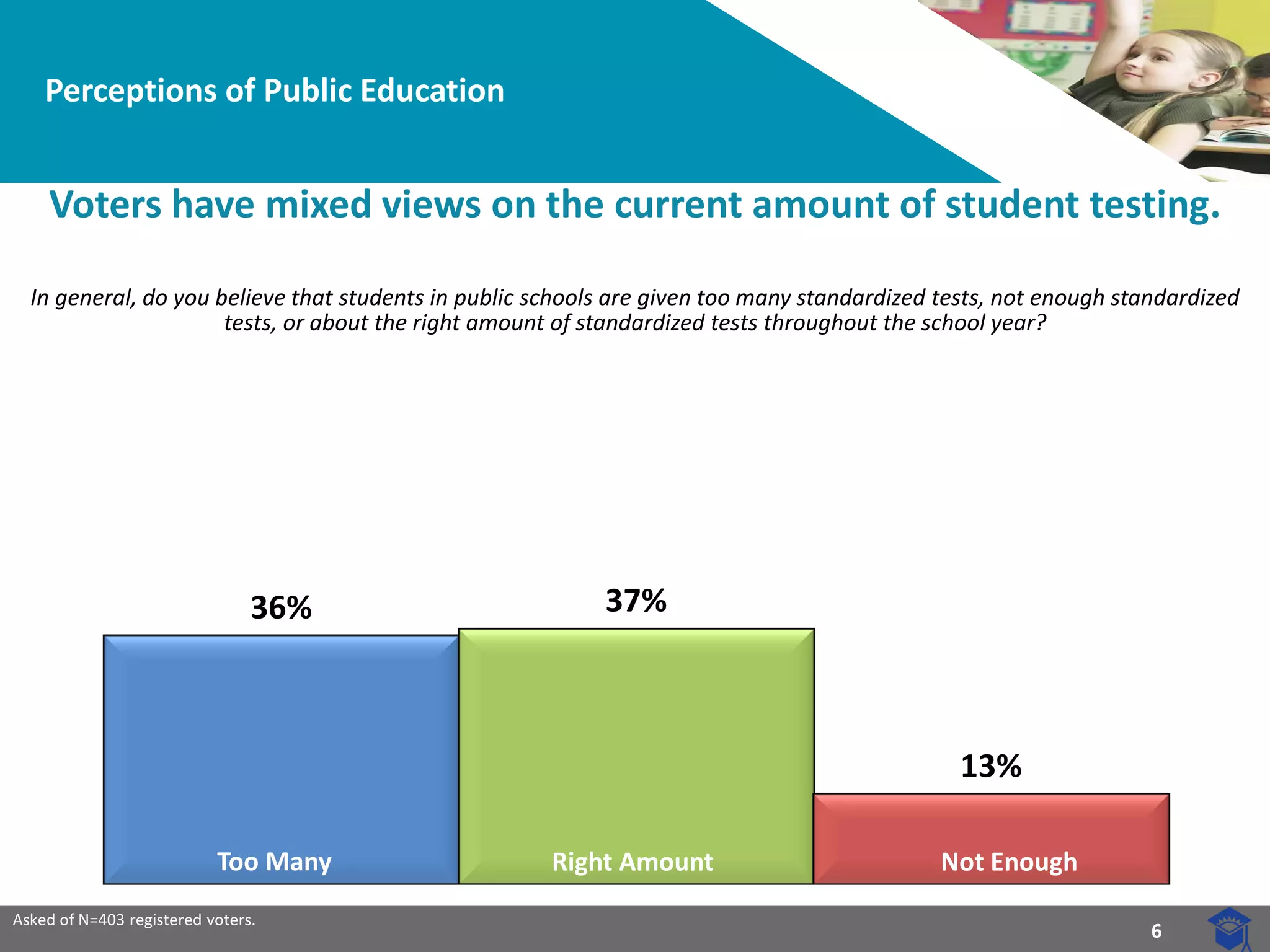
36% 
37% 
13% 
Perceptions of Public Education 
Voters have mixed views on the current amount of student testing. 
In general, do you believe that students in public schools are given too many standardized tests, not enough standardized tests, or about the right amount of standardized tests throughout the school year? 
Asked of N=403 registered voters. 
Too Many 
Right Amount 
Not Enough
7 
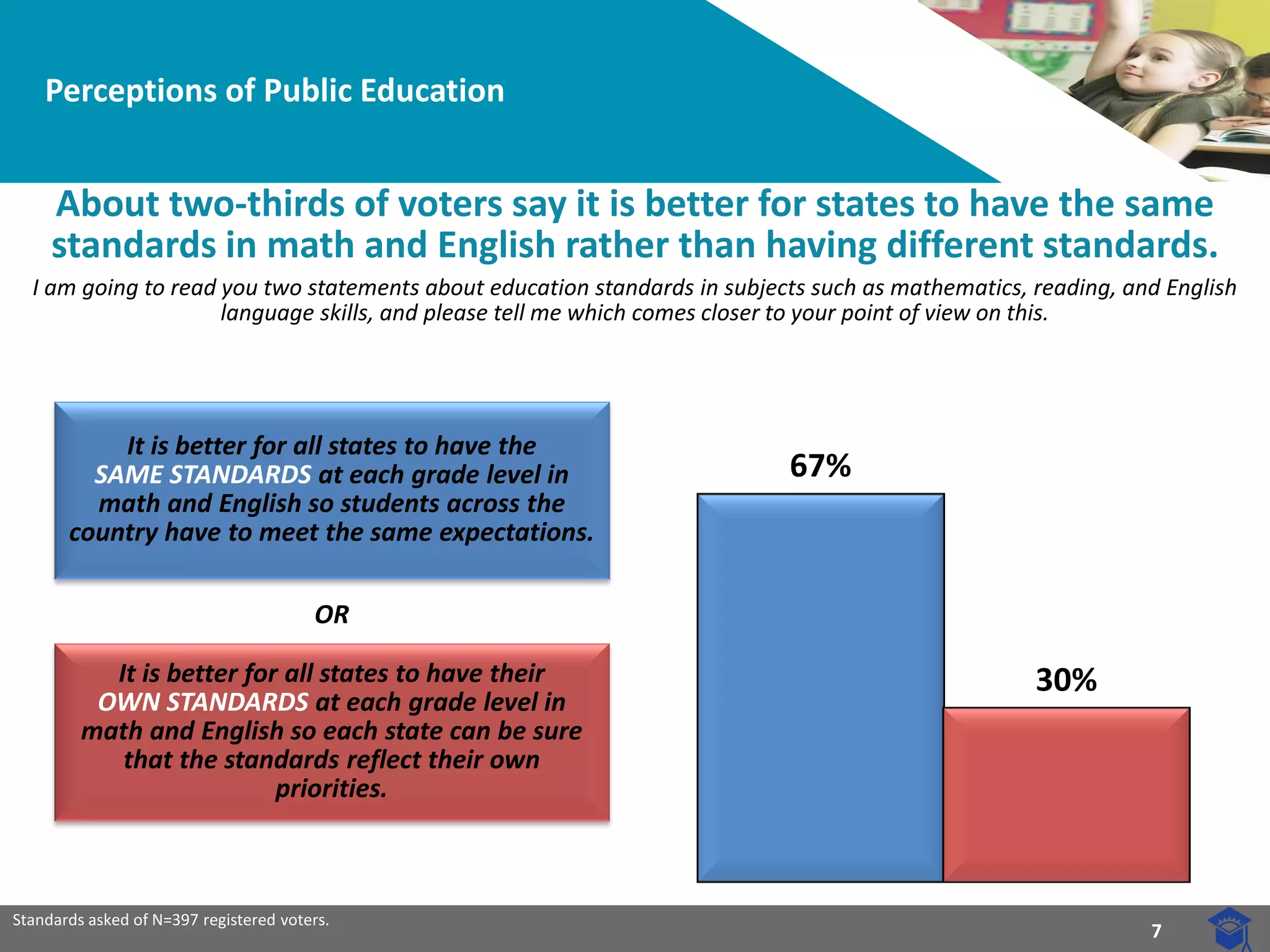
67% 
30% 
Perceptions of Public Education 
About two-thirds of voters say it is better for states to have the same standards in math and English rather than having different standards. 
I am going to read you two statements about education standards in subjects such as mathematics, reading, and English language skills, and please tell me which comes closer to your point of view on this. 
It is better for all states to have the 
SAME STANDARDS at each grade level in math and English so students across the country have to meet the same expectations. 
It is better for all states to have their 
OWN STANDARDS at each grade level in math and English so each state can be sure that the standards reflect their own priorities. 
OR 
Standards asked of N=397 registered voters.
8 
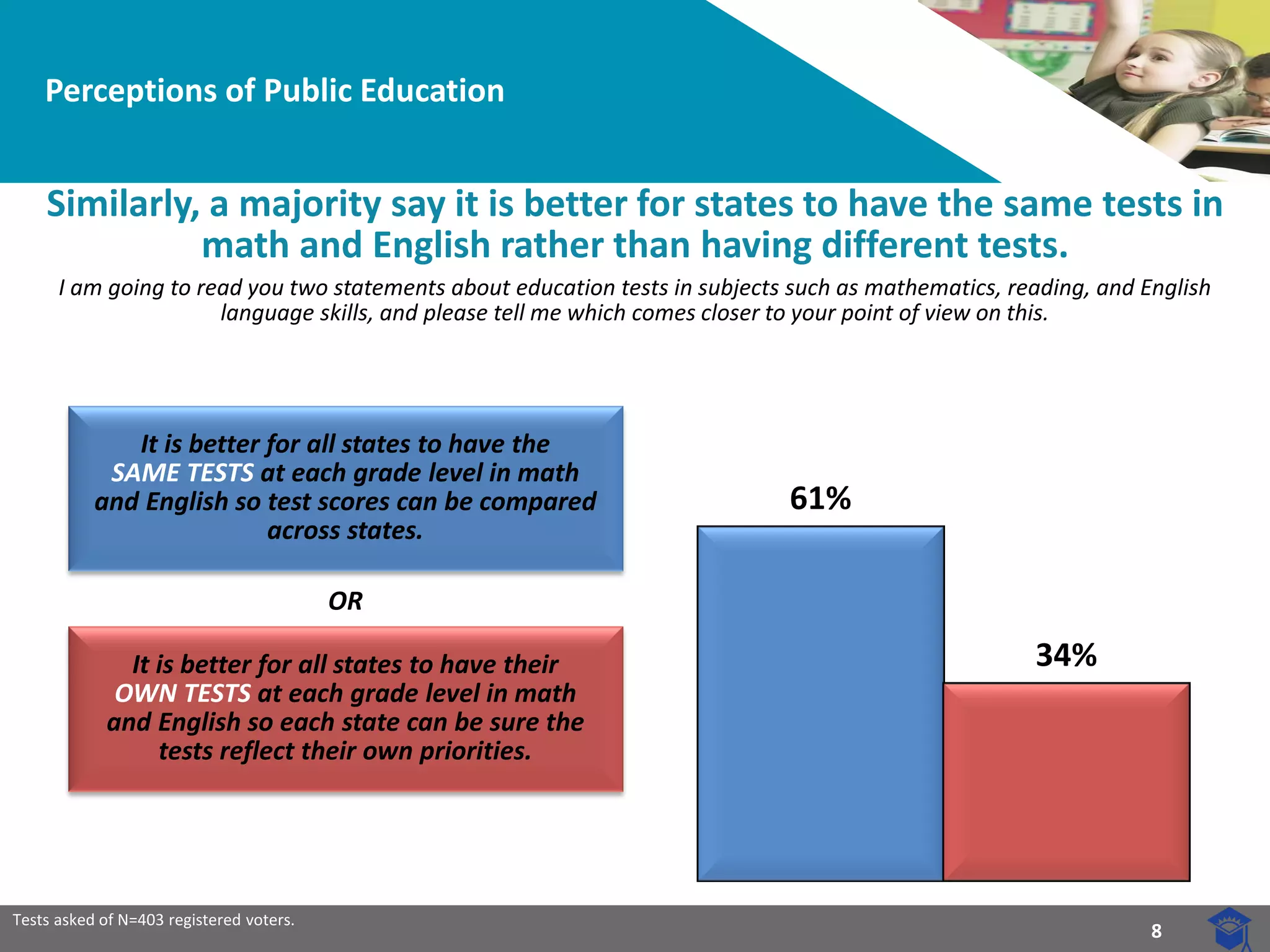
61% 
34% 
Perceptions of Public Education 
Similarly, a majority say it is better for states to have the same tests in 
math and English rather than having different tests. 
I am going to read you two statements about education tests in subjects such as mathematics, reading, and English language skills, and please tell me which comes closer to your point of view on this. 
It is better for all states to have the 
SAME TESTS at each grade level in math 
and English so test scores can be compared across states. 
It is better for all states to have their 
OWN TESTS at each grade level in math 
and English so each state can be sure the tests reflect their own priorities. 
OR 
Tests asked of N=403 registered voters.
9 
The Common Core State Standards (CCSS)
10 
The Common Core State Standards (CCSS) 
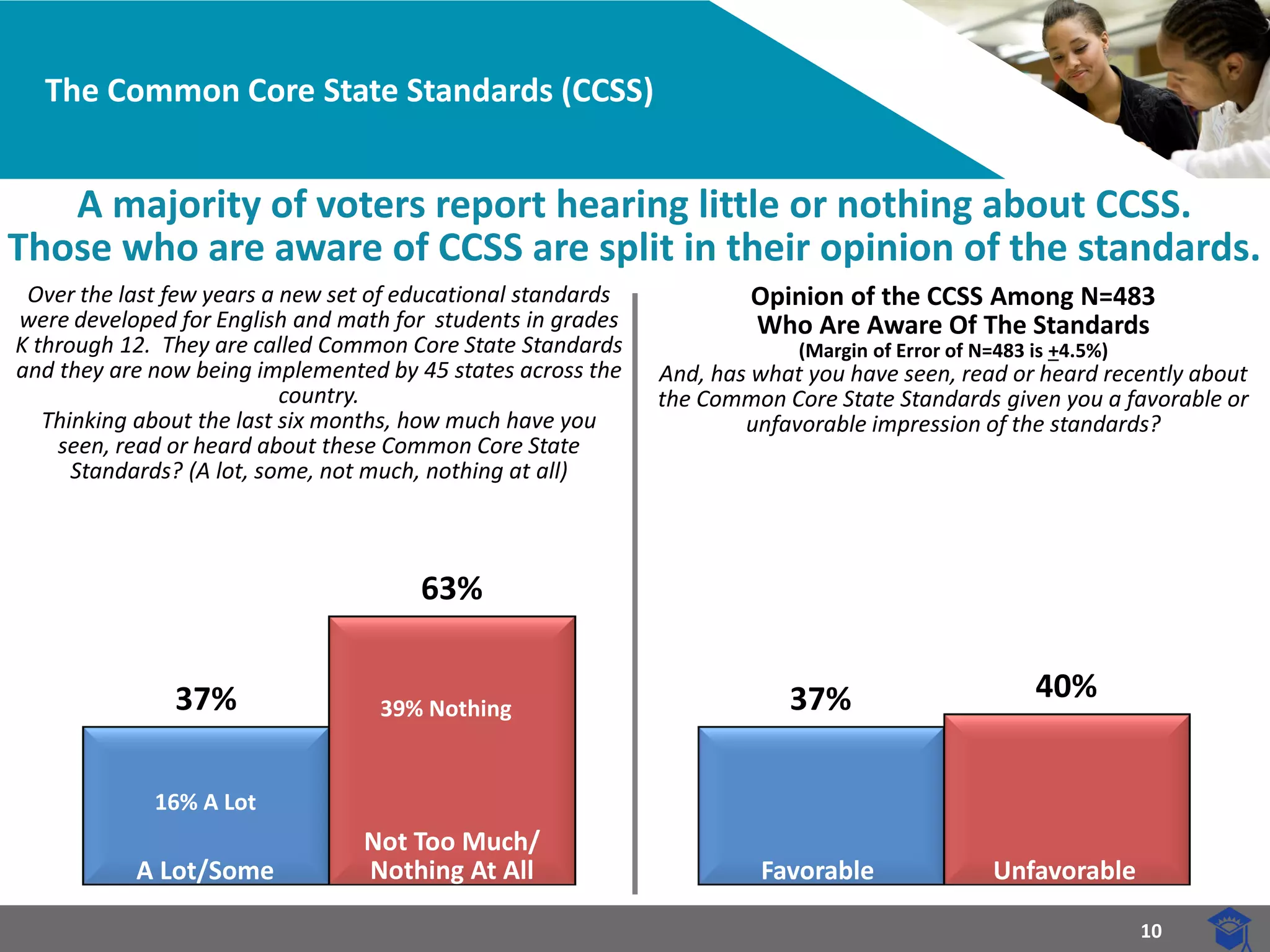
A majority of voters report hearing little or nothing about CCSS. 
Those who are aware of CCSS are split in their opinion of the standards. 
Over the last few years a new set of educational standards were developed for English and math for students in grades K through 12. They are called Common Core State Standards and they are now being implemented by 45 states across the country. 
Thinking about the last six months, how much have you seen, read or heard about these Common Core State Standards? (A lot, some, not much, nothing at all) 
37% 
37% 
63% 
40% 
16% A Lot 
39% Nothing 
Opinion of the CCSS Among N=483 
Who Are Aware Of The Standards 
(Margin of Error of N=483 is +4.5%) 
And, has what you have seen, read or heard recently about the Common Core State Standards given you a favorable or unfavorable impression of the standards? 
A Lot/Some 
Not Too Much/ 
Nothing At All 
Favorable 
Unfavorable
11 
The Common Core State Standards (CCSS) 
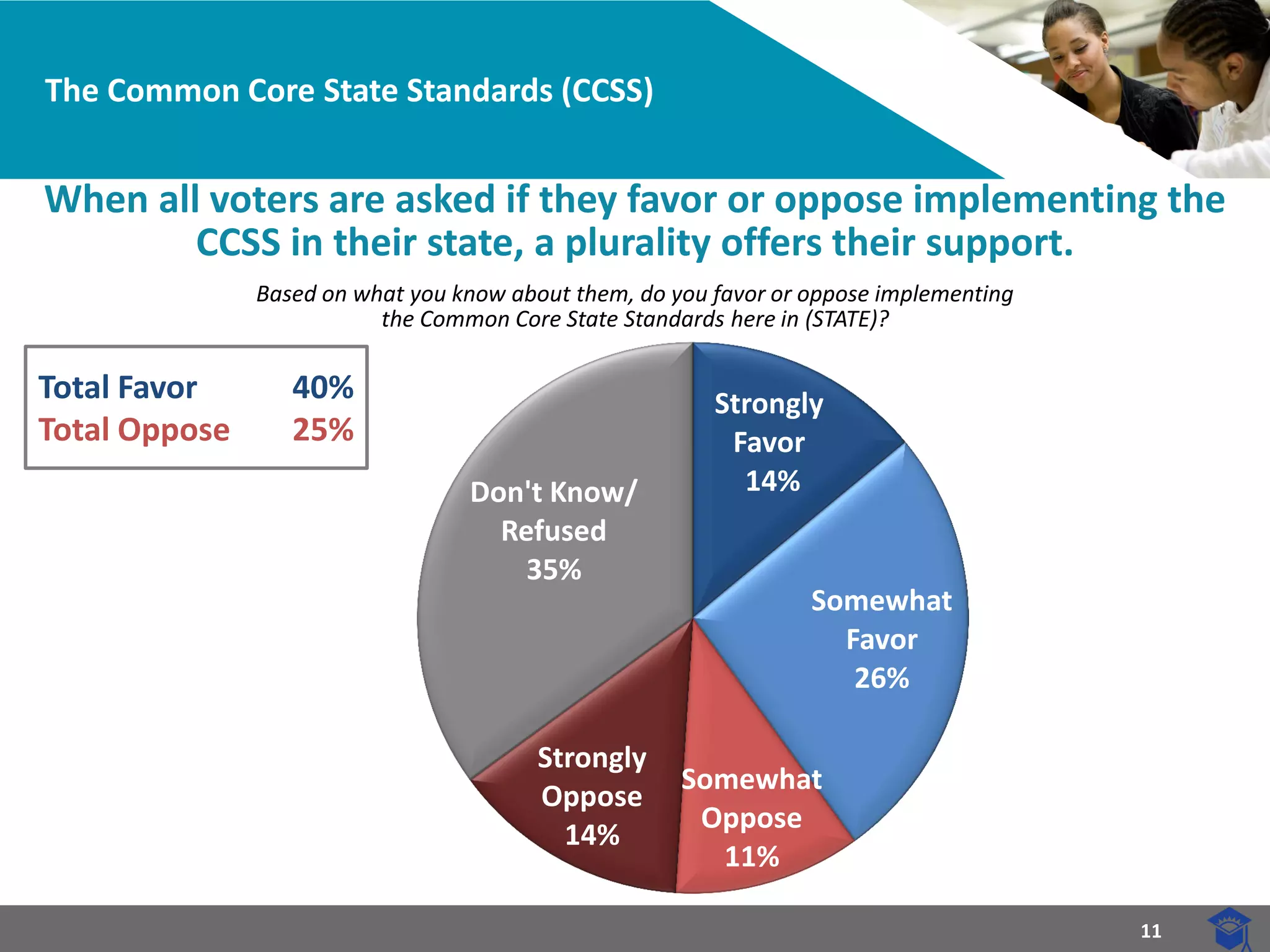
When all voters are asked if they favor or oppose implementing the CCSS in their state, a plurality offers their support. 
Based on what you know about them, do you favor or oppose implementing 
the Common Core State Standards here in (STATE)? 
Strongly Favor 
14% 
Somewhat Favor 26% 
Somewhat Oppose 11% 
Strongly Oppose 14% 
Don't Know/ Refused 35% 
Total Favor 40% 
Total Oppose 25%
12 
Respondents were provided with the following information about the Common Core State Standards and asked if they would favor or oppose their implementation: 
Over the last few years a new set of educational standards were developed for English and math for students in grades K through 12. They are called the Common Core State Standards and are now being taught in classrooms in 45 states across the country. 
The standards were developed under the guidance of state governors and state school chiefs who relied on teachers, content experts, and higher education faculty 
to help draft and review them. 
The goal of the standards is to help all students have the knowledge and skills they need in English and math so that they will be prepared as they leave high school and enter the workforce or go on to college, and that all students would be held to the same expectations, regardless of their state, school, or district.
13 
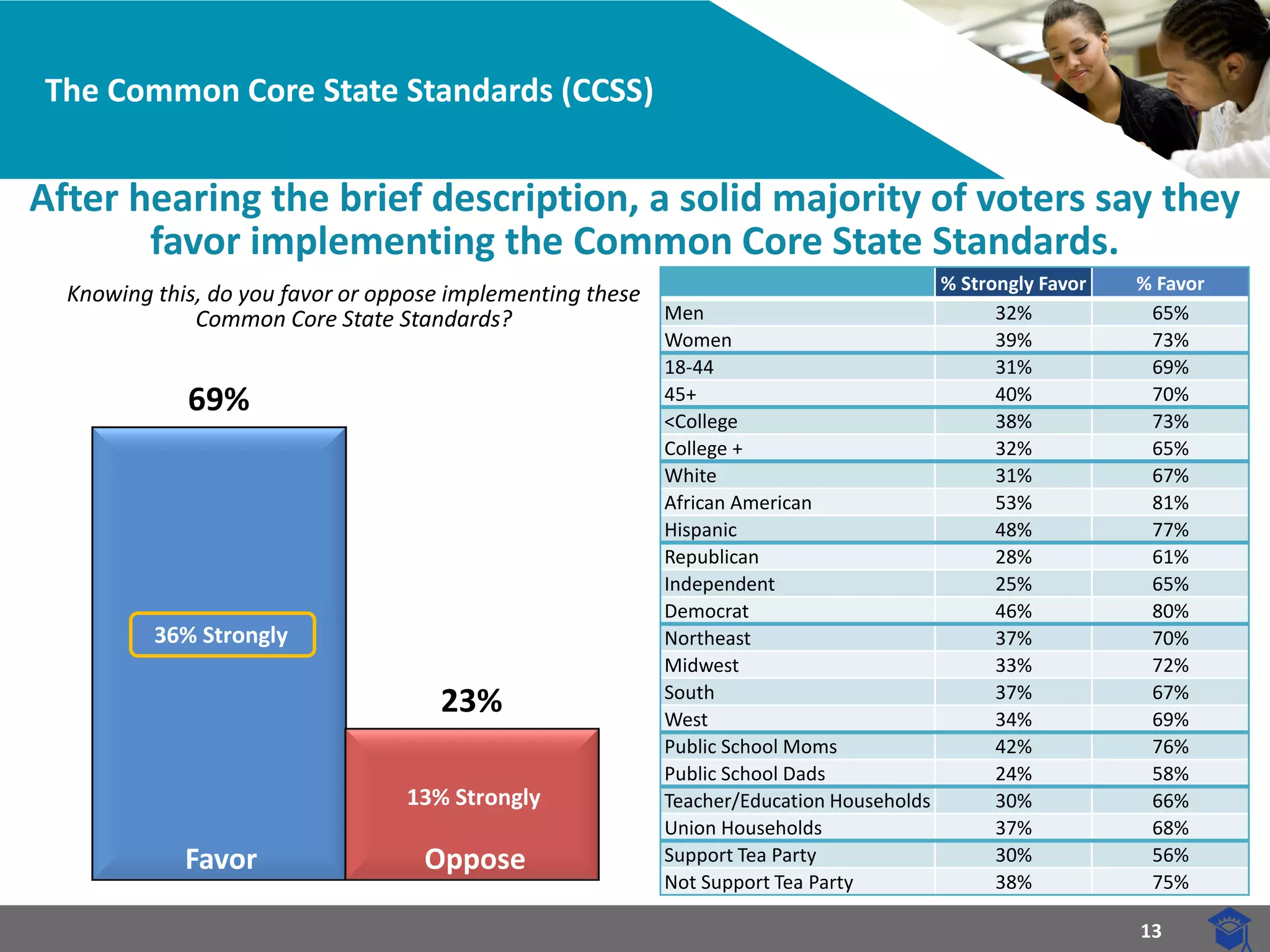
69% 
23% 
The Common Core State Standards (CCSS) 
After hearing the brief description, a solid majority of voters say they favor implementing the Common Core State Standards. 
Knowing this, do you favor or oppose implementing these Common Core State Standards? 
% Strongly Favor 
% Favor 
Men 
32% 
65% 
Women 
39% 
73% 
18-44 
31% 
69% 
45+ 
40% 
70% 
<College 
38% 
73% 
College + 
32% 
65% 
White 
31% 
67% 
African American 
53% 
81% 
Hispanic 
48% 
77% 
Republican 
28% 
61% 
Independent 
25% 
65% 
Democrat 
46% 
80% 
Northeast 
37% 
70% 
Midwest 
33% 
72% 
South 
37% 
67% 
West 
34% 
69% 
Public School Moms 
42% 
76% 
Public School Dads 
24% 
58% 
Teacher/Education Households 
30% 
66% 
Union Households 
37% 
68% 
Support Tea Party 
30% 
56% 
Not Support Tea Party 
38% 
75% 
36% Strongly 
13% Strongly 
Favor 
Oppose
14 
The Common Core State Standards (CCSS) 
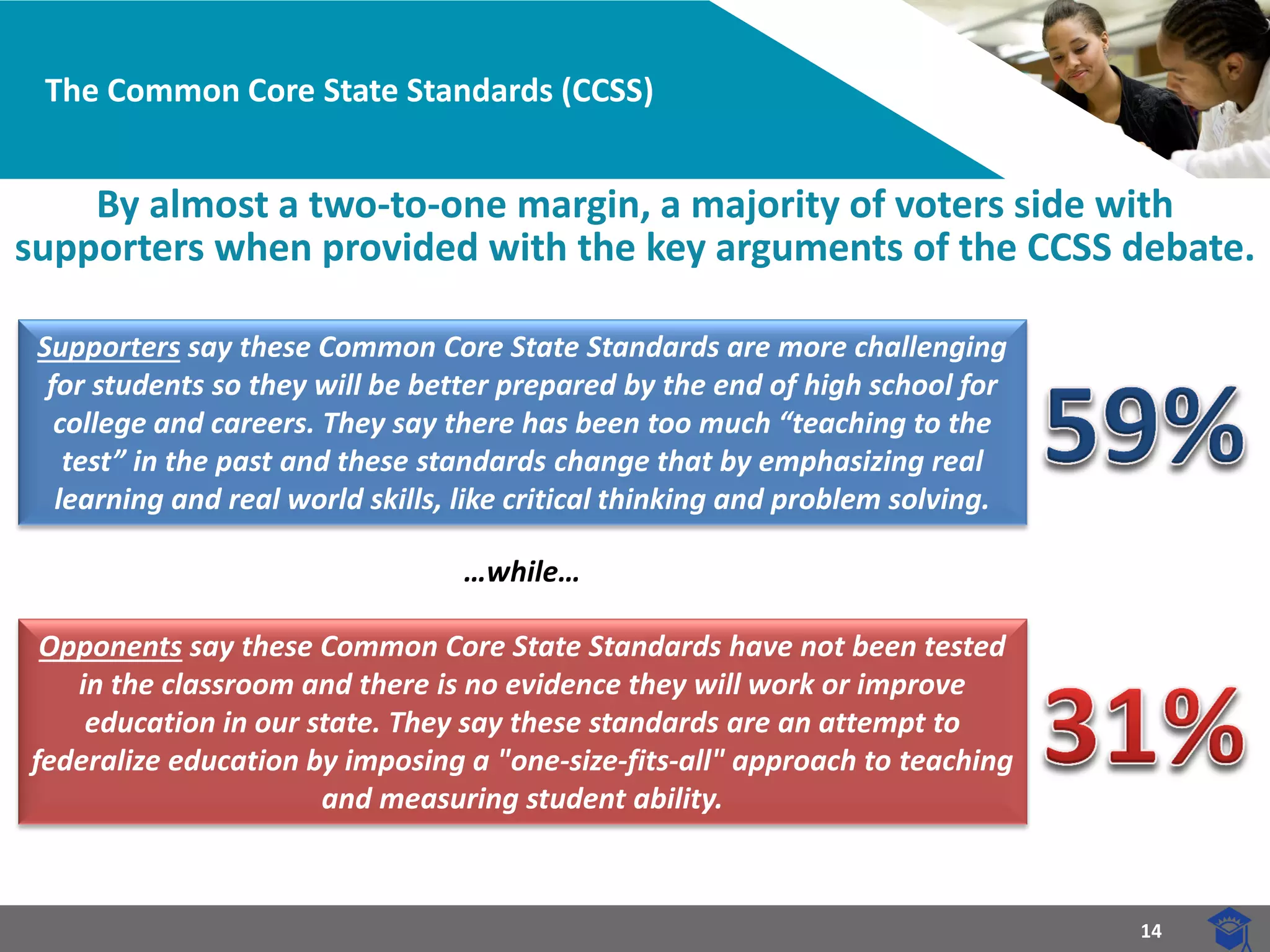
By almost a two-to-one margin, a majority of voters side with supporters when provided with the key arguments of the CCSS debate. 
Supporters say these Common Core State Standards are more challenging for students so they will be better prepared by the end of high school for college and careers. They say there has been too much “teaching to the test” in the past and these standards change that by emphasizing real learning and real world skills, like critical thinking and problem solving. 
Opponents say these Common Core State Standards have not been tested in the classroom and there is no evidence they will work or improve education in our state. They say these standards are an attempt to federalize education by imposing a "one‐size‐fits‐all" approach to teaching and measuring student ability. 
…while…
15 
The Common Core State Standards Assessments
16 
Respondents were provided with the following information about the Common Core State Standards Assessments and asked if they would favor or oppose their implementation: 
As the Common Core State Standards are being implemented and taught, new tests aligned to the standards are also under development. These new tests are designed to help determine what students know and can do, and whether they are on track to graduate from high school ready for college or the workforce. Over time, these new tests would replace the current end of year state tests being given here in (STATE).
17 
66% 
22% 
The Common Core State Standards Assessments (CCSS Assessments) 
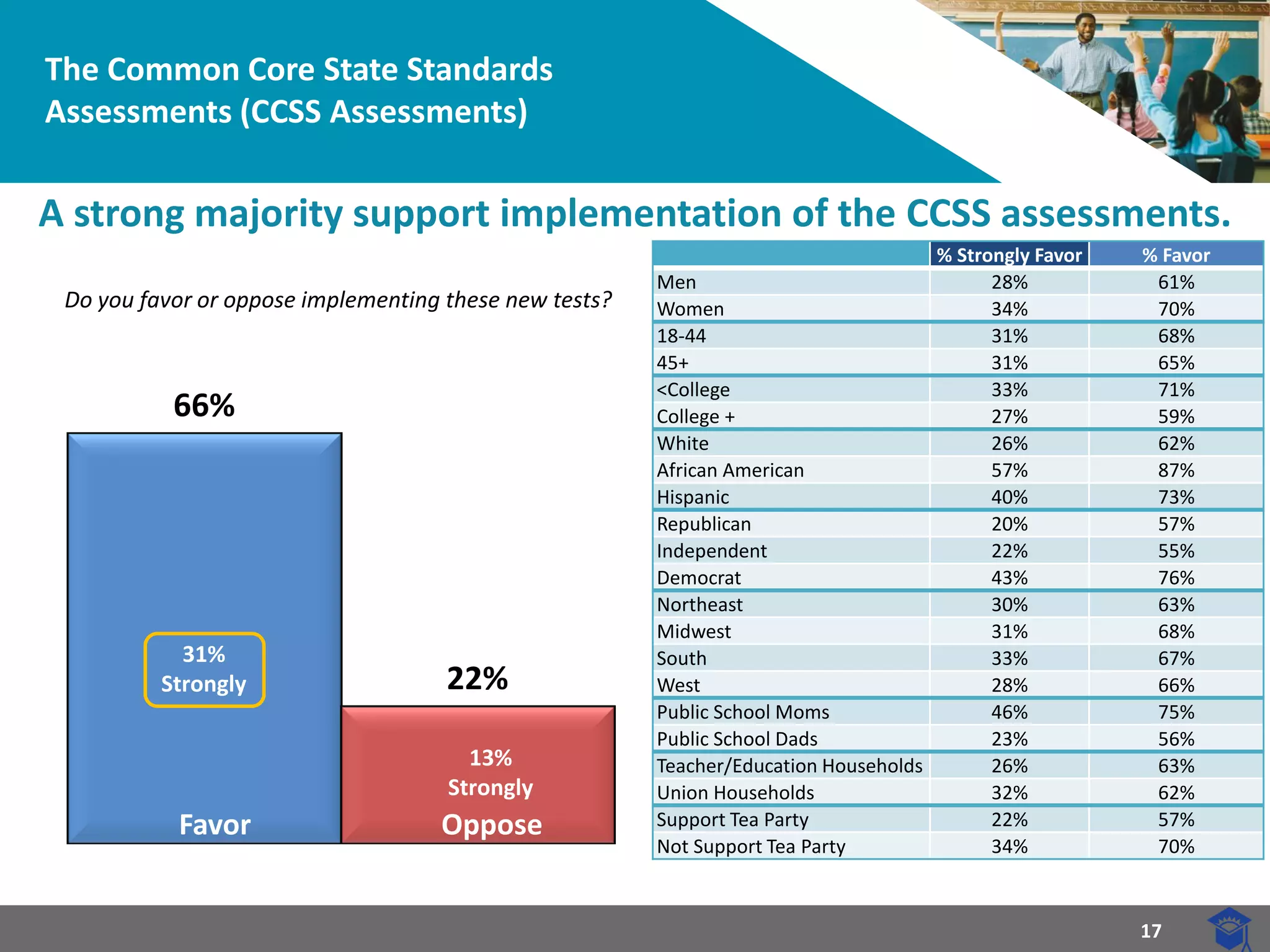
A strong majority support implementation of the CCSS assessments. 
Do you favor or oppose implementing these new tests? 
% Strongly Favor 
% Favor 
Men 
28% 
61% 
Women 
34% 
70% 
18-44 
31% 
68% 
45+ 
31% 
65% 
<College 
33% 
71% 
College + 
27% 
59% 
White 
26% 
62% 
African American 
57% 
87% 
Hispanic 
40% 
73% 
Republican 
20% 
57% 
Independent 
22% 
55% 
Democrat 
43% 
76% 
Northeast 
30% 
63% 
Midwest 
31% 
68% 
South 
33% 
67% 
West 
28% 
66% 
Public School Moms 
46% 
75% 
Public School Dads 
23% 
56% 
Teacher/Education Households 
26% 
63% 
Union Households 
32% 
62% 
Support Tea Party 
22% 
57% 
Not Support Tea Party 
34% 
70% 
31% Strongly 
13% Strongly 
Favor 
Oppose
18 
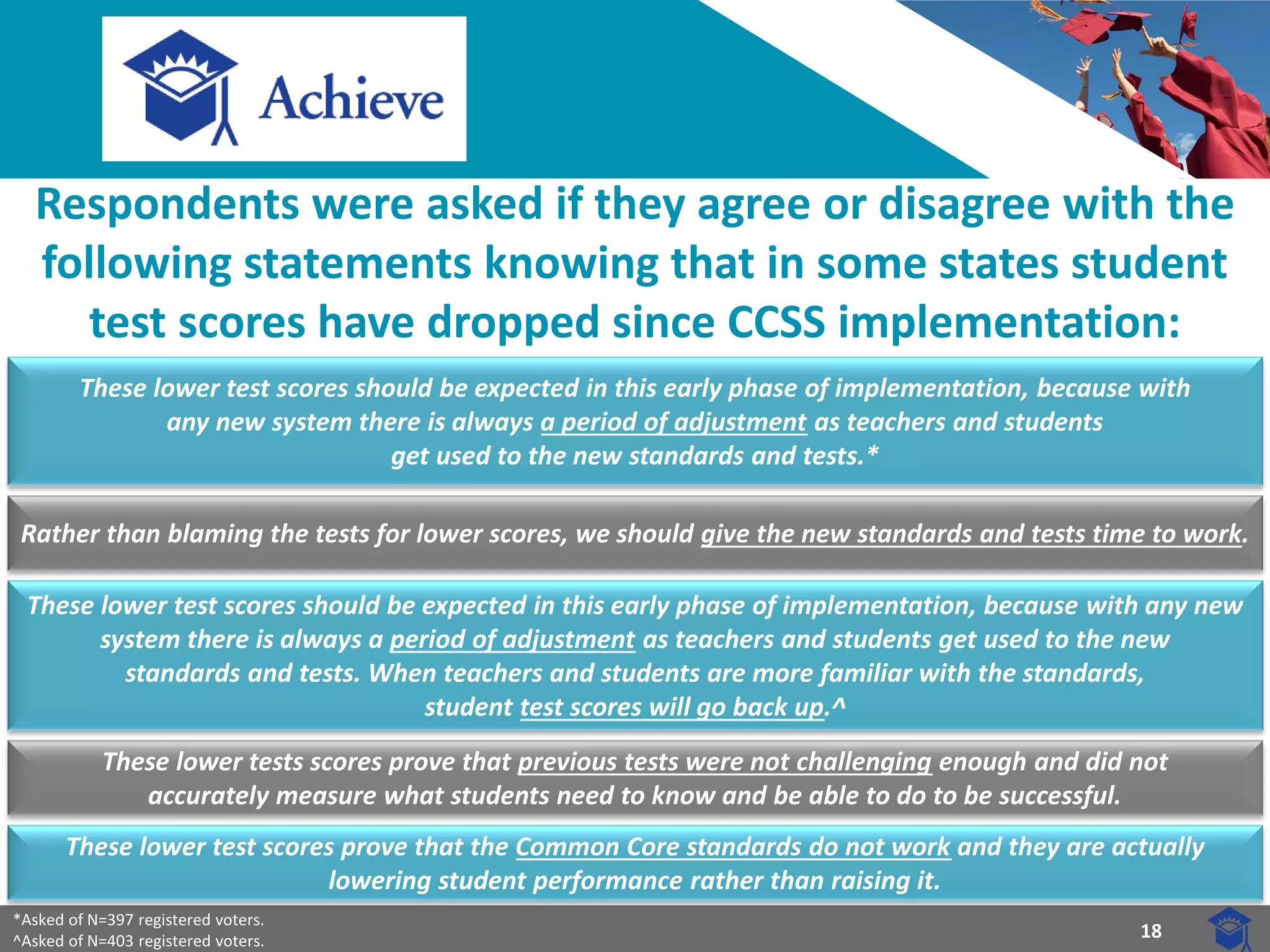
Respondents were asked if they agree or disagree with the following statements knowing that in some states student 
test scores have dropped since CCSS implementation: 
These lower test scores should be expected in this early phase of implementation, because with 
any new system there is always a period of adjustment as teachers and students 
get used to the new standards and tests.* 
Rather than blaming the tests for lower scores, we should give the new standards and tests time to work. 
These lower test scores should be expected in this early phase of implementation, because with any new system there is always a period of adjustment as teachers and students get used to the new 
standards and tests. When teachers and students are more familiar with the standards, 
student test scores will go back up.^ 
These lower tests scores prove that previous tests were not challenging enough and did not 
accurately measure what students need to know and be able to do to be successful. 
These lower test scores prove that the Common Core standards do not work and they are actually 
lowering student performance rather than raising it. 
*Asked of N=397 registered voters. 
^Asked of N=403 registered voters.
19 
4% 
6% 
6% 
11% 
12% 
12% 
11% 
13% 
14% 
26% 
8% 
9% 
13% 
21% 
30% 
35% 
36% 
35% 
28% 
16% 
41% 
38% 
33% 
26% 
16% 
The Common Core State Standards Assessments (CCSS Assessments) 
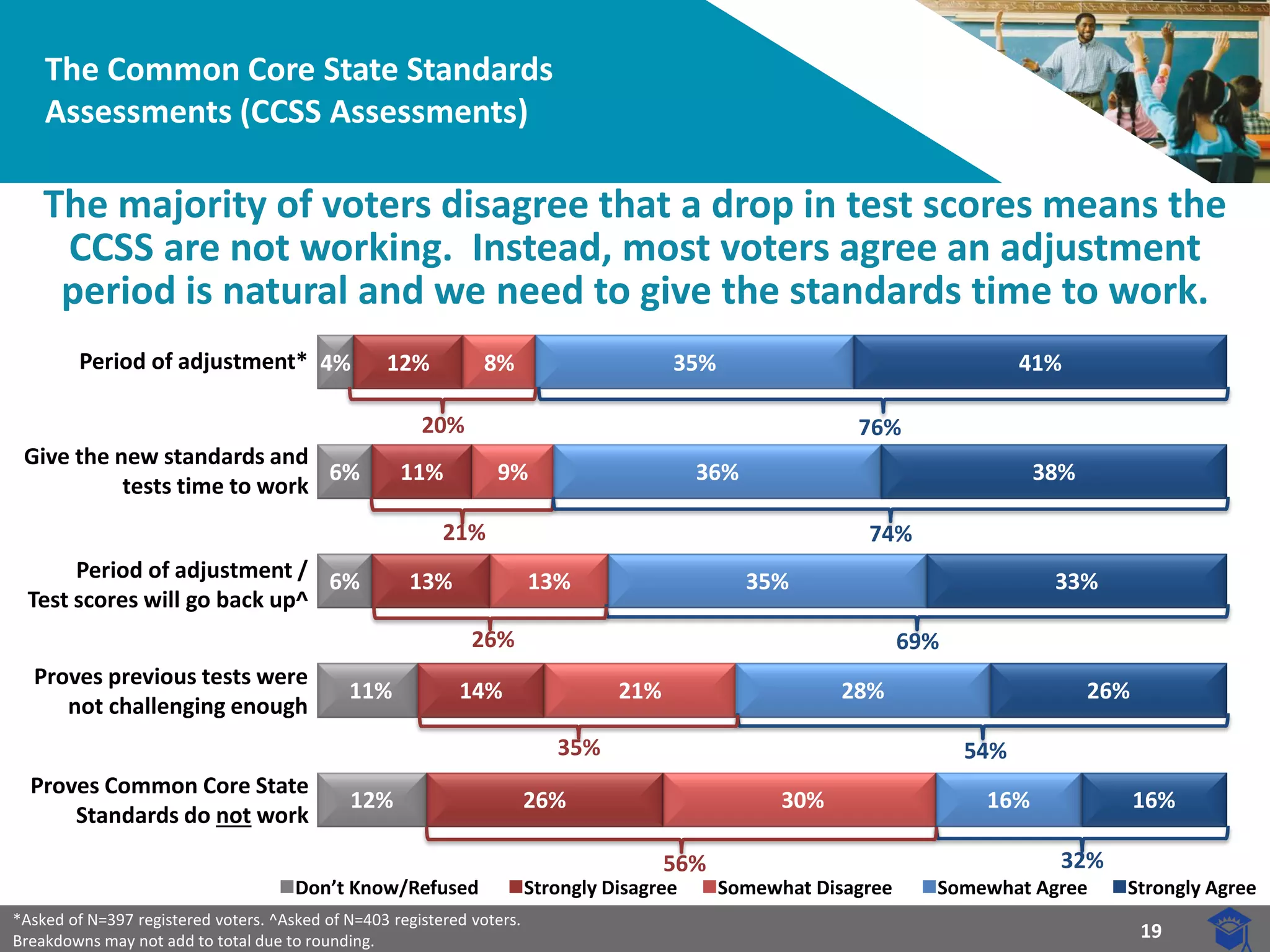
The majority of voters disagree that a drop in test scores means the CCSS are not working. Instead, most voters agree an adjustment period is natural and we need to give the standards time to work. 
Give the new standards and tests time to work 
76% 
Don’t Know/Refused Strongly Disagree Somewhat Disagree Somewhat Agree Strongly Agree 
20% 
Proves previous tests were not challenging enough 
Period of adjustment / 
Test scores will go back up^ 
74% 
21% 
32% 
56% 
Period of adjustment* 
54% 
26% 
Proves Common Core State Standards do not work 
69% 
35% 
*Asked of N=397 registered voters. ^Asked of N=403 registered voters. 
Breakdowns may not add to total due to rounding.
20 
81% 
15% 
The Common Core State Standards Assessments (CCSS Assessments) 
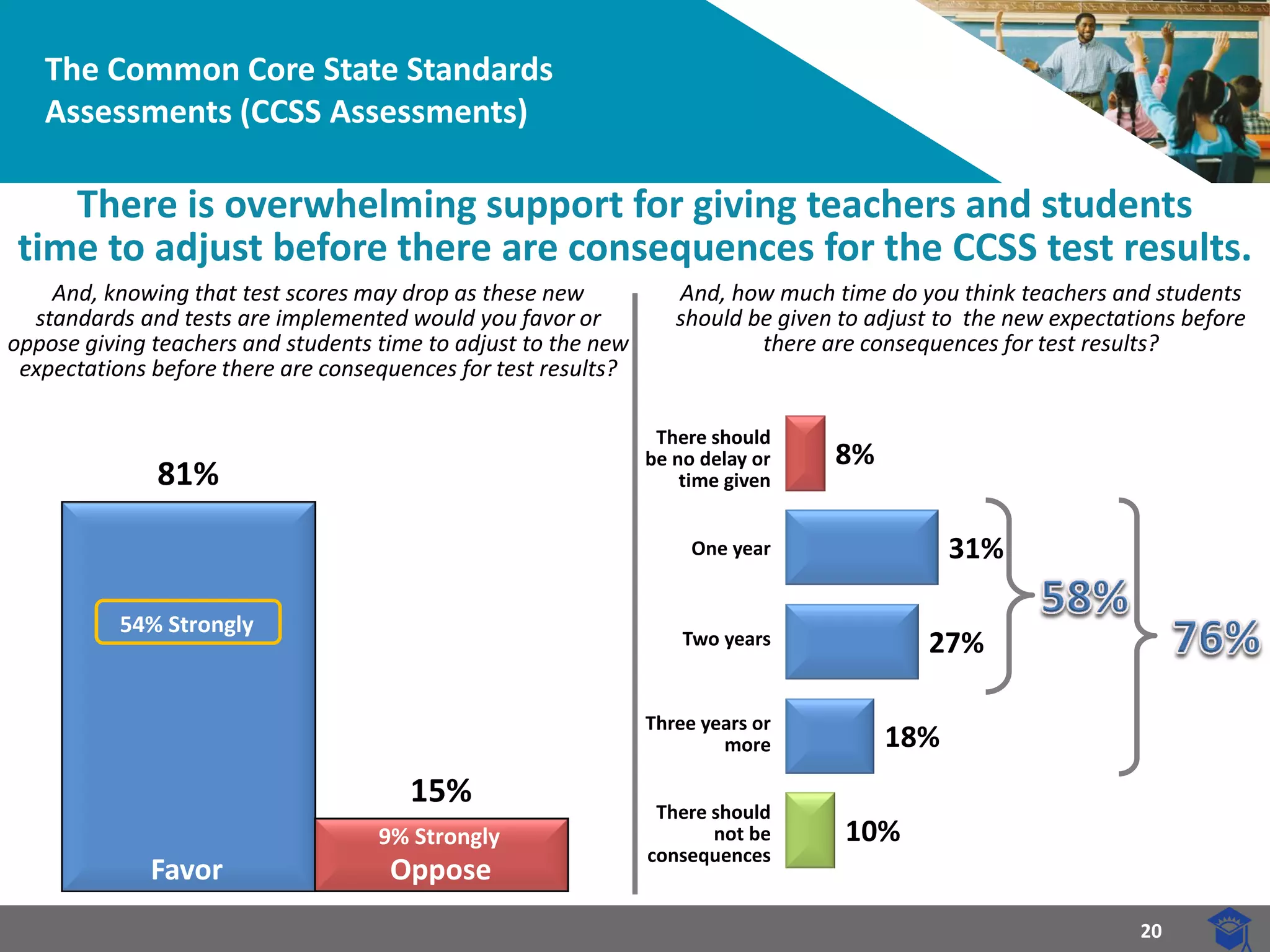
There is overwhelming support for giving teachers and students 
time to adjust before there are consequences for the CCSS test results. 
And, knowing that test scores may drop as these new standards and tests are implemented would you favor or oppose giving teachers and students time to adjust to the new expectations before there are consequences for test results? 
54% Strongly 
9% Strongly 
Favor 
Oppose 
And, how much time do you think teachers and students should be given to adjust to the new expectations before there are consequences for test results? 
8% 
31% 
27% 
18% 
10% 
There should be no delay or time given 
One year 
Two years 
Three years or more 
There should not be consequences
21 
The Common Core State Standards Assessments (CCSS Assessments) 
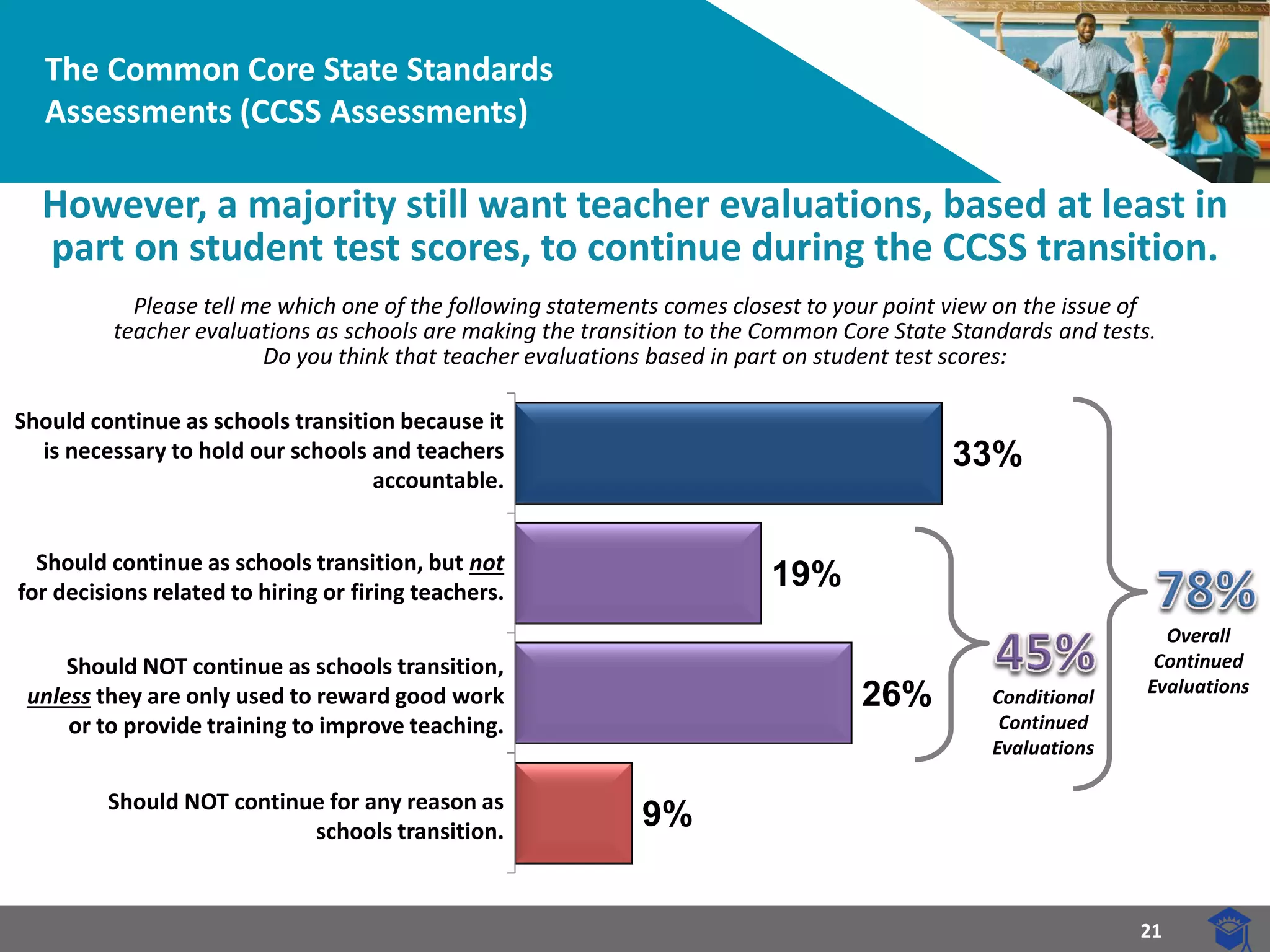
However, a majority still want teacher evaluations, based at least in part on student test scores, to continue during the CCSS transition. 
Please tell me which one of the following statements comes closest to your point view on the issue of 
teacher evaluations as schools are making the transition to the Common Core State Standards and tests. 
Do you think that teacher evaluations based in part on student test scores: 
33% 
19% 
26% 
9% 
Should continue as schools transition because it is necessary to hold our schools and teachers accountable. 
Should NOT continue for any reason as 
schools transition. 
Should NOT continue as schools transition, unless they are only used to reward good work or to provide training to improve teaching. 
Should continue as schools transition, but not for decisions related to hiring or firing teachers. 
Conditional Continued 
Evaluations 
Overall Continued 
Evaluations
22 
The Bottom Line
23 
The Bottom Line 
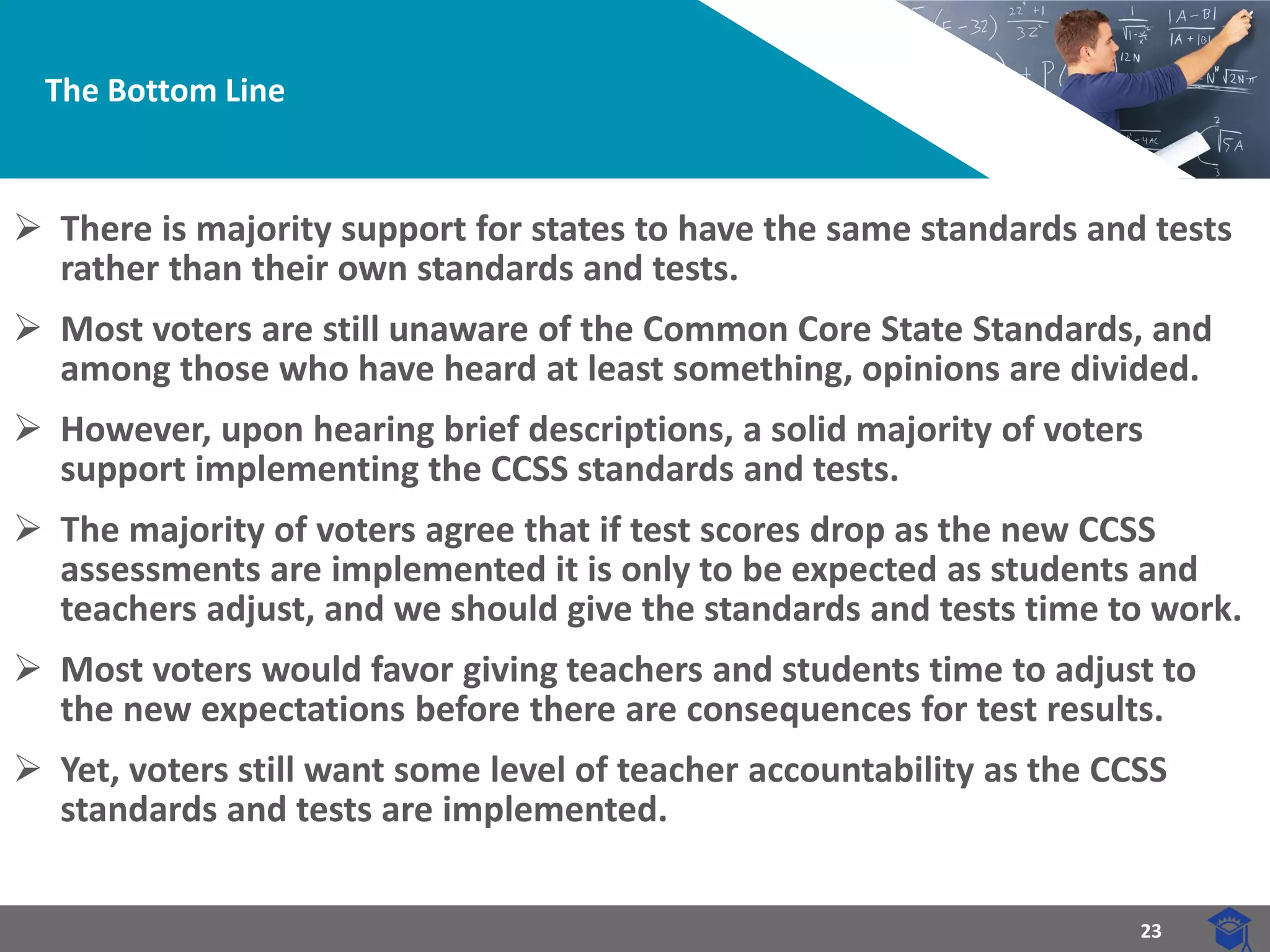
There is majority support for states to have the same standards and tests rather than their own standards and tests. 
Most voters are still unaware of the Common Core State Standards, and among those who have heard at least something, opinions are divided. 
However, upon hearing brief descriptions, a solid majority of voters support implementing the CCSS standards and tests. 
The majority of voters agree that if test scores drop as the new CCSS assessments are implemented it is only to be expected as students and teachers adjust, and we should give the standards and tests time to work. 
Most voters would favor giving teachers and students time to adjust to the new expectations before there are consequences for test results. 
Yet, voters still want some level of teacher accountability as the CCSS standards and tests are implemented.
24 
Phone: (202) 247-0593 
alex@pos.org 
Alex Bratty 
Dave Walker 
Phone: (202) 478-8300 
DWalker@gqrr.com

Voter Perceptions: Common Core State Standards and Assessments

  • 1.
    Voter Perceptions: CommonCore State Standards & Tests Project # 13480 Key Findings From A National Survey of N=800 Voters. Conducted November 14-18, 2013; Margin of Error +3.5%.
  • 2.
    2 Perceptions of Public Education
  • 3.
    3 *Asked ofN=397 registered voters. ^Asked of N=403 registered voters. In the issue landscape, public education is on par with the economy and government spending. Perceptions of Public Education Now, thinking about some issues facing our country, please tell me how important each of the following issues are for the government to address. Issues % Extremely Important % Extremely/Very Important Job creation and economic growth 43% 88% Reducing the federal budget deficit and government spending 41% 78% Improving the quality of public education 40% 82% Improving the health care system 34% 73% Combating terrorism at home in the United States and overseas 33% 72% Securing our borders and addressing the issue of immigration 28% 63% Investing in alternative energy sources* 21% 53% Reducing taxes^ 21% 52%
  • 4.
    4 9% 35% 32% 20% 43% 54% Working pretty well now A complete overhaul is needed Major changes are needed Some changes are needed, but basically should be kept the same Perceptions of Public Education Few voters think K-12 public education is working pretty well. A majority believe students are graduating high school unprepared. When it comes to public education in grades K through 12 in our country, do you think our public schools…. Breakdowns may not add to total due to rounding. And, when it comes to having sufficient academic knowledge and skills, do you believe graduates of our nation’s public high schools are – very prepared, somewhat prepared, somewhat unprepared or very unprepared – to meet the expectations they face as they take the next steps after high school? Prepared Unprepared
  • 5.
    5 66% 28% 3% Perceptions of Public Education A majority of voters say academic requirements for students in public schools should be raised. Asked of N=397 registered voters. In general, do you believe academic requirements for students in public schools should be raised, lowered, or kept the same as they are right now? Raised Kept The Same Lowered
  • 6.
    6 36% 37% 13% Perceptions of Public Education Voters have mixed views on the current amount of student testing. In general, do you believe that students in public schools are given too many standardized tests, not enough standardized tests, or about the right amount of standardized tests throughout the school year? Asked of N=403 registered voters. Too Many Right Amount Not Enough
  • 7.
    7 67% 30% Perceptions of Public Education About two-thirds of voters say it is better for states to have the same standards in math and English rather than having different standards. I am going to read you two statements about education standards in subjects such as mathematics, reading, and English language skills, and please tell me which comes closer to your point of view on this. It is better for all states to have the SAME STANDARDS at each grade level in math and English so students across the country have to meet the same expectations. It is better for all states to have their OWN STANDARDS at each grade level in math and English so each state can be sure that the standards reflect their own priorities. OR Standards asked of N=397 registered voters.
  • 8.
    8 61% 34% Perceptions of Public Education Similarly, a majority say it is better for states to have the same tests in math and English rather than having different tests. I am going to read you two statements about education tests in subjects such as mathematics, reading, and English language skills, and please tell me which comes closer to your point of view on this. It is better for all states to have the SAME TESTS at each grade level in math and English so test scores can be compared across states. It is better for all states to have their OWN TESTS at each grade level in math and English so each state can be sure the tests reflect their own priorities. OR Tests asked of N=403 registered voters.
  • 9.
    9 The CommonCore State Standards (CCSS)
  • 10.
    10 The CommonCore State Standards (CCSS) A majority of voters report hearing little or nothing about CCSS. Those who are aware of CCSS are split in their opinion of the standards. Over the last few years a new set of educational standards were developed for English and math for students in grades K through 12. They are called Common Core State Standards and they are now being implemented by 45 states across the country. Thinking about the last six months, how much have you seen, read or heard about these Common Core State Standards? (A lot, some, not much, nothing at all) 37% 37% 63% 40% 16% A Lot 39% Nothing Opinion of the CCSS Among N=483 Who Are Aware Of The Standards (Margin of Error of N=483 is +4.5%) And, has what you have seen, read or heard recently about the Common Core State Standards given you a favorable or unfavorable impression of the standards? A Lot/Some Not Too Much/ Nothing At All Favorable Unfavorable
  • 11.
    11 The CommonCore State Standards (CCSS) When all voters are asked if they favor or oppose implementing the CCSS in their state, a plurality offers their support. Based on what you know about them, do you favor or oppose implementing the Common Core State Standards here in (STATE)? Strongly Favor 14% Somewhat Favor 26% Somewhat Oppose 11% Strongly Oppose 14% Don't Know/ Refused 35% Total Favor 40% Total Oppose 25%
  • 12.
    12 Respondents wereprovided with the following information about the Common Core State Standards and asked if they would favor or oppose their implementation: Over the last few years a new set of educational standards were developed for English and math for students in grades K through 12. They are called the Common Core State Standards and are now being taught in classrooms in 45 states across the country. The standards were developed under the guidance of state governors and state school chiefs who relied on teachers, content experts, and higher education faculty to help draft and review them. The goal of the standards is to help all students have the knowledge and skills they need in English and math so that they will be prepared as they leave high school and enter the workforce or go on to college, and that all students would be held to the same expectations, regardless of their state, school, or district.
  • 13.
    13 69% 23% The Common Core State Standards (CCSS) After hearing the brief description, a solid majority of voters say they favor implementing the Common Core State Standards. Knowing this, do you favor or oppose implementing these Common Core State Standards? % Strongly Favor % Favor Men 32% 65% Women 39% 73% 18-44 31% 69% 45+ 40% 70% <College 38% 73% College + 32% 65% White 31% 67% African American 53% 81% Hispanic 48% 77% Republican 28% 61% Independent 25% 65% Democrat 46% 80% Northeast 37% 70% Midwest 33% 72% South 37% 67% West 34% 69% Public School Moms 42% 76% Public School Dads 24% 58% Teacher/Education Households 30% 66% Union Households 37% 68% Support Tea Party 30% 56% Not Support Tea Party 38% 75% 36% Strongly 13% Strongly Favor Oppose
  • 14.
    14 The CommonCore State Standards (CCSS) By almost a two-to-one margin, a majority of voters side with supporters when provided with the key arguments of the CCSS debate. Supporters say these Common Core State Standards are more challenging for students so they will be better prepared by the end of high school for college and careers. They say there has been too much “teaching to the test” in the past and these standards change that by emphasizing real learning and real world skills, like critical thinking and problem solving. Opponents say these Common Core State Standards have not been tested in the classroom and there is no evidence they will work or improve education in our state. They say these standards are an attempt to federalize education by imposing a "one‐size‐fits‐all" approach to teaching and measuring student ability. …while…
  • 15.
    15 The CommonCore State Standards Assessments
  • 16.
    16 Respondents wereprovided with the following information about the Common Core State Standards Assessments and asked if they would favor or oppose their implementation: As the Common Core State Standards are being implemented and taught, new tests aligned to the standards are also under development. These new tests are designed to help determine what students know and can do, and whether they are on track to graduate from high school ready for college or the workforce. Over time, these new tests would replace the current end of year state tests being given here in (STATE).
  • 17.
    17 66% 22% The Common Core State Standards Assessments (CCSS Assessments) A strong majority support implementation of the CCSS assessments. Do you favor or oppose implementing these new tests? % Strongly Favor % Favor Men 28% 61% Women 34% 70% 18-44 31% 68% 45+ 31% 65% <College 33% 71% College + 27% 59% White 26% 62% African American 57% 87% Hispanic 40% 73% Republican 20% 57% Independent 22% 55% Democrat 43% 76% Northeast 30% 63% Midwest 31% 68% South 33% 67% West 28% 66% Public School Moms 46% 75% Public School Dads 23% 56% Teacher/Education Households 26% 63% Union Households 32% 62% Support Tea Party 22% 57% Not Support Tea Party 34% 70% 31% Strongly 13% Strongly Favor Oppose
  • 18.
    18 Respondents wereasked if they agree or disagree with the following statements knowing that in some states student test scores have dropped since CCSS implementation: These lower test scores should be expected in this early phase of implementation, because with any new system there is always a period of adjustment as teachers and students get used to the new standards and tests.* Rather than blaming the tests for lower scores, we should give the new standards and tests time to work. These lower test scores should be expected in this early phase of implementation, because with any new system there is always a period of adjustment as teachers and students get used to the new standards and tests. When teachers and students are more familiar with the standards, student test scores will go back up.^ These lower tests scores prove that previous tests were not challenging enough and did not accurately measure what students need to know and be able to do to be successful. These lower test scores prove that the Common Core standards do not work and they are actually lowering student performance rather than raising it. *Asked of N=397 registered voters. ^Asked of N=403 registered voters.
  • 19.
    19 4% 6% 6% 11% 12% 12% 11% 13% 14% 26% 8% 9% 13% 21% 30% 35% 36% 35% 28% 16% 41% 38% 33% 26% 16% The Common Core State Standards Assessments (CCSS Assessments) The majority of voters disagree that a drop in test scores means the CCSS are not working. Instead, most voters agree an adjustment period is natural and we need to give the standards time to work. Give the new standards and tests time to work 76% Don’t Know/Refused Strongly Disagree Somewhat Disagree Somewhat Agree Strongly Agree 20% Proves previous tests were not challenging enough Period of adjustment / Test scores will go back up^ 74% 21% 32% 56% Period of adjustment* 54% 26% Proves Common Core State Standards do not work 69% 35% *Asked of N=397 registered voters. ^Asked of N=403 registered voters. Breakdowns may not add to total due to rounding.
  • 20.
    20 81% 15% The Common Core State Standards Assessments (CCSS Assessments) There is overwhelming support for giving teachers and students time to adjust before there are consequences for the CCSS test results. And, knowing that test scores may drop as these new standards and tests are implemented would you favor or oppose giving teachers and students time to adjust to the new expectations before there are consequences for test results? 54% Strongly 9% Strongly Favor Oppose And, how much time do you think teachers and students should be given to adjust to the new expectations before there are consequences for test results? 8% 31% 27% 18% 10% There should be no delay or time given One year Two years Three years or more There should not be consequences
  • 21.
    21 The CommonCore State Standards Assessments (CCSS Assessments) However, a majority still want teacher evaluations, based at least in part on student test scores, to continue during the CCSS transition. Please tell me which one of the following statements comes closest to your point view on the issue of teacher evaluations as schools are making the transition to the Common Core State Standards and tests. Do you think that teacher evaluations based in part on student test scores: 33% 19% 26% 9% Should continue as schools transition because it is necessary to hold our schools and teachers accountable. Should NOT continue for any reason as schools transition. Should NOT continue as schools transition, unless they are only used to reward good work or to provide training to improve teaching. Should continue as schools transition, but not for decisions related to hiring or firing teachers. Conditional Continued Evaluations Overall Continued Evaluations
  • 22.
  • 23.
    23 The BottomLine There is majority support for states to have the same standards and tests rather than their own standards and tests. Most voters are still unaware of the Common Core State Standards, and among those who have heard at least something, opinions are divided. However, upon hearing brief descriptions, a solid majority of voters support implementing the CCSS standards and tests. The majority of voters agree that if test scores drop as the new CCSS assessments are implemented it is only to be expected as students and teachers adjust, and we should give the standards and tests time to work. Most voters would favor giving teachers and students time to adjust to the new expectations before there are consequences for test results. Yet, voters still want some level of teacher accountability as the CCSS standards and tests are implemented.
  • 24.
    24 Phone: (202)247-0593 alex@pos.org Alex Bratty Dave Walker Phone: (202) 478-8300 DWalker@gqrr.com