Background 
 This is the eighth year that Achieve has surveyed all 50 states and 
reported on state progress in adopting college- and career-ready 
standards, graduation requirements, assessments, and accountability 
and data systems. 
 This year’s report includes information on policy adoption and 
implementation as well as recommendations for states as they look 
toward transition to assessments aligned to college- and career-ready 
standards. 
 The report includes state-by-state results on the policies and practices of 
forty-nine states and the District of Columbia that participated in this 
year’s survey. 
Achieve | 2013 Closing the Expectations Gap 2
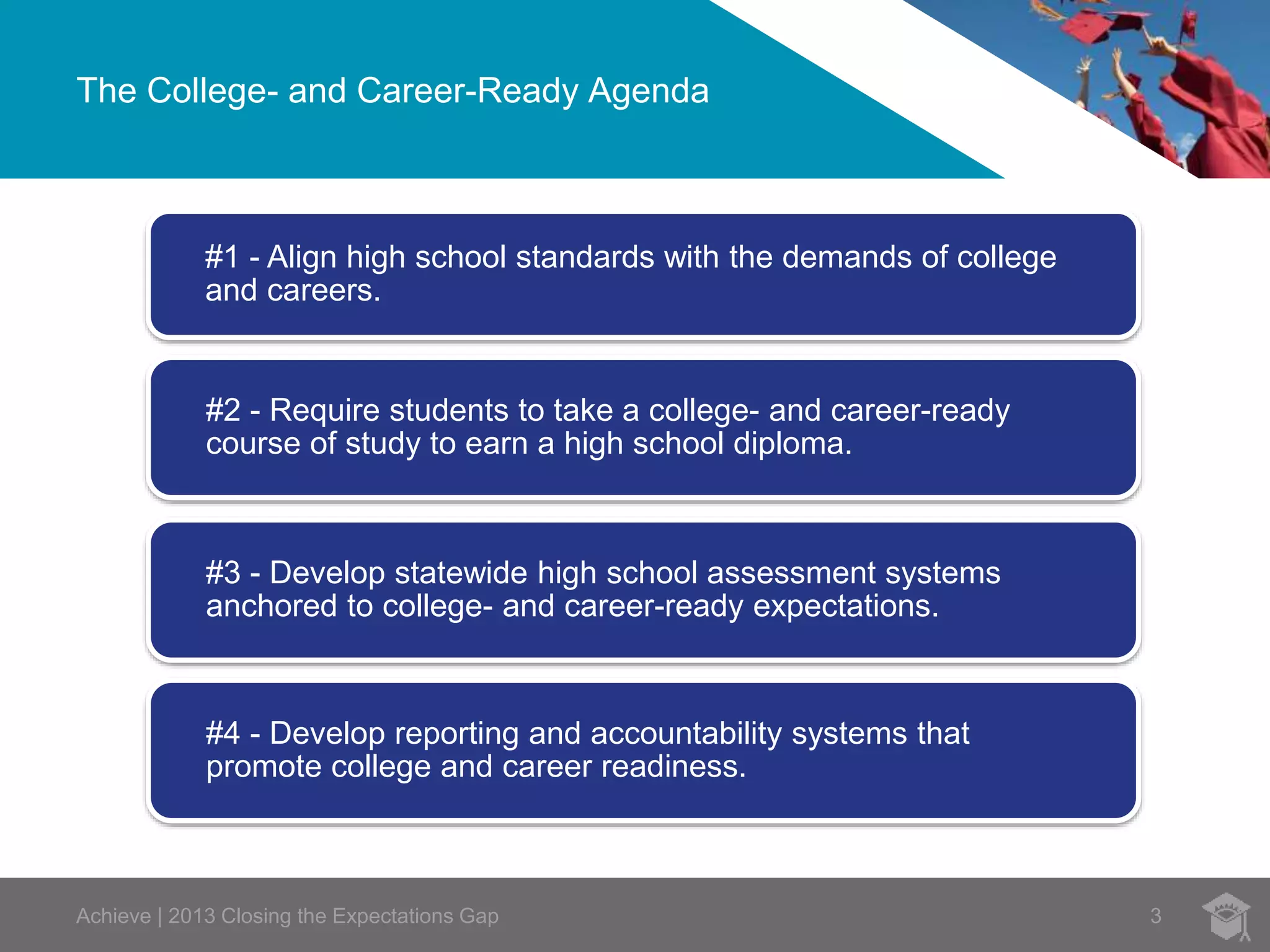
The College- and Career-Ready Agenda 
#1 - Align high school standards with the demands of college 
and careers. 
#2 - Require students to take a college- and career-ready 
course of study to earn a high school diploma. 
#3 - Develop statewide high school assessment systems 
anchored to college- and career-ready expectations. 
#4 - Develop reporting and accountability systems that 
promote college and career readiness. 
Achieve | 2013 Closing the Expectations Gap 3
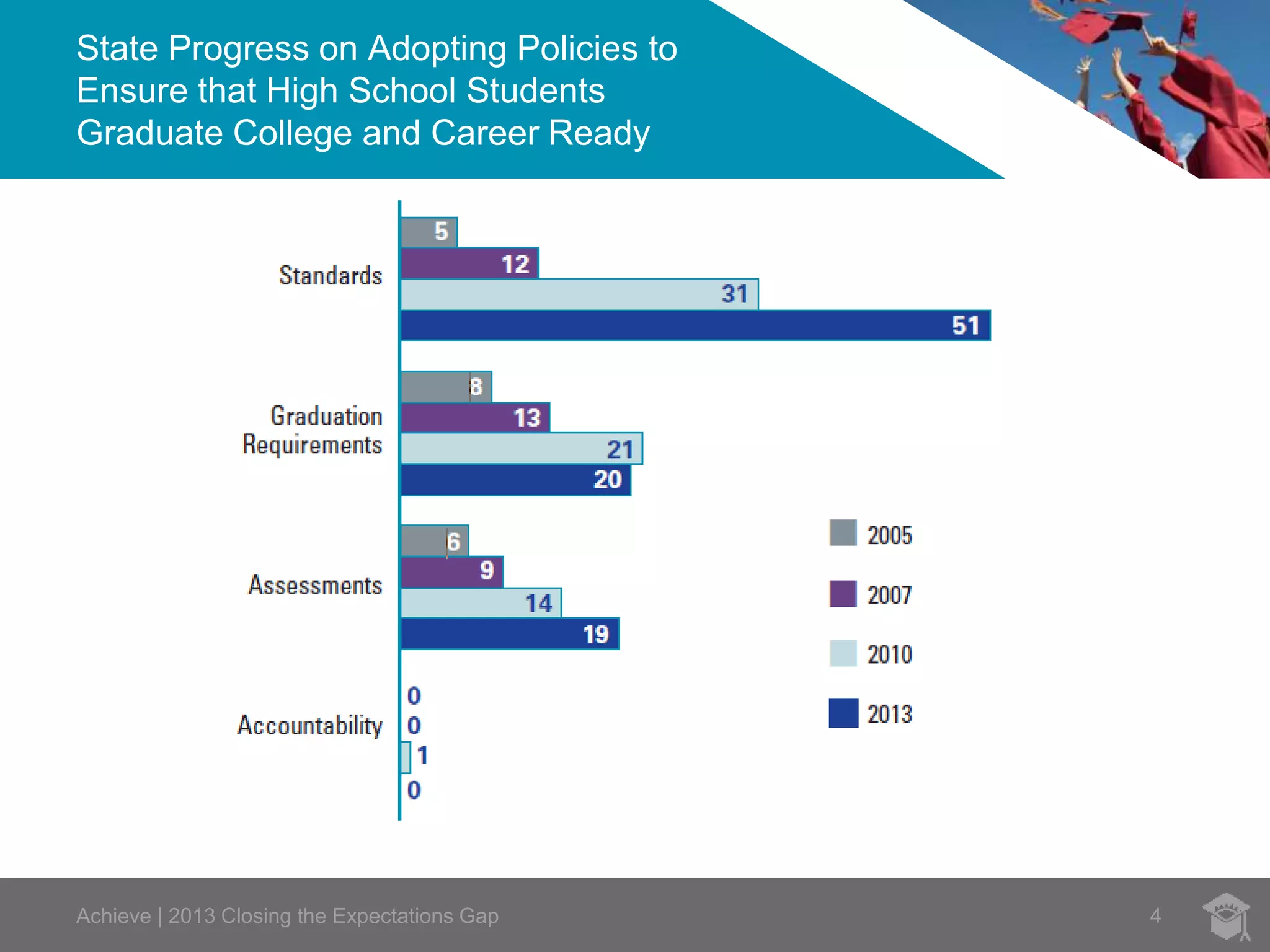
State Progress on Adopting Policies to 
Ensure that High School Students 
Graduate College and Career Ready 
Achieve | 2013 Closing the Expectations Gap 4
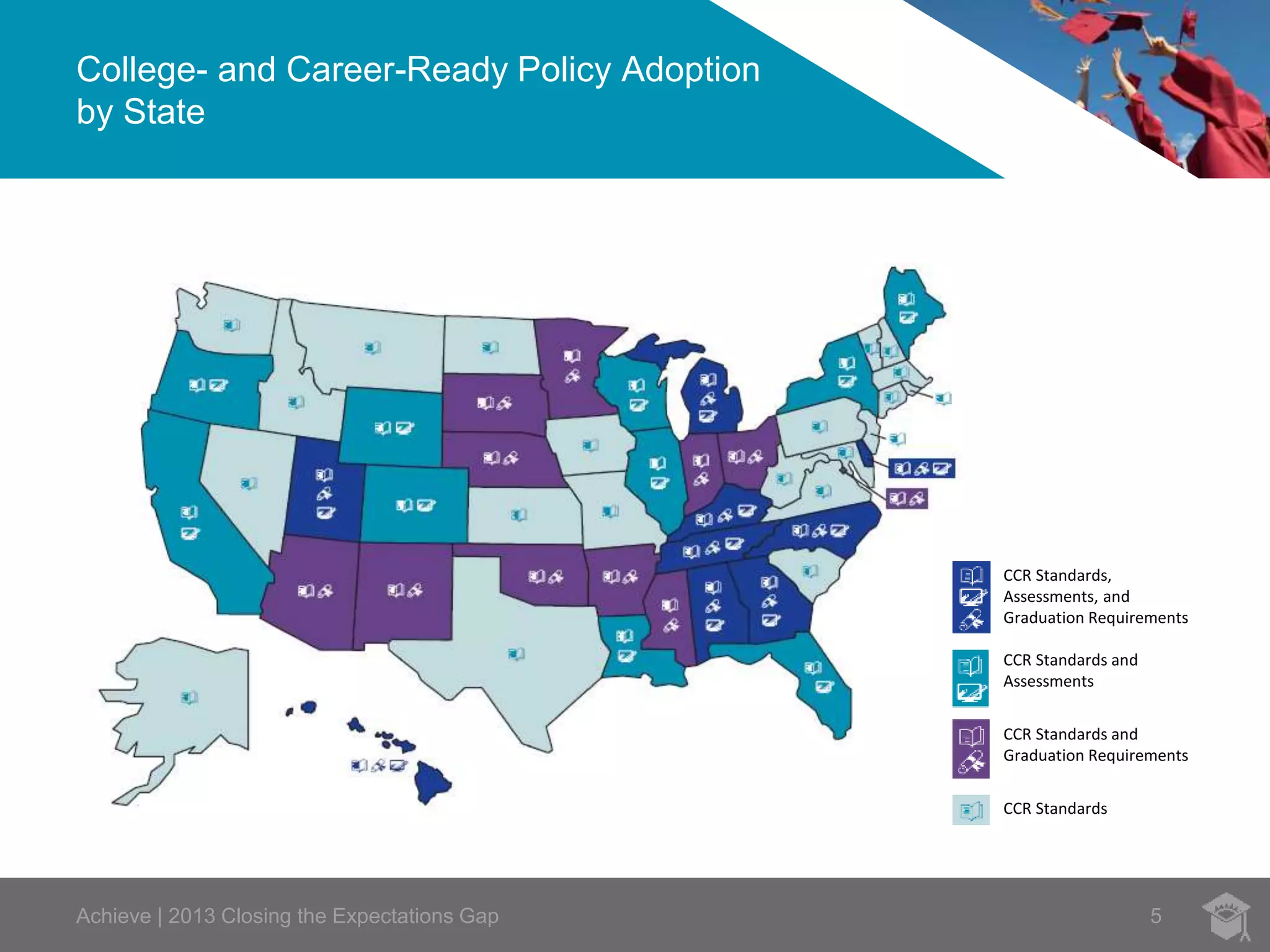
College- and Career-Ready Policy Adoption 
by State 
CCR Standards, 
Assessments, and 
Graduation Requirements 
5 
CCR Standards and 
Assessments 
CCR Standards and 
Graduation Requirements 
CCR Standards 
Achieve | 2013 Closing the Expectations Gap
#1 - College- and Career-Ready Standards 
In the survey, Achieve asked states whether they have 
developed and adopted high school academic content 
standards in English and mathematics aligned to college- and 
career-ready expectations. 
Achieve also asked about state efforts to support 
implementation, including access to high-quality instructional 
materials and professional learning opportunities aligned to the 
CCSS/CCR standards. 
Achieve | 2013 Closing the Expectations Gap 6
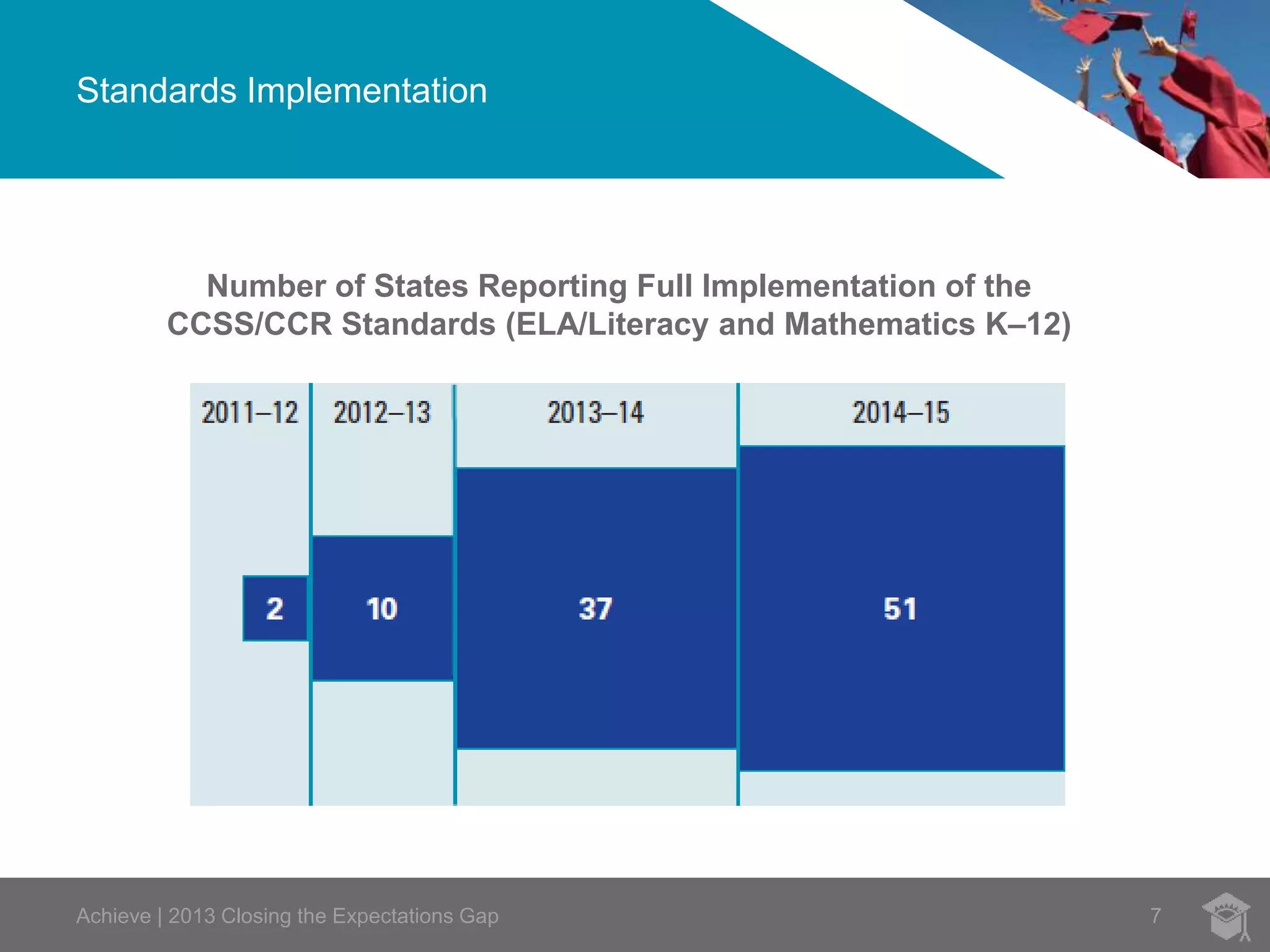
Standards Implementation 
Number of States Reporting Full Implementation of the 
CCSS/CCR Standards (ELA/Literacy and Mathematics K–12) 
Achieve | 2013 Closing the Expectations Gap 7
State Efforts to Support College- and Career- 
Ready Standards Implementation 
 41 states reported guiding/supporting district and school use by providing high-quality 
processes, protocols and exemplars 
 30 states reported they are developing curricular and supplemental materials for 
voluntary use by districts and schools to align the state’s required courses to the 
CCSS/CCR standards 
 17 states responded that they are approving/certifying a list of curricular and 
supplemental materials aligned to the new CCSS/CCR standards 
 5 states reported they are requiring district and school use of curricular 
materials aligned to the state’s required courses and the CCSS/CCR standards 
**Types of efforts listed above are not mutually exclusive 
Achieve | 2013 Closing the Expectations Gap 8
State Efforts to Support Professional 
Development in Light of the CCSS/CCR 
Standards 
 38 states have developed a coordinated agency-wide plan and calendar for 
professional development aligned to the CCSS/CCR standards 
 30 states have directed regional centers to provide training and support aligned 
to CCSS/CCR standards 
 16 states have or will identify high-quality or promising providers for 
districts/schools to access 
 8 states have or will audit existing professional development offerings for 
alignment to the CCSS/CCR standards 
Regardless of the role the state plays, it is critical that states make certain 
that the professional development teachers, principals and leaders receive is 
aligned to the CCSS/CCR standards, high quality and capable of affecting 
changes in instruction. 
**Types of efforts listed above are not mutually exclusive 
Achieve | 2013 Closing the Expectations Gap 9
#2 - College- and Career-Ready 
Graduation Requirements 
In the survey, Achieve asked states whether they require all 
students to complete a college- and career-ready course of 
study in order to earn a high school diploma. 
Achieve also asked states how they ensure that the courses 
students take are aligned with the state’s academic content 
standards and that the content of courses is consistent and 
equally rigorous across schools and districts. 
Achieve | 2013 Closing the Expectations Gap 10
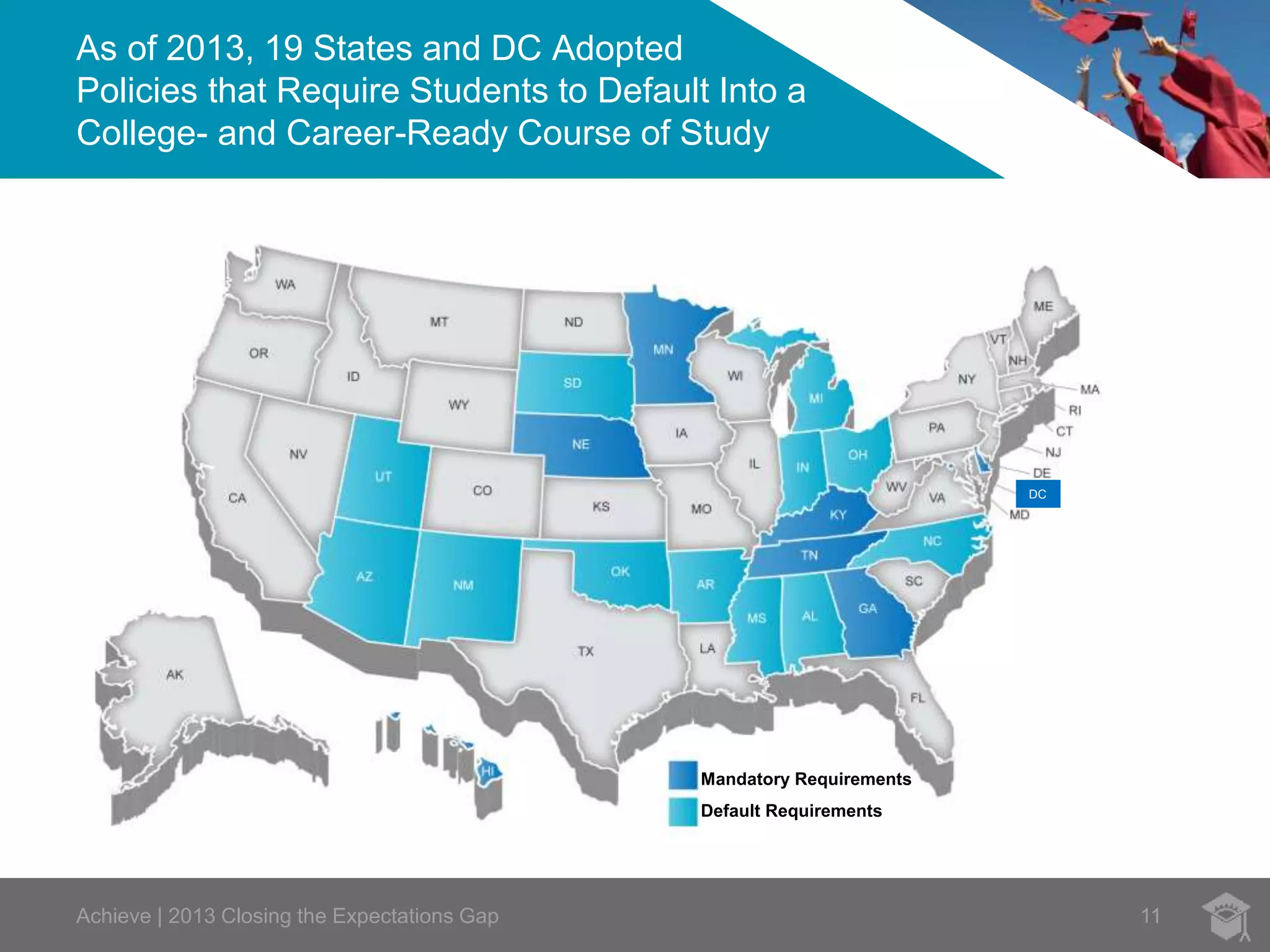
As of 2013, 19 States and DC Adopted 
Policies that Require Students to Default Into a 
College- and Career-Ready Course of Study 
Mandatory Requirements 
Default Requirements 
DC 
Achieve | 2013 Closing the Expectations Gap 11
Raising the Bar with 
College- and Career-Ready 
Graduation Requirements 
 31 states with CCSS/CCR standards have not aligned their graduation 
requirements to their standards to ensure that all students meet the college- and 
career-ready expectations found in their standards. 
 This year’s survey data indicate that most states without CCR course 
requirements are not considering proposals to raise their minimum high school 
graduation course requirements to the CCR level. 
 States send mixed signals about their commitment to CCR when the courses — or 
competency-based demonstrations — encompass only a subset of the academic 
knowledge and skills in literacy and mathematics needed to qualify for and 
succeed in entry-level, credit-bearing postsecondary coursework and/or job 
training. 
Achieve | 2013 Closing the Expectations Gap 12
Ensuring Rigor and Consistency of Course 
Requirements 
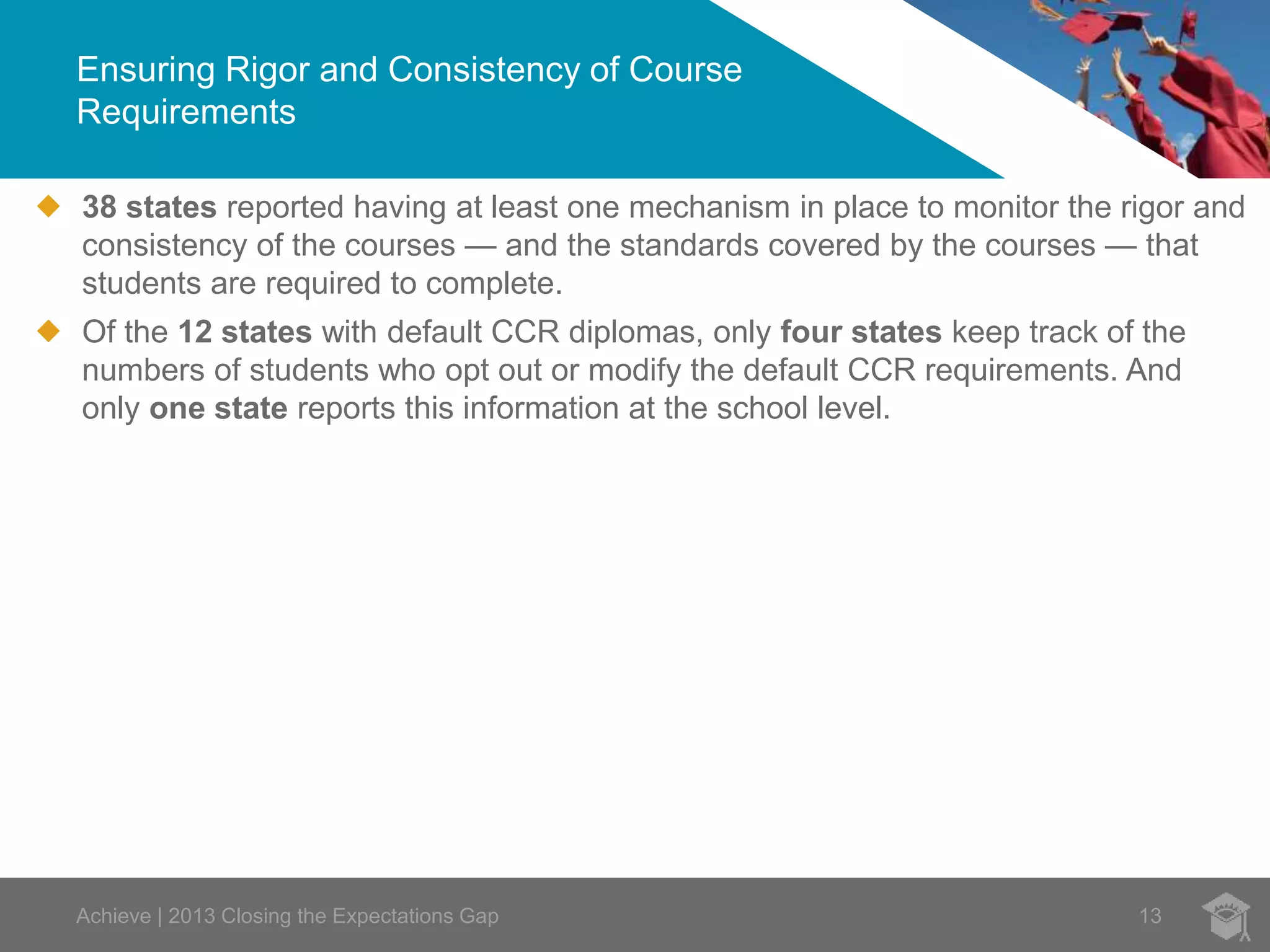
 38 states reported having at least one mechanism in place to monitor the rigor and 
consistency of the courses — and the standards covered by the courses — that 
students are required to complete. 
 Of the 12 states with default CCR diplomas, only four states keep track of the 
numbers of students who opt out or modify the default CCR requirements. And 
only one state reports this information at the school level. 
13 
Achieve | 2013 Closing the Expectations Gap
#3 - High School Assessments Anchored 
to College- and Career-Ready Expectations 
In the survey, Achieve asked states whether they administer to 
all students an assessment of college- and career-ready 
knowledge and skills capable of producing a readiness score 
used by postsecondary institutions and employers. 
14 
Achieve | 2013 Closing the Expectations Gap
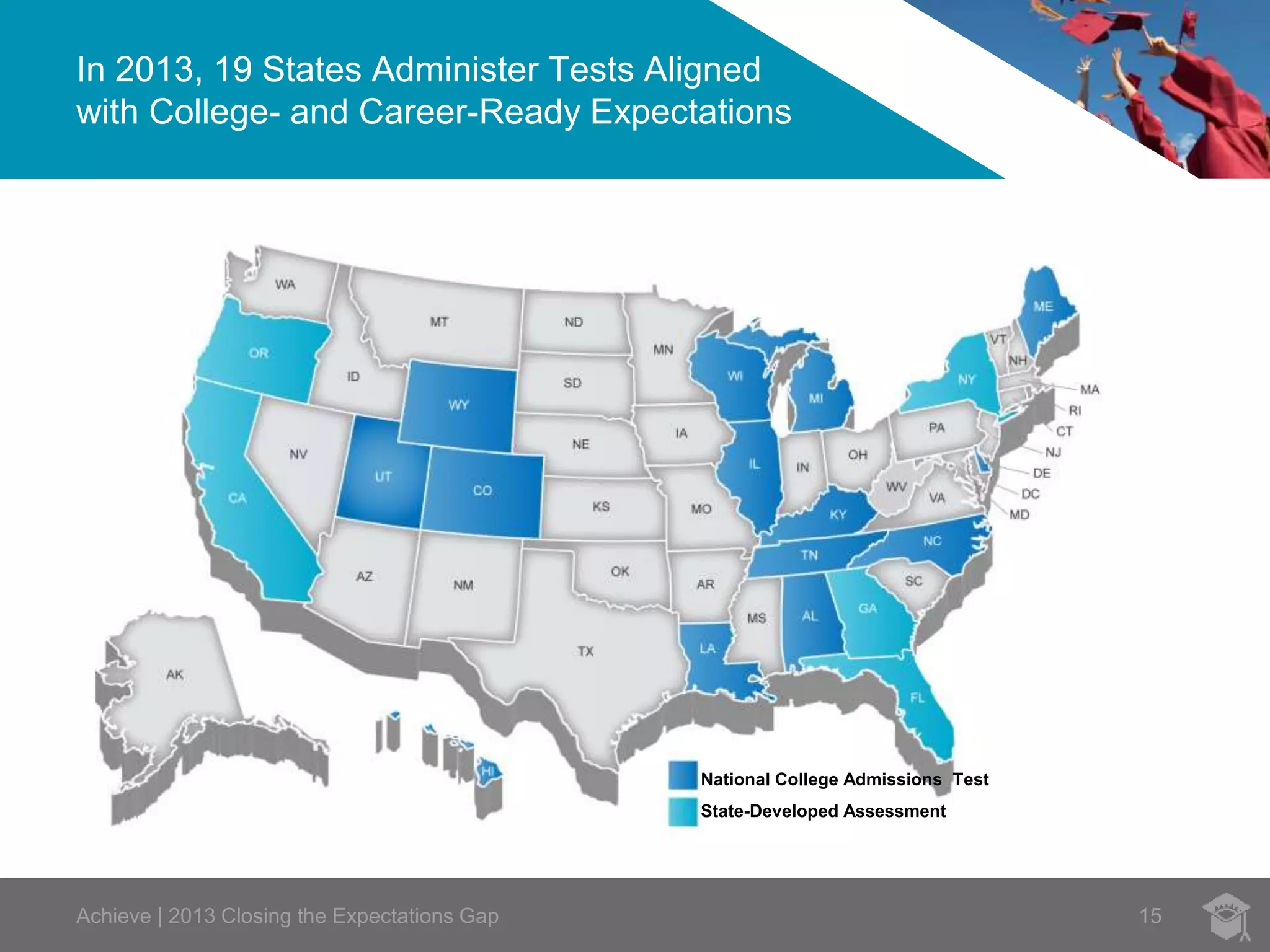
In 2013, 19 States Administer Tests Aligned 
with College- and Career-Ready Expectations 
National College Admissions Test 
State-Developed Assessment 
Achieve | 2013 Closing the Expectations Gap 15
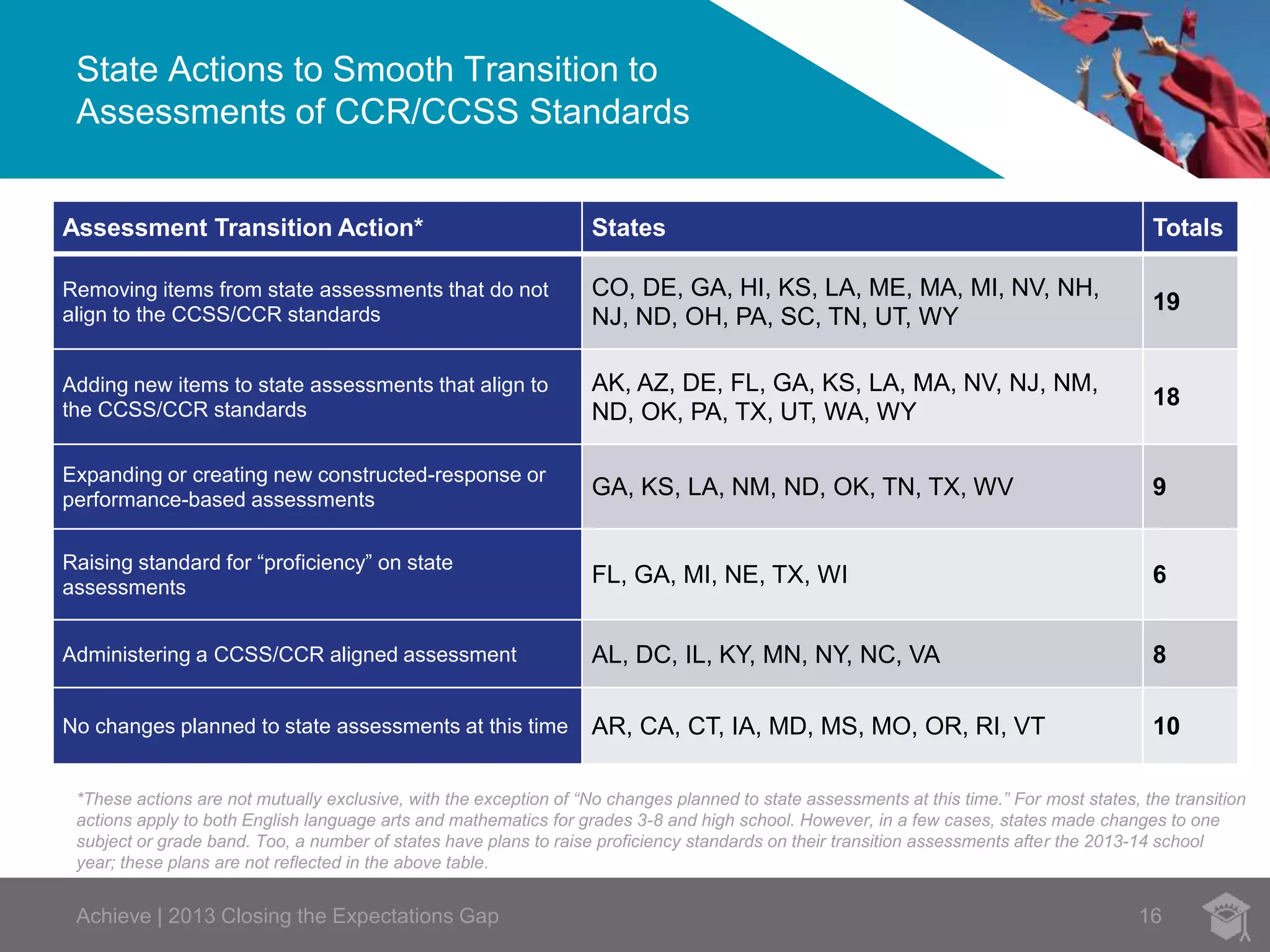
State Actions to Smooth Transition to 
Assessments of CCR/CCSS Standards 
Assessment Transition Action* States Totals 
Removing items from state assessments that do not 
align to the CCSS/CCR standards 
CO, DE, GA, HI, KS, LA, ME, MA, MI, NV, NH, 
NJ, ND, OH, PA, SC, TN, UT, WY 
19 
Adding new items to state assessments that align to 
the CCSS/CCR standards 
AK, AZ, DE, FL, GA, KS, LA, MA, NV, NJ, NM, 
ND, OK, PA, TX, UT, WA, WY 
18 
Expanding or creating new constructed-response or 
performance-based assessments 
GA, KS, LA, NM, ND, OK, TN, TX, WV 9 
Raising standard for “proficiency” on state 
assessments 
FL, GA, MI, NE, TX, WI 6 
Administering a CCSS/CCR aligned assessment AL, DC, IL, KY, MN, NY, NC, VA 8 
No changes planned to state assessments at this time AR, CA, CT, IA, MD, MS, MO, OR, RI, VT 10 
*These actions are not mutually exclusive, with the exception of “No changes planned to state assessments at this time.” For most states, the transition 
actions apply to both English language arts and mathematics for grades 3-8 and high school. However, in a few cases, states made changes to one 
subject or grade band. Too, a number of states have plans to raise proficiency standards on their transition assessments after the 2013-14 school 
year; these plans are not reflected in the above table. 
Achieve | 2013 Closing the Expectations Gap 16
#4 - Reporting & Accountability Systems that 
Promote College and Career Readiness 
In the survey, Achieve asked states whether they have 
incorporated a set of college- and career-ready indicators into 
their data, reporting and accountability systems. 
Achieve | 2013 Closing the Expectations Gap 17
Key College- and Career-Ready 
Accountability Indicators and Uses 
INDICATORS 
the percentage of students who... 
Earn a college- and 
career-ready diploma 
Score college-ready on 
high school assessments 
Earn college credit 
while in high school 
Are required to take remedial 
courses in college 
USES 
Annual school-level 
public reporting 
Set statewide 
performance goals 
Provide school-level 
incentives to improve 
Factor into accountability 
formula 
Achieve | 2013 Closing the Expectations Gap 18
In 2013, No State Met 
Accountability Criteria – But Four States 
Receive Partial Credit 
Achieve | 2013 Closing the Expectations Gap 19
Use of College- and Career-Ready Indicators 
over Time 
Achieve | 2013 Closing the Expectations Gap 20
Closing the Expectations Gap 2013 Annual Report

Closing the Expectations Gap 2013 Annual Report

  • 2.
    Background  Thisis the eighth year that Achieve has surveyed all 50 states and reported on state progress in adopting college- and career-ready standards, graduation requirements, assessments, and accountability and data systems.  This year’s report includes information on policy adoption and implementation as well as recommendations for states as they look toward transition to assessments aligned to college- and career-ready standards.  The report includes state-by-state results on the policies and practices of forty-nine states and the District of Columbia that participated in this year’s survey. Achieve | 2013 Closing the Expectations Gap 2
  • 3.
    The College- andCareer-Ready Agenda #1 - Align high school standards with the demands of college and careers. #2 - Require students to take a college- and career-ready course of study to earn a high school diploma. #3 - Develop statewide high school assessment systems anchored to college- and career-ready expectations. #4 - Develop reporting and accountability systems that promote college and career readiness. Achieve | 2013 Closing the Expectations Gap 3
  • 4.
    State Progress onAdopting Policies to Ensure that High School Students Graduate College and Career Ready Achieve | 2013 Closing the Expectations Gap 4
  • 5.
    College- and Career-ReadyPolicy Adoption by State CCR Standards, Assessments, and Graduation Requirements 5 CCR Standards and Assessments CCR Standards and Graduation Requirements CCR Standards Achieve | 2013 Closing the Expectations Gap
  • 6.
    #1 - College-and Career-Ready Standards In the survey, Achieve asked states whether they have developed and adopted high school academic content standards in English and mathematics aligned to college- and career-ready expectations. Achieve also asked about state efforts to support implementation, including access to high-quality instructional materials and professional learning opportunities aligned to the CCSS/CCR standards. Achieve | 2013 Closing the Expectations Gap 6
  • 7.
    Standards Implementation Numberof States Reporting Full Implementation of the CCSS/CCR Standards (ELA/Literacy and Mathematics K–12) Achieve | 2013 Closing the Expectations Gap 7
  • 8.
    State Efforts toSupport College- and Career- Ready Standards Implementation  41 states reported guiding/supporting district and school use by providing high-quality processes, protocols and exemplars  30 states reported they are developing curricular and supplemental materials for voluntary use by districts and schools to align the state’s required courses to the CCSS/CCR standards  17 states responded that they are approving/certifying a list of curricular and supplemental materials aligned to the new CCSS/CCR standards  5 states reported they are requiring district and school use of curricular materials aligned to the state’s required courses and the CCSS/CCR standards **Types of efforts listed above are not mutually exclusive Achieve | 2013 Closing the Expectations Gap 8
  • 9.
    State Efforts toSupport Professional Development in Light of the CCSS/CCR Standards  38 states have developed a coordinated agency-wide plan and calendar for professional development aligned to the CCSS/CCR standards  30 states have directed regional centers to provide training and support aligned to CCSS/CCR standards  16 states have or will identify high-quality or promising providers for districts/schools to access  8 states have or will audit existing professional development offerings for alignment to the CCSS/CCR standards Regardless of the role the state plays, it is critical that states make certain that the professional development teachers, principals and leaders receive is aligned to the CCSS/CCR standards, high quality and capable of affecting changes in instruction. **Types of efforts listed above are not mutually exclusive Achieve | 2013 Closing the Expectations Gap 9
  • 10.
    #2 - College-and Career-Ready Graduation Requirements In the survey, Achieve asked states whether they require all students to complete a college- and career-ready course of study in order to earn a high school diploma. Achieve also asked states how they ensure that the courses students take are aligned with the state’s academic content standards and that the content of courses is consistent and equally rigorous across schools and districts. Achieve | 2013 Closing the Expectations Gap 10
  • 11.
    As of 2013,19 States and DC Adopted Policies that Require Students to Default Into a College- and Career-Ready Course of Study Mandatory Requirements Default Requirements DC Achieve | 2013 Closing the Expectations Gap 11
  • 12.
    Raising the Barwith College- and Career-Ready Graduation Requirements  31 states with CCSS/CCR standards have not aligned their graduation requirements to their standards to ensure that all students meet the college- and career-ready expectations found in their standards.  This year’s survey data indicate that most states without CCR course requirements are not considering proposals to raise their minimum high school graduation course requirements to the CCR level.  States send mixed signals about their commitment to CCR when the courses — or competency-based demonstrations — encompass only a subset of the academic knowledge and skills in literacy and mathematics needed to qualify for and succeed in entry-level, credit-bearing postsecondary coursework and/or job training. Achieve | 2013 Closing the Expectations Gap 12
  • 13.
    Ensuring Rigor andConsistency of Course Requirements  38 states reported having at least one mechanism in place to monitor the rigor and consistency of the courses — and the standards covered by the courses — that students are required to complete.  Of the 12 states with default CCR diplomas, only four states keep track of the numbers of students who opt out or modify the default CCR requirements. And only one state reports this information at the school level. 13 Achieve | 2013 Closing the Expectations Gap
  • 14.
    #3 - HighSchool Assessments Anchored to College- and Career-Ready Expectations In the survey, Achieve asked states whether they administer to all students an assessment of college- and career-ready knowledge and skills capable of producing a readiness score used by postsecondary institutions and employers. 14 Achieve | 2013 Closing the Expectations Gap
  • 15.
    In 2013, 19States Administer Tests Aligned with College- and Career-Ready Expectations National College Admissions Test State-Developed Assessment Achieve | 2013 Closing the Expectations Gap 15
  • 16.
    State Actions toSmooth Transition to Assessments of CCR/CCSS Standards Assessment Transition Action* States Totals Removing items from state assessments that do not align to the CCSS/CCR standards CO, DE, GA, HI, KS, LA, ME, MA, MI, NV, NH, NJ, ND, OH, PA, SC, TN, UT, WY 19 Adding new items to state assessments that align to the CCSS/CCR standards AK, AZ, DE, FL, GA, KS, LA, MA, NV, NJ, NM, ND, OK, PA, TX, UT, WA, WY 18 Expanding or creating new constructed-response or performance-based assessments GA, KS, LA, NM, ND, OK, TN, TX, WV 9 Raising standard for “proficiency” on state assessments FL, GA, MI, NE, TX, WI 6 Administering a CCSS/CCR aligned assessment AL, DC, IL, KY, MN, NY, NC, VA 8 No changes planned to state assessments at this time AR, CA, CT, IA, MD, MS, MO, OR, RI, VT 10 *These actions are not mutually exclusive, with the exception of “No changes planned to state assessments at this time.” For most states, the transition actions apply to both English language arts and mathematics for grades 3-8 and high school. However, in a few cases, states made changes to one subject or grade band. Too, a number of states have plans to raise proficiency standards on their transition assessments after the 2013-14 school year; these plans are not reflected in the above table. Achieve | 2013 Closing the Expectations Gap 16
  • 17.
    #4 - Reporting& Accountability Systems that Promote College and Career Readiness In the survey, Achieve asked states whether they have incorporated a set of college- and career-ready indicators into their data, reporting and accountability systems. Achieve | 2013 Closing the Expectations Gap 17
  • 18.
    Key College- andCareer-Ready Accountability Indicators and Uses INDICATORS the percentage of students who... Earn a college- and career-ready diploma Score college-ready on high school assessments Earn college credit while in high school Are required to take remedial courses in college USES Annual school-level public reporting Set statewide performance goals Provide school-level incentives to improve Factor into accountability formula Achieve | 2013 Closing the Expectations Gap 18
  • 19.
    In 2013, NoState Met Accountability Criteria – But Four States Receive Partial Credit Achieve | 2013 Closing the Expectations Gap 19
  • 20.
    Use of College-and Career-Ready Indicators over Time Achieve | 2013 Closing the Expectations Gap 20