Gross Anatomy & Histology of
Parathyroid Glands
Dr. Rabia Inam Gandapore
Assistant Professor
Head of Department Anatomy
(Dentistry-BKCD)
B.D.S (SBDC), M.Phil. Anatomy (KMU),
Dip. Implant (Sharjah, Bangkok, ACHERS) , CHPE
(KMU),CHR (KMU), Dip. Arts (Florence, Italy)
Teaching Methodology
 LGF (Long Group Format)
 SGF (Short Group Format)
 LGD (Long Group Discussion, Interactive discussion with the use of
models or diagrams)
 SGD (Short Group)
 SDL (Self-Directed Learning)
 DSL (Directed-Self Learning)
 PBL (Problem- Based Learning)
 Online Teaching Method
 Role Play
 Demonstrations
 Laboratory
 Museum
 Library (Computed Assisted Learning or E-Learning)
 Assignments
 Video tutorial method
Goal/Aim (main objective)
 To help/facilitate/augment the students about the:
1. Describe Gross features of Parathyroid gland.
2. Describe the Histological features of Parathyroid gland
3. Describe Blood & Nerve supply of Parathyroid gland.
Specific Learning Objectives (cognitive)
At the end of the lecture the student will able to:
 Recognize the gross anatomical & Histological features of the Parathyroid
Gland
 Sketch labeled diagram of the Histology of Parathyroid Gland
Psychomotor Objective: (Guided response)
 A student to draw labelled diagram of the Histology of Parathyroid Gland
Affective domain
 To be able to display a good code of conduct and moral values in the class.
 To cooperate with the teacher and in groups with the colleagues.
 To demonstrate a responsible behavior in the class and be punctual, regular, attentive and on
time in the class.
 To be able to perform well in the class under the guidance and supervision of the teacher.
 Study the topic before entering the class.
 Discuss among colleagues the topic under discussion in SGDs.
 Participate in group activities and museum classes and follow the rules.
 Volunteer to participate in psychomotor activities.
 Listen to the teacher's instructions carefully and follow the guidelines.
 Ask questions in the class by raising hand and avoid creating a disturbance.
 To be able to submit all assignments on time and get your sketch logbooks checked.
Lesson contents
Clinical chair side question: Students will be asked if they know what is the function of
Outline:
 Activity 1 The facilitator will explain the student's Gross anatomy of Parathyroid Gland
 Activity 2 The facilitator will ask the students to make a labeled diagram of the Histology of Parathyroid
Gland
 Activity 3 The facilitator will ask the students a few Multiple Choice Questions related to it with
flashcards.
Recommended Books
 Students assessment: MCQs, Flashcards, Diagrams labeling.
 Learning resources: Langman’s T.W. Sadler, Laiq Hussain Siddiqui, Snell Clinical Anatomy,
Netter’s Atlas, BD Chaurasia’s Human anatomy, Internet sources links.
Thyroid Gland
Thyroid Gland
 Named after the Thyroid cartilage
 (Greek: Shield shaped)
 Largest endocrine gland
 Location: Anterior neck region
 2 Lateral lobes connected by isthmus
 Secretes:
1. Tetra-iodo-thyronine (Thyroxine)
2. Tri-ido-thyronine
3. Calcitonin
Location of thyroid gland
Gross Anatomy of
Parathyroid Gland
 GROSS FEATURES OF PARATHYROID GLAND.
 HISTOLOGICAL FEATURES OF PARATHYROID GLAND
 BLOOD & NERVE SUPPLY OF PARATHYROID GLAND.
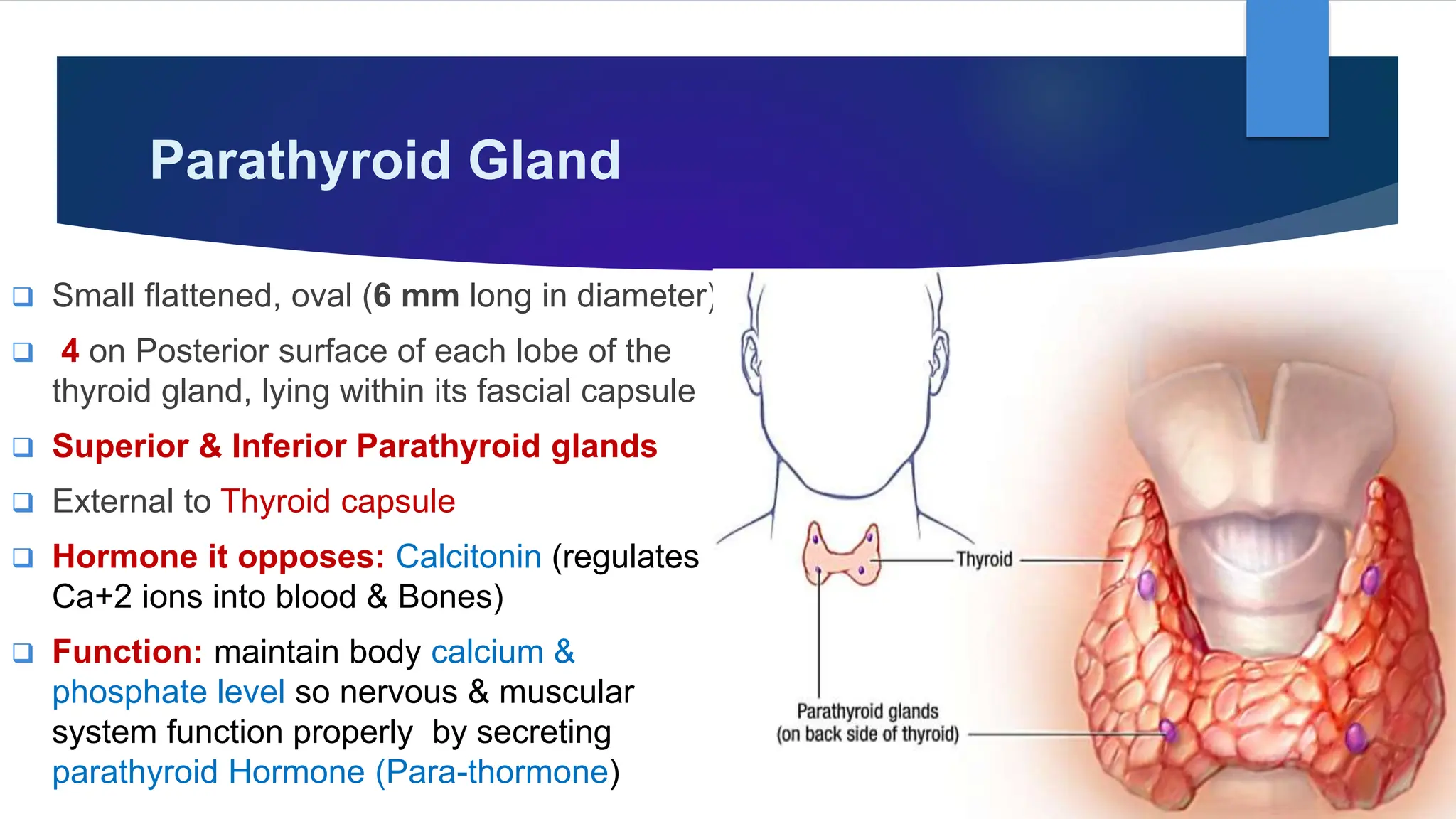
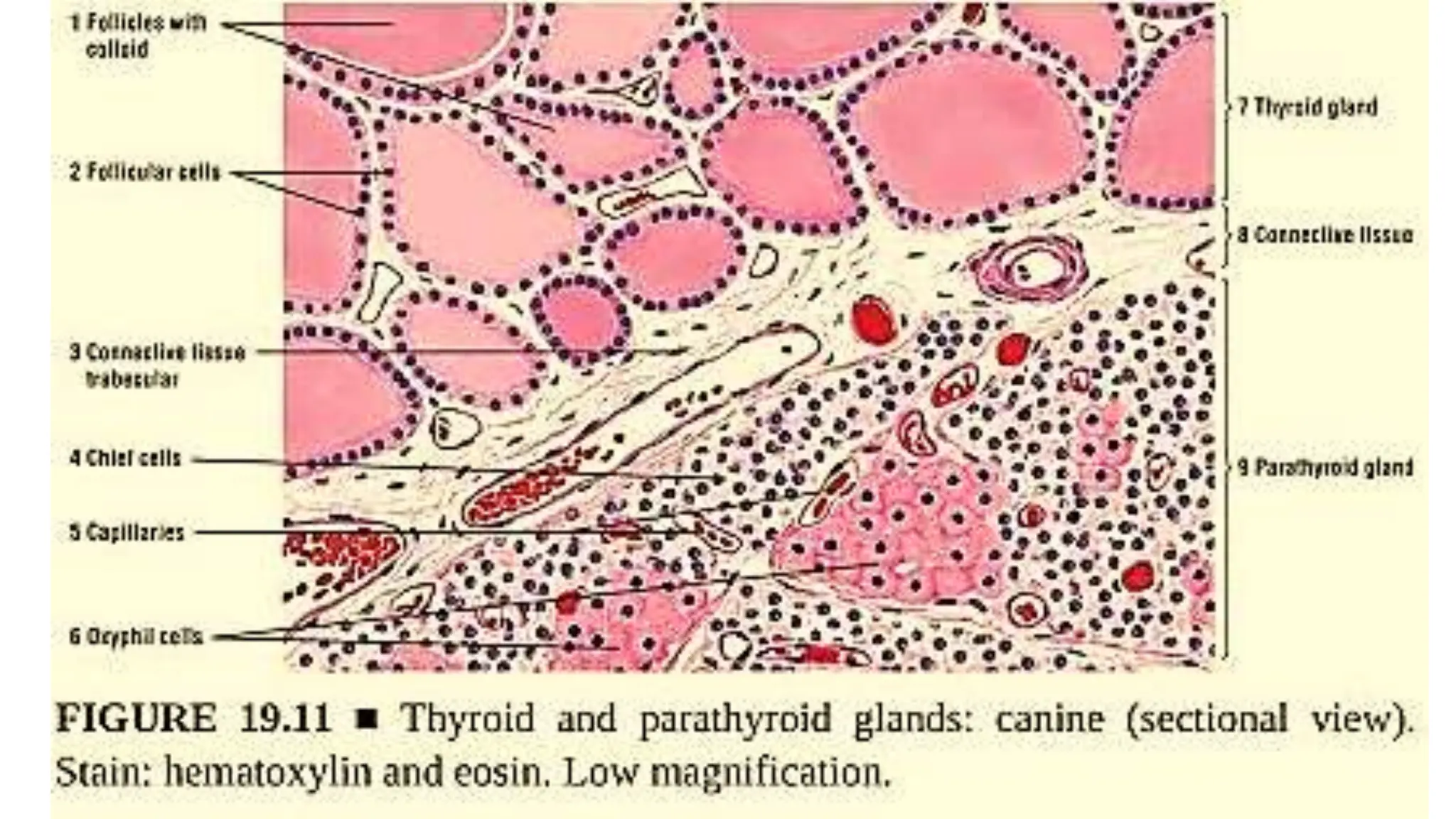
Parathyroid Gland
 Small flattened, oval (6 mm long in diameter)
 4 on Posterior surface of each lobe of the
thyroid gland, lying within its fascial capsule
 Superior & Inferior Parathyroid glands
 External to Thyroid capsule
 Hormone it opposes: Calcitonin (regulates
Ca+2 ions into blood & Bones)
 Function: maintain body calcium &
phosphate level so nervous & muscular
system function properly by secreting
parathyroid Hormone (Para-thormone)
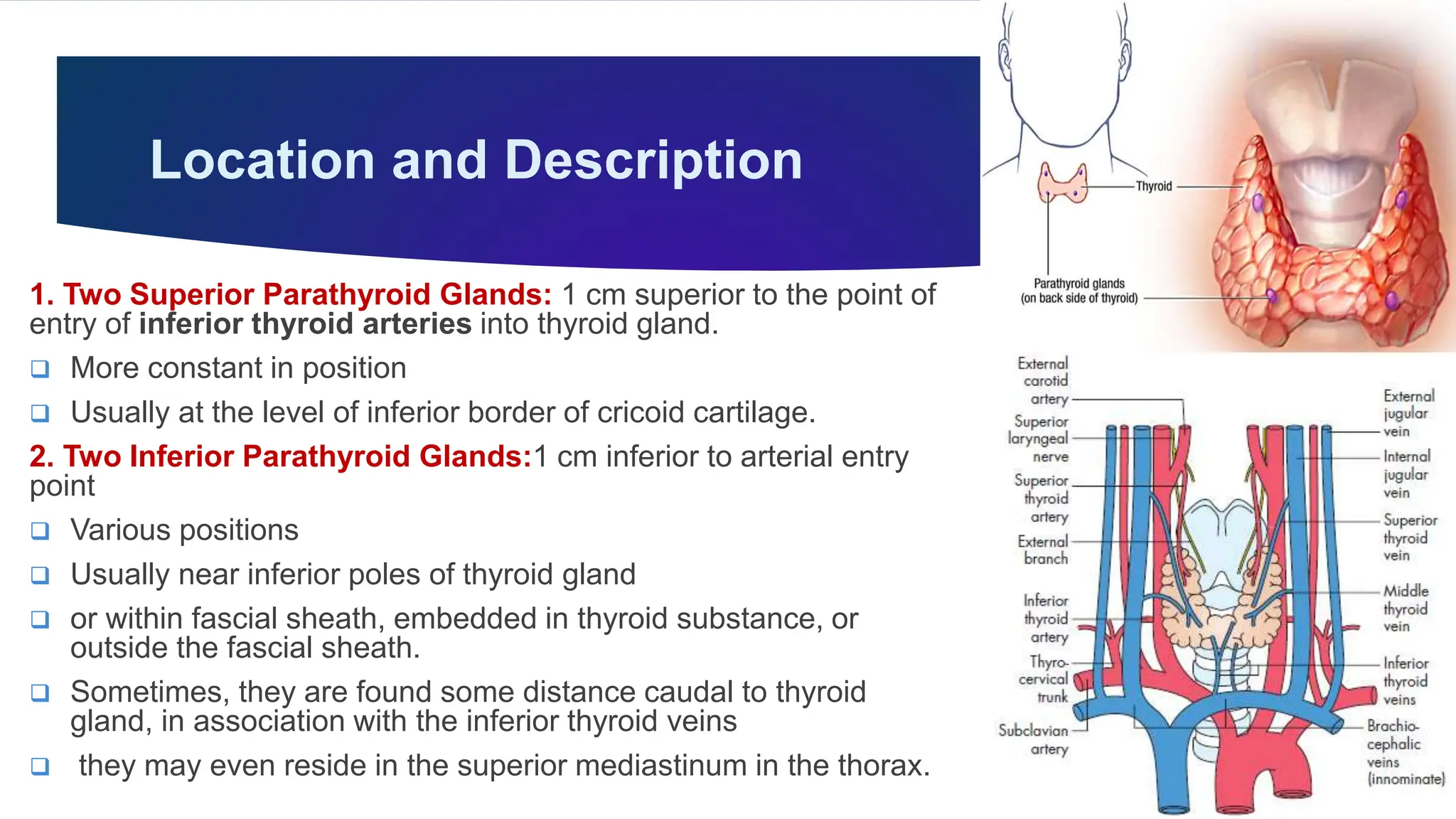
Location and Description
1. Two Superior Parathyroid Glands: 1 cm superior to the point of
entry of inferior thyroid arteries into thyroid gland.
 More constant in position
 Usually at the level of inferior border of cricoid cartilage.
2. Two Inferior Parathyroid Glands:1 cm inferior to arterial entry
point
 Various positions
 Usually near inferior poles of thyroid gland
 or within fascial sheath, embedded in thyroid substance, or
outside the fascial sheath.
 Sometimes, they are found some distance caudal to thyroid
gland, in association with the inferior thyroid veins
 they may even reside in the superior mediastinum in the thorax.
Blood & Nerve supply of
Parathyroid gland.
 GROSS FEATURES OF PARATHYROID GLAND.
 HISTOLOGICAL FEATURES OF PARATHYROID GLAND
 BLOOD & NERVE SUPPLY OF PARATHYROID GLAND.
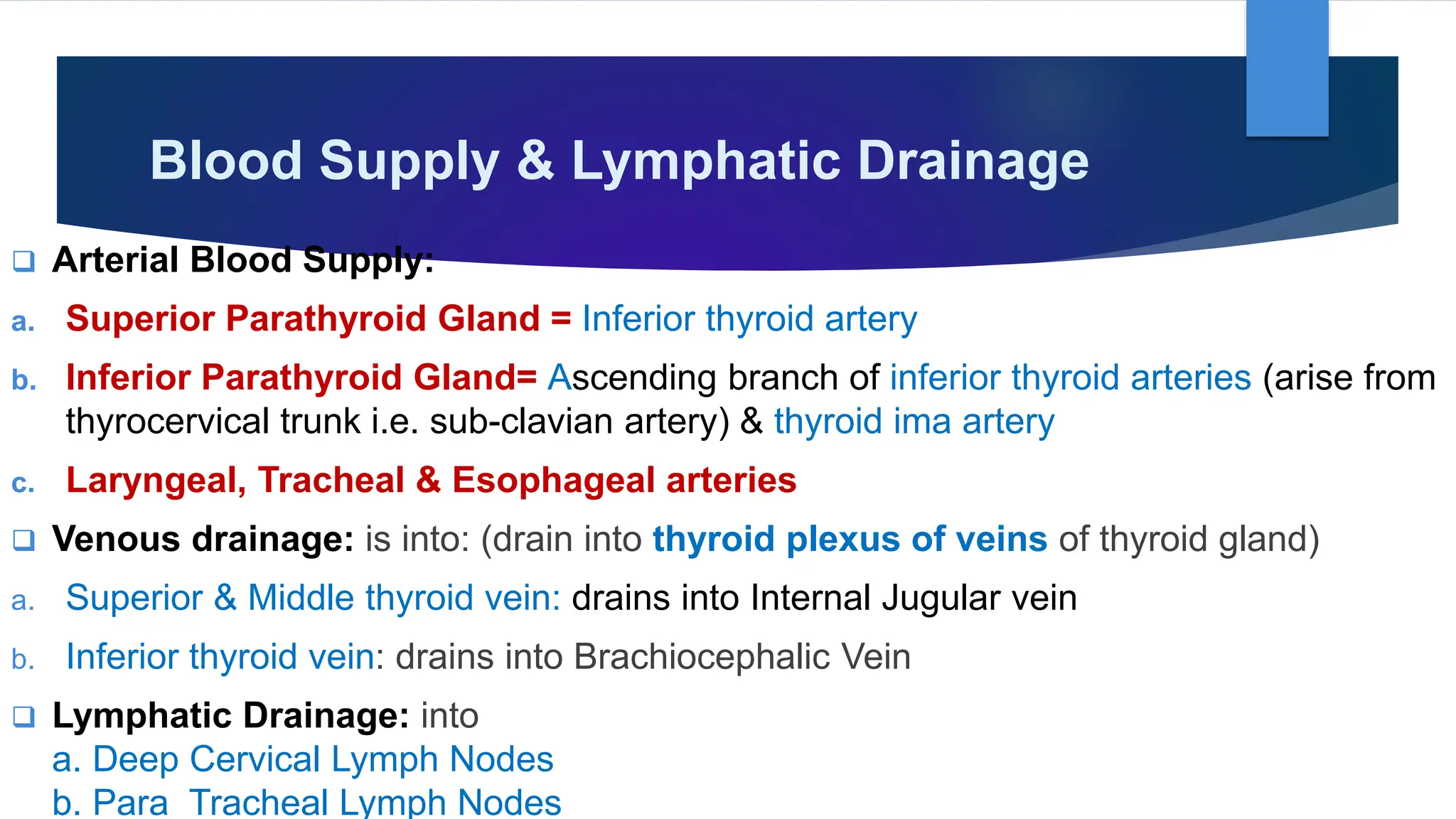
Blood Supply & Lymphatic Drainage
 Arterial Blood Supply:
a. Superior Parathyroid Gland = Inferior thyroid artery
b. Inferior Parathyroid Gland= Ascending branch of inferior thyroid arteries (arise from
thyrocervical trunk i.e. sub-clavian artery) & thyroid ima artery
c. Laryngeal, Tracheal & Esophageal arteries
 Venous drainage: is into: (drain into thyroid plexus of veins of thyroid gland)
a. Superior & Middle thyroid vein: drains into Internal Jugular vein
b. Inferior thyroid vein: drains into Brachiocephalic Vein
 Lymphatic Drainage: into
a. Deep Cervical Lymph Nodes
b. Para Tracheal Lymph Nodes
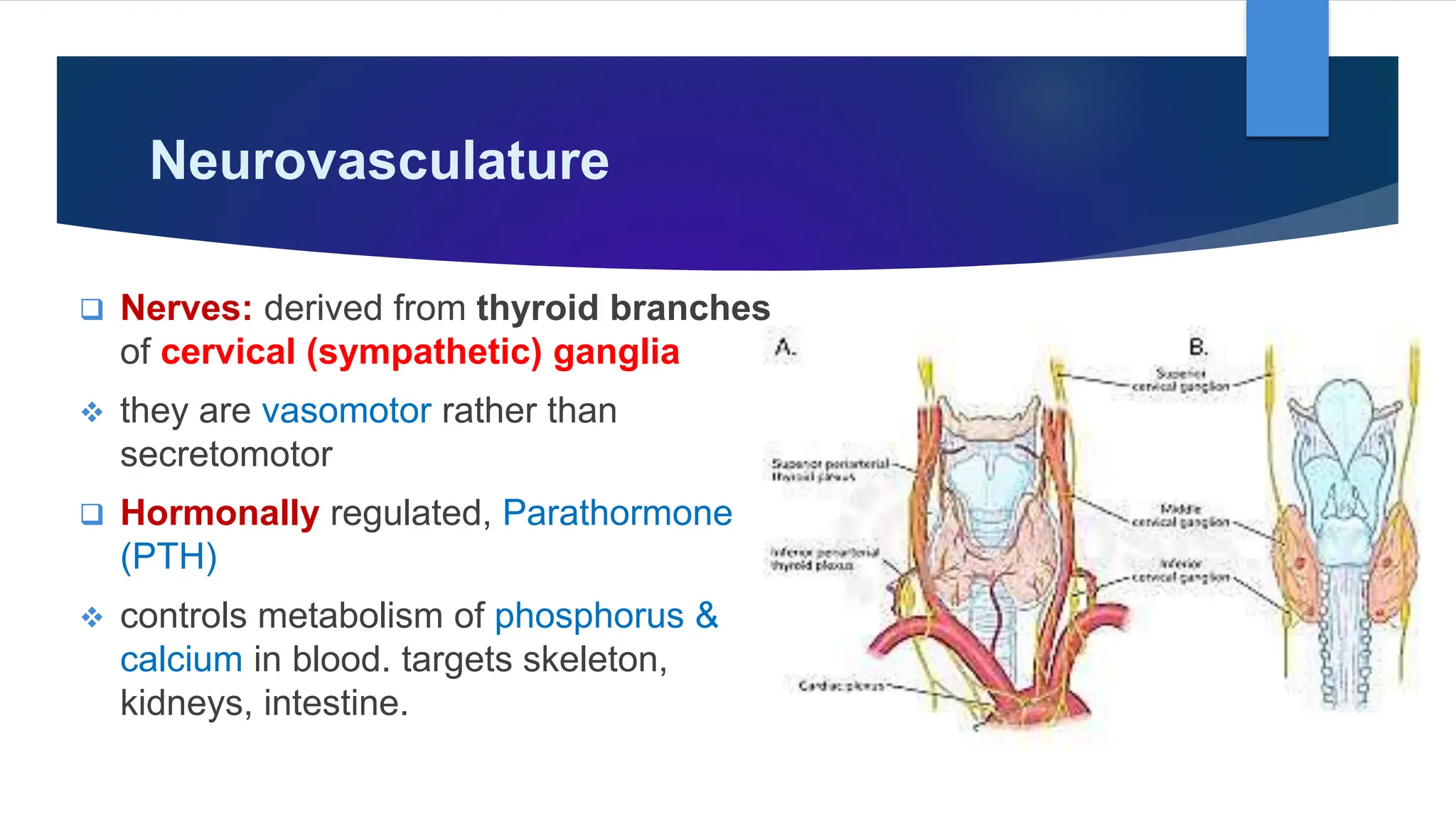
Neurovasculature
 Nerves: derived from thyroid branches
of cervical (sympathetic) ganglia
 they are vasomotor rather than
secretomotor
 Hormonally regulated, Parathormone
(PTH)
 controls metabolism of phosphorus &
calcium in blood. targets skeleton,
kidneys, intestine.
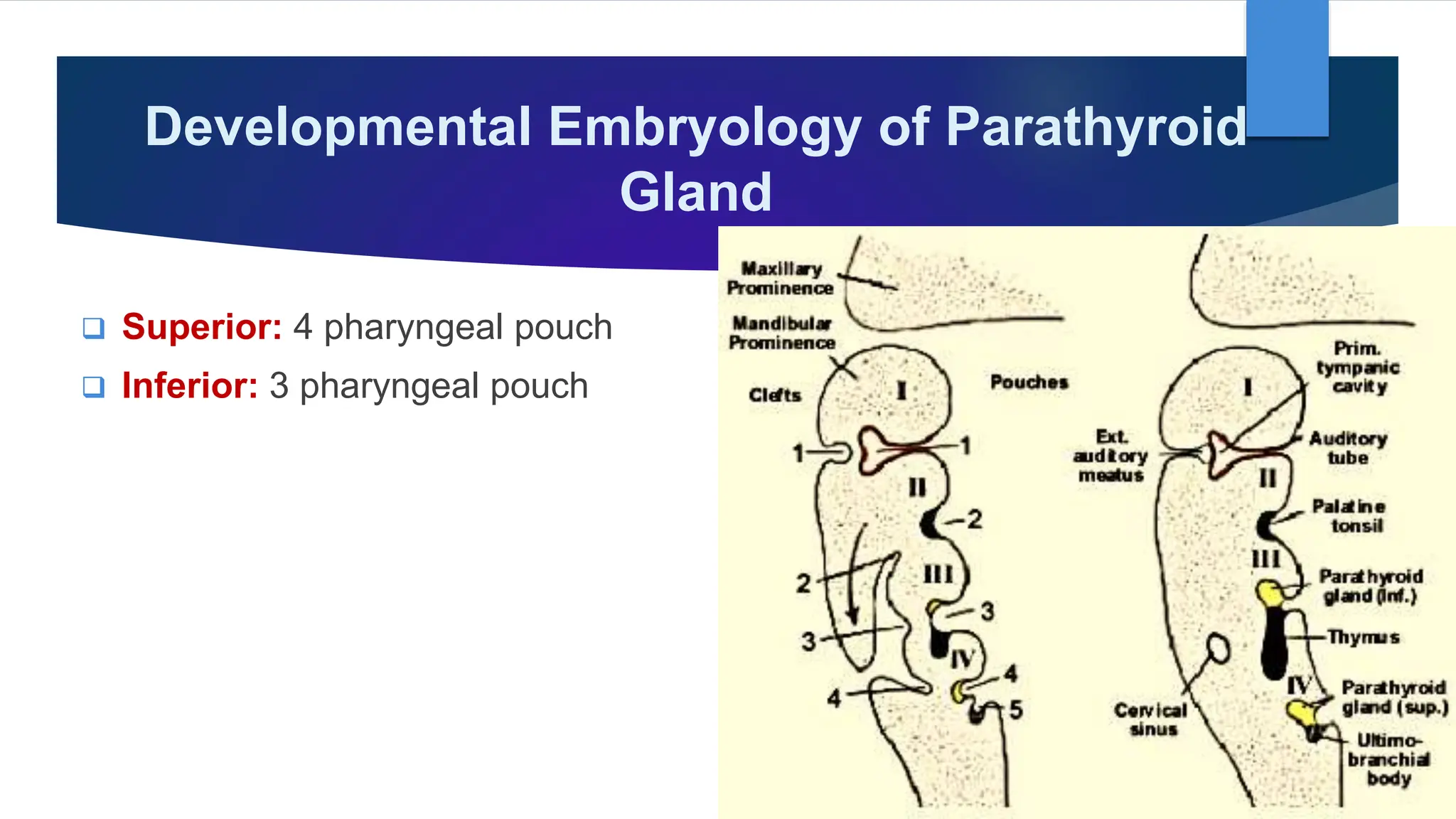
Developmental Embryology of Parathyroid
Gland
 Superior: 4 pharyngeal pouch
 Inferior: 3 pharyngeal pouch
Clinical Correlation
DiGeorge Syndrome
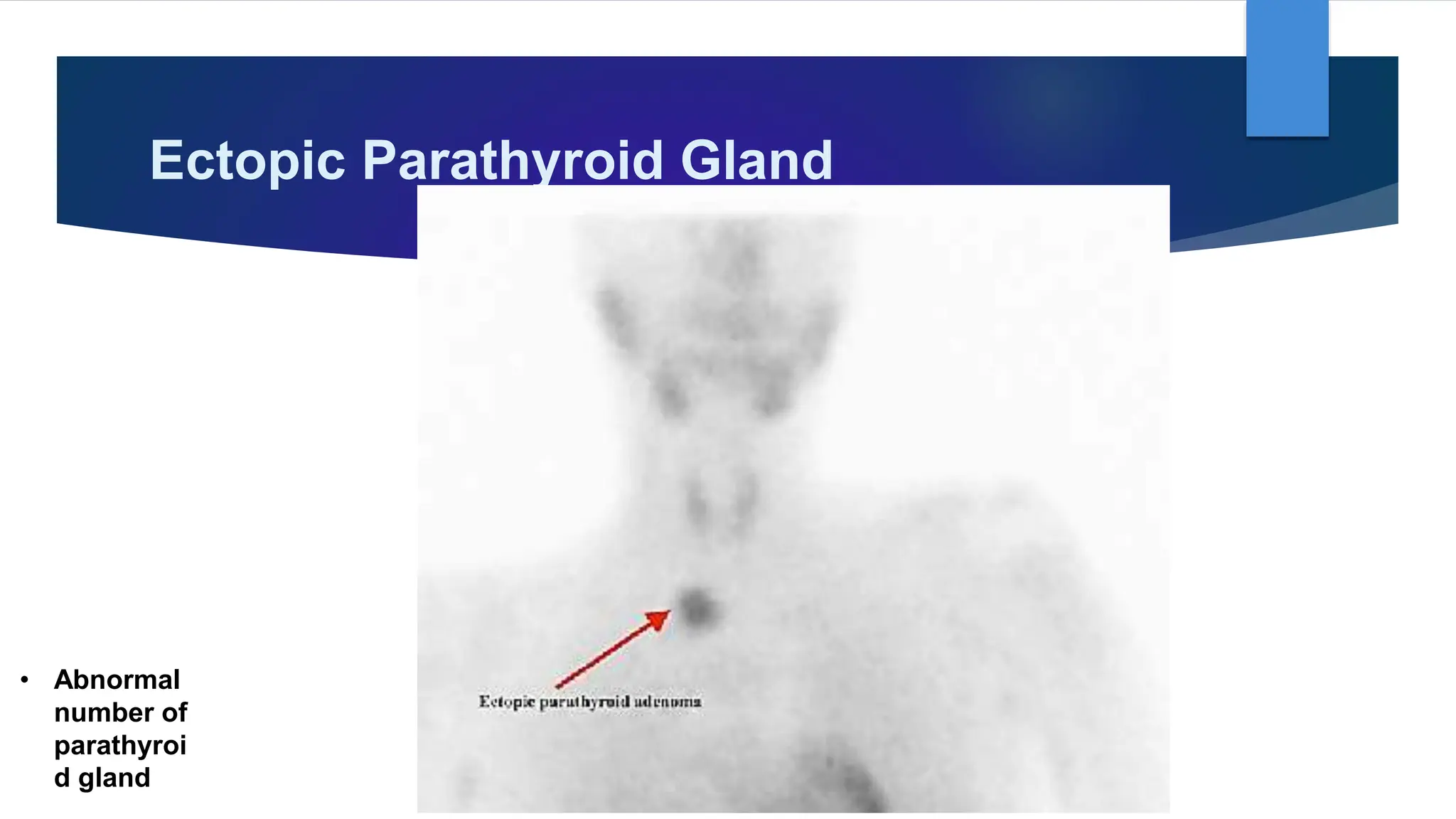
Ectopic Parathyroid Gland
• Abnormal
number of
parathyroi
d gland
Inadvertent Removal of Parathyroid Glands
Histological features of
Parathyroid gland
 GROSS FEATURES OF PARATHYROID GLAND.
 HISTOLOGICAL FEATURES OF PARATHYROID GLAND
 BLOOD & NERVE SUPPLY OF PARATHYROID GLAND.
Histology of the Endocrine System
Hormone delivery
 Pituitary (hypophysis)
– Anterior pituitary
– Posterior pituitary
 Adrenal gland (suprarenal)
– Adrenal cortex
– Adrenal medulla
 Thyroid gland
– Follicles
– Parafollicular cells
 Parathyroid gland
Considered in other lectures:
– Endocrine pancreas
– Male
– Female
– Enteroendocrine
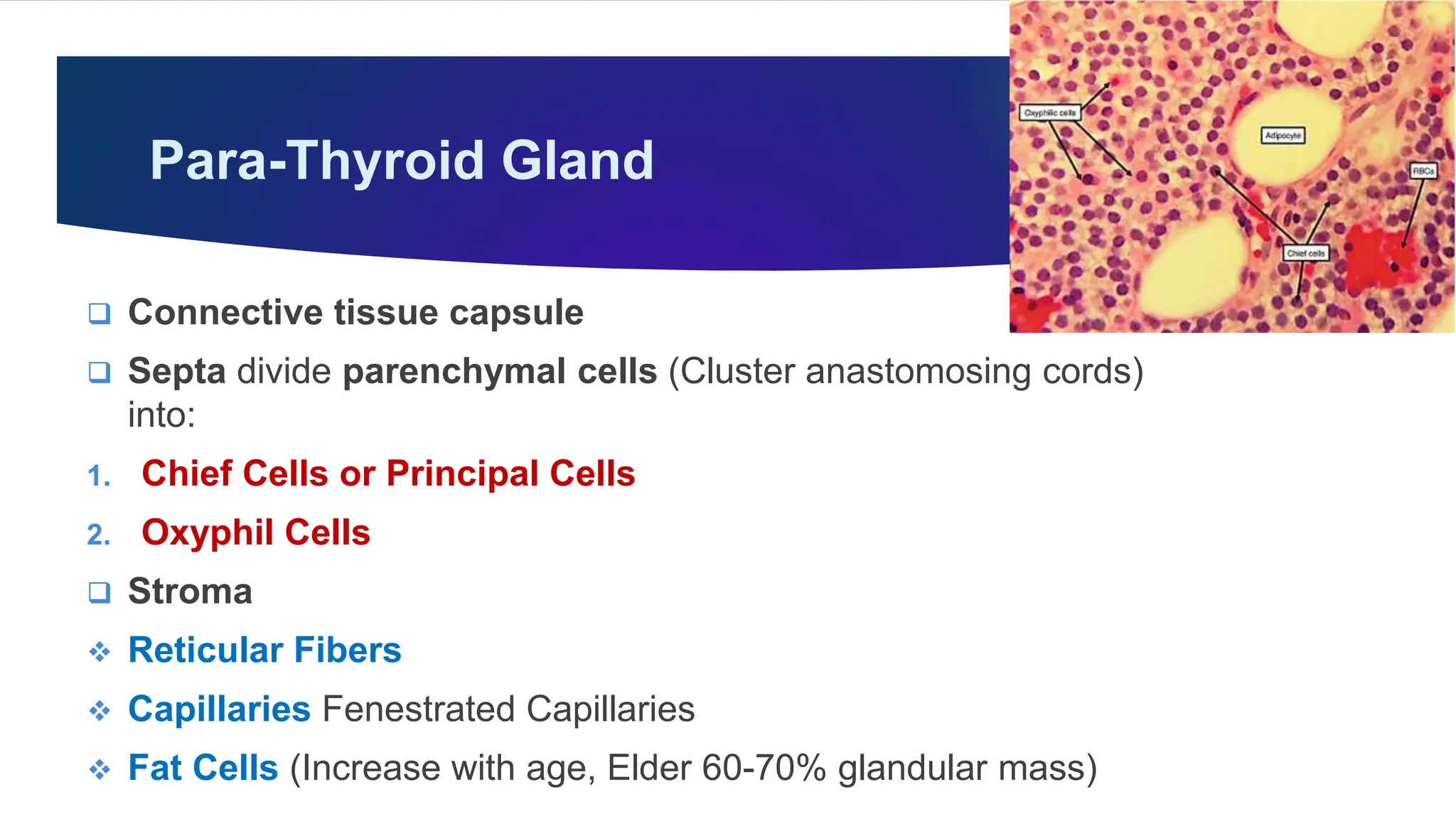
Para-Thyroid Gland
 Connective tissue capsule
 Septa divide parenchymal cells (Cluster anastomosing cords)
into:
1. Chief Cells or Principal Cells
2. Oxyphil Cells
 Stroma
 Reticular Fibers
 Capillaries Fenestrated Capillaries
 Fat Cells (Increase with age, Elder 60-70% glandular mass)
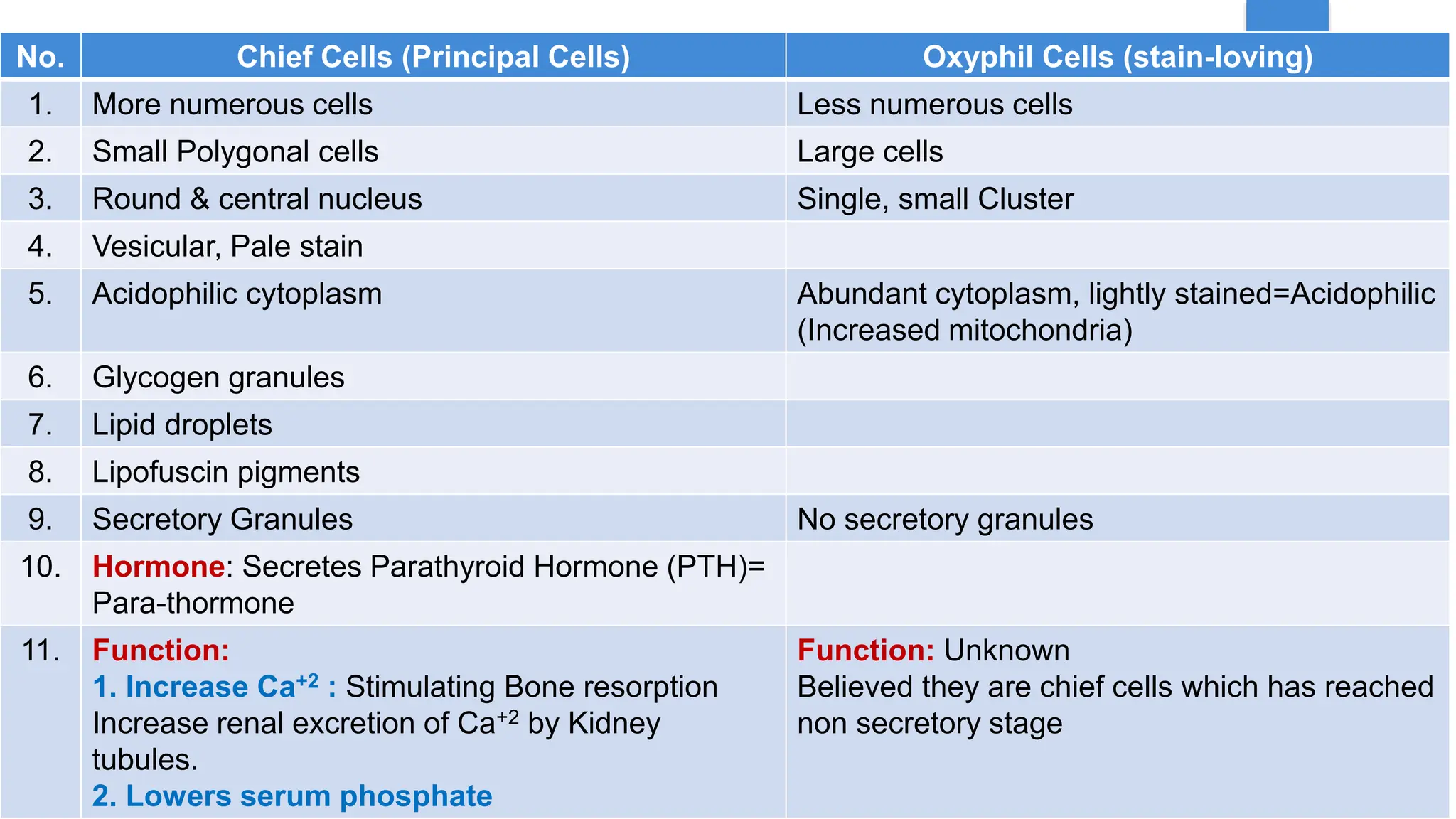
No. Chief Cells (Principal Cells) Oxyphil Cells (stain-loving)
1. More numerous cells Less numerous cells
2. Small Polygonal cells Large cells
3. Round & central nucleus Single, small Cluster
4. Vesicular, Pale stain
5. Acidophilic cytoplasm Abundant cytoplasm, lightly stained=Acidophilic
(Increased mitochondria)
6. Glycogen granules
7. Lipid droplets
8. Lipofuscin pigments
9. Secretory Granules No secretory granules
10. Hormone: Secretes Parathyroid Hormone (PTH)=
Para-thormone
11. Function:
1. Increase Ca+2 : Stimulating Bone resorption
Increase renal excretion of Ca+2 by Kidney
tubules.
2. Lowers serum phosphate
Function: Unknown
Believed they are chief cells which has reached
non secretory stage
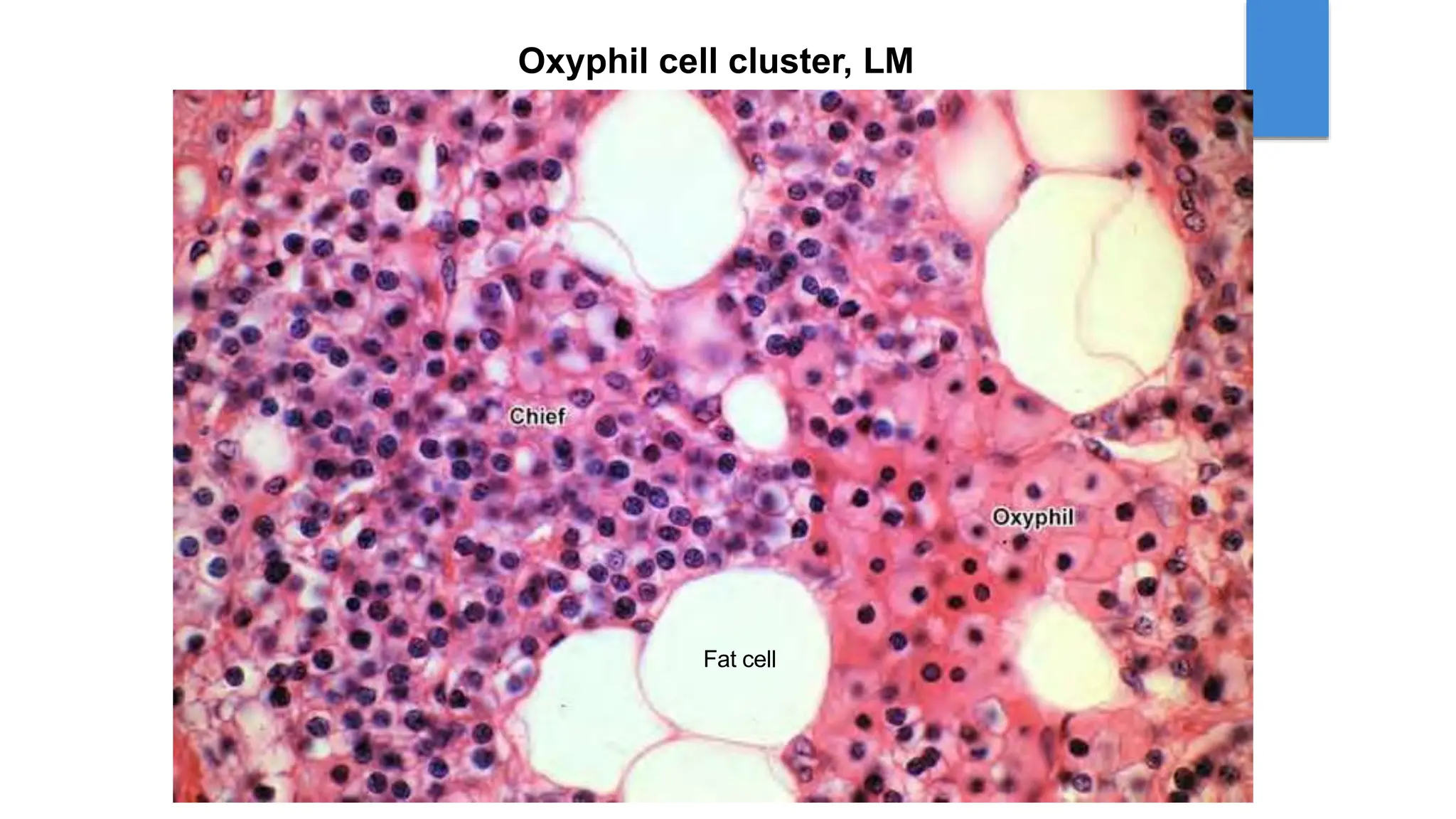
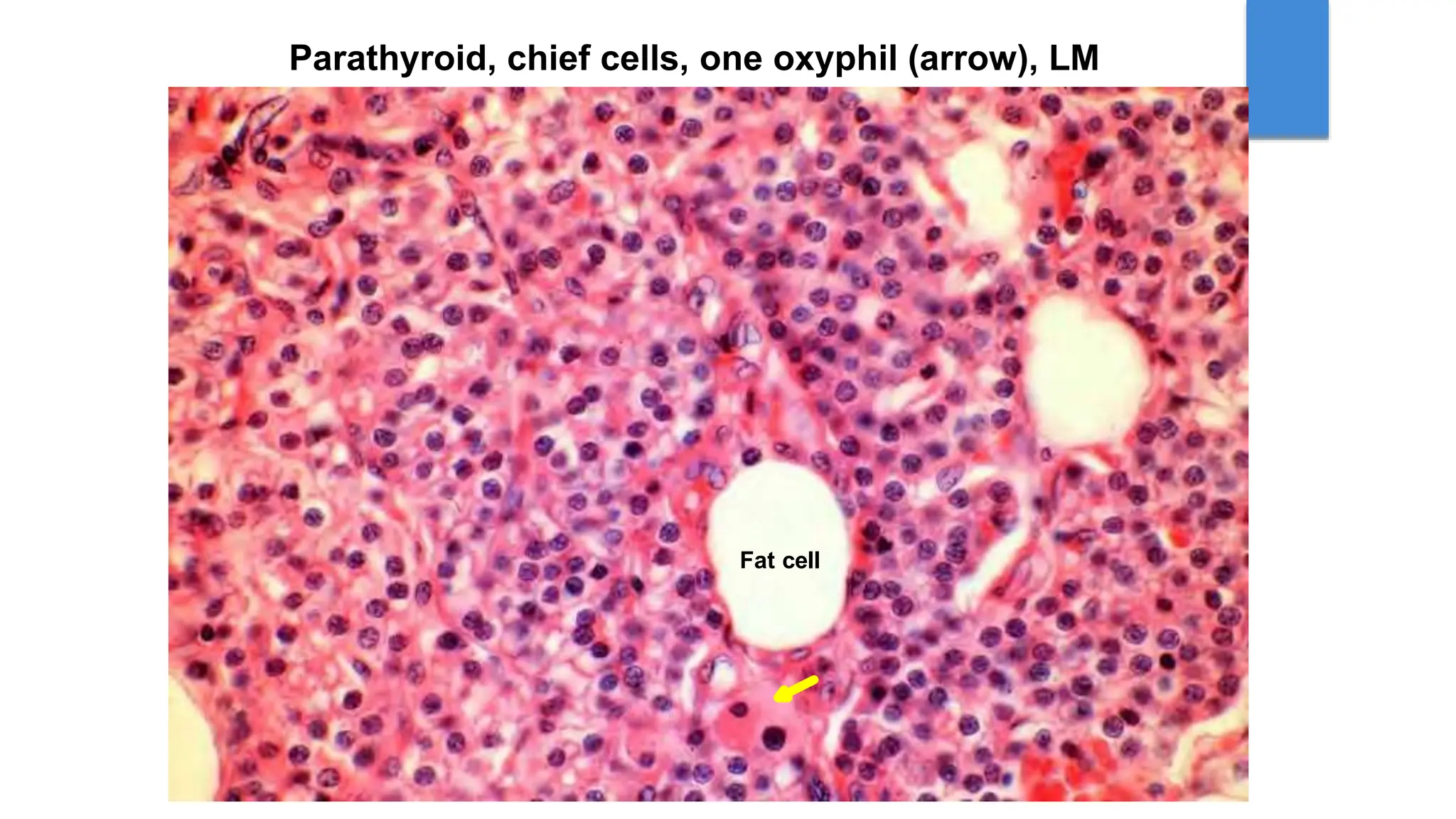
Fat cell
Oxyphil cell cluster, LM
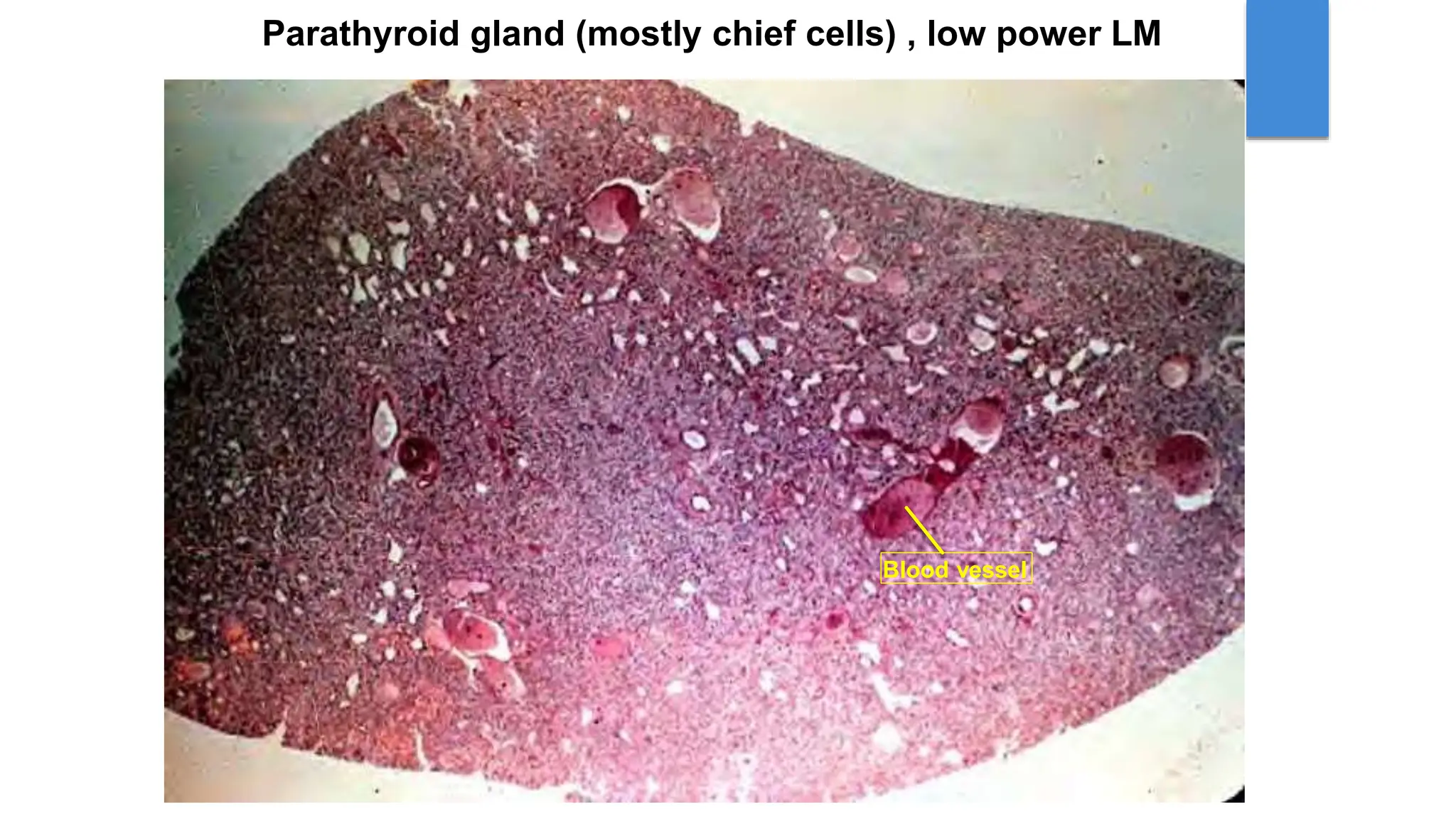
Parathyroid gland (mostly chief cells) , low power LM
Blood vessel
Parathyroid, chief cells, one oxyphil (arrow), LM
Fat cell
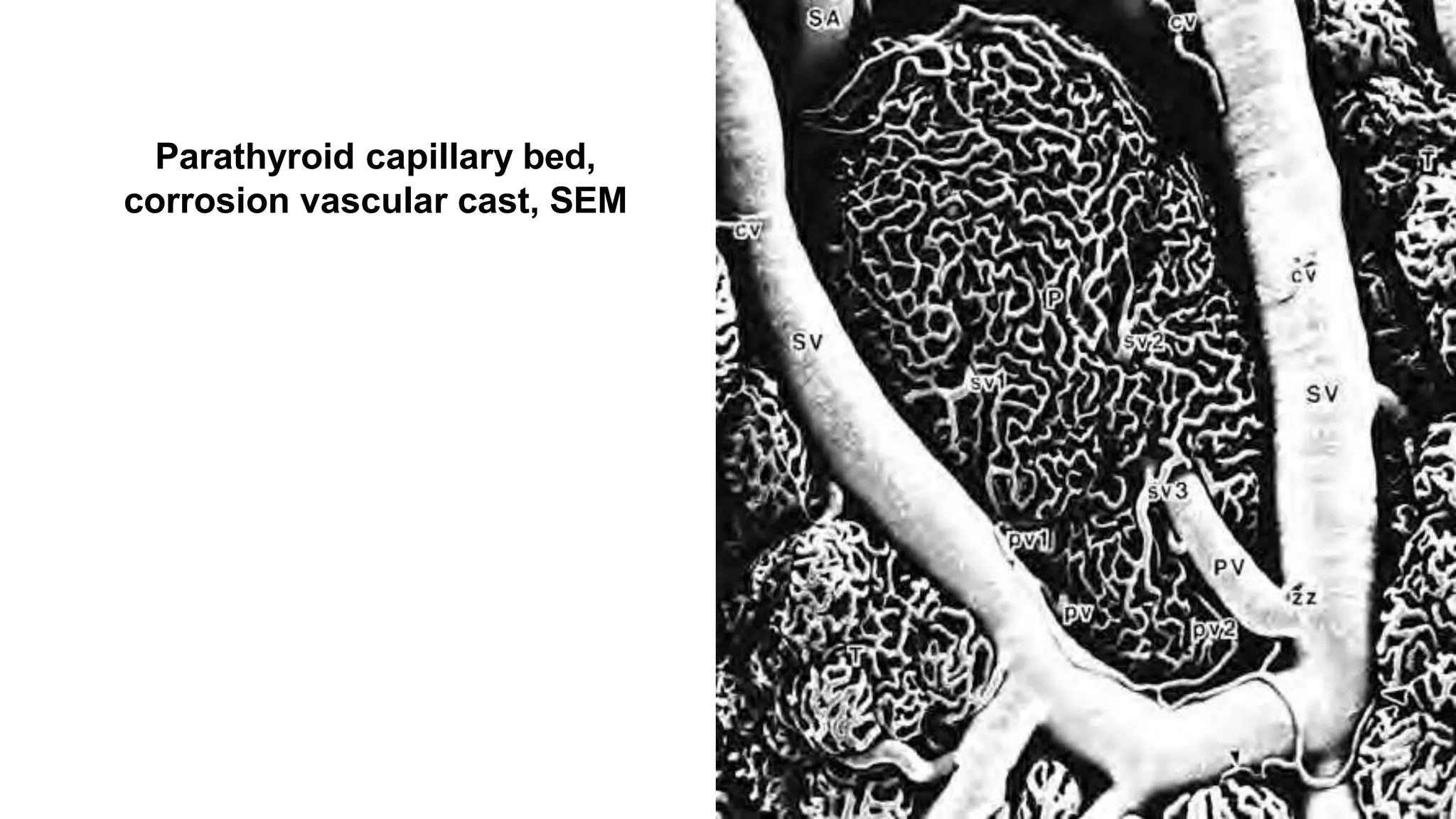
Parathyroid capillary bed,
corrosion vascular cast, SEM
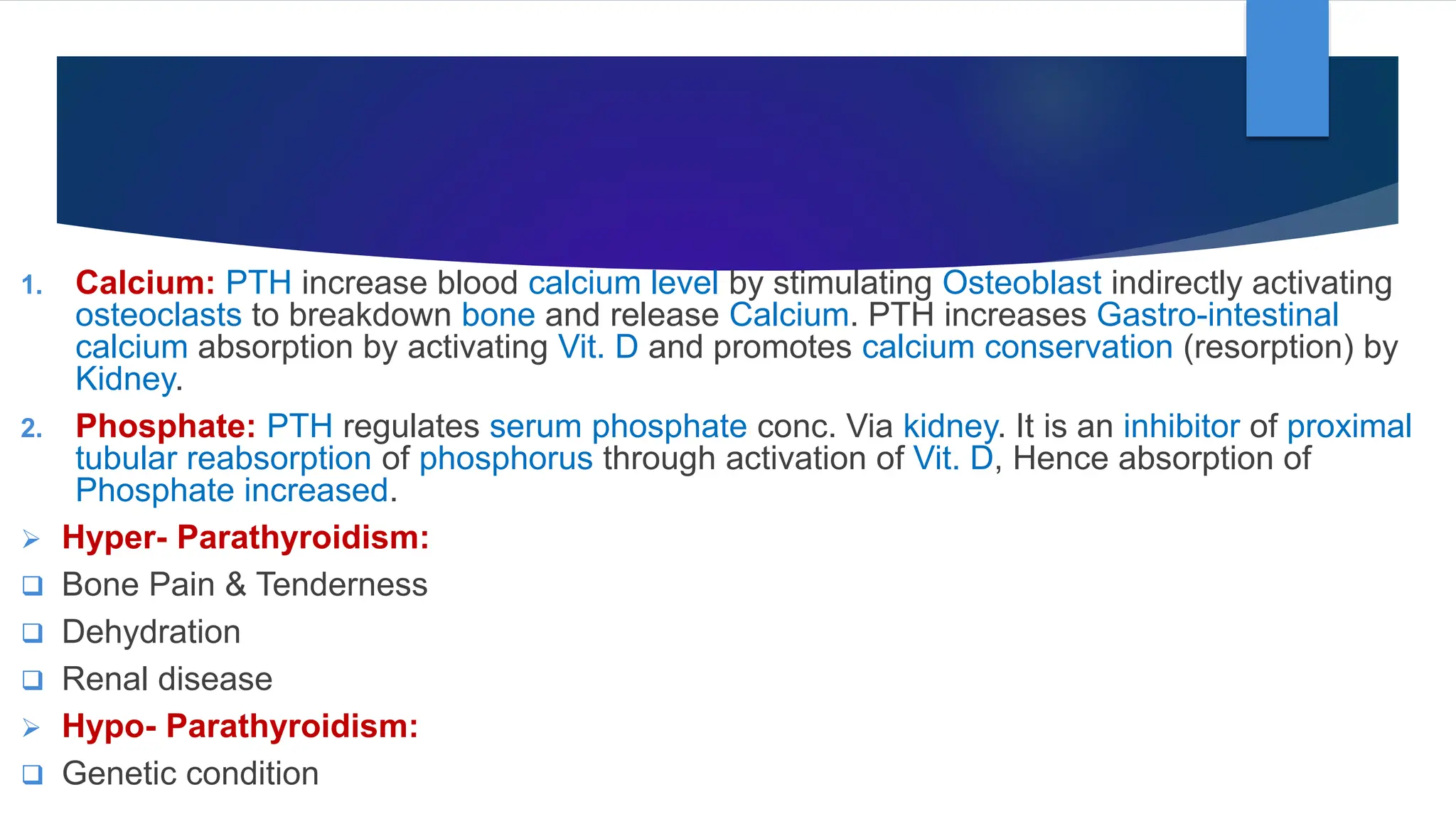
1. Calcium: PTH increase blood calcium level by stimulating Osteoblast indirectly activating
osteoclasts to breakdown bone and release Calcium. PTH increases Gastro-intestinal
calcium absorption by activating Vit. D and promotes calcium conservation (resorption) by
Kidney.
2. Phosphate: PTH regulates serum phosphate conc. Via kidney. It is an inhibitor of proximal
tubular reabsorption of phosphorus through activation of Vit. D, Hence absorption of
Phosphate increased.
 Hyper- Parathyroidism:
 Bone Pain & Tenderness
 Dehydration
 Renal disease
 Hypo- Parathyroidism:
 Genetic condition
Thank You
ANY QUESTIONS?

Parathyroid Glands- Gross Anatomy & Histology by Dr. Rabia Inam Gandapore.pptx

  • 1.
    Gross Anatomy &Histology of Parathyroid Glands Dr. Rabia Inam Gandapore Assistant Professor Head of Department Anatomy (Dentistry-BKCD) B.D.S (SBDC), M.Phil. Anatomy (KMU), Dip. Implant (Sharjah, Bangkok, ACHERS) , CHPE (KMU),CHR (KMU), Dip. Arts (Florence, Italy)
  • 2.
    Teaching Methodology  LGF(Long Group Format)  SGF (Short Group Format)  LGD (Long Group Discussion, Interactive discussion with the use of models or diagrams)  SGD (Short Group)  SDL (Self-Directed Learning)  DSL (Directed-Self Learning)  PBL (Problem- Based Learning)  Online Teaching Method  Role Play  Demonstrations  Laboratory  Museum  Library (Computed Assisted Learning or E-Learning)  Assignments  Video tutorial method
  • 3.
    Goal/Aim (main objective) To help/facilitate/augment the students about the: 1. Describe Gross features of Parathyroid gland. 2. Describe the Histological features of Parathyroid gland 3. Describe Blood & Nerve supply of Parathyroid gland.
  • 4.
    Specific Learning Objectives(cognitive) At the end of the lecture the student will able to:  Recognize the gross anatomical & Histological features of the Parathyroid Gland  Sketch labeled diagram of the Histology of Parathyroid Gland
  • 5.
    Psychomotor Objective: (Guidedresponse)  A student to draw labelled diagram of the Histology of Parathyroid Gland
  • 6.
    Affective domain  Tobe able to display a good code of conduct and moral values in the class.  To cooperate with the teacher and in groups with the colleagues.  To demonstrate a responsible behavior in the class and be punctual, regular, attentive and on time in the class.  To be able to perform well in the class under the guidance and supervision of the teacher.  Study the topic before entering the class.  Discuss among colleagues the topic under discussion in SGDs.  Participate in group activities and museum classes and follow the rules.  Volunteer to participate in psychomotor activities.  Listen to the teacher's instructions carefully and follow the guidelines.  Ask questions in the class by raising hand and avoid creating a disturbance.  To be able to submit all assignments on time and get your sketch logbooks checked.
  • 7.
    Lesson contents Clinical chairside question: Students will be asked if they know what is the function of Outline:  Activity 1 The facilitator will explain the student's Gross anatomy of Parathyroid Gland  Activity 2 The facilitator will ask the students to make a labeled diagram of the Histology of Parathyroid Gland  Activity 3 The facilitator will ask the students a few Multiple Choice Questions related to it with flashcards.
  • 8.
    Recommended Books  Studentsassessment: MCQs, Flashcards, Diagrams labeling.  Learning resources: Langman’s T.W. Sadler, Laiq Hussain Siddiqui, Snell Clinical Anatomy, Netter’s Atlas, BD Chaurasia’s Human anatomy, Internet sources links.
  • 9.
  • 10.
    Thyroid Gland  Namedafter the Thyroid cartilage  (Greek: Shield shaped)  Largest endocrine gland  Location: Anterior neck region  2 Lateral lobes connected by isthmus  Secretes: 1. Tetra-iodo-thyronine (Thyroxine) 2. Tri-ido-thyronine 3. Calcitonin Location of thyroid gland
  • 11.
    Gross Anatomy of ParathyroidGland  GROSS FEATURES OF PARATHYROID GLAND.  HISTOLOGICAL FEATURES OF PARATHYROID GLAND  BLOOD & NERVE SUPPLY OF PARATHYROID GLAND.
  • 12.
    Parathyroid Gland  Smallflattened, oval (6 mm long in diameter)  4 on Posterior surface of each lobe of the thyroid gland, lying within its fascial capsule  Superior & Inferior Parathyroid glands  External to Thyroid capsule  Hormone it opposes: Calcitonin (regulates Ca+2 ions into blood & Bones)  Function: maintain body calcium & phosphate level so nervous & muscular system function properly by secreting parathyroid Hormone (Para-thormone)
  • 13.
    Location and Description 1.Two Superior Parathyroid Glands: 1 cm superior to the point of entry of inferior thyroid arteries into thyroid gland.  More constant in position  Usually at the level of inferior border of cricoid cartilage. 2. Two Inferior Parathyroid Glands:1 cm inferior to arterial entry point  Various positions  Usually near inferior poles of thyroid gland  or within fascial sheath, embedded in thyroid substance, or outside the fascial sheath.  Sometimes, they are found some distance caudal to thyroid gland, in association with the inferior thyroid veins  they may even reside in the superior mediastinum in the thorax.
  • 14.
    Blood & Nervesupply of Parathyroid gland.  GROSS FEATURES OF PARATHYROID GLAND.  HISTOLOGICAL FEATURES OF PARATHYROID GLAND  BLOOD & NERVE SUPPLY OF PARATHYROID GLAND.
  • 15.
    Blood Supply &Lymphatic Drainage  Arterial Blood Supply: a. Superior Parathyroid Gland = Inferior thyroid artery b. Inferior Parathyroid Gland= Ascending branch of inferior thyroid arteries (arise from thyrocervical trunk i.e. sub-clavian artery) & thyroid ima artery c. Laryngeal, Tracheal & Esophageal arteries  Venous drainage: is into: (drain into thyroid plexus of veins of thyroid gland) a. Superior & Middle thyroid vein: drains into Internal Jugular vein b. Inferior thyroid vein: drains into Brachiocephalic Vein  Lymphatic Drainage: into a. Deep Cervical Lymph Nodes b. Para Tracheal Lymph Nodes
  • 19.
    Neurovasculature  Nerves: derivedfrom thyroid branches of cervical (sympathetic) ganglia  they are vasomotor rather than secretomotor  Hormonally regulated, Parathormone (PTH)  controls metabolism of phosphorus & calcium in blood. targets skeleton, kidneys, intestine.
  • 22.
    Developmental Embryology ofParathyroid Gland  Superior: 4 pharyngeal pouch  Inferior: 3 pharyngeal pouch
  • 23.
  • 24.
  • 25.
    Ectopic Parathyroid Gland •Abnormal number of parathyroi d gland
  • 26.
    Inadvertent Removal ofParathyroid Glands
  • 27.
    Histological features of Parathyroidgland  GROSS FEATURES OF PARATHYROID GLAND.  HISTOLOGICAL FEATURES OF PARATHYROID GLAND  BLOOD & NERVE SUPPLY OF PARATHYROID GLAND.
  • 28.
    Histology of theEndocrine System Hormone delivery  Pituitary (hypophysis) – Anterior pituitary – Posterior pituitary  Adrenal gland (suprarenal) – Adrenal cortex – Adrenal medulla  Thyroid gland – Follicles – Parafollicular cells  Parathyroid gland Considered in other lectures: – Endocrine pancreas – Male – Female – Enteroendocrine
  • 29.
    Para-Thyroid Gland  Connectivetissue capsule  Septa divide parenchymal cells (Cluster anastomosing cords) into: 1. Chief Cells or Principal Cells 2. Oxyphil Cells  Stroma  Reticular Fibers  Capillaries Fenestrated Capillaries  Fat Cells (Increase with age, Elder 60-70% glandular mass)
  • 31.
    No. Chief Cells(Principal Cells) Oxyphil Cells (stain-loving) 1. More numerous cells Less numerous cells 2. Small Polygonal cells Large cells 3. Round & central nucleus Single, small Cluster 4. Vesicular, Pale stain 5. Acidophilic cytoplasm Abundant cytoplasm, lightly stained=Acidophilic (Increased mitochondria) 6. Glycogen granules 7. Lipid droplets 8. Lipofuscin pigments 9. Secretory Granules No secretory granules 10. Hormone: Secretes Parathyroid Hormone (PTH)= Para-thormone 11. Function: 1. Increase Ca+2 : Stimulating Bone resorption Increase renal excretion of Ca+2 by Kidney tubules. 2. Lowers serum phosphate Function: Unknown Believed they are chief cells which has reached non secretory stage
  • 32.
  • 33.
    Parathyroid gland (mostlychief cells) , low power LM Blood vessel
  • 34.
    Parathyroid, chief cells,one oxyphil (arrow), LM Fat cell
  • 35.
  • 37.
    1. Calcium: PTHincrease blood calcium level by stimulating Osteoblast indirectly activating osteoclasts to breakdown bone and release Calcium. PTH increases Gastro-intestinal calcium absorption by activating Vit. D and promotes calcium conservation (resorption) by Kidney. 2. Phosphate: PTH regulates serum phosphate conc. Via kidney. It is an inhibitor of proximal tubular reabsorption of phosphorus through activation of Vit. D, Hence absorption of Phosphate increased.  Hyper- Parathyroidism:  Bone Pain & Tenderness  Dehydration  Renal disease  Hypo- Parathyroidism:  Genetic condition
  • 38.