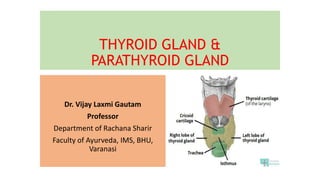
THYROID GLAND &
PARATHYROID GLAND
Dr. Vijay Laxmi Gautam
Professor
Department of Rachana Sharir
Faculty of Ayurveda, IMS, BHU,
Varanasi
THYROID GLAND
Introduction & Structures in the Neck
Location
Size, Shape & Weight
Blood Supply
Nerve Supply
Microscopic structure & Function
Clinical Anatomy
Development
Structures in the Neck- Contents
 GLANDS- Thyroid & Parathyroid
 THYMUS- Involutes at Puberty
 ARTERIES- Subclavian & Carotid
 VEINS- Subclavian, Internal jugular, & brachiocephalic
 NERVES- Glassopharyngeal, Vagus, Spinal accessory &
hypoglossal
 SYMPATHETIC TRUNK- 3 cervical ganglia
 LYMPH NODES & THORACIC DUCT
 STYLOID APPARATUS
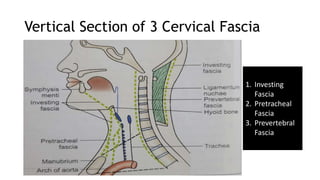
Vertical Section of 3 Cervical Fascia
1. Investing
Fascia
2. Pretracheal
Fascia
3. Prevertebral
Fascia
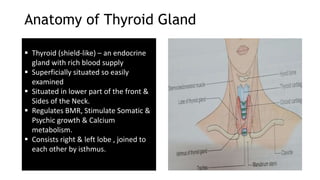
Anatomy of Thyroid Gland
 Thyroid (shield-like) – an endocrine
gland with rich blood supply
 Superficially situated so easily
examined
 Situated in lower part of the front &
Sides of the Neck.
 Regulates BMR, Stimulate Somatic &
Psychic growth & Calcium
metabolism.
 Consists right & left lobe , joined to
each other by isthmus.
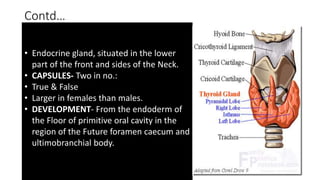
Contd…
• Endocrine gland, situated in the lower
part of the front and sides of the Neck.
• CAPSULES- Two in no.:
• True & False
• Larger in females than males.
• DEVELOPMENT- From the endoderm of
the Floor of primitive oral cavity in the
region of the Future foramen caecum and
ultimobranchial body.
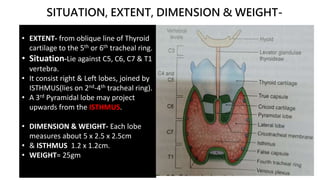
SITUATION, EXTENT, DIMENSION & WEIGHT-
• EXTENT- from oblique line of Thyroid
cartilage to the 5th or 6th tracheal ring.
• Situation-Lie against C5, C6, C7 & T1
vertebra.
• It consist right & Left lobes, joined by
ISTHMUS(lies on 2nd-4th tracheal ring).
• A 3rd Pyramidal lobe may project
upwards from the ISTHMUS.
• DIMENSION & WEIGHT- Each lobe
measures about 5 x 2.5 x 2.5cm
• & ISTHMUS 1.2 x 1.2cm.
• WEIGHT= 25gm
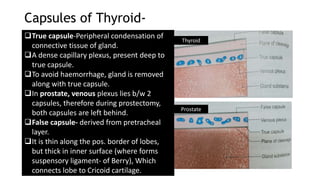
Capsules of Thyroid-
True capsule-Peripheral condensation of
connective tissue of gland.
A dense capillary plexus, present deep to
true capsule.
To avoid haemorrhage, gland is removed
along with true capsule.
In prostate, venous plexus lies b/w 2
capsules, therefore during prostectomy,
both capsules are left behind.
False capsule- derived from pretracheal
layer.
It is thin along the pos. border of lobes,
but thick in inner surface (where forms
suspensory ligament- of Berry), Which
connects lobe to Cricoid cartilage.
Thyroid
Prostate
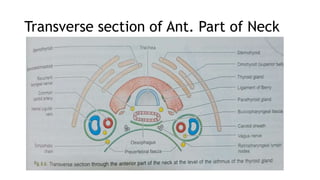
Transverse section of Ant. Part of Neck
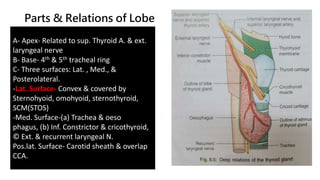
Parts & Relations of Lobe
A- Apex- Related to sup. Thyroid A. & ext.
laryngeal nerve
B- Base- 4th & 5th tracheal ring
C- Three surfaces: Lat. , Med., &
Posterolateral.
-Lat. Surface- Convex & covered by
Sternohyoid, omohyoid, sternothyroid,
SCM(STOS)
-Med. Surface-(a) Trachea & oeso
phagus, (b) Inf. Constrictor & cricothyroid,
© Ext. & recurrent laryngeal N.
Pos.lat. Surface- Carotid sheath & overlap
CCA.
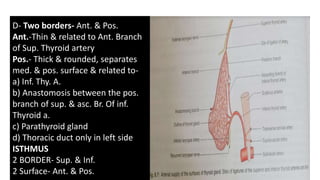
D- Two borders- Ant. & Pos.
Ant.-Thin & related to Ant. Branch
of Sup. Thyroid artery
Pos.- Thick & rounded, separates
med. & pos. surface & related to-
a) Inf. Thy. A.
b) Anastomosis between the pos.
branch of sup. & asc. Br. Of inf.
Thyroid a.
c) Parathyroid gland
d) Thoracic duct only in left side
ISTHMUS
2 BORDER- Sup. & Inf.
2 Surface- Ant. & Pos.
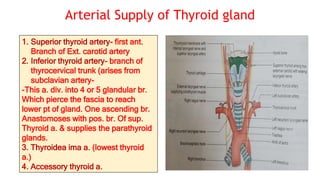
Arterial Supply of Thyroid gland
1. Superior thyroid artery- first ant.
Branch of Ext. carotid artery
2. Inferior thyroid artery- branch of
thyrocervical trunk (arises from
subclavian artery-
-This a. div. into 4 or 5 glandular br.
Which pierce the fascia to reach
lower pt of gland. One ascending br.
Anastomoses with pos. br. Of sup.
Thyroid a. & supplies the parathyroid
glands.
3. Thyroidea ima a. (lowest thyroid
a.)
4. Accessory thyroid a.
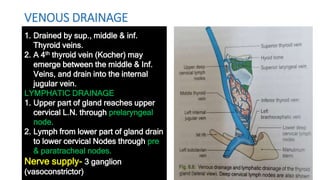
VENOUS DRAINAGE
1. Drained by sup., middle & inf.
Thyroid veins.
2. A 4th thyroid vein (Kocher) may
emerge between the middle & Inf.
Veins, and drain into the internal
jugular vein.
LYMPHATIC DRAINAGE
1. Upper part of gland reaches upper
cervical L.N. through prelaryngeal
node.
2. Lymph from lower part of gland drain
to lower cervical Nodes through pre
& paratracheal nodes.
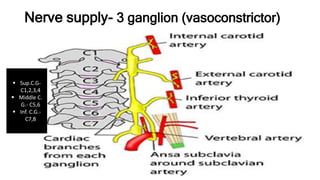
Nerve supply- 3 ganglion
(vasoconstrictor)
Nerve supply- 3 ganglion (vasoconstrictor)
 Sup.C.G-
C1,2,3,4
 Middle C.
G.- C5,6
 Inf. C.G.-
C7,8
Development of Thyroid, parathyroid & Thymus Gland
a) Thyroid gland dev.
From median
endodermal thyroid
diverticulum which
grown down in front
of neck from floor of
F. caecum
b) Foramen caecum
c) Thyroglossal duct
d) Developing Thyroid
gland from
thyroglossal duct
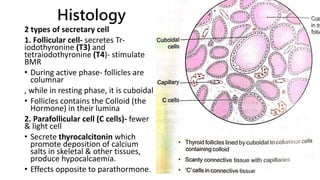
Histology
2 types of secretary cell
1. Follicular cell- secretes Tr-
iodothyronine (T3) and
tetraiodothyronine (T4)- stimulate
BMR
• During active phase- follicles are
columnar
, while in resting phase, it is cuboidal
• Follicles contains the Colloid (the
Hormone) in their lumina
2. Parafollicular cell (C cells)- fewer
& light cell
• Secrete thyrocalcitonin which
promote deposition of calcium
salts in skeletal & other tissues,
produce hypocalcaemia.
• Effects opposite to parathormone.
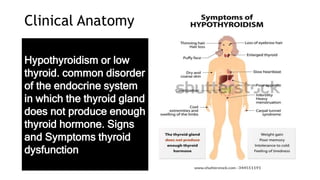
Clinical Anatomy
Hypothyroidism or low
thyroid. common disorder
of the endocrine system
in which the thyroid gland
does not produce enough
thyroid hormone. Signs
and Symptoms thyroid
dysfunction
Clinical Anatomy
Hypothyroidism causes cretinism
in infants and Myxoedema in
adults.
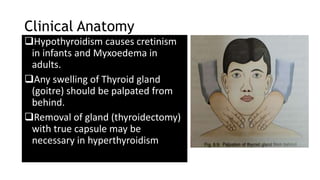
Any swelling of Thyroid gland
(goitre) should be palpated from
behind.
Removal of gland (thyroidectomy)
with true capsule may be
necessary in hyperthyroidism
PARATHYROID GLAND
Location
Size, Shape & Weight
Blood Supply
Nerve Supply
Microscopic structure & Function
Clinical Anatomy
Development
PARATHYROID GLAND
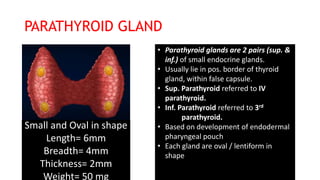
Small and Oval in shape
Length= 6mm
Breadth= 4mm
Thickness= 2mm
Weight= 50 mg
• Parathyroid glands are 2 pairs (sup. &
inf.) of small endocrine glands.
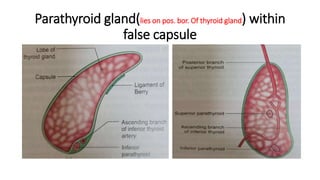
• Usually lie in pos. border of thyroid
gland, within false capsule.
• Sup. Parathyroid referred to IV
parathyroid.
• Inf. Parathyroid referred to 3rd
parathyroid.
• Based on development of endodermal
pharyngeal pouch
• Each gland are oval / lentiform in
shape
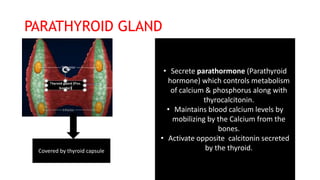
Parathyroid gland(lies on pos. bor. Of thyroid gland) within
false capsule
PARATHYROID GLAND
• Secrete parathormone (Parathyroid
hormone) which controls metabolism
of calcium & phosphorus along with
thyrocalcitonin.
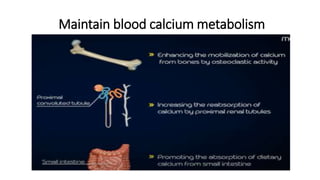
• Maintains blood calcium levels by
mobilizing by the Calcium from the
bones.
• Activate opposite calcitonin secreted
by the thyroid.
Covered by thyroid capsule
Location of Parathyroid Gland
(development)
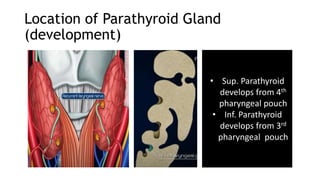
• Sup. Parathyroid
develops from 4th
pharyngeal pouch
• Inf. Parathyroid
develops from 3rd
pharyngeal pouch
Development
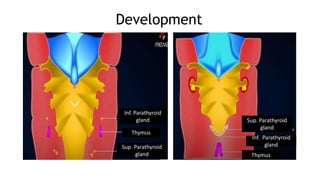
Sup. Parathyroid
gland
Sup. Parathyroid
gland
Inf. Parathyroid
gland
Inf. Parathyroid
gland
Thymus
Thymus
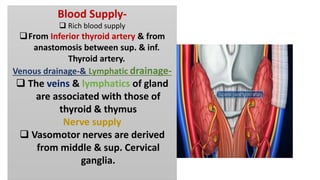
Blood Supply-
 Rich blood supply
From Inferior thyroid artery & from
anastomosis between sup. & inf.
Thyroid artery.
Venous drainage-& Lymphatic drainage-
 The veins & lymphatics of gland
are associated with those of
thyroid & thymus
Nerve supply
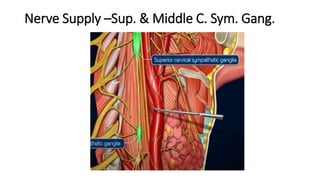
 Vasomotor nerves are derived
from middle & sup. Cervical
ganglia.
Nerve Supply –Sup. & Middle C. Sym. Gang.
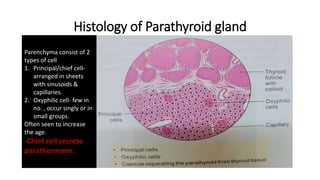
Histology of Parathyroid gland
Parenchyma consist of 2
types of cell
1. Principal/chief cell-
arranged in sheets
with sinusoids &
capillaries.
2. Oxyphilic cell- few in
no. , occur singly or in
small groups.
Often seen to increase
the age.
-Chief cell secrete
parathormone.
Maintain blood calcium metabolism
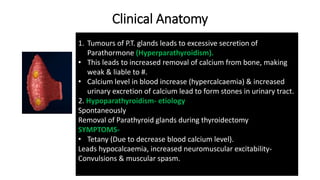
Clinical Anatomy
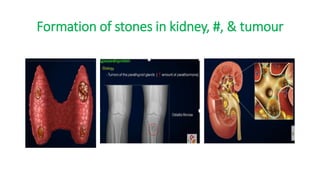
1. Tumours of P.T. glands leads to excessive secretion of
Parathormone (Hyperparathyroidism).
• This leads to increased removal of calcium from bone, making
weak & liable to #.
• Calcium level in blood increase (hypercalcaemia) & increased
urinary excretion of calcium lead to form stones in urinary tract.
2. Hypoparathyroidism- etiology
Spontaneously
Removal of Parathyroid glands during thyroidectomy
SYMPTOMS-
• Tetany (Due to decrease blood calcium level).
Leads hypocalcaemia, increased neuromuscular excitability-
Convulsions & muscular spasm.
Formation of stones in kidney, #, & tumour
Thyroid & Parathyroid gland-BAMS.pptx

Thyroid & Parathyroid gland-BAMS.pptx

  • 1.
    THYROID GLAND & PARATHYROIDGLAND Dr. Vijay Laxmi Gautam Professor Department of Rachana Sharir Faculty of Ayurveda, IMS, BHU, Varanasi
  • 2.
    THYROID GLAND Introduction &Structures in the Neck Location Size, Shape & Weight Blood Supply Nerve Supply Microscopic structure & Function Clinical Anatomy Development
  • 3.
    Structures in theNeck- Contents  GLANDS- Thyroid & Parathyroid  THYMUS- Involutes at Puberty  ARTERIES- Subclavian & Carotid  VEINS- Subclavian, Internal jugular, & brachiocephalic  NERVES- Glassopharyngeal, Vagus, Spinal accessory & hypoglossal  SYMPATHETIC TRUNK- 3 cervical ganglia  LYMPH NODES & THORACIC DUCT  STYLOID APPARATUS
  • 4.
    Vertical Section of3 Cervical Fascia 1. Investing Fascia 2. Pretracheal Fascia 3. Prevertebral Fascia
  • 5.
    Anatomy of ThyroidGland  Thyroid (shield-like) – an endocrine gland with rich blood supply  Superficially situated so easily examined  Situated in lower part of the front & Sides of the Neck.  Regulates BMR, Stimulate Somatic & Psychic growth & Calcium metabolism.  Consists right & left lobe , joined to each other by isthmus.
  • 6.
    Contd… • Endocrine gland,situated in the lower part of the front and sides of the Neck. • CAPSULES- Two in no.: • True & False • Larger in females than males. • DEVELOPMENT- From the endoderm of the Floor of primitive oral cavity in the region of the Future foramen caecum and ultimobranchial body.
  • 7.
    SITUATION, EXTENT, DIMENSION& WEIGHT- • EXTENT- from oblique line of Thyroid cartilage to the 5th or 6th tracheal ring. • Situation-Lie against C5, C6, C7 & T1 vertebra. • It consist right & Left lobes, joined by ISTHMUS(lies on 2nd-4th tracheal ring). • A 3rd Pyramidal lobe may project upwards from the ISTHMUS. • DIMENSION & WEIGHT- Each lobe measures about 5 x 2.5 x 2.5cm • & ISTHMUS 1.2 x 1.2cm. • WEIGHT= 25gm
  • 8.
    Capsules of Thyroid- Truecapsule-Peripheral condensation of connective tissue of gland. A dense capillary plexus, present deep to true capsule. To avoid haemorrhage, gland is removed along with true capsule. In prostate, venous plexus lies b/w 2 capsules, therefore during prostectomy, both capsules are left behind. False capsule- derived from pretracheal layer. It is thin along the pos. border of lobes, but thick in inner surface (where forms suspensory ligament- of Berry), Which connects lobe to Cricoid cartilage. Thyroid Prostate
  • 9.
    Transverse section ofAnt. Part of Neck
  • 10.
    Parts & Relationsof Lobe A- Apex- Related to sup. Thyroid A. & ext. laryngeal nerve B- Base- 4th & 5th tracheal ring C- Three surfaces: Lat. , Med., & Posterolateral. -Lat. Surface- Convex & covered by Sternohyoid, omohyoid, sternothyroid, SCM(STOS) -Med. Surface-(a) Trachea & oeso phagus, (b) Inf. Constrictor & cricothyroid, © Ext. & recurrent laryngeal N. Pos.lat. Surface- Carotid sheath & overlap CCA.
  • 11.
    D- Two borders-Ant. & Pos. Ant.-Thin & related to Ant. Branch of Sup. Thyroid artery Pos.- Thick & rounded, separates med. & pos. surface & related to- a) Inf. Thy. A. b) Anastomosis between the pos. branch of sup. & asc. Br. Of inf. Thyroid a. c) Parathyroid gland d) Thoracic duct only in left side ISTHMUS 2 BORDER- Sup. & Inf. 2 Surface- Ant. & Pos.
  • 12.
    Arterial Supply ofThyroid gland 1. Superior thyroid artery- first ant. Branch of Ext. carotid artery 2. Inferior thyroid artery- branch of thyrocervical trunk (arises from subclavian artery- -This a. div. into 4 or 5 glandular br. Which pierce the fascia to reach lower pt of gland. One ascending br. Anastomoses with pos. br. Of sup. Thyroid a. & supplies the parathyroid glands. 3. Thyroidea ima a. (lowest thyroid a.) 4. Accessory thyroid a.
  • 13.
    VENOUS DRAINAGE 1. Drainedby sup., middle & inf. Thyroid veins. 2. A 4th thyroid vein (Kocher) may emerge between the middle & Inf. Veins, and drain into the internal jugular vein. LYMPHATIC DRAINAGE 1. Upper part of gland reaches upper cervical L.N. through prelaryngeal node. 2. Lymph from lower part of gland drain to lower cervical Nodes through pre & paratracheal nodes. Nerve supply- 3 ganglion (vasoconstrictor)
  • 14.
    Nerve supply- 3ganglion (vasoconstrictor)  Sup.C.G- C1,2,3,4  Middle C. G.- C5,6  Inf. C.G.- C7,8
  • 15.
    Development of Thyroid,parathyroid & Thymus Gland a) Thyroid gland dev. From median endodermal thyroid diverticulum which grown down in front of neck from floor of F. caecum b) Foramen caecum c) Thyroglossal duct d) Developing Thyroid gland from thyroglossal duct
  • 16.
    Histology 2 types ofsecretary cell 1. Follicular cell- secretes Tr- iodothyronine (T3) and tetraiodothyronine (T4)- stimulate BMR • During active phase- follicles are columnar , while in resting phase, it is cuboidal • Follicles contains the Colloid (the Hormone) in their lumina 2. Parafollicular cell (C cells)- fewer & light cell • Secrete thyrocalcitonin which promote deposition of calcium salts in skeletal & other tissues, produce hypocalcaemia. • Effects opposite to parathormone.
  • 17.
    Clinical Anatomy Hypothyroidism orlow thyroid. common disorder of the endocrine system in which the thyroid gland does not produce enough thyroid hormone. Signs and Symptoms thyroid dysfunction
  • 18.
    Clinical Anatomy Hypothyroidism causescretinism in infants and Myxoedema in adults. Any swelling of Thyroid gland (goitre) should be palpated from behind. Removal of gland (thyroidectomy) with true capsule may be necessary in hyperthyroidism
  • 19.
    PARATHYROID GLAND Location Size, Shape& Weight Blood Supply Nerve Supply Microscopic structure & Function Clinical Anatomy Development
  • 20.
    PARATHYROID GLAND Small andOval in shape Length= 6mm Breadth= 4mm Thickness= 2mm Weight= 50 mg • Parathyroid glands are 2 pairs (sup. & inf.) of small endocrine glands. • Usually lie in pos. border of thyroid gland, within false capsule. • Sup. Parathyroid referred to IV parathyroid. • Inf. Parathyroid referred to 3rd parathyroid. • Based on development of endodermal pharyngeal pouch • Each gland are oval / lentiform in shape
  • 21.
    Parathyroid gland(lies onpos. bor. Of thyroid gland) within false capsule
  • 22.
    PARATHYROID GLAND • Secreteparathormone (Parathyroid hormone) which controls metabolism of calcium & phosphorus along with thyrocalcitonin. • Maintains blood calcium levels by mobilizing by the Calcium from the bones. • Activate opposite calcitonin secreted by the thyroid. Covered by thyroid capsule
  • 23.
    Location of ParathyroidGland (development) • Sup. Parathyroid develops from 4th pharyngeal pouch • Inf. Parathyroid develops from 3rd pharyngeal pouch
  • 24.
    Development Sup. Parathyroid gland Sup. Parathyroid gland Inf.Parathyroid gland Inf. Parathyroid gland Thymus Thymus
  • 25.
    Blood Supply-  Richblood supply From Inferior thyroid artery & from anastomosis between sup. & inf. Thyroid artery. Venous drainage-& Lymphatic drainage-  The veins & lymphatics of gland are associated with those of thyroid & thymus Nerve supply  Vasomotor nerves are derived from middle & sup. Cervical ganglia.
  • 26.
    Nerve Supply –Sup.& Middle C. Sym. Gang.
  • 27.
    Histology of Parathyroidgland Parenchyma consist of 2 types of cell 1. Principal/chief cell- arranged in sheets with sinusoids & capillaries. 2. Oxyphilic cell- few in no. , occur singly or in small groups. Often seen to increase the age. -Chief cell secrete parathormone.
  • 28.
  • 29.
    Clinical Anatomy 1. Tumoursof P.T. glands leads to excessive secretion of Parathormone (Hyperparathyroidism). • This leads to increased removal of calcium from bone, making weak & liable to #. • Calcium level in blood increase (hypercalcaemia) & increased urinary excretion of calcium lead to form stones in urinary tract. 2. Hypoparathyroidism- etiology Spontaneously Removal of Parathyroid glands during thyroidectomy SYMPTOMS- • Tetany (Due to decrease blood calcium level). Leads hypocalcaemia, increased neuromuscular excitability- Convulsions & muscular spasm.
  • 30.
    Formation of stonesin kidney, #, & tumour