Case
presentation
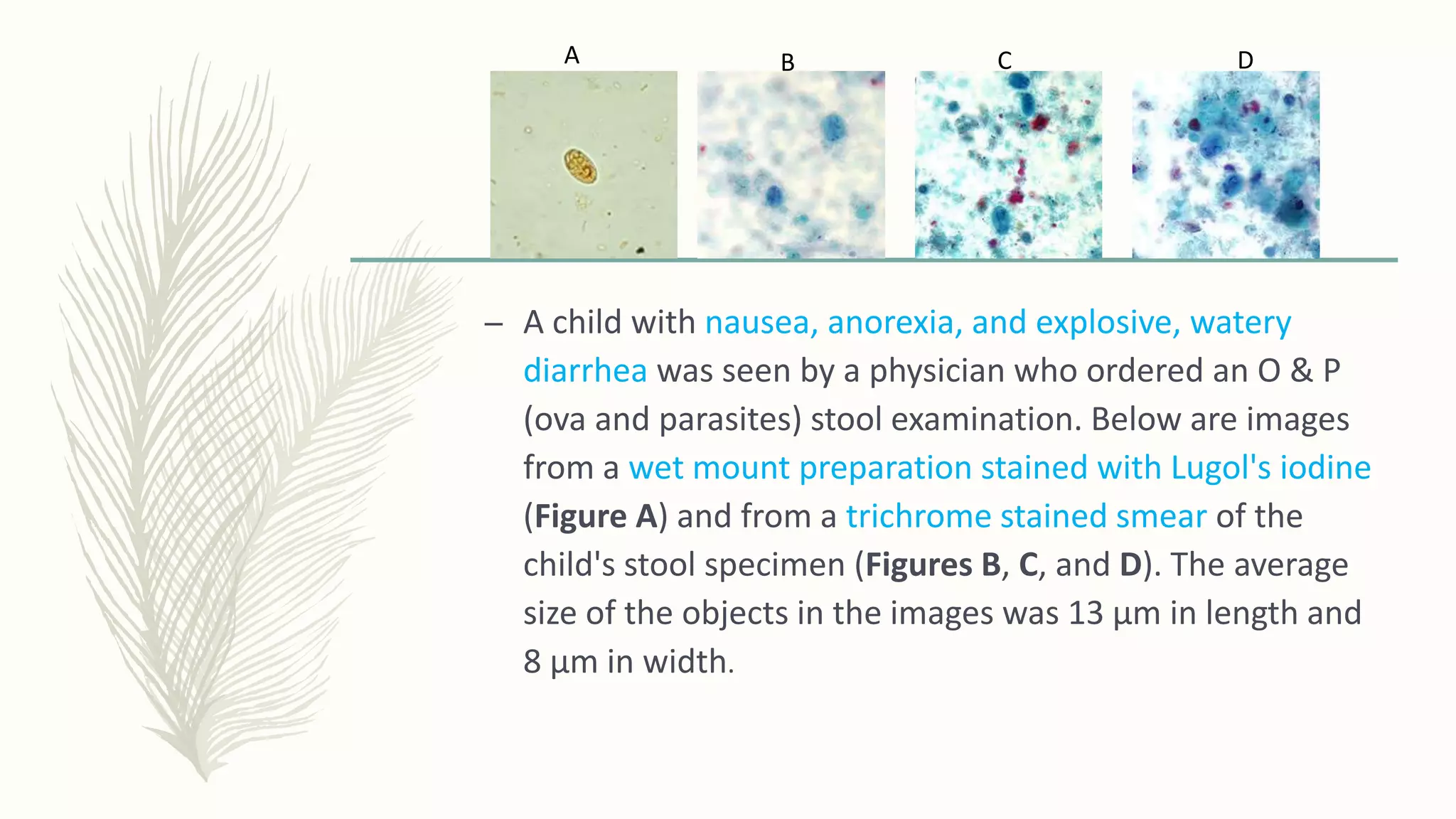
– A child with nausea, anorexia, and explosive, watery
diarrhea was seen by a physician who ordered an O & P
(ova and parasites) stool examination. Below are images
from a wet mount preparation stained with Lugol's iodine
(Figure A) and from a trichrome stained smear of the
child's stool specimen (Figures B, C, and D). The average
size of the objects in the images was 13 µm in length and
8 µm in width.
A B C D
GIARDIA
LAMBLIA
Abhishek. B. K
3rd year medical student at
Government medical college Palakkad
Facts
– Other names :Lamblia intestinalis, Giardia duodenalis
– If the organism is split and stained, resembles the "smiley face" symbol.
– "beaver fever"
What we are going to learn
– History
– General features
– Distribution
– Habitat
– Morphology
– Life cycle
– Pathogenesis
– Clinical features
– Lab diagnosis
– Treatment
– Prophylaxis
History
A Giardia
trophozoite, drawn
by Vilém Lambl and
published in 1859.
General features
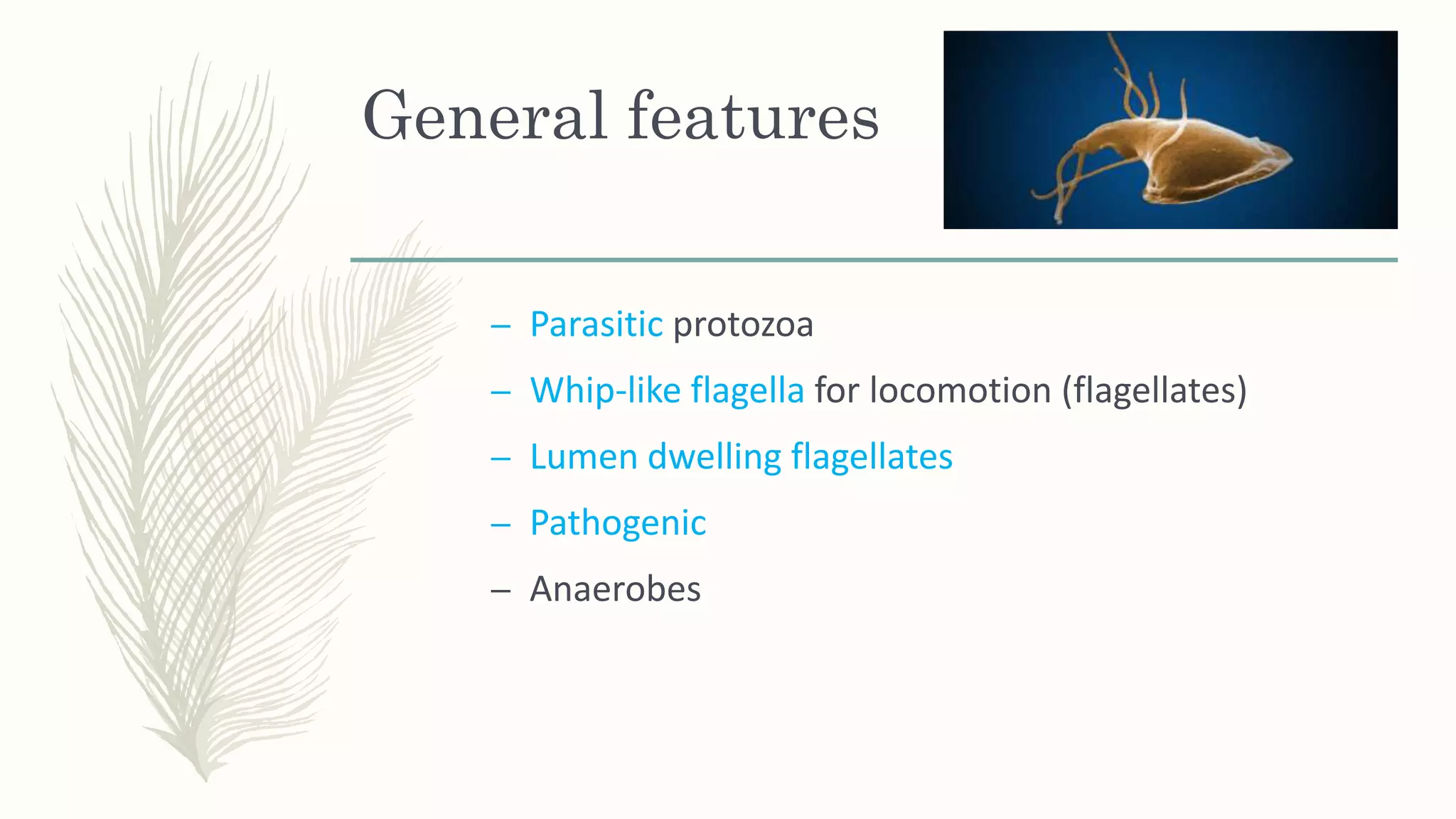
– Parasitic protozoa
– Whip-like flagella for locomotion (flagellates)
– Lumen dwelling flagellates
– Pathogenic
– Anaerobes
Distribution
– Cosmopolitan
– Sporadic individual infections / epidemic form
(drinking water)
– Endemicity very high in: low sanitation
. tropics and subtropics
– Visitors to such places : traveler’s diarrhea
Habitat
– Duodenum
– Upper jejunum
– Only protozoan parasite found
in lumen of human small
intestine
Morphology
– Two forms
1. Trophozoite (vegetative form)
2. Cyst (cystic form )
Trophozoite (vegetative form)
– Shape : tennis racket ( heart shaped or
pyriform shaped )
– Rounded anteriorly and pointed posteriorly
– Dorsally convex ; ventrally concave sucking
disc
– Bilaterally symmetrical and has
– 1 pair nuclei, 4 pair flagella, 4 pair
blepharoplast, 1 pair of axostyle, 2 sausage-
shaped parabasal or median bodies
– Motile- slow oscillation in long axis-falling leaf
BB
N
AD
MB
A
PF
Cyst (cystic form )
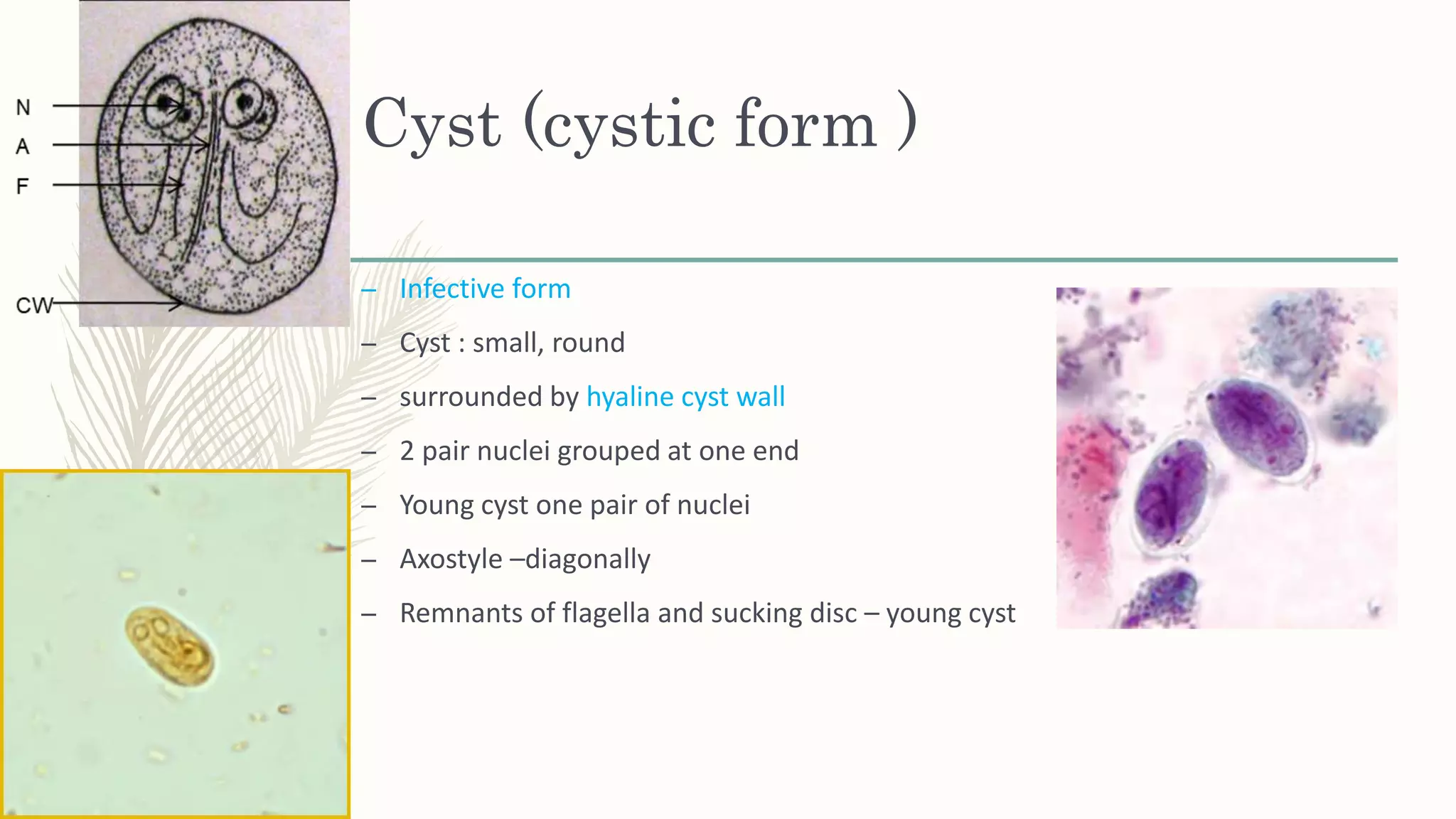
– Infective form
– Cyst : small, round
– surrounded by hyaline cyst wall
– 2 pair nuclei grouped at one end
– Young cyst one pair of nuclei
– Axostyle –diagonally
– Remnants of flagella and sucking disc – young cyst
Life cycle
– One host
– Infective form cyst
– Mode of transmission : ingestion of cyst in contaminated water and food
– Infective dose : 10-100
– Children commonly affected
– Direct person to person transmission may also occur
– Enhanced susceptibility: blood group A
. Achlorhydria
. Use of cannabis
. Chronic pancreatitis
. Immune deficiency (19 A deficiency )
. Hypogammaglobulinemia
– 10 cysts – can cause infection
– 2,00,000 cyst/feces
Within half hour of ingestion
:Cyst hatches out into
trophozoites
Multiply by binary fission and
colonize duodenum
Live in upper part of jejunum
Unfavorable condition
– encystment in colon
Feeding – pinocytosis
Cysts passed in stool –
remain in soil for weeks
This Photo by Unknown Author
is licensed under CC BY-SA
Pathogenesis
– Site : duodenal mucosa and jejunal mucosa
– It does not invade the tissue ; remain adherent to intestinal
epithelium
– Cause : abnormal villous architecture – apoptosis
. Increased lymphatic infiltration of lamina propria
. Loss of brush border epithelium-enzyme deficiency*
– Variant specific surface protein (vssp)
– Antigenic variation- evasion of host immune system
Clinical features
– Asymptomatic
– Mucus diarrhea with no blood
– Steatorrhea
– Dull epigastric pain
– Belching and flatulence
– Children : chronic diarrhea
. Malabsorption
. Weight loss and spur like syndrome
– Occasionally colonize gall bladder –biliary cholic and Jaundice
– Incubation period 2 weeks
Clinical types
Acute giardiasis
– It is characterized by acute watery
diarrhea, abdominal cramp,
bloating and flatulence.
Occasionally nausea, vomiting,
fever, rashes or constipation in
some.
– Pus, blood and mucus are not seen
in stool.
– The condition lasts for 5-7 days.
Chronic giardiasis
– Symptoms includes chronic
diarrhea with malabsorption of fat
(steatorrhea) and malabsorption of
vitamin A, protein and D-xylose,
weight loss, malaise, nausea,
anorexia
– Protuberance of abdomen, spindly
extremities and stunted growth are
most common sign in children.
– It lasts for several weeks
Lab
diagnosis
Stool examination
serodiagnosisEnterotest
Molecular methods
Stool examination
– Macroscopic examination : pale colored, offensive odor, fatty
and float in water
– Microscopic examination : cysts and trophozoites in diarrheal
stool by saline and iodine wet preparations
– Concentration techniques : formal ether or zinc acetate
– Asymptomatic carriers' cysts seen
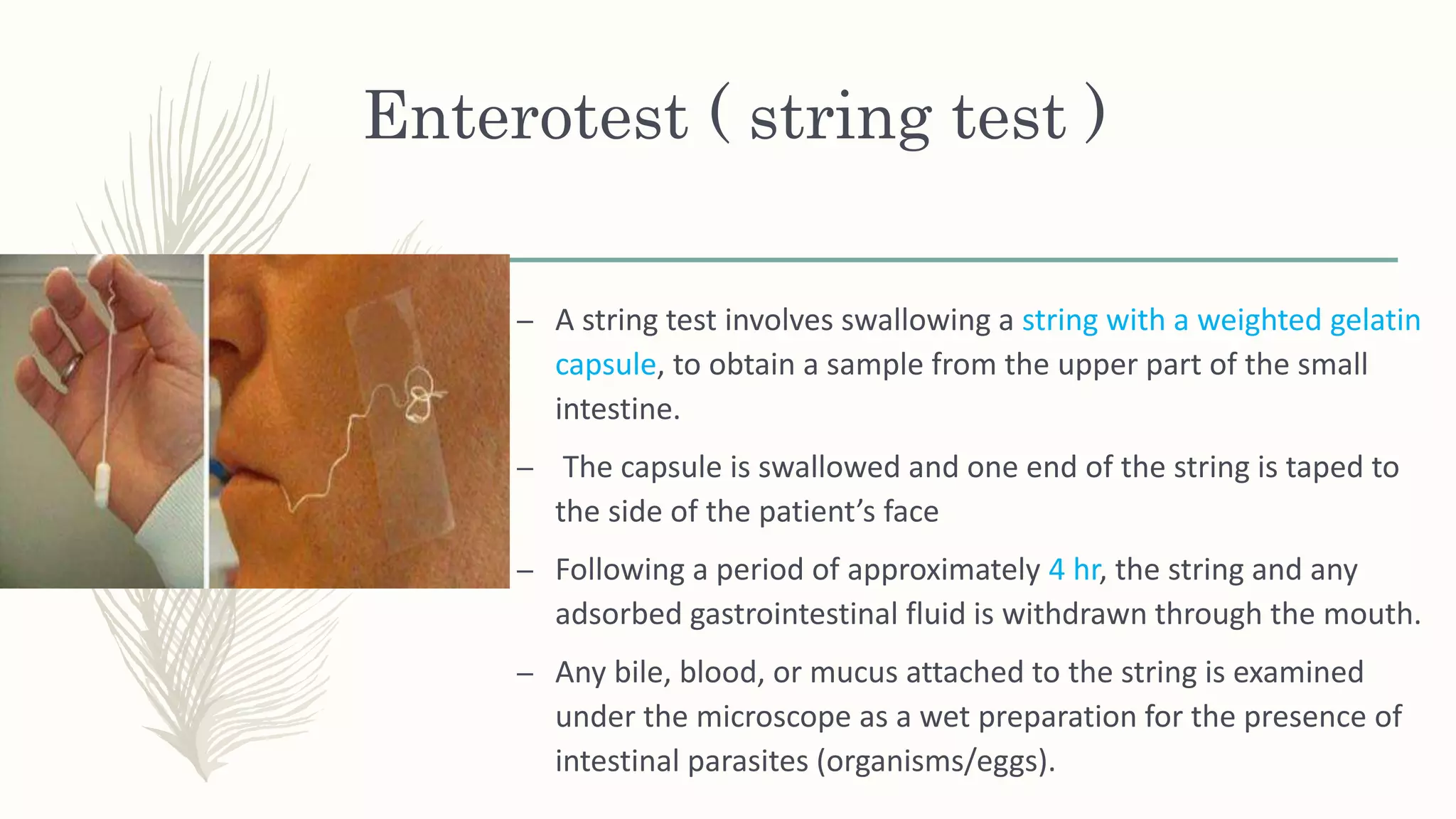
Enterotest ( string test )
– A string test involves swallowing a string with a weighted gelatin
capsule, to obtain a sample from the upper part of the small
intestine.
– The capsule is swallowed and one end of the string is taped to
the side of the patient’s face
– Following a period of approximately 4 hr, the string and any
adsorbed gastrointestinal fluid is withdrawn through the mouth.
– Any bile, blood, or mucus attached to the string is examined
under the microscope as a wet preparation for the presence of
intestinal parasites (organisms/eggs).
Serodiagnosis
Antigen detection
– ELISA
– Immunochromatographic strip test
– Indirect immunofluorescence
Indicate active infection
ProSpect T/Giardia kit : GSA65
Sensitivity 95%
Specificity 100%
Antibody detection
– ELISA
– Indirect immunofluorescence
Epidemiological and
pathophysiological study
Cannot differentiate present / past
infection
Low Sensitivity and Specificity
Molecular methods
– DNA probes
– PCR
– To demonstrate parasitic genome in stool sample
Treatment
– Metronidazole -250 mg tid for 5-7 days
– Tinidazole -2g single dose
– Tinidazole > Metronidazole
– Furazolidone -100 mg qid for 7 days / Nitazoxanide – 500 mg bid (for
children)
– Paromomycin oral aminoglycoside 500 mg tid for 5 days (pregnant
lady )
– *only give treatment for symptomatic cases
Prophylaxis
– Proper disposal of waste water and feces
– Practice of personal hygiene
– Prevention of food and water contamination
– Identifying the source of infection, particularly in outbreak situation
– Health education at individual as well as community levels
Summary
– Parasitic Lumen dwelling flagellated protozoan
– Mucus diarrhea with no blood
– Stool examination : pale colored, offensive odor, fatty and float in
water ; cysts and trophozoites seen microscopy
– Serologically : ELISA ,Immunochromatographic strip test ,Indirect
immunofluorescence
– Treatment :Tinidazole > Metronidazole ,Furazolidone (for children)
Paromomycin
– Prophylaxis: hygiene
Reference
– https://www.cdc.gov/dpdx/monthlyCaseStudies/2002/case76.h
tml
– https://en.wikipedia.org/wiki/Giardia_lamblia
– Paniker’s textbook of medical parasitology
– https://www.onlinebiologynotes.com/giardia-lamblia-
morphology-life-cycle-pathogenesis-clinical-manifestation-lab-
diagnosis-and-treatment/
Thankyou

PARASITEOLOGY :Giardia lamblia

  • 1.
  • 2.
    – A childwith nausea, anorexia, and explosive, watery diarrhea was seen by a physician who ordered an O & P (ova and parasites) stool examination. Below are images from a wet mount preparation stained with Lugol's iodine (Figure A) and from a trichrome stained smear of the child's stool specimen (Figures B, C, and D). The average size of the objects in the images was 13 µm in length and 8 µm in width. A B C D
  • 3.
    GIARDIA LAMBLIA Abhishek. B. K 3rdyear medical student at Government medical college Palakkad
  • 4.
    Facts – Other names:Lamblia intestinalis, Giardia duodenalis – If the organism is split and stained, resembles the "smiley face" symbol. – "beaver fever"
  • 5.
    What we aregoing to learn – History – General features – Distribution – Habitat – Morphology – Life cycle – Pathogenesis – Clinical features – Lab diagnosis – Treatment – Prophylaxis
  • 6.
    History A Giardia trophozoite, drawn byVilém Lambl and published in 1859.
  • 7.
    General features – Parasiticprotozoa – Whip-like flagella for locomotion (flagellates) – Lumen dwelling flagellates – Pathogenic – Anaerobes
  • 8.
    Distribution – Cosmopolitan – Sporadicindividual infections / epidemic form (drinking water) – Endemicity very high in: low sanitation . tropics and subtropics – Visitors to such places : traveler’s diarrhea
  • 9.
    Habitat – Duodenum – Upperjejunum – Only protozoan parasite found in lumen of human small intestine
  • 10.
    Morphology – Two forms 1.Trophozoite (vegetative form) 2. Cyst (cystic form )
  • 11.
    Trophozoite (vegetative form) –Shape : tennis racket ( heart shaped or pyriform shaped ) – Rounded anteriorly and pointed posteriorly – Dorsally convex ; ventrally concave sucking disc – Bilaterally symmetrical and has – 1 pair nuclei, 4 pair flagella, 4 pair blepharoplast, 1 pair of axostyle, 2 sausage- shaped parabasal or median bodies – Motile- slow oscillation in long axis-falling leaf BB N AD MB A PF
  • 12.
    Cyst (cystic form) – Infective form – Cyst : small, round – surrounded by hyaline cyst wall – 2 pair nuclei grouped at one end – Young cyst one pair of nuclei – Axostyle –diagonally – Remnants of flagella and sucking disc – young cyst
  • 13.
    Life cycle – Onehost – Infective form cyst – Mode of transmission : ingestion of cyst in contaminated water and food – Infective dose : 10-100 – Children commonly affected – Direct person to person transmission may also occur – Enhanced susceptibility: blood group A . Achlorhydria . Use of cannabis . Chronic pancreatitis . Immune deficiency (19 A deficiency ) . Hypogammaglobulinemia
  • 14.
    – 10 cysts– can cause infection – 2,00,000 cyst/feces Within half hour of ingestion :Cyst hatches out into trophozoites Multiply by binary fission and colonize duodenum Live in upper part of jejunum Unfavorable condition – encystment in colon Feeding – pinocytosis Cysts passed in stool – remain in soil for weeks This Photo by Unknown Author is licensed under CC BY-SA
  • 15.
    Pathogenesis – Site :duodenal mucosa and jejunal mucosa – It does not invade the tissue ; remain adherent to intestinal epithelium – Cause : abnormal villous architecture – apoptosis . Increased lymphatic infiltration of lamina propria . Loss of brush border epithelium-enzyme deficiency* – Variant specific surface protein (vssp) – Antigenic variation- evasion of host immune system
  • 16.
    Clinical features – Asymptomatic –Mucus diarrhea with no blood – Steatorrhea – Dull epigastric pain – Belching and flatulence – Children : chronic diarrhea . Malabsorption . Weight loss and spur like syndrome – Occasionally colonize gall bladder –biliary cholic and Jaundice – Incubation period 2 weeks
  • 17.
    Clinical types Acute giardiasis –It is characterized by acute watery diarrhea, abdominal cramp, bloating and flatulence. Occasionally nausea, vomiting, fever, rashes or constipation in some. – Pus, blood and mucus are not seen in stool. – The condition lasts for 5-7 days. Chronic giardiasis – Symptoms includes chronic diarrhea with malabsorption of fat (steatorrhea) and malabsorption of vitamin A, protein and D-xylose, weight loss, malaise, nausea, anorexia – Protuberance of abdomen, spindly extremities and stunted growth are most common sign in children. – It lasts for several weeks
  • 18.
  • 19.
    Stool examination – Macroscopicexamination : pale colored, offensive odor, fatty and float in water – Microscopic examination : cysts and trophozoites in diarrheal stool by saline and iodine wet preparations – Concentration techniques : formal ether or zinc acetate – Asymptomatic carriers' cysts seen
  • 20.
    Enterotest ( stringtest ) – A string test involves swallowing a string with a weighted gelatin capsule, to obtain a sample from the upper part of the small intestine. – The capsule is swallowed and one end of the string is taped to the side of the patient’s face – Following a period of approximately 4 hr, the string and any adsorbed gastrointestinal fluid is withdrawn through the mouth. – Any bile, blood, or mucus attached to the string is examined under the microscope as a wet preparation for the presence of intestinal parasites (organisms/eggs).
  • 21.
    Serodiagnosis Antigen detection – ELISA –Immunochromatographic strip test – Indirect immunofluorescence Indicate active infection ProSpect T/Giardia kit : GSA65 Sensitivity 95% Specificity 100% Antibody detection – ELISA – Indirect immunofluorescence Epidemiological and pathophysiological study Cannot differentiate present / past infection Low Sensitivity and Specificity
  • 22.
    Molecular methods – DNAprobes – PCR – To demonstrate parasitic genome in stool sample
  • 23.
    Treatment – Metronidazole -250mg tid for 5-7 days – Tinidazole -2g single dose – Tinidazole > Metronidazole – Furazolidone -100 mg qid for 7 days / Nitazoxanide – 500 mg bid (for children) – Paromomycin oral aminoglycoside 500 mg tid for 5 days (pregnant lady ) – *only give treatment for symptomatic cases
  • 24.
    Prophylaxis – Proper disposalof waste water and feces – Practice of personal hygiene – Prevention of food and water contamination – Identifying the source of infection, particularly in outbreak situation – Health education at individual as well as community levels
  • 25.
    Summary – Parasitic Lumendwelling flagellated protozoan – Mucus diarrhea with no blood – Stool examination : pale colored, offensive odor, fatty and float in water ; cysts and trophozoites seen microscopy – Serologically : ELISA ,Immunochromatographic strip test ,Indirect immunofluorescence – Treatment :Tinidazole > Metronidazole ,Furazolidone (for children) Paromomycin – Prophylaxis: hygiene
  • 26.
    Reference – https://www.cdc.gov/dpdx/monthlyCaseStudies/2002/case76.h tml – https://en.wikipedia.org/wiki/Giardia_lamblia –Paniker’s textbook of medical parasitology – https://www.onlinebiologynotes.com/giardia-lamblia- morphology-life-cycle-pathogenesis-clinical-manifestation-lab- diagnosis-and-treatment/
  • 27.

Editor's Notes