Download to read offline

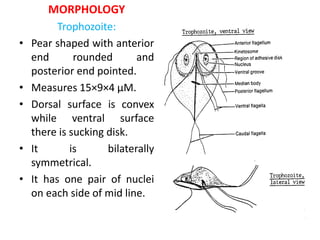
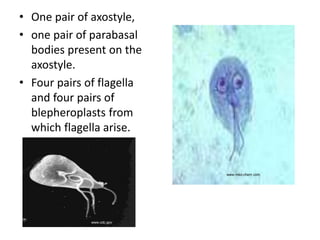




This document summarizes information about Giardia lamblia, including its discovery in 1681, morphology, life cycle, pathogenesis, clinical features, laboratory diagnosis, and treatment. Key points include: - G. lamblia, commonly known as giardia, is a cosmopolitan intestinal parasite that infects the duodenum and jejunum. - It has two forms - a pear-shaped trophozoite and an oval cyst. The infective form is the cyst which is passed in feces. - Its life cycle involves attachment in the small intestine, encystation and passage in feces, then excystation and multiplication in the new host. - Clinical features include


