Nonverbal Communication:
Paralanguage and Silence
By Mary Butler DeSpain
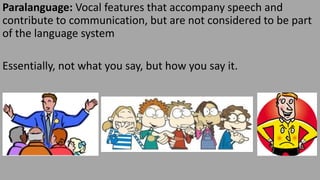
Paralanguage: Vocal features that accompany speech and
contribute to communication, but are not considered to be part
of the language system
Essentially, not what you say, but how you say it.
Elements of Paralanguage
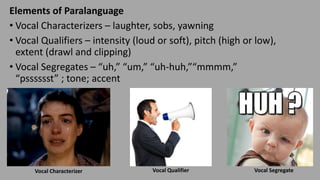
• Vocal Characterizers – laughter, sobs, yawning
• Vocal Qualifiers – intensity (loud or soft), pitch (high or low),
extent (drawl and clipping)
• Vocal Segregates – “uh,” “um,” “uh-huh,”“mmmm,”
“psssssst” ; tone; accent
Vocal Characterizer Vocal Qualifier Vocal Segregate
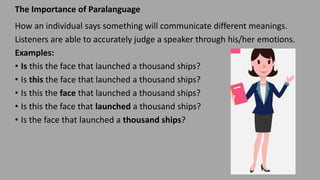
The Importance of Paralanguage
How an individual says something will communicate different meanings.
Listeners are able to accurately judge a speaker through his/her emotions.
Examples:
• Is this the face that launched a thousand ships?
• Is the face that launched a thousand ships?
Paralanguage Across the Globe
• In Spanish culture, “pssssst” is a polite way to call a waiter over
• In Thai culture, soft speaking portrays polite manners and a good education
• In British culture, increased volume in a speaker portrays anger
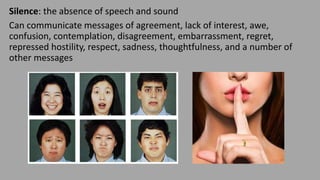
Silence: the absence of speech and sound
Can communicate messages of agreement, lack of interest, awe,
confusion, contemplation, disagreement, embarrassment, regret,
repressed hostility, respect, sadness, thoughtfulness, and a number of
other messages
The Importance of Silence
Can communicate as intensely as verbal communication.
Functions of Silence:
• Gives the speaker time to think before responding
• Can be utilized as a “weapon” (the silent treatment)
• Communicates emotional responses to the listener
• Indicates Communication Apprehension (Stage Fright), which is the fear/anxiety associated
with real or expected communication with an individual
Silence Across the Globe
Individuals from different cultures have very different understandings of silence.
Examples:
• In Chinese culture, silence is used in most situations, thus the attitude of Chinese
culture towards silence is positive. During communication, pause and silence can
express plenty of meaning, from agreement and praise to disagreement and protest.
• In American culture, the attitude towards silence is negative. Americans tend to
consider silence in communication as messages of indifference, anger, shame, disgust,
or embarrassment.
• Egyptian culture views silence as a form of consent.
• Greek culture views silence as refusal.
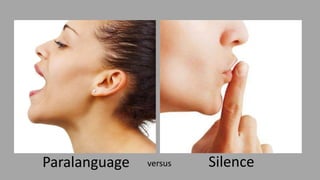
Paralanguage Silenceversus

Nonverbal Communication

  • 1.
    Nonverbal Communication: Paralanguage andSilence By Mary Butler DeSpain
  • 2.
    Paralanguage: Vocal featuresthat accompany speech and contribute to communication, but are not considered to be part of the language system Essentially, not what you say, but how you say it.
  • 3.
    Elements of Paralanguage •Vocal Characterizers – laughter, sobs, yawning • Vocal Qualifiers – intensity (loud or soft), pitch (high or low), extent (drawl and clipping) • Vocal Segregates – “uh,” “um,” “uh-huh,”“mmmm,” “psssssst” ; tone; accent Vocal Characterizer Vocal Qualifier Vocal Segregate
  • 4.
    The Importance ofParalanguage How an individual says something will communicate different meanings. Listeners are able to accurately judge a speaker through his/her emotions. Examples: • Is this the face that launched a thousand ships? • Is this the face that launched a thousand ships? • Is this the face that launched a thousand ships? • Is this the face that launched a thousand ships? • Is the face that launched a thousand ships?
  • 5.
    Paralanguage Across theGlobe • In Spanish culture, “pssssst” is a polite way to call a waiter over • In Thai culture, soft speaking portrays polite manners and a good education • In British culture, increased volume in a speaker portrays anger
  • 6.
    Silence: the absenceof speech and sound Can communicate messages of agreement, lack of interest, awe, confusion, contemplation, disagreement, embarrassment, regret, repressed hostility, respect, sadness, thoughtfulness, and a number of other messages
  • 7.
    The Importance ofSilence Can communicate as intensely as verbal communication. Functions of Silence: • Gives the speaker time to think before responding • Can be utilized as a “weapon” (the silent treatment) • Communicates emotional responses to the listener • Indicates Communication Apprehension (Stage Fright), which is the fear/anxiety associated with real or expected communication with an individual
  • 8.
    Silence Across theGlobe Individuals from different cultures have very different understandings of silence. Examples: • In Chinese culture, silence is used in most situations, thus the attitude of Chinese culture towards silence is positive. During communication, pause and silence can express plenty of meaning, from agreement and praise to disagreement and protest. • In American culture, the attitude towards silence is negative. Americans tend to consider silence in communication as messages of indifference, anger, shame, disgust, or embarrassment. • Egyptian culture views silence as a form of consent. • Greek culture views silence as refusal.
  • 9.