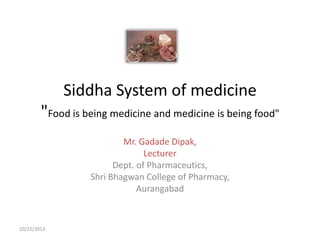
Siddha System of medicine
"Food is being medicine and medicine is being food"
Mr. Gadade Dipak,
Lecturer
Dept. of Pharmaceutics,
Shri Bhagwan College of Pharmacy,
Aurangabad

10/22/2013
10/22/2013
Introduction
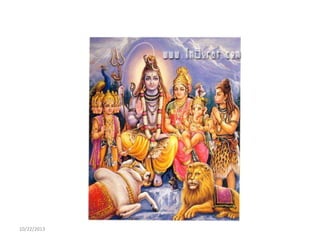
God Shiva who unfolded the knowledge of
Siddha system of medicine to his concert
Parvati who handed it down to Nandi Deva & he
the Siddhars.

Siddhars

adopted

principles

of

Shaiva

Siddhantham.
Siddhars in olden days followed and adopted the
principles

for

preparing

herbal, minerals and metals

10/22/2013

all

medicines

like
Introduction

Developed in preayurvedic period with civilization
of Mohenzo-daro and Harappa in Indus river

valley, 6000-7000 years ago.
It was transplated in Southern India by Dravidian
people about 2500 years ago.
Siddhars

classified

diseases

in

different

categories and accounted for total 4448 diseases

in human body.
10/22/2013
INTRODUCTION
They

mentioned

incurable

about

the

curable

and

diseases along with the symptoms of

the body and predicted the concerned, proper
medicines also.
Thousands of herbs & minerals were included in
siddha sys. which are effective in managing

chronic, degenerative diseases, viral diseases and
heart diseases
10/22/2013
Introduction
Very simple herbal processes are advised by the
Siddhars

for

diseases

like

migraine,

Sinusitis,

Hypertension,

Diabetes

Mellitus, Gynaecological disturbances, leucoderma

and

psoriasis,

Asthmatic attacks,

piles

and

pistula, Rheumatisms, Dental problems etc.
It has proven its promise
Hemoglobin as well as

to improve the

immunization of AIDS

patients without any side effects

10/22/2013
Introduction
Agathiyar was considered the prominent
leader with his later Lord Subramaniyar
Agastya & Aryan Sages were also
contributed to dvpt. „Agattiyar Charakku‟
imp. Tamil work ascribed to them
Turumullar
was founder various siddha
schools in India
Bogar, a taoist chinese worked extensively
on medicine and alchemy
Pullpari was another chinese settelled in
10/22/2013
Tamilnadu
Theory & Basic Principles
This principles and doctrines of this
system,
both
fundamental
and
applied, have a close similarity to
Ayurveda, with specialization in Iatrochemistry. According to this system the
human body is the replica of the
universe and so are the food and drugs
irrespective of their origin.
10/22/2013
Theory & Basic Principles
The
five
major
concept
of
Panchmahabhutas,
are
named
as
Nilam, Neer, Neruppu, Kattru and
Veli, which are respectively in hands
known as Prithivi (Earth), Appu
(water,), Theyu (fire), Vayu(air ), and
Akash (sky)
Imbalanced ratio of panchamahabhutas
may cause disease
10/22/2013
Theory & Basic Principles
As in Ayurveda, this system also considers
the human body as a conglomeration of
three humors, basic tissues and the waste
products of the body such as feces, urine
and sweat. The food is considered to be
basic building material of human body
which gets processed into humors, body
tissues and waste products.
Equilibrium –> health whilw disturbance or
imbalance -> disease or sickness.
10/22/2013
Theory & Basic Principles
Based on principles of Triguna
Vata, pitta and Kapha

Believed as its origin itsellf in foetal

dvpt. stages in mothers womb
These imbalanced due to

nutritional, physical and environmental
conditions

10/22/2013
Theory & Basic Principles
Predominance of triguna according to
time in a day is as below6.00 am to 10.00 am-Vata

10.00 am to 2.00 pm- Pitta
2.00 pm to 6.oo pm- Kapha

Same order of time followed by body in
night

10/22/2013
Theory & Basic Principles…
Vata Guna:
Chr‟s- stout, black, cold & inactive
personality
Increased vata develops flatulence,
acidity, dysentry, obesity,etc
Individuals show arogent behaviour,
partial paralysis, heart attack, neck &
chest pain, etc.

10/22/2013
Theory & Basic Principles…
Pitta Guna:
Chr‟s: lean, wheatish complexion, hot
personality
Increased pitta results in early
greying of hairs, reddish eyes & more
sexual desire
Individuals suffer from
anemia, burning chest, mental
derangement, etc.
10/22/2013
Theory & Basic Principles…
Kapha Guna:
Chr‟s: well build, good
complexion, good behaved personality
More afiinity towards sweet food &
sex
Incresed Kapha develops diseases like
jaundice, heart
attack, fever, anemia,etc.
10/22/2013
Diagnosis
The diagnosis of diseases involve
identifying it causes.
Physician
generally
identifies
of
causative factors thr‟ exam. of Nadi
(pulse), Dhwani (speech/voice), Twaka
(tongue), Deiham (Body), Malam (Feaces
and
the
status
of
digestive
system), Mutram (urine), Vizhi (Eyes
color)
10/22/2013
Diagnosis
The system has worked out details
procedure of urine examination which
includes
study
of
it‟s
color, smell, density, quantity and oil
drop spreading pattern.
For any diseases due to infection or
otherwise,
the
treatment
is
individualistic on examination of that
particular patient
10/22/2013
Diagnosis
Pulse reading is imp. & helpful in
diagnosis. Pulse changes with balance of
triguna.
Full nadi indicates asthama & ½ or ¼ nadi
denotes pain, arthritis & swelling, etc.
Abnormal intense pulse shows T.B.
10/22/2013
Diagnosis
If pulse propagates to left side it
denotes loss of self control while
propagation to right side shows sign of
death.
Voice with high sound shows piita & low
sound denotes low B.P.
Tounge with boils shows imbalance of
vata, sense of bitterness denotes pitta
& white slimy tongue shows low B.P.
10/22/2013
Diagnosis
Body with vibration shows vatta. Hot &
cold body is indicative of pitta & kapha
respectively.
Study of color of fecal matter, urine &
eyes gives idea of imbalance of triguna.
Darker color indicates vata,
Greenish/ reddish color indicates pitta &
Whitish color shows kapha.
10/22/2013
Treatment
Treatment based on all diagnostic chr‟s
of patient
Treatment also takes into account
environment, age, sex, race, habits, men
tal
status, habitat, diet, appetite, physical
condition, physiological constitution, etc.
Vaidya (Physician) has knowledge of
herbs & their effectiveness in specific
diseases

10/22/2013
Treatment
Siddha
formulary
extensively
incorporates drugs of vegetable, animal
and mineral origin.
It described the drugs made from the
metals and nonmetals. Use of the
mercury, gold, silver, sulphur, zinc,
copper sulphate, alum, borax, mica,
asbestos and arsenic is widespread.
10/22/2013
Treatment
It also mentions the drugs from animal
secretions like Civet and musk, shells
and bones of aquatic animals, deer homs
and animal flesh

10/22/2013
Treatment
Siddha system also prescribes medicines for
menarche and post menopausal states to
strenthen reproductive system and to deals
with harmonal imbalances respectively.
Siddha System believes in the principle of
“Food itself is medicine” and during this nursing
period, lactating mothers are advised to take
the food rich in iron, protein and fibre so as to
prevent any nutritional disorders both to the
child as well as the mothers.

10/22/2013
Diet during Treatment
„Patthya‟ - some restrictions on the diet
during treatment. Avoiding certain food
types which otherwise aggravate the
balance of triguna and disturb the
curative abilities of medicine.
No
restrictions
for
wheat, milk, ghee, pulse, tender
vegetables,
goat
meat,
sugar
turmeric, black pepper etc. and the
patients may take the food prepared

10/22/2013
Siddha Formulations
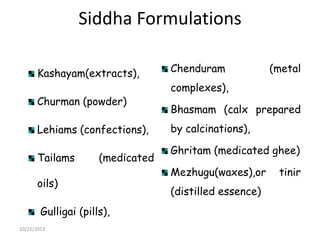
Kashayam(extracts),
Churman (powder)
Lehiams (confections),
Tailams

(medicated

oils)
Gulligai (pills),
10/22/2013

Chenduram

(metal

complexes),
Bhasmam (calx prepared
by calcinations),
Ghritam (medicated ghee)
Mezhugu(waxes),or

(distilled essence)

tinir
Types of formulations in Siddha
System

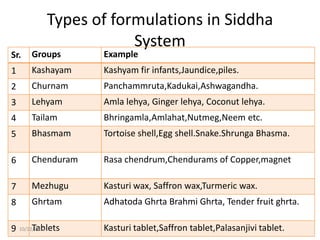
Sr.

Groups

Example

1

Kashayam

Kashyam fir infants,Jaundice,piles.

2

Churnam

Panchammruta,Kadukai,Ashwagandha.

3

Lehyam

Amla lehya, Ginger lehya, Coconut lehya.

4

Tailam

Bhringamla,Amlahat,Nutmeg,Neem etc.

5

Bhasmam

Tortoise shell,Egg shell.Snake.Shrunga Bhasma.

6

Chenduram

Rasa chendrum,Chendurams of Copper,magnet

7

Mezhugu

Kasturi wax, Saffron wax,Turmeric wax.

8

Ghrtam

Adhatoda Ghrta Brahmi Ghrta, Tender fruit ghrta.

Tablets

Kasturi tablet,Saffron tablet,Palasanjivi tablet.

9

10/22/2013
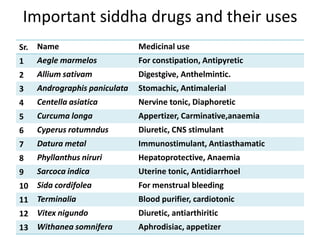
Important siddha drugs and their uses
Sr.

Name

Medicinal use

1

Aegle marmelos

For constipation, Antipyretic

2

Allium sativam

Digestgive, Anthelmintic.

3

Andrographis paniculata

Stomachic, Antimalerial

4

Centella asiatica

Nervine tonic, Diaphoretic

5

Curcuma longa

Appertizer, Carminative,anaemia

6

Cyperus rotumndus

Diuretic, CNS stimulant

7

Datura metal

Immunostimulant, Antiasthamatic

8

Phyllanthus niruri

Hepatoprotective, Anaemia

9

Sarcoca indica

Uterine tonic, Antidiarrhoel

10 Sida cordifolea
11 Terminalia

For menstrual bleeding

12 Vitex nigundo
13 Withanea somnifera

Diuretic, antiarthiritic

Blood purifier, cardiotonic
Aphrodisiac, appetizer
References
• http://www.sysindia.com/medical/aboutsiddh
a.html
• http://indianmedicine.nic.in/siddha.asp

10/22/2013

Siddhasystemofmedicine 110322064502-phpapp01

  • 1.
    Siddha System ofmedicine "Food is being medicine and medicine is being food" Mr. Gadade Dipak, Lecturer Dept. of Pharmaceutics, Shri Bhagwan College of Pharmacy, Aurangabad 10/22/2013
  • 2.
  • 3.
    Introduction God Shiva whounfolded the knowledge of Siddha system of medicine to his concert Parvati who handed it down to Nandi Deva & he the Siddhars. Siddhars adopted principles of Shaiva Siddhantham. Siddhars in olden days followed and adopted the principles for preparing herbal, minerals and metals 10/22/2013 all medicines like
  • 4.
    Introduction Developed in preayurvedicperiod with civilization of Mohenzo-daro and Harappa in Indus river valley, 6000-7000 years ago. It was transplated in Southern India by Dravidian people about 2500 years ago. Siddhars classified diseases in different categories and accounted for total 4448 diseases in human body. 10/22/2013
  • 5.
    INTRODUCTION They mentioned incurable about the curable and diseases along withthe symptoms of the body and predicted the concerned, proper medicines also. Thousands of herbs & minerals were included in siddha sys. which are effective in managing chronic, degenerative diseases, viral diseases and heart diseases 10/22/2013
  • 6.
    Introduction Very simple herbalprocesses are advised by the Siddhars for diseases like migraine, Sinusitis, Hypertension, Diabetes Mellitus, Gynaecological disturbances, leucoderma and psoriasis, Asthmatic attacks, piles and pistula, Rheumatisms, Dental problems etc. It has proven its promise Hemoglobin as well as to improve the immunization of AIDS patients without any side effects 10/22/2013
  • 7.
    Introduction Agathiyar was consideredthe prominent leader with his later Lord Subramaniyar Agastya & Aryan Sages were also contributed to dvpt. „Agattiyar Charakku‟ imp. Tamil work ascribed to them Turumullar was founder various siddha schools in India Bogar, a taoist chinese worked extensively on medicine and alchemy Pullpari was another chinese settelled in 10/22/2013 Tamilnadu
  • 8.
    Theory & BasicPrinciples This principles and doctrines of this system, both fundamental and applied, have a close similarity to Ayurveda, with specialization in Iatrochemistry. According to this system the human body is the replica of the universe and so are the food and drugs irrespective of their origin. 10/22/2013
  • 9.
    Theory & BasicPrinciples The five major concept of Panchmahabhutas, are named as Nilam, Neer, Neruppu, Kattru and Veli, which are respectively in hands known as Prithivi (Earth), Appu (water,), Theyu (fire), Vayu(air ), and Akash (sky) Imbalanced ratio of panchamahabhutas may cause disease 10/22/2013
  • 10.
    Theory & BasicPrinciples As in Ayurveda, this system also considers the human body as a conglomeration of three humors, basic tissues and the waste products of the body such as feces, urine and sweat. The food is considered to be basic building material of human body which gets processed into humors, body tissues and waste products. Equilibrium –> health whilw disturbance or imbalance -> disease or sickness. 10/22/2013
  • 11.
    Theory & BasicPrinciples Based on principles of Triguna Vata, pitta and Kapha Believed as its origin itsellf in foetal dvpt. stages in mothers womb These imbalanced due to nutritional, physical and environmental conditions 10/22/2013
  • 12.
    Theory & BasicPrinciples Predominance of triguna according to time in a day is as below6.00 am to 10.00 am-Vata 10.00 am to 2.00 pm- Pitta 2.00 pm to 6.oo pm- Kapha Same order of time followed by body in night 10/22/2013
  • 13.
    Theory & BasicPrinciples… Vata Guna: Chr‟s- stout, black, cold & inactive personality Increased vata develops flatulence, acidity, dysentry, obesity,etc Individuals show arogent behaviour, partial paralysis, heart attack, neck & chest pain, etc. 10/22/2013
  • 14.
    Theory & BasicPrinciples… Pitta Guna: Chr‟s: lean, wheatish complexion, hot personality Increased pitta results in early greying of hairs, reddish eyes & more sexual desire Individuals suffer from anemia, burning chest, mental derangement, etc. 10/22/2013
  • 15.
    Theory & BasicPrinciples… Kapha Guna: Chr‟s: well build, good complexion, good behaved personality More afiinity towards sweet food & sex Incresed Kapha develops diseases like jaundice, heart attack, fever, anemia,etc. 10/22/2013
  • 16.
    Diagnosis The diagnosis ofdiseases involve identifying it causes. Physician generally identifies of causative factors thr‟ exam. of Nadi (pulse), Dhwani (speech/voice), Twaka (tongue), Deiham (Body), Malam (Feaces and the status of digestive system), Mutram (urine), Vizhi (Eyes color) 10/22/2013
  • 17.
    Diagnosis The system hasworked out details procedure of urine examination which includes study of it‟s color, smell, density, quantity and oil drop spreading pattern. For any diseases due to infection or otherwise, the treatment is individualistic on examination of that particular patient 10/22/2013
  • 18.
    Diagnosis Pulse reading isimp. & helpful in diagnosis. Pulse changes with balance of triguna. Full nadi indicates asthama & ½ or ¼ nadi denotes pain, arthritis & swelling, etc. Abnormal intense pulse shows T.B. 10/22/2013
  • 19.
    Diagnosis If pulse propagatesto left side it denotes loss of self control while propagation to right side shows sign of death. Voice with high sound shows piita & low sound denotes low B.P. Tounge with boils shows imbalance of vata, sense of bitterness denotes pitta & white slimy tongue shows low B.P. 10/22/2013
  • 20.
    Diagnosis Body with vibrationshows vatta. Hot & cold body is indicative of pitta & kapha respectively. Study of color of fecal matter, urine & eyes gives idea of imbalance of triguna. Darker color indicates vata, Greenish/ reddish color indicates pitta & Whitish color shows kapha. 10/22/2013
  • 21.
    Treatment Treatment based onall diagnostic chr‟s of patient Treatment also takes into account environment, age, sex, race, habits, men tal status, habitat, diet, appetite, physical condition, physiological constitution, etc. Vaidya (Physician) has knowledge of herbs & their effectiveness in specific diseases 10/22/2013
  • 22.
    Treatment Siddha formulary extensively incorporates drugs ofvegetable, animal and mineral origin. It described the drugs made from the metals and nonmetals. Use of the mercury, gold, silver, sulphur, zinc, copper sulphate, alum, borax, mica, asbestos and arsenic is widespread. 10/22/2013
  • 23.
    Treatment It also mentionsthe drugs from animal secretions like Civet and musk, shells and bones of aquatic animals, deer homs and animal flesh 10/22/2013
  • 24.
    Treatment Siddha system alsoprescribes medicines for menarche and post menopausal states to strenthen reproductive system and to deals with harmonal imbalances respectively. Siddha System believes in the principle of “Food itself is medicine” and during this nursing period, lactating mothers are advised to take the food rich in iron, protein and fibre so as to prevent any nutritional disorders both to the child as well as the mothers. 10/22/2013
  • 25.
    Diet during Treatment „Patthya‟- some restrictions on the diet during treatment. Avoiding certain food types which otherwise aggravate the balance of triguna and disturb the curative abilities of medicine. No restrictions for wheat, milk, ghee, pulse, tender vegetables, goat meat, sugar turmeric, black pepper etc. and the patients may take the food prepared 10/22/2013
  • 26.
    Siddha Formulations Kashayam(extracts), Churman (powder) Lehiams(confections), Tailams (medicated oils) Gulligai (pills), 10/22/2013 Chenduram (metal complexes), Bhasmam (calx prepared by calcinations), Ghritam (medicated ghee) Mezhugu(waxes),or (distilled essence) tinir
  • 27.
    Types of formulationsin Siddha System Sr. Groups Example 1 Kashayam Kashyam fir infants,Jaundice,piles. 2 Churnam Panchammruta,Kadukai,Ashwagandha. 3 Lehyam Amla lehya, Ginger lehya, Coconut lehya. 4 Tailam Bhringamla,Amlahat,Nutmeg,Neem etc. 5 Bhasmam Tortoise shell,Egg shell.Snake.Shrunga Bhasma. 6 Chenduram Rasa chendrum,Chendurams of Copper,magnet 7 Mezhugu Kasturi wax, Saffron wax,Turmeric wax. 8 Ghrtam Adhatoda Ghrta Brahmi Ghrta, Tender fruit ghrta. Tablets Kasturi tablet,Saffron tablet,Palasanjivi tablet. 9 10/22/2013
  • 28.
    Important siddha drugsand their uses Sr. Name Medicinal use 1 Aegle marmelos For constipation, Antipyretic 2 Allium sativam Digestgive, Anthelmintic. 3 Andrographis paniculata Stomachic, Antimalerial 4 Centella asiatica Nervine tonic, Diaphoretic 5 Curcuma longa Appertizer, Carminative,anaemia 6 Cyperus rotumndus Diuretic, CNS stimulant 7 Datura metal Immunostimulant, Antiasthamatic 8 Phyllanthus niruri Hepatoprotective, Anaemia 9 Sarcoca indica Uterine tonic, Antidiarrhoel 10 Sida cordifolea 11 Terminalia For menstrual bleeding 12 Vitex nigundo 13 Withanea somnifera Diuretic, antiarthiritic Blood purifier, cardiotonic Aphrodisiac, appetizer
  • 29.