PARACOMPACT
SPACE
Sumit kumar Bajpeyee
( Ph.D Scholar)
Mahatma Gandhi Central
University (Motihari)
Title and Content
1. INTRODUCTION
2. GENERAL INTRODUCTION
3. SCOPE AND LIMITATION
4. AIM AND OBJECTIVES
5. HISTORICAL BACKGROUND
6. HISTORICAL DEVELOPMENT OF THE CONCEPT OF COMPACTNESS AND
PARACOMPACTNESS
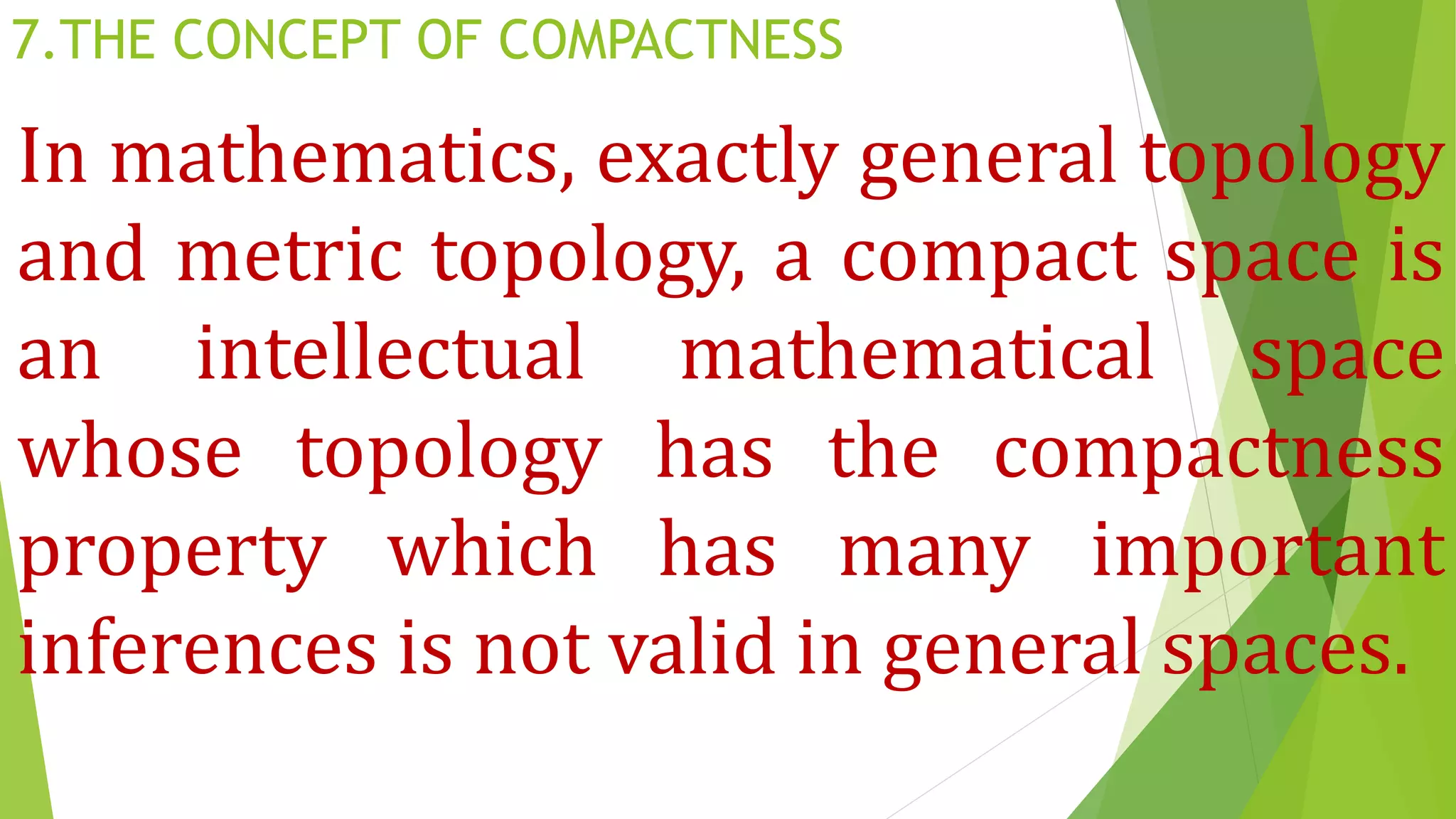
7.THE CONCEPT OF COMPACTNESS
8. PRELIMINARIES FOR COMPACT SPACE
9. USES /APPLICATION OF COMPACTNESS
10. PARACOMPACT SPACE
11. PROPERTIES OF PARACOMPACT
12. PRELIMINARIES FOR PARACOMPACT SPACE
13. USE OF PARACOMPACT SPACE
14. COMPARISION OF PARACOMPACTNESS WITH
COMPACTNESS
1. INTRODUCTION
This Chapter focus on general
introduction of this literature work ,
Which includes aim and objective,
some scope and limitation and
definition for some basic terms in this
literature survey
During this paper we discuss about
paracompactness it’s history and its use
in topology. Paracompact space is used
in many area such as in topology and
differential geometry. Such as in
differential manifold.
Compactness is one of the various
covering properties of topological
spaces. A very important property of
spaces used in many ways in many
different areas of mathematics.
2. GENERAL INTRODUCTION
Mathematic starts with counting and
then later became the body of
knowledge centred on concepts such as
quantity, structures, space and change
and also academic discipline which
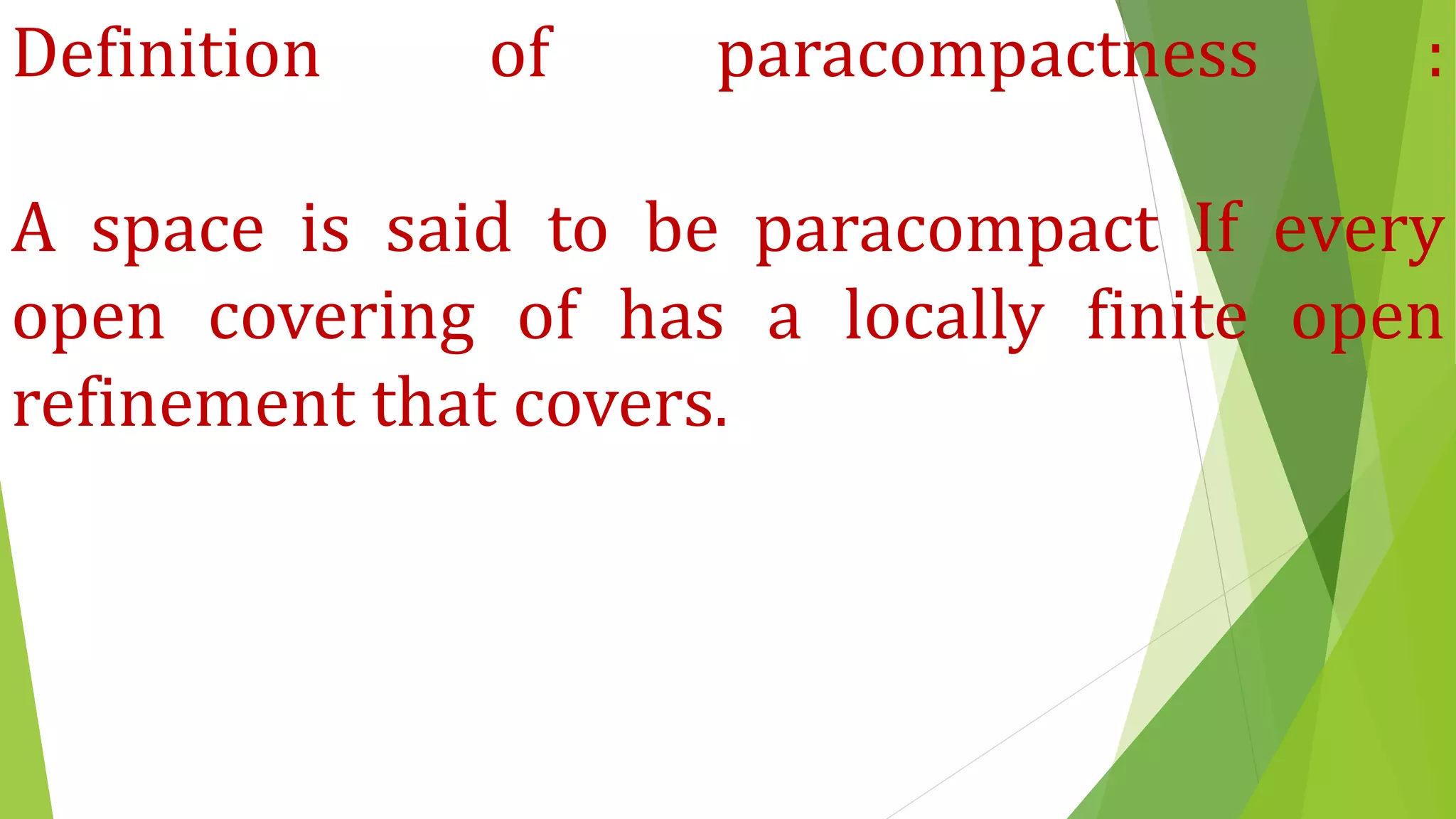
studies them
Benjamin Pierce called it
“The science that draw
necessary conclusion”.
Many branches of mathematics were
discovered, topology is one of these branches.
Topology is defined on spaces. We see the
general definition allows concepts which is
quite different mathematical objects to be
clasped intuitively by comparison with the
real numbers.
Likewise, the concept of a topological space is
concerned with generalizing the structure of sets
in Euclidean spaces. Interesting differences in the
structure of sets in Euclidean space which have
analogies in topological spaces are:
connectedness, compactness, dimensionality and
the presence of holes.
Speaking of compactness as a very
interesting structure of topological
spaces, we should centralize our mind in
talking about some open covers that
have necessarily a finite subcover of our
topological space.
3. SCOPE AND LIMITATION
This work lies beyond the scope of my
investigation on the concepts of compactness
and paracompactness. Therefore this work
will only consider the two concepts with
respect to topological space and sometimes
make reference out of topological space to
metric space.
4. AIM AND OBJECTIVES
AIM :- The main goal of this work is to
analysis the concept of paracompactness
OBJECTIVES :- To see paracompactness as a
more general convering properties of a space
than compactness where possible i.e to see
how compactness implies paracompactness
5. HISTORICAL BACKGROUND
In 1944 jean Alexander Eugene Dieudon
introduce the paracompact space. He was
French mathematician who was born on 1 july
1906.He had done a notable research in
Abstract Algebra , Geometry and a Functional
Analysis , His particular involvement in
Functional Analysis and Algebric Topology .
Paracompact space is also the part of topology.
Mathematician associate the development of
topology as a specific area of mathematics with
1895 publication of analysis situs by Frenchman
Henri Poincare although many topological idea
had found their way during the previous century
and half..
The Latin phrase analysis situs may be
interpret as analysis of position used in 1735
by swiss Mathematician Leonhard Euler to
describe the Konigsberg bridge problem. This
Konigsberg seven bridge problem is notable
problem in mathematics .
It’s negative resolution by Leonhard
Euler in 1736 Laid to found the graph
theory and it prefigured the idea of
topology.I n History of Mathematics
Euler’s solution of konigsbergs bridge
problem consider to be the first
theorem of graph theory.
During the 19 th century two distinct movement
developed that would ultimate produce the sibling
specialization of algebraic topology and general
topology . The first was characterised by attempt
to understand the topology aspects of surface like
object that arises by combining elementry shape
such as polygon.
Topology is the mathematical study of
the properties that are conserve through
contortion, twist, and stretch of objects.
Tearing, however, is not allowed. A circle
is topologically equivalent to an ellipse
and a sphere is tantamount to an
ellipsoid.
Similarly, the set of all possible
positions of the hour hand of a clock is
topologically equal to a circle. There is
more about to the topology, though. In
Topology we study about study of
curves, surfaces, and other objects in
the plane and three-space.
For example, let us take the statement "if we
remove a point from a circle, we get a line
segment" This applies just as well to the
circle as to an ellipse, and even to tangled or
knotted circles, since the statement involves
only topological properties. Topology can be
divided into algebraic topology , differential
topology,
Algebric Topology : Algebraic topology is the
study of intrinsic qualitative
aspects of spatial objects that remain invariant
under both-directions continuous one-to-one
(homeomorphic) transformations.
The discipline of
algebraic topology is popularly known as
"rubber-sheet geometry" and can
also be viewed as the study of dis connectivities.
Algebraic topology has a great deal of
mathematical machinery for studying
different kinds of hole structures, and it
gets the prefix "algebraic" since many
hole structures are represented best by
algebraic objects like groups and rings.
Differential Geometry :
The motivating force of topology, consisting
of the study of smooth (differentiable)
manifolds. Differential topology deals with
non metrical notions of manifolds, while
differential geometry deals with metrical
notions of manifolds.
HISTORICAL DEVELOPMENT OF THE CONCEPT OF
COMPACTNESS AND PARACOMPACTNESS
In the 19th century, some dissimilar mathematical
properties were understood that would far along be
seen as consequences of compactness. Bernard
Bolzano (1817) had been aware that any bounded
sequence of points has a subsequence that must
eventually get arbitrary close to some other points
called a limit point.
Bolzano’s proof relied on the method of
bisection: The sequence was located
into an interval that was then divided
into two equal parts, and a part
containing infinitely many terms of the
sequence was selected.
The process could then be repeated by dividing
the resulting smaller interval into smaller parts
until it closes down on the desired limit point. .
Bolzano’s proof relied on the method of
bisection: The sequence was located into an
interval that was then divided into two equal
parts, and a part containing infinitely many
terms of the sequence was selected.
The process could then be repeated by
dividing the resulting smaller interval into
smaller parts until it closes down on the
desired limit point. The full significance of
Bolzano’s Theorem and its method of proof
did not emerge until almost 50years later
(around 1867) when it was re-discovered by
Karl Weiestrass.
The reason for the change of the name of the
theorem to Bolzano-Weiestrass .In the
1880s, it became clear that results similar to
the Bolzano-Weiestrass theorem could be
formulated for spaces of functions rather
than just numbers or geometrical points.
It was Maurice Frechet who, in 1906 had
extracted the essence of the Bolzano-
Weiestrass property and created the term
compactness to refer to this general
phenomenon. In 1870, Eduard Heine showed
that a continuous function defined on a closed
and bounded interval was actually uniformly
continuous.
The Heine-Borel Theorem, as the result is
now identified, is another special property
owned by closed and bounded sets of real
numbers. This property was important
because it allowed for the passage from local
information about a set (such as the
continuity of a function) to global
information about the set
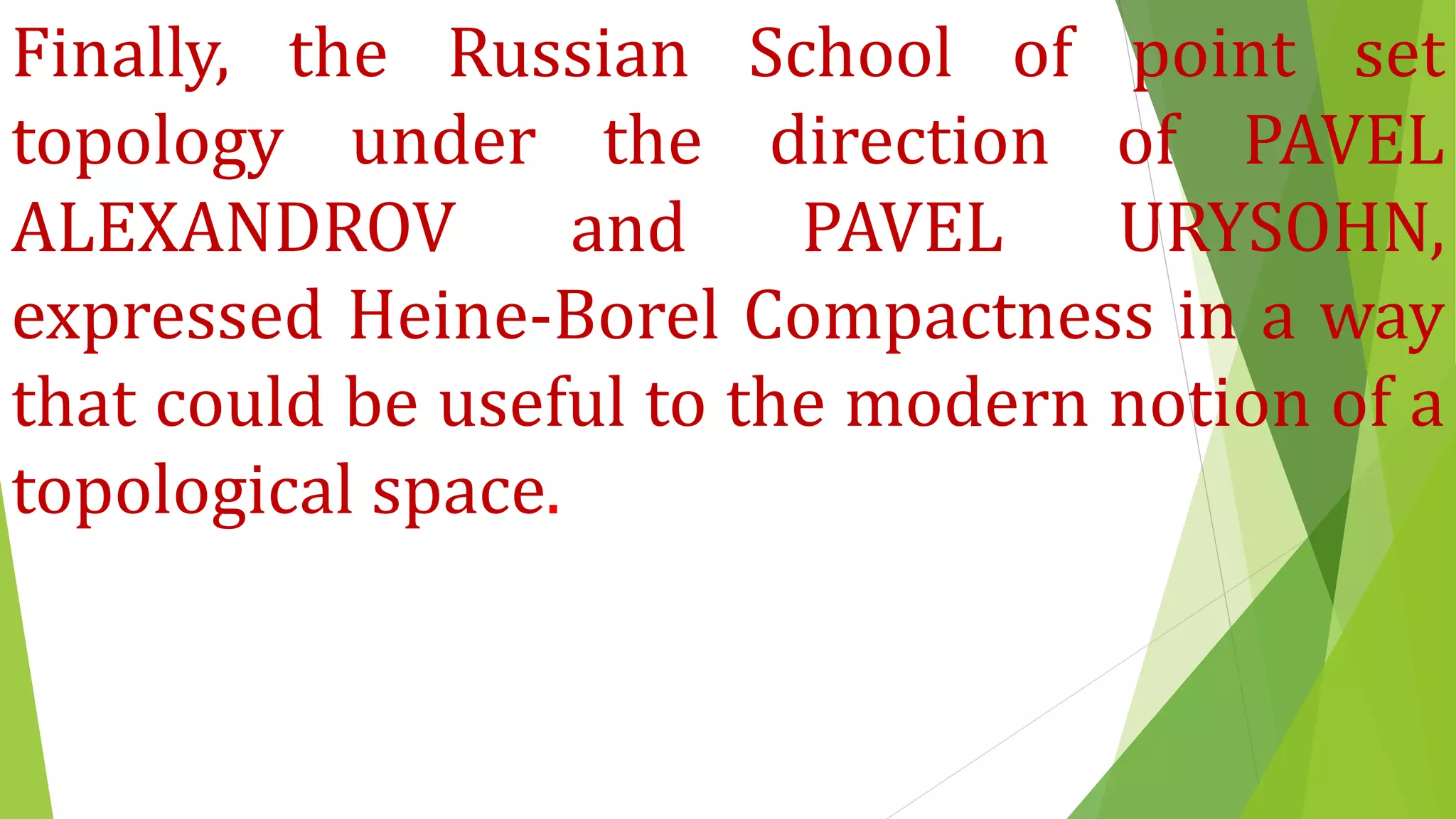
Finally, the Russian School of point set
topology under the direction of PAVEL
ALEXANDROV and PAVEL URYSOHN,
expressed Heine-Borel Compactness in a way
that could be useful to the modern notion of a
topological space.
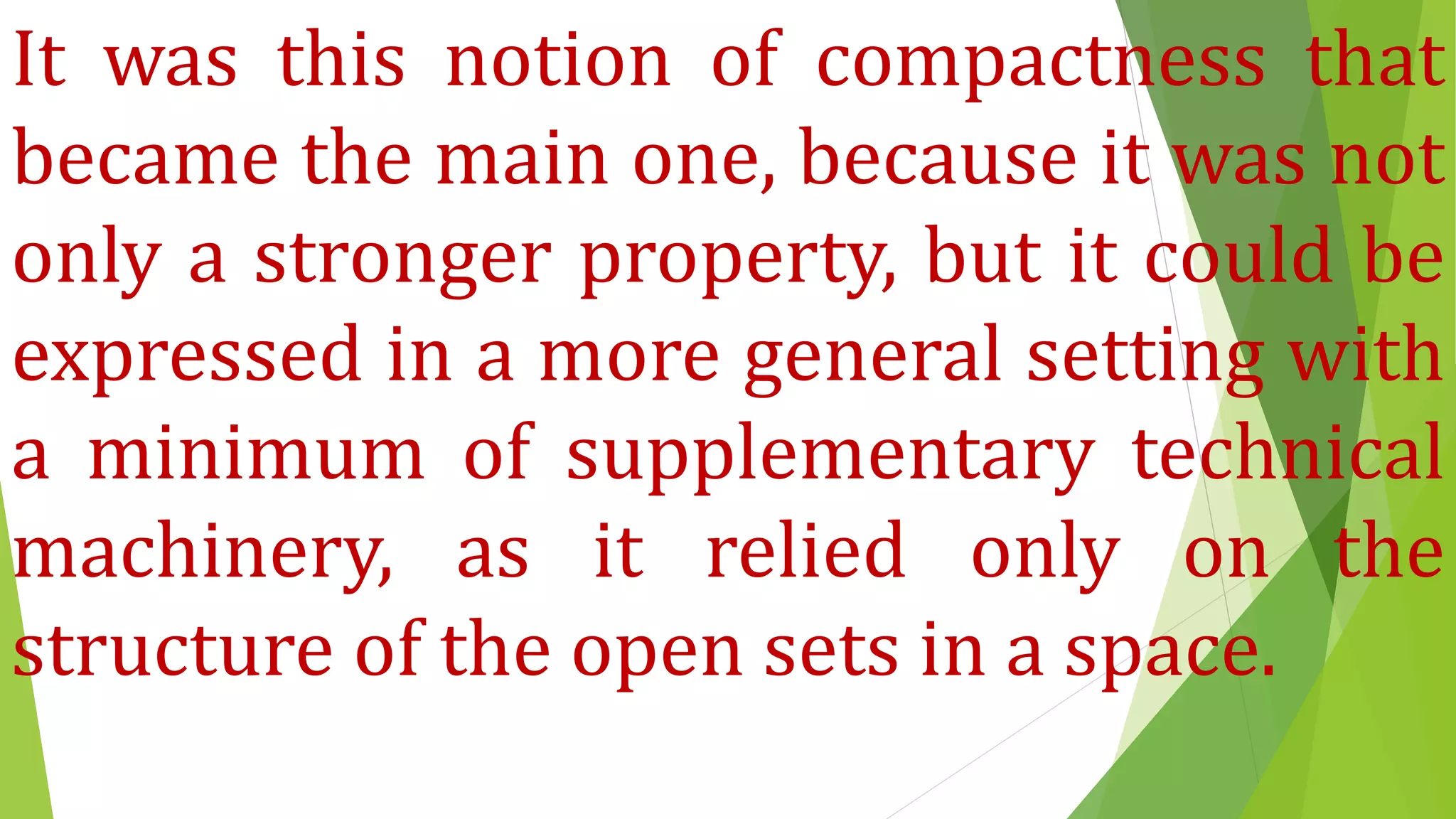
It was this notion of compactness that
became the main one, because it was not
only a stronger property, but it could be
expressed in a more general setting with
a minimum of supplementary technical
machinery, as it relied only on the
structure of the open sets in a space.
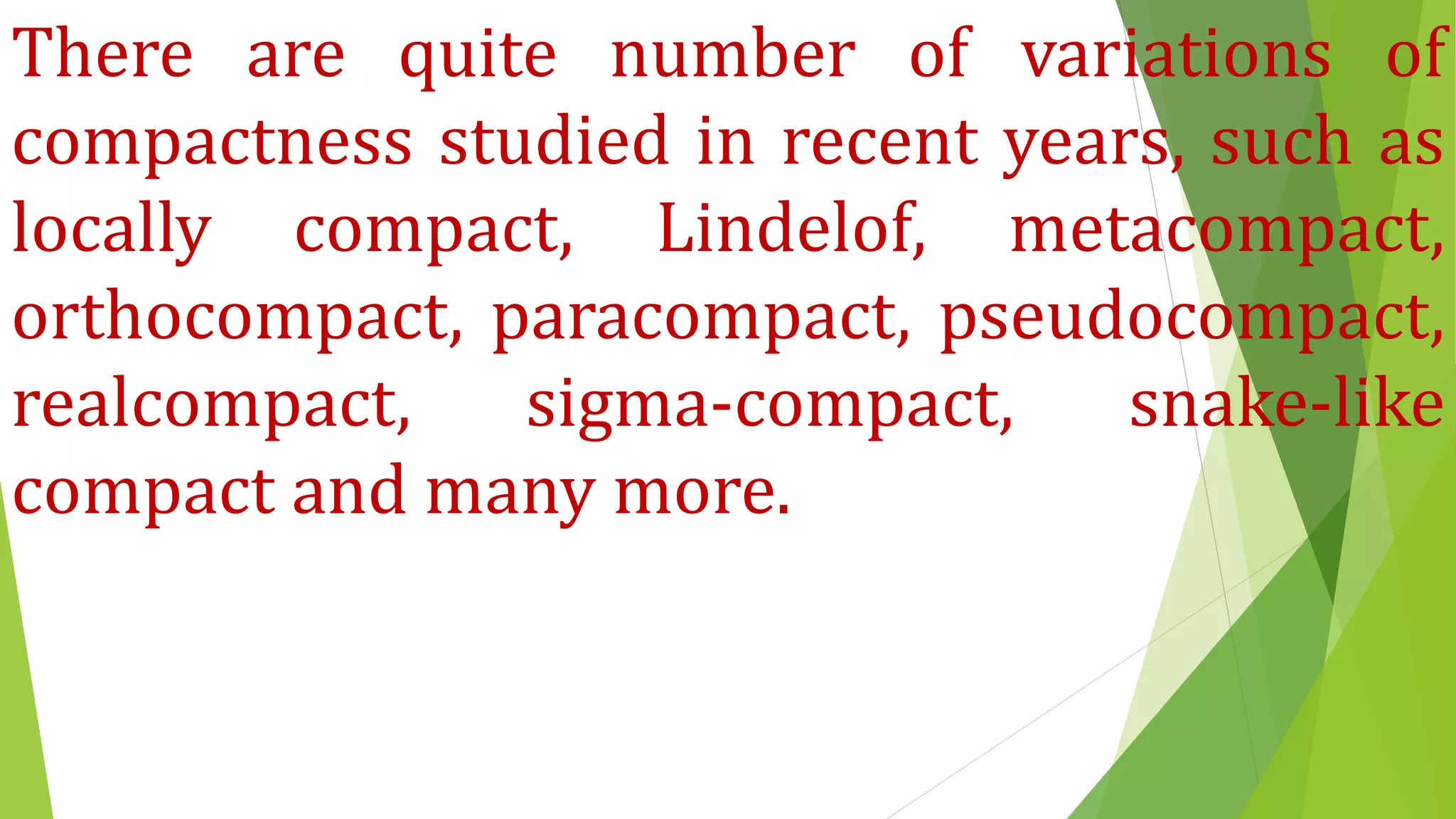
There are quite number of variations of
compactness studied in recent years, such as
locally compact, Lindelof, metacompact,
orthocompact, paracompact, pseudocompact,
realcompact, sigma-compact, snake-like
compact and many more.
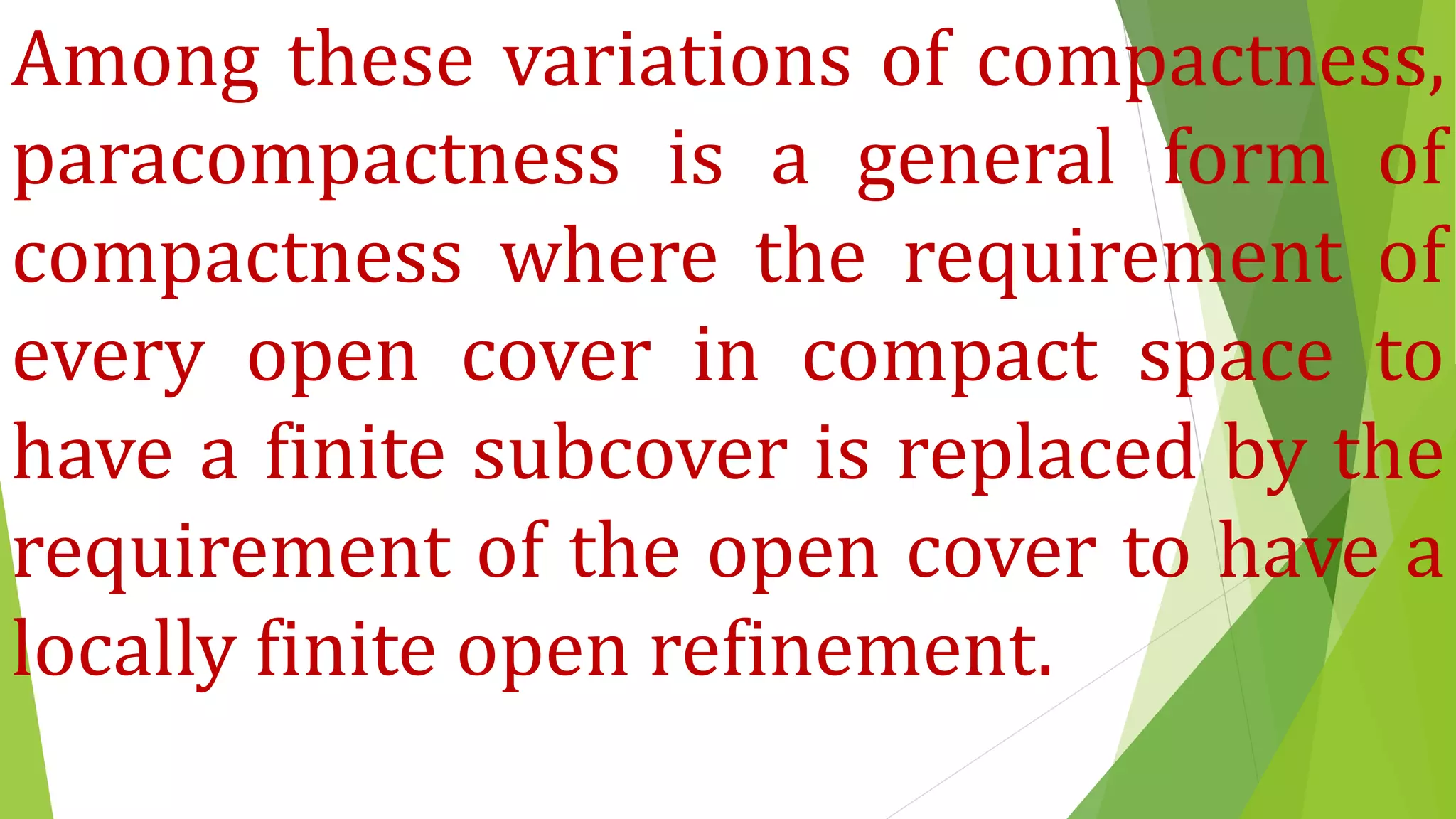
Among these variations of compactness,
paracompactness is a general form of
compactness where the requirement of
every open cover in compact space to
have a finite subcover is replaced by the
requirement of the open cover to have a
locally finite open refinement.
7.THE CONCEPT OF COMPACTNESS
In mathematics, exactly general topology
and metric topology, a compact space is
an intellectual mathematical space
whose topology has the compactness
property which has many important
inferences is not valid in general spaces.
Compactness is not very easy to describe
precisely in an instinctive manner; in
approximately sense, it says that the
topology allows the space to be well
thought-out as “small” (compactness is a
kind of topological counterpart to
finiteness of set), even though as a set, it
may be quite large.
Furthermore, more instinctive
characterizations of compactness are
often dependent on additional
properties of topological space to be
valid;
8. PRELIMINARIES FOR COMPACT SPACE
A collection of A of subset of a space X is said to
be cover of X or to be a covering of X, if the union
of elements of A is equal to X . It is called an open
covering of X if its elements are open subset of X.
Compact:- A space X is said to be compact if every
open covering A of X a finite sub collection that
also covers X.
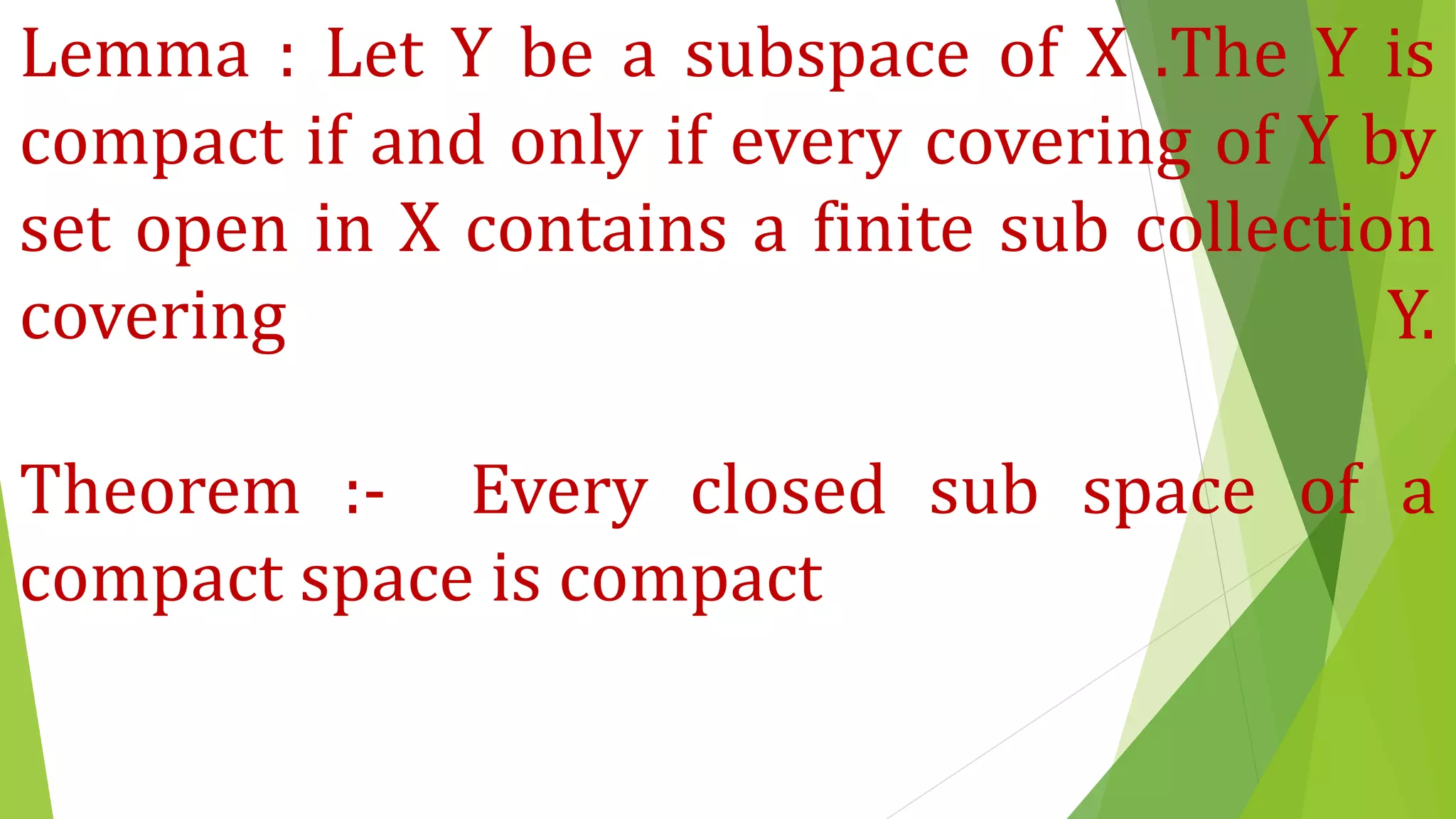
Lemma : Let Y be a subspace of X .The Y is
compact if and only if every covering of Y by
set open in X contains a finite sub collection
covering Y.
Theorem :- Every closed sub space of a
compact space is compact
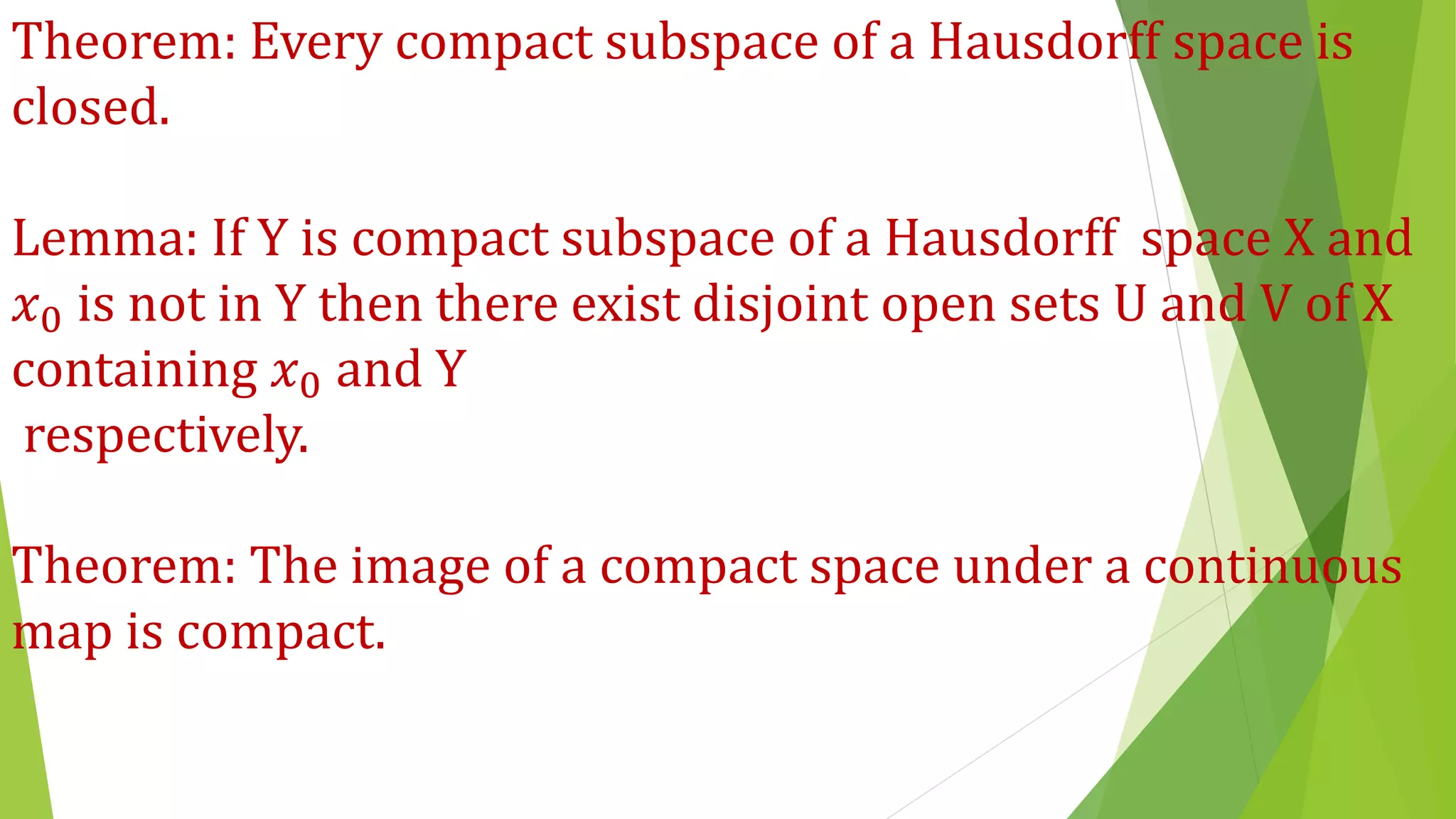
Theorem: Every compact subspace of a Hausdorff space is
closed.
Lemma: If Y is compact subspace of a Hausdorff space X and
𝑥0 is not in Y then there exist disjoint open sets U and V of X
containing 𝑥0 and Y
respectively.
Theorem: The image of a compact space under a continuous
map is compact.
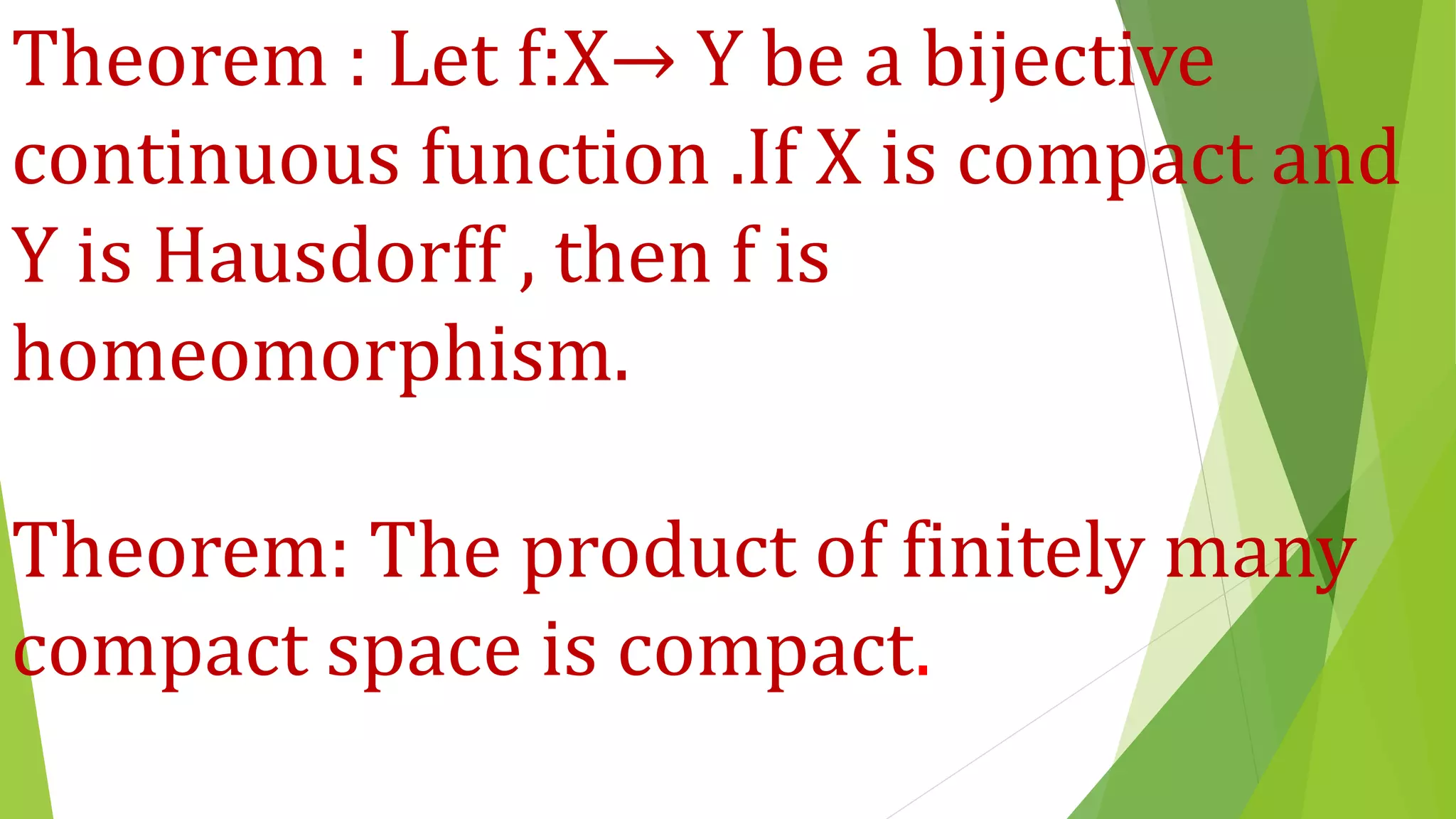
Theorem : Let f:X→ Y be a bijective
continuous function .If X is compact and
Y is Hausdorff , then f is
homeomorphism.
Theorem: The product of finitely many
compact space is compact.
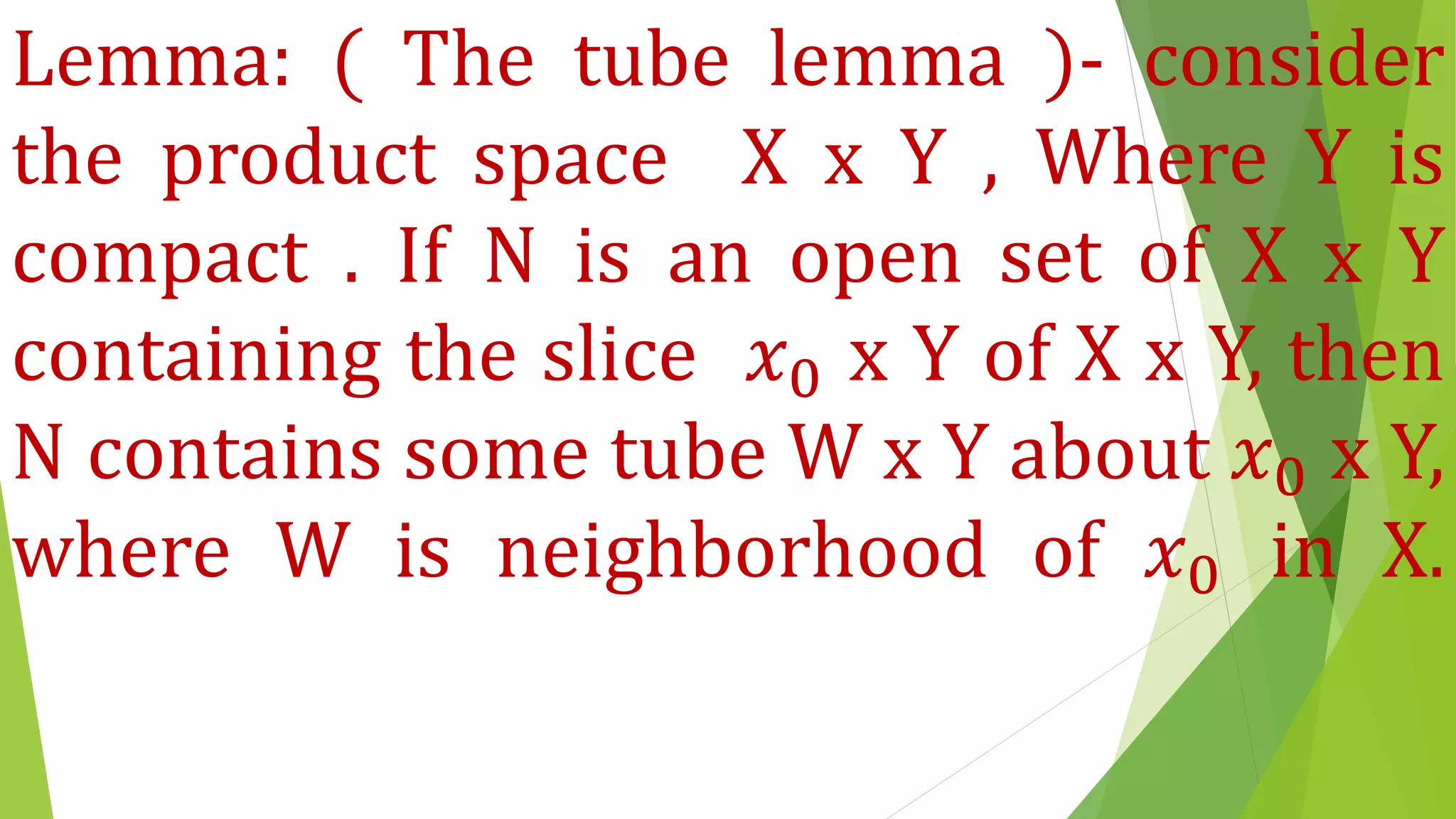
Lemma: ( The tube lemma )- consider
the product space X x Y , Where Y is
compact . If N is an open set of X x Y
containing the slice 𝑥0 x Y of X x Y, then
N contains some tube W x Y about 𝑥0 x Y,
where W is neighborhood of 𝑥0 in X.
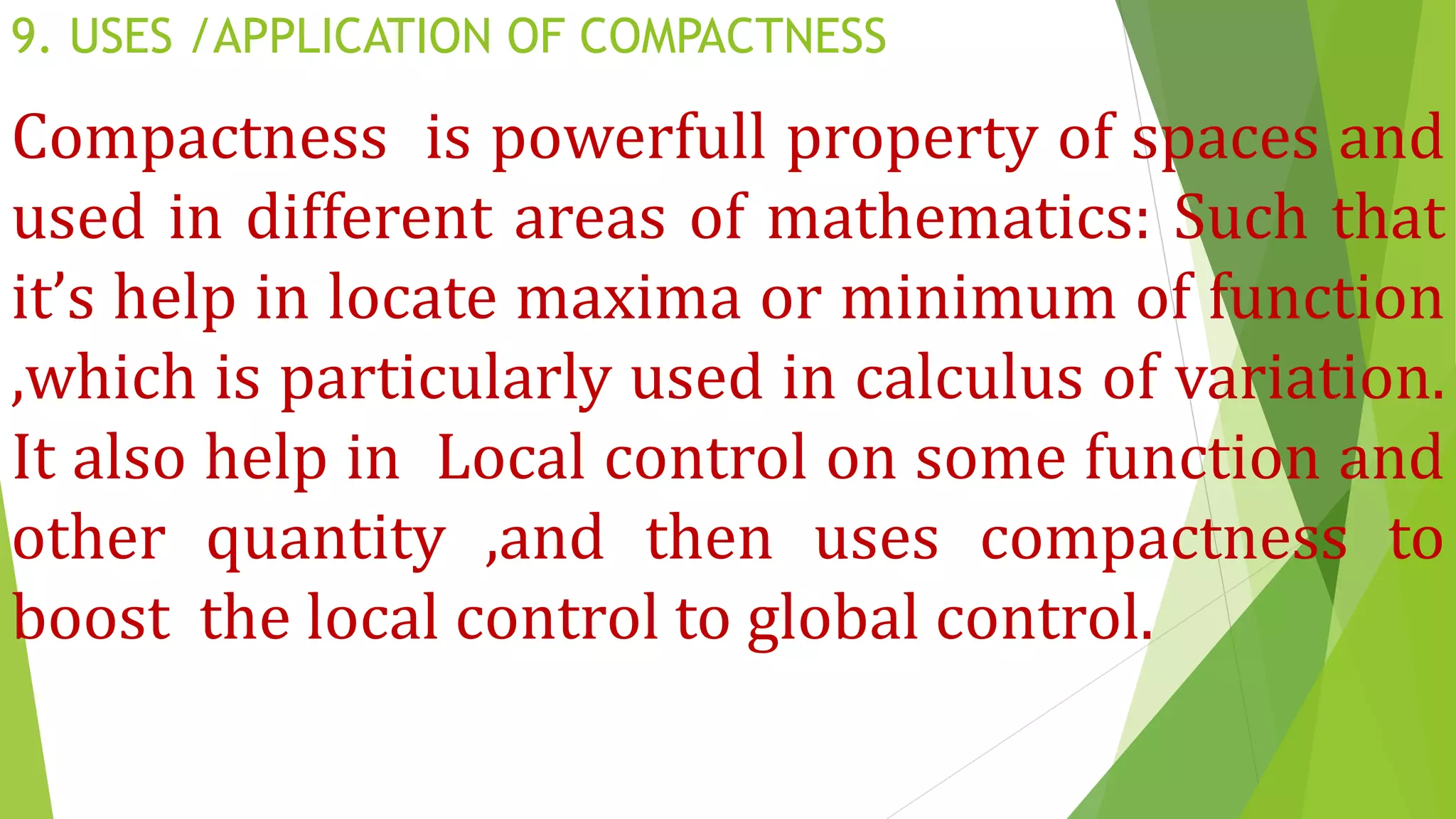
9. USES /APPLICATION OF COMPACTNESS
Compactness is powerfull property of spaces and
used in different areas of mathematics: Such that
it’s help in locate maxima or minimum of function
,which is particularly used in calculus of variation.
It also help in Local control on some function and
other quantity ,and then uses compactness to
boost the local control to global control.
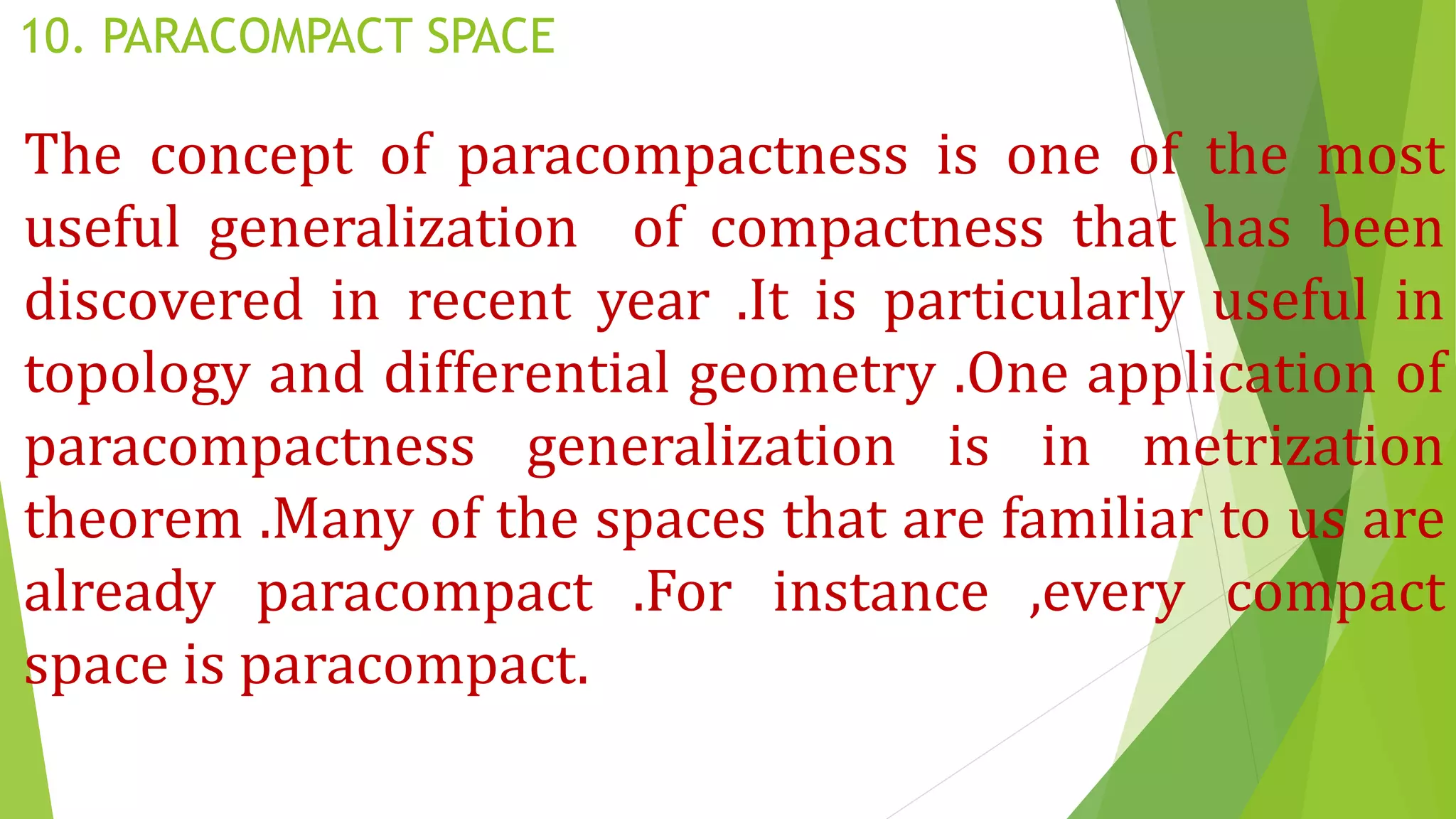
10. PARACOMPACT SPACE
The concept of paracompactness is one of the most
useful generalization of compactness that has been
discovered in recent year .It is particularly useful in
topology and differential geometry .One application of
paracompactness generalization is in metrization
theorem .Many of the spaces that are familiar to us are
already paracompact .For instance ,every compact
space is paracompact.
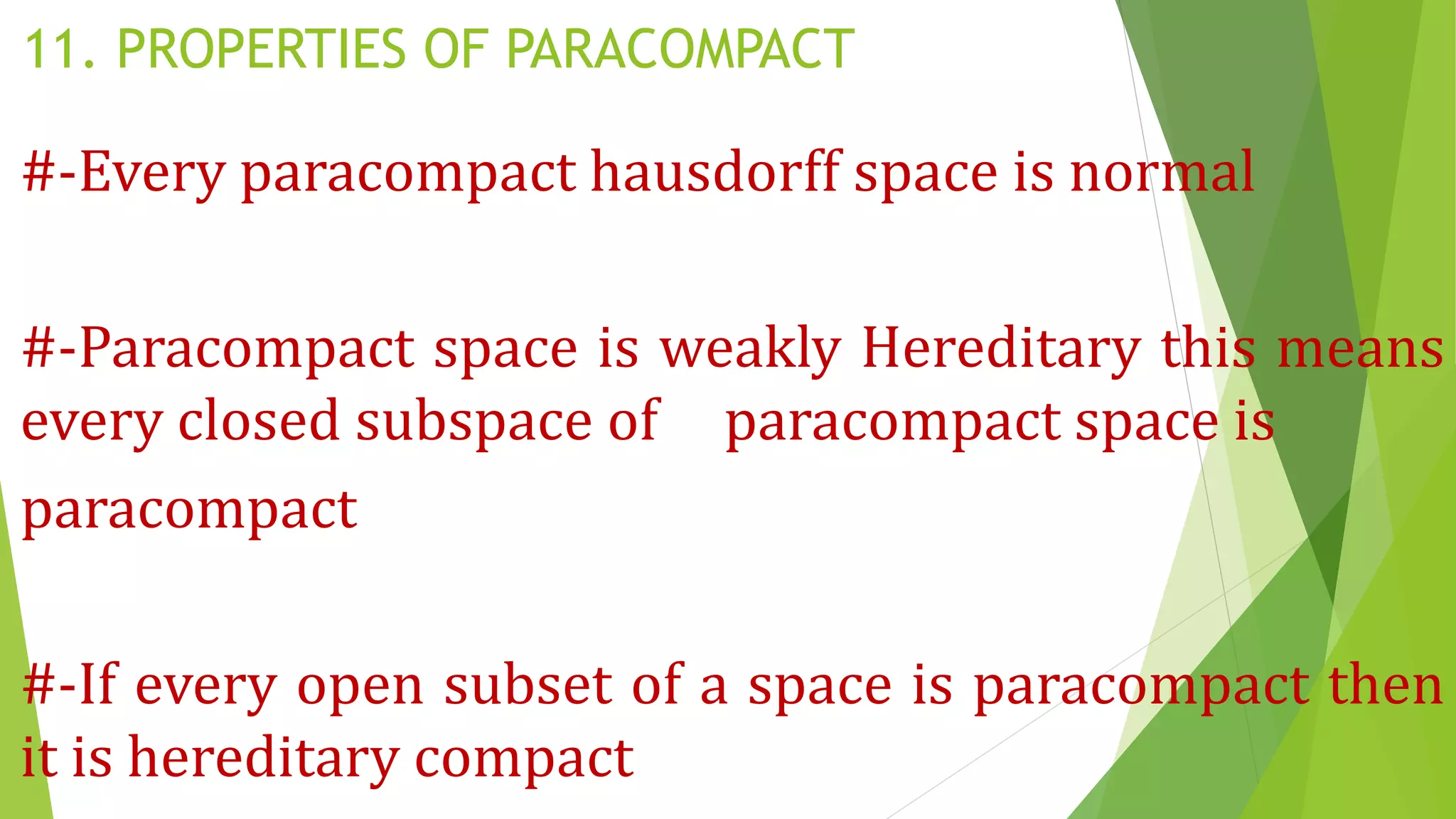
11. PROPERTIES OF PARACOMPACT
#-Every paracompact hausdorff space is normal
#-Paracompact space is weakly Hereditary this means
every closed subspace of paracompact space is
paracompact
#-If every open subset of a space is paracompact then
it is hereditary compact
Definition of paracompactness :
A space is said to be paracompact If every
open covering of has a locally finite open
refinement that covers.
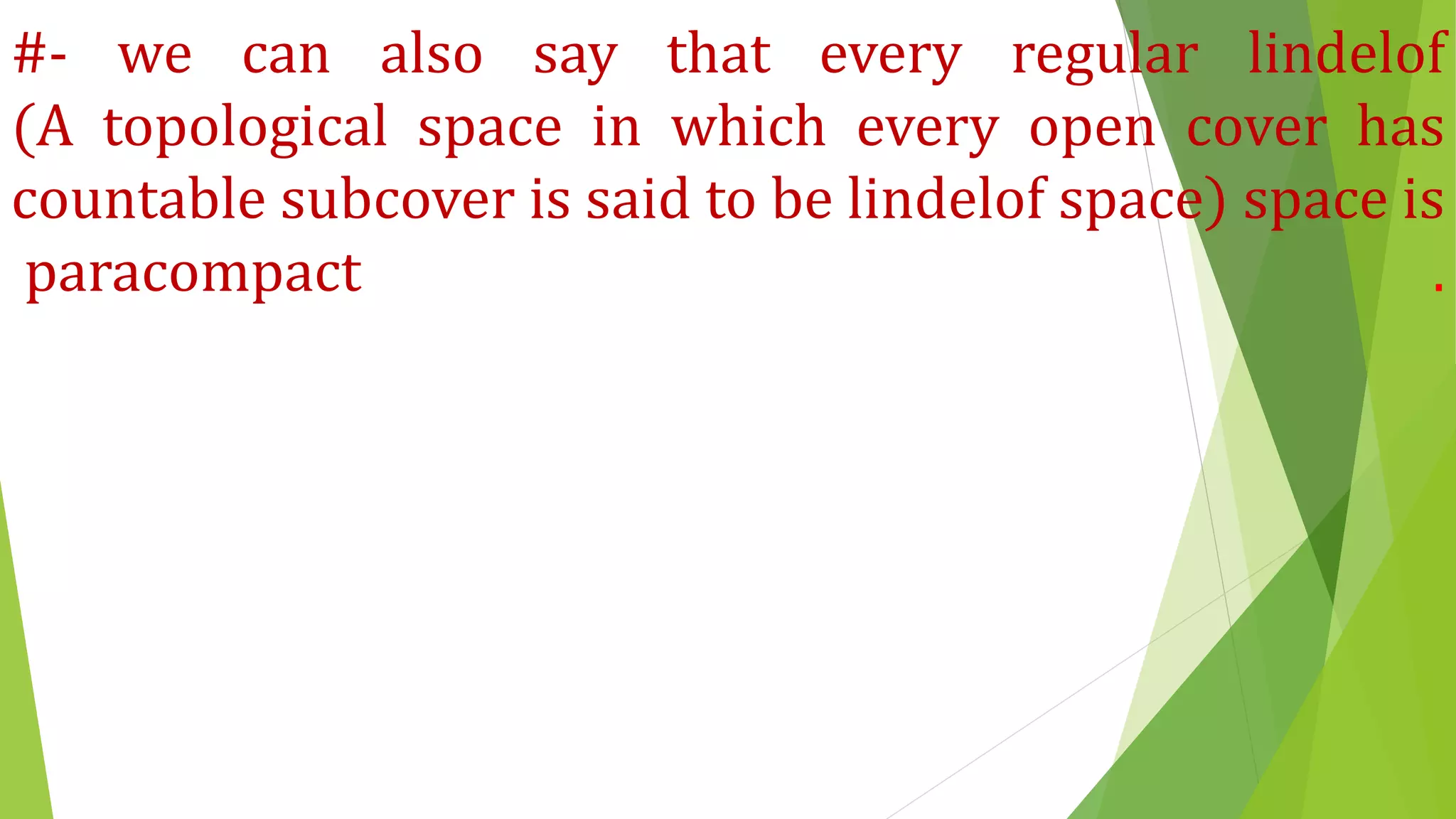
#- we can also say that every regular lindelof
(A topological space in which every open cover has
countable subcover is said to be lindelof space) space is
paracompact .
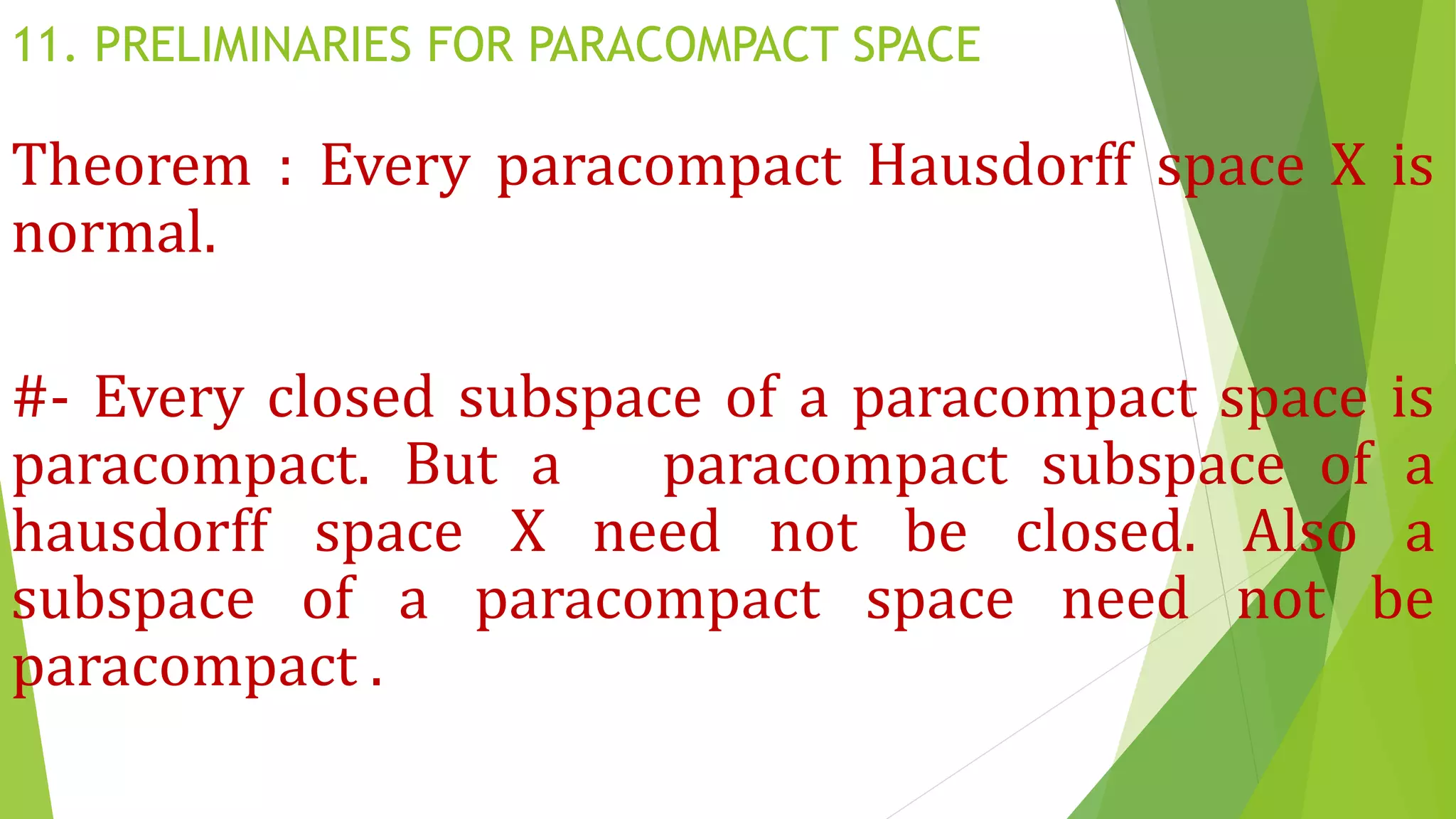
11. PRELIMINARIES FOR PARACOMPACT SPACE
Theorem : Every paracompact Hausdorff space X is
normal.
#- Every closed subspace of a paracompact space is
paracompact. But a paracompact subspace of a
hausdorff space X need not be closed. Also a
subspace of a paracompact space need not be
paracompact .
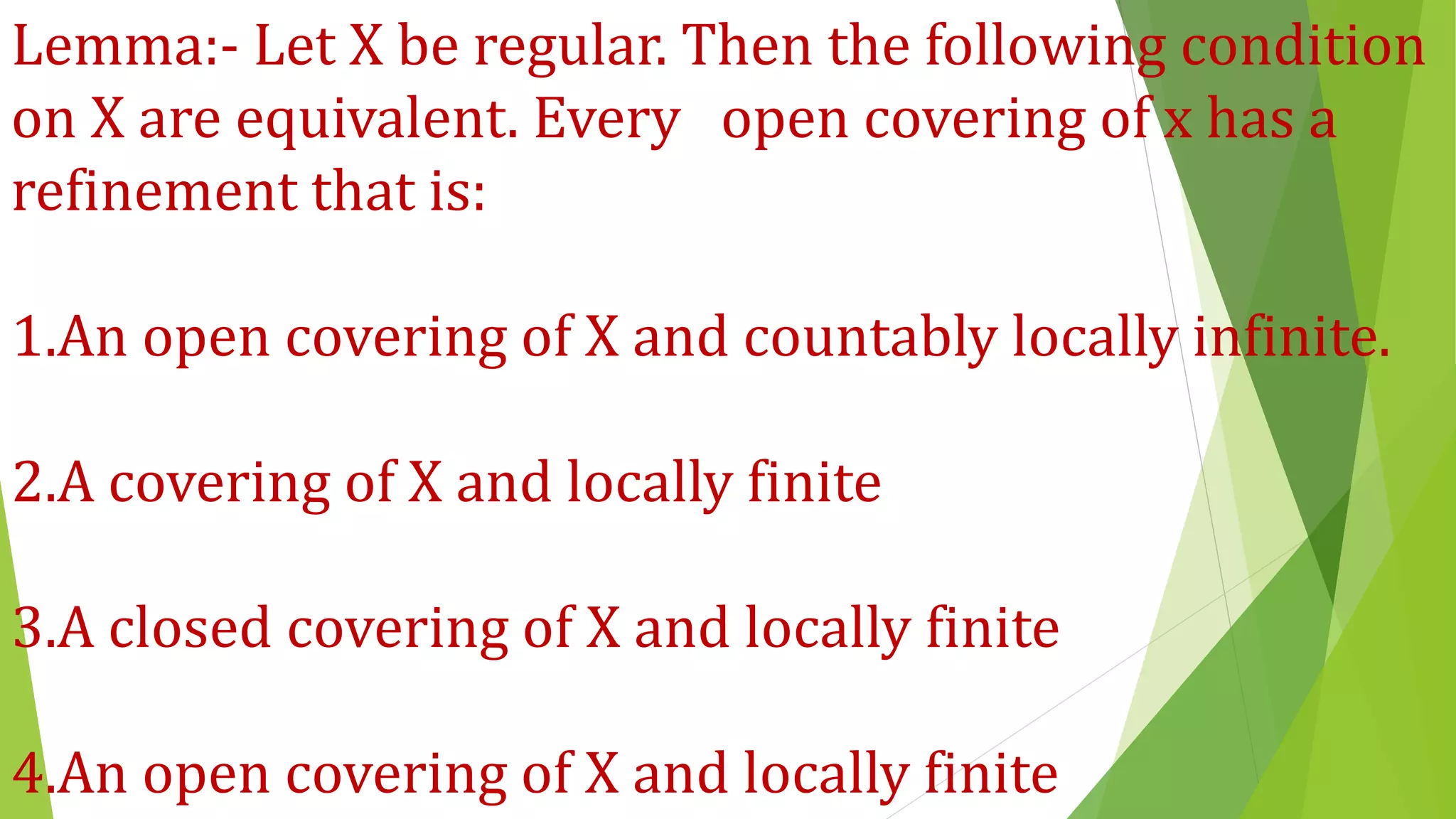
Lemma:- Let X be regular. Then the following condition
on X are equivalent. Every open covering of x has a
refinement that is:
1.An open covering of X and countably locally infinite.
2.A covering of X and locally finite
3.A closed covering of X and locally finite
4.An open covering of X and locally finite
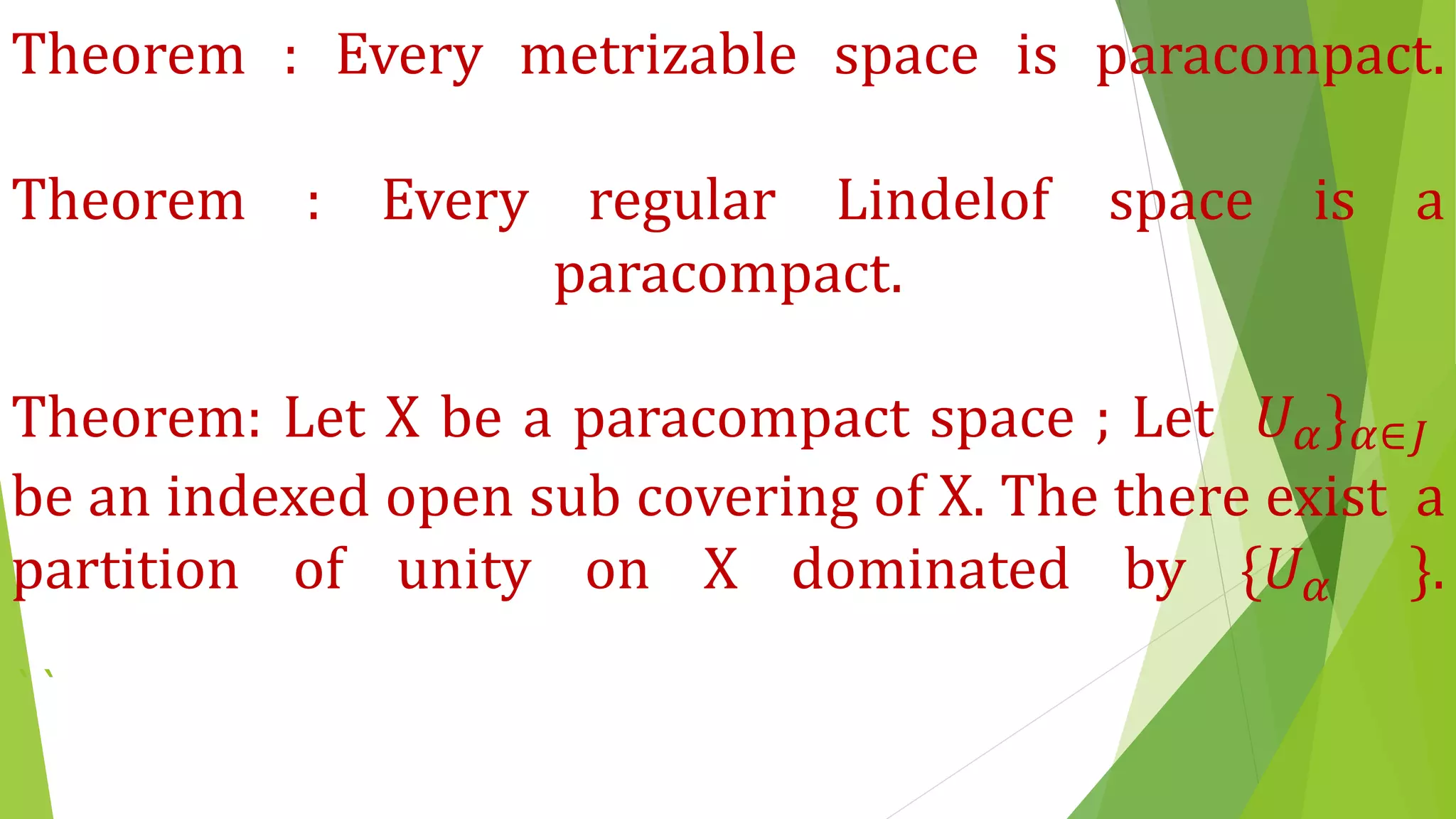
Theorem : Every metrizable space is paracompact.
Theorem : Every regular Lindelof space is a
paracompact.
Theorem: Let X be a paracompact space ; Let 𝑈 𝛼} 𝛼∈𝐽
be an indexed open sub covering of X. The there exist a
partition of unity on X dominated by {𝑈 𝛼 }.
``
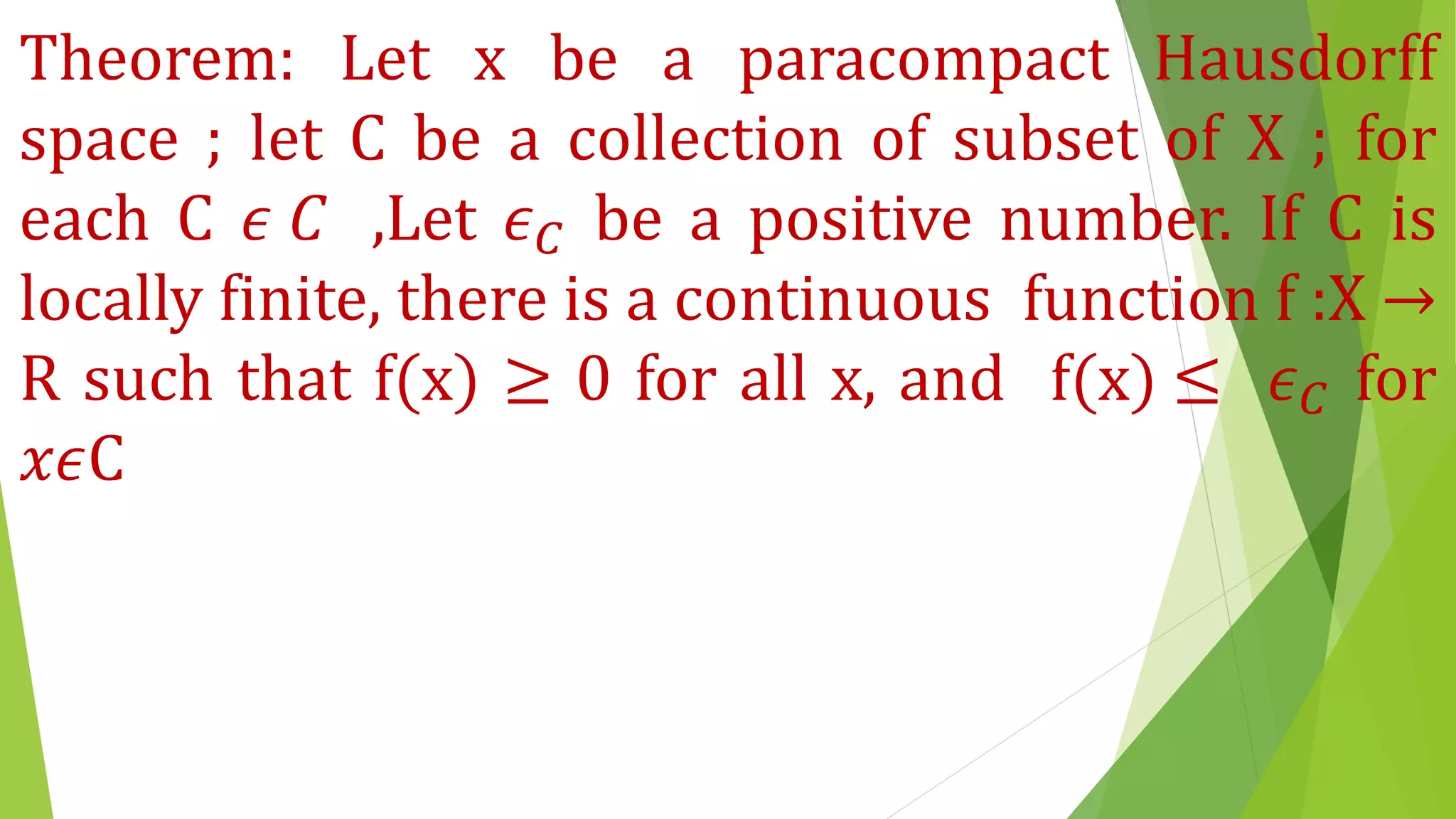
Theorem: Let x be a paracompact Hausdorff
space ; let C be a collection of subset of X ; for
each C 𝜖 𝐶 ,Let 𝜖 𝐶 be a positive number. If C is
locally finite, there is a continuous function f :X →
R such that f(x) ≥ 0 for all x, and f(x) ≤ 𝜖 𝐶 for
𝑥𝜖C
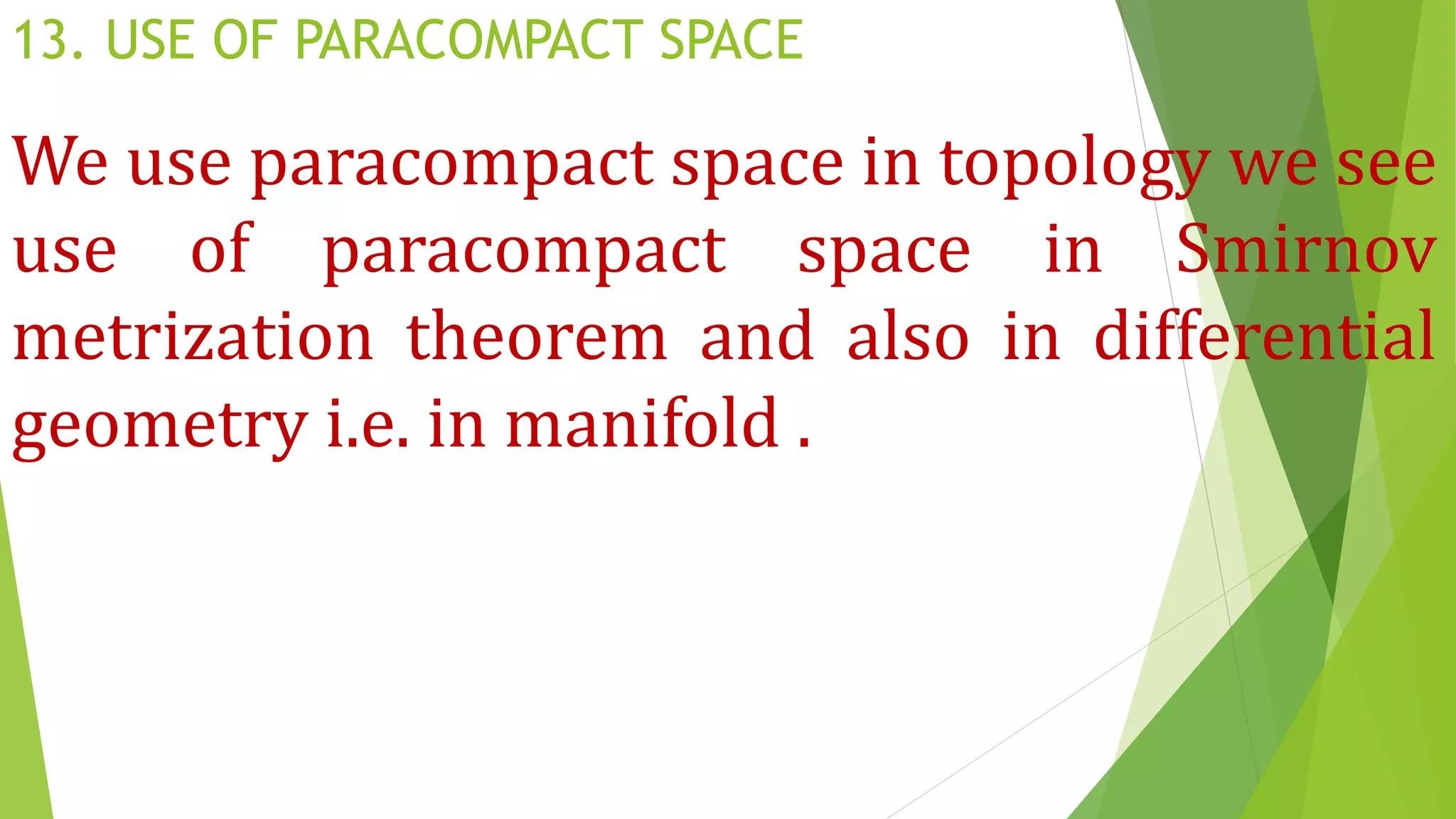
13. USE OF PARACOMPACT SPACE
We use paracompact space in topology we see
use of paracompact space in Smirnov
metrization theorem and also in differential
geometry i.e. in manifold .
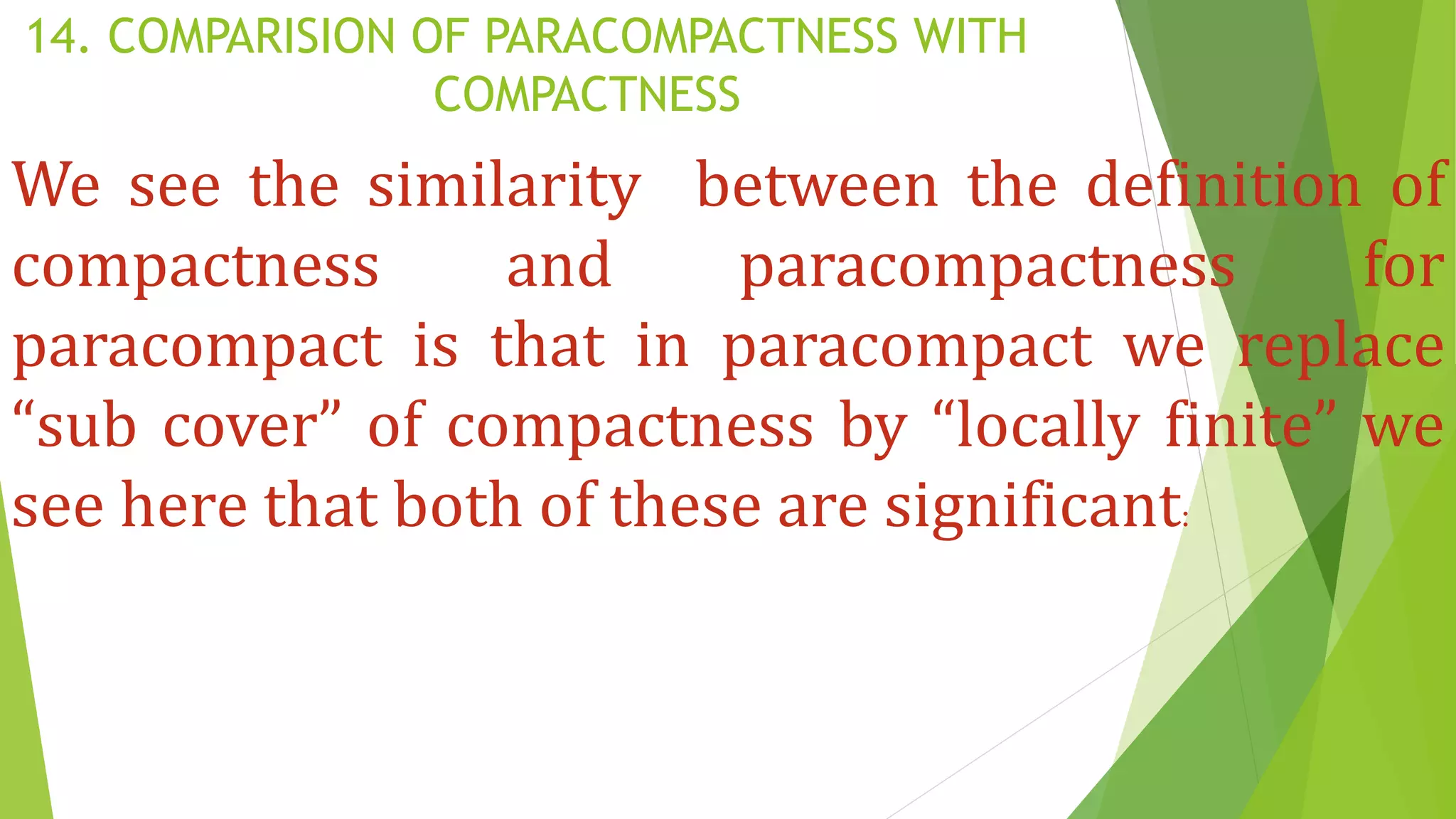
14. COMPARISION OF PARACOMPACTNESS WITH
COMPACTNESS
We see the similarity between the definition of
compactness and paracompactness for
paracompact is that in paracompact we replace
“sub cover” of compactness by “locally finite” we
see here that both of these are significant:
If we talk about the above definition of
paracompact and we change “open
refinement” back to “ sub cover” or “
locally finite” back to “finite”
Paracompact is similar to compactness is the following
respects:
#-Every closed subset of paracompact space is paracompact
( every closed subset of compact space is compact)
#- Every paracompact Hausdorff space is normal ( Every
compact Hausdorff space is normal)
Paracompactness is different from compactness in the
following Respects:
#-A paracompact subset of a Hausdorff space need not
be closed .In fact in metric space ,all subset are
paracompact.( a compact subset of a Hausdorff space is
closed).
#-A product of paracompact space need
not paracompact(product of compact
spaces is compact), the square of the real
line R in the lower limit topology is
the classical example for this.
Note:- :
We often say that paracompactness is
generalization of compactness but it is not
always true because se coffinite topology is
compact space but not paracompact. Let us
see it We have to show that Cofinite
topology is not paracompact and we also
know that every locally compact Hausdorff
space is paracompact
CONCLUSION
Paracompactness was first introduce by
jean Alexander Eugene Diedon in 1944.
Some time we say paracompactness is
generalization of compactness .Which is
not quite correct and this is proved above
that coffinite topology is compact space
but not paracompact space.
The concept of paracompactness is one of the
most useful generalization of compactness
that has been discovered in recent year .It is
particularly useful in topology and differential
geometry . We use paracompact space in
topology we see use of paracompact space in
Smirnov metrization theorem and also in
differential geometry i.e. in manifold .
THANK YOU
References
# James Mukres
# K D Joshi
Paracompact space Literature Survey
Email-sumitbajpeyee5355@gmail.com

Paracompact Space Literature Survey

  • 1.
    PARACOMPACT SPACE Sumit kumar Bajpeyee (Ph.D Scholar) Mahatma Gandhi Central University (Motihari)
  • 2.
    Title and Content 1.INTRODUCTION 2. GENERAL INTRODUCTION 3. SCOPE AND LIMITATION 4. AIM AND OBJECTIVES 5. HISTORICAL BACKGROUND 6. HISTORICAL DEVELOPMENT OF THE CONCEPT OF COMPACTNESS AND PARACOMPACTNESS 7.THE CONCEPT OF COMPACTNESS 8. PRELIMINARIES FOR COMPACT SPACE
  • 3.
    9. USES /APPLICATIONOF COMPACTNESS 10. PARACOMPACT SPACE 11. PROPERTIES OF PARACOMPACT 12. PRELIMINARIES FOR PARACOMPACT SPACE 13. USE OF PARACOMPACT SPACE 14. COMPARISION OF PARACOMPACTNESS WITH COMPACTNESS
  • 4.
    1. INTRODUCTION This Chapterfocus on general introduction of this literature work , Which includes aim and objective, some scope and limitation and definition for some basic terms in this literature survey
  • 5.
    During this paperwe discuss about paracompactness it’s history and its use in topology. Paracompact space is used in many area such as in topology and differential geometry. Such as in differential manifold.
  • 6.
    Compactness is oneof the various covering properties of topological spaces. A very important property of spaces used in many ways in many different areas of mathematics.
  • 7.
    2. GENERAL INTRODUCTION Mathematicstarts with counting and then later became the body of knowledge centred on concepts such as quantity, structures, space and change and also academic discipline which studies them
  • 8.
    Benjamin Pierce calledit “The science that draw necessary conclusion”.
  • 9.
    Many branches ofmathematics were discovered, topology is one of these branches. Topology is defined on spaces. We see the general definition allows concepts which is quite different mathematical objects to be clasped intuitively by comparison with the real numbers.
  • 10.
    Likewise, the conceptof a topological space is concerned with generalizing the structure of sets in Euclidean spaces. Interesting differences in the structure of sets in Euclidean space which have analogies in topological spaces are: connectedness, compactness, dimensionality and the presence of holes.
  • 11.
    Speaking of compactnessas a very interesting structure of topological spaces, we should centralize our mind in talking about some open covers that have necessarily a finite subcover of our topological space.
  • 12.
    3. SCOPE ANDLIMITATION This work lies beyond the scope of my investigation on the concepts of compactness and paracompactness. Therefore this work will only consider the two concepts with respect to topological space and sometimes make reference out of topological space to metric space.
  • 13.
    4. AIM ANDOBJECTIVES AIM :- The main goal of this work is to analysis the concept of paracompactness OBJECTIVES :- To see paracompactness as a more general convering properties of a space than compactness where possible i.e to see how compactness implies paracompactness
  • 14.
    5. HISTORICAL BACKGROUND In1944 jean Alexander Eugene Dieudon introduce the paracompact space. He was French mathematician who was born on 1 july 1906.He had done a notable research in Abstract Algebra , Geometry and a Functional Analysis , His particular involvement in Functional Analysis and Algebric Topology .
  • 15.
    Paracompact space isalso the part of topology. Mathematician associate the development of topology as a specific area of mathematics with 1895 publication of analysis situs by Frenchman Henri Poincare although many topological idea had found their way during the previous century and half..
  • 16.
    The Latin phraseanalysis situs may be interpret as analysis of position used in 1735 by swiss Mathematician Leonhard Euler to describe the Konigsberg bridge problem. This Konigsberg seven bridge problem is notable problem in mathematics .
  • 17.
    It’s negative resolutionby Leonhard Euler in 1736 Laid to found the graph theory and it prefigured the idea of topology.I n History of Mathematics Euler’s solution of konigsbergs bridge problem consider to be the first theorem of graph theory.
  • 18.
    During the 19th century two distinct movement developed that would ultimate produce the sibling specialization of algebraic topology and general topology . The first was characterised by attempt to understand the topology aspects of surface like object that arises by combining elementry shape such as polygon.
  • 19.
    Topology is themathematical study of the properties that are conserve through contortion, twist, and stretch of objects. Tearing, however, is not allowed. A circle is topologically equivalent to an ellipse and a sphere is tantamount to an ellipsoid.
  • 20.
    Similarly, the setof all possible positions of the hour hand of a clock is topologically equal to a circle. There is more about to the topology, though. In Topology we study about study of curves, surfaces, and other objects in the plane and three-space.
  • 21.
    For example, letus take the statement "if we remove a point from a circle, we get a line segment" This applies just as well to the circle as to an ellipse, and even to tangled or knotted circles, since the statement involves only topological properties. Topology can be divided into algebraic topology , differential topology,
  • 22.
    Algebric Topology :Algebraic topology is the study of intrinsic qualitative aspects of spatial objects that remain invariant under both-directions continuous one-to-one (homeomorphic) transformations. The discipline of algebraic topology is popularly known as "rubber-sheet geometry" and can also be viewed as the study of dis connectivities.
  • 23.
    Algebraic topology hasa great deal of mathematical machinery for studying different kinds of hole structures, and it gets the prefix "algebraic" since many hole structures are represented best by algebraic objects like groups and rings.
  • 24.
    Differential Geometry : Themotivating force of topology, consisting of the study of smooth (differentiable) manifolds. Differential topology deals with non metrical notions of manifolds, while differential geometry deals with metrical notions of manifolds.
  • 25.
    HISTORICAL DEVELOPMENT OFTHE CONCEPT OF COMPACTNESS AND PARACOMPACTNESS In the 19th century, some dissimilar mathematical properties were understood that would far along be seen as consequences of compactness. Bernard Bolzano (1817) had been aware that any bounded sequence of points has a subsequence that must eventually get arbitrary close to some other points called a limit point.
  • 26.
    Bolzano’s proof reliedon the method of bisection: The sequence was located into an interval that was then divided into two equal parts, and a part containing infinitely many terms of the sequence was selected.
  • 27.
    The process couldthen be repeated by dividing the resulting smaller interval into smaller parts until it closes down on the desired limit point. . Bolzano’s proof relied on the method of bisection: The sequence was located into an interval that was then divided into two equal parts, and a part containing infinitely many terms of the sequence was selected.
  • 28.
    The process couldthen be repeated by dividing the resulting smaller interval into smaller parts until it closes down on the desired limit point. The full significance of Bolzano’s Theorem and its method of proof did not emerge until almost 50years later (around 1867) when it was re-discovered by Karl Weiestrass.
  • 29.
    The reason forthe change of the name of the theorem to Bolzano-Weiestrass .In the 1880s, it became clear that results similar to the Bolzano-Weiestrass theorem could be formulated for spaces of functions rather than just numbers or geometrical points.
  • 30.
    It was MauriceFrechet who, in 1906 had extracted the essence of the Bolzano- Weiestrass property and created the term compactness to refer to this general phenomenon. In 1870, Eduard Heine showed that a continuous function defined on a closed and bounded interval was actually uniformly continuous.
  • 31.
    The Heine-Borel Theorem,as the result is now identified, is another special property owned by closed and bounded sets of real numbers. This property was important because it allowed for the passage from local information about a set (such as the continuity of a function) to global information about the set
  • 32.
    Finally, the RussianSchool of point set topology under the direction of PAVEL ALEXANDROV and PAVEL URYSOHN, expressed Heine-Borel Compactness in a way that could be useful to the modern notion of a topological space.
  • 33.
    It was thisnotion of compactness that became the main one, because it was not only a stronger property, but it could be expressed in a more general setting with a minimum of supplementary technical machinery, as it relied only on the structure of the open sets in a space.
  • 34.
    There are quitenumber of variations of compactness studied in recent years, such as locally compact, Lindelof, metacompact, orthocompact, paracompact, pseudocompact, realcompact, sigma-compact, snake-like compact and many more.
  • 35.
    Among these variationsof compactness, paracompactness is a general form of compactness where the requirement of every open cover in compact space to have a finite subcover is replaced by the requirement of the open cover to have a locally finite open refinement.
  • 36.
    7.THE CONCEPT OFCOMPACTNESS In mathematics, exactly general topology and metric topology, a compact space is an intellectual mathematical space whose topology has the compactness property which has many important inferences is not valid in general spaces.
  • 37.
    Compactness is notvery easy to describe precisely in an instinctive manner; in approximately sense, it says that the topology allows the space to be well thought-out as “small” (compactness is a kind of topological counterpart to finiteness of set), even though as a set, it may be quite large.
  • 38.
    Furthermore, more instinctive characterizationsof compactness are often dependent on additional properties of topological space to be valid;
  • 39.
    8. PRELIMINARIES FORCOMPACT SPACE A collection of A of subset of a space X is said to be cover of X or to be a covering of X, if the union of elements of A is equal to X . It is called an open covering of X if its elements are open subset of X. Compact:- A space X is said to be compact if every open covering A of X a finite sub collection that also covers X.
  • 40.
    Lemma : LetY be a subspace of X .The Y is compact if and only if every covering of Y by set open in X contains a finite sub collection covering Y. Theorem :- Every closed sub space of a compact space is compact
  • 41.
    Theorem: Every compactsubspace of a Hausdorff space is closed. Lemma: If Y is compact subspace of a Hausdorff space X and 𝑥0 is not in Y then there exist disjoint open sets U and V of X containing 𝑥0 and Y respectively. Theorem: The image of a compact space under a continuous map is compact.
  • 42.
    Theorem : Letf:X→ Y be a bijective continuous function .If X is compact and Y is Hausdorff , then f is homeomorphism. Theorem: The product of finitely many compact space is compact.
  • 43.
    Lemma: ( Thetube lemma )- consider the product space X x Y , Where Y is compact . If N is an open set of X x Y containing the slice 𝑥0 x Y of X x Y, then N contains some tube W x Y about 𝑥0 x Y, where W is neighborhood of 𝑥0 in X.
  • 44.
    9. USES /APPLICATIONOF COMPACTNESS Compactness is powerfull property of spaces and used in different areas of mathematics: Such that it’s help in locate maxima or minimum of function ,which is particularly used in calculus of variation. It also help in Local control on some function and other quantity ,and then uses compactness to boost the local control to global control.
  • 45.
    10. PARACOMPACT SPACE Theconcept of paracompactness is one of the most useful generalization of compactness that has been discovered in recent year .It is particularly useful in topology and differential geometry .One application of paracompactness generalization is in metrization theorem .Many of the spaces that are familiar to us are already paracompact .For instance ,every compact space is paracompact.
  • 46.
    11. PROPERTIES OFPARACOMPACT #-Every paracompact hausdorff space is normal #-Paracompact space is weakly Hereditary this means every closed subspace of paracompact space is paracompact #-If every open subset of a space is paracompact then it is hereditary compact
  • 47.
    Definition of paracompactness: A space is said to be paracompact If every open covering of has a locally finite open refinement that covers.
  • 48.
    #- we canalso say that every regular lindelof (A topological space in which every open cover has countable subcover is said to be lindelof space) space is paracompact .
  • 49.
    11. PRELIMINARIES FORPARACOMPACT SPACE Theorem : Every paracompact Hausdorff space X is normal. #- Every closed subspace of a paracompact space is paracompact. But a paracompact subspace of a hausdorff space X need not be closed. Also a subspace of a paracompact space need not be paracompact .
  • 50.
    Lemma:- Let Xbe regular. Then the following condition on X are equivalent. Every open covering of x has a refinement that is: 1.An open covering of X and countably locally infinite. 2.A covering of X and locally finite 3.A closed covering of X and locally finite 4.An open covering of X and locally finite
  • 51.
    Theorem : Everymetrizable space is paracompact. Theorem : Every regular Lindelof space is a paracompact. Theorem: Let X be a paracompact space ; Let 𝑈 𝛼} 𝛼∈𝐽 be an indexed open sub covering of X. The there exist a partition of unity on X dominated by {𝑈 𝛼 }. ``
  • 52.
    Theorem: Let xbe a paracompact Hausdorff space ; let C be a collection of subset of X ; for each C 𝜖 𝐶 ,Let 𝜖 𝐶 be a positive number. If C is locally finite, there is a continuous function f :X → R such that f(x) ≥ 0 for all x, and f(x) ≤ 𝜖 𝐶 for 𝑥𝜖C
  • 53.
    13. USE OFPARACOMPACT SPACE We use paracompact space in topology we see use of paracompact space in Smirnov metrization theorem and also in differential geometry i.e. in manifold .
  • 54.
    14. COMPARISION OFPARACOMPACTNESS WITH COMPACTNESS We see the similarity between the definition of compactness and paracompactness for paracompact is that in paracompact we replace “sub cover” of compactness by “locally finite” we see here that both of these are significant:
  • 55.
    If we talkabout the above definition of paracompact and we change “open refinement” back to “ sub cover” or “ locally finite” back to “finite”
  • 56.
    Paracompact is similarto compactness is the following respects: #-Every closed subset of paracompact space is paracompact ( every closed subset of compact space is compact) #- Every paracompact Hausdorff space is normal ( Every compact Hausdorff space is normal)
  • 57.
    Paracompactness is differentfrom compactness in the following Respects: #-A paracompact subset of a Hausdorff space need not be closed .In fact in metric space ,all subset are paracompact.( a compact subset of a Hausdorff space is closed).
  • 58.
    #-A product ofparacompact space need not paracompact(product of compact spaces is compact), the square of the real line R in the lower limit topology is the classical example for this.
  • 59.
    Note:- : We oftensay that paracompactness is generalization of compactness but it is not always true because se coffinite topology is compact space but not paracompact. Let us see it We have to show that Cofinite topology is not paracompact and we also know that every locally compact Hausdorff space is paracompact
  • 60.
    CONCLUSION Paracompactness was firstintroduce by jean Alexander Eugene Diedon in 1944. Some time we say paracompactness is generalization of compactness .Which is not quite correct and this is proved above that coffinite topology is compact space but not paracompact space.
  • 61.
    The concept ofparacompactness is one of the most useful generalization of compactness that has been discovered in recent year .It is particularly useful in topology and differential geometry . We use paracompact space in topology we see use of paracompact space in Smirnov metrization theorem and also in differential geometry i.e. in manifold .
  • 62.
  • 63.
  • 64.
    Paracompact space LiteratureSurvey Email-sumitbajpeyee5355@gmail.com

Editor's Notes

  • #2 NOTE: To change the image on this slide, select the picture and delete it. Then click the Pictures icon in the placeholder to insert your own image.