The Infinitedimensional Topology Of Function Spaces Illustrated Edition J Van Mill
The Infinitedimensional Topology Of Function Spaces Illustrated Edition J Van Mill
The Infinitedimensional Topology Of Function Spaces Illustrated Edition J Van Mill
The Infinitedimensional Topology Of Function Spaces Illustrated Edition J Van Mill
The Infinitedimensional Topology Of Function Spaces Illustrated Edition J Van Mill
1.
The Infinitedimensional TopologyOf Function
Spaces Illustrated Edition J Van Mill download
https://ebookbell.com/product/the-infinitedimensional-topology-
of-function-spaces-illustrated-edition-j-van-mill-1528804
Explore and download more ebooks at ebookbell.com
2.
Here are somerecommended products that we believe you will be
interested in. You can click the link to download.
The Geometry Of Infinitedimensional Groups 1st Edition Boris Khesin
https://ebookbell.com/product/the-geometry-of-infinitedimensional-
groups-1st-edition-boris-khesin-1008970
The Geometry Of Infinite Dimensional Groups 1st Edition Boris Khesin
https://ebookbell.com/product/the-geometry-of-infinite-dimensional-
groups-1st-edition-boris-khesin-924726
Infinite Dimensional Harmonic Analysis Proceedings Of The Third
Germanjapanese Symposium University Of Tubingen Germany 1520 September
2003 Illustrated Edition Herbert Heyer
https://ebookbell.com/product/infinite-dimensional-harmonic-analysis-
proceedings-of-the-third-germanjapanese-symposium-university-of-
tubingen-germany-1520-september-2003-illustrated-edition-herbert-
heyer-1526680
Infinite Dimensional Linear Control Systems The Time Optimal And Norm
Optimal Problems Ho Fattorini Eds
https://ebookbell.com/product/infinite-dimensional-linear-control-
systems-the-time-optimal-and-norm-optimal-problems-ho-fattorini-
eds-1531124
3.
Dynamics Of InfinitedimensionalGroups The Ramseydvoretzkymilman
Phenomenon Pestov V
https://ebookbell.com/product/dynamics-of-infinitedimensional-groups-
the-ramseydvoretzkymilman-phenomenon-pestov-v-2601492
Infinite Dimensional Harmonic Analysis Iv On The Interplay Between
Representation Theory Random Matrices Joachim Hilgert
https://ebookbell.com/product/infinite-dimensional-harmonic-analysis-
iv-on-the-interplay-between-representation-theory-random-matrices-
joachim-hilgert-1147892
Infinitedimensional Dynamical Systems An Introduction To Dissipative
Parabolic Pdes And The Theory Of Global Attractors 1st Edition James C
Robinson
https://ebookbell.com/product/infinitedimensional-dynamical-systems-
an-introduction-to-dissipative-parabolic-pdes-and-the-theory-of-
global-attractors-1st-edition-james-c-robinson-2260258
Proceedings Of The Conference Quantum Probability And Infinite
Dimensional Analysis Burg Spreewald Germany 1520 March 2001
Freudenberg W Ed
https://ebookbell.com/product/proceedings-of-the-conference-quantum-
probability-and-infinite-dimensional-analysis-burg-spreewald-
germany-1520-march-2001-freudenberg-w-ed-2632306
Quantum Probability And Infinite Dimensional Analysis Proceedings Of
The 29th Conference Hammamet Tunisia 1318 October 2008 Ouerdiane H
https://ebookbell.com/product/quantum-probability-and-infinite-
dimensional-analysis-proceedings-of-the-29th-conference-hammamet-
tunisia-1318-october-2008-ouerdiane-h-2632546
North-Holland MathematicalLibrary
Board ofHonorary Editors:
M. Artin, H. Bass, J. Eells, W. Feit, P.J. Freyd, F.W. Gehring,
H. Halberstam, L.V. Hormander, J.H.B. Kemperman, W.A.J. Luxemburg,
P.P. Peterson, I.M. Singer and A.C. Zaanen
Board of Advisory Editors:
A. Bjorner, R.H. Dijkgraaf, A. Dimca, A.S. Dow, JJ. Duistermaat,
E. Looijenga, J.P. May, I. Moerdijk, S.M. Mori, J.P. Palis, A. Schrijver,
J. Sjostrand, J.H.M. Steenbrink, F. Takens and J. van Mill
VOLUME 64
ELSEVIER
Amsterdam - London - NewYork - Oxford - Paris - Shannon - Tokyo
8.
The Infinite-Dimensional
Topology ofFunction Spaces
Jan van Mill
Faculteit der Exacte Wetenschappen, Amsterdam, The Netherlands
2001
ELSEVIER
Amsterdam - London - NewYork - Oxford - Paris - Shannon - Tokyo
Contents
Introduction xi
Chapter 1.Basic topology 1
1.1. Linear spaces 1
1.2. Extending continuous functions 21
1.3. Function spaces 29
1.4. The Borsuk homotopy extension theorem 37
1.5. Topological characterization of some familiar spaces 41
1.6. The inductive convergence criterion and applications 58
1.7. Bing's shrinking criterion 66
1.8. Isotopies 70
1.9. Homogeneous zero-dimensional spaces 73
1.10. Inverse limits 80
1.11. Hyperspaces 95
Chapter 2. Basic combinatorial topology Ill
2.1. Affine notions Ill
2.2. Barycenters and subdivisions 125
2.3. The nerve of an open covering 132
2.4. Simplices in Rn
138
2.5. The Lusternik-Schnirelman-Borsuk theorem 148
Chapter 3. Basic dimension theory 151
3.1. The covering dimension 151
3.2. Translation into open covers 157
3.3. The imbedding theorem 168
3.4. The inductive dimension functions ind and Ind 176
3.5. Dimensional properties of compactifications 183
3.6. Mappings into spheres 193
3.7. Dimension of subsets of Rn
and certain generalizations 204
3.8. Higher-dimensional hereditarily indecomposable continua 210
3.9. Totally disconnected spaces 216
3.10. The origins of dimension theory 221
3.11. The dimensional kernel of a space 227
3.12. Colorings of maps 237
13.
3.13. Various kindsof infinite-dimensionality 251
3.14. The Brouwer fixed-point theorem revisited 257
Chapter 4. Basic AMR theory 263
4.1. Some properties of ANR's 263
4.2. A characterization of ANR's and AR's 277
4.3. Open subspaces of ANR's 301
Chapter 5. Basic infinite-dimensional topology 307
5.1. Z-sets 307
5.2. Extending homeomorphisms in s 311
5.3. The estimated homeomorphism extension theorem 320
5.4. The compact absorption property 329
5.5. Absorbing systems 343
Chapter 6. Function spaces 367
6.1. Notation 368
6.2. The spaces CP(X): Introductory remarks 369
6.3. The Borel complexity of function spaces 372
6.4. The Baire property in function spaces 377
6.5. Filters and the Baire property in CP(N?) 387
6.6. Extenders 393
6.7. The topological dual of CP(X) 399
6.8. The support function 404
6.9. Nonexistence of linear homeomorphisms 411
6.10. Bounded functions 416
6.11. Nonexistence of homeomorphisms 426
6.12. Topological equivalence of certain function spaces 434
6.13. Examples 445
Appendix A. Preliminaries 457
A.I. Prerequisites and notation 457
A.2. Separable metrizable topological spaces 465
A.3. Limits of continuous functions 468
A.4. Normality type properties 469
A.5. Compactness type properties 473
A.6. Completeness type properties 479
A.7. A covering type property 485
A.8. Extension type properties 490
A.9. Wallman compactifications 494
A.10. Connectivity 500
A.11. The quotient topology 505
A.12. Homotopies 510
A.13. Borel and similar sets 517
14.
Appendix B. Answersto selected exercises 527
Appendix C. Notes and comments 579
Bibliography 597
Special Symbols 613
Author Index 615
Subject Index 619
Introduction
In this bookwe study function spaces of low Borel complexity. This
is a particularly interesting class of spaces; to investigate it one needs a
mix of methods and techniques from areas as diverse as general topology,
infinite-dimensional topology, functional analysis and descriptive set theory.
A striking result is the theorem of Dobrowolski, Marciszewski and Mogilski,
which states that all function spaces of low Borel complexity are topologically
homeomorphic. A major feature ofthis book is a complete and self-contained
proof of this remarkable fact.
In order to understand these details, a solid background in infinite-
dimensional topology is needed. And for that one needs to know a fair
amount of dimension theory as well as ANR theory. The necessary mate-
rial was partially covered in my previous book 'Infinite-dimensional topology,
prerequisites and introduction'. A selection of what was done in that volume
can also be found here, but completely revised and in many places expanded
with recent results. I chose to take a 'scenic' route towards the Dobrowol-
ski-Marciszewski-Mogilski Theorem, that is linking the results needed for
the theorem's proof to interesting recent research developments in dimension
theory and infinite-dimensional topology.
The first five chapters of this book are intended as a text for graduate
courses in topology. For a course in dimension theory, one should cover
Chapters 2 and 3 and part of Chapter I. For a course in infinite-dimensional
topology, one should cover Chapters 1, 4 and 5. In Chapter 6, which deals
with function spaces, I discuss recent research results. It can also be used for
a graduate course in topology but its focus is more suited to that ofa research
monograph than of a textbook; it would, therefore, be more appropriate to
use it as a text for a research seminar. This book, consequently, has the
character of a textbook as well as a research monograph.
In Chapters 1 through 5, unless stated otherwise, all spaces under dis-
cussion are separable and metrizable. In Chapter 6 results for more general
classes of spaces are presented.
In Appendix A we collected for easy reference and for sake of complete-
ness some basic facts that are important in the book. The reader will see
that it is not intended as the basis for a course in topology; its purpose is to
collect what one should know about general topology, nothing more nothing
less.
The exercises in the book serve three purposes: to test the reader's un-
derstanding of the material, to supply proofs of statements that are used in
the text and are not proven therein, and to provide additional information
not covered by the text. We included the solutions to selected exercises in
17.
Appendix B. Theseexercises are important or difficult; they are marked in
the text by the symbol >•.
If the reader wants to find the meaning of some unfamiliar term in this
book, it is best to check Appendix A first, since many basic concepts are
defined there. To simplify the search process, in the index all page numbers
for terms from Appendix A are italicized. For example, if the reader would
like to know the definition of the term 'topologically complete', she or he
should look at Page 480. For in the index, the first italicized page number
under 'topologically complete' is 480.
Finally, I express my indebtedness to Jan Baars, Stoyu Barov, Jan Dijk-
stra, Tadek Dobrowolski, Klaas Pieter Hart, Michael van Hartskamp, Hen-
ryk Michalewski,Witek Marciszewski, Roman Pol, Ruud Salomon and Jan de
Vries for their critical reading of parts of the manuscript and their many valu-
able suggestions for improvements. None of these distinguished colleagues is
responsible for the remaining errors, which are mine.
Jan van Mill
Bussum, March 29, 2001
18.
CHAPTER 1
Basic topology
Inthis chapter we present some basic facts on the topology of separa-
ble metrizable spaces. We discuss linear spaces, inverse limits, hyperspaces,
Bing's Shrinking Criterion, etc. Questions about the possibility of extending
continuous functions, or creating new continuous functions from old ones,
are central in this chapter. Applications include a proof of the topological
homogeneity of the Hilbert cube and proofs of topological characterizations
of various interesting spaces such as the Cantor set, the unit interval and the
spaces of rational and irrational numbers, respectively. Many of the results
presented in this chapter are geometrically motivated, although this is not
always clear at first sight.
For background information, see Appendix A. Our conventions with re-
spect to notation can be found in §A.l.
All topological spaces under discussion are separable and metrizable.
1.1. Linear spaces
A linear space is a real vector space L carrying a (separable metrizable)
topology with the property that the algebraic operations of addition and
scalar multiplication are continuous (warning: a vector space is an algebraic
structure which may or may not carry a topology while a linear space is au-
tomatically a topological space). Observe that the continuity of the algebraic
operations on a linear space show that it is a topological group.
A subset A of a linear space L is called convex if for all x,y £ A and a GI
we have ax + (1 —a)y G A.
Let L be a linear space. If A C L then conv(A) denotes the smallest
convex subset of L containing A] this set is called the convex hull of A.
A convex combination of elements of A is a vector of the form ^T=i ^a
i
with ai,..., on € A, AI , . . . , An € I and Y%=i ^i = 1 •
For each n G N, let convn(A) denote the set of vectors x G L that can
be written as a convex combination of at most n vectors from A. Also, put
= [J convn(A)
19.
2 1. BASICTOPOLOGY
and observe that convoo(A) is the set of all convex combinations of elements
of A
It is left as an exercise to the reader to present a proof of the following
basic lemma (see Exercise 1.1.5).
Lemma 1.1.1. Let L be a linear space with subset A. Then
(1) conv(A) =
(2) if A is finite then conv(A) is compact.
A linear space L is called locally convex if the origin of L (which we shall
always denote by 0) has arbitrarily small convex neighborhoods. Obviously,
the spaces Rn
for n G N U {00} with their usual product topologies are
locally convex linear spaces under coordinatewise denned addition and scalar
multiplication.
Let L be a vector space. A norm on L is a function ||-||: L —> [0,oo)
having the following properties:
(1) x + y < x+ y forallz,y e L,
(2) tx = t • x for alU 6 M and x € L,
(3) x =0 if and only if x = 0.
If ||-|| is a norm on L then the function
g(x,y) = x-y
defines a metric on L; it is called the metric derived from the norm -. We
call a linear space L normable provided that there exists a norm on it such
that the metric derived from this norm is admissible; for obvious reasons
such a norm is called admissible. Observe that each normable linear space is
locally convex (See Exercise 1.1.6). A normed linear space is a pair (L, -||),
where L is a vector space and ||-|| is a norm on L. We shall always endow the
underlying vector space of a normed linear space with the topology derived
from its norm.
So we make a formal distinction between normed linear space and norma-
ble linear space: a normable linear space may possess many different norms
that generate its topology, see Exercise 1.1.8, whereas in a normed linear
space the norm is fixed. In topology we make a similar distinction between
metric and metrizable spaces. A metrizable space may posses many admis-
sible metrics generating the same topology, whereas in a metric space the
metric under consideration is fixed.
If (V, ||-||) is a normed linear space then
B = {x 6 V : x < 1}
and
S = x£ B: x = 1
20.
1.1. LINEAR SPACES3
denote its unit ball and unit sphere, respectively.
A subset A of a normed linear space L is called bounded if there exists
an e E [0,oo) such that ||a|| < e for every a £ A.
A Banach space is a normable linear space for which there exists an
admissible norm such that the metric derived from it is complete.
So a Banach space is topologically complete by definition, and hence is
a Baire space by Theorem A.6.6.
Examples of linear spaces. We will now discuss various important
examples of linear spaces.
Example 1.1.2. The Euclidean spaces W1
.
The standard norm on W1
is the Euclidean norm which is defined by
As noticed on Page 461, Bn
and §n l
abbreviate the unit ball and unit sphere
in W1
. It is clear that W1
is a Banach space since the metric derived from its
Euclidean norm is the well-known Euclidean metric which is complete.
Example 1.1.3. The space s.
The space s is the vector space E°° endowed with the Tychonoff product
topology. It is a classical object both in topology and functional analysis and
will play a central role in the remaining part of this book.
Observe that s is topologically complete by Lemma A.6.2. Its standard
complete metric is the following one:
CO I I
/ _ V^2_n xn-yn
n=l ~r I n J/n|
(See Exercise 1.1.1 for the verification.)
Since each Mn
is normable and since s is in many respects their 'limit',
the question naturally arises whether s is normable. We will show below that
it is not. Define
cr = {x € s : xn = 0 for all but finitely many n G N}.
It is clear that cr is a linear subspace of s.
Lemma 1.1.4. If L is a linear subspace of s with cr C L then L, endowed
with the subspace topology it inherits from s, is not normable.
Proof. Assume, to the contrary, that ||-|| is an admissible norm on L. Then
U = {xeL: x < 1}
21.
1. BASIC TOPOLOGY
isan open neighborhood of the origin of L. By definition of the product
topology on s there are an open neighborhood V of 0 in R and an n G N such
that
n oo
(*) (n^x
n ^)n£cc/,
i=l i=n+l
where Vi = V for i < n and Rj = IR for i > n. Let y 6 s be defined
by yi = 0 if i ^ n + 1 and yn+ = 1. Since y E a C L and y 7^ 0 it follows
that e = ||y|| > 0. By (*), £y 6 U for every t € E. In particular, ||s/e|| < 1
but also 11 Veil — £
/e — 1> which is a contradiction. D
From the proof of Lemma 1.1.4 it is clear that the interplay between
the topology and the linear structure on s prevents it from being normable.
(The question naturally arises whether every vector space can be endowed
with a norm which is compatible with its linear structure. The answer to this
question is in the affirmative, see Exercise 1.1.8.) Consequently, although s
seems a natural 'limit' of the spaces IRn
, it is notably different from any of
its finite dimensional analogs W1
.
Example 1.1.5. The spaces C(X) and C*(X).
For a nonempty compact space X we let C ( X ) denote the set of all continuous
real-valued functions on X. Obviously, C(X) is a vector space; addition of
functions and scalar multiplication are defined pointwise. If / e C(X) then
define its norm, ||/||, by
H/ll = sup{f(x):xeX}.
(Observe that by compactness of X this supremum is attained. That is:
there is an element x e X such that ||/|| = f(x}.) It is easily seen
that ||-|| : C(X] —> [0,oo) is indeed a norm; it is called the sup-norm on C(X).
Consequently, the function
(*) Q(f, 9) = f~9
defines a metric on C(X) and therefore generates a topology. From now on
we shall endow C(X] with this topology.
There are other useful and interesting topologies on C(X). In Chapter 6
we shall endow C(X) with the so-called topology of pointwise convergence.
It will be clear from our notation which topology on C(X] we are using.
For example, C(X) denotes the set C(X] endowed with the above topology,
and CP(X) denotes the set C(X) endowed with the topology of pointwise
convergence,etc.
We claim that C(X) is a Banach space. Let (fn }n be a £-Cauchy se-
quence. Then (fn }n clearly converges pointwise, so / = limn^.^ fn exists and
belongs to C(X) by Lemma A.3.1. It therefore suffices to prove that fn —> f
in C(X). But this follows easily from the proof of Lemma A.3.1.
22.
1.1. LINEAR SPACES5
The spaces C(X] have the following interesting property that will be
used quite frequently in our Chapter 4 on ANR-theory.
Lemma 1.1.6. For every compact space X there are a compact space A and
an imbedding i: X <—> C(A) such that i[X] is linearly independent.
Remark 1.1.7. The linear independence of the set i[X] in the above result
is quite interesting, and has proved to be useful in several research papers in
infinite-dimensional and related topology.
Proof. Let Y be the topological sum of X and a point XQ £ X, and let Q be
an admissible metric for Y. Let A be the subspace of C(Y) consisting of all
Lipschitz functions /: Y -> R such that f ( x 0 ) = 0. Observe that if / G A
then
f[Y] C [-diam(y),diam(T)].
This is clear since if y G Y then
l/(i/)l = I/to) - o = l/(y) - /0*o)| < e(y,*o) < diam(r).
It is easy to show that A is a closed subspace of C(Y). But even more is
true.
Claim 1. A is compact.
Proof. Let (fm)m be any sequence in A. It suffices to prove that it has a
convergent subsequence in A (Theorem A.5.1). For every n let Un be a finite
open cover of [—diam(F), diam(F)] consisting of open sets with diameter at
most 7rn
'. This cover has a Lebesgue number, say Xn > 0 (Lemma A.5.3).
By compactness of X there is a finite open cover Vn of X such that
mesh(Vn) < i/2An.
Now fix any / GA and V GVn. Since / is Lipschitz, the diameter of f[V] is
at most Xn. Hence f[V] is contained in an element U G Un. So for each / G A
there is a function
£n(/): V n - > U n
such that for every V € Vn we have
Let n = 1. Observe that there are finitely many functions Vi —> Ui only.
Hence there is an infinite subset NI C N such that £i(/m) = £i(/fc) f°r
all
integers m, k 6 A7
"!. Let m and k be two arbitrary elements of NI , and pick an
arbitrary x 6 X. Pick an element F G Vi such that ar G I7
. Then both fm(x)
and /jfc(x) belong to the same element of Ui, i.e., |/m(^) ~ /fc(x
)| < 2"1
.
Since x was arbitrary, this shows that ||/m —/^|| < 2"1
. So now it is clear
how to proceed. Let n = minA^i and consider the infinite set N {n}.
There is an infinite subset N% C NI {HI} such that for all ra and k in A^
the functions ^(/m) and £2 (/A:) agree. Then by a similar argument as the
23.
6 1. BASICTOPOLOGY
one above, ||/m —fk < 2~2
for all m, k 6 N2. Let n2 = min 7V2. Continuing
in this way resursively, we can construct an infinite sequence
ni < n2 < ••• < nm < • • •
of natural numbers and a Cauchy sequence (fn )m in C(Y). Since C(Y) is
a Banach space, this sequence has a limit and since A is closed, this limit
belongs to A. So we conclude that (fnm)m is the desired convergent subse-
quence Of(fn}n- 0
Define i : X —> C(A) by the following formula:
t(*0(/) = /(*).
Observe that i is well-defined. For i(x) should be an element of C(A), hence
should be a function i(x) : A —> M. But an element of A is a function /
from Y to R. So the formula tells us that i(x) sends the function / onto its
evaluation in the point x £ X C Y.
Claim 2. i: X —> i[X] is an isometry.
Proof. Let £i,rr2 G X. Then
||t(xi) - i(x2) =sup{|t(*i)(/) - »
(1)
Observe that the last inequality follows from the fact that / is Lipschitz.
Define the function g : Y -> M by
If y, y' 6 y are arbitrary then
g(y) - g(y'} = e(y,x2)
= Q(y,x2) -e(y',x2)
< Q(y,y'}-
Also, g(xo) — 0. Hence g E A and
-i(x2)(g} = Q(xi,x2) - Q(x0,
Hence by (1) we get ||Z(:EI) —z(^2)|| = ^(^15^2), as required. 0
It remains to prove that i[X] is a linearly independent subset of C(A). To
this end, let #1, . . . ,xn+i be distinct elements of ^C. We claim that z(xn+i)
is not a linear combination of the i(xi), . . .,i(xn).
Define /i : Y -> E by
= mm e(y,Xi).
0<^<n
24.
1.1. LINEAR SPACES7
Claim 3. h G A.
Proof. We shall first prove that h is Lipschitz. To this end, pick arbi-
trary a, b 6 Y. We may assume without loss of generality that h(b) < h(a).
Fix i and j such that h(a) = g(a, Xi) and h(b) = g(b,Xj). Since h(a) = g(a,Xi)
we get by the definition of h that g(a,Xi) < g(a,Xj). From this we conclude
that
h(a)-h(b) =h(a)-h(b)
= g(a,Xi} - g(b,Xj)
< g(a,Xj) - g(b,Xj)
< 0(a,b),
as required.
Since it is trivial that h(xo) = 0, this completes the proof. 0
Observe that i(xk)(h) = h(xk) = 0 for every k < n, but since the XQ, ..., xn+i
are distinct elements of F,
i(xn+i)(h) ^ 0.
So i(xn+i} is not a linear combination of the i(x),..., «(xn), and this is what
we had to prove. D
Corollary 1.1.8. Every space is homeomorphic to a linearly independent
bounded and closed subspace of a normed linear space.
Proof. Let X be a space, and let aX be a compactification of X (Corol-
lary A.4.8). By Lemma 1.1.6there are a compact space A and an imbed-
ding i: aX —>• C(A) such that i[aX] is linearly independent. By linear inde-
pendence, if L is the linear hull of i[X] then L n i[aX] = i[X]. Hence i[X] is
a closed linearly independent subset of the normed linear space L.
Since ||-||: C(A) —> [0, oo) is continuous, and aX is compact, it is clear
that i[aX] is a bounded subset of C(A), hence so is i[X]. D
If X is not compact then C(X) contains unbounded functions (seeEx-
ercise A.5.14 below), and so the formula
f =sup{f(x):x£X}
does not define a norm on C(X). By considering the subset C*(X) of C(X)
consisting of all bounded functions, this problem does not occur; C*(X) en-
dowed with the sup-norm is a Banach space for the same reasons C(Y) is for
compact Y.
The topology defined here on C*(X) is called the topology of uniform
convergence.
25.
8 1. BASICTOPOLOGY
Example 1.1.9. The space CQ.
Put CQ= {x E s : linin-j.oo xn = 0}, and endow it with the norm
x = sup{|xn| : n E N}.
It follows by straightforward calculations that this is indeed a norm compat-
ible with the linear structure on CQ.There is however another way of proving
this. Let S be a nontrivial convergent sequence including its limit t, and
consider
L = {/ EC(S) : /(*) -0}.
Then L is a closed linear subspace of C(S) which clearly can be identified
with CQ.So c0 is a closed linear subspace of the function space C(S).
The set CQ endowed with a different vector space topology will play a
prominent role in our analysis of function spaces later. See Chapter 6 for
details.
Example 1.1.10. The Hilbert space I2
.
We saw that the topology on s is very different from the topology on any of
its finite dimensional analogs W1
. We shall now construct another natural
'limit' of the spaces W1
which behaves better (in this respect).
Consider the usual inner product on En
given by
n
(X I// — 7 OC '11'
5 y/ / j iyi'
If we try to generalize this inner product for E°° then we have to deal with
infinite series and it is therefore quite natural to restrict ourselves to the
following subset of M°°:
oo
I2
— {x E s : /]x2
< oo}.
We shall first prove that t2
is a linear subspace of M°°. For every x E t2
we
write p(x) = v/X^i X
1- ^ x
-> V e
^•> tnen
Schwarz's inequality applied to En
shows that | 5^=i ^^1 —P(X
} ' P(y}- From this it follows that
P(x] -p(y] < oo,
1=1
and so
oo
since all infinite series considered are convergent. We conclude that for ev-
ery x, y G I2
we have x + y G i2
. If x e i2
and t G M then trivially tx € I2
.
Consequently, i2
is indeed a linear subspace of M°°.
26.
1.1. LINEAR SPACES
SinceX^i x
iVi < °° f°r a
^ X
->V e
^ we
have a well-defined func-
tion {-,-): i2
x£2
-^M,
1=1
which is easily seen to be an inner product. Consequently, x —p(x] defines
a norm on I2
and the metric derived from this norm is:
oo
£'
We endow I2
with the topology generated by this metric and refer to I2
with
this topology as Hilbert space.
It is clear that a is a subset of I2
and so Lemma 1.1.4 shows that the
topology that i2
inherits from s is different from the topology on i2
which
we just defined. We will comment on the precise relation between these
topologies later.
Lemma 1.1.11. The metric g on I2
defined above is complete.
So i2
is also a Banach space. But there is a difference with the spa-
ces C(X] that we discussed before. The norm on i2
is derived from an inner
product, while no inner product on C(I) yields its standard norm (Exer-
cise 1.1.9).
The topology on s is the topology of 'coordinatewise convergence', see
Exercise A.2.2. Topologists usually find such product topologies easier to
handle than topologies derived from a norm. However, convergence in £2
can
be handled with the same ease, as is stated in the next result.
Lemma 1.1.12 (Exercise 1.1.26). Suppose that (x(n)] is a sequence in I2
,
and x GI2
. The following statements are equivalent:
(1) linin-^oo x(n) = x (in I2
),
(2) limn_>.00 ||x(n)|| = ||x|| and for every i 6 N, lim^-^oo x(n}i = Xi.
From Lemma 1.1.12 it immediately follows that the topology on I2
is
finer than the topology that I2
inherits from s. However, more can be con-
cluded. For example, consider the unit sphere 5 = {xe£2
:|x|| = l}. Since
all points in 5 have the same norm, the topology that 5 inherits from f2
is
precisely the same as the topology that S inherits from s, i.e., the topology
of 'coordinatewise convergence'. This remark plays an important role in the
proof of the Anderson Theorem from ANDERSON [15] that I2
and s are topo-
logically homeomorphic (see also VAN MILL [298, Chapter 6] for a complete
proof of this result).
27.
10 1. BASICTOPOLOGY
Classical theorems. We now present some classical theorems on Ba-
nach spaces that will be important later.
Open Mapping Theorem 1.1.13. Let T be a continuous linear mapping
of a Banach space E onto a Banach space F. Then T is open.
Proof. The proof is in three steps.
Claim 1. There exists a > 0 such that such that
{y € F : y < 1} C T[{x G£ : ||x|| < a}].
Proof. For each a > 0 put Ba = {x G-E1
: ||x|| < a}. Since
oo
F
= U
n=l
and F is a Baire space (see Page 3), there exists m GN such that T[Bm] has
nonempty interior. Since T is linear, it follows easily that T[Bm] is convex,
and by the continuity of the algebraic operations on F, so is T[Bm}. In
addition, Bm is symmetric, i.e., — Bm = Bm. Again since T is linear, it
follows that T[Bm] is symmetric, from which it follows easily that T[Bm] is
symmetric as well. Now choose y G F and /3 > 0 such that D(y,/3) C T[Bm].
Letz GF be such that z </?. Then (z+y)-y <(3,hencez+y G T[Jgmj.
Similarly, ||(y —z) — y < /3 from which it follows that y — z G T[Bm]
and so since T[Bm] is symmetric that z —y G T[Bm]. Now observe that
since 0 G T[Bm] by convexity we get
T[B
This proves that D(Q,/3) C T[Bm] from which it follows easily that
x?(Q,i)cr[Ba],
where a —m
/p. 0
In the remaining part of the proof we adopt the notation introduced in
Claim 1.
Claim 2. {y G F : y < 1} C T[B2a].
Proof. Let y G F with | y < 1. We shall define recursively a sequence (yn}n
in T[Ba] such that for all n,
n
" " " < Tn
.
28.
1.1. LINEAR SPACES11
By Claim 1, there exists y 6 T[-£?«] such that y —y < l
/z- Suppose
that yi,..., yn are chosen properly. Then
< 1
fc=l
and therefore, again by Claim 1, there exists yn+i G T[Ba} such that
k=l
It is clear that yn+i is as required.
From (*) it easily follows that
y = lim
n—>oo
k=l
For every n choose a point xn £ Ba with T(xn) = yn. Since xn < a <oo
for every n, it is easily seen that the sequence
is Cauchy, and hence that
x = lim
n—><x>
exists. Since ||-||: E —>• R is continuous,
00 00
X ^ f 2* K^/c / ' Ot ^— ZiOi.
k=l k=
By observing that T is continuous and linear we obtain
T(x)= lim
n—>oo
from which we conclude that y 6 T[B^a. -0
We are now in a position to prove that T is open. Indeed, let U be a
nonempty open subset of E. Let x £ U and choose e > 0 with D(x,e) C[7.
Consequently, £?e C [7 —x. It follows by Claim 2 that
{?/ e F : Hi/11 < -/2a} C T[Be].
Consequently, since T[5e] C T[U - x] = T[U] - T(x), wehave
{y£F:y-T(x)<*/2a}CT[U].
So T[t7] is a neighborhood of T(x) and since x was an arbitrarily chosen point
from £7, we are done. D
29.
12 1. BASICTOPOLOGY
Corollary 1.1.14. A bijective continuous linear function between Banach
spaces is a (linear) homeomorphism.
Proof. This is clear since such a function is open by Theorem 1.1.13. D
The following corollary to Theorem 1.1.13 will be of particular impor-
tance later. Its converse is trivial (Exercise A.1.8).
Closed Graph Theorem 1.1.15. Let E and F be Banach spaces and let
T: E-+F
be linear. If the graph
F = {(x,Tx) :xeE}
ofT is a closed subset of E x F then T is continuous.
Proof. Observe that F is a closed linear subspace of the Banach space Ex F
(Exercise A.1.8) and hence is a Banach space itself. In addition, the func-
tion Si: F —> E defined by 5i(x,Tx) = x is clearly continuous (since it is
the restriction of a projection). As a consequence, Si is a linear homeomor-
phism by Corollary 1.1.14. Observe that the function £2: F —>• F defined
by 52(x,T(x)) = T(x) is continuous as well. So the function E -> F de-
fined by x H-» (x, Tx] !->• Tx is continuous, being a composition of continuous
functions. So T is continuous. D
Corollary 1.1.16. Let E and F be Banach spaces additionally endowed
with weaker vector space topologies. I f T : E —> F is a linear homeomorphism
with respect to the weaker topologies then it is also a linear homeomorphism
with respect to the Banach space topologies.
Proof. All we need to observe is that by continuity the graph of T is closed
in the weaker topology on E x F (Exercise A.1.8) and hence also in E x F
endowed with the product of the Banach space topologies. Simply observe
that the product of the weaker topologies is weaker than the product of the
Banach space topologies. D
The Michael selection theorem. We shall prove that certain set-
valued functions admit a continuous selection (for definitions, see below).
Let X and Y be sets. A set-valued function F from X to Y is defined to
be a function from X to 9(Y) {0}, i.e., F: X ->> 7(Y) {0}. Bythesymbol
F: X =>Y
we shall mean that F is a set-valued function from X to Y.
Let X and Y be topological spaces and let F: X => Y. For every V C Y
we put
F*=[V] = {x 6 X : F(x] n V / 0}.
30.
1.1. LINEAR SPACES13
We say that F is lower semi-continuous (abbreviated LSC) provided that
for every open subset U of Y, F^[U] is open in X. Observe that if U is a
covering of Y then
F*=[U] = {F^[U] :U GU}
covers X since for every x £ X, F(x) ^ 0.
A basic example of an LSC set-valued function is the following one. If X
and Y are spaces and /: X —> Y is an open surjection then we define
F: Y => X
by F(y] — f ~ l
( y } . The function F is LSC since for every open U C Y we
have
F*[U] = {y£Y: F(y] n U ^ 0}= {y e Y : f ~ l
( y } n t/ ^ 0} = f[U].
Other examples of LSCset-valued mappings will be presented later.
Let X and Y be sets and let F : X =£> Y. A function / : X —> Y is called
a selection for F if for all x e X, /(x) G F(x). Since for all £ € JC the
set -F(x) is nonempty, by the Axiom of Choice such a selection exists. The
question naturally arises whether it is possible to find a continuous selection
if X and Y are topological spaces. This question is natural but rather naive.
Simple examples show that the answer in general is in the negative.
Example 1.1.17. Define F: I => I by
( 0 < x < V 3 ) ,
(Vs < * < % )
There does not exist a continuous function / : I ->• I the graph of which
is contained in the 'graph' of F, which is left as an exercise to the reader as
well as to prove that F is LSC.
The values of F in the above example are too 'small' for F to admit a
continuous selection. If we enlarge these values by for example to require
that F(x) = I for all 1
/3 < x < 2
/3 then F does admit a continuous selection.
The following result shows that although not every LSCmap has a con-
tinuous selection any map with sufficiently many continuous selections must
be LSC.
Proposition 1.1.18. Let X and Y be spaces and let F: X =>• Y be a set-
valued function with the following property:
for all x e X and y 6 F(x) there exists a continuous selec-
tion f for F such that f ( x ) = y.
Then F isLSC.
31.
14 1. BASICTOPOLOGY
Proof. Let U C Y be open and take x 6 F^[U}. Pick y e F(x)rU.
By assumption there exists a continuous selection /: X —»• Y for F such
that f ( x ) — y. Put V^ = f ~ 1
[ U ] , By continuity of /, V is a neighborhood
of x. In addition, V C F^[U] since if x' G V then
/(x') € F(z') n tf.
We conclude that F^ [U] is open. D
One of the main results here is the Michael Selection Theorem which
states that in normed linear spaces, convex valued LSCset-valued functions
admit continuous selections. The following three technical lemmas are needed
in the proof of this result.
Lemma 1.1.19. Let X and Y be spaces. If F: X => Y is LSC then
(1) the function Fc: X =* Y denned by Fc(x) = F(x) is LSC,
(2) if f : X -> Y is continuous and Q is an admissible metric for Y and
the number r > 0 is such that
then the function G: X =£• Y denned by
G(x)=F(x}nB(f(x),r)
isLSC.
Proof. For (1), simply observe that for all x GX and open U C Y we have
that F(x) H U 7^ 0 if and only if F(x) n U ^ 0. Consequently, for every open
subset U C Y the equality F^[U] = F^=[U] holds.
For (2) we use (1) to conclude that it suffices to prove that the set-valued
mapping G : X =$• Y defined by
(*), r)
is LSC. Let V C Y be open and take a point x € G^[V]. There exists y € Y
such that
Let e = r —g(y: /(x)) and choose 0 < 6 < e such that
B(y,S)CB(f(x),r)nV.
Since F(x)CB(y, %) ^ 0 and F is LSC, U0 = F<=[B(y, %)} is a neighborhood
of x. In addition, since / is continuous, U = f ~ l
[ B ( f ( x ) , 5
/2)] is a
lso a
neighborhood of x. Put U = U0 n U. We claim that U C G^[V].
To this end, take an arbitrary x' € U. Since x' € f/0, there exists a
point y' e F(ar') n B(y, 6
/2). In addition, f ( x ' ) G B ( f ( x ) , 5
/2) since x' e C/i.
32.
1.1. LINEAR SPACES15
Consequently,
<?(!/',/(*')) < Q(y',y) + 0(yJ(x))+e(f(x)j(x'))
< %+ r - e + %
< % +r - 6+%
— 7*
and therefore y' e F(x') n B(f(x'),r) n V = G(x') n F. We conclude that
the point x' belongs to G^[V]. D
Lemma 1.1.20. Let L be a normed linear space, let X be a space and
let F: X =^> L be LSC such that F(x) is convex for every x e X. Then
for every r > 0 there exists a continuous function f : X —> L such that for
every x € X we have g(f(x),F(x)] < r.
Proof. Put
By Theorem A.7.5 there exists a partition of unity IP on X which is subor-
dinated to F^l'B]. Consequently, for each p G CP there exists bp G L such
that
Define / : X -> L by
For each a; 6 X there are a neighborhood Ux and a finite subset G(x) of IP
such that Ux Hp~l
[(0, 1]] ^ 0 if and only if p G G(x).
Now fix an arbitrary x £ X. Observe that the restriction of / to Ux is
given by
which is a continuous expression in y since G(x) is finite. From this we
conclude that / is well-defined and continuous at x.
Put 9(x) = {p e G(x] : x € p~l
[(0, 1]] }. For each p e 9(«) we have
z G p-1
[(0, 1]] CF^[£(&p,r)]
and so there exists yp € F(x] rB(bp,r}. Observe that
33.
16 1. BASICTOPOLOGY
This implies that
f / X ^ / ^ X ^ / I I 7 I I
T [ nf* X TM T* I • "Jl <L X 711 O" 1 * 11/I 11 I
/W /_. Px
) yp ^ / _ . JPW ll°p ypll
= r.
Since F(x) is convex and Y ^ & ( x P ( x
} = 1 we have
(Lemma 1.1.1), and consequently, ^>(/(x),F(x)) < r. D
We need one more technical lemma.
Lemma 1.1.21. Let X and Y be spaces and let F: X => Y be LSC. Suppose
that A C X is closed and that f : A ->• Y is a continuous selection for the
function FA:A=>Y. Define G: X => Y by
r f(~} (v (^ A
iJ x
/j vx c
•"•>•>
F(x) (xeXA).
Then G isLSC.
Proof. Let U C Y be open. We first claim that f~l
[U] C F*=[U]. Indeed,
take an arbitrary x 6 f~1
[U]. Then f(x) 6 F(x) H U, hence x € F^[U].
Observe that by continuity of /, the set f~l
[U] is open in A. So there is an
open V C X such that V n A = f~l
[U}. Since f~l
[U] C F^[C7] and F^[f7]
is open, without loss of generality, V C F^IU]. Consequently,
is open. D
Let (L, ||-||) be a normed linear space. A subset A of L is called complete
with respect to - if the restriction of the metric g(x,y) = x —y to A is
complete. Observe that such an A is automatically closed in L and also that
every compact subset of L is complete with respect to ||-||.
We are now in a position to prove the announced classical result.
The Michael Selection Theorem 1.1.22. let X be a space and let
be LSC, where (L, ||-||) is a normed linear space. Assume that each F(x) is
convex in L and complete with respect to -. Then for every closed subset A
of X and every continuous selection f : A —> L for the function
F A: A=> L,
34.
1.1. LINEAR SPACES17
there exists a continuous selection g: X —> L for F which extends f .
Proof. We shall first prove the theorem in the special case A = 0.
By induction on n we shall construct a sequence (fn)n in C(X, L) such
that
(1) e(/n ,/n+l)<2-("-1
),
(2) g(fn (x),F(x)) < 2~n
for every xtX.
Apply Lemma 1.1.20 with r = 1/2 to find f: X ->• L such that for
every x 6 X,
e(f1(x),F(x)) < %.
Suppose that fn has been defined. Define Fn: X =>• L by
Fn(x)=F(x)nB(fn(x),2-n
).
Then Fn is LSCby Lemma 1.1.19. By another appeal to Lemma 1.1.20 we
find h: X —> L such that g(h(x),Fn (x)) < 2~n
for every x G X. It is easy
to see that fn+i = h is as required.
Claim 1. For every x GX, g(x) —limn^.oo fn(x) exists and belongs to F(x}.
Proof. Take an arbitrary x G X. By (2) there exists for every n G N a
point an GF(x) such that 0(/n(aO,an) < 2~n
. Consequently, by (1) we have
Q(an,an+i} < g(an ,fn (x)) + g(fn(x), fn+i(x)) + g(/n+i(o;),an+i)
We conclude that the sequence (an)n is Cauchy and so by completeness
of F(x), a = rimn_j.00 an exists. Since 0(fn (x),an ) < 2~n
for every n, this
implies that limn^.00 fn(x) = g(x) also exists and is equal to a G F(a;). <0
By Lemma A.3.1 we consequently conclude that the function g is the
required continuous selection.
Now if A ^ 0, the above special case and Lemma 1.1.21 yield the desired
result. D
Theorem 1.1.13 and the Michael Selection Theorem imply the following
Corollary 1.1.23. Let E and F be Banach spaces and let T: E ^ F be
a surjective continuous and linear function. In addition, let KerT denote
the kernel ofT. Then there exists a continuous function f : F —> E such
that To f = 1F. The function h: E -4 KerT x F defined by
h(x) = (x- f ( T x } , T x ]
is a homeomorphism.
35.
18 1. BASICTOPOLOGY
Proof. Define H: F => E by H(y) = T~l
(y). Then for each open U C E
we have H*=[U] = T[U], so by Theorem 1.1.13, F is LSC. Since the fibers
of T are convex and closed by linearity and continuity of T, respectively, the
existence of / follows directly from Theorem 1.1.22.
The easy proof that h is a homeomorphism is left as an exercise to the
reader. D
Remarks. We conclude this section by some remarks. We introduced
linear spaces, locally convex linear spaces, normable linear spaces and im-
plicitly also inner product spaces. Obviously, the 'underlying' linear space of
an inner product space is normable and each normable linear space is locally
convex. Since s is locally convex but not normable (Lemma 1.1.4), we see
that the class of normable linear spaces is a proper subclass of the class of all
locally convex linear spaces. The sup-norm on C(I) violates the parallelogram
law and therefore cannot be derived from an inner product (Exercise 1.1.9).
As a consequence, the class of normed spaces is strictly larger than the class
of inner product spaces.
In Exercise 1.1.13 we will present examples of linear spaces that are not
locally convex.
It is also possible to introduce topological versions of the above concepts.
One may ask for example whether every linear space is homeomorphic to
a locally convex linear space, whether every locally convex linear space is
homeomorphic to a normed linear space and whether every normed linear
space is homeomorphic to an inner product space. There is a lot of research
in infinite-dimensionaltopology on these questions, especially when the linear
spaces under consideration are (absolutely) Borel. For general (separable
metrizable) linear spaces, the answers to these questions are in the negative,
see MARCISZEWSKI [269].
Exercises for §1.1. Let L be a linear space. A maximal linearly independent
subset B of L (i.e., a subset of L which is maximal with respect to the property
of being linearly independent) is called a Hamel basis for L. The Kuratowski-Zorn
Lemma easily implies that every linear space has a Hamel basis. It is well-known,
and easy to prove, that if B is a Hamel basis for L then each x (E L {0} can be
written uniquely in the form
+ Oiix-i + •••+ anxn,
with Xi £ B and on € R {0} for every i < n (for details, consult any (good)
textbook on Linear Algebra).
A linear space L is called finite dimensional if it has a finite Hamel basis.
Otherwise it is called infinite- dimensional.
36.
1.1. LINEAR SPACES19
If L is a linear space and x, y £ L then I(x, y) denotes the straight-line segment
from x to y, i.e.,
I(x, y} = {ax + (1 —a)y : a £ I}.
Let X be a space. For a compact subset K in X and an open U in R. define
Topologize C(X] by taking the collection
{[K, U] : K C X is compact and U C R. is open}
as an open subbase. This topology is called the compact-open topology on C(X).
1. Prove that the formula
,(,.,) - V - - - * '
n=1 * n
defines an admissible metric on s.
2. Let L be a linear space. Prove that for every x £ L and every convex C C L
the set x + C is convex as well.
3. Let L be a linear space. Prove that every translation of L is a homeomor-
phism.
4. Let L be a linear space and let x £ L. In addition, let W be a local base
at the origin of L. Show that x has arbitrarily small neighborhoods of the
form x + W, where W £ W.
5. Prove Lemma 1.1.1.
6. Prove that every normable linear space is locally convex.
7. Define a function |||-|||: M" —> E by |||z||| = max{|a;i| : ! < « ' < n}. Prove
that ||| -||| is a norm on Rn
and that it generates the Euclidean topology.
8. Let L be a linear space and let B be a Hamel basis for L. If
X — OilXl + 0(2X2 + • • • + anXn,
with Xi GB and on £ R for every i < n, then put
||z|| = |ai| + |a2 +----h|an|.
Prove that ||-|| defines a norm on L.
9. Prove that the sup-norm on C(I) cannot be derived from an inner product
by showing that it violates the parallelogram law.
0. Prove that for every compact space (X, Q) there exists an isometry
i: X^C(X)
such that
(1) for every subset Y C X the image set i[Y] is closed in conv(z[F]),
(2) t[X]C{/
37.
20 1. BASICTOPOLOGY
11. Prove that there does not exist a homeomorphism h: I2
—>• s which is
linear, i.e., has the property that
h(x + p,y) —h(x) + (J,h(y)
for all x,y € I2
and A,/z e It
12. Let A be a bounded subset of a normed linear space L. Prove that if (tn)n
is a sequence in R such that tn —> 0 and (an)n is any sequence of elements
in A then tnan —>• 0.
M3. Let 0 < p < 1 and put lp
= {x <E s : E^°=i 1^1" < °°}- Prove that
^ is
a linear subspace of s (in the algebraic sense). Define the following metric
on lp
:
oo
e(*,y) =^2x
^ -ynp
.
n = l
Prove that lp
with the topology derived from this metric is a linear space
which is not locally convex.
14. Let X be a compact space. Prove that the compact-open topology on C(X)
coincides with the topology derived from the sup-norm ||-||.
15. Prove that I2
and s are separable.
16. Prove that i2
and I2
x R are linearly homeomorphic.
17. Let X = {x € I2
: (Vn £ N)(|xn| < YJ}. Prove that X and Q are
homeomorphic.
Let ||-|| be a norm on R". Prove that the topology derived from this norm
is the Euclidean topology. In particular, for every x € Rn
and e > 0 we
have that the set {y (E Rn
: x —y < e} is compact.
19. Let V be a normed linear space and let W be a finite dimensional linear
subspace. Prove that W is closed in V.
20. Let ||-|| be a norm on Rra
and let / : Rn
-> R be linear but not identically 0.
Prove that there exists t > 0 such that
(1) /-1
(i)
(2) /-1
(t)
Let V be an infinite-dimensionalnormed linear space. Prove that there is
a sequence (en)n in V such that
(1) {en : n e N} is linearly independent,
(2) ||eB|| = l ( n € N ) ,
(3) |jem - en|| > 1 (m, n e N, m ^ n).
22. Let V be an infinite-dimensional normed linear space. Prove that the unit
sphere S = {x G V : ||a;|| = 1} is not compact.
23. Let x e W1
and let
Prove that for every a e [0, 1) there exists e > 0 such that B(ax, e) C K.
. Prove that every compact convex subset A C Rn
with nonempty interior
is homeomorphic to Bn
and its boundary is homeomorphic to S™"1
.
38.
1.2. EXTENDING CONTINUOUSFUNCTIONS 21
25. Prove that the metric Q on I2
defined on Page 9 is complete.
*>26. Prove Lemma 1.1.12.
27. Let X be a space and let /, g: X —> R with / Isc and g use. Prove that
if 9 < /> i-e
-j g(x
) < f ( x
) f°r
every x £ X, then the function F: X =>• R
defined by F(x] — [g(x),f(x)] is LSC. Use this to conclude that there
exists a continuous h: X —> R such that g < h < f. (See Corollary A.7.6
for a stronger result.)
28. Prove that the function in Corollary 1.1.23 is a homeomorphism.
^•29. Let X be a closed and bounded subspace of a normed linear space L. Prove
that A(X) is homeomorphic to the subspace
{((1 -t)x,t) :tel,xe X}
of L x I.
30. Let E and F be Banach spaces and let (p: E —»• F be linear and continuous.
Prove that there exists k G N such that
<p(x)<kx.
for every x & E.
31. Let E1
and F be Banach spaces and let <p: E —> F be a linear homeo-
morphism. Prove that there exists k E N such that for every x £ E we
have
x/k< M*)|| <*N|.
1.2. Extending continuous functions
Suppose that X, Y and Z are topological spaces with Y a subspace of X
and let /: Y —> Z be continuous. In topology it is often of interest to know
whether / is the restriction to Y of a continuous function /: X —> Z. Easy
examples show that in general this need not be the case. If / is the restriction
to F of a continuous function /: X —> Z then we say that / is continuously
extendable over X or that / is a continuous extension of /. In this sectionwe
shall present examples of spaces Z having the property that if Y is closed in an
arbitrary space X, then every continuous function /: Y —>• Z is continuously
extendable over X (respectively, over some neighborhood of F).
Observe that Urysohn's Lemma can be looked at as a result on extending
continuous functions. For let X be a space and let A and B be disjoint closed
subsets ofX. If E = AJF then by Lemma A.4.1 it follows that the continuous
function /: E -» I denned by / A = 0 and f B = I can be extended to a
continuous function /: X —> E. The function /: E —>• I is not very interesting
and the question naturally arises whether it is also possible to extend more
interesting functions. In order to study this question with success, let us first
formulate and prove the following technical result.
39.
22 1. BASICTOPOLOGY
Lemma 1.2.1. Let X be a space, A a closed subset of X, and let A' C A
be dense in A. Then there exist a locally finite open cover U of X A and a
sequence of points [au : U E U} in A' such that
(1) for all U 6 U and x € U, g(x, au) < 2@(x, A),
(2) if Un E U for every n and
lim g(Un,A) = 0
n —>-oo
then
lim diam(t/n) = 0.
n—>oo
Proof. Let
V={B(x,VtQ(x,A)):xeXA}.
Since A is closed, Vis an open cover ofX A. Byparacompactness ofX A
(Corollary A.7.3) there exists a locally finite open cover U of X A that
refines V. Since U < V, for each U E U there exists xu E X A with
UCB(xu,l
/4Q(xu,A)).
In addition, since A' is dense in A, for each U E U there exists au E -4' with
We claim that the C/'s and the Of/'s are as required.
Claim 1. For every C7 G U and x G C/ the following inequalities hold:
Proof. The first inequality is easy since
g(x, au) < Q(X,
Also,
Q(XU, A] < Q(XU,X) + g(x, A) < %g(xu, A) + g(x, A),
from which it follows that
%g(xu,A) < g(x,A),
as required. <C>
So it remains to verify (2). To this end,assume that Un G U for all n and
that
lim g(Un,A) =0.
n—>ao
For each n pick pn G Un such that linin^oo g(pn, A) = 0. By the claim we
obtain
lim Q(xUn,A) < lim 4
/3^Pn, A) = 0.
n—too n—>oo
40.
1.2. EXTENDING CONTINUOUSFUNCTIONS 23
Since Un C B(xun, 1
/4^(x[/n,A)) for all n, we get limn^.oo diam(t/n) = 0. So
we are done. D
An open cover It and a sequence of points {au '• U G U} such as in this
lemma is called a Dugundji system for X and A.
We now come to the main result in this section.
The Dugundji Theorem (Part 1) 1.2.2. Let L be a locally convexlin-
ear space and let C C L be convex. Then for every space X with closed
subspace A, every continuous function f : A -» C can be extended to a con-
tinuous function f : X — > C .
Remark 1.2.3. For Part 2 of The Dugundji Theorem, see Page394.
Proof. Let the open cover U of X A and the sequence of points (au
in A(= A) be a Dugundjisystem for X and A. In addition, let KU '• XA
for U G U be the Ac-functions with respect to U.
Define /: X -» L by
f f(T (r p A
(± f(~. _ J / W lx fc
^)i
' ~ i v^ ,,-(~ tt~^ (x £ X A)
We will first prove that / is well-defined and continuous at all points of XA.
To this end,fixan arbitrary x 6 X A. Since U is locally finite, there is
a neighborhood W of x in X A meeting finitely many elements of U only,
say C/i, .. . , Un. For U 6 U missing W we clearly have
As a consequence, for every y £ W we have
n=l
So J(y] is a convex combination of points in C and therefore belongs to C.
By continuity of the ^-functions, it also follows that / |~ W is continuous.
It suffices to prove continuity of / at the points of A. Pick an arbi-
trary element a G A. An arbitrary neighborhood of /(a) is without loss of
generality of the form /(a) + W, where W is a convex neighborhood of 0 (Ex-
ercise 1.1.4). So let /(a) + W be such a neighborhood. The continuity of /
at a implies that there exists 6 > 0 such that B(a, 6) n A C f~l
[f(a) + W].
Claim 1. /[B(a, %)} C /(a) + W.
Proof. Pick an arbitrary x G -B(a, 5
/s)- ~H x E A then there is nothing to
prove. So assume without loss of generality that x 0 A. Then
Q(x,A) < g(x,a) < %;
41.
24 1. BASICTOPOLOGY
as a consequence, if x E U E U then
g(a, au) < g(a, x) + g(x,
< e(a,x) + 2g(x,A)
<S
by (1) of Lemma 1.2.1. From this we conclude that if x E U E U then we
have au E #(a, 6) (~ A and so /(at/) E /(a) + W. Consequently,
/ » - / » = ( J] ^(x)- /(at/)) -/(a)
Since /(at/) - /(a) 6 W for every C7 6 U we see that f ( x ) —/(a) is a convex
combination of elements of W. Hence by convexity of W we obviously get
that f ( x ) —/(a) E W, as required. 0
We conclude that / is continuous at a. D
Remark 1.2.4. It is a natural problem whether the local convexity assump-
tion in Theorem 1.2.2 can be dropped. This was a fundamental open problem
ever since DUGUNDJI'S paper [140] appeared in 1951. It was finally solved
in 1994 by CAUTY [87] in the negative. His construction used in an essen-
tial way DRANISNIKOV'S result in [139] about the existence of an infinite-
dimensional compactum with finite cohomological dimension.
As a corollary to the Dugundji Theorem we get (cf. Theorem A.4.6):
The Tietze Theorem 1.2.5. For every space X with closed subspace A,
every continuous function from A to E or I can be extended over X.
A space X is called an Absolute Retract (abbreviated AR) provided it is
a retract of every space Y containing it as a closed subspace. If X is an AR
and / : X —> Y is a homeomorphism then Y is an AR as well. Consequently, X
is an AR if and only if for every space Y containing a closed subspace Z which
is homeomorphic to X, there exists a retraction r: Y —>• Z. Theorem 1.2.7
below implies that a retract of an AR is an AR.
A space X is called an Absolute Neighborhood Retract (abbreviated ANR)
provided it is a neighborhood retract ofevery space Y containing it as a closed
subspace. The space X = {0, 1} is easily seen to be an ANR but is not an AR;
simply observe that by continuity retractions preserve connectivity, and so
there does not exist a retraction r:I-*X. Notice that every ARis an ANR.
As above, Theorem 1.2.7 below easily implies that X is an ANR if and
only if for every space Y containing a closed subspace Z which is homeo-
morphic to X, Z is a neighborhood retract of Y. Also, every neighborhood
retract of an ANR is again an ANR (Proposition 1.2.10).
42.
1.2. EXTENDING CONTINUOUSFUNCTIONS 25
We call a space X an Absolute (Neighborhood) Extensor (abbreviated
A(N)E) provided that for every space Y and for every closed subspace A
of y, every continuous function /: A —> X can be extended over Y (over a
neighborhood (depending on /) of A'mY). We shall prove in Theorem 1.2.7
below that X is an A(N)R if and only if X is an A(N)E. This is of funda-
mental importance. In the sequel we shall not always conscientiously refer
to Theorem 1.2.7 when dealing with A(N)R's. The reader should keep this in
mind.
We first prove an important fact.
Lemma 1.2.6. Every space can be imbedded as a closed subspace of some
AE.
Proof. This is easy. First observe that every space is homeomorphic to a
closed subspace of some normed linear space (Corollary 1.1.8). Now apply
Theorem 1.2.2. D
We shall now present the announced characterization of A(N)R's.
Theorem 1.2.7. Let X be a space. The following statements are equivalent:
(1) X is an A(N)R,
(2) X is an A(N)E.
Proof. The implication (2) =>• (1) is trivial.
For (1) => (2), let us assume that X is an ANR. The proof for AR'sis
entirely similar, and shall therefore be omitted.
Let Y be a space, A C Y be closed, and /: A —>• X be continuous.
By Lemma 1.2.6, we may assume that X is a closed subspace of some AE,
say Z. Let G: Y —> Z be a continuous extension of /. Since X is a closed
subspace of Z, it follows that X is a neighborhood retract of Z. So let U
be a neighborhood of X in Z for which there exists a retraction r: U —>• X.
Put V = G~l
[U]. Since G[A] C X, V is clearly a neighborhood of A in Y.
Let h denote the restriction of r o G to V (observe that h is well-defined
since G[V] C U). Then h is continuous and extends / since for every y G A
we have h(y) = r(G(y}} = f ( y ) . D
Corollary 1.2.8. Every space is homeomorphic to a closed subspace of an
AR.
Proof. This follows directly from Lemma 1.2.6 and Theorem 1.2.7. D
Corollary 1.2.9. Let C be a convex subset of a locally convex linear space.
Then C is an AR.
Proof. This follows from Theorems 1.2.2 and 1.2.7. D
43.
26 1. BASICTOPOLOGY
Notice that Cauty's linear space mentioned in Remark 1.2.4 shows that
the local convexity assumption in this corollary cannot be dropped.
Proposition 1.2.10. A neighborhood retract of an ANR is an ANR. As a
consequence, an open subspace of an ANR is an ANR.
Proof. Let X be an ANR, A C X closed, U an open neighborhood of A,
and r: U —)• A a retraction. In addition, let B be a closed subspace of a
space Y and let /: B —> A be continuous. Since X is an ANR there are a
neighborhood V of B in Y and a continuous extension g: V —> X of /. Then
clearly W = g~l
U] is a neighborhood of A. The function f = ro g: W —> A
is continuous and extends / since for every y G B we have
Since an open subspace of a space is clearly a neighborhood retract, the
second statement is indeed a consequence of the first. D
Proving that a given space is an AR or an ANR is usually a difficult task.
We will come back to this in Chapter 4. For the moment we shall prove a
few elementary results about AR'sand ANR's only.
Proposition 1.2.11. A product of countably many nonempty spaces is an
AR iff all factors are.
Corollary 1.2.12. Rn
, ln
, Q and s are AR's.
Proof. Apply Proposition 1.2.11 and Corollary 1.2.9. D
Corollary 1.2.13. For each n > 0, §n
is an ANR.
Proof. Let U = Rn+1
{(0, 0, . . . , 0)}. Then U is an ANR by Corollary 1.2.12
and Proposition 1.2.10. The function r: U —>• §n
defined by
x
T(T — -
{
' X
llx
ll
is clearly a retraction. Consequently, Sn
is a neighborhood retract of an ANR
and is therefore an ANR itself (Proposition 1.2.10). D
In Chapter 2 we shall prove that no §n
is an AR.
Proposition 1.2.14. The product of finitely many ANR's is an ANR.
Proof. The simple proof is left as an exercise to the reader. D
A product of a countably infinite number of ANR's need not be an ANR
(in contrast to Proposition 1.2.11 on AR's). The following result gives more
information on this.
44.
1.2. EXTENDING CONTINUOUSFUNCTIONS 27
Theorem 1.2.15. Let Xn be a nonempty space for every n £ N. For the
product X = n^Li Xn, the following statements are equivalent:
(1) X is an ANR,
(2) each Xn is an ANR and there is an n E N such that Xm is an AR for
every m > n.
Proof. Since for arbitrary n, the product X can be factorized as
n oo
n^x n x
»
i=l i=n+l
the implication (2) =$• (1) follows from Propositions 1.2.11 and 1.2.14.
For (1) =>• (2), first observe that each Xn can be viewed as a retract
of X (cf.the proof of Proposition 1.2.11), hence Xn is an ANR for every n.
Now take points xn G Xn, n e N, and let C^ be an AR which contains the
space Xn as a closed subset (Corollary 1.2.8). Since X is an ANR and is
closed in C = fl^Li Cn (Exercise A.1.13), there is a neighborhood U of X
in C for which there exists a retraction r: C7 -> X. Put x = (xi,X2, . ..)•
Since C/ is a neighborhood of x, there are an n G N and neighborhoods V^
of Xi in Cj for every i < n —1 such that
x e W = Vi x ••• x Vn-i x Cn x Cn+i x ••• C [/.
Observe that by Proposition 1.2.11, the product ~[^=nCm is an AR. Now
define a function
by
An easy check shows that s is a retraction, from which it follows that the
product rim=n^™ is an AR. Now apply Proposition 1.2.11. D
The following result enables us to create many new A(N)R's from old
ones in yet another way.
Theorem 1.2.16. Let X = X 11X2, where Xi and X% are closed in X, and
let X0 =Xi nX2. Then
(1) I f X 0 , Xl and X2 are A(N)R's then X is an A(N)R.
(2) IfX and X0 are A(N)R's then Xi and X2 are A(N)R's.
Proof. For (1), assume that XQ, X and X% are ANR's. We shall prove
that X is an ANR. The proof of (1) for AR'sis similar.
45.
28 1. BASICTOPOLOGY
Assume that X is a closed subset of a space Z. Our task is to construct
a neighborhood U of X in Z and a retraction r:U-*X. To this end, define
respectively (cf. the proof of Lemma A.8.1). It is clear that Z; n X = Xi
for i G (0, 1, 2}, that Zi HZ2 = Z0 and finally that Zi UZ2 = Z. Also observe
that the Zi are closed in Z.
Since XQ is closed in ZQ there are a closed neighborhood WQ of XQ in ZQ
and a retraction r0 : W0 —>• XQ. Now for i E {1, 2} define Ti : WQ U Xi —>• Xj
by
r -
T i z
- z
Observe that r^ is a retraction. By Theorem 1.2.7 there exists a closed neigh-
borhood Vi of W0 U Xi in Zi such that r; can be extended to a continuous
function
fi-.Vi^Xi (te{l,2».
It is clear that there exists for i 6 {1, 2} a closed neighborhood Ui of Xi in Zi
such that Ui C Vi and Ui n ZQ C W0. Then
E/i n E/2 C W0
from which it follows that the function f : UiUU2 -^ X defined by
f i ( z ) (z€Ui),
r2(z) (z G C72),
is a well-defined retraction. Since U U U2 is a neighborhood of X in the
space Z, we are done.
For (2), let XQ and X be ANR's. Again, the proof for AR's is simi-
lar. Since XQ is an ANR, there are a neighborhood UQof XQ in X and a
retraction r: UQ->• X0. Define f : Xi U UQ -» Xi by
(x 6 A"i),
An easy check shows that r is a retraction. Since X Uf/o is a neighborhood
of Xi and X is an ANR, it now follows that Xi is an ANR as well. The proof
for X2 is the same. D
Exercises for §1.2.
1. Prove that every ANR is locally contractible.
2. Prove that if A ( X ) is an ANR then so is X.
46.
1.3. FUNCTION SPACES29
3. Prove Proposition 1.2.11.
4. Let X - {0} U {l
/n : n e N}. Prove that A(X) is an example of a
contractible space which is not an ANR.
5. Let A C S™"1
. Observe that Bn
A is a convex subset ofW1
and hence is
an AR. Present a direct proof of this.
6. Prove that each AR is path-connected. Prove that every ANR is locally
path-connected. Observe that, in particular, every ANR is locallycon-
nected.
7. Give an example of a subspace X of R, such that X is an ANR, but XU{p}
is not an ANR for some p G R.
8. Let X be the sin(yx)-continuum in the plane. Prove that X is not an
ANR.
^•9. Let .4i and A^ be closed subsets of the locally convex linear spaces LI
and 1/2, respectively. Prove that for each homeomorphism h: A —> AI
there exists a homeomorphism H: LI x 1/2 —> LI x Lz such that
H(a,0) = (0,/i(a))
for every a G A.
10. Let L be a linear space. In addition, let X be a space, A C X be closed
and /: A —> L be continuous. Finally, let It and {au • U £ It} be a
Dugundji system for X and A. For each x G X A let
8.(x) = {U <E U : x 6 U}.
Define a function F =>• L by
Ffx) =
^ ' ' conv({/(a[/) : U e £ ( x ) } ) (x£XA).
Prove that F isLSC.
11. Use Exercise 1.2.10 to prove that a normed linear space satisfies the con-
clusion of the Dugundji Theorem 1.2.2.
12. Let L be a linear space. Assume that for every space X, every LSC func-
tion F: X => L such that for every x G X the set F(x) is compact and
convex, has a continuous selection. Prove that every linear subspace of L
is an AR.
1.3. Function spaces
The space C*(X) from Example 1.1.5 is a special case of a more general
construction. Let X and Y be spaces and let Q be an admissible metric on Y.
Define
Ce(X,Y) = {/ € C(X,Y) : diaine(/[X]) < oo}.
It is sometimes convenient to refer to the elements of Ce(X, Y} as bounded
functions. We shall endow CB(X, Y) with a useful topology.
47.
30 1. BASICTOPOLOGY
In §A.2 we observed that @ need not be a metric on C(X, Y). Fortunately,
on Ce(X,Y) it is a metric.
Lemma 1.3.1. Let X and Y be spaces and let Q be an admissible metric
on Y. Then
(1) for all /, g 6 Ce(X, Y) we have £(/, g) < oo,
(2) the function g: Ce(X,Y) x Ce(X,Y) -> [0,oo) is a metric.
Proof. For (1), take an arbitrary point z G X and observe that for all
functions /, g GCe(X, Y) the following holds:
Q(f,9) < diam,(/pq) + Q ( f ( z ) , g ( z ) ) + diam, (g(X)) <oo.
The proof of (2) is routine and is left as an exercise to the reader. D
From now on we shall endow CQ(X, Y} with the topology induced by Q.
Let us emphasize that the set Ce(X, Y} as well as its topology depend on the
choice of the metric Q. It is a natural question to ask when the choice of Qis
irrelevant.
Lemma 1.3.2. Let X and Y be spaces with X compact. In addition, let Q
and Q-2 be admissible metrics for Y. Then
(1) Cei(X,Y)=Cea(X,Y)=C(X,Y),
(2) the topologies on C(X,Y] induced by QI and £2 are the same.
Proof. (1) is trivial.
For each e > 0, y e Y and i G {1, 2} we put
Bi(y,e) = {zeY : Qi(y,z) < e}.
For (2), take / 6 Cei(X,Y) and e > 0, arbitrarily. Our aim is to prove
that there exists 6 > 0 such that
{g € CQ2(X,Y) : g2(f,g) < 6} C {g e CB1(X,Y) : ^ ( f . g ] < e},
i.e., that the ^2-ball about / with radius 6 is contained in the ^i-ball about /
with radius e.
To this end, observe that since f[X] is compact, the open cover
has a 02-Lebesgue number, say 6 (Lemma A.5.3). We claim that this 8 is as
required. To see that this is indeed the case, take an arbitrary g 6 CQ2 (X, Y}
such that Qi(f,g) < 5. For each x e X we have 02(f(x),g(x)') < 5, so there
exists px e X such that { f ( x ) , g ( x } } C J3i(/(pz), e
/2). Consequently, for each
element x G X we have
Qi(f(x},g(x)) <e,
from which it follows by Exercise A.5.4 that Qi(f,g) < £•
48.
1.3. FUNCTION SPACES31
So we conclude that the topology on C(X, Y) induced by £2 is finer than
the topology on C(X,Y) induced by 0i. By interchanging the roles of g
and £2 m
the above argument we find that the induced topologies are indeed
the same. D
Let X and Y be spaces with X compact. From the above lemma we
conclude that all the topologies we defined on the set C(X, Y) coincide. So
for compact X and any (Y,g) we shall denote the space Ce(X,Y) simply
by C(X, Y). The topology on C(X,Y) is called the topology of uniform
convergence.
Observe that the norm topology on C(X) for compact X defined in
Example 1.1.5 coincides with the just defined topology on C(X, R).
On Page 19 we defined the so-called compact-open topology on C(X}.
This is again a special case of a more general construction. Indeed, let X
and Y be spaces and for an arbitrary compact subset K in X and an arbitrary
open subset U in Y define
[K,U] = {feC(X,Y):f[K]CU}.
Topologize C(X, Y) by taking the collection
{[K, U] : K C X compact and U C Y open}
as an open subbase. This topology is called the compact-open topology on
the set C(X,Y).
We will now show that for compact X and arbitrary Y the compact-open
topology on C(X, Y) coincides with the topology of uniform convergence
on C(X, Y). This allows us to prove quite easily that C(X, Y) is separable.
Proposition 1.3.3. Let X and Y be spaces with X compact. The topology
of uniform convergence on C(X, Y) coincides with the compact-open topology
on C(X,Y). As a consequence, C(X,Y} is separable.
Proof. Let g be an admissible metric on Y. In addition, let K C X be
compact and U C Y open. If / G [K, U] then f[K] is a compact subset of U.
By Corollary A.5.4 there exists 8 > 0 such that
B ( f [ K , S ) C U .
This clearly implies that if g G C(X, Y} is such that £>(/, g) < 6 then g[K] is
contained in U, i.e.,
{geC(X,Y):Q(f,g)<6}C[K,U}.
From this we conclude that [K, U] is open in the topology of uniform con-
vergence on C(X, Y) and hence that the topology of uniform convergence is
finer than the compact-open topology.
49.
32 1. BASICTOPOLOGY
For the converse, let !B and £ be countable open bases for X and Y,
respectively, which are both closed under finite unions. For B € *B and E € £
put
By the above, each A(B,E) is open in the topology of uniform convergence
on C(X,Y). Let A be the (countable) collection of all A(B:E)'s. We claim
that the family A* of all finite intersections of elements of A is an open base
for C(X, Y) endowed with the topology of uniform convergence. This proves
on the one hand that compact-open topology is finer than the topology of
uniform convergence and on the other hand that that C(X, Y) has a countable
base.
Let / G C(X,Y) and e > 0. We shall prove that there exists an ele-
ment F € A* such that / G F C {g G C(X,Y) : g(f,g) < e}. By compact-
ness of the set f[X], there are finitely many elements of £, say E,E-z, ••••> En,
such that
(1)
(2) for every i < n, diam(Ei) < e.
Let U = {f~l
[Ei : i < n}. Since "B is a base, there clearly is a a cover V of X
consisting of elements of 23 such that V < U. By compactness of X, we may
assume that V is finite. For each i < n let Wi be the union of the elements
of V the closures of which are contained in f~1
[Ei], Since "B is closed under
finite unions, W = {Wi : i < n} is a subcollection of !B, "W covers X, and W
has the property that the closure of each Wi is contained in f~1
[Ei. (This
is so since Wi is a finite union of sets the closures of which are contained
in f-^Ei].) Now put
It is clear that / G F. In addition, F is open in the topology of uniform
convergence. We claim that F C {g G C(X,Y) : £(/, 5) < e}. To this end,
take g G F and x G X. There exists i < n with x G Wi. Since /, g G F, it
follows that f[Wi] Ug[Wi] C Ei. Consequently, both f(x) and g(x) belong
to Ei from which we get by (2) that g(f(x},g(x)] < £. So we are done. D
This result can be used to estimate the number of continuous functions.
Corollary 1.3.4. Let X and Y be spaces with X compact. Then C(X,Y)
has cardinality at most c.
Proof. This follows from Proposition 1.3.3 and Exercise A.2.16. D
We now turn to completeness properties of C(X,Y) and CS(X,Y).
50.
1.3. FUNCTION SPACES33
Proposition 1.3.5. Let X and (Y, g) be spaces. Let (fn }n be a g-Cauchy
sequence in C(X,Y] such that for every x G X, lim^^oo fn(x) exists. Then
the function f : X -> Y defined by f(x] — limn^oo /n(x) is continuous. In
addition, if fn G Ce(X, Y) for every n then f G Cg(X, Y} and f = lim™-^ fn
(inCe(X,Y)).
Proof. For the first part of the proposition, see Lemma A.3.1.
For the remaining part, suppose that fn G CS(X, Y) for every n. We
shall prove that diam(/[A"]) < oo. By Claim 1 in the proof of Lemma A.3.1
there exists an M G N such that for every x G X, g ( f ( x ) , /M(^)) < 1- Take
arbitrary x,z GX. Then
g ( f ( x ) J ( z } ) < g ( f ( x ) , f M ( x ) ) + Q(fM(x], f M ( z ) ) + g ( f M ( z } J ( z ) )
< 2 + diam(/M[A]),
so diam(/[A"]) < oo.
It remains to prove that / = limTn.00 fn (in C8(X,Y)). But this follows
again easily from Claim 1 in the proof of Lemma A.3.1. D
Corollary 1.3.6. Let X and (Y, g) be spaces. Then g is complete if and
only if g is complete.
Proof. Suppose that (Y, g) is complete and let (fn}n be a 0-Cauchy sequence
in Ce(X,Y). Fix z G A" arbitrarily and let e > 0. There exists A7
" G N such
that g(fm fm) < £ for all n,ra > N. Since for all n and m,
we conclude that (fn(z)) is Cauchy in (Y,g). The completeness of (Y, g)
and Proposition 1.3.5 now yield that the sequence (/n)n converges.
Now assume that g is complete. Let (yn)n be a ^-Cauchy sequence in Y.
For each n let fn : X -> Y be the constant function with value yn. It is easy
to see that (fn )n is a ^-Cauchy sequence in Ce(X,Y). So / = limn_^oo fn
exists and belongs to Ce(X,Y). It is trivial to prove that / is constant and
that the sequence (yn)n converges to the unique point in the range of /. D
Corollary 1.3.7. Let X be compact and Y topologically complete. Then
the space C(X,Y) is topologically complete.
Groups of homeomorphisms. We will now restrict our attention to
spaces of homeomorphisms and will derive some basic properties of them.
Let X and Y be spaces and define
§(A,F) = {/ G C(X,Y) : f is surjective}.
There are spaces X and Y for which §(A", Y) is empty, for example this is
the case if X has smaller cardinality than Y.
51.
34 1. BASICTOPOLOGY
Proposition 1.3.8. Let X and Y be spaces with X compact. Then §>(X, Y}
is closed in C(X, Y).
Proof. Take an arbitrary / ^ S(X, Y). There exists a point y GY f[X].
So
fe[X,Y{y}]CC(X,Y)S(X,Y).
Since [X, Y {y}] is open in C(X,Y) (Proposition 1.3.3), this shows that
is a neighborhood of /. Hence C(X, Y) B(X, Y} is open in C(X, Y}. D
Let X and Y be spaces with X compact, and let e > 0. A continuous
function /: X —> Y is called an e-map if for every y G Y,
s.
Let e > 0 and put
CE(X, Y) = {/ G C(X, Y) : f is an e-map}
and
Se(X,Y)=Ce(X,Y)nS(X,Y),
respectively. In addition, put
Lemma 1.3.9. Let X and Y be spaces with X compact. Then C£(X,Y) is
open in C(X, Y) for every e > 0. Consequently, S£(X, Y} is a closed subset
ofC(X,Y).
Proof. Take / G C£(X,Y). Since X is compact, /: X ->• f[X] is a closed
map (Exercise A.5.5). We claim that for every y G f[X] there exists an open
neighborhood Uy (in /[-X"]) such that
diam(f-l
[Uy}) <e.
This will be achieved in two steps. Take an arbitrary y G f[X]. Then
diam(f-l
(y)) <e
since / is an £-map. There clearly exists an open neighborhood U of f ~ l
( y )
such that diam(C7) < e. Nowby using that / is a closed map, Exercise A. 1.15
gives us the required neighborhood Uy.
Let 6 > 0 be a Lebesgue number for the open covering
{Uy-.yz f[X}}
off[X] (Lemma A.5.3). Let g G C(X, Y) be such that g(g, /) < %. We claim
that g G C£(X, Y). This clearly suffices. To this end, take an arbitrary y G Y.
Since we have 0(f,g) < 5
/2 it follows easily that diam (fg~1
(y)) < 5. There
52.
1.3. FUNCTION SPACES35
~l
consequently exists a point z 6 f[X] such that fg~l
(y) C Uz. This implies
that
Since g~1
(y) C f~1
fg~1
(y), we conclude that diam (g~1
(y)} < £•, i.e., g is
an e-map. That $£ (X,Y) is closed now follows by Proposition 1.3.8. D
Let X and Y be spaces. We introduce a few more interesting subsets
of C(X, Y). Let 3(X, Y) denote the subset of C(X, Y) consisting of all imbed-
dings of X into Y, and let 9t(X, Y) denote the set of all homeomorphisms
from X onto Y. If X = Y then for H ( X , X ) we shall simply write
As usual, ^K(X) is called the autohomeomorphism group of X.
Lemma 1.3.10. Let X and Y be spaces with X compact. Then
As a consequence, 3(X,Y) is a G^-subset ofC(X,Y), and 3{,(X,Y) is a G$
subset of both C(X, Y) and S(X, Y).
Proof. That 3(X,Y) C f}™=l Cif (X,Y] is a triviality. Pick an arbitrary
Then / is a 1
/n-map for every n, hence / is one-to-one. So the compact-
ness of X implies that / is an imbedding (Exercise A.5.9). The remaining
statements are obvious. D
Corollary 1.3.11. Let X and Y be spaces with X compact and Y topolog-
ically complete. Then both 3(X, Y} and 'H(X, Y) are topologically complete.
Proof. Since C(X,Y) is completely metrizable by Corollary 1.3.6, this fol-
lows immediately from Lemma 1.3.10 and Theorem A.6.3. D
So 'K(X) is complete if X is compact. It will be convenient to explicitly
describe a complete metric for "H(X) that generates its topology.
Proposition 1.3.12. Let X be a compact space. For /, g 6 'K(X) define
Then a is a complete metric on "H(X) that generates its topology.
Proof. That a is a metric is left as an exercise to the reader. We shall
first prove that Q and a generate the same topology on J{,(X}.. Since for
53.
36 1. BASICTOPOLOGY
all /, g E 3t(X] we have £>(/,#) < cr(/, <?), the only thing to verify is that for
every e > 0 and every / E Oi(X) there exists S > 0 such that
if g E K(X} and g(f,g) < 6 then a(f,g) < E.
Choose arbitrary e > 0 and / E ^K(X). By compactness, /-1
is uniformly
continuous (Exercise A.5.18) and consequently there exists 7 > 0 such that
for all x,y E X with g(x,y) < 7 we have g ( f ~ l
( x ) , f ~ l
( y } } < £
/2- Let
Take g 6 3{(X) such that Q(f,g) < S. Pick an arbitrary x e X and put
z = g~l
(x).
Since £>(/, g) < 6, it follows that
Q(f(z),g(z)) = Q(fg-l
(x},x} < 6 < 7.
As a consequence,
We conclude that 6(g~1
,f~i
) < E
li by Exercise A.5.4. Therefore,
Now let (fn)n be a cr-Cauchy sequence in "H(X}. Then (fn)n is a Q-
Cauchy sequence in C(X, X) and therefore the limit / = limn_>oo fn exists
and belongs to C(X, X] (Corollary 1.3.6). Similarly, by the definition of cr,
the limit g = limn^.oo f~l
exists and belongs to C(X,X). It is easily seen
that fog = lx=gof from which it follows that / 6 'H(X). D
Lemma 1.3.10 and Proposition 1.3.12 both imply by Theorem A.6.6 the
following
Corollary 1.3.13. If X is compact then 3i(X) is a Baire space.
Exercises for §1.3.
1. Let N denote the discrete space of natural numbers. Prove that C(N, K; |-|)
is not separable.
2. Let X, Y and Z be compact spaces. For / € C(Z, X) and g,h£ C(X, Y)
prove that
Q(g° f,ho f ) < g(g,h).
In addition, show that if / is surjective then
3. Let X be compact, let /, g G C(X, X) such that g is a homeomorphism.
Prove that
54.
1.4. THE BORSUKHOMOTOPY EXTENSION THEOREM 37
4. Let X be a compact space. Prove that the function
f: M(X) x :K(X)-» K(X)
defined by
^(/,S) = /o5"1
is continuous (i.e., 'K(X) is a topological group).
5. Prove that the function /: I —>• I defined by
x (0 < x < V4),
belongs to the closure of IK(I) in C(I,I). (Hence IK(A") is even for com-
pact A not necessarily a closed subspace of C(X, A).)
6. Prove that IK(I) has exactly two components.
7. Give an example of two nontrivial continua A and Y such that S(A", Y) is
empty.
1.4. The Borsuk homotopy extension theorem
The aim of the present section is to prove that a continuous function /
from a closed subspace A of a space X into an ANR Z is extendable over X
if and only if / is homotopic to an extendable function g: A —> Z.
We shall need the following simple lemma:
Lemma 1.4.1. Let A be a closed subset of a space X. Then for every
neighborhood V of B — (X x {0}) U (A x I) in X x I there is a continuous
function a: X x I —>• V which is the identity on B.
I
V
U
0 x A
Figure 1.
Proof. Let TT: X x I ->• X be the projection. Then by compactness of I, TT is
closed by Exercise A.5.8. We may assume without loss of generality that V
is open. So F = (X x I) U is a closed set which misses A x I. Hence
U = X 7t[F}
“Then maybe you’dbetter go too,” said his mother, persuasively.
“You could show the girls right where they are.”
Tom may have regretted that he had aired his knowledge, but there
was no escape for him now, especially as his grandfather added
briskly, “Yes, Tom, you can go as well as not, for we shan’t get in the
hay that’s down this afternoon, it’s so cloudy.”
And so it happened that an hour later the four, well supplied with tin
pails, were off in search of huckleberries. Across the fields odorous
of new-mown hay, by the foot-bridge over the meadow brook,
across the old county road and over the low stone wall, they made
their pleasant pilgrimage. Tom and Kate were ahead, she keeping
steady pace with his easy swing, lowlander though she was, and not
to the manner born of such climbing as this. Once, in a dimple of the
hill, she made a dash forward, and, swinging her pail above her
head, shouted: “I’ve found the first! Here they are!”
But Tom, who was up with her in a moment, gave a whoop of
disdain as he scanned the low cluster of bushes. “Those! why, those
are blueberries. Don’t you know the difference?”
Kate confessed with some humility that she did not, but the humility
vanished when he added loftily: “And just as like as not you never
will. There were some Westerners boarding over at Lester’s one
summer, and those folks couldn’t tell one from t’other clear up to the
end of the season.”
“Well,” said Kate, with a toss of her head, “maybe we can’t tell
huckleberries from blueberries, but we can always tell hickory nuts
from walnuts, which is more than you folks here can do, and there’s
a sight more difference between them than there is between these
little things.”
She broke a blueberry bush, and looked at it with an attention which
promised that she, at least, would know the species when she met it
57.
again, then startedon with the remark, “Well, whichever of them I
get, I mean to fill my bucket with something before I leave this hill.”
“There you go again,” grumbled Tom, who had been rather set back
by the taunt about the nuts. “You always call a pail a bucket.”
“Well, it is a bucket,” cried Kate, beating a tattoo on the bottom of
hers with spirit. “You couldn’t prove that I was wrong when you
went to the dictionary about it, and anyway it isn’t half as funny to
call a pail a bucket as to call a frying-pan a ‘spider’ and a stool a
‘cricket.’”
“I suppose you children are quarrelling about something as usual,”
observed Stella, who with Esther had just caught up with the
advance guard. “I wonder how you can keep it up so steadily. I
should think you’d sometimes get tired.”
“I’ll tell you one thing, sis,” said Tom, with brotherly responsiveness,
“you’ll have to keep at the picking a little steadier than you generally
do, or it won’t make anybody tired to carry home the berries you’ll
get. This is the way she does,” he added, turning to his cousins; “she
goes fidgeting round, looking for the place where they’re thickest,
and when she finds it she settles down and draws a picture of a
tree, or a rock, or something. I’ll bet she’s got her drawing things
with her now.”
Stella did not deny the charge. “What irrelevant remarks you do
contrive to make, Tom!” she said. “Come, go ahead, if you mean to
show us where those berries are.”
They found them, and were all busily picking in a few minutes more.
However Stella’s interest in huckleberries might flag later on there
was no criticism to be made on her attention at first, and her fingers
flew over the bushes at a rate which augured well for the filling of
her pail. As for the Northmore girls, they were in ecstasies. Kate
settled down to the business at once, though for a while she ate
most of the berries she picked, while Esther paused between the
58.
handfuls to takelong whiffs of the sweet fern which grew
everywhere among the bushes, and to fill her eyes with the
landscape which looked fairer than ever from the side of this green
old hill.
Everything was interesting—the sights, the smells, the blossoms
which were all around them; even the sprig of lobelia which Tom
presented for his cousins’ tasting, having first cunningly prepared the
way with spearmint and pennyroyal—how Kate wished she could
return the favor with a green persimmon!—and the slender yellow
worm, industriously measuring the bushes, had its own claim to
attention. Its name and manner of travel reminded Kate of one of
Aunt Milly’s songs with an admonishing refrain of, “Keep an inching
along, Keep an inching along,” and she trolled it out with a rollicking
plantation accent that charmed her audience.
Perhaps it was the singing which drew a traveller who was climbing
up the hill in their direction. In a pause of the verses Tom suddenly
exclaimed: “Upon my word, there’s Solomon Ridgeway. He’s got his
pack on his back, too. Let’s have some fun.”
It was indeed the queer protégé of Aunt Katharine who appeared at
that moment, bowing and smiling as he emerged from behind a
rock. Evidently Tom did not share his grandfather’s extreme dislike
for the man’s society, for he advanced to meet him in the most
friendly manner.
“Well, Solomon,” he exclaimed, “so you thought you’d come
huckleberrying, too! Do you expect to fill that box of yours this
afternoon?”
The face of the little old man, which was fairly twinkling with
pleasure, expressed an eager dissent. “Oh, no, I—I didn’t come
huckleberryin’,” he said, “and I couldn’t think of puttin’ ’em in this
box. Why this box—” he lowered his voice with a delighted chuckle
—“has got some of my jewels in it You see, I’m goin’ over to see
59.
little Mary Berger.They say she’s got the mumps, and I kind o’
thought ’twould brighten her up to see ’em. It don’t hurt the children
—bless their hearts—to see fine things; it does ’em good. And I
always tell ’em,” he added earnestly, “that there air things better ’n
pearls and rubies. Tain’t everybody that the Lord gives riches to, and
if they’re good they’ll be happy without ’em.”
“Why, that’s quite a moral, Solomon,” said Tom. “You ought to have
been a preacher.” He sent a roguish glance at the girls, then,
throwing an accent of solicitude into his voice, added: “But aren’t
you afraid you might get robbed going through those woods?
There’s quite a strip of them before you get to Berger’s.”
The owner of the jewels sent an apprehensive glance into the woods
which skirted the brow of the hill and answered bravely: “Yes, I be,
Thomas. I be a little afeared of it. I—I won’t go so far as to say I
ain’t. But I don’t b’lieve a body or’ to stan’ back on that account
when there’s somethin’ they feel as if they or’ to be doin’, and I’ve
always been took care of before—I’ve always been took care of.”
The manliness of this ought to have shamed Tom out of his
waggishness, but he was not done with it yet. “Solomon,” he said,
with the utmost gravity,—“I should think you’d want to get your
property into something besides jewellery. Then you wouldn’t run
such risks. Besides, if you had it in the bank, you know, it would be
growing bigger all the time.”
The little man’s face wore a look of distress, and he put his hand on
his box protectingly. “They tell me that sometimes,” he said in a
plaintive tone, “but I—I couldn’t think of it. It wouldn’t be half as
much comfort to me as ’tis this way. Besides, I’m rich enough now,
and when a body’s got enough, it’s enough, ain’t it? And why can’t
you settle down and take the good of it?”
“I think you’re quite right, Mr. Ridgeway,” said Stella. “It’s perfectly
vulgar for people to go straining and scrambling after more money
60.
when they haveas much as they can enjoy already. The world would
be a good deal pleasanter place than it is if more people felt as you
do about that.”
She punctuated this with reproving glances at Tom, to which,
however, he paid not the smallest attention.
“But you know, Solomon,” he said artfully, “if you only had your
money where you could draw on it, you wouldn’t have to work as
you do now. They keep you trotting pretty lively at the farm, don’t
they? And I’ll warrant Aunt Katharine finds you chores enough when
you’re at her house.”
The little man’s face was clear again. Here, at least, was a point on
which he had no misgiving. “Law, Thomas,” he said, “I—I like to
keep busy. Why, there ain’t a bit o’ sense in a body bein’ all puffed
up and thinkin’ he’s too good to work like other folks jest ’cause he’s
rich. ’Tain’t your own doings, being rich, leastways not all of it. It’s
partly the way things happen, and then it’s the disposition you’ve
got. That’s the way I look at it. And it always ’peared to me,” he
added, with the most touching simplicity, “that, when a body’s rich
as I be, he or’ to do a leetle more ’n common folks to sort o’ try ’n’
pay up for it.”
“Mr. Ridgeway,” exclaimed Stella—it was impossible after this to let
that graceless brother say another word—“would you mind showing
us some of your pretty things right now? My cousins never saw
them, and I’m sure they’d enjoy it ever so much.”
The countenance of Solomon Ridgeway was aflame with pleasure.
He lowered his box from his shoulders and unstrapped it with a
childish eagerness. “Why, I—I’d be proud to, Miss Stella,” he said,
with a hurrying rapture. Then, looking about for a suitable place of
exhibition, he added, “Jest come under that big chestnut tree over
there, and I’ll spread ’em all out so you can see ’em.”
61.
It was nothuckleberrying, but something much more unique, which
engaged them for the next half hour. The collection which Solomon
Ridgeway drew from his box and spread before their dazzled eyes
was a marvel of tinsel and glitter. There were brooches and rings
and chains enough to have made the fortune of half a dozen
pedlers; trumpery stuff, most of it, but what of that?
The owner was not one to let a carping world settle for him the
value of his treasure. There was paste that gleamed like diamonds in
settings burnished like the finest gold, and there were the colors of
topaz and emerald and sapphire and ruby. Who cared whether they
flashed in bits of glass or in stones drawn from the mines? They
were things of beauty for a’ that, and they filled their owner’s soul
with joy. He had gathered them slowly through the savings of earlier
years, and the gifts of friends; he loved them every one, and
believed them to be of fabulous value.
“They ain’t all I’ve got, you know. There’s a lot more,” he said
repeatedly; and then he rubbed his hands together and smiled upon
his audience with the air of a Crœsus demanding, “Do you know any
one richer than I?”
It was impossible not to wish to give him pleasure, and more than
once the girls exclaimed over the beauty of some trinket. Esther was
especially warm in her admiration, and there was no insincerity in
her words when she said: “I think you have some perfectly lovely
things, Mr. Ridgeway. I don’t wonder you prize them, and I’m sure
that little girl who is sick will thank you all her life for letting her see
them.”
He had almost forgotten his friend on the other side of the hill. He
gathered up his treasures now with a sudden remembrance, lifted
his box to his shoulders again and was off, turning back again and
again to make his little bow, half of pomposity and half of humility,
as he hurried away.
62.
“Is he crazy,or isn’t he?” exclaimed Kate, when he was fairly out of
hearing.
“He’s queer. That’s all you can say,” said Stella; “but for my part, I
don’t mind him. People are so much of a pattern here in America
that I think it’s rather nice to have one of a different sort mixed in
now and then.”
“I don’t see how he can keep up his notion of being rich and live in a
poorhouse,” said Kate.
“Don Quixote thought all the inns were castles,” said Stella. “I don’t
know why a person with an imagination like his shouldn’t take a
poorhouse for a first-class hotel.”
Her interest in huckleberrying was gone now, and the mood Tom
had foretold was upon her. Esther divined it as she saw her looking
at the chestnut tree, with her head tipped to one side.
“Oh, do sketch it, dear,” she whispered. “Did you really bring drawing
materials with you?”
Stella laughed, and drew a pencil and small pad from the bag that
hung at her belt.
“Fill my pail for me, and you shall have it for a souvenir,” she said.
The sketch was a pretty thing, and the pails, though not all full,
contained a goodly quantity of berries, when they descended the hill
in the late afternoon. As they reached the bottom a sudden thought
came to Esther. “Do you suppose your mother would care if I should
take my berries round to Aunt Katharine?” she asked.
“My mother would be ready to give you a special reward for thinking
of it,” said Stella. “But do you really feel like going round by Aunt
Katharine’s? It’s ever so far out of our way!”
63.
“Oh, I don’tcare for that,” said Esther, and she added quickly: “but
please don’t feel that you must go too. I know the way.”
Perhaps she was not really anxious that Stella should accompany
her, nor sorry that Kate was already far ahead with Tom, when she
turned down the old road a few minutes later with her face toward
Aunt Katharine’s. “I shall only stay a little while,” she called back.
“You won’t be home very long before me.”
But she was wrong as to this. Supper was over and the sunset
fading when she appeared at her grandfather’s.
“She insisted on my staying, though I had no thought of her asking
me,” she explained to Aunt Elsie. “She was delighted with the
huckleberries.”
Sitting in the south doorway afterward with Stella, she said very
earnestly: “You never saw anybody pleasanter than Aunt Katharine
was all the time I was there. I’m sure she’s a great deal kinder than
you think she is. Do you know we got talking of Solomon Ridgeway,
and she told me some real interesting things about him. She says he
was married when he was young, but his wife only lived a few
months. Evidently Aunt Katharine didn’t think much of her, for she
said she was a silly little thing, who cared more about finery than
anything else. But he was all bound up in her, and when she died it
almost killed him. He had a terrible sickness, and when he got over
it his mind had this queer kink in it, and never came right afterward.”
She paused a moment, then added, “Somehow I couldn’t help
thinking that there might be a clew in that story to the reason why
she is so good to him.”
“She’s just as queer in her way as he is in his. I guess it’s an affinity
of queerness,” said Stella, carelessly. And then she called her
cousin’s attention to the color of the clouds, which were fading in
airy fringes over Gray’s Hill.
64.
CHAPTER VIII—A PAIROF CALLS
Among the honors which came to Ruel Saxon with advancing years
there was probably none which he valued more than his position,
well recognized in the community, as keeper of the best fund of
stories of the olden time, and referee-in-chief on all debated points
of local history. There were plenty of old people in Esterly, some
even who had reached the patriarchal age in which he himself so
gloried, but there was no other with a memory like his, none with so
unique a gift for setting out the past event in warmth and color. The
gift was his own, but the memory was in part at least that of some
who had gone before.
It had been the old man’s fortune in his youth to be the constant
companion of a grandfather who, like himself, was a local authority;
a deaf man, who relied much on the boy’s clear voice and quick
attention for intercourse with his fellows. Perhaps the service had
been irksome sometimes to the boy, but it had its reward for him
now; for his grandfather’s experiences and his own blended in his
thought as one continuous whole, and covered a space of time no
other memory in the town could match.
The time was not yet when every rural village of New England had
its historical society, but the recovery of the past was becoming a
fad in the cities, and families who valued themselves on their
standing were waking up to the importance of making sure of their
ancestors. A letter from some gatherer of ancient facts, making
requisition on Ruel Saxon’s knowledge, was not uncommon now, and
more than once a caller had stopped at the farmhouse hoping to
gain help from him in tracing some obscure branch of a family tree.
65.
The person benton such an errand was so commonly of serious and
elderly aspect that the extremely stylish young man who rode into
the yard one afternoon was not suspected by the girls, who saw him
from the parlor, of belonging to this class. Kate, who was nearest the
window, was quite excited by the appearance of a gentleman on
horseback. She had not seen one before since she left home, and
the horse itself was as interesting as the rider.
“I’ll wager anything that’s a blooded Kentucky,” she said, craning her
neck for a fuller view. “My, but isn’t she a beauty? I’ll have a good
look at her if his highness gets down. Wouldn’t I like to call out,
‘Light, and come in, stranger!’” she added under her breath. “Stella,
who is he? He must be some admirer of yours.”
“Never saw him before,” said Stella, who was eying him with as
much curiosity as Kate. “I’ll tell you what, he must be a connoisseur
in art and has heard of my Breton Peasant. Ha! With that horse and
that riding costume I shall charge him a hundred and fifty.”
By this time the young man had reached the hitching post and
jumped down from the saddle. He patted his horse’s neck when he
had adjusted the hitching rein, flicked the dust from his riding boots
with his gold-handled whip, and proceeded toward the door.
“You go, Kate,” whispered Stella, who was drawing Greenaway
figures with pen and ink on a set of table doilies, and Kate was not
loath.
“Is Deacon Saxon at home?” inquired the young man in a pleasant
voice.
“I think so. Will you come in?” responded Kate.
“It isn’t the Breton Peasant after all,” murmured Stella to Esther. “I
wonder if it can be an ancestor.” She arranged the doilies with a
quick artistic touch, and rose as the young man entered the room.
66.
He had presentedKate with a small engraved card, and though it
was a new discovery for her that gentlemen ever carried such
things, she used it as if to the manner born.
“Mr. Philip Hadley, Miss Saxon and Miss Northmore,” she announced
easily, and Stella added, with a pretty bow, “And, Mr. Hadley, Miss
Kate Northmore.”
The young man looked bewildered. In search of a country deacon of
advanced years, at an old-fashioned farmhouse, to be ushered into
one of the most attractive of parlors, with three charming young
ladies in possession, was enough to bewilder. But he rose to the
surprise gracefully in another moment.
“I must apologize for intruding myself in this way,” he said, “but I
have heard that Deacon Saxon is quite an authority on Esterly
antiquities, and I wanted to see him on a little matter of inquiry.”
“He will be delighted to talk with you. You may be sure of it,” said
Stella.
It was only a minute before the old gentleman appeared, walking in
his nimblest manner from his own room, whither Kate had gone in
search of him. She had put him in possession of his caller’s name,
and he extended his hand with an air of welcome and curiosity
combined.
“Hadley? Did you say your name was Hadley? Well, I’m pleased to
see you.”
“I’m very pleased to see you, sir,” said the young man, bowing with
a deference of manner which was peculiarly pleasing. “I’m taking a
liberty in calling on you, I’m well aware of it, but it’s the penalty one
pays for having a reputation like yours. People say you know
everything that ever happened in Esterly, and as I’m looking up our
family history a little, I thought perhaps you could help me. I confess
67.
though,” he addedwith a smile, “I expected to see a much older
person.”
“Older than eighty-eight?” quoth Ruel Saxon. “I was born in the year
seventeen hundred and ninety-one, and if I live till the twenty-first
day of next June I shall be eighty-nine.”
He was too much pleased with the young man’s errand, and himself
as the person appealed to, to pause for a compliment at this point,
and added briskly, “I shall be glad to tell you anything I know. ’Tisn’t
many young men that go to the old men to inquire about things that
are past. They did in Bible times. In fact, they were commanded to:
‘Ask thy father and he will show thee, thy elders and they will tell
thee.’ That’s what it says; but they don’t do it much nowadays.”
“They have more books to go to now, you know, grandfather,” said
Stella, glancing from the figure she was drawing, a charming little
maid in a sunbonnet, and incidentally holding it up as she spoke.
“Yes, too many of ’em,” said her grandfather, rather grimly. “They’d
go to the old folks more if they couldn’t get the printed stuff so
easy.”
“But, grandfather,” exclaimed Esther, “the young people can’t all go
to the old people who know the stories. Kate and I didn’t have you,
for instance, till a few weeks ago.”
Her grandfather’s face relaxed, and Mr. Philip Hadley looked amused.
“But Deacon Saxon is right,” he said, turning to the young ladies.
“It’s a much more delightful thing to hear a story from one who has
been a part of it, or remembers those who were, than to get it from
the printed page. I fancy the spirit of a thing is much better
preserved by oral tradition than by cold print. You remember Sir
Walter attributed a good deal of his enthusiasm for Scottish history
to the tales of his grandmother. I see you have a charming sketch of
68.
Abbotsford,” he added,glancing at a picture on the wall opposite,
and from there with a questioning look to Stella.
She gave a pleased nod. “We were sketching in Scotland, a party of
us, last summer,” she said.
“Were you?” exclaimed the young man. “I was tramping on the
Border myself.”
Perhaps he would have liked to defer his consultation with the old
gentleman long enough for a chat with the young lady, but the
former was impatient for it now. He had been scrutinizing his caller’s
face for the last few moments with sharp attention.
“You say your name is Hadley. Are you any relation to the Hadleys
that used to live in our town? There was quite a family of ’em here
fifty years ago.”
“I think I am,” said the young man, smiling. “My father was born in
Esterly, but moved away before his remembrance. Perhaps you knew
my grandfather, Moses Hadley.”
“I knew of him,” said the old gentleman, nodding; “but our family
never had much to do with the Hadleys, for they lived on the other
side of town. They were good respectable folks,” he added in a
ruminating tone; “didn’t care any great about schooling, I guess, but
they were master hands for making money. I’ve heard one of ’em
made a great fortune somewhere out West. He sent a handsome
subscription to our soldiers’ monument.”
The young man, who had flushed distinctly during part of this
speech, looked relieved at its conclusion. “That must have been my
Uncle Nathan,” he said. “My father went into business in Boston.”
Perhaps it was by way of foot-note to the remark about his
ancestors’ lack of zeal for learning that he added carelessly: “I
remember my cousin came to Esterly once to see your monument.
We were in Harvard together at the time.”
69.
The remark waslost on the old gentleman. He was pursuing his own
train of recollection now. “I knew your grandmother’s folks better ’n
I did your grandfather’s,” he said. “Moses Hadley married Mercy
Bridgewood, and the Bridgewoods and our folks neighbored a good
deal.”
“Did they?” exclaimed the young man, with a quick eagerness in his
voice. “It was the Bridgewood line that I came to see you about. Did
you ever hear of Jabez Bridgewood?”
“Jabez Bridgewood!” exclaimed Ruel Saxon. “What, old Jabe that
used to live on Cony Hill? Why, sartin, sartin! He ’n’ my grandfather
were great cronies. I’ve heard my mother say more ’n once, when
she saw him coming across the fields: ‘Girls, we may as well plan for
an extra one to supper. There’s Jabe Bridgewood, and he ’n’ your
grandfather’ll set an’ talk till all’s blue. There’ll be no getting rid of
him.’”
The young man colored again, and this time the girls did too. But
they might have spared their blushes. The old gentleman was
serenely unconscious of having said anything to call them out, and
was pursuing his subject now under a full head of delighted
reminiscence.
“He was an uncommon bright man, old Jabez Bridgewood; sort o’
crotchety and queer, but chuck full of ideas, and ready to stand up
for ’em agin anybody. He was pretty quick-tempered, too, when
anybody riled him up. My grandfather’s told me more ’n once about
a row he got into with Peleg Wright; and the beginning of it was
right here in this room. You see, Peleg was a regular Tory, though he
didn’t let out fair ’n’ square where he stood; and Jabez he was hot
on the other side, right from the start.”
A gleam of amused recollection came into his eyes as he added:
“They used to tell about a contrivance he had on the hill to pepper
the British with, if they should happen to come marching along his
70.
road. It wasa young sapling that he bent down and loaded with
stones and hitched a rope to, so he could jerk it up and let fly at a
moment’s notice. They called it ‘Bridgewood’s Battery,’ but I guess
he never used it. He was firing that old flint-lock gun of his instead.
He was one of the minute-men, you know.
“But about that fuss with Peleg Wright. I don’ know just what ’twas
Peleg said. He was sitting here talking with Jabe ’n’ my grandfather,
getting hold of everything he could, I guess; and he said something
about our duty to the king that stirred Jabe up so that he just bent
down and scooped up a handful o’ sand—you know they had the
floors sanded in those days, instead of having carpets on ’em—and
flung it right square into Peleg’s face.”
“Shocking!” exclaimed Mr. Hadley, laughing. “Is that the sort of
manners my great-great-grandfather had? I’m ashamed of him.”
“Well, there was a good many that thought he hadn’t or’ to have
done it,” admitted the old gentleman, “but I don’t know. Peleg was a
terrible mean-spirited, deceiving sort of cretur. It came out
afterwards that ’twas he that put the British on the track of some
gunpowder our folks had stored up; and sometimes I’ve kind o’
thought it served him right. The Bible says, ‘Bread of deceit is sweet
to a man, but afterwards his mouth shall be filled with gravel,’ and I
don’ know but your grandfather was just fulfilling scripture when he
gave it to him.”
“Do you suppose he thought of that verse when he did it?” said Mr.
Hadley, laughing more heartily than before.
“Mebbe he didn’t,” said the deacon; “but there’s been plenty of
scripture fulfilled without folks knowing it. Well, naturally it made
Peleg pretty mad, ’specially when folks twitted him ’bout it; and a
day or two afterward he pitched on Jabez down town, and I guess
it’s more ’n likely one of ’em would have got hurt if folks hadn’t
71.
separated ’em. Jabezwrote some verses about it afterward, and I
remember my grandfather telling me one of ’em was:—
“‘Old Tory Wright with me did fight,
Designing me to kill;
But over me did not obtain
To gain his cursèd will.’”
“So he was a poet, too!” exclaimed Mr. Hadley.
“Bless you, yes,” said Ruel Saxon. “When he warn’t contriving
something or other, he was always making up verses. I’ve seen ’em
scribbled with chalk all over his house. It was a little house without
any paint on it, and when it got so full it wouldn’t hold any more
he’d rub ’em out and put on some fresh ones. Paper warn’t as plenty
in those days as it is now, specially not with Jabez.”
“Do you remember any more of his verses?” asked Mr. Hadley, who
was evidently a good deal impressed with this ancestor of his, in
spite of his lack of that economic turn of mind which had so
distinguished the other side of his house.
“I don’ know as I do,” said the old gentleman, “though I guess I
could think up some of ’em if I tried. Oh, Jabez Bridgewood was a
good deal of a character. He could do anything he set his hand to,
and I never did see anybody that knew as much about things
outdoors as he did. He was like Solomon, and spoke of the trees,
‘from the cedar that is in Lebanon to the hyssop that springeth out
of the wall’; and when it came to the beasts of the field, and the
fowls of the air, and the creeping things, it seemed as if he knew ’em
all, though some folks did think he spent too much time watching
’em, for the good of his family.”
“Why, he must have been a real genius, a Thoreau sort of man,”
exclaimed Esther, who had been listening with rapt attention, as she
always did when her grandfather told a story. “Grandpa, won’t you
72.
show me someday where his little house stood, and the tree he
loaded with stones to fire at the British?”
“And please let me go, too,” said Mr. Hadley, glancing at the girl, and
catching her quick responsive smile at her grandfather; “I should like
it immensely.”
“Why, to be sure, I should like it myself,” said Deacon Saxon,
promptly; “though there ain’t anything there now but dirt and rocks.
And I’ll take you round by the old burying-ground and show you his
grave, and the grave of my great-grandfather, John Saxon, that was
killed by the Indians, if you want me to.”
They had it settled in another minute, with Stella in the plan too. Mr.
Hadley was to call again in a few days, and they were all to take the
trip together. And then the young man stayed a little longer, not
talking of his ancestors now, but of things more modern; of Scotland
with Stella; of her impressions of New England with Esther; and with
the old gentleman of the summer home in a neighboring town,
which the Hadleys had lately purchased. It seemed he had ridden
over from there to-day. There was no chance to talk with Kate of
anything. She had disappeared long ago.
“I’m afraid you’ll think I’ve inherited the staying qualities of my
great-great-grandfather,” he said, rising at last. “Really, I don’t
wonder he found it hard to get away from here.” And then he bowed
himself out with renewed expressions of gratitude for the
information he had received, and of delight in that trip that was
coming.
“A most estimable young man,” said Ruel Saxon, when he had ridden
away.
“I think he’s the most agreeable young man I ever saw,” said Esther,
warmly, and Stella added, “Quite au fait; but I mean to find out the
next time he comes whether he really knows anything about art.”
73.
From Mr. PhilipHadley to Miss Katharine Saxon was a far cry, but the
latter had a genius for supplying contrasts, and she furnished one at
that moment by appearing suddenly at the door. Aunt Elsie, who had
been picking raspberries in the garden, was with her.
“Well, Katharine,” exclaimed her brother, hastening to meet her,
“’pears to me you’re getting pretty smart to come walking all the
way from your house this hot day.”
“I always had the name of being smart, Ruel,” said the old lady,
seating herself, and proceeding with much vigor to use a feather fan
made of a partridge tail, which hung at her belt; “but I shouldn’t
have taken the trouble to show it by walking up here to-day if I
hadn’t had an errand. Mary ’Liza wants to go home for a couple o’
days—her sister’s going to get married—and I s’pose I or’ to have
somebody in the house with me. Not that I’m ’fraid of anything,” she
added, “but I s’pose there’d be a terrible to-do in the town if I
should mind my own business and die in my bed some night without
putting anybody to any trouble about it. So I thought, long ’s you’ve
got so many folks up here just now, I’d see if one of the girls was a
mind to come down and stay with me.”
She had been facing her brother as she talked, but she turned
toward Esther with the last words.
The girl’s face lighted with an instant pleasure. “Let me come, Aunt
Katharine,” she said. “I should like to, dearly.”
There was a gleam of satisfaction in Aunt Katharine’s eyes. “I’d be
much obleeged to you to do it,” she said promptly.
“But Aunt Katharine,” exclaimed Aunt Elsie, “don’t you think you’d
better come here and stay with us? We should like to have you, and
it’s a long time since you slept in your old room.”
“I don’t care anything particular about old rooms,” said Miss Saxon.
“I’m beholden to you, Elsie; but I’d rather be in my own house, long
74.
’s I canhave somebody with me.”
“I s’pose you’ve got Solomon Ridgeway there yet,” observed her
brother, maliciously. “You don’t seem to count much on him, but
mebbe you’re afraid of robbers, with all his jewellery in the house.”
She took no notice of the sarcasm. “Solomon’s been gone ’most a
week,” she said. “Took a notion he wanted to be back at the farm
again.”
“So he’s gone back to the poor’us, has he?” said the old gentleman.
“Well, it’s the place for him, poor afflicted cretur!”
She threw up her head with the quick impatient motion. “Dreadful
’flicted, Ruel,” she said. “He’s a leetle the happiest man I know.”
“Hm,” grunted her brother; “happy because he hain’t got sense
enough to know his own situation. He thinks he’s rich, when all he’s
got wouldn’t buy him a week’s victuals and a suit o’ clothes.”
Miss Saxon’s eyes narrowed to the hawk-like expression which was
common in her controversies with her brother. “Oh, he’s crazy, of
course,” she said, with an inexpressible dryness in her voice; “thinks
he’s rich when he’s poor! But you didn’t call Squire Ethan crazy when
he had so much money he didn’t know what to do with it, and was
so ’fraid he’d come to want that he dassn’t give a cent of it away, or
let his own folks have enough to live on.”
“I ain’t excusing Squire Ethan,” said the deacon, bridling. “He made
a god of his money, and he’ll be held responsible for it. But Solomon
Ridgeway ain’t half witted. He’s been crack-brained for the last forty
years, and you know it.”
The coolness of her manner increased with his rising heat. “Oh,
Solomon’s daft, Ruel,” she said in her politest manner. “We won’t
argy about that. A man must be daft that takes his wife’s death so
hard it eeny most kills him, and he stays single all the rest of his life.
75.
A man thathad full sense would be courting some other woman
inside a year.”
The deacon’s eyes kindled. “You talk like one of the foolish women,
Katharine,” he said sharply. “A man ain’t compelled to stay single all
the rest of his days because the Lord’s seen fit to take away his wife.
The Bible says it ain’t good for man to be alone, and ‘whoso findeth
a wife findeth a good thing.’”
She laughed her thin mocking laugh. “And the more he has of ’em
the better, I s’pose! You don’t happen to remember, do you, any
place where it says she that finds a husband finds a good thing?”
Apparently the exact verse was not at hand, but Ruel Saxon was
prepared without it. “There are some things that folks with common
sense are s’posed to know without being told,” he said tartly.
The words had come so fast from both sides that even Aunt Elsie
had not been able to interpose till this moment. She seized the
pause now with hurrying eagerness. “Aunt Katharine,” she said,
“here you are sitting all this time with your bonnet on. You must
take it off and stay to supper with us.”
The old woman rose and untied the strings. “Thank ye kindly, Elsie,”
she said; “I b’lieve I will.”
76.
Welcome to ourwebsite – the perfect destination for book lovers and
knowledge seekers. We believe that every book holds a new world,
offering opportunities for learning, discovery, and personal growth.
That’s why we are dedicated to bringing you a diverse collection of
books, ranging from classic literature and specialized publications to
self-development guides and children's books.
More than just a book-buying platform, we strive to be a bridge
connecting you with timeless cultural and intellectual values. With an
elegant, user-friendly interface and a smart search system, you can
quickly find the books that best suit your interests. Additionally,
our special promotions and home delivery services help you save time
and fully enjoy the joy of reading.
Join us on a journey of knowledge exploration, passion nurturing, and
personal growth every day!
ebookbell.com









![CHAPTER 1
Basic topology
In this chapter we present some basic facts on the topology of separa-
ble metrizable spaces. We discuss linear spaces, inverse limits, hyperspaces,
Bing's Shrinking Criterion, etc. Questions about the possibility of extending
continuous functions, or creating new continuous functions from old ones,
are central in this chapter. Applications include a proof of the topological
homogeneity of the Hilbert cube and proofs of topological characterizations
of various interesting spaces such as the Cantor set, the unit interval and the
spaces of rational and irrational numbers, respectively. Many of the results
presented in this chapter are geometrically motivated, although this is not
always clear at first sight.
For background information, see Appendix A. Our conventions with re-
spect to notation can be found in §A.l.
All topological spaces under discussion are separable and metrizable.
1.1. Linear spaces
A linear space is a real vector space L carrying a (separable metrizable)
topology with the property that the algebraic operations of addition and
scalar multiplication are continuous (warning: a vector space is an algebraic
structure which may or may not carry a topology while a linear space is au-
tomatically a topological space). Observe that the continuity of the algebraic
operations on a linear space show that it is a topological group.
A subset A of a linear space L is called convex if for all x,y £ A and a GI
we have ax + (1 —a)y G A.
Let L be a linear space. If A C L then conv(A) denotes the smallest
convex subset of L containing A] this set is called the convex hull of A.
A convex combination of elements of A is a vector of the form ^T=i ^a
i
with ai,..., on € A, AI , . . . , An € I and Y%=i ^i = 1 •
For each n G N, let convn(A) denote the set of vectors x G L that can
be written as a convex combination of at most n vectors from A. Also, put
= [J convn(A)](https://image.slidesharecdn.com/764402-250518172750-213807ba/75/The-Infinitedimensional-Topology-Of-Function-Spaces-Illustrated-Edition-J-Van-Mill-18-2048.jpg)


![1. BASIC TOPOLOGY
is an open neighborhood of the origin of L. By definition of the product
topology on s there are an open neighborhood V of 0 in R and an n G N such
that
n oo
(*) (n^x
n ^)n£cc/,
i=l i=n+l
where Vi = V for i < n and Rj = IR for i > n. Let y 6 s be defined
by yi = 0 if i ^ n + 1 and yn+ = 1. Since y E a C L and y 7^ 0 it follows
that e = ||y|| > 0. By (*), £y 6 U for every t € E. In particular, ||s/e|| < 1
but also 11 Veil — £
/e — 1> which is a contradiction. D
From the proof of Lemma 1.1.4 it is clear that the interplay between
the topology and the linear structure on s prevents it from being normable.
(The question naturally arises whether every vector space can be endowed
with a norm which is compatible with its linear structure. The answer to this
question is in the affirmative, see Exercise 1.1.8.) Consequently, although s
seems a natural 'limit' of the spaces IRn
, it is notably different from any of
its finite dimensional analogs W1
.
Example 1.1.5. The spaces C(X) and C*(X).
For a nonempty compact space X we let C ( X ) denote the set of all continuous
real-valued functions on X. Obviously, C(X) is a vector space; addition of
functions and scalar multiplication are defined pointwise. If / e C(X) then
define its norm, ||/||, by
H/ll = sup{f(x):xeX}.
(Observe that by compactness of X this supremum is attained. That is:
there is an element x e X such that ||/|| = f(x}.) It is easily seen
that ||-|| : C(X] —> [0,oo) is indeed a norm; it is called the sup-norm on C(X).
Consequently, the function
(*) Q(f, 9) = f~9
defines a metric on C(X) and therefore generates a topology. From now on
we shall endow C(X] with this topology.
There are other useful and interesting topologies on C(X). In Chapter 6
we shall endow C(X) with the so-called topology of pointwise convergence.
It will be clear from our notation which topology on C(X] we are using.
For example, C(X) denotes the set C(X] endowed with the above topology,
and CP(X) denotes the set C(X) endowed with the topology of pointwise
convergence,etc.
We claim that C(X) is a Banach space. Let (fn }n be a £-Cauchy se-
quence. Then (fn }n clearly converges pointwise, so / = limn^.^ fn exists and
belongs to C(X) by Lemma A.3.1. It therefore suffices to prove that fn —> f
in C(X). But this follows easily from the proof of Lemma A.3.1.](https://image.slidesharecdn.com/764402-250518172750-213807ba/75/The-Infinitedimensional-Topology-Of-Function-Spaces-Illustrated-Edition-J-Van-Mill-21-2048.jpg)
![1.1. LINEAR SPACES 5
The spaces C(X] have the following interesting property that will be
used quite frequently in our Chapter 4 on ANR-theory.
Lemma 1.1.6. For every compact space X there are a compact space A and
an imbedding i: X <—> C(A) such that i[X] is linearly independent.
Remark 1.1.7. The linear independence of the set i[X] in the above result
is quite interesting, and has proved to be useful in several research papers in
infinite-dimensional and related topology.
Proof. Let Y be the topological sum of X and a point XQ £ X, and let Q be
an admissible metric for Y. Let A be the subspace of C(Y) consisting of all
Lipschitz functions /: Y -> R such that f ( x 0 ) = 0. Observe that if / G A
then
f[Y] C [-diam(y),diam(T)].
This is clear since if y G Y then
l/(i/)l = I/to) - o = l/(y) - /0*o)| < e(y,*o) < diam(r).
It is easy to show that A is a closed subspace of C(Y). But even more is
true.
Claim 1. A is compact.
Proof. Let (fm)m be any sequence in A. It suffices to prove that it has a
convergent subsequence in A (Theorem A.5.1). For every n let Un be a finite
open cover of [—diam(F), diam(F)] consisting of open sets with diameter at
most 7rn
'. This cover has a Lebesgue number, say Xn > 0 (Lemma A.5.3).
By compactness of X there is a finite open cover Vn of X such that
mesh(Vn) < i/2An.
Now fix any / GA and V GVn. Since / is Lipschitz, the diameter of f[V] is
at most Xn. Hence f[V] is contained in an element U G Un. So for each / G A
there is a function
£n(/): V n - > U n
such that for every V € Vn we have
Let n = 1. Observe that there are finitely many functions Vi —> Ui only.
Hence there is an infinite subset NI C N such that £i(/m) = £i(/fc) f°r
all
integers m, k 6 A7
"!. Let m and k be two arbitrary elements of NI , and pick an
arbitrary x 6 X. Pick an element F G Vi such that ar G I7
. Then both fm(x)
and /jfc(x) belong to the same element of Ui, i.e., |/m(^) ~ /fc(x
)| < 2"1
.
Since x was arbitrary, this shows that ||/m —/^|| < 2"1
. So now it is clear
how to proceed. Let n = minA^i and consider the infinite set N {n}.
There is an infinite subset N% C NI {HI} such that for all ra and k in A^
the functions ^(/m) and £2 (/A:) agree. Then by a similar argument as the](https://image.slidesharecdn.com/764402-250518172750-213807ba/75/The-Infinitedimensional-Topology-Of-Function-Spaces-Illustrated-Edition-J-Van-Mill-22-2048.jpg)
![6 1. BASIC TOPOLOGY
one above, ||/m —fk < 2~2
for all m, k 6 N2. Let n2 = min 7V2. Continuing
in this way resursively, we can construct an infinite sequence
ni < n2 < ••• < nm < • • •
of natural numbers and a Cauchy sequence (fn )m in C(Y). Since C(Y) is
a Banach space, this sequence has a limit and since A is closed, this limit
belongs to A. So we conclude that (fnm)m is the desired convergent subse-
quence Of(fn}n- 0
Define i : X —> C(A) by the following formula:
t(*0(/) = /(*).
Observe that i is well-defined. For i(x) should be an element of C(A), hence
should be a function i(x) : A —> M. But an element of A is a function /
from Y to R. So the formula tells us that i(x) sends the function / onto its
evaluation in the point x £ X C Y.
Claim 2. i: X —> i[X] is an isometry.
Proof. Let £i,rr2 G X. Then
||t(xi) - i(x2) =sup{|t(*i)(/) - »
(1)
Observe that the last inequality follows from the fact that / is Lipschitz.
Define the function g : Y -> M by
If y, y' 6 y are arbitrary then
g(y) - g(y'} = e(y,x2)
= Q(y,x2) -e(y',x2)
< Q(y,y'}-
Also, g(xo) — 0. Hence g E A and
-i(x2)(g} = Q(xi,x2) - Q(x0,
Hence by (1) we get ||Z(:EI) —z(^2)|| = ^(^15^2), as required. 0
It remains to prove that i[X] is a linearly independent subset of C(A). To
this end, let #1, . . . ,xn+i be distinct elements of ^C. We claim that z(xn+i)
is not a linear combination of the i(xi), . . .,i(xn).
Define /i : Y -> E by
= mm e(y,Xi).
0<^<n](https://image.slidesharecdn.com/764402-250518172750-213807ba/75/The-Infinitedimensional-Topology-Of-Function-Spaces-Illustrated-Edition-J-Van-Mill-23-2048.jpg)
![1.1. LINEAR SPACES 7
Claim 3. h G A.
Proof. We shall first prove that h is Lipschitz. To this end, pick arbi-
trary a, b 6 Y. We may assume without loss of generality that h(b) < h(a).
Fix i and j such that h(a) = g(a, Xi) and h(b) = g(b,Xj). Since h(a) = g(a,Xi)
we get by the definition of h that g(a,Xi) < g(a,Xj). From this we conclude
that
h(a)-h(b) =h(a)-h(b)
= g(a,Xi} - g(b,Xj)
< g(a,Xj) - g(b,Xj)
< 0(a,b),
as required.
Since it is trivial that h(xo) = 0, this completes the proof. 0
Observe that i(xk)(h) = h(xk) = 0 for every k < n, but since the XQ, ..., xn+i
are distinct elements of F,
i(xn+i)(h) ^ 0.
So i(xn+i} is not a linear combination of the i(x),..., «(xn), and this is what
we had to prove. D
Corollary 1.1.8. Every space is homeomorphic to a linearly independent
bounded and closed subspace of a normed linear space.
Proof. Let X be a space, and let aX be a compactification of X (Corol-
lary A.4.8). By Lemma 1.1.6there are a compact space A and an imbed-
ding i: aX —>• C(A) such that i[aX] is linearly independent. By linear inde-
pendence, if L is the linear hull of i[X] then L n i[aX] = i[X]. Hence i[X] is
a closed linearly independent subset of the normed linear space L.
Since ||-||: C(A) —> [0, oo) is continuous, and aX is compact, it is clear
that i[aX] is a bounded subset of C(A), hence so is i[X]. D
If X is not compact then C(X) contains unbounded functions (seeEx-
ercise A.5.14 below), and so the formula
f =sup{f(x):x£X}
does not define a norm on C(X). By considering the subset C*(X) of C(X)
consisting of all bounded functions, this problem does not occur; C*(X) en-
dowed with the sup-norm is a Banach space for the same reasons C(Y) is for
compact Y.
The topology defined here on C*(X) is called the topology of uniform
convergence.](https://image.slidesharecdn.com/764402-250518172750-213807ba/75/The-Infinitedimensional-Topology-Of-Function-Spaces-Illustrated-Edition-J-Van-Mill-24-2048.jpg)
![8 1. BASIC TOPOLOGY
Example 1.1.9. The space CQ.
Put CQ= {x E s : linin-j.oo xn = 0}, and endow it with the norm
x = sup{|xn| : n E N}.
It follows by straightforward calculations that this is indeed a norm compat-
ible with the linear structure on CQ.There is however another way of proving
this. Let S be a nontrivial convergent sequence including its limit t, and
consider
L = {/ EC(S) : /(*) -0}.
Then L is a closed linear subspace of C(S) which clearly can be identified
with CQ.So c0 is a closed linear subspace of the function space C(S).
The set CQ endowed with a different vector space topology will play a
prominent role in our analysis of function spaces later. See Chapter 6 for
details.
Example 1.1.10. The Hilbert space I2
.
We saw that the topology on s is very different from the topology on any of
its finite dimensional analogs W1
. We shall now construct another natural
'limit' of the spaces W1
which behaves better (in this respect).
Consider the usual inner product on En
given by
n
(X I// — 7 OC '11'
5 y/ / j iyi'
If we try to generalize this inner product for E°° then we have to deal with
infinite series and it is therefore quite natural to restrict ourselves to the
following subset of M°°:
oo
I2
— {x E s : /]x2
< oo}.
We shall first prove that t2
is a linear subspace of M°°. For every x E t2
we
write p(x) = v/X^i X
1- ^ x
-> V e
^•> tnen
Schwarz's inequality applied to En
shows that | 5^=i ^^1 —P(X
} ' P(y}- From this it follows that
P(x] -p(y] < oo,
1=1
and so
oo
since all infinite series considered are convergent. We conclude that for ev-
ery x, y G I2
we have x + y G i2
. If x e i2
and t G M then trivially tx € I2
.
Consequently, i2
is indeed a linear subspace of M°°.](https://image.slidesharecdn.com/764402-250518172750-213807ba/75/The-Infinitedimensional-Topology-Of-Function-Spaces-Illustrated-Edition-J-Van-Mill-25-2048.jpg)
![1.1. LINEAR SPACES
Since X^i x
iVi < °° f°r a
^ X
->V e
^ we
have a well-defined func-
tion {-,-): i2
x£2
-^M,
1=1
which is easily seen to be an inner product. Consequently, x —p(x] defines
a norm on I2
and the metric derived from this norm is:
oo
£'
We endow I2
with the topology generated by this metric and refer to I2
with
this topology as Hilbert space.
It is clear that a is a subset of I2
and so Lemma 1.1.4 shows that the
topology that i2
inherits from s is different from the topology on i2
which
we just defined. We will comment on the precise relation between these
topologies later.
Lemma 1.1.11. The metric g on I2
defined above is complete.
So i2
is also a Banach space. But there is a difference with the spa-
ces C(X] that we discussed before. The norm on i2
is derived from an inner
product, while no inner product on C(I) yields its standard norm (Exer-
cise 1.1.9).
The topology on s is the topology of 'coordinatewise convergence', see
Exercise A.2.2. Topologists usually find such product topologies easier to
handle than topologies derived from a norm. However, convergence in £2
can
be handled with the same ease, as is stated in the next result.
Lemma 1.1.12 (Exercise 1.1.26). Suppose that (x(n)] is a sequence in I2
,
and x GI2
. The following statements are equivalent:
(1) linin-^oo x(n) = x (in I2
),
(2) limn_>.00 ||x(n)|| = ||x|| and for every i 6 N, lim^-^oo x(n}i = Xi.
From Lemma 1.1.12 it immediately follows that the topology on I2
is
finer than the topology that I2
inherits from s. However, more can be con-
cluded. For example, consider the unit sphere 5 = {xe£2
:|x|| = l}. Since
all points in 5 have the same norm, the topology that 5 inherits from f2
is
precisely the same as the topology that S inherits from s, i.e., the topology
of 'coordinatewise convergence'. This remark plays an important role in the
proof of the Anderson Theorem from ANDERSON [15] that I2
and s are topo-
logically homeomorphic (see also VAN MILL [298, Chapter 6] for a complete
proof of this result).](https://image.slidesharecdn.com/764402-250518172750-213807ba/75/The-Infinitedimensional-Topology-Of-Function-Spaces-Illustrated-Edition-J-Van-Mill-26-2048.jpg)
![10 1. BASIC TOPOLOGY
Classical theorems. We now present some classical theorems on Ba-
nach spaces that will be important later.
Open Mapping Theorem 1.1.13. Let T be a continuous linear mapping
of a Banach space E onto a Banach space F. Then T is open.
Proof. The proof is in three steps.
Claim 1. There exists a > 0 such that such that
{y € F : y < 1} C T[{x G£ : ||x|| < a}].
Proof. For each a > 0 put Ba = {x G-E1
: ||x|| < a}. Since
oo
F
= U
n=l
and F is a Baire space (see Page 3), there exists m GN such that T[Bm] has
nonempty interior. Since T is linear, it follows easily that T[Bm] is convex,
and by the continuity of the algebraic operations on F, so is T[Bm}. In
addition, Bm is symmetric, i.e., — Bm = Bm. Again since T is linear, it
follows that T[Bm] is symmetric, from which it follows easily that T[Bm] is
symmetric as well. Now choose y G F and /3 > 0 such that D(y,/3) C T[Bm].
Letz GF be such that z </?. Then (z+y)-y <(3,hencez+y G T[Jgmj.
Similarly, ||(y —z) — y < /3 from which it follows that y — z G T[Bm]
and so since T[Bm] is symmetric that z —y G T[Bm]. Now observe that
since 0 G T[Bm] by convexity we get
T[B
This proves that D(Q,/3) C T[Bm] from which it follows easily that
x?(Q,i)cr[Ba],
where a —m
/p. 0
In the remaining part of the proof we adopt the notation introduced in
Claim 1.
Claim 2. {y G F : y < 1} C T[B2a].
Proof. Let y G F with | y < 1. We shall define recursively a sequence (yn}n
in T[Ba] such that for all n,
n
" " " < Tn
.](https://image.slidesharecdn.com/764402-250518172750-213807ba/75/The-Infinitedimensional-Topology-Of-Function-Spaces-Illustrated-Edition-J-Van-Mill-27-2048.jpg)
![1.1. LINEAR SPACES 11
By Claim 1, there exists y 6 T[-£?«] such that y —y < l
/z- Suppose
that yi,..., yn are chosen properly. Then
< 1
fc=l
and therefore, again by Claim 1, there exists yn+i G T[Ba} such that
k=l
It is clear that yn+i is as required.
From (*) it easily follows that
y = lim
n—>oo
k=l
For every n choose a point xn £ Ba with T(xn) = yn. Since xn < a <oo
for every n, it is easily seen that the sequence
is Cauchy, and hence that
x = lim
n—><x>
exists. Since ||-||: E —>• R is continuous,
00 00
X ^ f 2* K^/c / ' Ot ^— ZiOi.
k=l k=
By observing that T is continuous and linear we obtain
T(x)= lim
n—>oo
from which we conclude that y 6 T[B^a. -0
We are now in a position to prove that T is open. Indeed, let U be a
nonempty open subset of E. Let x £ U and choose e > 0 with D(x,e) C[7.
Consequently, £?e C [7 —x. It follows by Claim 2 that
{?/ e F : Hi/11 < -/2a} C T[Be].
Consequently, since T[5e] C T[U - x] = T[U] - T(x), wehave
{y£F:y-T(x)<*/2a}CT[U].
So T[t7] is a neighborhood of T(x) and since x was an arbitrarily chosen point
from £7, we are done. D](https://image.slidesharecdn.com/764402-250518172750-213807ba/75/The-Infinitedimensional-Topology-Of-Function-Spaces-Illustrated-Edition-J-Van-Mill-28-2048.jpg)
![12 1. BASIC TOPOLOGY
Corollary 1.1.14. A bijective continuous linear function between Banach
spaces is a (linear) homeomorphism.
Proof. This is clear since such a function is open by Theorem 1.1.13. D
The following corollary to Theorem 1.1.13 will be of particular impor-
tance later. Its converse is trivial (Exercise A.1.8).
Closed Graph Theorem 1.1.15. Let E and F be Banach spaces and let
T: E-+F
be linear. If the graph
F = {(x,Tx) :xeE}
ofT is a closed subset of E x F then T is continuous.
Proof. Observe that F is a closed linear subspace of the Banach space Ex F
(Exercise A.1.8) and hence is a Banach space itself. In addition, the func-
tion Si: F —> E defined by 5i(x,Tx) = x is clearly continuous (since it is
the restriction of a projection). As a consequence, Si is a linear homeomor-
phism by Corollary 1.1.14. Observe that the function £2: F —>• F defined
by 52(x,T(x)) = T(x) is continuous as well. So the function E -> F de-
fined by x H-» (x, Tx] !->• Tx is continuous, being a composition of continuous
functions. So T is continuous. D
Corollary 1.1.16. Let E and F be Banach spaces additionally endowed
with weaker vector space topologies. I f T : E —> F is a linear homeomorphism
with respect to the weaker topologies then it is also a linear homeomorphism
with respect to the Banach space topologies.
Proof. All we need to observe is that by continuity the graph of T is closed
in the weaker topology on E x F (Exercise A.1.8) and hence also in E x F
endowed with the product of the Banach space topologies. Simply observe
that the product of the weaker topologies is weaker than the product of the
Banach space topologies. D
The Michael selection theorem. We shall prove that certain set-
valued functions admit a continuous selection (for definitions, see below).
Let X and Y be sets. A set-valued function F from X to Y is defined to
be a function from X to 9(Y) {0}, i.e., F: X ->> 7(Y) {0}. Bythesymbol
F: X =>Y
we shall mean that F is a set-valued function from X to Y.
Let X and Y be topological spaces and let F: X => Y. For every V C Y
we put
F*=[V] = {x 6 X : F(x] n V / 0}.](https://image.slidesharecdn.com/764402-250518172750-213807ba/75/The-Infinitedimensional-Topology-Of-Function-Spaces-Illustrated-Edition-J-Van-Mill-29-2048.jpg)
![1.1. LINEAR SPACES 13
We say that F is lower semi-continuous (abbreviated LSC) provided that
for every open subset U of Y, F^[U] is open in X. Observe that if U is a
covering of Y then
F*=[U] = {F^[U] :U GU}
covers X since for every x £ X, F(x) ^ 0.
A basic example of an LSC set-valued function is the following one. If X
and Y are spaces and /: X —> Y is an open surjection then we define
F: Y => X
by F(y] — f ~ l
( y } . The function F is LSC since for every open U C Y we
have
F*[U] = {y£Y: F(y] n U ^ 0}= {y e Y : f ~ l
( y } n t/ ^ 0} = f[U].
Other examples of LSCset-valued mappings will be presented later.
Let X and Y be sets and let F : X =£> Y. A function / : X —> Y is called
a selection for F if for all x e X, /(x) G F(x). Since for all £ € JC the
set -F(x) is nonempty, by the Axiom of Choice such a selection exists. The
question naturally arises whether it is possible to find a continuous selection
if X and Y are topological spaces. This question is natural but rather naive.
Simple examples show that the answer in general is in the negative.
Example 1.1.17. Define F: I => I by
( 0 < x < V 3 ) ,
(Vs < * < % )
There does not exist a continuous function / : I ->• I the graph of which
is contained in the 'graph' of F, which is left as an exercise to the reader as
well as to prove that F is LSC.
The values of F in the above example are too 'small' for F to admit a
continuous selection. If we enlarge these values by for example to require
that F(x) = I for all 1
/3 < x < 2
/3 then F does admit a continuous selection.
The following result shows that although not every LSCmap has a con-
tinuous selection any map with sufficiently many continuous selections must
be LSC.
Proposition 1.1.18. Let X and Y be spaces and let F: X =>• Y be a set-
valued function with the following property:
for all x e X and y 6 F(x) there exists a continuous selec-
tion f for F such that f ( x ) = y.
Then F isLSC.](https://image.slidesharecdn.com/764402-250518172750-213807ba/75/The-Infinitedimensional-Topology-Of-Function-Spaces-Illustrated-Edition-J-Van-Mill-30-2048.jpg)
![14 1. BASIC TOPOLOGY
Proof. Let U C Y be open and take x 6 F^[U}. Pick y e F(x)rU.
By assumption there exists a continuous selection /: X —»• Y for F such
that f ( x ) — y. Put V^ = f ~ 1
[ U ] , By continuity of /, V is a neighborhood
of x. In addition, V C F^[U] since if x' G V then
/(x') € F(z') n tf.
We conclude that F^ [U] is open. D
One of the main results here is the Michael Selection Theorem which
states that in normed linear spaces, convex valued LSCset-valued functions
admit continuous selections. The following three technical lemmas are needed
in the proof of this result.
Lemma 1.1.19. Let X and Y be spaces. If F: X => Y is LSC then
(1) the function Fc: X =* Y denned by Fc(x) = F(x) is LSC,
(2) if f : X -> Y is continuous and Q is an admissible metric for Y and
the number r > 0 is such that
then the function G: X =£• Y denned by
G(x)=F(x}nB(f(x),r)
isLSC.
Proof. For (1), simply observe that for all x GX and open U C Y we have
that F(x) H U 7^ 0 if and only if F(x) n U ^ 0. Consequently, for every open
subset U C Y the equality F^[U] = F^=[U] holds.
For (2) we use (1) to conclude that it suffices to prove that the set-valued
mapping G : X =$• Y defined by
(*), r)
is LSC. Let V C Y be open and take a point x € G^[V]. There exists y € Y
such that
Let e = r —g(y: /(x)) and choose 0 < 6 < e such that
B(y,S)CB(f(x),r)nV.
Since F(x)CB(y, %) ^ 0 and F is LSC, U0 = F<=[B(y, %)} is a neighborhood
of x. In addition, since / is continuous, U = f ~ l
[ B ( f ( x ) , 5
/2)] is a
lso a
neighborhood of x. Put U = U0 n U. We claim that U C G^[V].
To this end, take an arbitrary x' € U. Since x' € f/0, there exists a
point y' e F(ar') n B(y, 6
/2). In addition, f ( x ' ) G B ( f ( x ) , 5
/2) since x' e C/i.](https://image.slidesharecdn.com/764402-250518172750-213807ba/75/The-Infinitedimensional-Topology-Of-Function-Spaces-Illustrated-Edition-J-Van-Mill-31-2048.jpg)
![1.1. LINEAR SPACES 15
Consequently,
<?(!/',/(*')) < Q(y',y) + 0(yJ(x))+e(f(x)j(x'))
< %+ r - e + %
< % +r - 6+%
— 7*
and therefore y' e F(x') n B(f(x'),r) n V = G(x') n F. We conclude that
the point x' belongs to G^[V]. D
Lemma 1.1.20. Let L be a normed linear space, let X be a space and
let F: X =^> L be LSC such that F(x) is convex for every x e X. Then
for every r > 0 there exists a continuous function f : X —> L such that for
every x € X we have g(f(x),F(x)] < r.
Proof. Put
By Theorem A.7.5 there exists a partition of unity IP on X which is subor-
dinated to F^l'B]. Consequently, for each p G CP there exists bp G L such
that
Define / : X -> L by
For each a; 6 X there are a neighborhood Ux and a finite subset G(x) of IP
such that Ux Hp~l
[(0, 1]] ^ 0 if and only if p G G(x).
Now fix an arbitrary x £ X. Observe that the restriction of / to Ux is
given by
which is a continuous expression in y since G(x) is finite. From this we
conclude that / is well-defined and continuous at x.
Put 9(x) = {p e G(x] : x € p~l
[(0, 1]] }. For each p e 9(«) we have
z G p-1
[(0, 1]] CF^[£(&p,r)]
and so there exists yp € F(x] rB(bp,r}. Observe that](https://image.slidesharecdn.com/764402-250518172750-213807ba/75/The-Infinitedimensional-Topology-Of-Function-Spaces-Illustrated-Edition-J-Van-Mill-32-2048.jpg)
![16 1. BASIC TOPOLOGY
This implies that
f / X ^ / ^ X ^ / I I 7 I I
T [ nf* X TM T* I • "Jl <L X 711 O" 1 * 11/I 11 I
/W /_. Px
) yp ^ / _ . JPW ll°p ypll
= r.
Since F(x) is convex and Y ^ & ( x P ( x
} = 1 we have
(Lemma 1.1.1), and consequently, ^>(/(x),F(x)) < r. D
We need one more technical lemma.
Lemma 1.1.21. Let X and Y be spaces and let F: X => Y be LSC. Suppose
that A C X is closed and that f : A ->• Y is a continuous selection for the
function FA:A=>Y. Define G: X => Y by
r f(~} (v (^ A
iJ x
/j vx c
•"•>•>
F(x) (xeXA).
Then G isLSC.
Proof. Let U C Y be open. We first claim that f~l
[U] C F*=[U]. Indeed,
take an arbitrary x 6 f~1
[U]. Then f(x) 6 F(x) H U, hence x € F^[U].
Observe that by continuity of /, the set f~l
[U] is open in A. So there is an
open V C X such that V n A = f~l
[U}. Since f~l
[U] C F^[C7] and F^[f7]
is open, without loss of generality, V C F^IU]. Consequently,
is open. D
Let (L, ||-||) be a normed linear space. A subset A of L is called complete
with respect to - if the restriction of the metric g(x,y) = x —y to A is
complete. Observe that such an A is automatically closed in L and also that
every compact subset of L is complete with respect to ||-||.
We are now in a position to prove the announced classical result.
The Michael Selection Theorem 1.1.22. let X be a space and let
be LSC, where (L, ||-||) is a normed linear space. Assume that each F(x) is
convex in L and complete with respect to -. Then for every closed subset A
of X and every continuous selection f : A —> L for the function
F A: A=> L,](https://image.slidesharecdn.com/764402-250518172750-213807ba/75/The-Infinitedimensional-Topology-Of-Function-Spaces-Illustrated-Edition-J-Van-Mill-33-2048.jpg)
![1.1. LINEAR SPACES 17
there exists a continuous selection g: X —> L for F which extends f .
Proof. We shall first prove the theorem in the special case A = 0.
By induction on n we shall construct a sequence (fn)n in C(X, L) such
that
(1) e(/n ,/n+l)<2-("-1
),
(2) g(fn (x),F(x)) < 2~n
for every xtX.
Apply Lemma 1.1.20 with r = 1/2 to find f: X ->• L such that for
every x 6 X,
e(f1(x),F(x)) < %.
Suppose that fn has been defined. Define Fn: X =>• L by
Fn(x)=F(x)nB(fn(x),2-n
).
Then Fn is LSCby Lemma 1.1.19. By another appeal to Lemma 1.1.20 we
find h: X —> L such that g(h(x),Fn (x)) < 2~n
for every x G X. It is easy
to see that fn+i = h is as required.
Claim 1. For every x GX, g(x) —limn^.oo fn(x) exists and belongs to F(x}.
Proof. Take an arbitrary x G X. By (2) there exists for every n G N a
point an GF(x) such that 0(/n(aO,an) < 2~n
. Consequently, by (1) we have
Q(an,an+i} < g(an ,fn (x)) + g(fn(x), fn+i(x)) + g(/n+i(o;),an+i)
We conclude that the sequence (an)n is Cauchy and so by completeness
of F(x), a = rimn_j.00 an exists. Since 0(fn (x),an ) < 2~n
for every n, this
implies that limn^.00 fn(x) = g(x) also exists and is equal to a G F(a;). <0
By Lemma A.3.1 we consequently conclude that the function g is the
required continuous selection.
Now if A ^ 0, the above special case and Lemma 1.1.21 yield the desired
result. D
Theorem 1.1.13 and the Michael Selection Theorem imply the following
Corollary 1.1.23. Let E and F be Banach spaces and let T: E ^ F be
a surjective continuous and linear function. In addition, let KerT denote
the kernel ofT. Then there exists a continuous function f : F —> E such
that To f = 1F. The function h: E -4 KerT x F defined by
h(x) = (x- f ( T x } , T x ]
is a homeomorphism.](https://image.slidesharecdn.com/764402-250518172750-213807ba/75/The-Infinitedimensional-Topology-Of-Function-Spaces-Illustrated-Edition-J-Van-Mill-34-2048.jpg)
![18 1. BASIC TOPOLOGY
Proof. Define H: F => E by H(y) = T~l
(y). Then for each open U C E
we have H*=[U] = T[U], so by Theorem 1.1.13, F is LSC. Since the fibers
of T are convex and closed by linearity and continuity of T, respectively, the
existence of / follows directly from Theorem 1.1.22.
The easy proof that h is a homeomorphism is left as an exercise to the
reader. D
Remarks. We conclude this section by some remarks. We introduced
linear spaces, locally convex linear spaces, normable linear spaces and im-
plicitly also inner product spaces. Obviously, the 'underlying' linear space of
an inner product space is normable and each normable linear space is locally
convex. Since s is locally convex but not normable (Lemma 1.1.4), we see
that the class of normable linear spaces is a proper subclass of the class of all
locally convex linear spaces. The sup-norm on C(I) violates the parallelogram
law and therefore cannot be derived from an inner product (Exercise 1.1.9).
As a consequence, the class of normed spaces is strictly larger than the class
of inner product spaces.
In Exercise 1.1.13 we will present examples of linear spaces that are not
locally convex.
It is also possible to introduce topological versions of the above concepts.
One may ask for example whether every linear space is homeomorphic to
a locally convex linear space, whether every locally convex linear space is
homeomorphic to a normed linear space and whether every normed linear
space is homeomorphic to an inner product space. There is a lot of research
in infinite-dimensionaltopology on these questions, especially when the linear
spaces under consideration are (absolutely) Borel. For general (separable
metrizable) linear spaces, the answers to these questions are in the negative,
see MARCISZEWSKI [269].
Exercises for §1.1. Let L be a linear space. A maximal linearly independent
subset B of L (i.e., a subset of L which is maximal with respect to the property
of being linearly independent) is called a Hamel basis for L. The Kuratowski-Zorn
Lemma easily implies that every linear space has a Hamel basis. It is well-known,
and easy to prove, that if B is a Hamel basis for L then each x (E L {0} can be
written uniquely in the form
+ Oiix-i + •••+ anxn,
with Xi £ B and on € R {0} for every i < n (for details, consult any (good)
textbook on Linear Algebra).
A linear space L is called finite dimensional if it has a finite Hamel basis.
Otherwise it is called infinite- dimensional.](https://image.slidesharecdn.com/764402-250518172750-213807ba/75/The-Infinitedimensional-Topology-Of-Function-Spaces-Illustrated-Edition-J-Van-Mill-35-2048.jpg)
![1.1. LINEAR SPACES 19
If L is a linear space and x, y £ L then I(x, y) denotes the straight-line segment
from x to y, i.e.,
I(x, y} = {ax + (1 —a)y : a £ I}.
Let X be a space. For a compact subset K in X and an open U in R. define
Topologize C(X] by taking the collection
{[K, U] : K C X is compact and U C R. is open}
as an open subbase. This topology is called the compact-open topology on C(X).
1. Prove that the formula
,(,.,) - V - - - * '
n=1 * n
defines an admissible metric on s.
2. Let L be a linear space. Prove that for every x £ L and every convex C C L
the set x + C is convex as well.
3. Let L be a linear space. Prove that every translation of L is a homeomor-
phism.
4. Let L be a linear space and let x £ L. In addition, let W be a local base
at the origin of L. Show that x has arbitrarily small neighborhoods of the
form x + W, where W £ W.
5. Prove Lemma 1.1.1.
6. Prove that every normable linear space is locally convex.
7. Define a function |||-|||: M" —> E by |||z||| = max{|a;i| : ! < « ' < n}. Prove
that ||| -||| is a norm on Rn
and that it generates the Euclidean topology.
8. Let L be a linear space and let B be a Hamel basis for L. If
X — OilXl + 0(2X2 + • • • + anXn,
with Xi GB and on £ R for every i < n, then put
||z|| = |ai| + |a2 +----h|an|.
Prove that ||-|| defines a norm on L.
9. Prove that the sup-norm on C(I) cannot be derived from an inner product
by showing that it violates the parallelogram law.
0. Prove that for every compact space (X, Q) there exists an isometry
i: X^C(X)
such that
(1) for every subset Y C X the image set i[Y] is closed in conv(z[F]),
(2) t[X]C{/](https://image.slidesharecdn.com/764402-250518172750-213807ba/75/The-Infinitedimensional-Topology-Of-Function-Spaces-Illustrated-Edition-J-Van-Mill-36-2048.jpg)

![1.2. EXTENDING CONTINUOUS FUNCTIONS 21
25. Prove that the metric Q on I2
defined on Page 9 is complete.
*>26. Prove Lemma 1.1.12.
27. Let X be a space and let /, g: X —> R with / Isc and g use. Prove that
if 9 < /> i-e
-j g(x
) < f ( x
) f°r
every x £ X, then the function F: X =>• R
defined by F(x] — [g(x),f(x)] is LSC. Use this to conclude that there
exists a continuous h: X —> R such that g < h < f. (See Corollary A.7.6
for a stronger result.)
28. Prove that the function in Corollary 1.1.23 is a homeomorphism.
^•29. Let X be a closed and bounded subspace of a normed linear space L. Prove
that A(X) is homeomorphic to the subspace
{((1 -t)x,t) :tel,xe X}
of L x I.
30. Let E and F be Banach spaces and let (p: E —»• F be linear and continuous.
Prove that there exists k G N such that
<p(x)<kx.
for every x & E.
31. Let E1
and F be Banach spaces and let <p: E —> F be a linear homeo-
morphism. Prove that there exists k E N such that for every x £ E we
have
x/k< M*)|| <*N|.
1.2. Extending continuous functions
Suppose that X, Y and Z are topological spaces with Y a subspace of X
and let /: Y —> Z be continuous. In topology it is often of interest to know
whether / is the restriction to Y of a continuous function /: X —> Z. Easy
examples show that in general this need not be the case. If / is the restriction
to F of a continuous function /: X —> Z then we say that / is continuously
extendable over X or that / is a continuous extension of /. In this sectionwe
shall present examples of spaces Z having the property that if Y is closed in an
arbitrary space X, then every continuous function /: Y —>• Z is continuously
extendable over X (respectively, over some neighborhood of F).
Observe that Urysohn's Lemma can be looked at as a result on extending
continuous functions. For let X be a space and let A and B be disjoint closed
subsets ofX. If E = AJF then by Lemma A.4.1 it follows that the continuous
function /: E -» I denned by / A = 0 and f B = I can be extended to a
continuous function /: X —> E. The function /: E —>• I is not very interesting
and the question naturally arises whether it is also possible to extend more
interesting functions. In order to study this question with success, let us first
formulate and prove the following technical result.](https://image.slidesharecdn.com/764402-250518172750-213807ba/75/The-Infinitedimensional-Topology-Of-Function-Spaces-Illustrated-Edition-J-Van-Mill-38-2048.jpg)
![22 1. BASIC TOPOLOGY
Lemma 1.2.1. Let X be a space, A a closed subset of X, and let A' C A
be dense in A. Then there exist a locally finite open cover U of X A and a
sequence of points [au : U E U} in A' such that
(1) for all U 6 U and x € U, g(x, au) < 2@(x, A),
(2) if Un E U for every n and
lim g(Un,A) = 0
n —>-oo
then
lim diam(t/n) = 0.
n—>oo
Proof. Let
V={B(x,VtQ(x,A)):xeXA}.
Since A is closed, Vis an open cover ofX A. Byparacompactness ofX A
(Corollary A.7.3) there exists a locally finite open cover U of X A that
refines V. Since U < V, for each U E U there exists xu E X A with
UCB(xu,l
/4Q(xu,A)).
In addition, since A' is dense in A, for each U E U there exists au E -4' with
We claim that the C/'s and the Of/'s are as required.
Claim 1. For every C7 G U and x G C/ the following inequalities hold:
Proof. The first inequality is easy since
g(x, au) < Q(X,
Also,
Q(XU, A] < Q(XU,X) + g(x, A) < %g(xu, A) + g(x, A),
from which it follows that
%g(xu,A) < g(x,A),
as required. <C>
So it remains to verify (2). To this end,assume that Un G U for all n and
that
lim g(Un,A) =0.
n—>ao
For each n pick pn G Un such that linin^oo g(pn, A) = 0. By the claim we
obtain
lim Q(xUn,A) < lim 4
/3^Pn, A) = 0.
n—too n—>oo](https://image.slidesharecdn.com/764402-250518172750-213807ba/75/The-Infinitedimensional-Topology-Of-Function-Spaces-Illustrated-Edition-J-Van-Mill-39-2048.jpg)
![1.2. EXTENDING CONTINUOUS FUNCTIONS 23
Since Un C B(xun, 1
/4^(x[/n,A)) for all n, we get limn^.oo diam(t/n) = 0. So
we are done. D
An open cover It and a sequence of points {au '• U G U} such as in this
lemma is called a Dugundji system for X and A.
We now come to the main result in this section.
The Dugundji Theorem (Part 1) 1.2.2. Let L be a locally convexlin-
ear space and let C C L be convex. Then for every space X with closed
subspace A, every continuous function f : A -» C can be extended to a con-
tinuous function f : X — > C .
Remark 1.2.3. For Part 2 of The Dugundji Theorem, see Page394.
Proof. Let the open cover U of X A and the sequence of points (au
in A(= A) be a Dugundjisystem for X and A. In addition, let KU '• XA
for U G U be the Ac-functions with respect to U.
Define /: X -» L by
f f(T (r p A
(± f(~. _ J / W lx fc
^)i
' ~ i v^ ,,-(~ tt~^ (x £ X A)
We will first prove that / is well-defined and continuous at all points of XA.
To this end,fixan arbitrary x 6 X A. Since U is locally finite, there is
a neighborhood W of x in X A meeting finitely many elements of U only,
say C/i, .. . , Un. For U 6 U missing W we clearly have
As a consequence, for every y £ W we have
n=l
So J(y] is a convex combination of points in C and therefore belongs to C.
By continuity of the ^-functions, it also follows that / |~ W is continuous.
It suffices to prove continuity of / at the points of A. Pick an arbi-
trary element a G A. An arbitrary neighborhood of /(a) is without loss of
generality of the form /(a) + W, where W is a convex neighborhood of 0 (Ex-
ercise 1.1.4). So let /(a) + W be such a neighborhood. The continuity of /
at a implies that there exists 6 > 0 such that B(a, 6) n A C f~l
[f(a) + W].
Claim 1. /[B(a, %)} C /(a) + W.
Proof. Pick an arbitrary x G -B(a, 5
/s)- ~H x E A then there is nothing to
prove. So assume without loss of generality that x 0 A. Then
Q(x,A) < g(x,a) < %;](https://image.slidesharecdn.com/764402-250518172750-213807ba/75/The-Infinitedimensional-Topology-Of-Function-Spaces-Illustrated-Edition-J-Van-Mill-40-2048.jpg)
![24 1. BASIC TOPOLOGY
as a consequence, if x E U E U then
g(a, au) < g(a, x) + g(x,
< e(a,x) + 2g(x,A)
<S
by (1) of Lemma 1.2.1. From this we conclude that if x E U E U then we
have au E #(a, 6) (~ A and so /(at/) E /(a) + W. Consequently,
/ » - / » = ( J] ^(x)- /(at/)) -/(a)
Since /(at/) - /(a) 6 W for every C7 6 U we see that f ( x ) —/(a) is a convex
combination of elements of W. Hence by convexity of W we obviously get
that f ( x ) —/(a) E W, as required. 0
We conclude that / is continuous at a. D
Remark 1.2.4. It is a natural problem whether the local convexity assump-
tion in Theorem 1.2.2 can be dropped. This was a fundamental open problem
ever since DUGUNDJI'S paper [140] appeared in 1951. It was finally solved
in 1994 by CAUTY [87] in the negative. His construction used in an essen-
tial way DRANISNIKOV'S result in [139] about the existence of an infinite-
dimensional compactum with finite cohomological dimension.
As a corollary to the Dugundji Theorem we get (cf. Theorem A.4.6):
The Tietze Theorem 1.2.5. For every space X with closed subspace A,
every continuous function from A to E or I can be extended over X.
A space X is called an Absolute Retract (abbreviated AR) provided it is
a retract of every space Y containing it as a closed subspace. If X is an AR
and / : X —> Y is a homeomorphism then Y is an AR as well. Consequently, X
is an AR if and only if for every space Y containing a closed subspace Z which
is homeomorphic to X, there exists a retraction r: Y —>• Z. Theorem 1.2.7
below implies that a retract of an AR is an AR.
A space X is called an Absolute Neighborhood Retract (abbreviated ANR)
provided it is a neighborhood retract ofevery space Y containing it as a closed
subspace. The space X = {0, 1} is easily seen to be an ANR but is not an AR;
simply observe that by continuity retractions preserve connectivity, and so
there does not exist a retraction r:I-*X. Notice that every ARis an ANR.
As above, Theorem 1.2.7 below easily implies that X is an ANR if and
only if for every space Y containing a closed subspace Z which is homeo-
morphic to X, Z is a neighborhood retract of Y. Also, every neighborhood
retract of an ANR is again an ANR (Proposition 1.2.10).](https://image.slidesharecdn.com/764402-250518172750-213807ba/75/The-Infinitedimensional-Topology-Of-Function-Spaces-Illustrated-Edition-J-Van-Mill-41-2048.jpg)
![1.2. EXTENDING CONTINUOUS FUNCTIONS 25
We call a space X an Absolute (Neighborhood) Extensor (abbreviated
A(N)E) provided that for every space Y and for every closed subspace A
of y, every continuous function /: A —> X can be extended over Y (over a
neighborhood (depending on /) of A'mY). We shall prove in Theorem 1.2.7
below that X is an A(N)R if and only if X is an A(N)E. This is of funda-
mental importance. In the sequel we shall not always conscientiously refer
to Theorem 1.2.7 when dealing with A(N)R's. The reader should keep this in
mind.
We first prove an important fact.
Lemma 1.2.6. Every space can be imbedded as a closed subspace of some
AE.
Proof. This is easy. First observe that every space is homeomorphic to a
closed subspace of some normed linear space (Corollary 1.1.8). Now apply
Theorem 1.2.2. D
We shall now present the announced characterization of A(N)R's.
Theorem 1.2.7. Let X be a space. The following statements are equivalent:
(1) X is an A(N)R,
(2) X is an A(N)E.
Proof. The implication (2) =>• (1) is trivial.
For (1) => (2), let us assume that X is an ANR. The proof for AR'sis
entirely similar, and shall therefore be omitted.
Let Y be a space, A C Y be closed, and /: A —>• X be continuous.
By Lemma 1.2.6, we may assume that X is a closed subspace of some AE,
say Z. Let G: Y —> Z be a continuous extension of /. Since X is a closed
subspace of Z, it follows that X is a neighborhood retract of Z. So let U
be a neighborhood of X in Z for which there exists a retraction r: U —>• X.
Put V = G~l
[U]. Since G[A] C X, V is clearly a neighborhood of A in Y.
Let h denote the restriction of r o G to V (observe that h is well-defined
since G[V] C U). Then h is continuous and extends / since for every y G A
we have h(y) = r(G(y}} = f ( y ) . D
Corollary 1.2.8. Every space is homeomorphic to a closed subspace of an
AR.
Proof. This follows directly from Lemma 1.2.6 and Theorem 1.2.7. D
Corollary 1.2.9. Let C be a convex subset of a locally convex linear space.
Then C is an AR.
Proof. This follows from Theorems 1.2.2 and 1.2.7. D](https://image.slidesharecdn.com/764402-250518172750-213807ba/75/The-Infinitedimensional-Topology-Of-Function-Spaces-Illustrated-Edition-J-Van-Mill-42-2048.jpg)
![26 1. BASIC TOPOLOGY
Notice that Cauty's linear space mentioned in Remark 1.2.4 shows that
the local convexity assumption in this corollary cannot be dropped.
Proposition 1.2.10. A neighborhood retract of an ANR is an ANR. As a
consequence, an open subspace of an ANR is an ANR.
Proof. Let X be an ANR, A C X closed, U an open neighborhood of A,
and r: U —)• A a retraction. In addition, let B be a closed subspace of a
space Y and let /: B —> A be continuous. Since X is an ANR there are a
neighborhood V of B in Y and a continuous extension g: V —> X of /. Then
clearly W = g~l
U] is a neighborhood of A. The function f = ro g: W —> A
is continuous and extends / since for every y G B we have
Since an open subspace of a space is clearly a neighborhood retract, the
second statement is indeed a consequence of the first. D
Proving that a given space is an AR or an ANR is usually a difficult task.
We will come back to this in Chapter 4. For the moment we shall prove a
few elementary results about AR'sand ANR's only.
Proposition 1.2.11. A product of countably many nonempty spaces is an
AR iff all factors are.
Corollary 1.2.12. Rn
, ln
, Q and s are AR's.
Proof. Apply Proposition 1.2.11 and Corollary 1.2.9. D
Corollary 1.2.13. For each n > 0, §n
is an ANR.
Proof. Let U = Rn+1
{(0, 0, . . . , 0)}. Then U is an ANR by Corollary 1.2.12
and Proposition 1.2.10. The function r: U —>• §n
defined by
x
T(T — -
{
' X
llx
ll
is clearly a retraction. Consequently, Sn
is a neighborhood retract of an ANR
and is therefore an ANR itself (Proposition 1.2.10). D
In Chapter 2 we shall prove that no §n
is an AR.
Proposition 1.2.14. The product of finitely many ANR's is an ANR.
Proof. The simple proof is left as an exercise to the reader. D
A product of a countably infinite number of ANR's need not be an ANR
(in contrast to Proposition 1.2.11 on AR's). The following result gives more
information on this.](https://image.slidesharecdn.com/764402-250518172750-213807ba/75/The-Infinitedimensional-Topology-Of-Function-Spaces-Illustrated-Edition-J-Van-Mill-43-2048.jpg)
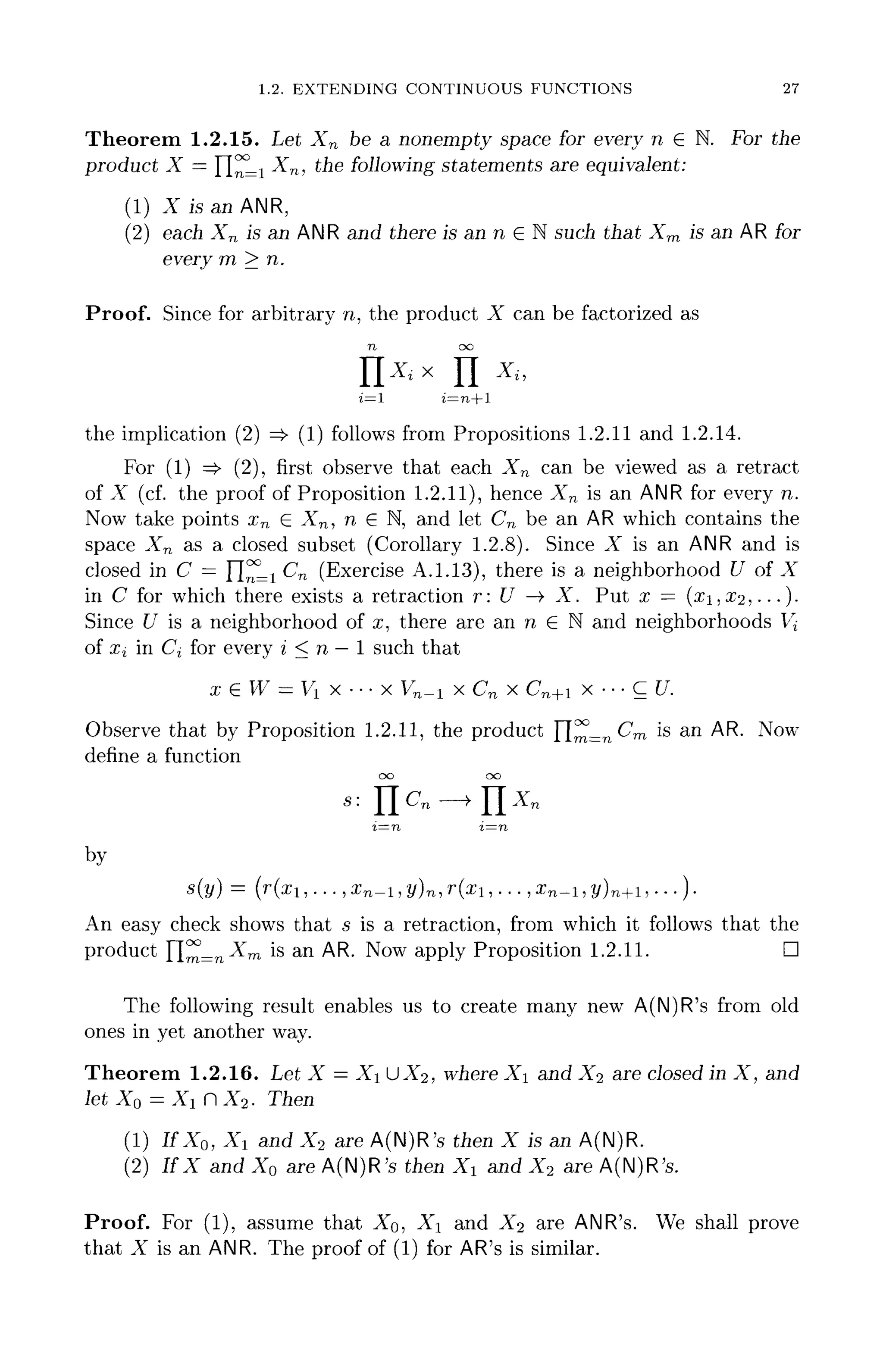

![1.3. FUNCTION SPACES 29
3. Prove Proposition 1.2.11.
4. Let X - {0} U {l
/n : n e N}. Prove that A(X) is an example of a
contractible space which is not an ANR.
5. Let A C S™"1
. Observe that Bn
A is a convex subset ofW1
and hence is
an AR. Present a direct proof of this.
6. Prove that each AR is path-connected. Prove that every ANR is locally
path-connected. Observe that, in particular, every ANR is locallycon-
nected.
7. Give an example of a subspace X of R, such that X is an ANR, but XU{p}
is not an ANR for some p G R.
8. Let X be the sin(yx)-continuum in the plane. Prove that X is not an
ANR.
^•9. Let .4i and A^ be closed subsets of the locally convex linear spaces LI
and 1/2, respectively. Prove that for each homeomorphism h: A —> AI
there exists a homeomorphism H: LI x 1/2 —> LI x Lz such that
H(a,0) = (0,/i(a))
for every a G A.
10. Let L be a linear space. In addition, let X be a space, A C X be closed
and /: A —> L be continuous. Finally, let It and {au • U £ It} be a
Dugundji system for X and A. For each x G X A let
8.(x) = {U <E U : x 6 U}.
Define a function F =>• L by
Ffx) =
^ ' ' conv({/(a[/) : U e £ ( x ) } ) (x£XA).
Prove that F isLSC.
11. Use Exercise 1.2.10 to prove that a normed linear space satisfies the con-
clusion of the Dugundji Theorem 1.2.2.
12. Let L be a linear space. Assume that for every space X, every LSC func-
tion F: X => L such that for every x G X the set F(x) is compact and
convex, has a continuous selection. Prove that every linear subspace of L
is an AR.
1.3. Function spaces
The space C*(X) from Example 1.1.5 is a special case of a more general
construction. Let X and Y be spaces and let Q be an admissible metric on Y.
Define
Ce(X,Y) = {/ € C(X,Y) : diaine(/[X]) < oo}.
It is sometimes convenient to refer to the elements of Ce(X, Y} as bounded
functions. We shall endow CB(X, Y) with a useful topology.](https://image.slidesharecdn.com/764402-250518172750-213807ba/75/The-Infinitedimensional-Topology-Of-Function-Spaces-Illustrated-Edition-J-Van-Mill-46-2048.jpg)
![30 1. BASIC TOPOLOGY
In §A.2 we observed that @ need not be a metric on C(X, Y). Fortunately,
on Ce(X,Y) it is a metric.
Lemma 1.3.1. Let X and Y be spaces and let Q be an admissible metric
on Y. Then
(1) for all /, g 6 Ce(X, Y) we have £(/, g) < oo,
(2) the function g: Ce(X,Y) x Ce(X,Y) -> [0,oo) is a metric.
Proof. For (1), take an arbitrary point z G X and observe that for all
functions /, g GCe(X, Y) the following holds:
Q(f,9) < diam,(/pq) + Q ( f ( z ) , g ( z ) ) + diam, (g(X)) <oo.
The proof of (2) is routine and is left as an exercise to the reader. D
From now on we shall endow CQ(X, Y} with the topology induced by Q.
Let us emphasize that the set Ce(X, Y} as well as its topology depend on the
choice of the metric Q. It is a natural question to ask when the choice of Qis
irrelevant.
Lemma 1.3.2. Let X and Y be spaces with X compact. In addition, let Q
and Q-2 be admissible metrics for Y. Then
(1) Cei(X,Y)=Cea(X,Y)=C(X,Y),
(2) the topologies on C(X,Y] induced by QI and £2 are the same.
Proof. (1) is trivial.
For each e > 0, y e Y and i G {1, 2} we put
Bi(y,e) = {zeY : Qi(y,z) < e}.
For (2), take / 6 Cei(X,Y) and e > 0, arbitrarily. Our aim is to prove
that there exists 6 > 0 such that
{g € CQ2(X,Y) : g2(f,g) < 6} C {g e CB1(X,Y) : ^ ( f . g ] < e},
i.e., that the ^2-ball about / with radius 6 is contained in the ^i-ball about /
with radius e.
To this end, observe that since f[X] is compact, the open cover
has a 02-Lebesgue number, say 6 (Lemma A.5.3). We claim that this 8 is as
required. To see that this is indeed the case, take an arbitrary g 6 CQ2 (X, Y}
such that Qi(f,g) < 5. For each x e X we have 02(f(x),g(x)') < 5, so there
exists px e X such that { f ( x ) , g ( x } } C J3i(/(pz), e
/2). Consequently, for each
element x G X we have
Qi(f(x},g(x)) <e,
from which it follows by Exercise A.5.4 that Qi(f,g) < £•](https://image.slidesharecdn.com/764402-250518172750-213807ba/75/The-Infinitedimensional-Topology-Of-Function-Spaces-Illustrated-Edition-J-Van-Mill-47-2048.jpg)
![1.3. FUNCTION SPACES 31
So we conclude that the topology on C(X, Y) induced by £2 is finer than
the topology on C(X,Y) induced by 0i. By interchanging the roles of g
and £2 m
the above argument we find that the induced topologies are indeed
the same. D
Let X and Y be spaces with X compact. From the above lemma we
conclude that all the topologies we defined on the set C(X, Y) coincide. So
for compact X and any (Y,g) we shall denote the space Ce(X,Y) simply
by C(X, Y). The topology on C(X,Y) is called the topology of uniform
convergence.
Observe that the norm topology on C(X) for compact X defined in
Example 1.1.5 coincides with the just defined topology on C(X, R).
On Page 19 we defined the so-called compact-open topology on C(X}.
This is again a special case of a more general construction. Indeed, let X
and Y be spaces and for an arbitrary compact subset K in X and an arbitrary
open subset U in Y define
[K,U] = {feC(X,Y):f[K]CU}.
Topologize C(X, Y) by taking the collection
{[K, U] : K C X compact and U C Y open}
as an open subbase. This topology is called the compact-open topology on
the set C(X,Y).
We will now show that for compact X and arbitrary Y the compact-open
topology on C(X, Y) coincides with the topology of uniform convergence
on C(X, Y). This allows us to prove quite easily that C(X, Y) is separable.
Proposition 1.3.3. Let X and Y be spaces with X compact. The topology
of uniform convergence on C(X, Y) coincides with the compact-open topology
on C(X,Y). As a consequence, C(X,Y} is separable.
Proof. Let g be an admissible metric on Y. In addition, let K C X be
compact and U C Y open. If / G [K, U] then f[K] is a compact subset of U.
By Corollary A.5.4 there exists 8 > 0 such that
B ( f [ K , S ) C U .
This clearly implies that if g G C(X, Y} is such that £>(/, g) < 6 then g[K] is
contained in U, i.e.,
{geC(X,Y):Q(f,g)<6}C[K,U}.
From this we conclude that [K, U] is open in the topology of uniform con-
vergence on C(X, Y) and hence that the topology of uniform convergence is
finer than the compact-open topology.](https://image.slidesharecdn.com/764402-250518172750-213807ba/75/The-Infinitedimensional-Topology-Of-Function-Spaces-Illustrated-Edition-J-Van-Mill-48-2048.jpg)
![32 1. BASIC TOPOLOGY
For the converse, let !B and £ be countable open bases for X and Y,
respectively, which are both closed under finite unions. For B € *B and E € £
put
By the above, each A(B,E) is open in the topology of uniform convergence
on C(X,Y). Let A be the (countable) collection of all A(B:E)'s. We claim
that the family A* of all finite intersections of elements of A is an open base
for C(X, Y) endowed with the topology of uniform convergence. This proves
on the one hand that compact-open topology is finer than the topology of
uniform convergence and on the other hand that that C(X, Y) has a countable
base.
Let / G C(X,Y) and e > 0. We shall prove that there exists an ele-
ment F € A* such that / G F C {g G C(X,Y) : g(f,g) < e}. By compact-
ness of the set f[X], there are finitely many elements of £, say E,E-z, ••••> En,
such that
(1)
(2) for every i < n, diam(Ei) < e.
Let U = {f~l
[Ei : i < n}. Since "B is a base, there clearly is a a cover V of X
consisting of elements of 23 such that V < U. By compactness of X, we may
assume that V is finite. For each i < n let Wi be the union of the elements
of V the closures of which are contained in f~1
[Ei], Since "B is closed under
finite unions, W = {Wi : i < n} is a subcollection of !B, "W covers X, and W
has the property that the closure of each Wi is contained in f~1
[Ei. (This
is so since Wi is a finite union of sets the closures of which are contained
in f-^Ei].) Now put
It is clear that / G F. In addition, F is open in the topology of uniform
convergence. We claim that F C {g G C(X,Y) : £(/, 5) < e}. To this end,
take g G F and x G X. There exists i < n with x G Wi. Since /, g G F, it
follows that f[Wi] Ug[Wi] C Ei. Consequently, both f(x) and g(x) belong
to Ei from which we get by (2) that g(f(x},g(x)] < £. So we are done. D
This result can be used to estimate the number of continuous functions.
Corollary 1.3.4. Let X and Y be spaces with X compact. Then C(X,Y)
has cardinality at most c.
Proof. This follows from Proposition 1.3.3 and Exercise A.2.16. D
We now turn to completeness properties of C(X,Y) and CS(X,Y).](https://image.slidesharecdn.com/764402-250518172750-213807ba/75/The-Infinitedimensional-Topology-Of-Function-Spaces-Illustrated-Edition-J-Van-Mill-49-2048.jpg)
![1.3. FUNCTION SPACES 33
Proposition 1.3.5. Let X and (Y, g) be spaces. Let (fn }n be a g-Cauchy
sequence in C(X,Y] such that for every x G X, lim^^oo fn(x) exists. Then
the function f : X -> Y defined by f(x] — limn^oo /n(x) is continuous. In
addition, if fn G Ce(X, Y) for every n then f G Cg(X, Y} and f = lim™-^ fn
(inCe(X,Y)).
Proof. For the first part of the proposition, see Lemma A.3.1.
For the remaining part, suppose that fn G CS(X, Y) for every n. We
shall prove that diam(/[A"]) < oo. By Claim 1 in the proof of Lemma A.3.1
there exists an M G N such that for every x G X, g ( f ( x ) , /M(^)) < 1- Take
arbitrary x,z GX. Then
g ( f ( x ) J ( z } ) < g ( f ( x ) , f M ( x ) ) + Q(fM(x], f M ( z ) ) + g ( f M ( z } J ( z ) )
< 2 + diam(/M[A]),
so diam(/[A"]) < oo.
It remains to prove that / = limTn.00 fn (in C8(X,Y)). But this follows
again easily from Claim 1 in the proof of Lemma A.3.1. D
Corollary 1.3.6. Let X and (Y, g) be spaces. Then g is complete if and
only if g is complete.
Proof. Suppose that (Y, g) is complete and let (fn}n be a 0-Cauchy sequence
in Ce(X,Y). Fix z G A" arbitrarily and let e > 0. There exists A7
" G N such
that g(fm fm) < £ for all n,ra > N. Since for all n and m,
we conclude that (fn(z)) is Cauchy in (Y,g). The completeness of (Y, g)
and Proposition 1.3.5 now yield that the sequence (/n)n converges.
Now assume that g is complete. Let (yn)n be a ^-Cauchy sequence in Y.
For each n let fn : X -> Y be the constant function with value yn. It is easy
to see that (fn )n is a ^-Cauchy sequence in Ce(X,Y). So / = limn_^oo fn
exists and belongs to Ce(X,Y). It is trivial to prove that / is constant and
that the sequence (yn)n converges to the unique point in the range of /. D
Corollary 1.3.7. Let X be compact and Y topologically complete. Then
the space C(X,Y) is topologically complete.
Groups of homeomorphisms. We will now restrict our attention to
spaces of homeomorphisms and will derive some basic properties of them.
Let X and Y be spaces and define
§(A,F) = {/ G C(X,Y) : f is surjective}.
There are spaces X and Y for which §(A", Y) is empty, for example this is
the case if X has smaller cardinality than Y.](https://image.slidesharecdn.com/764402-250518172750-213807ba/75/The-Infinitedimensional-Topology-Of-Function-Spaces-Illustrated-Edition-J-Van-Mill-50-2048.jpg)
![34 1. BASIC TOPOLOGY
Proposition 1.3.8. Let X and Y be spaces with X compact. Then §>(X, Y}
is closed in C(X, Y).
Proof. Take an arbitrary / ^ S(X, Y). There exists a point y GY f[X].
So
fe[X,Y{y}]CC(X,Y)S(X,Y).
Since [X, Y {y}] is open in C(X,Y) (Proposition 1.3.3), this shows that
is a neighborhood of /. Hence C(X, Y) B(X, Y} is open in C(X, Y}. D
Let X and Y be spaces with X compact, and let e > 0. A continuous
function /: X —> Y is called an e-map if for every y G Y,
s.
Let e > 0 and put
CE(X, Y) = {/ G C(X, Y) : f is an e-map}
and
Se(X,Y)=Ce(X,Y)nS(X,Y),
respectively. In addition, put
Lemma 1.3.9. Let X and Y be spaces with X compact. Then C£(X,Y) is
open in C(X, Y) for every e > 0. Consequently, S£(X, Y} is a closed subset
ofC(X,Y).
Proof. Take / G C£(X,Y). Since X is compact, /: X ->• f[X] is a closed
map (Exercise A.5.5). We claim that for every y G f[X] there exists an open
neighborhood Uy (in /[-X"]) such that
diam(f-l
[Uy}) <e.
This will be achieved in two steps. Take an arbitrary y G f[X]. Then
diam(f-l
(y)) <e
since / is an £-map. There clearly exists an open neighborhood U of f ~ l
( y )
such that diam(C7) < e. Nowby using that / is a closed map, Exercise A. 1.15
gives us the required neighborhood Uy.
Let 6 > 0 be a Lebesgue number for the open covering
{Uy-.yz f[X}}
off[X] (Lemma A.5.3). Let g G C(X, Y) be such that g(g, /) < %. We claim
that g G C£(X, Y). This clearly suffices. To this end, take an arbitrary y G Y.
Since we have 0(f,g) < 5
/2 it follows easily that diam (fg~1
(y)) < 5. There](https://image.slidesharecdn.com/764402-250518172750-213807ba/75/The-Infinitedimensional-Topology-Of-Function-Spaces-Illustrated-Edition-J-Van-Mill-51-2048.jpg)
![1.3. FUNCTION SPACES 35
~l
consequently exists a point z 6 f[X] such that fg~l
(y) C Uz. This implies
that
Since g~1
(y) C f~1
fg~1
(y), we conclude that diam (g~1
(y)} < £•, i.e., g is
an e-map. That $£ (X,Y) is closed now follows by Proposition 1.3.8. D
Let X and Y be spaces. We introduce a few more interesting subsets
of C(X, Y). Let 3(X, Y) denote the subset of C(X, Y) consisting of all imbed-
dings of X into Y, and let 9t(X, Y) denote the set of all homeomorphisms
from X onto Y. If X = Y then for H ( X , X ) we shall simply write
As usual, ^K(X) is called the autohomeomorphism group of X.
Lemma 1.3.10. Let X and Y be spaces with X compact. Then
As a consequence, 3(X,Y) is a G^-subset ofC(X,Y), and 3{,(X,Y) is a G$
subset of both C(X, Y) and S(X, Y).
Proof. That 3(X,Y) C f}™=l Cif (X,Y] is a triviality. Pick an arbitrary
Then / is a 1
/n-map for every n, hence / is one-to-one. So the compact-
ness of X implies that / is an imbedding (Exercise A.5.9). The remaining
statements are obvious. D
Corollary 1.3.11. Let X and Y be spaces with X compact and Y topolog-
ically complete. Then both 3(X, Y} and 'H(X, Y) are topologically complete.
Proof. Since C(X,Y) is completely metrizable by Corollary 1.3.6, this fol-
lows immediately from Lemma 1.3.10 and Theorem A.6.3. D
So 'K(X) is complete if X is compact. It will be convenient to explicitly
describe a complete metric for "H(X) that generates its topology.
Proposition 1.3.12. Let X be a compact space. For /, g 6 'K(X) define
Then a is a complete metric on "H(X) that generates its topology.
Proof. That a is a metric is left as an exercise to the reader. We shall
first prove that Q and a generate the same topology on J{,(X}.. Since for](https://image.slidesharecdn.com/764402-250518172750-213807ba/75/The-Infinitedimensional-Topology-Of-Function-Spaces-Illustrated-Edition-J-Van-Mill-52-2048.jpg)
![36 1. BASIC TOPOLOGY
all /, g E 3t(X] we have £>(/,#) < cr(/, <?), the only thing to verify is that for
every e > 0 and every / E Oi(X) there exists S > 0 such that
if g E K(X} and g(f,g) < 6 then a(f,g) < E.
Choose arbitrary e > 0 and / E ^K(X). By compactness, /-1
is uniformly
continuous (Exercise A.5.18) and consequently there exists 7 > 0 such that
for all x,y E X with g(x,y) < 7 we have g ( f ~ l
( x ) , f ~ l
( y } } < £
/2- Let
Take g 6 3{(X) such that Q(f,g) < S. Pick an arbitrary x e X and put
z = g~l
(x).
Since £>(/, g) < 6, it follows that
Q(f(z),g(z)) = Q(fg-l
(x},x} < 6 < 7.
As a consequence,
We conclude that 6(g~1
,f~i
) < E
li by Exercise A.5.4. Therefore,
Now let (fn)n be a cr-Cauchy sequence in "H(X}. Then (fn)n is a Q-
Cauchy sequence in C(X, X) and therefore the limit / = limn_>oo fn exists
and belongs to C(X, X] (Corollary 1.3.6). Similarly, by the definition of cr,
the limit g = limn^.oo f~l
exists and belongs to C(X,X). It is easily seen
that fog = lx=gof from which it follows that / 6 'H(X). D
Lemma 1.3.10 and Proposition 1.3.12 both imply by Theorem A.6.6 the
following
Corollary 1.3.13. If X is compact then 3i(X) is a Baire space.
Exercises for §1.3.
1. Let N denote the discrete space of natural numbers. Prove that C(N, K; |-|)
is not separable.
2. Let X, Y and Z be compact spaces. For / € C(Z, X) and g,h£ C(X, Y)
prove that
Q(g° f,ho f ) < g(g,h).
In addition, show that if / is surjective then
3. Let X be compact, let /, g G C(X, X) such that g is a homeomorphism.
Prove that](https://image.slidesharecdn.com/764402-250518172750-213807ba/75/The-Infinitedimensional-Topology-Of-Function-Spaces-Illustrated-Edition-J-Van-Mill-53-2048.jpg)