A SEPTIC
TECHNIQUE
PP2Assignment
Aseptic Technique refers to manipulations
of compounded sterile products &
parenteral preparations that prevents
contamination.
This includes manipulations of syringes,
needles, vials,
ampules, removal
of packaging,
assembling of
sterile products,
hand placement,
etc.
Annisa H ayatunnufus
(012014052438)
AM PULES
- Stepsto break ampule:
a. Clean ampule neck with
alcohol swab
b. Leave swab in place
c. Grasp ampule neck with
thumb and index finger
d. Use quick, firm, snapping
motion away from body
towardsside wall of hood
e. Do not break towards heap
filter
-
- Steps to withdraw medication
from ampule:
a. Tilt ampule
b. Place needle bevel in corner
space near opening
c. Pull back syringe plunger
- Steps to avoid glass
contamination of ampule
solution:
a. Use 5 micron filter needle to
filter glass as solution is
pushed out of the syringe
b. A filter needle can only be
used in one direction,
otherwise glass particles
originally filtered are
reintroduced
REMEMBER!
- Giving patient a contaminated
product can cause serious adverse
effectsincludingdeath.
- Discard any potentially
contaminated product and inform
the pharmacist that product was
discarded.
SU M M A RY
In assembling all the
product, great caremust
beexcersied to prevent
any touch contamination
of critical edgesor
component surfaces
CORING,VIALS,SW AB
- Do not touch the tip nor plunger.
- Preferably use Luer-lock syringe than slip-tip
syringe. Even though the latter cost less, the
needle connection islesssecure.
- Do not use syringeswhose gradationsare greater
than twice the volume being measured.
- Use glass syringes in rare compounding
scenarios (ie. Preparing certain chemotherapy
products or drug is incompatible with syringe
components).
125
145
290
* * *
SYRINGE
NEEDLES
- Choose the size according to the length and
gauge (the larger, the finer the diameter of
needle?sbore)
- Do not touch any part of the needle
- Open needle package within hood to maintain
sterility
- Do not swab the needle with alcohol before use.
Discard immediately in a sharps container even
in the slightest contamination
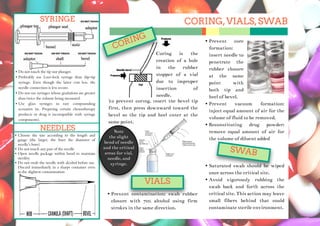
To prevent coring, insert the bevel tip
first, then press downward toward the
bevel so the tip and heel enter at the
samepoint.
CORING
Coring is the
creation of a hole
in the rubber
stopper of a vial
due to improper
insertion of
needle.
Note
theslight
bendof needle
andthecritical
areasfor vial,
needle, and
syringe.
- Prevent contamination: swab rubber
closure with 70%alcohol using firm
strokesin thesamedirection.
VIALS
- Prevent core
formation:
insert needleto
penetrate the
rubber closure
at the same
point with
both tip and
heel of bevel.
- Prevent vacuum formation:
inject equal amount of air for the
volumeof fluidtoberemoved.
- Reconstituting drug powder:
remove equal amount of air for
thevolumeof diluent added
- Saturated swab should be wiped
onceacrossthecritical site.
- Avoid vigorously rubbing the
swab back and forth across the
critical site. Thisaction may leave
small fibers behind that could
contaminatesterileenvironment.
SW AB

Aseptic Technique Brochure

  • 1.
    A SEPTIC TECHNIQUE PP2Assignment Aseptic Techniquerefers to manipulations of compounded sterile products & parenteral preparations that prevents contamination. This includes manipulations of syringes, needles, vials, ampules, removal of packaging, assembling of sterile products, hand placement, etc. Annisa H ayatunnufus (012014052438) AM PULES - Stepsto break ampule: a. Clean ampule neck with alcohol swab b. Leave swab in place c. Grasp ampule neck with thumb and index finger d. Use quick, firm, snapping motion away from body towardsside wall of hood e. Do not break towards heap filter - - Steps to withdraw medication from ampule: a. Tilt ampule b. Place needle bevel in corner space near opening c. Pull back syringe plunger - Steps to avoid glass contamination of ampule solution: a. Use 5 micron filter needle to filter glass as solution is pushed out of the syringe b. A filter needle can only be used in one direction, otherwise glass particles originally filtered are reintroduced REMEMBER! - Giving patient a contaminated product can cause serious adverse effectsincludingdeath. - Discard any potentially contaminated product and inform the pharmacist that product was discarded. SU M M A RY In assembling all the product, great caremust beexcersied to prevent any touch contamination of critical edgesor component surfaces
  • 2.
    CORING,VIALS,SW AB - Donot touch the tip nor plunger. - Preferably use Luer-lock syringe than slip-tip syringe. Even though the latter cost less, the needle connection islesssecure. - Do not use syringeswhose gradationsare greater than twice the volume being measured. - Use glass syringes in rare compounding scenarios (ie. Preparing certain chemotherapy products or drug is incompatible with syringe components). 125 145 290 * * * SYRINGE NEEDLES - Choose the size according to the length and gauge (the larger, the finer the diameter of needle?sbore) - Do not touch any part of the needle - Open needle package within hood to maintain sterility - Do not swab the needle with alcohol before use. Discard immediately in a sharps container even in the slightest contamination To prevent coring, insert the bevel tip first, then press downward toward the bevel so the tip and heel enter at the samepoint. CORING Coring is the creation of a hole in the rubber stopper of a vial due to improper insertion of needle. Note theslight bendof needle andthecritical areasfor vial, needle, and syringe. - Prevent contamination: swab rubber closure with 70%alcohol using firm strokesin thesamedirection. VIALS - Prevent core formation: insert needleto penetrate the rubber closure at the same point with both tip and heel of bevel. - Prevent vacuum formation: inject equal amount of air for the volumeof fluidtoberemoved. - Reconstituting drug powder: remove equal amount of air for thevolumeof diluent added - Saturated swab should be wiped onceacrossthecritical site. - Avoid vigorously rubbing the swab back and forth across the critical site. Thisaction may leave small fibers behind that could contaminatesterileenvironment. SW AB