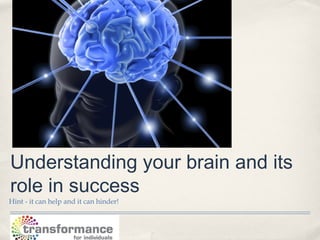
Understanding your brain and its
role in success
Hint - it can help and it can hinder!
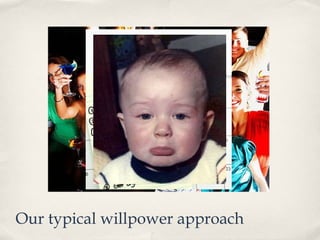
Our typical willpower approach
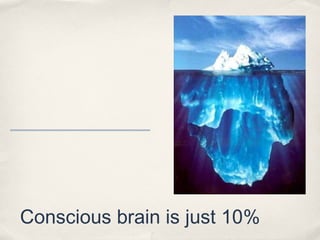
Conscious brain is just 10%
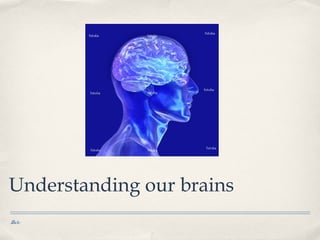
Understanding our brains
Date
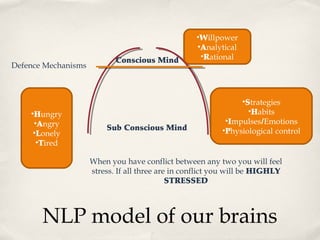
•Willpower
                                                   •Analytical
                            Conscious Mind          •Rational
Defence Mechanisms


                                                               •Strategies
    •Hungry                                                      •Habits
     •Angry                                                •Impulses/Emotions
                         Sub Conscious Mind               •Physiological control
     •Lonely
      •Tired

                     When you have conflict between any two you will feel
                     stress. If all three are in conflict you will be HIGHLY
                                             STRESSED


       NLP model of our brains
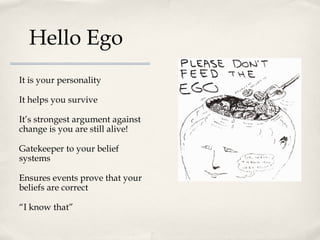
Hello Ego
It is your personality

It helps you survive

It’s strongest argument against
change is you are still alive!

Gatekeeper to your belief
systems

Ensures events prove that your
beliefs are correct

“I know that”
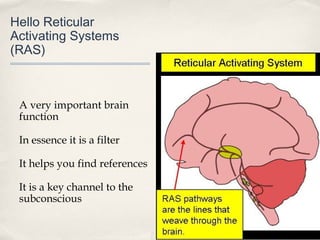
Hello Reticular
Activating Systems
(RAS)


 A very important brain
 function

 In essence it is a filter

 It helps you find references

 It is a key channel to the
 subconscious
RAS helps define consciousness

You are aware of things in the room right now

Your brain has processed information

It has probably processed around 130 bits

How many bits of information do you think are in the room?


                 Millions!!
Awareness / consciousness

You can see that “reality” is very personal process

Your perception is driven by what bits of information you
are allowing to be processed

The rest of the information exists - you have just discounted
it

RAS is the gatekeeper to your Subconscious - it lets in
what you tell it is important

Your beliefs are stored in your subconscious
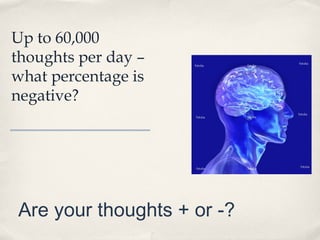
Up to 60,000
thoughts per day –
what percentage is
negative?


Are your thoughts + or -?
A look at emotions
Date
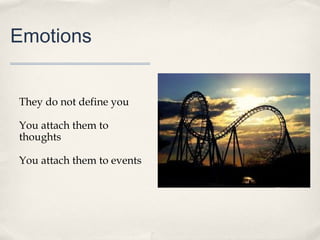
Emotions


They do not define you

You attach them to
thoughts

You attach them to events
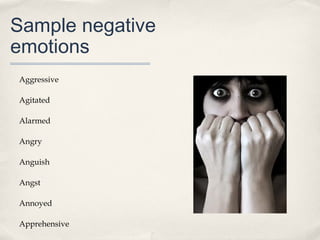
Sample negative
emotions
Aggressive

Agitated

Alarmed

Angry

Anguish

Angst

Annoyed

Apprehensive
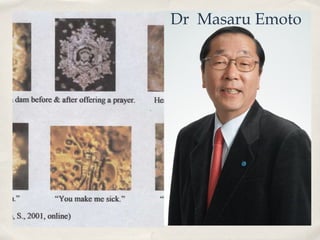
Dr Masaru Emoto
Emotional
baggage

In your workbook list any
emotional baggage you are
still carrying

List negative emotions that
keep recurring
A closer look at beliefs
Date
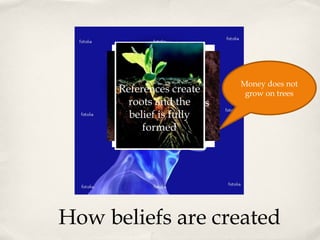
An idea gets     Money does not
      References create
            planted         grow on trees
        roots and the
      Subconscious looks
        belief is fully
         for references
           formed


How beliefs are created
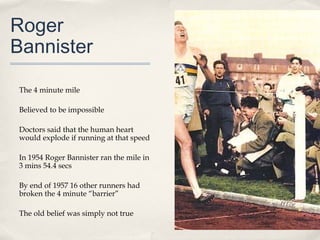
Roger
Bannister

The 4 minute mile

Believed to be impossible

Doctors said that the human heart
would explode if running at that speed

In 1954 Roger Bannister ran the mile in
3 mins 54.4 secs

By end of 1957 16 other runners had
broken the 4 minute “barrier”

The old belief was simply not true
What about the
flat earth belief?


 The ancient Greeks figured it out

 However there is still a flat Earth
 Society alive and well today!
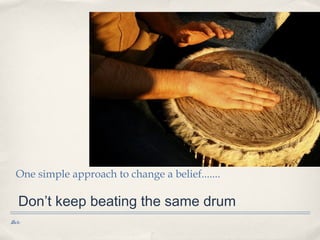
One simple approach to change a belief.......

   Don’t keep beating the same drum
Date
Exercise - Part 1

 List any beliefs that you think are holding you back

 Where did that belief come from?

 What has this belief cost me over the years?

 What has it prevented me from doing/ having/ being?
Exercise Part 2
-

Success
 What does it mean to YOU?

 What would it look like?

 How would you “feel”?

 What resources will you need?

 What do you need to BELIEVE
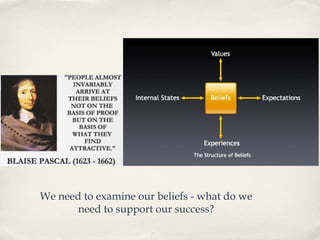
We need to examine our beliefs - what do we
       need to support our success?
Tools for
changing
beliefs


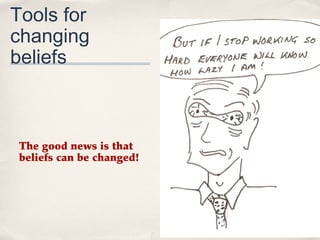
 The good news is that
 beliefs can be changed!
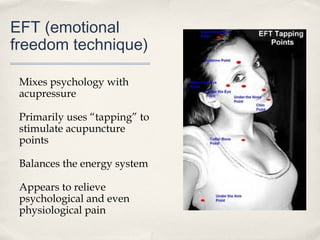
EFT (emotional
freedom technique)

 Mixes psychology with
 acupressure

 Primarily uses “tapping” to
 stimulate acupuncture
 points

 Balances the energy system

 Appears to relieve
 psychological and even
 physiological pain
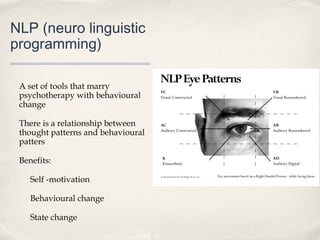
NLP (neuro linguistic
programming)

 A set of tools that marry
 psychotherapy with behavioural
 change

 There is a relationship between
 thought patterns and behavioural
 patters

 Benefits:

    Self -motivation

    Behavioural change

    State change
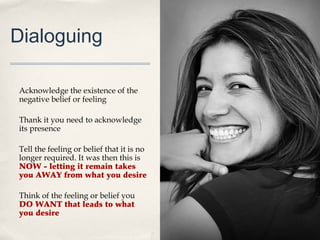
Dialoguing

Acknowledge the existence of the
negative belief or feeling

Thank it you need to acknowledge
its presence

Tell the feeling or belief that it is no
longer required. It was then this is
NOW - letting it remain takes
you AWAY from what you desire

Think of the feeling or belief you
DO WANT that leads to what
you desire
Sedona Method

In a nutshell

   Allow the negative emotion to
   appear

   Examine it

   “Could I let this feeling go?

   “Would I let this feeling go?”

   If so when?
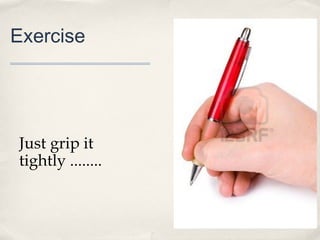
Exercise


Just grip it
tightly ........
The Power of Questions


They can be life enhancing
They can be life detracting
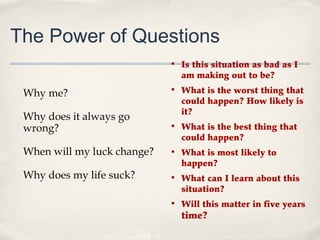
The Power of Questions
                             • Is this situation as bad as I
                               am making out to be?

 Why me?                     • What is the worst thing that
                               could happen? How likely is
                               it?
 Why does it always go
 wrong?                      • What is the best thing that
                               could happen?
 When will my luck change?   • What is most likely to
                               happen?
 Why does my life suck?      • What can I learn about this
                               situation?
                             • Will this matter in five years
                               time?
Tony Robbins - morning
power questions


 What am I happy about in my
 life right now?

 What am I excited about in my
 life right now?

 What am I grateful for right
 now?

 What am I enjoying in my life
 right now?

 Who do I love and who loves
 me?
Evening power
questions

What have I given today?

What did I learn today?

How has today contributed
to my future?

What did I feel grateful for
today?
Transformance
power thoughts

“What if ......?”

“What else is possible?”

“How does it get any better
than this?”

“Wouldn’t it be nice if...?”

“There is plenty more
where that came from”
PHYSIOLOGY
AND
SUCCESS
USING YOUR BODY AND MIND IN A
CYBERNETIC LOOP
Mind and body are connected

Breathing

How you speak

How you hold your body

Muscle tension

Head up

How you move
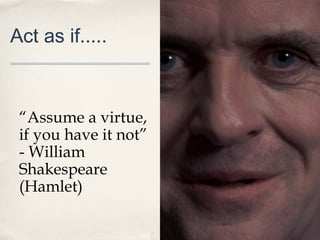
Act as if.....


 “Assume a virtue,
 if you have it not”
 - William
 Shakespeare
 (Hamlet)
Exercise


List the virtues
you think you
need to achieve
your desires

Module 4 understanding your mind

  • 1.
    Understanding your brainand its role in success Hint - it can help and it can hinder!
  • 2.
  • 3.
  • 4.
  • 5.
    •Willpower •Analytical Conscious Mind •Rational Defence Mechanisms •Strategies •Hungry •Habits •Angry •Impulses/Emotions Sub Conscious Mind •Physiological control •Lonely •Tired When you have conflict between any two you will feel stress. If all three are in conflict you will be HIGHLY STRESSED NLP model of our brains
  • 6.
    Hello Ego It isyour personality It helps you survive It’s strongest argument against change is you are still alive! Gatekeeper to your belief systems Ensures events prove that your beliefs are correct “I know that”
  • 7.
    Hello Reticular Activating Systems (RAS) A very important brain function In essence it is a filter It helps you find references It is a key channel to the subconscious
  • 8.
    RAS helps defineconsciousness You are aware of things in the room right now Your brain has processed information It has probably processed around 130 bits How many bits of information do you think are in the room? Millions!!
  • 9.
    Awareness / consciousness Youcan see that “reality” is very personal process Your perception is driven by what bits of information you are allowing to be processed The rest of the information exists - you have just discounted it RAS is the gatekeeper to your Subconscious - it lets in what you tell it is important Your beliefs are stored in your subconscious
  • 10.
    Up to 60,000 thoughtsper day – what percentage is negative? Are your thoughts + or -?
  • 11.
    A look atemotions Date
  • 12.
    Emotions They do notdefine you You attach them to thoughts You attach them to events
  • 13.
  • 14.
  • 15.
    Emotional baggage In your workbooklist any emotional baggage you are still carrying List negative emotions that keep recurring
  • 16.
    A closer lookat beliefs Date
  • 17.
    An idea gets Money does not References create planted grow on trees roots and the Subconscious looks belief is fully for references formed How beliefs are created
  • 18.
    Roger Bannister The 4 minutemile Believed to be impossible Doctors said that the human heart would explode if running at that speed In 1954 Roger Bannister ran the mile in 3 mins 54.4 secs By end of 1957 16 other runners had broken the 4 minute “barrier” The old belief was simply not true
  • 19.
    What about the flatearth belief? The ancient Greeks figured it out However there is still a flat Earth Society alive and well today!
  • 20.
    One simple approachto change a belief....... Don’t keep beating the same drum Date
  • 21.
    Exercise - Part1 List any beliefs that you think are holding you back Where did that belief come from? What has this belief cost me over the years? What has it prevented me from doing/ having/ being?
  • 22.
    Exercise Part 2 - Success What does it mean to YOU? What would it look like? How would you “feel”? What resources will you need? What do you need to BELIEVE
  • 23.
    We need toexamine our beliefs - what do we need to support our success?
  • 24.
    Tools for changing beliefs Thegood news is that beliefs can be changed!
  • 25.
    EFT (emotional freedom technique) Mixes psychology with acupressure Primarily uses “tapping” to stimulate acupuncture points Balances the energy system Appears to relieve psychological and even physiological pain
  • 26.
    NLP (neuro linguistic programming) A set of tools that marry psychotherapy with behavioural change There is a relationship between thought patterns and behavioural patters Benefits: Self -motivation Behavioural change State change
  • 27.
    Dialoguing Acknowledge the existenceof the negative belief or feeling Thank it you need to acknowledge its presence Tell the feeling or belief that it is no longer required. It was then this is NOW - letting it remain takes you AWAY from what you desire Think of the feeling or belief you DO WANT that leads to what you desire
  • 28.
    Sedona Method In anutshell Allow the negative emotion to appear Examine it “Could I let this feeling go? “Would I let this feeling go?” If so when?
  • 29.
  • 30.
    The Power ofQuestions They can be life enhancing They can be life detracting
  • 31.
    The Power ofQuestions • Is this situation as bad as I am making out to be? Why me? • What is the worst thing that could happen? How likely is it? Why does it always go wrong? • What is the best thing that could happen? When will my luck change? • What is most likely to happen? Why does my life suck? • What can I learn about this situation? • Will this matter in five years time?
  • 32.
    Tony Robbins -morning power questions What am I happy about in my life right now? What am I excited about in my life right now? What am I grateful for right now? What am I enjoying in my life right now? Who do I love and who loves me?
  • 33.
    Evening power questions What haveI given today? What did I learn today? How has today contributed to my future? What did I feel grateful for today?
  • 34.
    Transformance power thoughts “What if......?” “What else is possible?” “How does it get any better than this?” “Wouldn’t it be nice if...?” “There is plenty more where that came from”
  • 35.
    PHYSIOLOGY AND SUCCESS USING YOUR BODYAND MIND IN A CYBERNETIC LOOP
  • 36.
    Mind and bodyare connected Breathing How you speak How you hold your body Muscle tension Head up How you move
  • 37.
    Act as if..... “Assume a virtue, if you have it not” - William Shakespeare (Hamlet)
  • 38.
    Exercise List the virtues youthink you need to achieve your desires