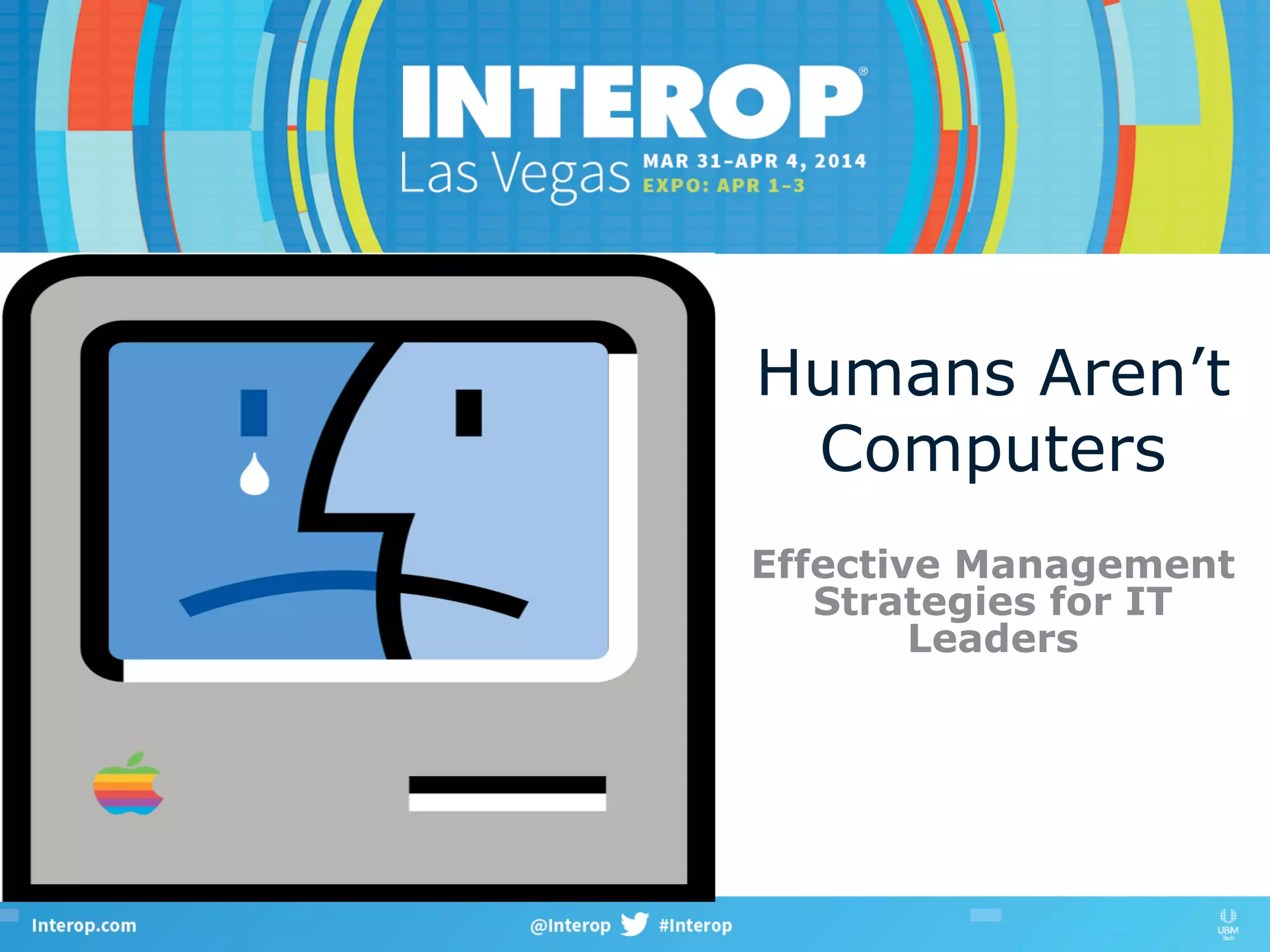
Humans Aren’t
Computers
Effective Management
Strategies for IT
Leaders
Who Are We?
•  Michele Chubirka, aka "Mrs. Y.,” host of Healthy
Paranoia Podcast, information security feed of
Packetpushers and official nerd stalker.
www.healthyparanoia.net
chubirka@postmodernsecurity.com
@MrsYisWhy
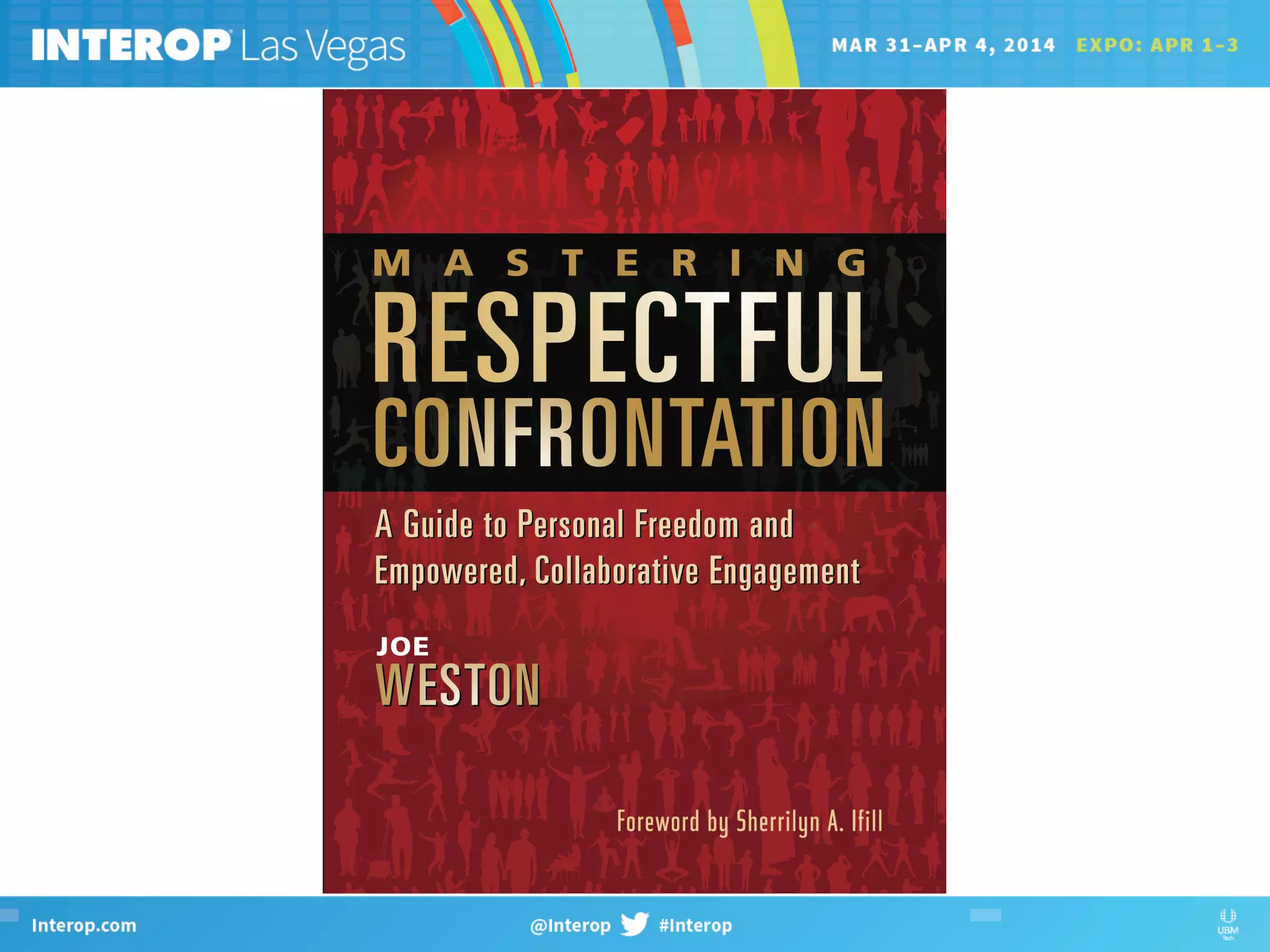
•  Joe Weston, workshop facilitator, consultant, and
author of the book Mastering Respectful
Confrontation. Also founder of the Heartwalker
Peace Project.
heartwalker@joeweston.com
http://www.respectfulconfrontation.com/
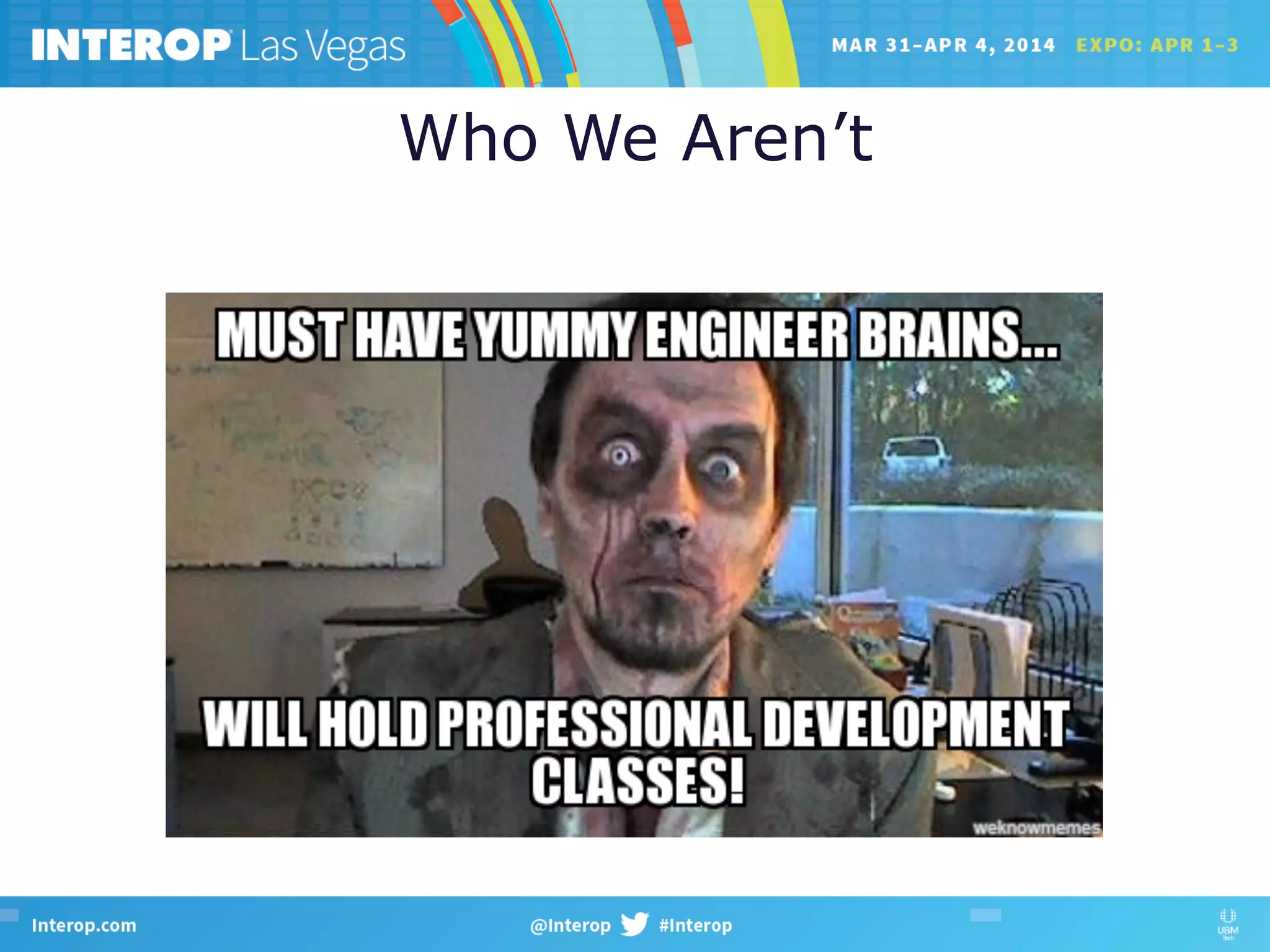
Who We Aren’t
How engaged can you be today?
•  How many of you started out as engineers
or technical staff?
•  Are you happy and energized by this
choice?
•  Would you like to improve the quality of
your professional environment?
•  Why did you accept a leadership role?
What’s the SLA with Our Staff?
•  Employees Are the Most Valuable Asset.
•  Why is the relationship so challenging?
•  Do we treat them better or worse than our
hardware assets?
“Leadership is not a rank, it’s a decision.”
-Simon Sinek
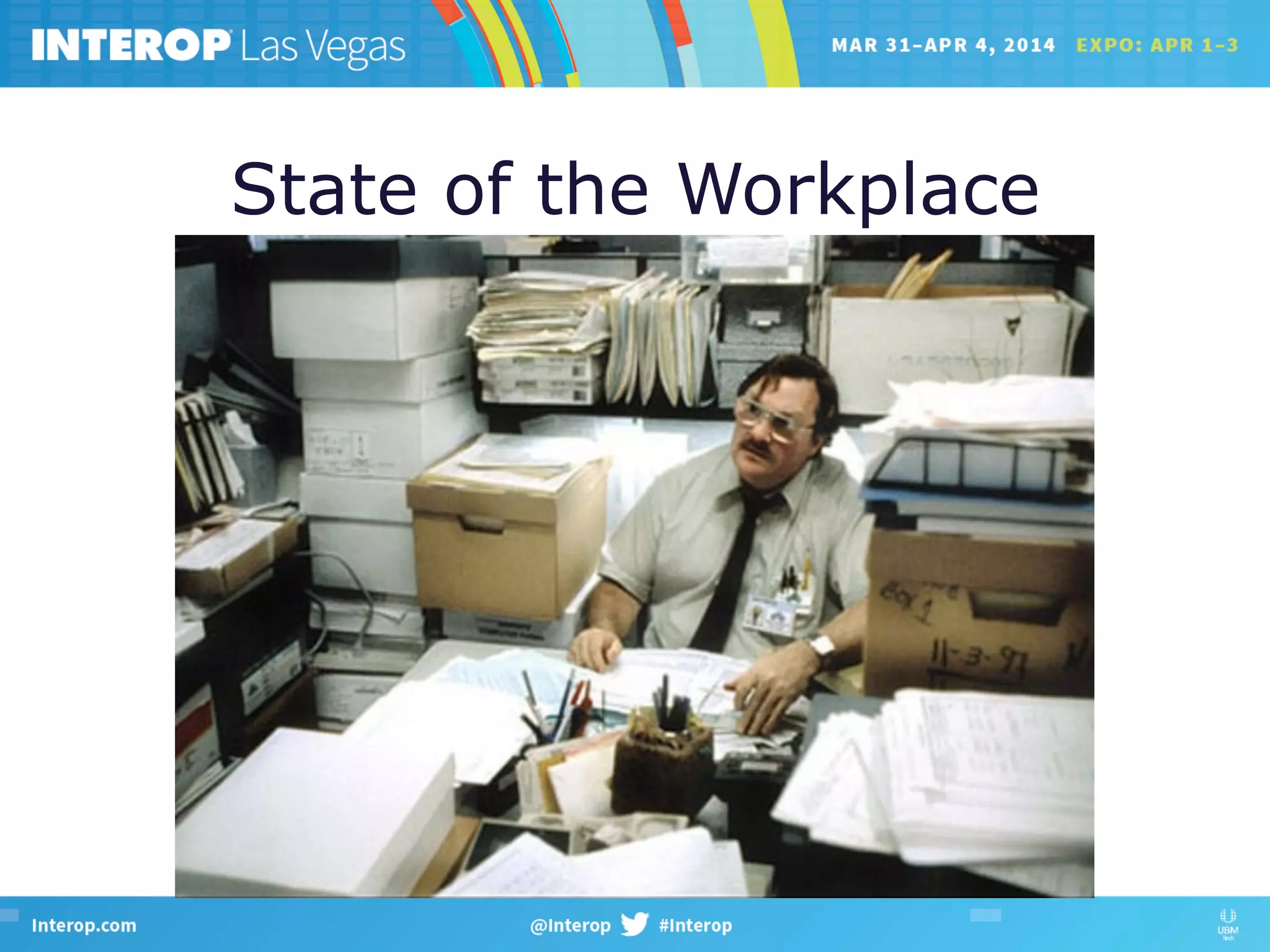
State of the Workplace
According to Wikipedia:
An "engaged employee" is one who is fully
absorbed by and enthusiastic about their
work and so takes positive action to further
the organization's reputation and interests.
Gallup’s 2013 State of the American
Workplace
•  Engagement brings higher productivity,
profits, customer ratings and employee
retention
•  Disengagement costs U.S. $450 to $550
billion per year.
•  70% of American workers are “not
engaged” or “actively disengaged.”
•  Those with college degree are less likely to
be engaged.
2012 Global Workforce Study by Towers Watson
•  Out of 32,000 full-time workers, only 35%
were highly engaged.
•  Employee retention depends on
relationship with management, trust in
senior leadership and ability to manage
work-related stress.
•  Less than half surveyed believed that
supervisors have time to address
interpersonal issues.
Drivers of Engagement
•  Leadership
•  Stress, balance and workload
•  Goals and objectives
•  Supervisors
•  Organization’s image
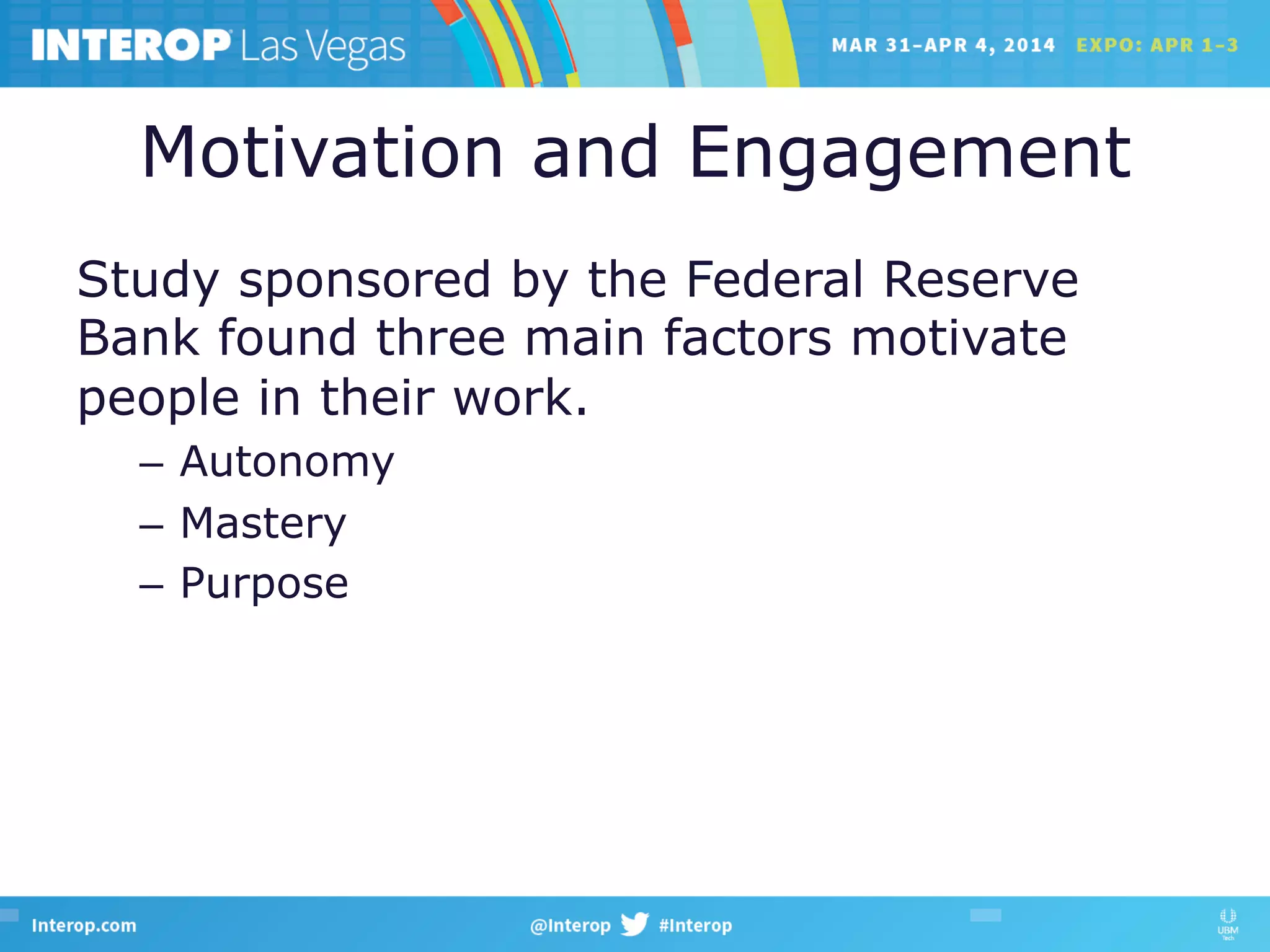
Motivation and Engagement
Study sponsored by the Federal Reserve
Bank found three main factors motivate
people in their work.
–  Autonomy
–  Mastery
–  Purpose
What Can You Do About It?
Power and Leadership in the
21st century
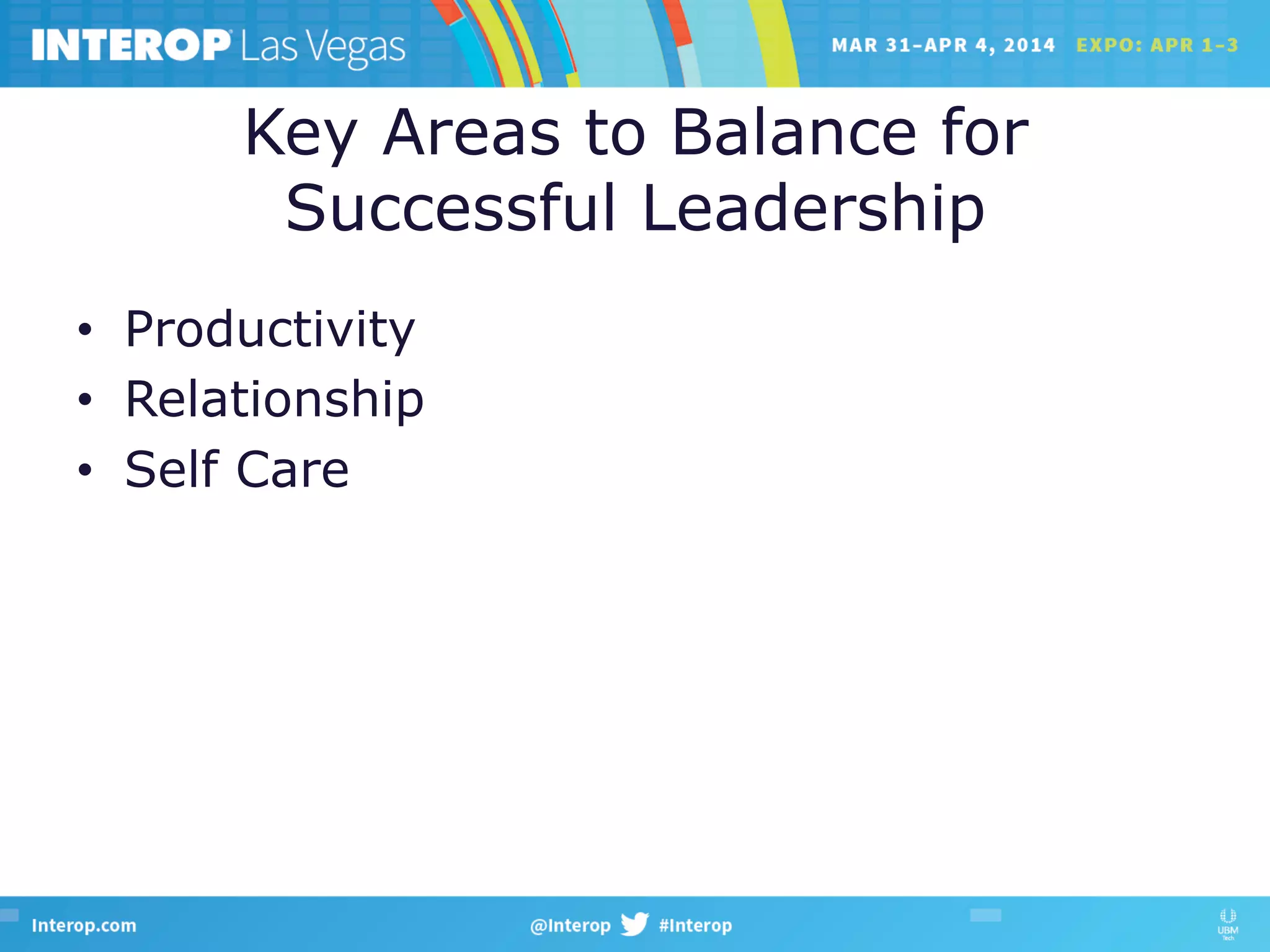
Key Areas to Balance for
Successful Leadership
•  Productivity
•  Relationship
•  Self Care
“Human beings have discretionary energy,
and they would give it to you if you treat
them with dignity and respect.”
-Paul O’Neill, former Treasury
Secretary of US under George W. Bush
When one moves into their
vulnerability,
then their true power is revealed.
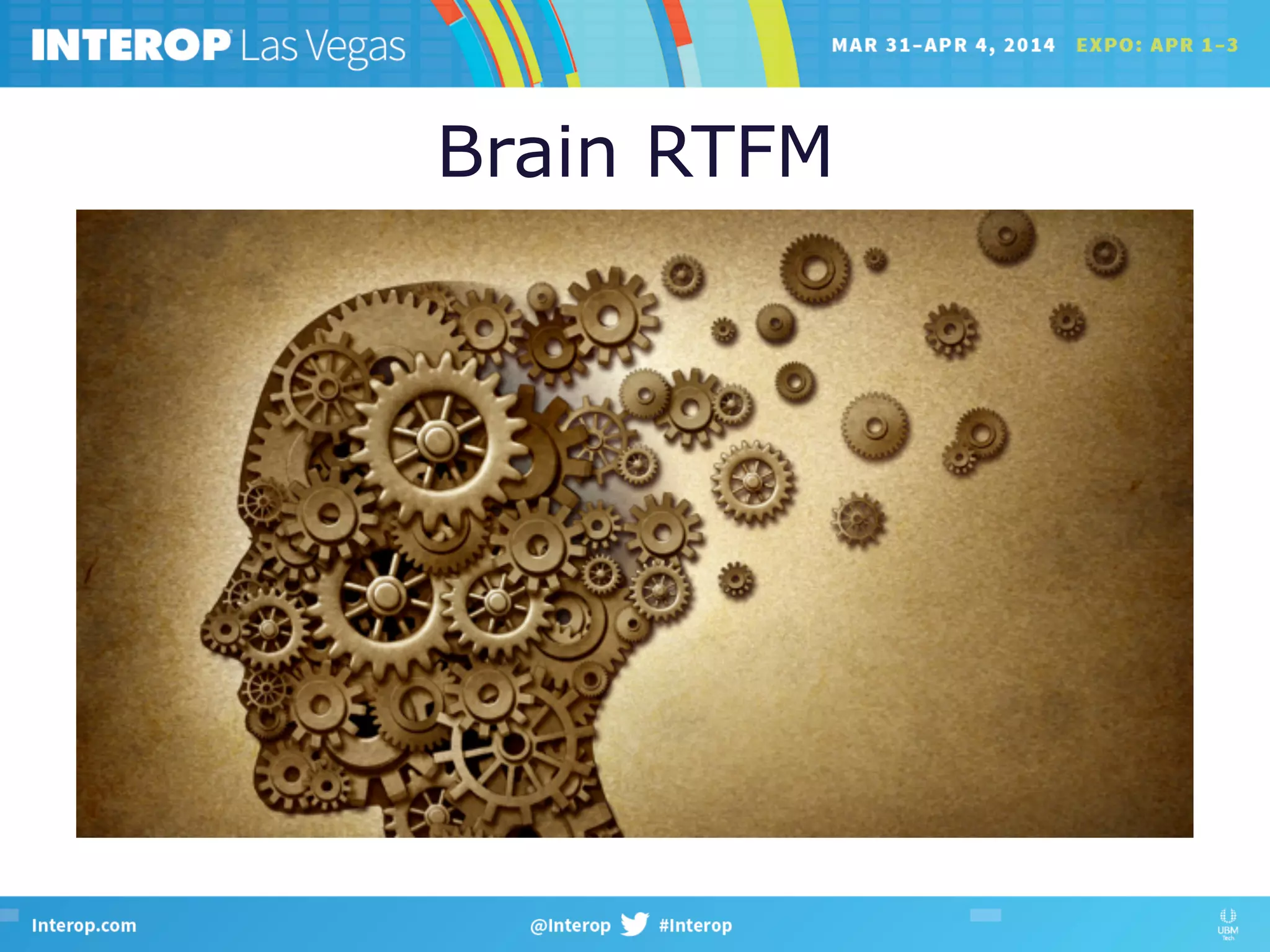
Brain RTFM
"The human brain hasn't had a hardware
upgrade in about 100,000 years."
Daniel Goleman, Author of Emotional
Intelligence
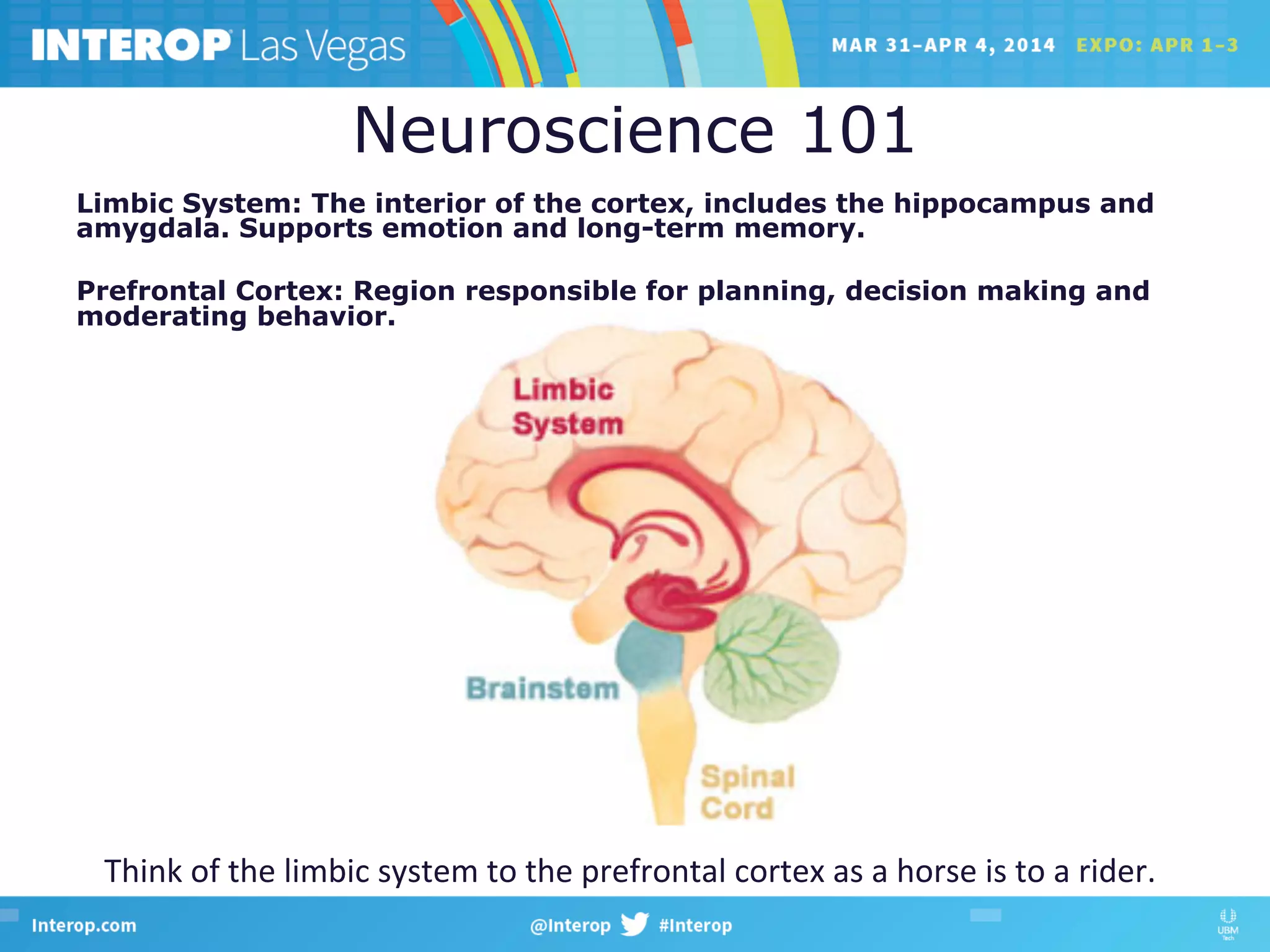
Neuroscience 101
Limbic System: The interior of the cortex, includes the hippocampus and
amygdala. Supports emotion and long-term memory.
Prefrontal Cortex: Region responsible for planning, decision making and
moderating behavior.
Think	
  of	
  the	
  limbic	
  system	
  to	
  the	
  prefrontal	
  cortex	
  as	
  a	
  horse	
  is	
  to	
  a	
  rider.	
  
Demonstration: A Brain In the
Palm of Your Hand
•  Hold up your hand and make a fist.
•  This is a good representation of the
brain and spinal column.
•  The brain stem, limbic system and
neocortex.
* These two slides are oversimplifications of a very
complex system.
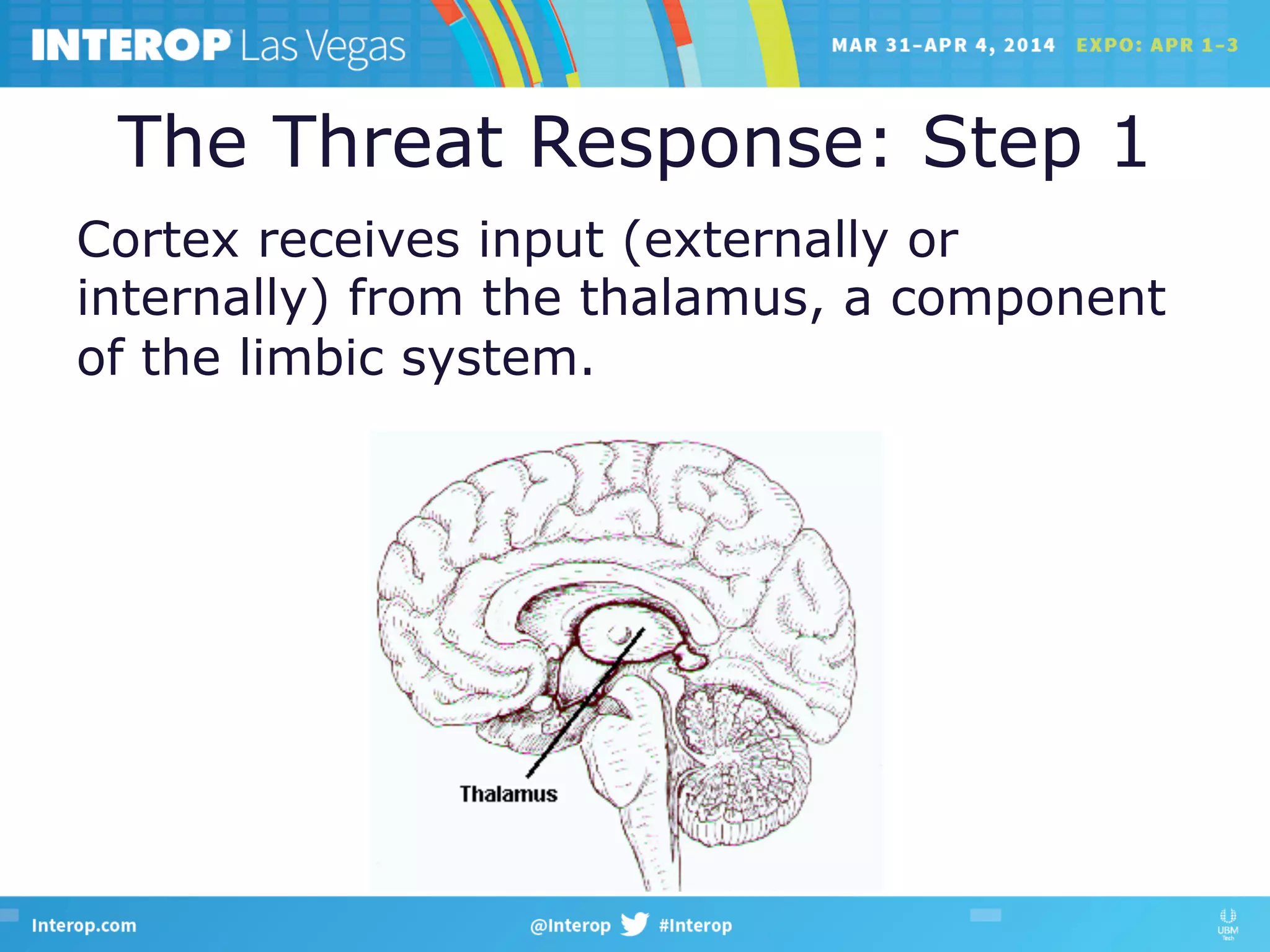
The Threat Response: Step 1
Cortex receives input (externally or
internally) from the thalamus, a component
of the limbic system.
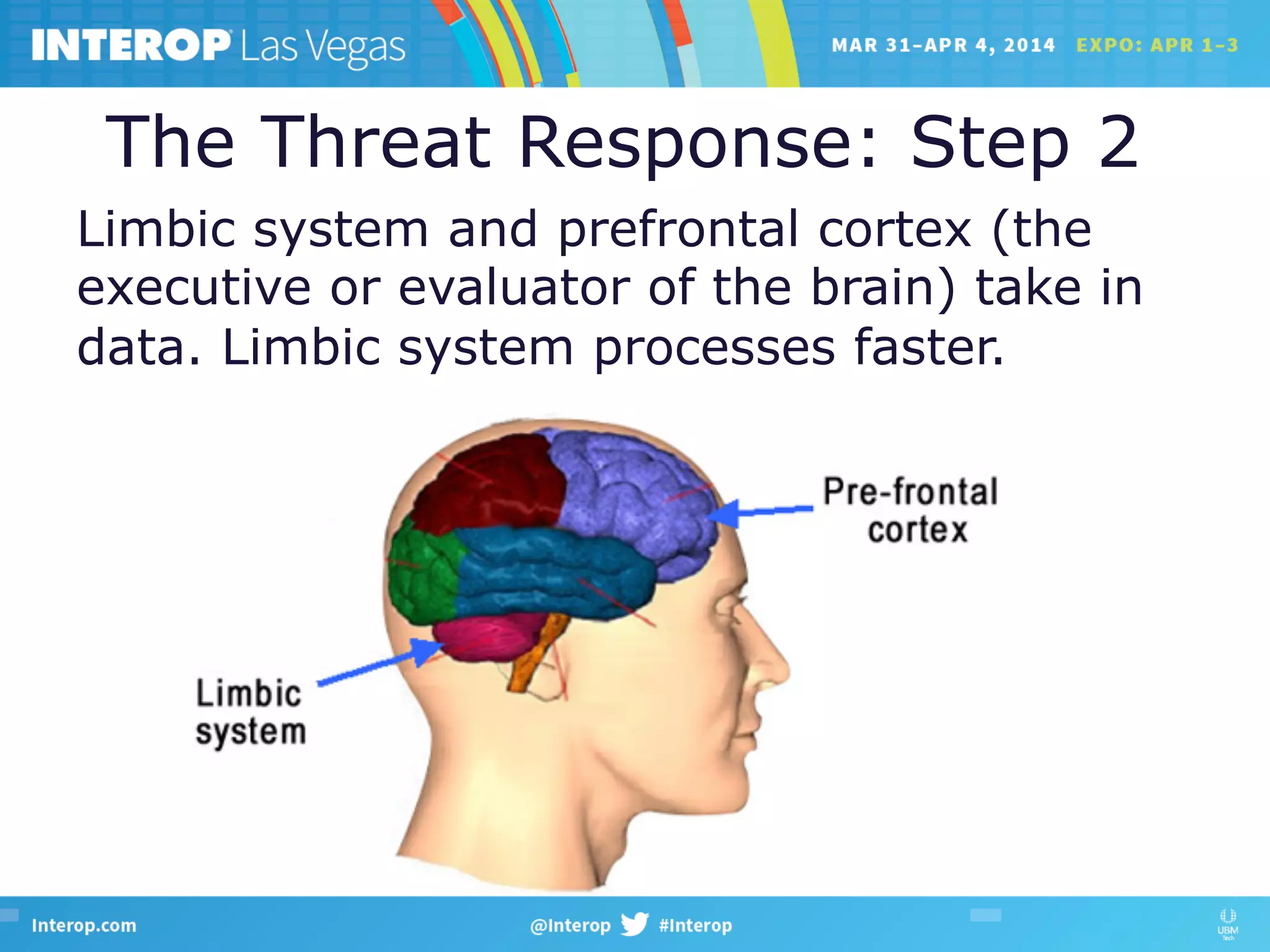
The Threat Response: Step 2
Limbic system and prefrontal cortex (the
executive or evaluator of the brain) take in
data. Limbic system processes faster.
The Threat Response: Step 3
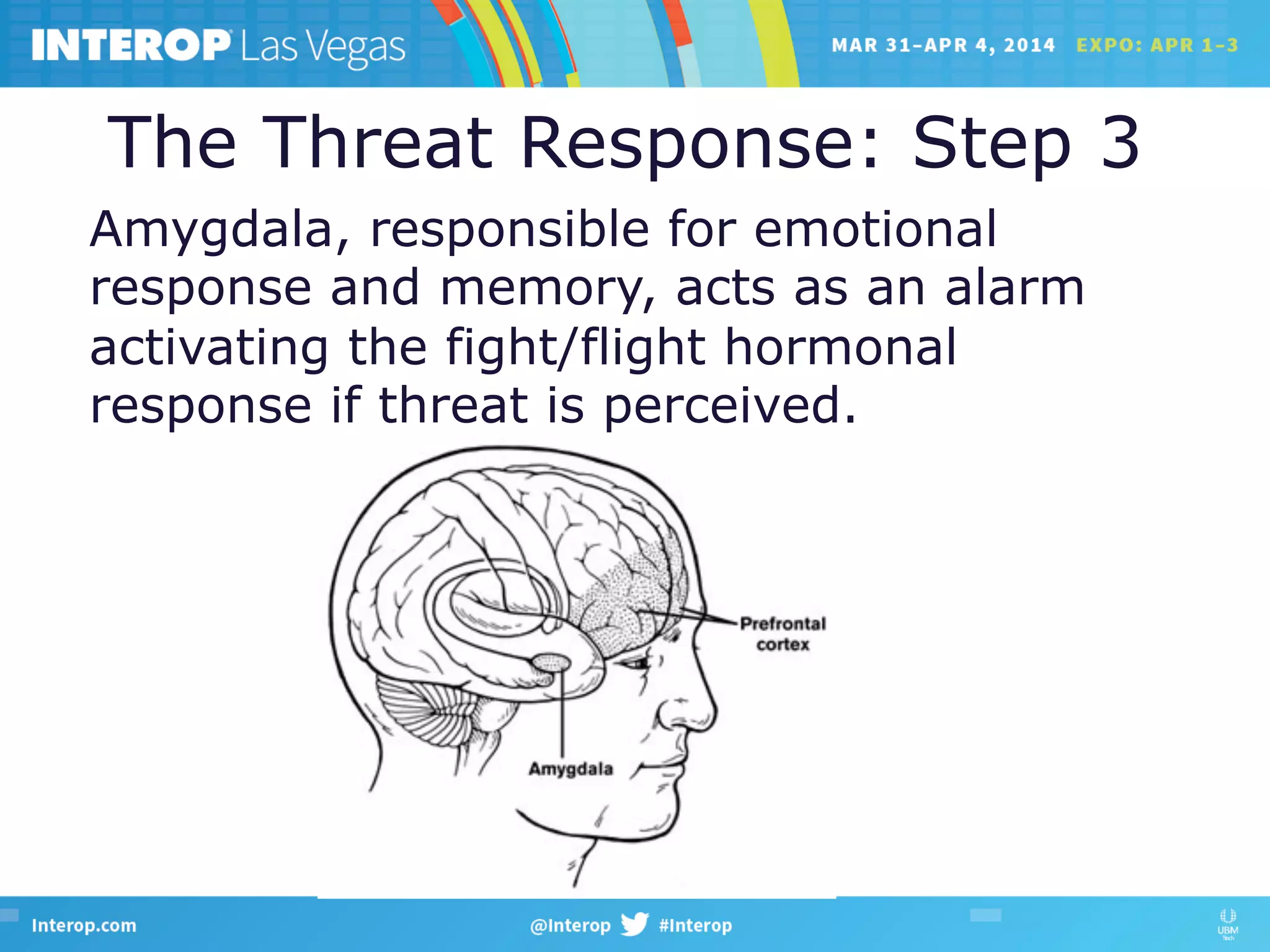
Amygdala, responsible for emotional
response and memory, acts as an alarm
activating the fight/flight hormonal
response if threat is perceived.
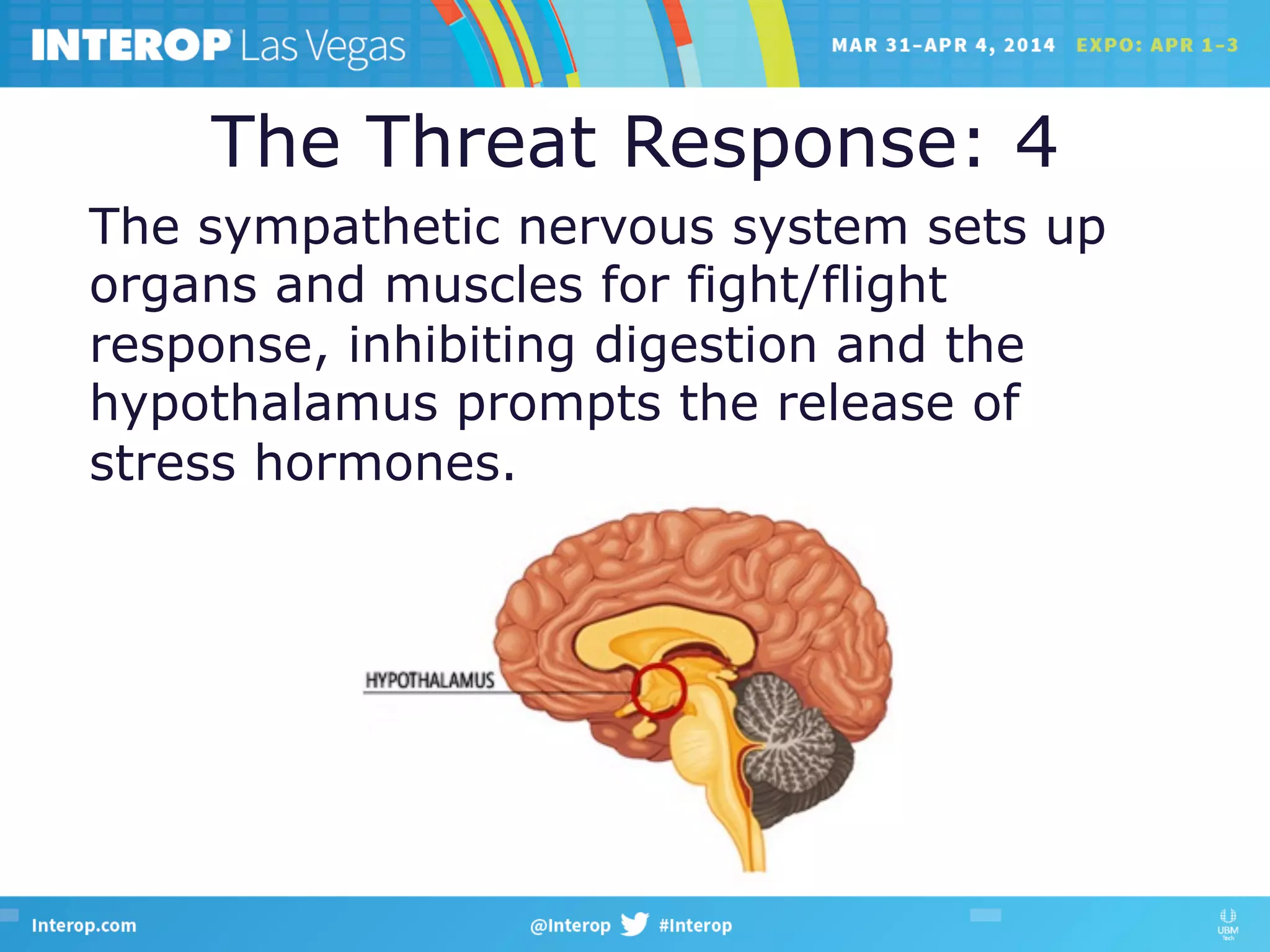
The Threat Response: 4
The sympathetic nervous system sets up
organs and muscles for fight/flight
response, inhibiting digestion and the
hypothalamus prompts the release of
stress hormones.
Emotional Contagion
•  The limbic system is an “open loop,”
influenced by other people’s emotions, aka
mirror neurons.
•  Mirror neurons activate when an animal
performs an action or when an animal
observes the same action of another
animal.
•  They are thought to be the basis of
empathy.
•  Also called emotional contagion.
The Power of Mirror Neurons
Marie Dasborough observed two groups:
•  One group was given negative feedback
accompanied by positive emotional signs,
nods and smiles.
•  Another was provided positive feedback
that was delivered using negative
emotional cues, frowns and narrowed
eyes.
Entrainment
•  Those receiving positive feedback with
negative emotional signs reportedly felt
worse than participants receiving
negative feedback given with positive
emotional cues.
•  Your emotions and actions are mirrored
by those around you.
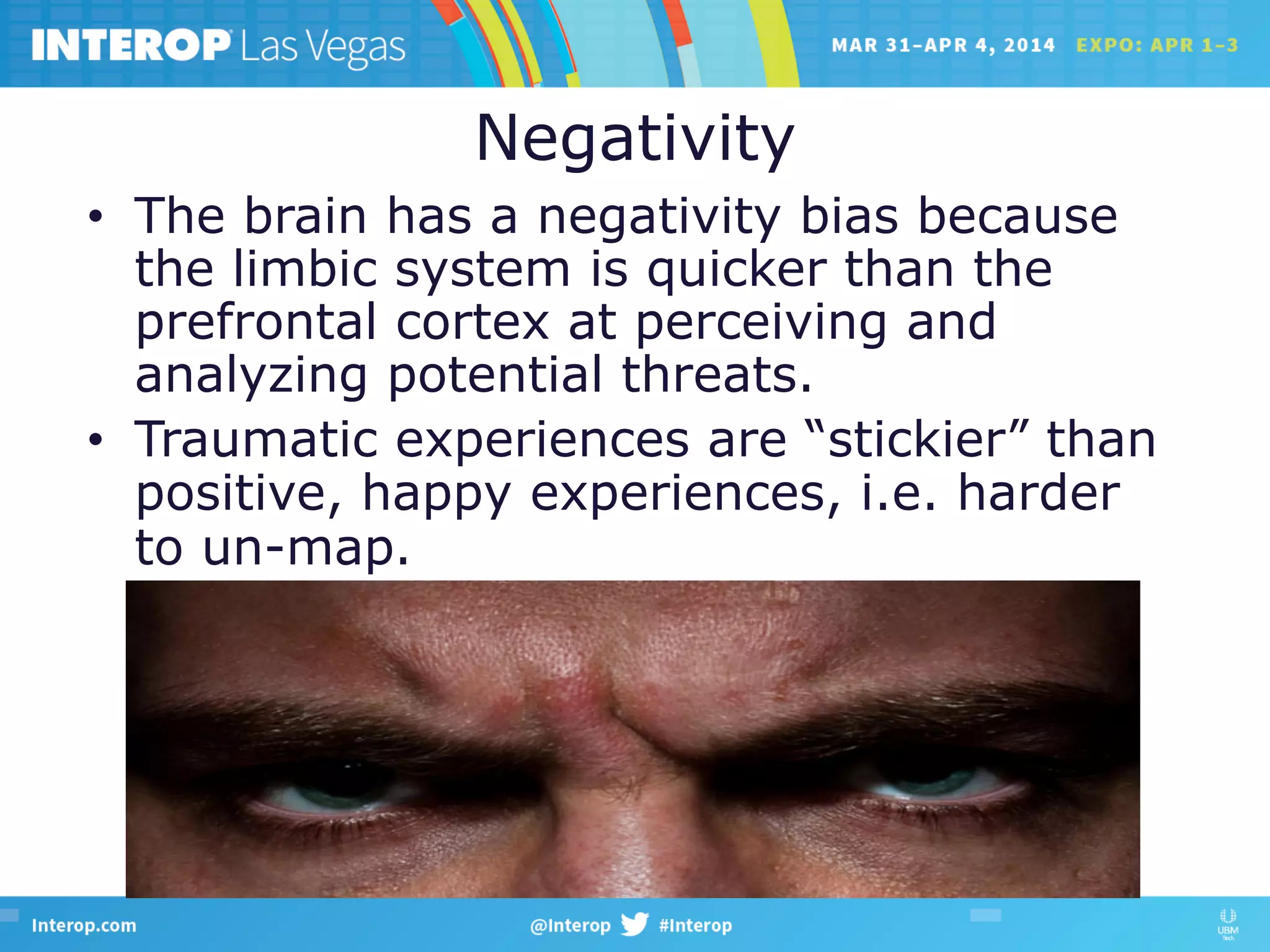
Negativity
•  The brain has a negativity bias because
the limbic system is quicker than the
prefrontal cortex at perceiving and
analyzing potential threats.
•  Traumatic experiences are “stickier” than
positive, happy experiences, i.e. harder
to un-map.
No Escape From Threat
•  Most are in a permanent state of cortisol
overload due to the constant stressors of
modern life.
•  Stress hormones stay in the body for
hours.
•  Decreases intellectual capacity, memory
capacity and lowers impulse control.
•  Stress makes you stupid.
Amygdala Hijack?
An intense and immediate emotional reaction,
followed by the understanding that it was
inappropriate.
•  I thought that stick on the ground was a
snake!
•  I don’t like you or I’m bored, so I won’t
cooperate or listen to what you have to say.
•  That guy who cut me off in traffic was trying
to kill me!
•  Why were you so insulting to me in that
email yesterday? (studies show there’s a
negativity bias in email.)
•  Other examples?
Thin Slicing
•  Human beings make quick decisions based
on intuition.
•  This is called “Thin Slicing” or “Fast
Thinking.”
Thin Slicing: Bedside Manner
•  The likelihood of a doctor being sued
doesn’t correlate with the number of
errors made.
•  Psychologists are able to predict which
doctors will be sued by analyzing the
amount of time spent with patients and if
the tone of their voices sounded
“concerned.”
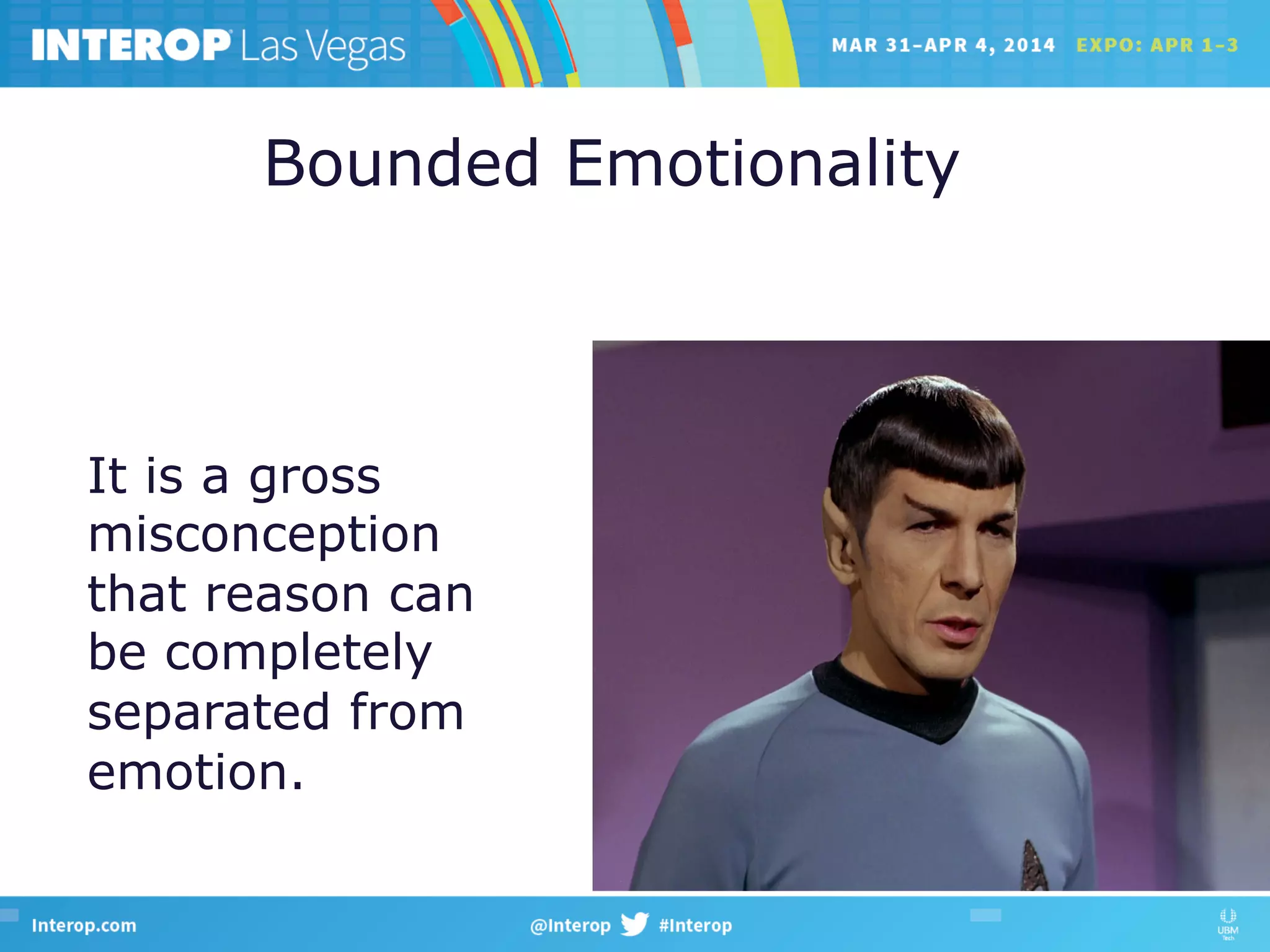
There’s No Mr. Spock
•  Neurologist, Dr. Antonio Damasio, had a
patient who had been a successful
corporate lawyer.
•  A tumor was discovered in his prefrontal
lobes and the surgeon who removed it
inadvertently severed the circuit between
this area and his amygdala.
Somatic Marker
•  No damage to his cognitive abilities, but
his life fell apart.
•  He couldn’t make decisions when
presented with simple choices.
•  He no longer had any feelings regarding
options, no preferences.
•  Case is basis for the Somatic Marker
Hypothesis, a theory that emotions assist
with decision-making.
It is a gross
misconception
that reason can
be completely
separated from
emotion.
Bounded Emotionality
“Connections” matter
How To Engage a Terrorist
Interrogator, Matthew Alexander discovered
that building rapport with prisoners in Iraq
was the most effective interrogation
method, not torture.
“The quickest way to get most (but not all)
captives talking is to be nice to them.”
Mark Bowden, author of Black Hawk Down
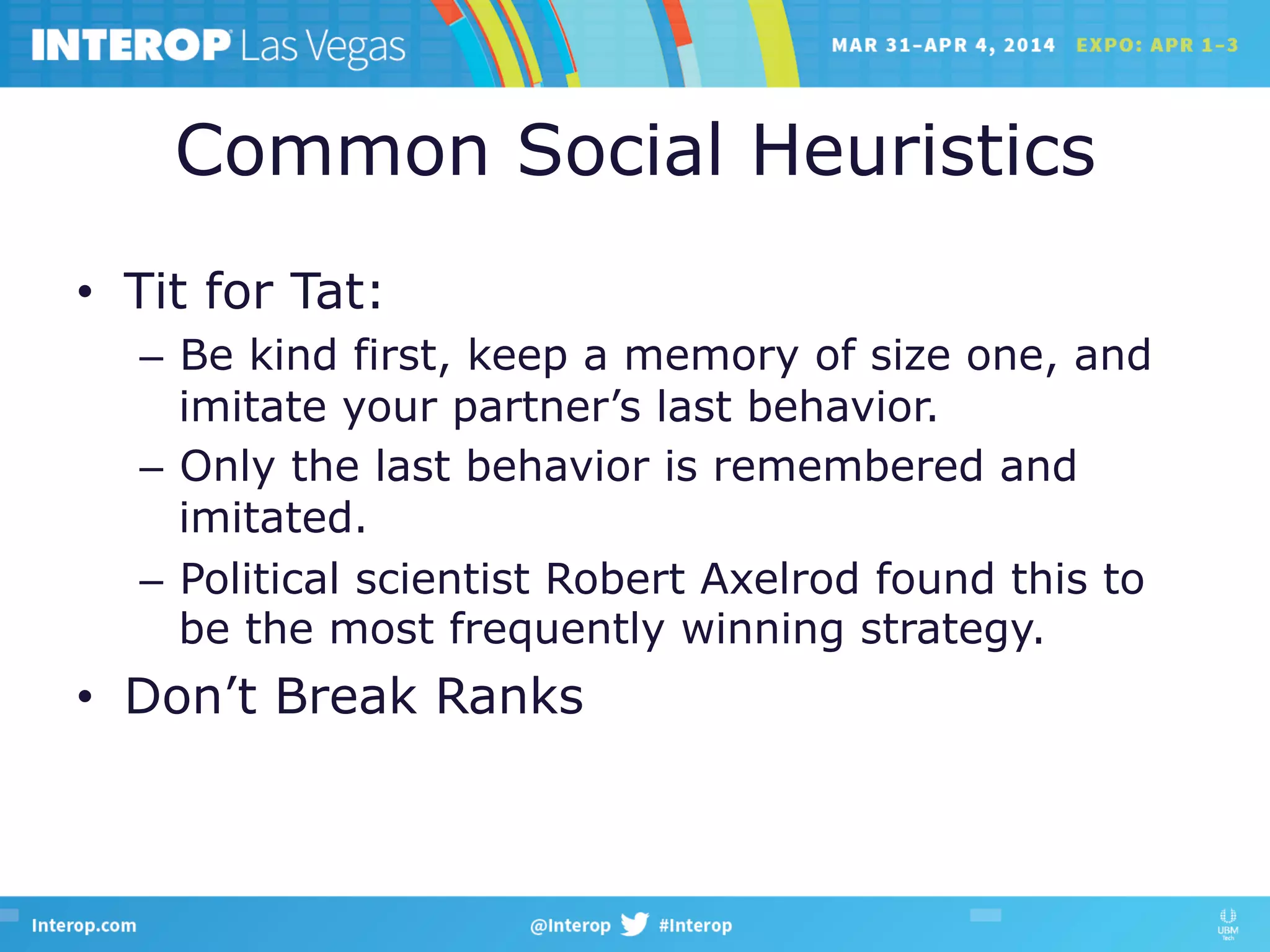
Common Social Heuristics
•  Tit for Tat:
–  Be kind first, keep a memory of size one, and
imitate your partner’s last behavior.
–  Only the last behavior is remembered and
imitated.
–  Political scientist Robert Axelrod found this to
be the most frequently winning strategy.
•  Don’t Break Ranks
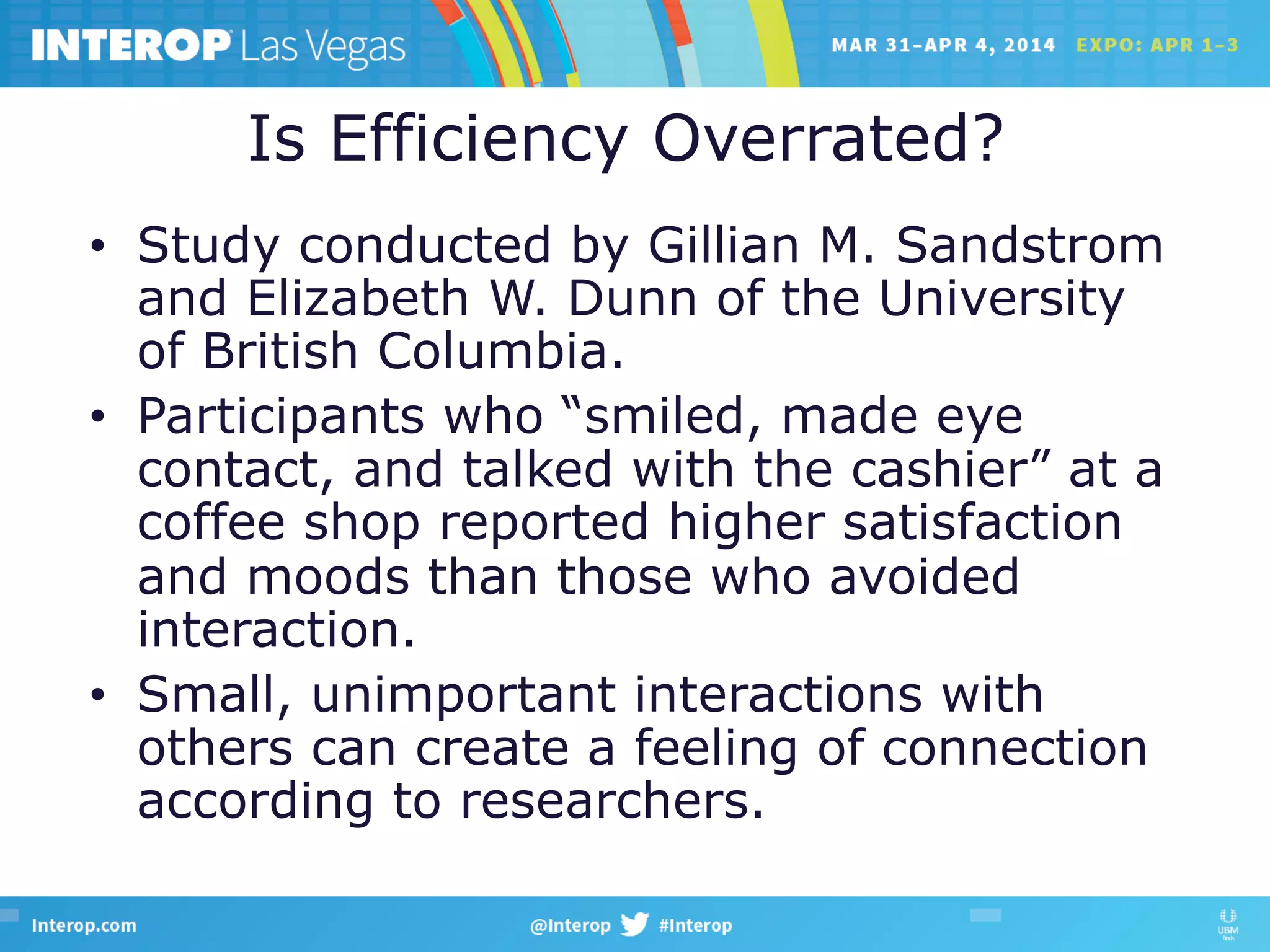
Is Efficiency Overrated?
•  Study conducted by Gillian M. Sandstrom
and Elizabeth W. Dunn of the University
of British Columbia.
•  Participants who “smiled, made eye
contact, and talked with the cashier” at a
coffee shop reported higher satisfaction
and moods than those who avoided
interaction.
•  Small, unimportant interactions with
others can create a feeling of connection
according to researchers.
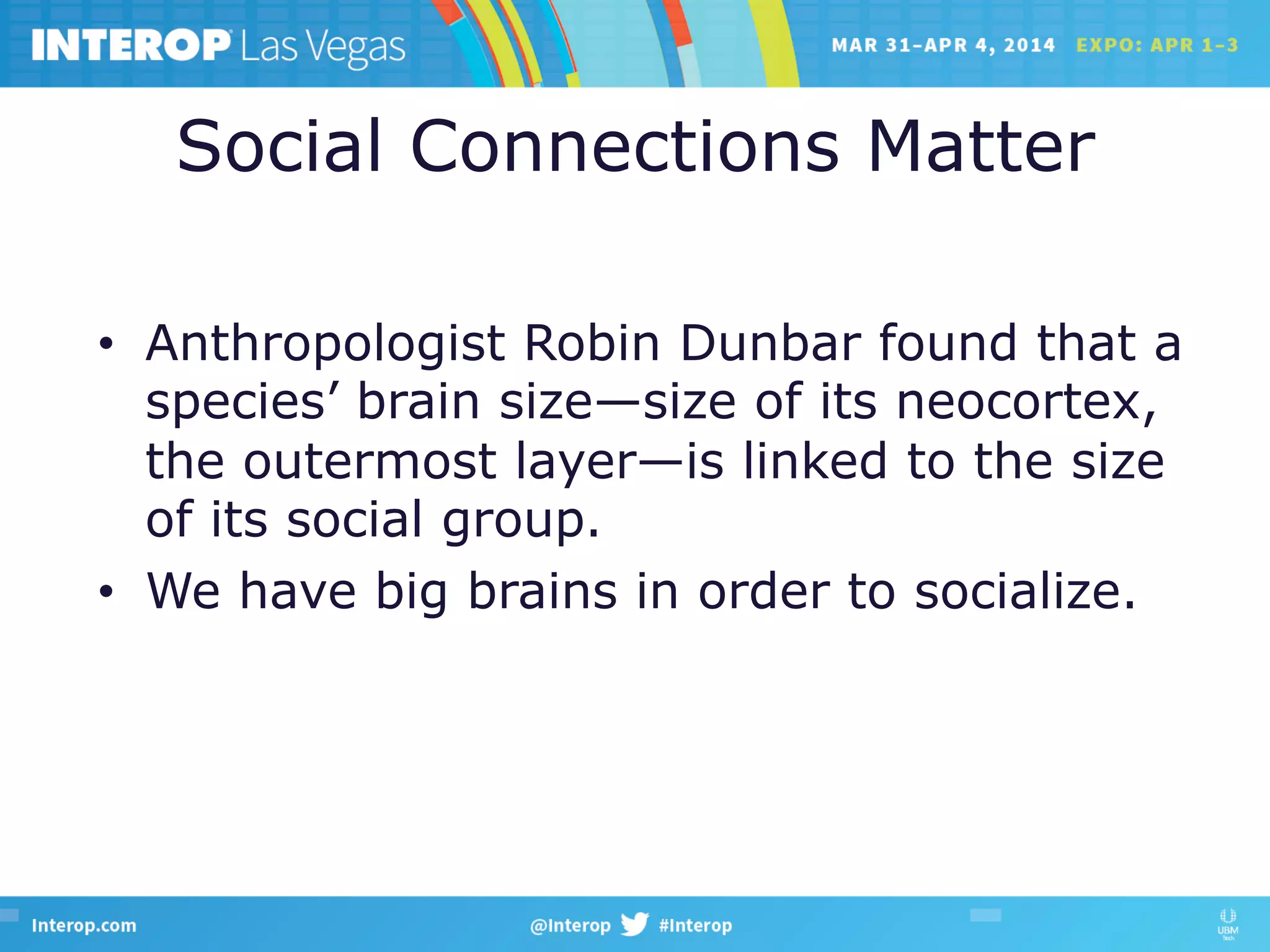
Social Connections Matter
•  Anthropologist Robin Dunbar found that a
species’ brain size—size of its neocortex,
the outermost layer—is linked to the size
of its social group.
•  We have big brains in order to socialize.
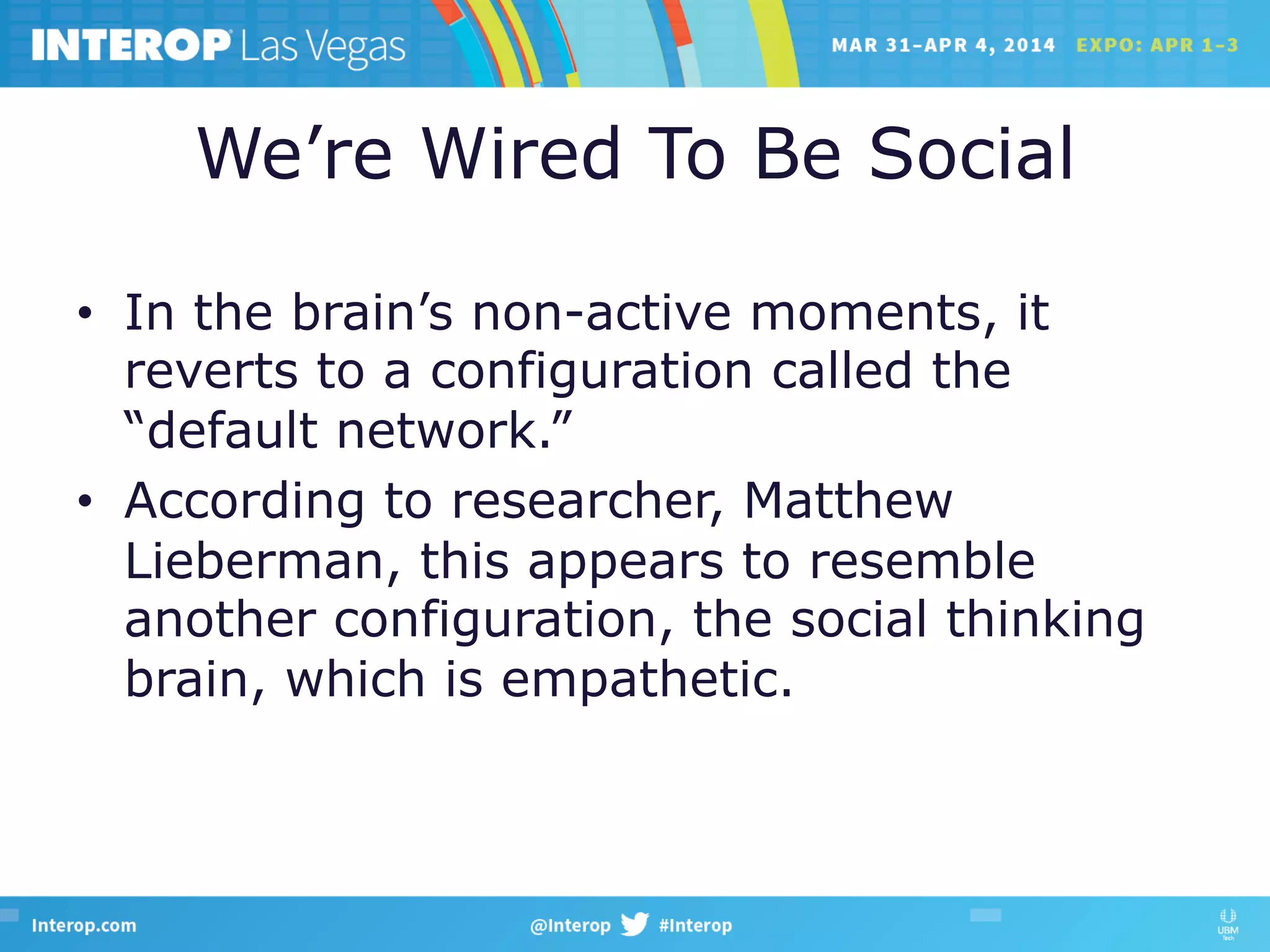
We’re Wired To Be Social
•  In the brain’s non-active moments, it
reverts to a configuration called the
“default network.”
•  According to researcher, Matthew
Lieberman, this appears to resemble
another configuration, the social thinking
brain, which is empathetic.
Make Stress Your Friend
•  A study tracked stress in 30,000 adults
over eight years.
•  Researchers found those under great
stress had a 43% increased risk of death,
if they believed stress was dangerous.
•  Under stress, the pituitary gland releases
Oxytocin, the bonding hormone.
•  Acts as anti-inflammatory which can
counteract negative effects of stress.
Your Response to Stress Matters
"When you choose to connect with others
under stress, you can create resilience"
- Kelly McGonigal, health psychologist and
researcher, Stanford University
Methods of Engagement
•  Interaction based on core competencies
of Emotional Intelligence, such as self-
awareness, self-regulation, empathy, and
motivation.
•  Social engineers and con artists use the
same skills to create emotional and social
affinity with a target.
•  Conflict resolution methods.
“We have to face the fact that either
all of us are going to die together or
we are going to learn to live together,
and if we are to live together we have
to talk.”
- Eleanor Roosevelt
Effective Collaboration Levels
Personal
Social
Institutional
Personal + social = institutional change
Communication Models Based On Empathy
•  XYZ model
•  NVC
•  Respectful Confrontation
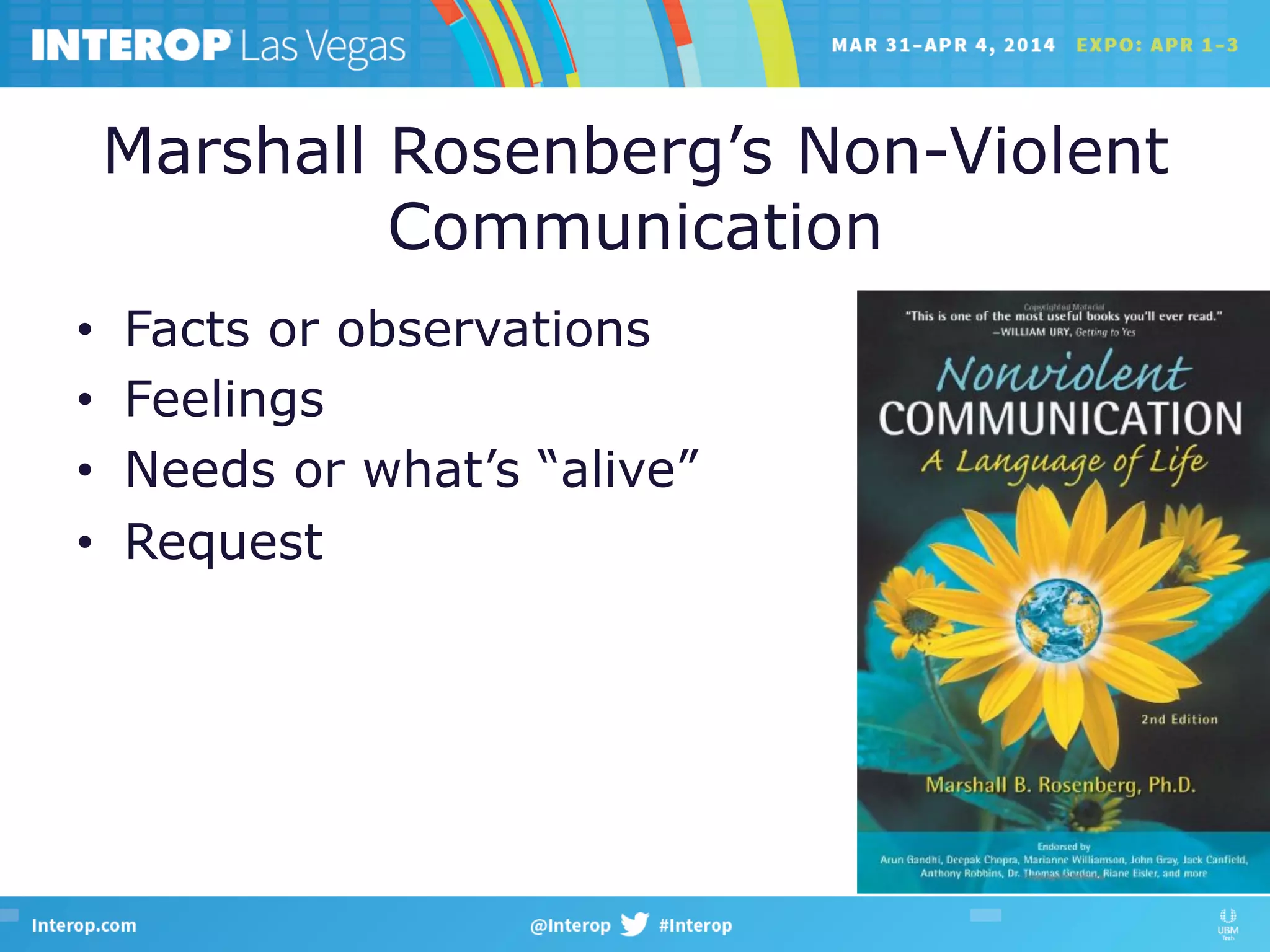
Marshall Rosenberg’s Non-Violent
Communication
•  Facts or observations
•  Feelings
•  Needs or what’s “alive”
•  Request
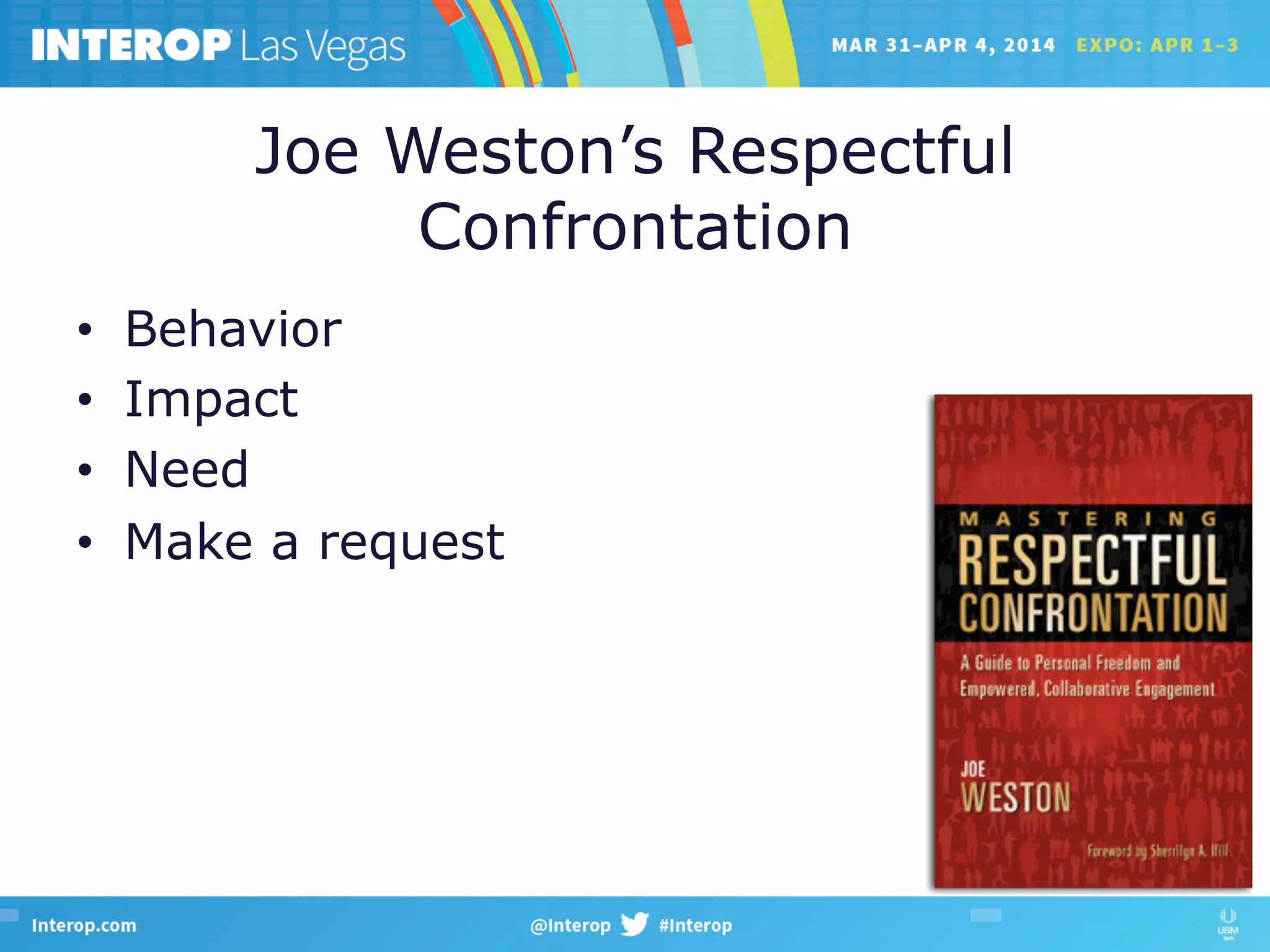
Joe Weston’s Respectful
Confrontation
•  Behavior
•  Impact
•  Need
•  Make a request
"Niceness can be a dodge to avoid engaging
in unpleasant interactions."
-Bill Kahn, Ph.D.
Goals
•  Learn about empowered, collaborative
engagement.
•  Reframe views on confrontation,
assertiveness, and true power.
•  Achieve greater self-confidence, personal
freedom, fulfillment, and peaceful
interactions with others.
My truth ≠ The truth
Respectful Confrontation
•  The practice of developing the respectful self
•  The practice of respectful engagement
•  The practice of respectful offense
•  The practice of respectful defense
3 F’s
Fight
Flight
Freeze
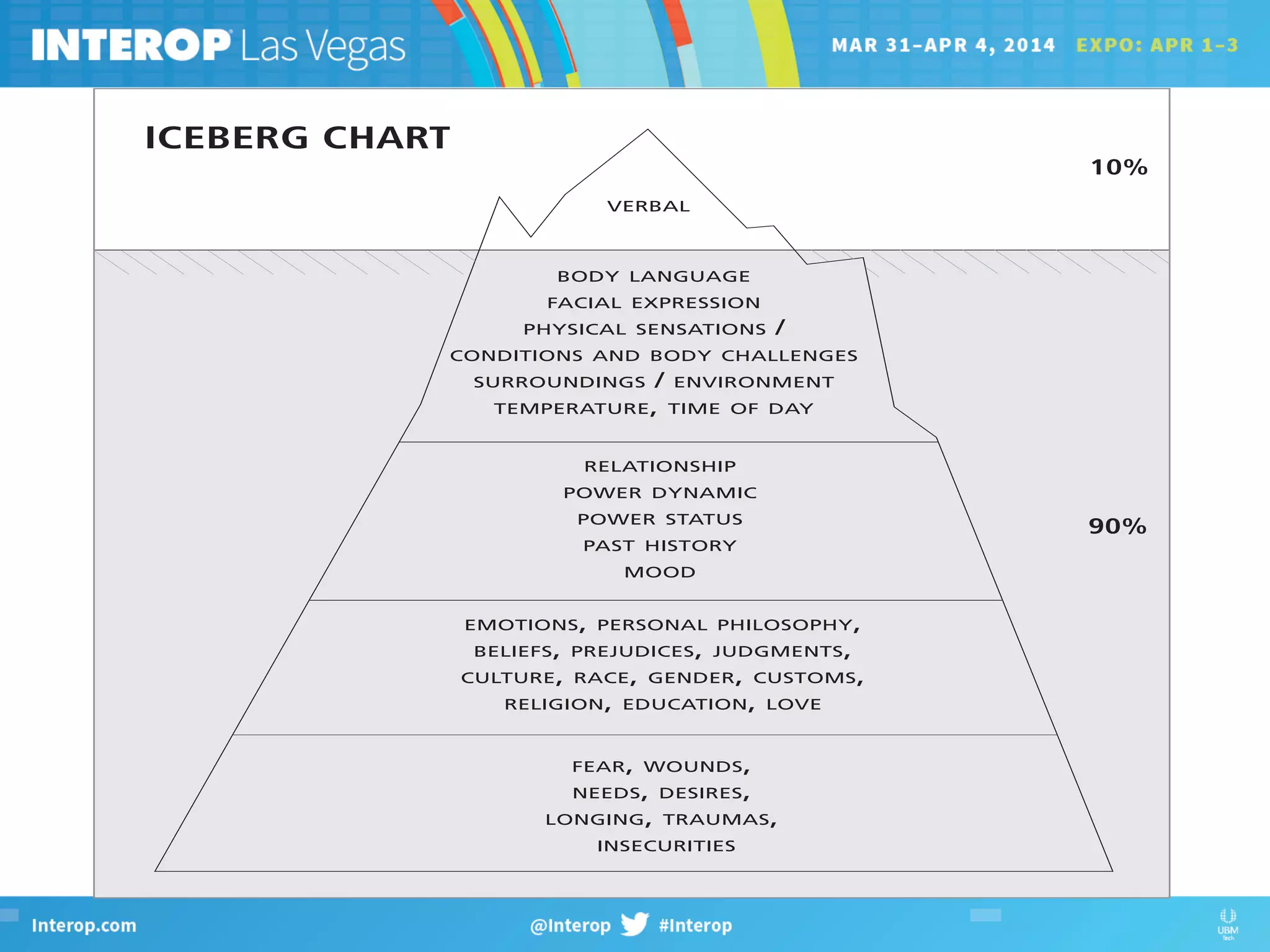
break down your communication, connection, and collaboration.
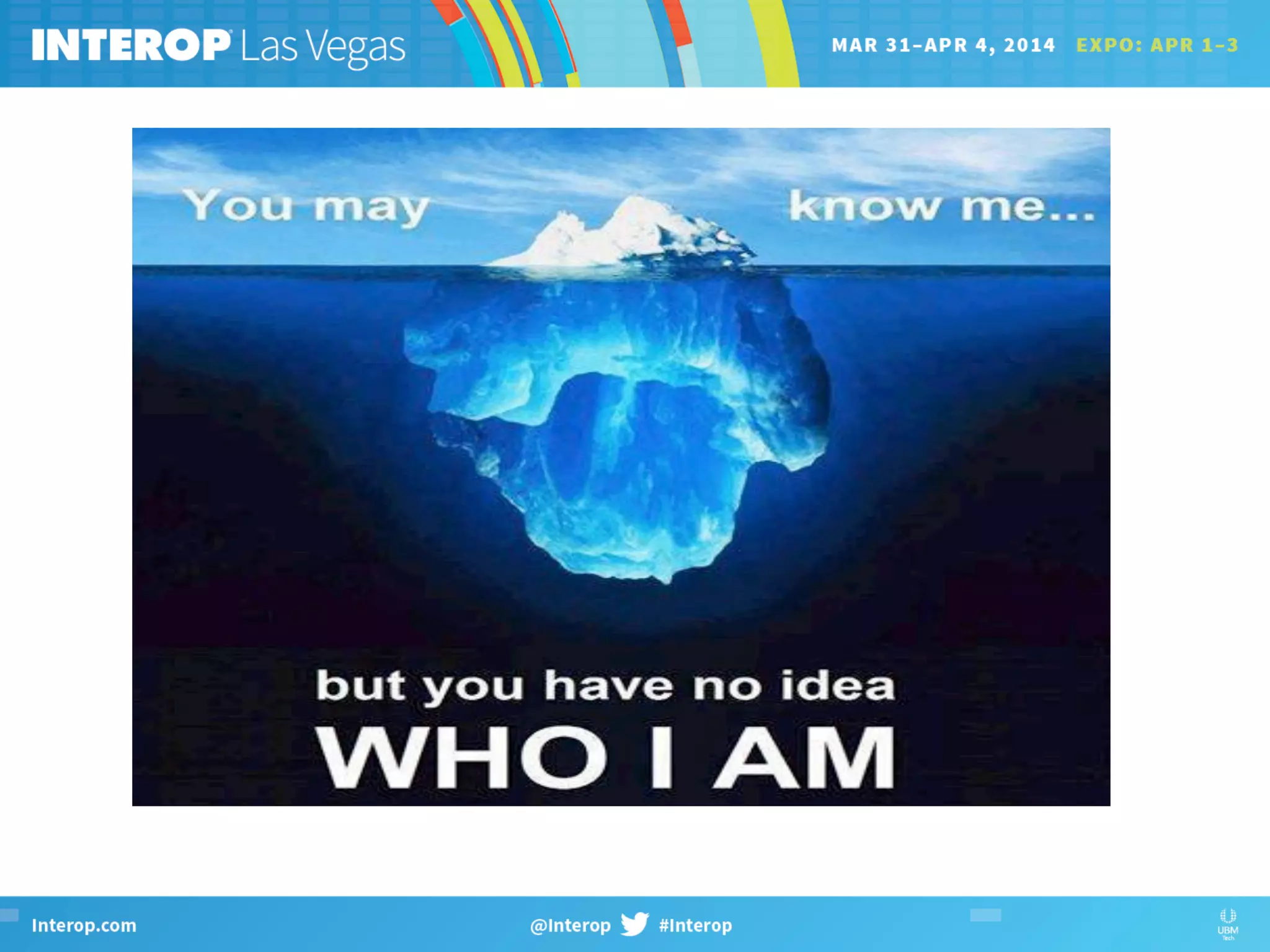
ICEBERG CHART
BODY LANGUAGE
FACIAL EXPRESSION
PHYSICAL SENSATIONS /
CONDITIONS AND BODY CHALLENGES
SURROUNDINGS / ENVIRONMENT
TEMPERATURE, TIME OF DAY
RELATIONSHIP
POWER DYNAMIC
POWER STATUS
PAST HISTORY
MOOD
EMOTIONS, PERSONAL PHILOSOPHY,
BELIEFS, PREJUDICES, JUDGMENTS,
CULTURE, RACE, GENDER, CUSTOMS,
RELIGION, EDUCATION, LOVE
FEAR, WOUNDS,
NEEDS, DESIRES,
LONGING, TRAUMAS,
INSECURITIES
VERBAL
10%
90%
“Hmm, I’d like a cup of tea…”
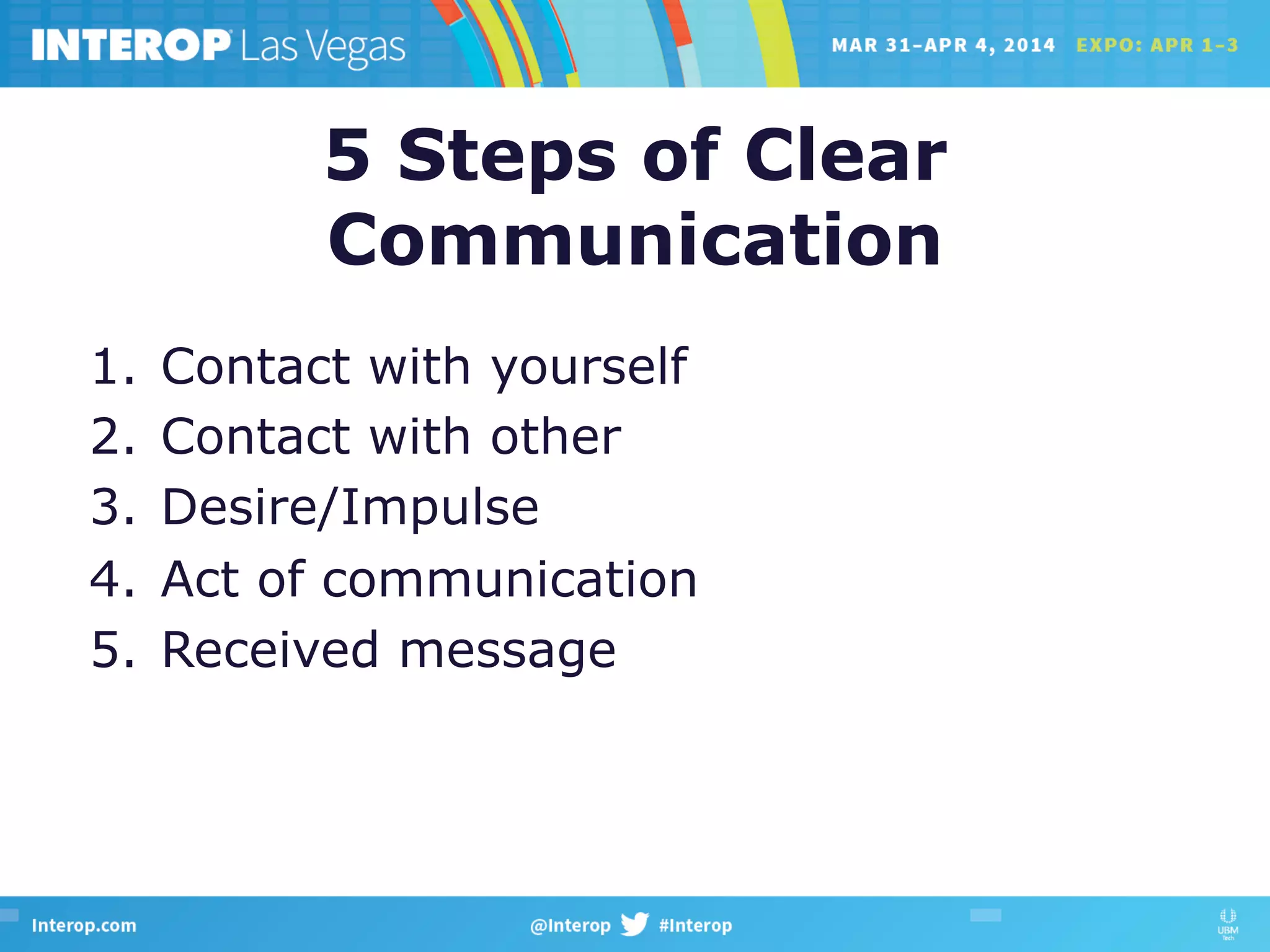
5 Steps of Clear
Communication
1.  Contact with yourself
2.  Contact with other
3.  Desire/Impulse
4.  Act of communication
5.  Received message
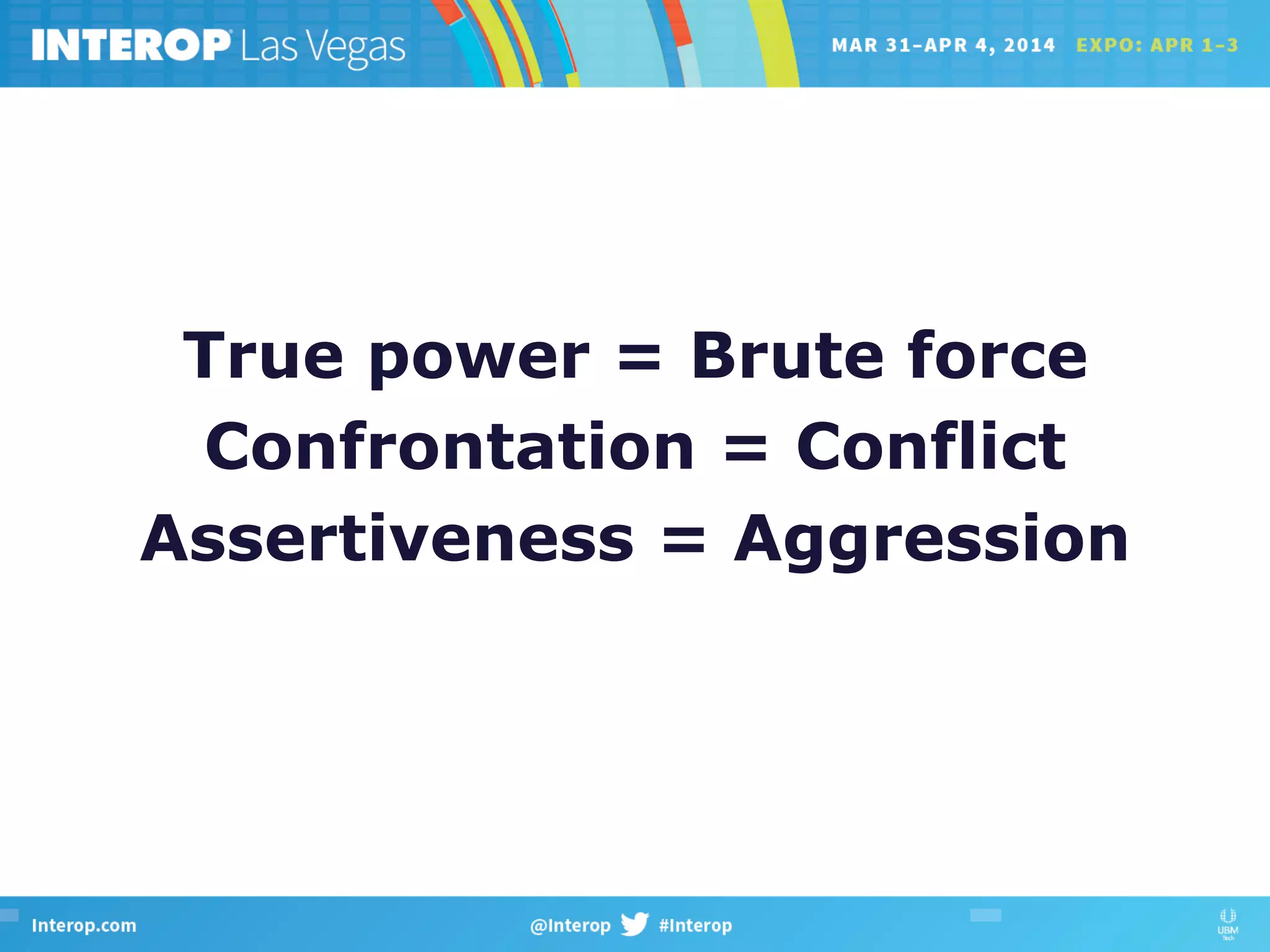
True power = Brute force
Confrontation = Conflict
Assertiveness = Aggression
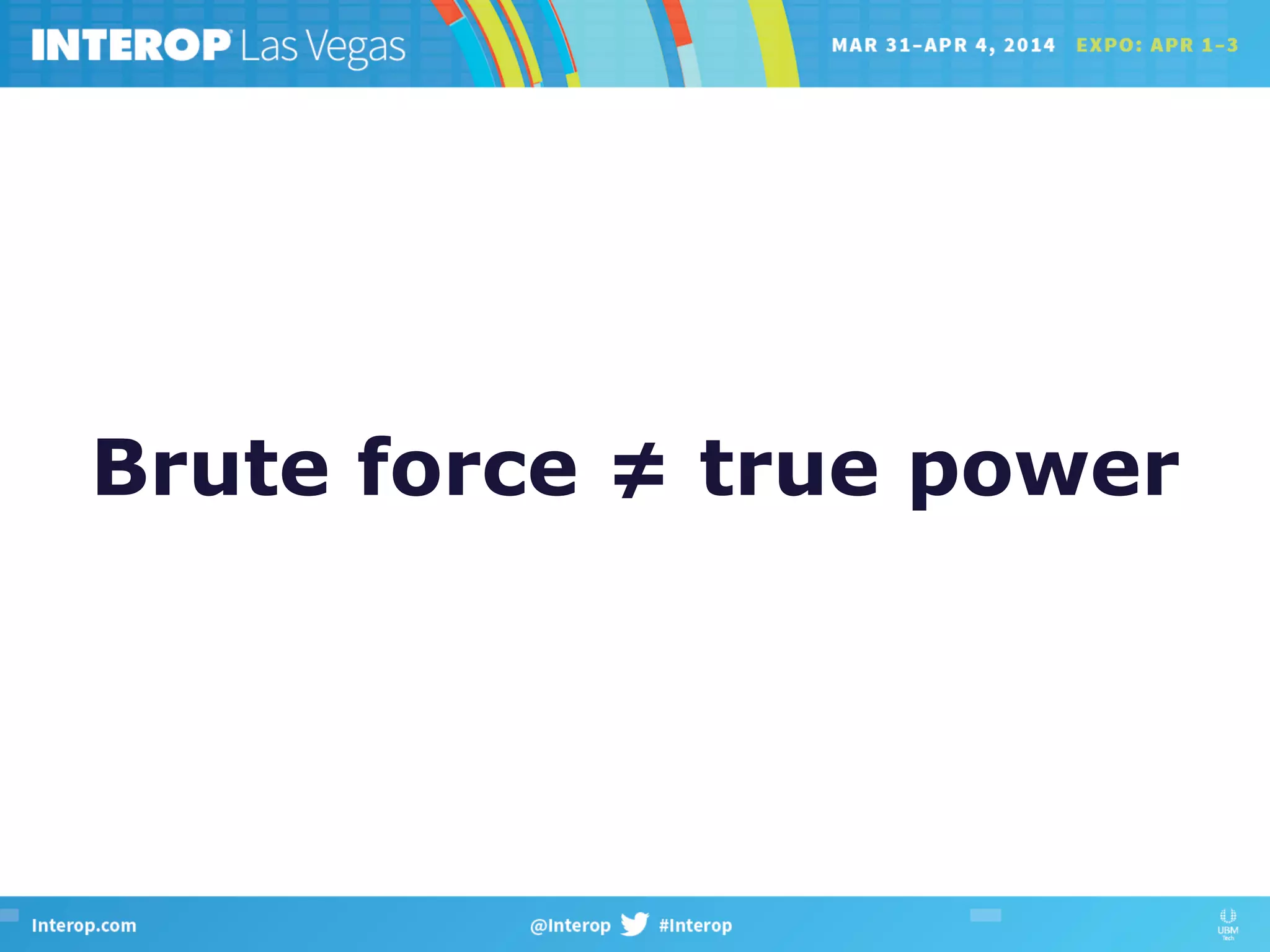
Brute force ≠ true power
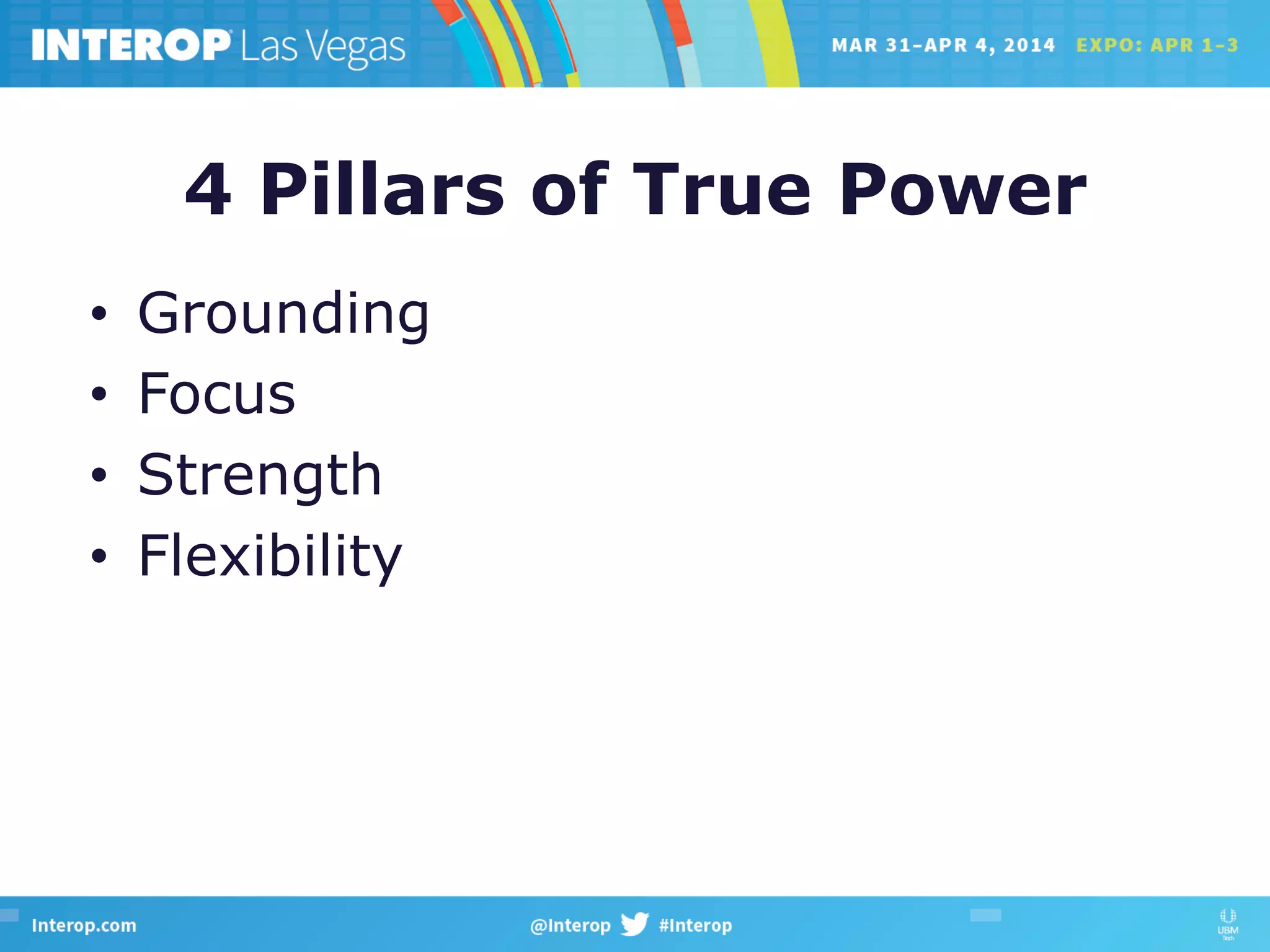
4 Pillars of True Power
•  Grounding
•  Focus
•  Strength
•  Flexibility
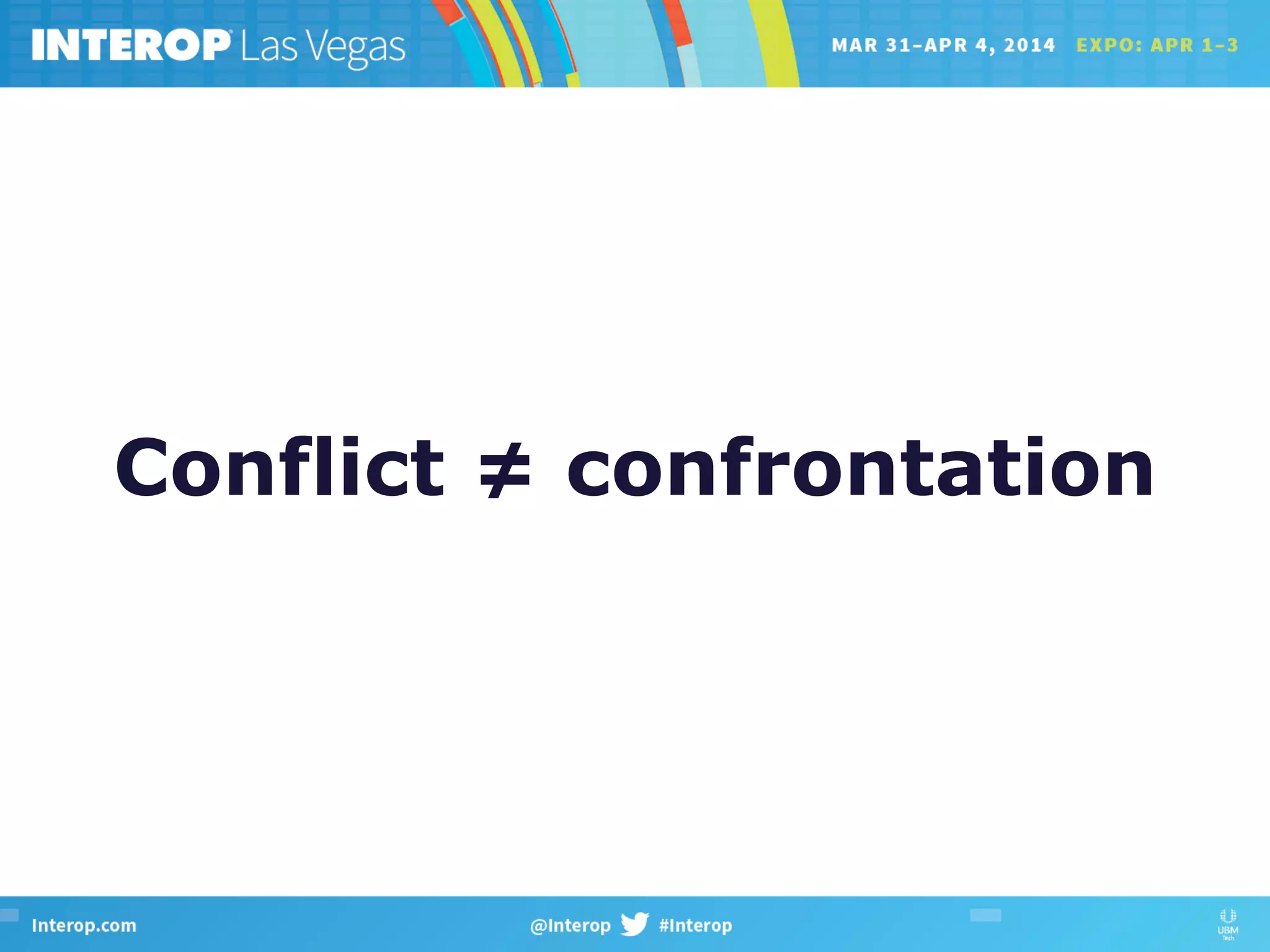
Conflict ≠ confrontation
“Courage is what it takes to stand
up and speak. Courage is what it
takes to sit down and listen.”
- Winston Churchill
1 : FIGHT, BATTLE, WAR
2 a : competitive or opposing action of
incompatibles : antagonistic state or action
(as of divergent ideas, interests, or
persons) b : mental struggle resulting from
incompatible or opposing needs, drives,
wishes, or external or internal demands;
see DISCORD
Conflict
Confront
con·front
1 : to face especially in challenge : OPPOSE
2 a : to cause to meet : bring face-to-face
<confront a reader with statistics> b : to
meet face-to-face : ENCOUNTER
Respectful Confrontation
Definition
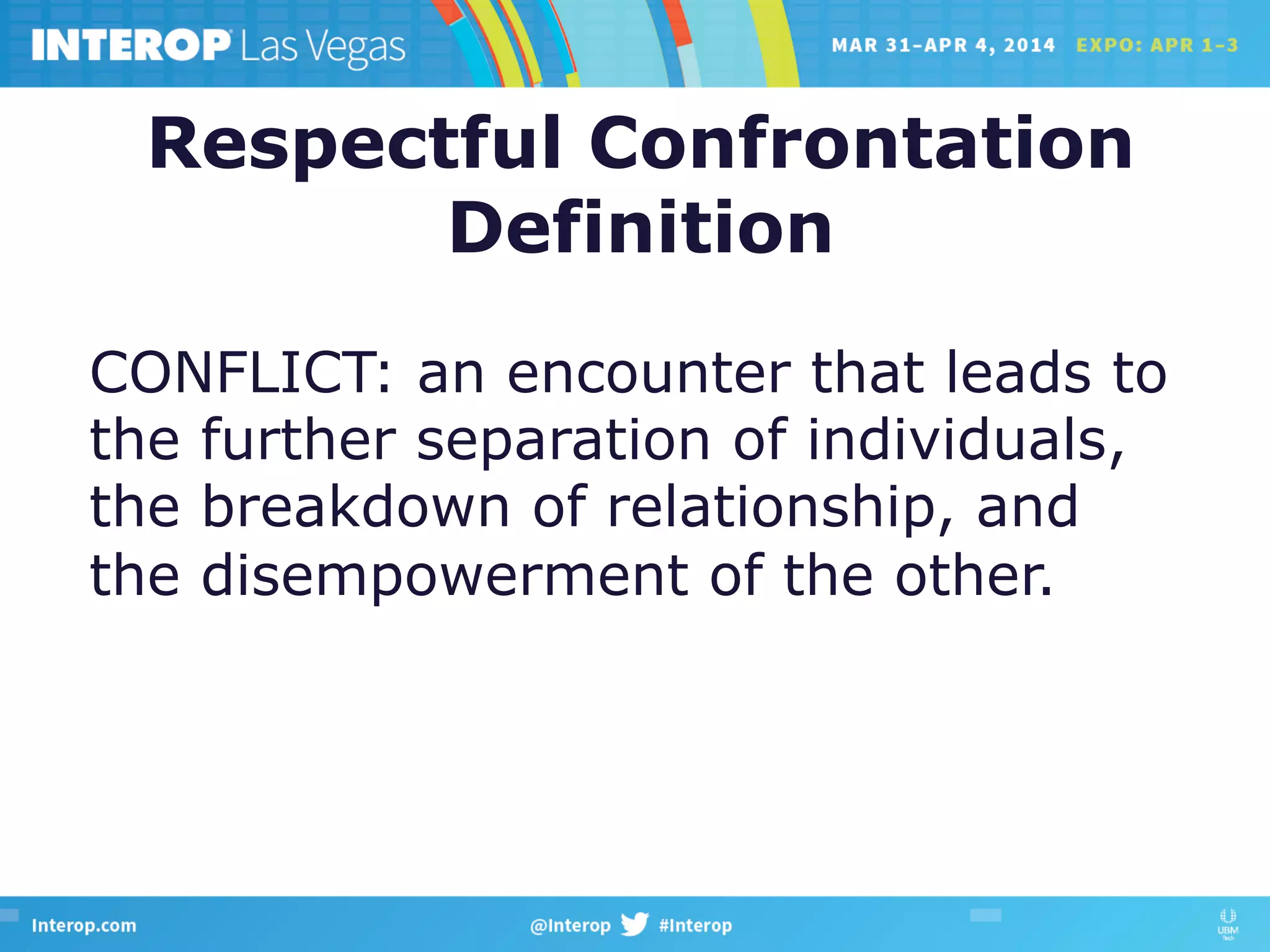
CONFLICT: an encounter that leads to
the further separation of individuals,
the breakdown of relationship, and
the disempowerment of the other.
Respectful Confrontation
Definition
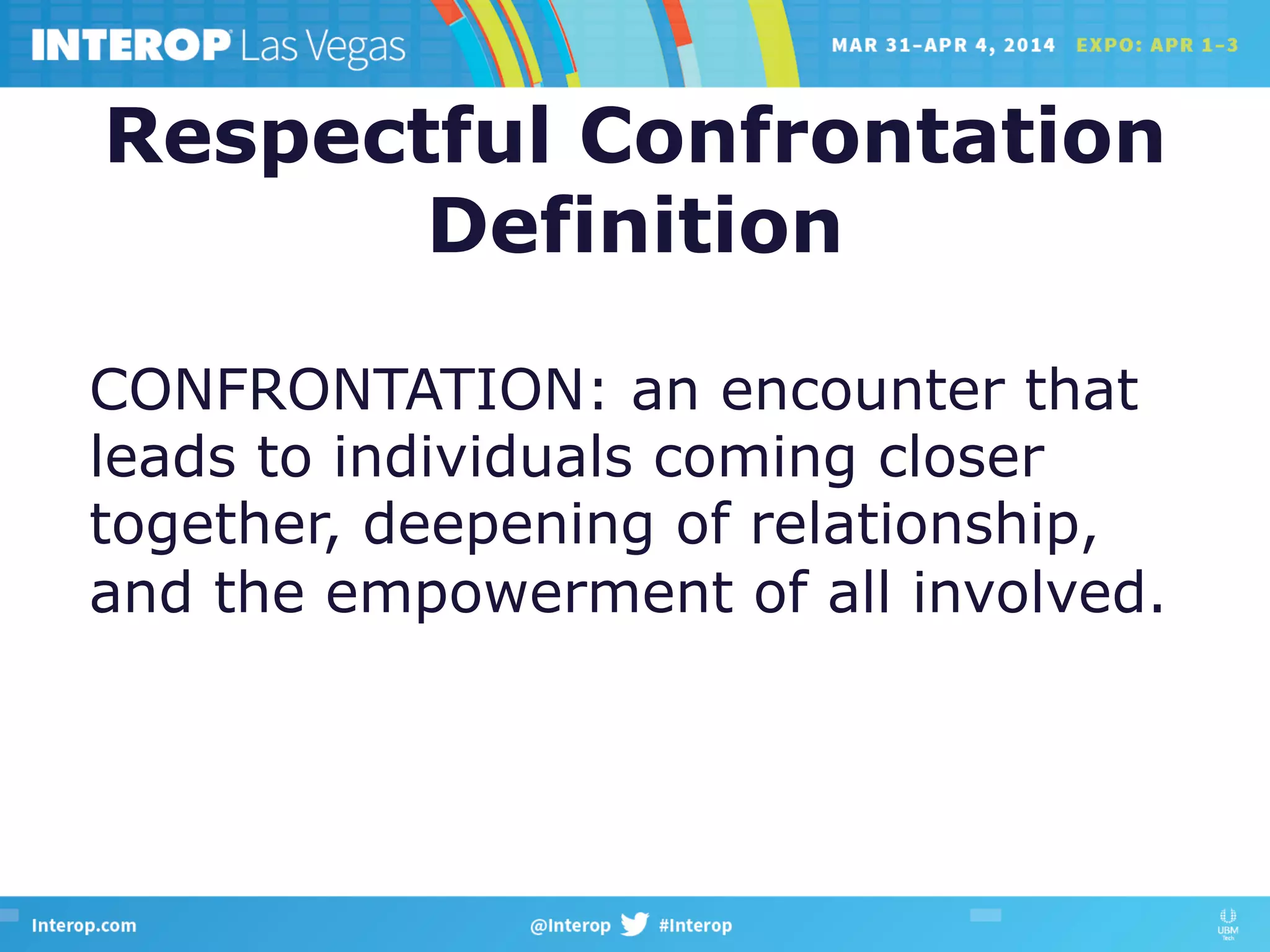
CONFRONTATION: an encounter that
leads to individuals coming closer
together, deepening of relationship,
and the empowerment of all involved.
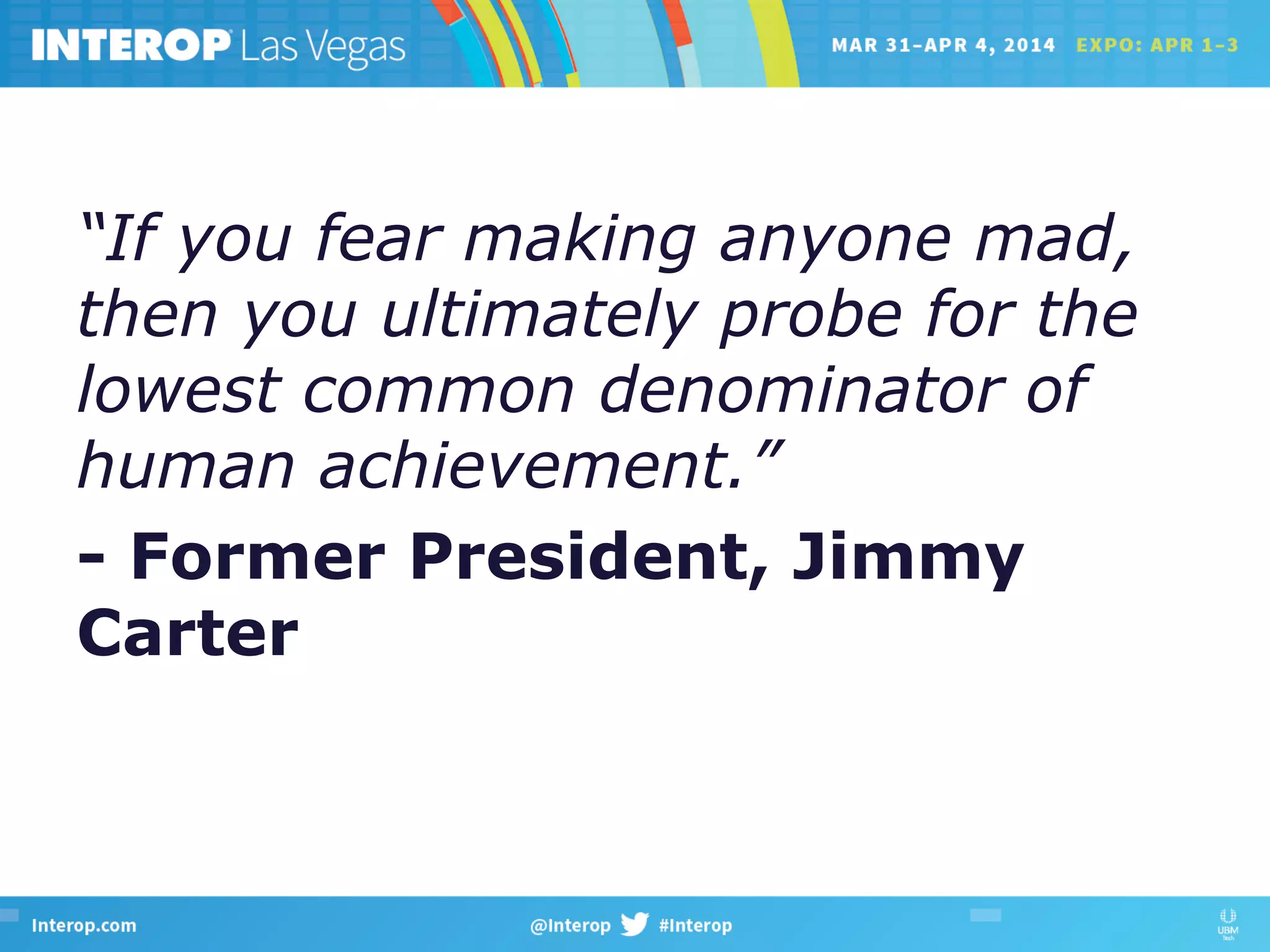
“If you fear making anyone mad,
then you ultimately probe for the
lowest common denominator of
human achievement.”
- Former President, Jimmy
Carter
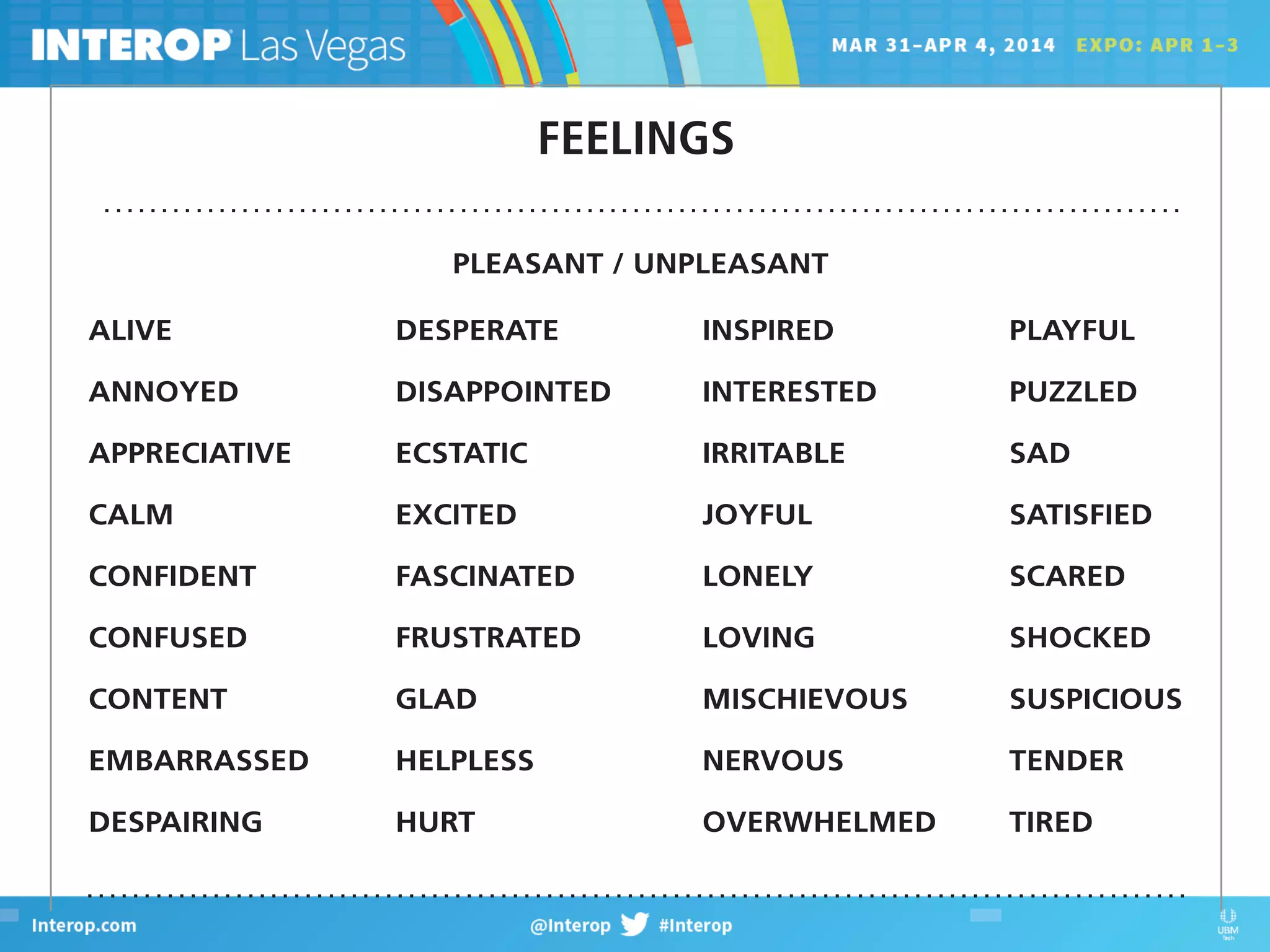
ALIVE
ANNOYED
APPRECIATIVE
CALM
CONFIDENT
CONFUSED
CONTENT
EMBARRASSED
DESPAIRING
DESPERATE
DISAPPOINTED
ECSTATIC
EXCITED
FASCINATED
FRUSTRATED
GLAD
HELPLESS
HURT
INSPIRED
INTERESTED
IRRITABLE
JOYFUL
LONELY
LOVING
MISCHIEVOUS
NERVOUS
OVERWHELMED
PLAYFUL
PUZZLED
SAD
SATISFIED
SCARED
SHOCKED
SUSPICIOUS
TENDER
TIRED
. . . . . . . . . . . . . . . . . . . . . . . . . . . . . . . . . . . . . . . . . . . . . . . . . . . . . . . . . . . . . . . . . . . . . . . . . . . . . . . . . . . . . . . . . . . . . . . .
FEELINGS
. . . . . . . . . . . . . . . . . . . . . . . . . . . . . . . . . . . . . . . . . . . . . . . . . . . . . . . . . . . . . . . . . . . . . . . . . . . . . . . . . . . . . . . . . . . . . .
PLEASANT / UNPLEASANT
DESPAIRING HURT OVERWHELMED TIRED
................................................................................................
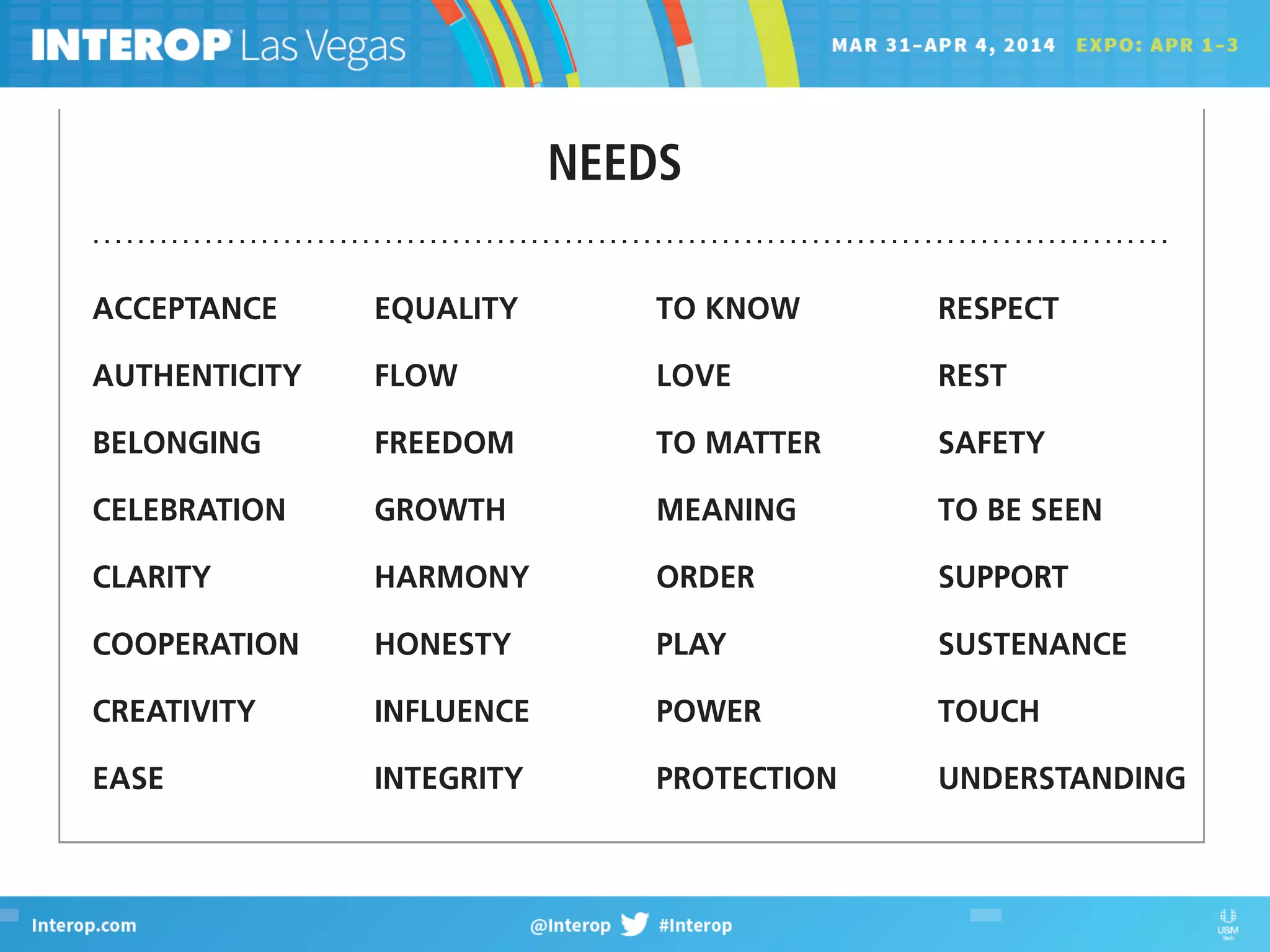
NEEDS
................................................................................................
ACCEPTANCE
AUTHENTICITY
BELONGING
CELEBRATION
CLARITY
COOPERATION
CREATIVITY
EASE
EQUALITY
FLOW
FREEDOM
GROWTH
HARMONY
HONESTY
INFLUENCE
INTEGRITY
TO KNOW
LOVE
TO MATTER
MEANING
ORDER
PLAY
POWER
PROTECTION
RESPECT
REST
SAFETY
TO BE SEEN
SUPPORT
SUSTENANCE
TOUCH
UNDERSTANDING
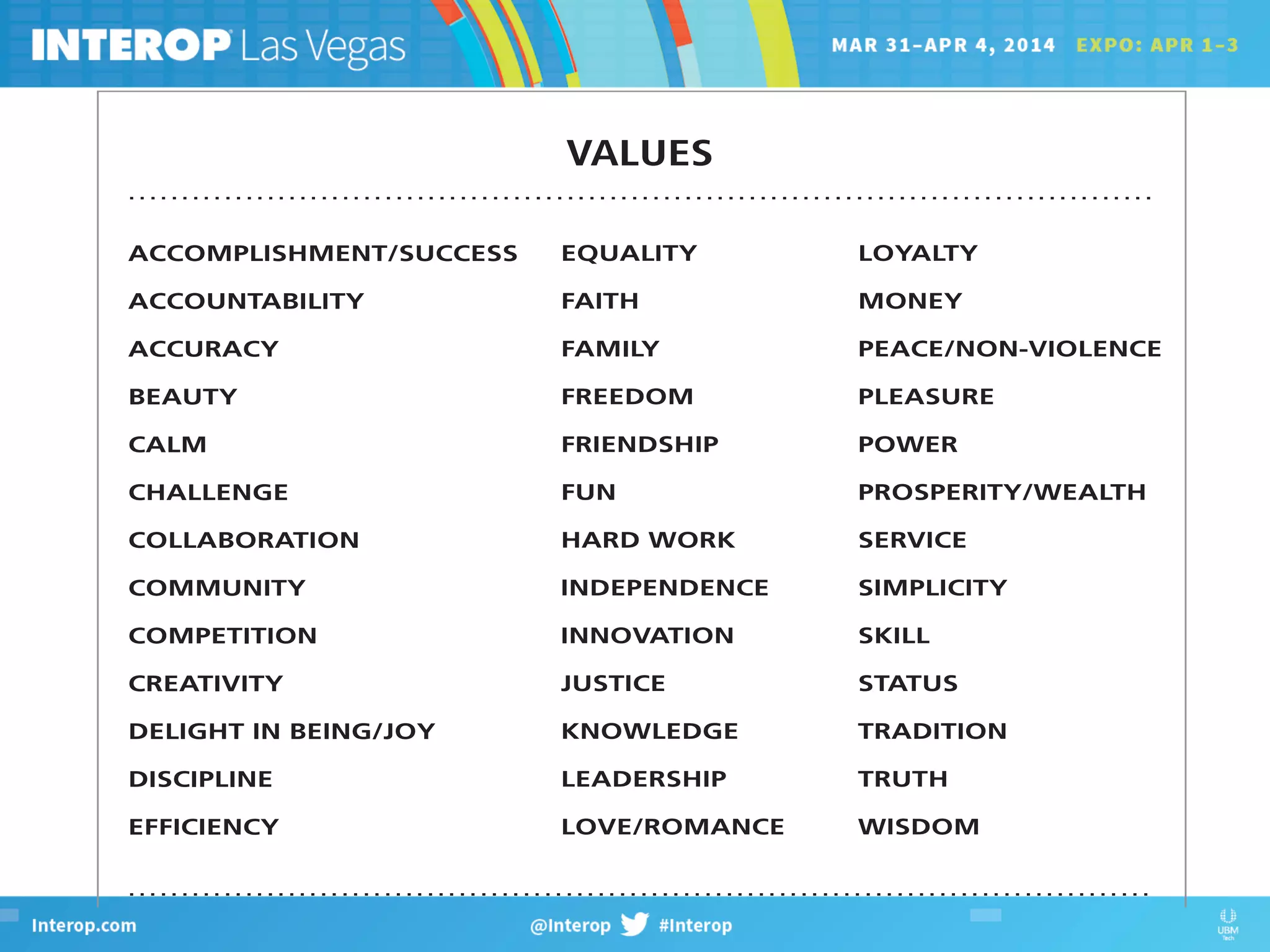
VALUES
. . . . . . . . . . . . . . . . . . . . . . . . . . . . . . . . . . . . . . . . . . . . . . . . . . . . . . . . . . . . . . . . . . . . . . . . . . . . . . . . . . . . . . . . . . . . . . . .
ACCOMPLISHMENT/SUCCESS
ACCOUNTABILITY
ACCURACY
BEAUTY
CALM
CHALLENGE
COLLABORATION
COMMUNITY
COMPETITION
CREATIVITY
DELIGHT IN BEING/JOY
DISCIPLINE
EFFICIENCY
EQUALITY
FAITH
FAMILY
FREEDOM
FRIENDSHIP
FUN
HARD WORK
INDEPENDENCE
INNOVATION
JUSTICE
KNOWLEDGE
LEADERSHIP
LOVE/ROMANCE
LOYALTY
MONEY
PEACE/NON-VIOLENCE
PLEASURE
POWER
PROSPERITY/WEALTH
SERVICE
SIMPLICITY
SKILL
STATUS
TRADITION
TRUTH
WISDOM
. . . . . . . . . . . . . . . . . . . . . . . . . . . . . . . . . . . . . . . . . . . . . . . . . . . . . . . . . . . . . . . . . . . . . . . . . . . . . . . . . . . . . . . . . . . . . . . .
Choose ten values from the list
Aggression ≠ Assertiveness
Assertive
1 : disposed to or characterized by bold or
confident assertion <an assertive leader>
2 : having a strong or distinctive flavor or
aroma <assertive wines>
Aggressive
1 a: tending toward or exhibiting aggression
<aggressive behavior> b: marked by
combative readiness <an aggressive fighter>
2 a: marked by obtrusive energy b: marked by
driving forceful energy or
initiative : enterprising <an aggressive
salesman>
3: strong or emphatic in effect or intent
<aggressive colors> <aggressive flavors>
4: growing, developing, or spreading rapidly
<aggressive bone tumors>
Respectful Confrontation
Definition
AGGRESSION: any behavior, action,
remark, gesture, or facial expression
that impacts another with the goal to
disempower and/or is received by the
other in a harmful, threatening way.
Respectful Confrontation
Definition
ASSERTIVENESS: any behavior,
action, remark, gesture, or facial
expression that impacts another with
the goal to empower and/or is
received by the other in a positive
way.
“With realization of one’s potential, and
self-confidence in one’s ability, one can
build a better world.”
- His Holiness the Dalai Lama
“Water is fluid, soft, and yielding. But water
will wear away rock, which is rigid and
cannot yield.... what is soft is strong.”
- Lao Tzu
http://www.respectfulconfrontation.com/
Key Takeaways
•  Bad trumps good in the human brain.
•  You can’t turn your emotions off or leave them at
home. It’s like wearing a bad toupee. You aren’t
fooling anyone.
•  If the limbic system is an open loop, we’re all
responsible for the quality of the emotional
landscape.
•  Stress makes you stupid, by shutting down blood
flow to the critical pre-frontal lobes. If you set off
a stress response in someone, you minimize the
chance of having a rational dialogue.
•  Confrontation isn’t always negative. Resistance to
change can be a valuable source of feedback.
Where Can You Find Us?
Michele Chubirka, spending quality time in kernel
mode.
http://www.healthyparanoia.net
Twitter @MrsYisWhy
Google+ MrsYisWhy
networksecurityprincess@gmail.com
Joe Weston, writing and teaching workshops.
http://www.respectfulconfrontation.com/
References
Esfahani Smith, Emily. "Social Connection Makes a Better Brain." The Atlantic 29 Oct. 2013: n. pag.
Print.
Global Workforce Study - Engagement at Risk: Driving Strong Performance in a Volatile Global
Environment. Rep. no. TW-NA-2012-25644. N.p.: Towers Watson, 2012. Print.
Goleman, Daniel, and Richard Boyatzis. "Social Intelligence and the Biology of Leadership." Harvard
Business Review Sept. 2008: 74-81. Print.
Goleman, Daniel. Working with Emotional Intelligence. New York: Bantam, 1998. Print.
Hanson, Rick, and Richard Mendius. Buddha's Brain: The Practical Neuroscience of Happiness, Love &
Wisdom. Oakland, CA: New Harbinger Publications, 2009. Print.
Kryder, Suzanne. The Mind to Lead. N.p.: NeuroLeap, 2011. Print.
Luders, Eileen, Florian Kurth, Emeran A. Mayer, Arthur W. Toga, Katherine L. Narr, and Christian
Gaser. "The Unique Brain Anatomy of Meditation Practitioners: Alterations in Cortical Gyrification."
Frontiers in Human Neuroscience 6.34 (2012): 1-9. Print.
O'Connell, Andrew. "HBR Blog Network / The Daily Stat." Harvard Business Review. Harvard Business
Review, 30 Oct. 2013. Web. 02 Nov. 2013.
Pink, Daniel H. Drive: The Surprising Truth about What Motivates Us. New York, NY: Riverhead, 2009.
Print.
Pink, Daniel. "Why Bosses Need to Show Their Soft Side." The Telegraph 17 July 2011: n. pag. Print.
Rosenberg, Marshall B. Nonviolent Communication: A Language of Life. Encinitas, CA: PuddleDancer,
2003. Print.
Siegel, Daniel J. The Mindful Brain: Reflection and Attunement in the Cultivation of Well-being. New
York: W.W. Norton, 2007. Print.
State of the American Workplace: Employee Engagement Insights for U.S. Business Leaders. Rep.
N.p.: Gallup, 2013. Print.
Weston, Joe. Mastering Respectful Confrontation: A Guide to Personal Freedom and Empowered,
Collaborative Engagement. Emeryville, CA: Heartwalker, 2011. Print.
Humans Aren’t Computers: Effective Management Strategies for IT Leaders

Humans Aren’t Computers: Effective Management Strategies for IT Leaders

  • 1.
  • 2.
    Who Are We? • Michele Chubirka, aka "Mrs. Y.,” host of Healthy Paranoia Podcast, information security feed of Packetpushers and official nerd stalker. www.healthyparanoia.net chubirka@postmodernsecurity.com @MrsYisWhy •  Joe Weston, workshop facilitator, consultant, and author of the book Mastering Respectful Confrontation. Also founder of the Heartwalker Peace Project. heartwalker@joeweston.com http://www.respectfulconfrontation.com/
  • 3.
  • 4.
    How engaged canyou be today?
  • 5.
    •  How manyof you started out as engineers or technical staff? •  Are you happy and energized by this choice? •  Would you like to improve the quality of your professional environment? •  Why did you accept a leadership role?
  • 6.
    What’s the SLAwith Our Staff? •  Employees Are the Most Valuable Asset. •  Why is the relationship so challenging? •  Do we treat them better or worse than our hardware assets?
  • 7.
    “Leadership is nota rank, it’s a decision.” -Simon Sinek
  • 8.
    State of theWorkplace
  • 9.
    According to Wikipedia: An"engaged employee" is one who is fully absorbed by and enthusiastic about their work and so takes positive action to further the organization's reputation and interests.
  • 10.
    Gallup’s 2013 Stateof the American Workplace •  Engagement brings higher productivity, profits, customer ratings and employee retention •  Disengagement costs U.S. $450 to $550 billion per year. •  70% of American workers are “not engaged” or “actively disengaged.” •  Those with college degree are less likely to be engaged.
  • 11.
    2012 Global WorkforceStudy by Towers Watson •  Out of 32,000 full-time workers, only 35% were highly engaged. •  Employee retention depends on relationship with management, trust in senior leadership and ability to manage work-related stress. •  Less than half surveyed believed that supervisors have time to address interpersonal issues.
  • 12.
    Drivers of Engagement • Leadership •  Stress, balance and workload •  Goals and objectives •  Supervisors •  Organization’s image
  • 13.
    Motivation and Engagement Studysponsored by the Federal Reserve Bank found three main factors motivate people in their work. –  Autonomy –  Mastery –  Purpose
  • 14.
    What Can YouDo About It?
  • 15.
    Power and Leadershipin the 21st century
  • 16.
    Key Areas toBalance for Successful Leadership •  Productivity •  Relationship •  Self Care
  • 17.
    “Human beings havediscretionary energy, and they would give it to you if you treat them with dignity and respect.” -Paul O’Neill, former Treasury Secretary of US under George W. Bush
  • 18.
    When one movesinto their vulnerability, then their true power is revealed.
  • 23.
  • 24.
    "The human brainhasn't had a hardware upgrade in about 100,000 years." Daniel Goleman, Author of Emotional Intelligence
  • 25.
    Neuroscience 101 Limbic System:The interior of the cortex, includes the hippocampus and amygdala. Supports emotion and long-term memory. Prefrontal Cortex: Region responsible for planning, decision making and moderating behavior. Think  of  the  limbic  system  to  the  prefrontal  cortex  as  a  horse  is  to  a  rider.  
  • 26.
    Demonstration: A BrainIn the Palm of Your Hand •  Hold up your hand and make a fist. •  This is a good representation of the brain and spinal column. •  The brain stem, limbic system and neocortex. * These two slides are oversimplifications of a very complex system.
  • 27.
    The Threat Response:Step 1 Cortex receives input (externally or internally) from the thalamus, a component of the limbic system.
  • 28.
    The Threat Response:Step 2 Limbic system and prefrontal cortex (the executive or evaluator of the brain) take in data. Limbic system processes faster.
  • 29.
    The Threat Response:Step 3 Amygdala, responsible for emotional response and memory, acts as an alarm activating the fight/flight hormonal response if threat is perceived.
  • 30.
    The Threat Response:4 The sympathetic nervous system sets up organs and muscles for fight/flight response, inhibiting digestion and the hypothalamus prompts the release of stress hormones.
  • 31.
    Emotional Contagion •  Thelimbic system is an “open loop,” influenced by other people’s emotions, aka mirror neurons. •  Mirror neurons activate when an animal performs an action or when an animal observes the same action of another animal. •  They are thought to be the basis of empathy. •  Also called emotional contagion.
  • 32.
    The Power ofMirror Neurons Marie Dasborough observed two groups: •  One group was given negative feedback accompanied by positive emotional signs, nods and smiles. •  Another was provided positive feedback that was delivered using negative emotional cues, frowns and narrowed eyes.
  • 33.
    Entrainment •  Those receivingpositive feedback with negative emotional signs reportedly felt worse than participants receiving negative feedback given with positive emotional cues. •  Your emotions and actions are mirrored by those around you.
  • 34.
    Negativity •  The brainhas a negativity bias because the limbic system is quicker than the prefrontal cortex at perceiving and analyzing potential threats. •  Traumatic experiences are “stickier” than positive, happy experiences, i.e. harder to un-map.
  • 35.
    No Escape FromThreat •  Most are in a permanent state of cortisol overload due to the constant stressors of modern life. •  Stress hormones stay in the body for hours. •  Decreases intellectual capacity, memory capacity and lowers impulse control. •  Stress makes you stupid.
  • 36.
    Amygdala Hijack? An intenseand immediate emotional reaction, followed by the understanding that it was inappropriate. •  I thought that stick on the ground was a snake! •  I don’t like you or I’m bored, so I won’t cooperate or listen to what you have to say. •  That guy who cut me off in traffic was trying to kill me! •  Why were you so insulting to me in that email yesterday? (studies show there’s a negativity bias in email.) •  Other examples?
  • 37.
    Thin Slicing •  Humanbeings make quick decisions based on intuition. •  This is called “Thin Slicing” or “Fast Thinking.”
  • 38.
    Thin Slicing: BedsideManner •  The likelihood of a doctor being sued doesn’t correlate with the number of errors made. •  Psychologists are able to predict which doctors will be sued by analyzing the amount of time spent with patients and if the tone of their voices sounded “concerned.”
  • 39.
    There’s No Mr.Spock •  Neurologist, Dr. Antonio Damasio, had a patient who had been a successful corporate lawyer. •  A tumor was discovered in his prefrontal lobes and the surgeon who removed it inadvertently severed the circuit between this area and his amygdala.
  • 40.
    Somatic Marker •  Nodamage to his cognitive abilities, but his life fell apart. •  He couldn’t make decisions when presented with simple choices. •  He no longer had any feelings regarding options, no preferences. •  Case is basis for the Somatic Marker Hypothesis, a theory that emotions assist with decision-making.
  • 41.
    It is agross misconception that reason can be completely separated from emotion. Bounded Emotionality
  • 42.
  • 43.
    How To Engagea Terrorist Interrogator, Matthew Alexander discovered that building rapport with prisoners in Iraq was the most effective interrogation method, not torture.
  • 44.
    “The quickest wayto get most (but not all) captives talking is to be nice to them.” Mark Bowden, author of Black Hawk Down
  • 45.
    Common Social Heuristics • Tit for Tat: –  Be kind first, keep a memory of size one, and imitate your partner’s last behavior. –  Only the last behavior is remembered and imitated. –  Political scientist Robert Axelrod found this to be the most frequently winning strategy. •  Don’t Break Ranks
  • 46.
    Is Efficiency Overrated? • Study conducted by Gillian M. Sandstrom and Elizabeth W. Dunn of the University of British Columbia. •  Participants who “smiled, made eye contact, and talked with the cashier” at a coffee shop reported higher satisfaction and moods than those who avoided interaction. •  Small, unimportant interactions with others can create a feeling of connection according to researchers.
  • 47.
    Social Connections Matter • Anthropologist Robin Dunbar found that a species’ brain size—size of its neocortex, the outermost layer—is linked to the size of its social group. •  We have big brains in order to socialize.
  • 48.
    We’re Wired ToBe Social •  In the brain’s non-active moments, it reverts to a configuration called the “default network.” •  According to researcher, Matthew Lieberman, this appears to resemble another configuration, the social thinking brain, which is empathetic.
  • 49.
    Make Stress YourFriend •  A study tracked stress in 30,000 adults over eight years. •  Researchers found those under great stress had a 43% increased risk of death, if they believed stress was dangerous. •  Under stress, the pituitary gland releases Oxytocin, the bonding hormone. •  Acts as anti-inflammatory which can counteract negative effects of stress.
  • 50.
    Your Response toStress Matters "When you choose to connect with others under stress, you can create resilience" - Kelly McGonigal, health psychologist and researcher, Stanford University
  • 51.
    Methods of Engagement • Interaction based on core competencies of Emotional Intelligence, such as self- awareness, self-regulation, empathy, and motivation. •  Social engineers and con artists use the same skills to create emotional and social affinity with a target. •  Conflict resolution methods.
  • 52.
    “We have toface the fact that either all of us are going to die together or we are going to learn to live together, and if we are to live together we have to talk.” - Eleanor Roosevelt
  • 53.
  • 54.
    Communication Models BasedOn Empathy •  XYZ model •  NVC •  Respectful Confrontation
  • 55.
    Marshall Rosenberg’s Non-Violent Communication • Facts or observations •  Feelings •  Needs or what’s “alive” •  Request
  • 56.
    Joe Weston’s Respectful Confrontation • Behavior •  Impact •  Need •  Make a request
  • 57.
    "Niceness can bea dodge to avoid engaging in unpleasant interactions." -Bill Kahn, Ph.D.
  • 59.
    Goals •  Learn aboutempowered, collaborative engagement. •  Reframe views on confrontation, assertiveness, and true power. •  Achieve greater self-confidence, personal freedom, fulfillment, and peaceful interactions with others.
  • 60.
    My truth ≠The truth
  • 61.
    Respectful Confrontation •  Thepractice of developing the respectful self •  The practice of respectful engagement •  The practice of respectful offense •  The practice of respectful defense
  • 62.
  • 63.
    break down yourcommunication, connection, and collaboration. ICEBERG CHART BODY LANGUAGE FACIAL EXPRESSION PHYSICAL SENSATIONS / CONDITIONS AND BODY CHALLENGES SURROUNDINGS / ENVIRONMENT TEMPERATURE, TIME OF DAY RELATIONSHIP POWER DYNAMIC POWER STATUS PAST HISTORY MOOD EMOTIONS, PERSONAL PHILOSOPHY, BELIEFS, PREJUDICES, JUDGMENTS, CULTURE, RACE, GENDER, CUSTOMS, RELIGION, EDUCATION, LOVE FEAR, WOUNDS, NEEDS, DESIRES, LONGING, TRAUMAS, INSECURITIES VERBAL 10% 90%
  • 64.
    “Hmm, I’d likea cup of tea…”
  • 65.
    5 Steps ofClear Communication 1.  Contact with yourself 2.  Contact with other 3.  Desire/Impulse 4.  Act of communication 5.  Received message
  • 66.
    True power =Brute force Confrontation = Conflict Assertiveness = Aggression
  • 67.
    Brute force ≠true power
  • 68.
    4 Pillars ofTrue Power •  Grounding •  Focus •  Strength •  Flexibility
  • 69.
  • 70.
    “Courage is whatit takes to stand up and speak. Courage is what it takes to sit down and listen.” - Winston Churchill
  • 71.
    1 : FIGHT,BATTLE, WAR 2 a : competitive or opposing action of incompatibles : antagonistic state or action (as of divergent ideas, interests, or persons) b : mental struggle resulting from incompatible or opposing needs, drives, wishes, or external or internal demands; see DISCORD Conflict
  • 72.
    Confront con·front 1 : toface especially in challenge : OPPOSE 2 a : to cause to meet : bring face-to-face <confront a reader with statistics> b : to meet face-to-face : ENCOUNTER
  • 73.
    Respectful Confrontation Definition CONFLICT: anencounter that leads to the further separation of individuals, the breakdown of relationship, and the disempowerment of the other.
  • 74.
    Respectful Confrontation Definition CONFRONTATION: anencounter that leads to individuals coming closer together, deepening of relationship, and the empowerment of all involved.
  • 75.
    “If you fearmaking anyone mad, then you ultimately probe for the lowest common denominator of human achievement.” - Former President, Jimmy Carter
  • 76.
    ALIVE ANNOYED APPRECIATIVE CALM CONFIDENT CONFUSED CONTENT EMBARRASSED DESPAIRING DESPERATE DISAPPOINTED ECSTATIC EXCITED FASCINATED FRUSTRATED GLAD HELPLESS HURT INSPIRED INTERESTED IRRITABLE JOYFUL LONELY LOVING MISCHIEVOUS NERVOUS OVERWHELMED PLAYFUL PUZZLED SAD SATISFIED SCARED SHOCKED SUSPICIOUS TENDER TIRED . . .. . . . . . . . . . . . . . . . . . . . . . . . . . . . . . . . . . . . . . . . . . . . . . . . . . . . . . . . . . . . . . . . . . . . . . . . . . . . . . . . . . . . . . . . . . . . . FEELINGS . . . . . . . . . . . . . . . . . . . . . . . . . . . . . . . . . . . . . . . . . . . . . . . . . . . . . . . . . . . . . . . . . . . . . . . . . . . . . . . . . . . . . . . . . . . . . . PLEASANT / UNPLEASANT
  • 77.
    DESPAIRING HURT OVERWHELMEDTIRED ................................................................................................ NEEDS ................................................................................................ ACCEPTANCE AUTHENTICITY BELONGING CELEBRATION CLARITY COOPERATION CREATIVITY EASE EQUALITY FLOW FREEDOM GROWTH HARMONY HONESTY INFLUENCE INTEGRITY TO KNOW LOVE TO MATTER MEANING ORDER PLAY POWER PROTECTION RESPECT REST SAFETY TO BE SEEN SUPPORT SUSTENANCE TOUCH UNDERSTANDING
  • 78.
    VALUES . . .. . . . . . . . . . . . . . . . . . . . . . . . . . . . . . . . . . . . . . . . . . . . . . . . . . . . . . . . . . . . . . . . . . . . . . . . . . . . . . . . . . . . . . . . . . . . . ACCOMPLISHMENT/SUCCESS ACCOUNTABILITY ACCURACY BEAUTY CALM CHALLENGE COLLABORATION COMMUNITY COMPETITION CREATIVITY DELIGHT IN BEING/JOY DISCIPLINE EFFICIENCY EQUALITY FAITH FAMILY FREEDOM FRIENDSHIP FUN HARD WORK INDEPENDENCE INNOVATION JUSTICE KNOWLEDGE LEADERSHIP LOVE/ROMANCE LOYALTY MONEY PEACE/NON-VIOLENCE PLEASURE POWER PROSPERITY/WEALTH SERVICE SIMPLICITY SKILL STATUS TRADITION TRUTH WISDOM . . . . . . . . . . . . . . . . . . . . . . . . . . . . . . . . . . . . . . . . . . . . . . . . . . . . . . . . . . . . . . . . . . . . . . . . . . . . . . . . . . . . . . . . . . . . . . . . Choose ten values from the list
  • 79.
  • 80.
    Assertive 1 : disposedto or characterized by bold or confident assertion <an assertive leader> 2 : having a strong or distinctive flavor or aroma <assertive wines>
  • 81.
    Aggressive 1 a: tendingtoward or exhibiting aggression <aggressive behavior> b: marked by combative readiness <an aggressive fighter> 2 a: marked by obtrusive energy b: marked by driving forceful energy or initiative : enterprising <an aggressive salesman> 3: strong or emphatic in effect or intent <aggressive colors> <aggressive flavors> 4: growing, developing, or spreading rapidly <aggressive bone tumors>
  • 82.
    Respectful Confrontation Definition AGGRESSION: anybehavior, action, remark, gesture, or facial expression that impacts another with the goal to disempower and/or is received by the other in a harmful, threatening way.
  • 83.
    Respectful Confrontation Definition ASSERTIVENESS: anybehavior, action, remark, gesture, or facial expression that impacts another with the goal to empower and/or is received by the other in a positive way.
  • 84.
    “With realization ofone’s potential, and self-confidence in one’s ability, one can build a better world.” - His Holiness the Dalai Lama
  • 85.
    “Water is fluid,soft, and yielding. But water will wear away rock, which is rigid and cannot yield.... what is soft is strong.” - Lao Tzu
  • 86.
  • 87.
    Key Takeaways •  Badtrumps good in the human brain. •  You can’t turn your emotions off or leave them at home. It’s like wearing a bad toupee. You aren’t fooling anyone. •  If the limbic system is an open loop, we’re all responsible for the quality of the emotional landscape. •  Stress makes you stupid, by shutting down blood flow to the critical pre-frontal lobes. If you set off a stress response in someone, you minimize the chance of having a rational dialogue. •  Confrontation isn’t always negative. Resistance to change can be a valuable source of feedback.
  • 88.
    Where Can YouFind Us? Michele Chubirka, spending quality time in kernel mode. http://www.healthyparanoia.net Twitter @MrsYisWhy Google+ MrsYisWhy networksecurityprincess@gmail.com Joe Weston, writing and teaching workshops. http://www.respectfulconfrontation.com/
  • 89.
    References Esfahani Smith, Emily."Social Connection Makes a Better Brain." The Atlantic 29 Oct. 2013: n. pag. Print. Global Workforce Study - Engagement at Risk: Driving Strong Performance in a Volatile Global Environment. Rep. no. TW-NA-2012-25644. N.p.: Towers Watson, 2012. Print. Goleman, Daniel, and Richard Boyatzis. "Social Intelligence and the Biology of Leadership." Harvard Business Review Sept. 2008: 74-81. Print. Goleman, Daniel. Working with Emotional Intelligence. New York: Bantam, 1998. Print. Hanson, Rick, and Richard Mendius. Buddha's Brain: The Practical Neuroscience of Happiness, Love & Wisdom. Oakland, CA: New Harbinger Publications, 2009. Print. Kryder, Suzanne. The Mind to Lead. N.p.: NeuroLeap, 2011. Print. Luders, Eileen, Florian Kurth, Emeran A. Mayer, Arthur W. Toga, Katherine L. Narr, and Christian Gaser. "The Unique Brain Anatomy of Meditation Practitioners: Alterations in Cortical Gyrification." Frontiers in Human Neuroscience 6.34 (2012): 1-9. Print. O'Connell, Andrew. "HBR Blog Network / The Daily Stat." Harvard Business Review. Harvard Business Review, 30 Oct. 2013. Web. 02 Nov. 2013. Pink, Daniel H. Drive: The Surprising Truth about What Motivates Us. New York, NY: Riverhead, 2009. Print. Pink, Daniel. "Why Bosses Need to Show Their Soft Side." The Telegraph 17 July 2011: n. pag. Print. Rosenberg, Marshall B. Nonviolent Communication: A Language of Life. Encinitas, CA: PuddleDancer, 2003. Print. Siegel, Daniel J. The Mindful Brain: Reflection and Attunement in the Cultivation of Well-being. New York: W.W. Norton, 2007. Print. State of the American Workplace: Employee Engagement Insights for U.S. Business Leaders. Rep. N.p.: Gallup, 2013. Print. Weston, Joe. Mastering Respectful Confrontation: A Guide to Personal Freedom and Empowered, Collaborative Engagement. Emeryville, CA: Heartwalker, 2011. Print.