Intuition: Leading Edge for You and Your Clients

SBODN
August 1, 2011


Rossella Derickson
Rossella@Corporate-Wisdom.com


www.Corporate-Wisdom.com
Bio: Rossella Derickson, ICF Trained Coach

              Rossella Derickson, a biochemist, has 22 years experience leading sales, marketing, and
              project management teams with P&L responsibility. She is a founder and a principal in the
              company www.Corporate-Wisdom.com. Over the past 5 years, organizations with which
              she has worked include Cisco, Stanford University, Phoenix Technology, PARC, eGain,
              Formfactor, Morrison and Foester, Santa Clara County Executive Office, Applied
              BioSystems, Amgen, Kodak, and Hitachi.

Rossella   brings a centered style to help clients open up to deal with challenges. She brings clarity and
problem solving approaches through tools learned through formal training and practical experience.
Rossella has translated her experience into Wisdom in the Workplace training modules to support
leadership and emotional intelligence development. She utilizes Kotter and Nadler change models,
depending upon the organization’s need for vision or business alignment. She facilitates learning through
webinar, video conferencing, telepresence and in person sessions. Rossella has launched customized
off-sites and training for multinational companies in the U.S., Europe, and Asia.

For 8 years, Rossella held the position of Director of the South Bay Organizational Development Network,
SBODN.com – a forum for live and virtual events bringing thought leaders in OD, training, and coaching.

Rossella holds a B.S. in Biochemistry from Rutgers University and is an ICF trained executive coach. She
is a gifted intuitive, having studied at Esalen and Aikido with Robert Nadeau, a student of Aikido founder
Morihei Ueshiba. Rossella is an author of "Awakening Social Responsibility, A Call to Action."

                                                                                                       2
When Do Leaders Need Intuition?

Ron Schultz, in Unconventional Wisdom,
interviewed what he termed “twelve
remarkable innovators.” In their own words,
they explained how intuition can revolutionize
decision-making.

When is intuition most helpful to leaders?

   when there is insufficient data, or not
    enough time to gather the data
   when there is too much information, or the
    data is conflicting
   when data seems to support several
    options equally
Check-in: How intuitive are you (on a good day or under pressure)?


Intuition Defined - Comprehension without the use of reasoning. It
sometimes comes in the form of symbols.
Intuition is a “physical state.” Laura Day, author of Practical Intuition,
states that the normal, waking cognitive “filters” are down. Then we use
our rational mind to interpret the impression.
Western - Eastern Convergence

Neural pathways         Energy/ Life Force
Brain Waves             Consciousness
Neurotransmitters
Electromagnetic field
How Does Intuition Manifest?
   Mind perception - Ability to put all the information
    together without all the “facts,” quantum leap

   Audio perception - Hearing the meta-messages when
    someone is speaking

   Gut feeling - feeling in the body

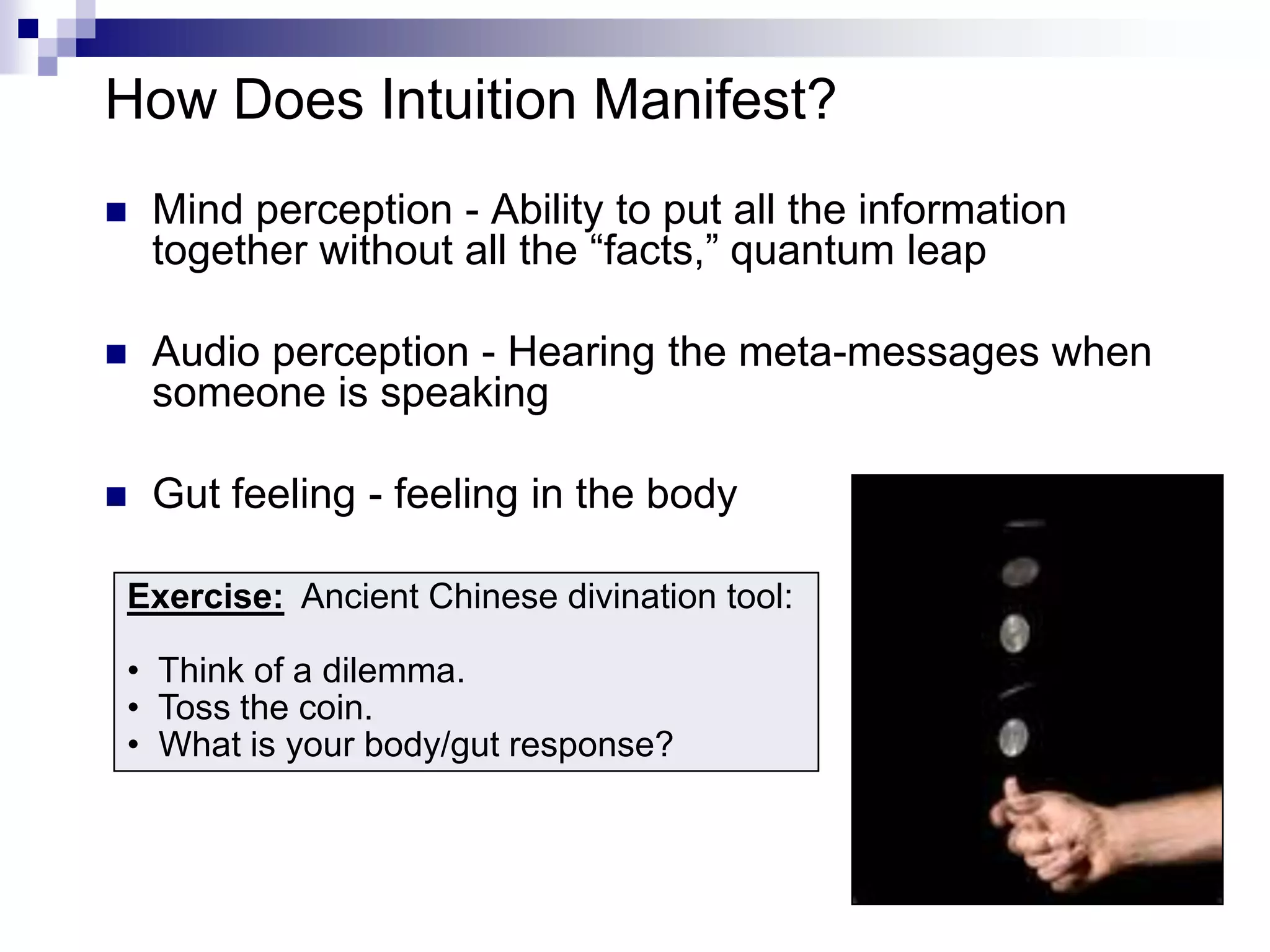
Exercise: Ancient Chinese divination tool:

• Think of a dilemma.
• Toss the coin.
• What is your body/gut response?
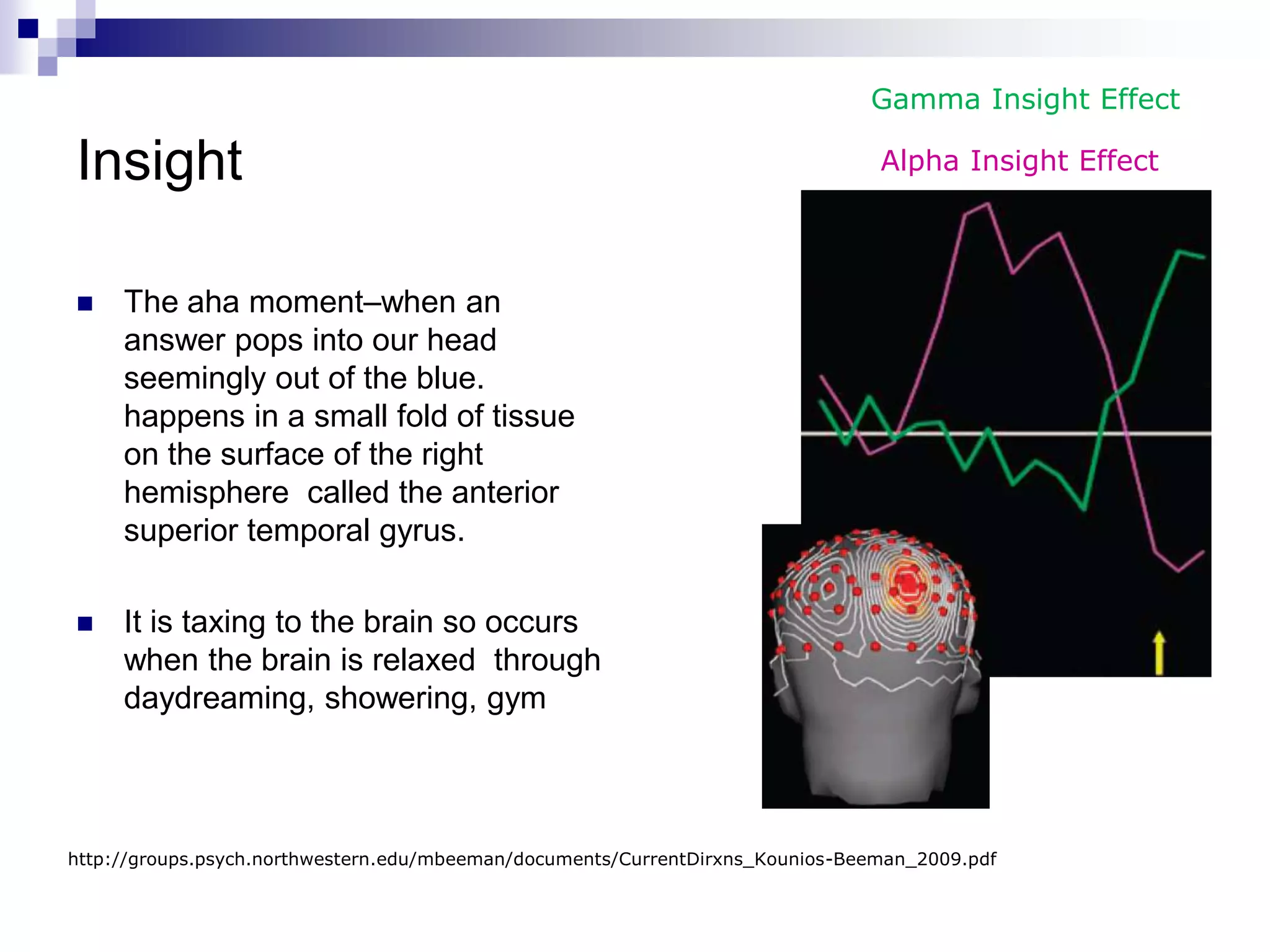
Gamma Insight Effect

Insight                                                                         Alpha Insight Effect


    The aha moment–when an
     answer pops into our head
     seemingly out of the blue.
     happens in a small fold of tissue
     on the surface of the right
     hemisphere called the anterior
     superior temporal gyrus.

    It is taxing to the brain so occurs
     when the brain is relaxed through
     daydreaming, showering, gym


http://groups.psych.northwestern.edu/mbeeman/documents/CurrentDirxns_Kounios-Beeman_2009.pdf
Engaging Your Intuition
Intuition is goal directed. It’s activated by a
question asked consciously or unconsciously.

        Unconscious question:
         (For example) Why does It always
         seem like it is my fault when I argue
         with my boss?

Intuitive information sometimes comes in the
form of symbols.

Exercise:

Your eye will be drawn to see what you need to
see; to know what you need to know….

Am I on the right track with my career?
My intuition guides me …
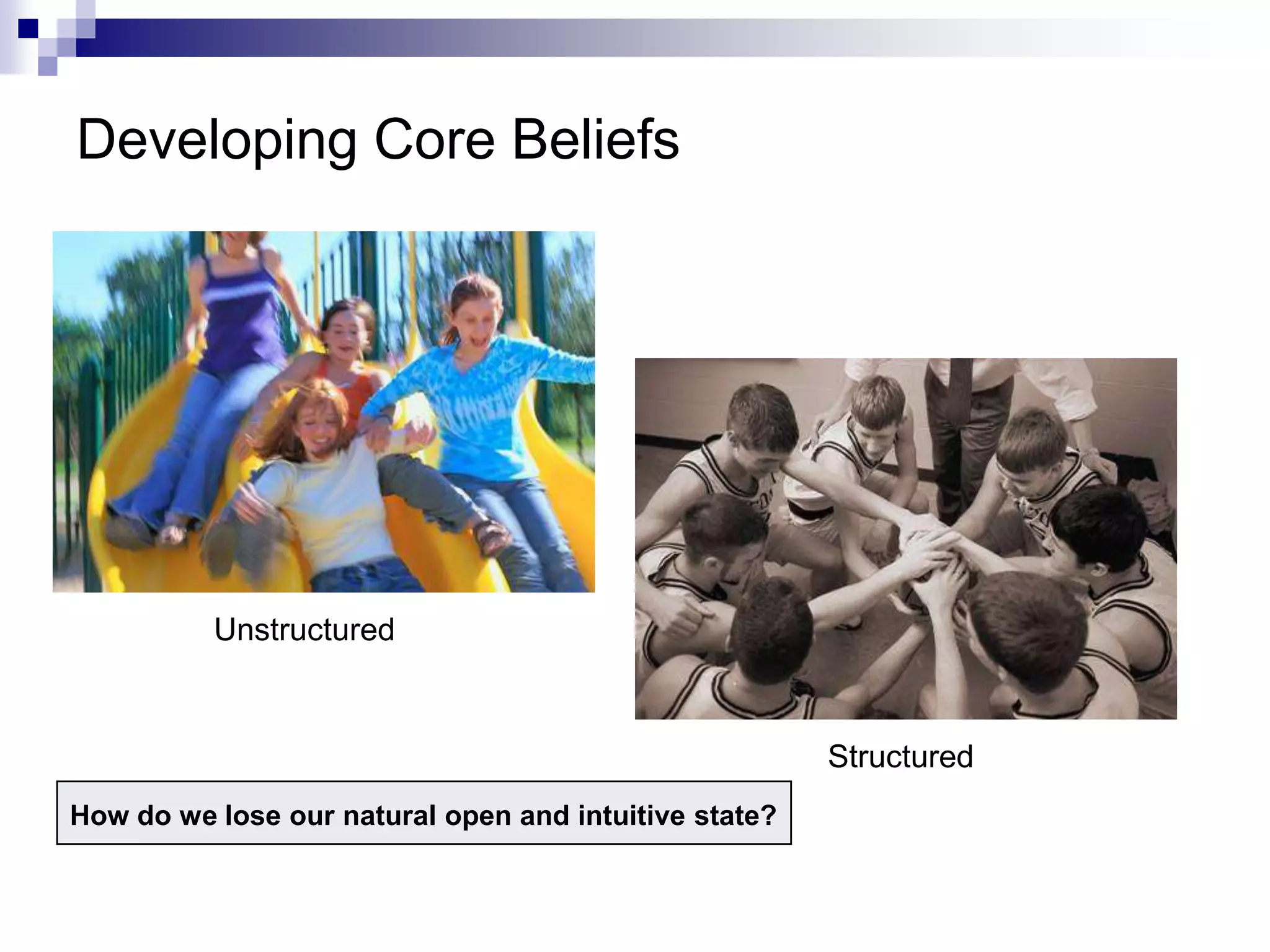
Developing Core Beliefs


          Unstructured


                                                       Structured
How do we lose our natural open and intuitive state?
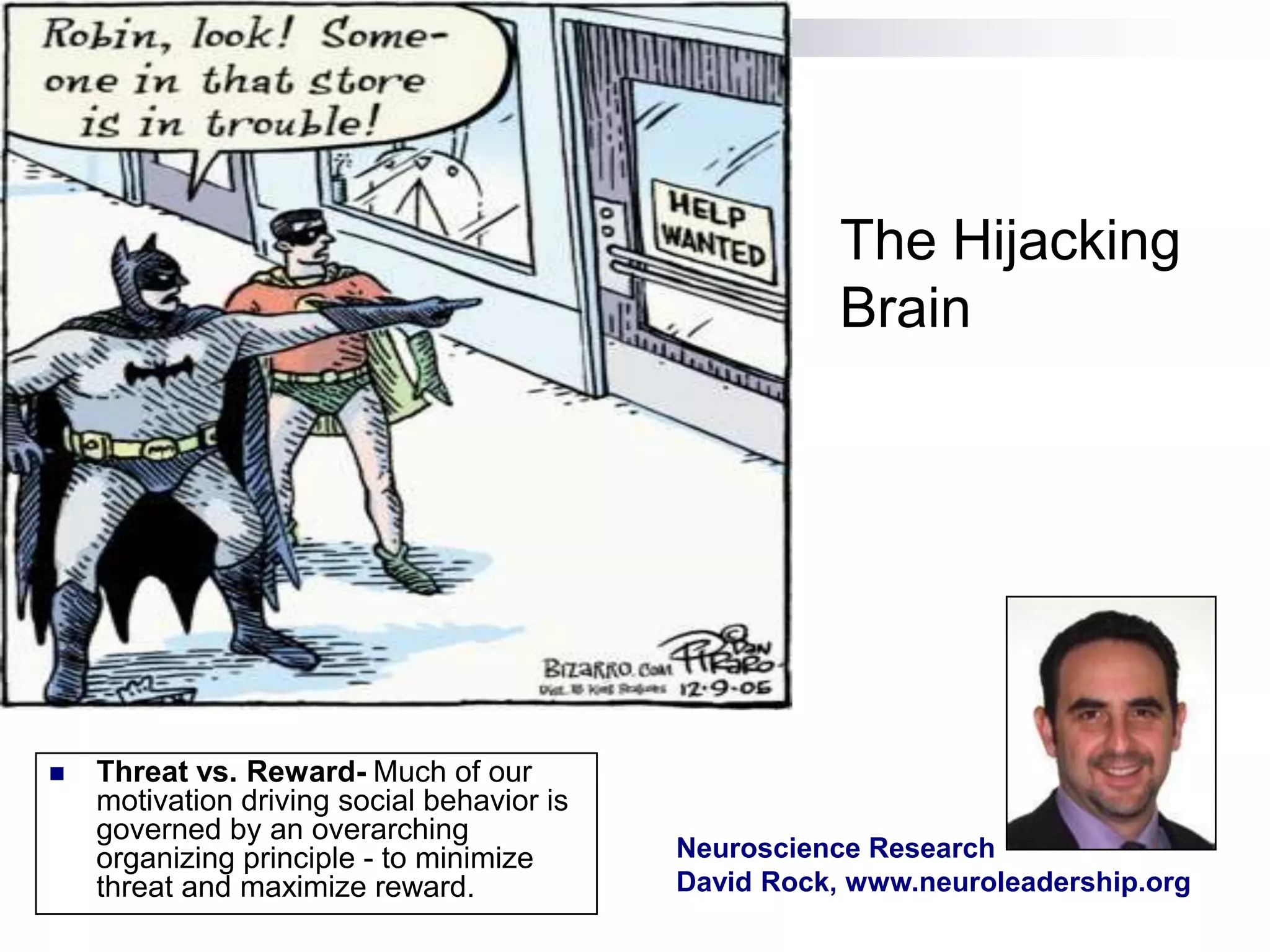
The Hijacking
                                                       Brain


   Threat vs. Reward- Much of our
    motivation driving social behavior is
    governed by an overarching
    organizing principle - to minimize      Neuroscience Research
    threat and maximize reward.             David Rock, www.neuroleadership.org
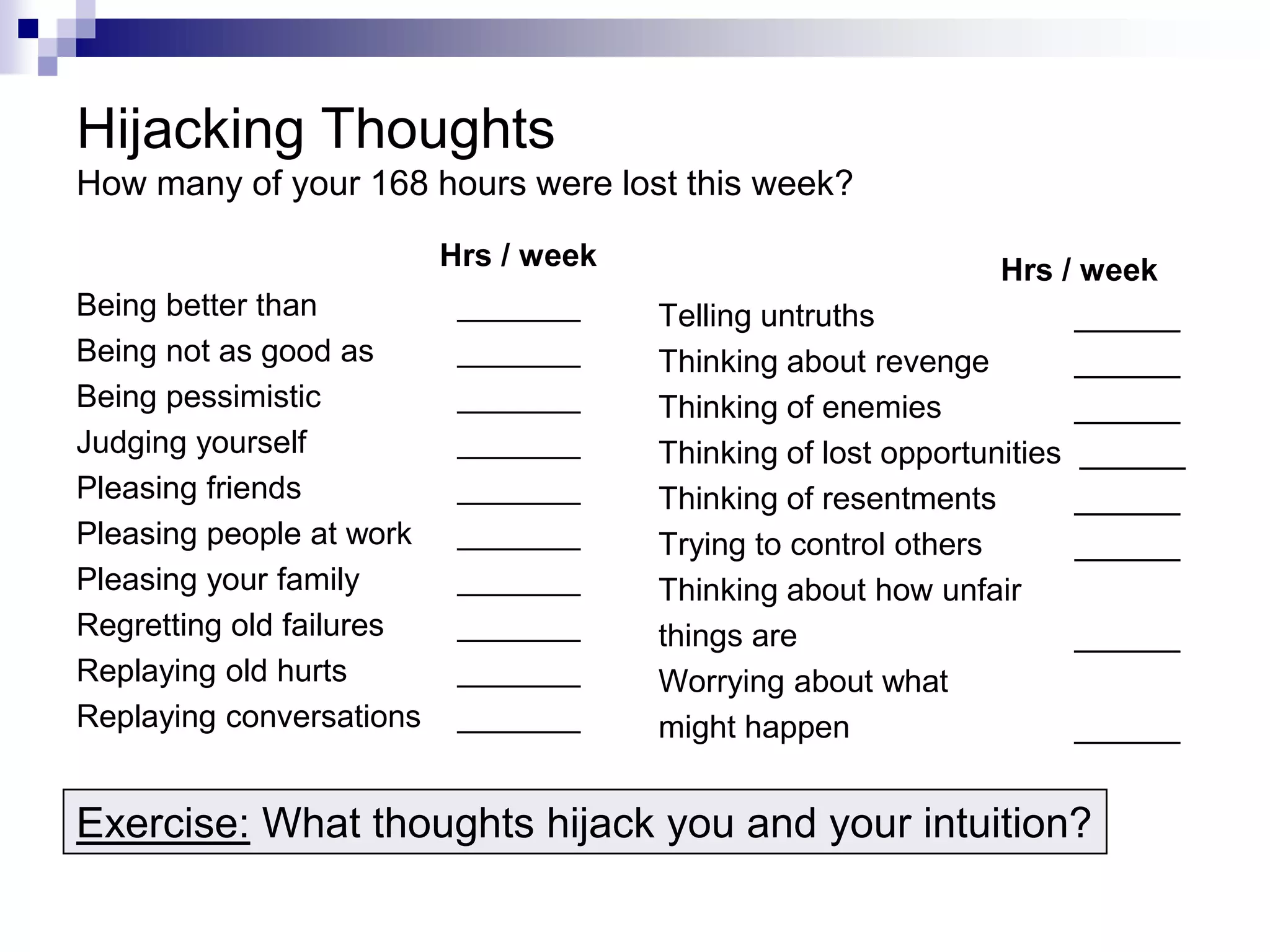
Hijacking Thoughts
How many of your 168 hours were lost this week?

                          Hrs / week                            Hrs / week
Being better than          _______     Telling untruths               ______
Being not as good as       _______     Thinking about revenge         ______
Being pessimistic          _______     Thinking of enemies            ______
Judging yourself           _______     Thinking of lost opportunities ______
Pleasing friends           _______     Thinking of resentments        ______
Pleasing people at work    _______     Trying to control others       ______
Pleasing your family       _______     Thinking about how unfair
Regretting old failures    _______     things are                     ______
Replaying old hurts        _______     Worrying about what
Replaying conversations    _______     might happen                   ______


Exercise: What thoughts hijack you and your intuition?
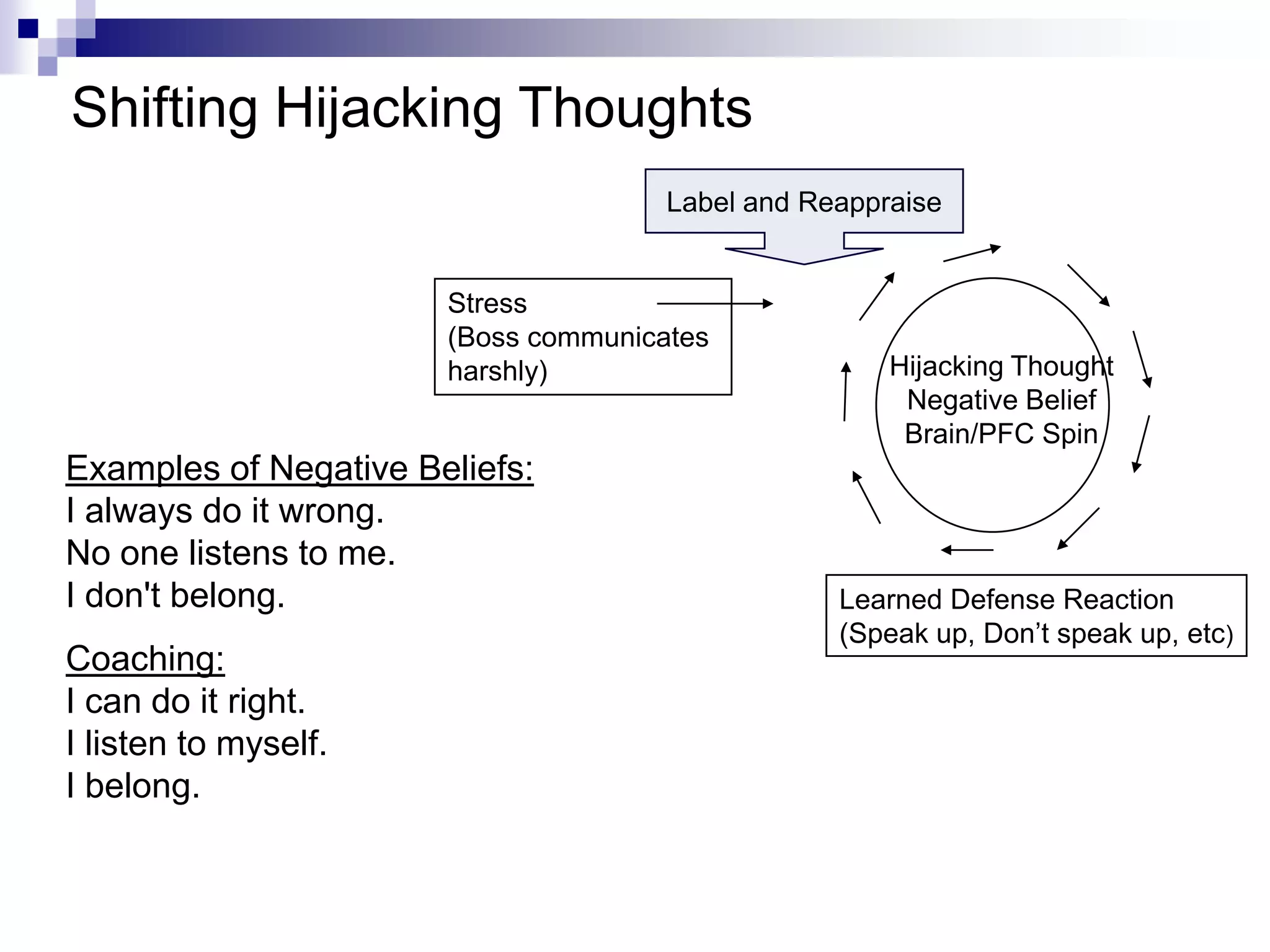
Shifting Hijacking Thoughts
                                      Label and Reappraise


                       Stress
                       (Boss communicates
                       harshly)                       Hijacking Thought
                                                       Negative Belief
                                                       Brain/PFC Spin
Examples of Negative Beliefs:
I always do it wrong.
No one listens to me.
I don't belong.                                   Learned Defense Reaction
                                                  (Speak up, Don’t speak up, etc)
Coaching:
I can do it right.
I listen to myself.
I belong.
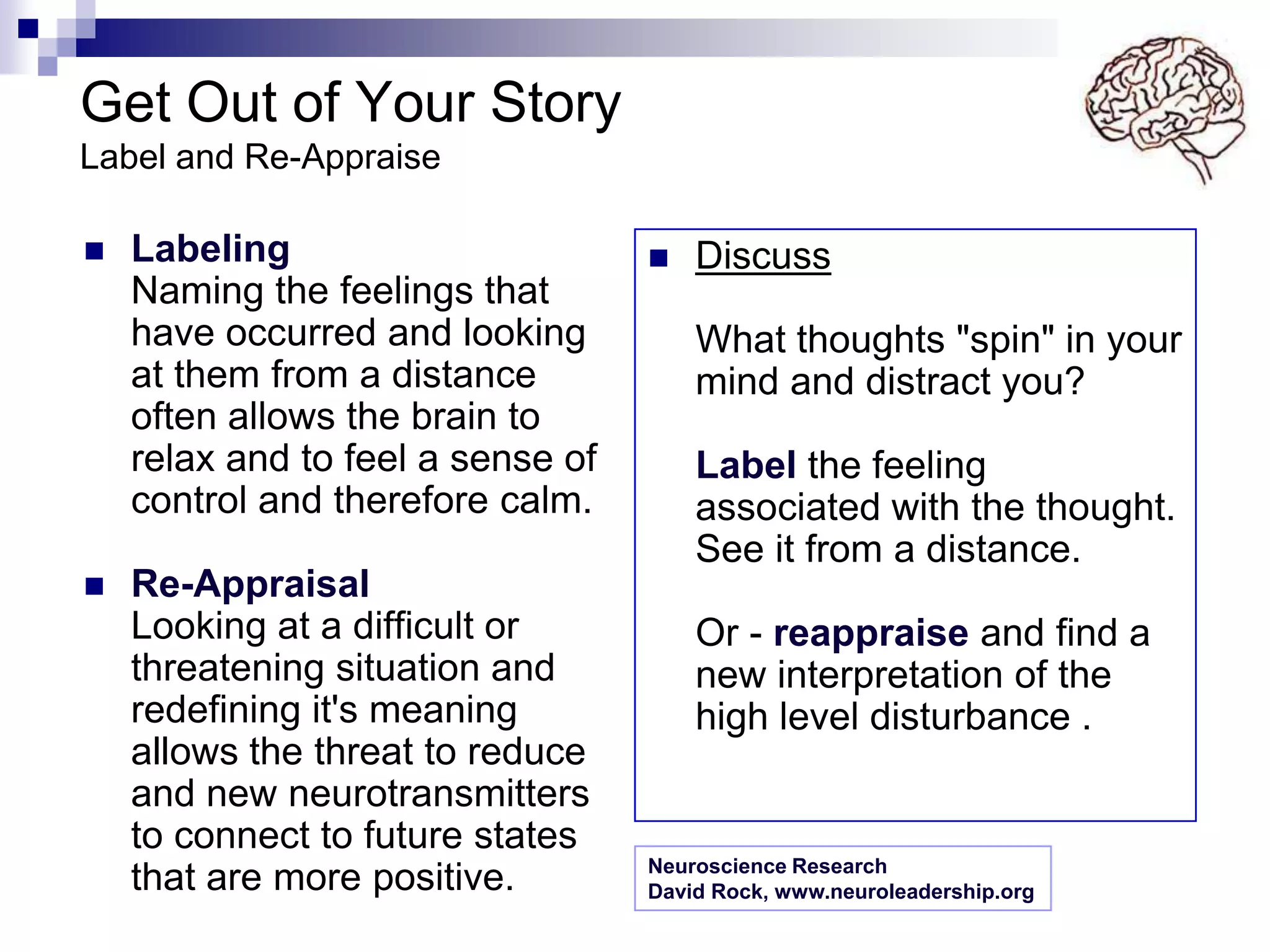
Get Out of Your Story
Label and Re-Appraise

   Labeling                          Discuss
    Naming the feelings that
    have occurred and looking          What thoughts "spin" in your
    at them from a distance            mind and distract you?
    often allows the brain to
    relax and to feel a sense of       Label the feeling
    control and therefore calm.        associated with the thought.
                                       See it from a distance.
   Re-Appraisal
    Looking at a difficult or          Or - reappraise and find a
    threatening situation and          new interpretation of the
    redefining it's meaning            high level disturbance .
    allows the threat to reduce
    and new neurotransmitters
    to connect to future states
                                   Neuroscience Research
    that are more positive.        David Rock, www.neuroleadership.org
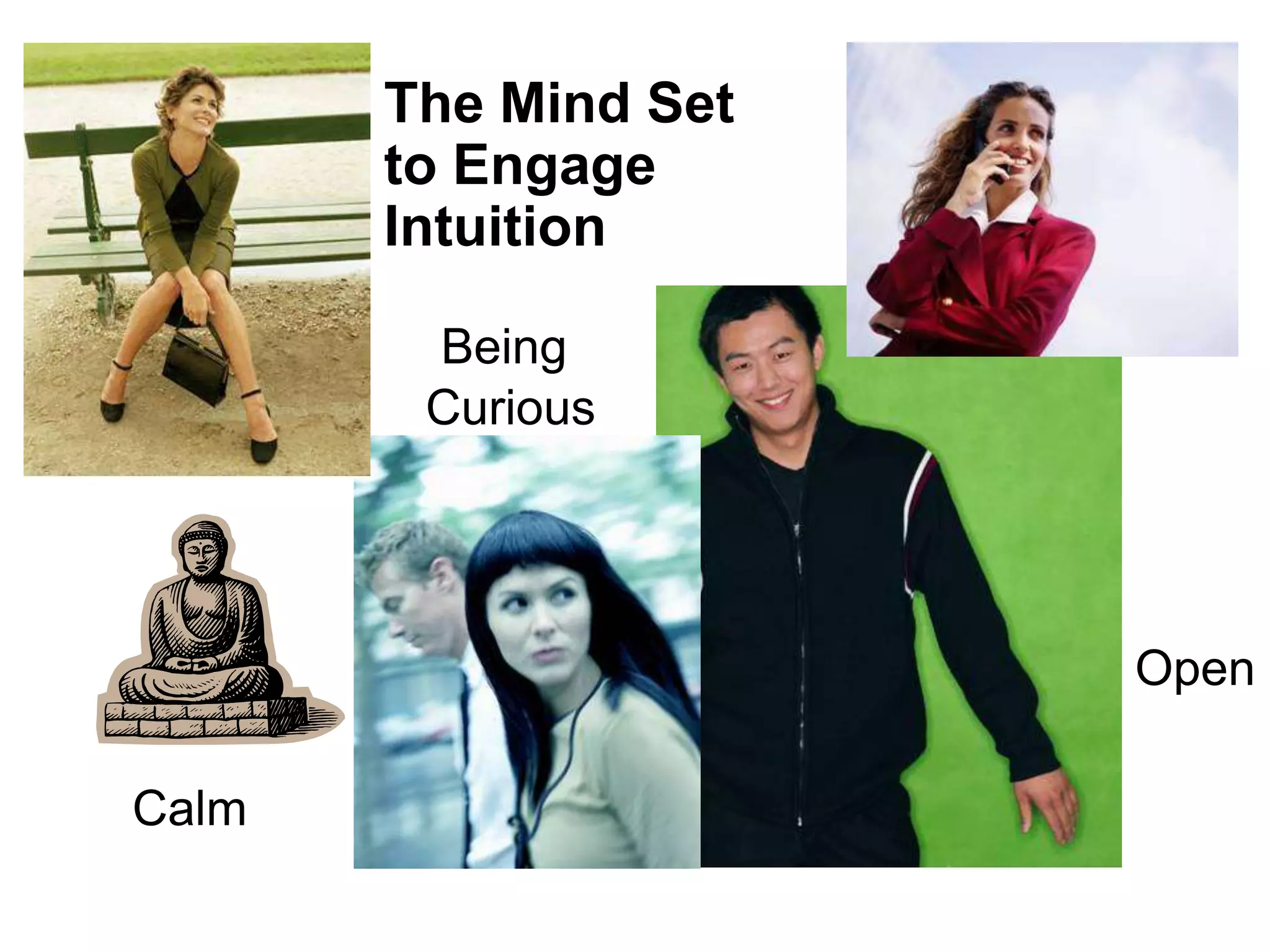
The Mind Set
       to Engage
       Intuition

        Being
        Curious


                      Open

Calm
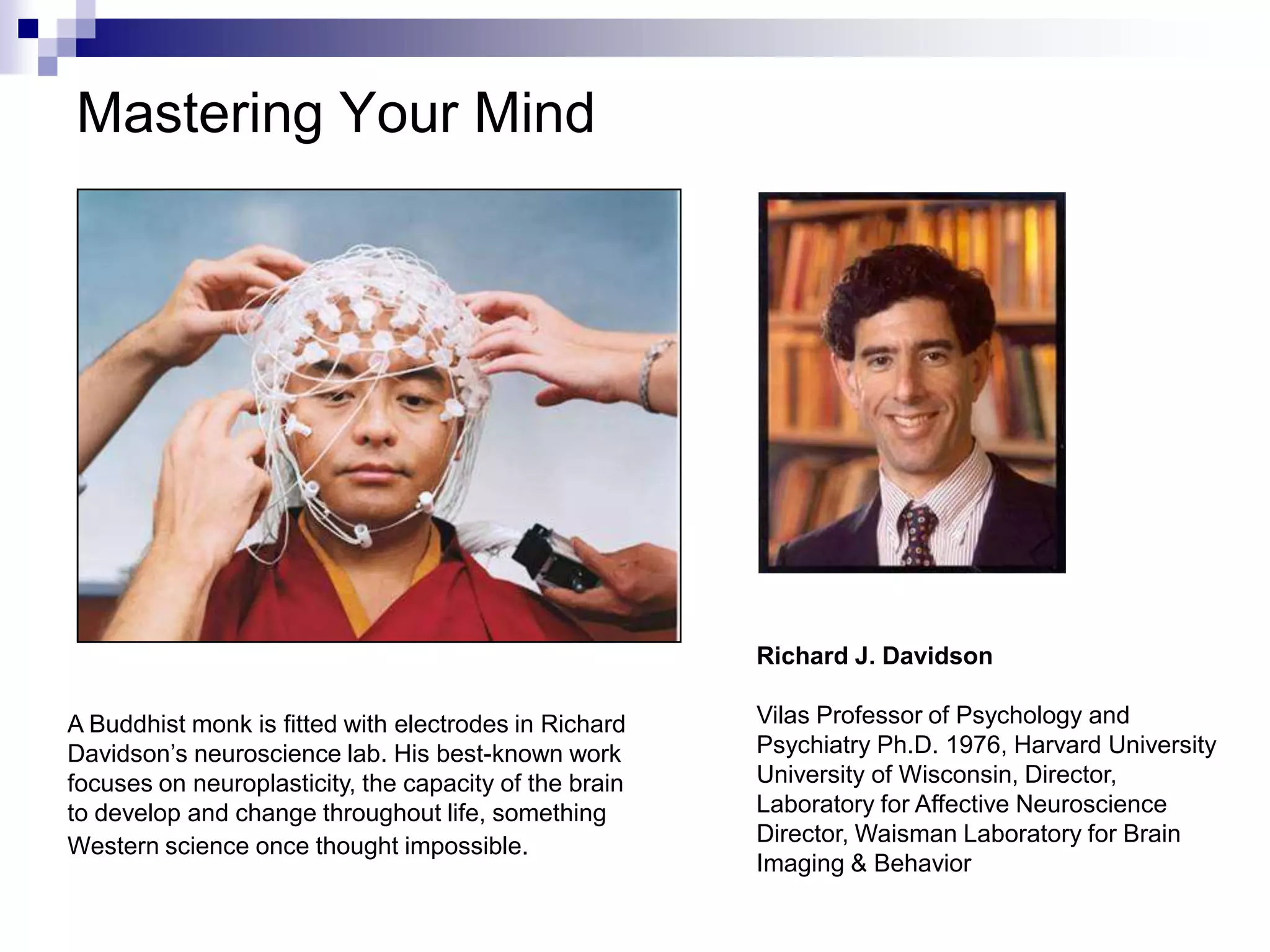
Mastering Your Mind


                                                        Richard J. Davidson

A Buddhist monk is fitted with electrodes in Richard    Vilas Professor of Psychology and
Davidson’s neuroscience lab. His best-known work        Psychiatry Ph.D. 1976, Harvard University
focuses on neuroplasticity, the capacity of the brain   University of Wisconsin, Director,
to develop and change throughout life, something        Laboratory for Affective Neuroscience
Western science once thought impossible.                Director, Waisman Laboratory for Brain
                                                        Imaging & Behavior
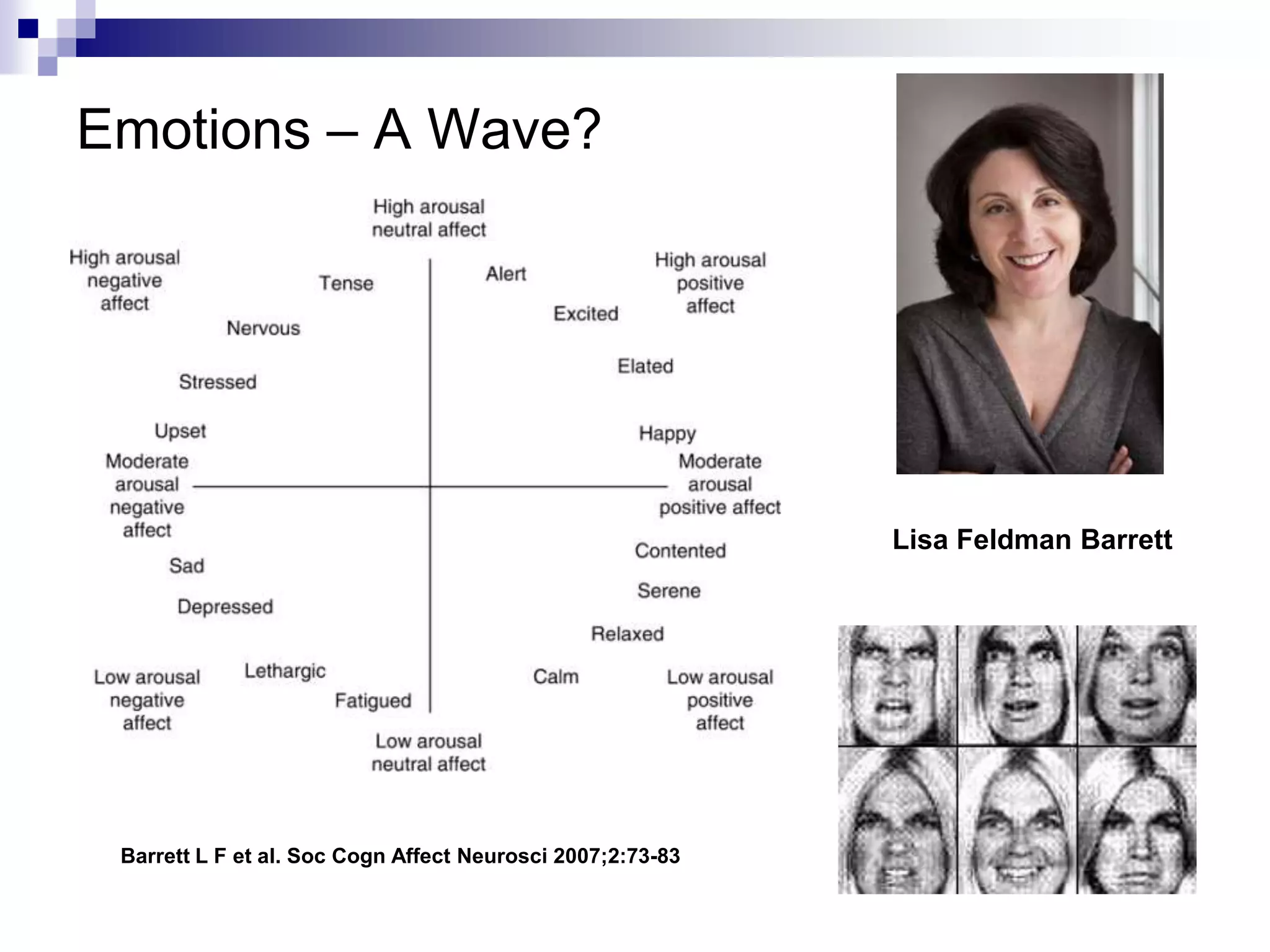
Emotions – A Wave?


                                                            Lisa Feldman Barrett


 Barrett L F et al. Soc Cogn Affect Neurosci 2007;2:73-83
Emotions- Awareness of Others

   We can’t really know what’s going on until we stop
    running and connect first with ourselves and then with
    others.

   Ordinary empathy is sympathizing with a friend.

   Intuitive empathy is the capacity to energetically merge
    with others and see life (positively and negatively)
    through their eyes, and sense the world through their
    feelings.                           Dr. J.Orloff, M.D. Second Sight

   It becomes difficult to distinguish these sensations from
    your own, sometimes throwing you off center.
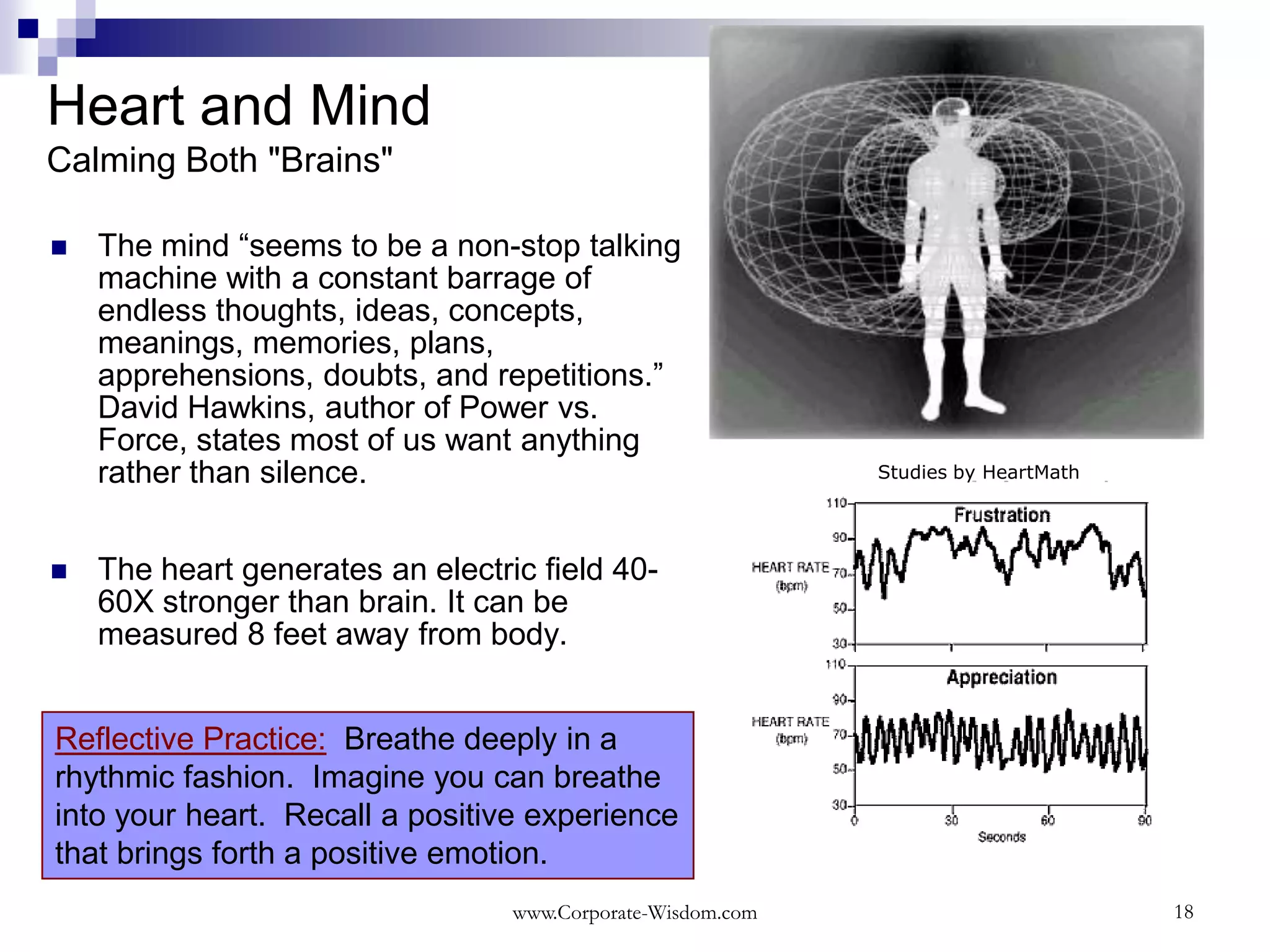
Heart and Mind
Calming Both "Brains"

   The mind “seems to be a non-stop talking
    machine with a constant barrage of
    endless thoughts, ideas, concepts,
    meanings, memories, plans,
    apprehensions, doubts, and repetitions.”
    David Hawkins, author of Power vs.
    Force, states most of us want anything
    rather than silence.                                     Studies by HeartMath


   The heart generates an electric field 40-
    60X stronger than brain. It can be
    measured 8 feet away from body.


Reflective Practice: Breathe deeply in a
rhythmic fashion. Imagine you can breathe
into your heart. Recall a positive experience
that brings forth a positive emotion.
                                  www.Corporate-Wisdom.com                          18
Using Intuition to Decide on a Course of Action

Think of a situation you are grappling with. Define the situation clearly.

Think of 2 possible solutions. Take a deep breath. Close your eyes. RELAX.

Imagine a jacket, and associate the jacket with one of the possible solutions to the
situation you are grappling with. How does the jacket fit? How does it feel?

Put on the second jacket. How does this one fit? Feel?

What is your intuition telling you?
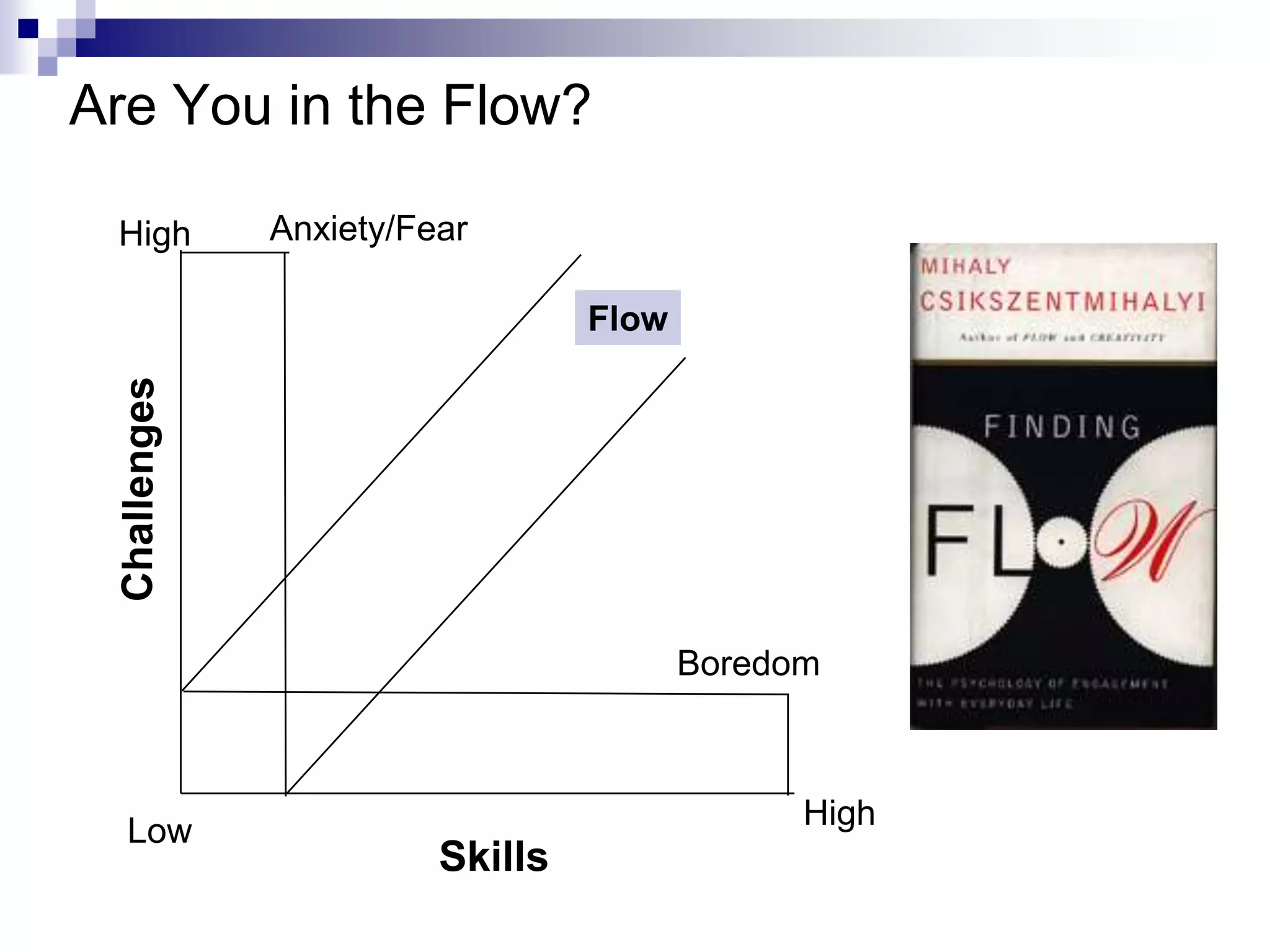
Are You in the Flow?

 High   Anxiety/Fear

                           Flow


                                  Boredom


                                        High
  Low
                  Skills
Follow the Flow
   Being at the right place at the
    right time. Knowing what is
    next.
   Being awake to possibilities
    without distraction.
   Having a clear question and
    trusting the “effortless flow.”


Quote by Oprah Winfrey: Find the flow and follow it. You can’t go
wrong. Even if you’re in a situation where you are uncomfortable or
out of place, don’t try to swim against the current. Change direction.
Find the flow and follow it.
Flow
   Alignment – Google “The
    Energy Project”
   Purpose is not something you
    do intellectually… It comes
    from the core of who you are
    and drives your success


    Intention: If I followed my deepest intuition I would…
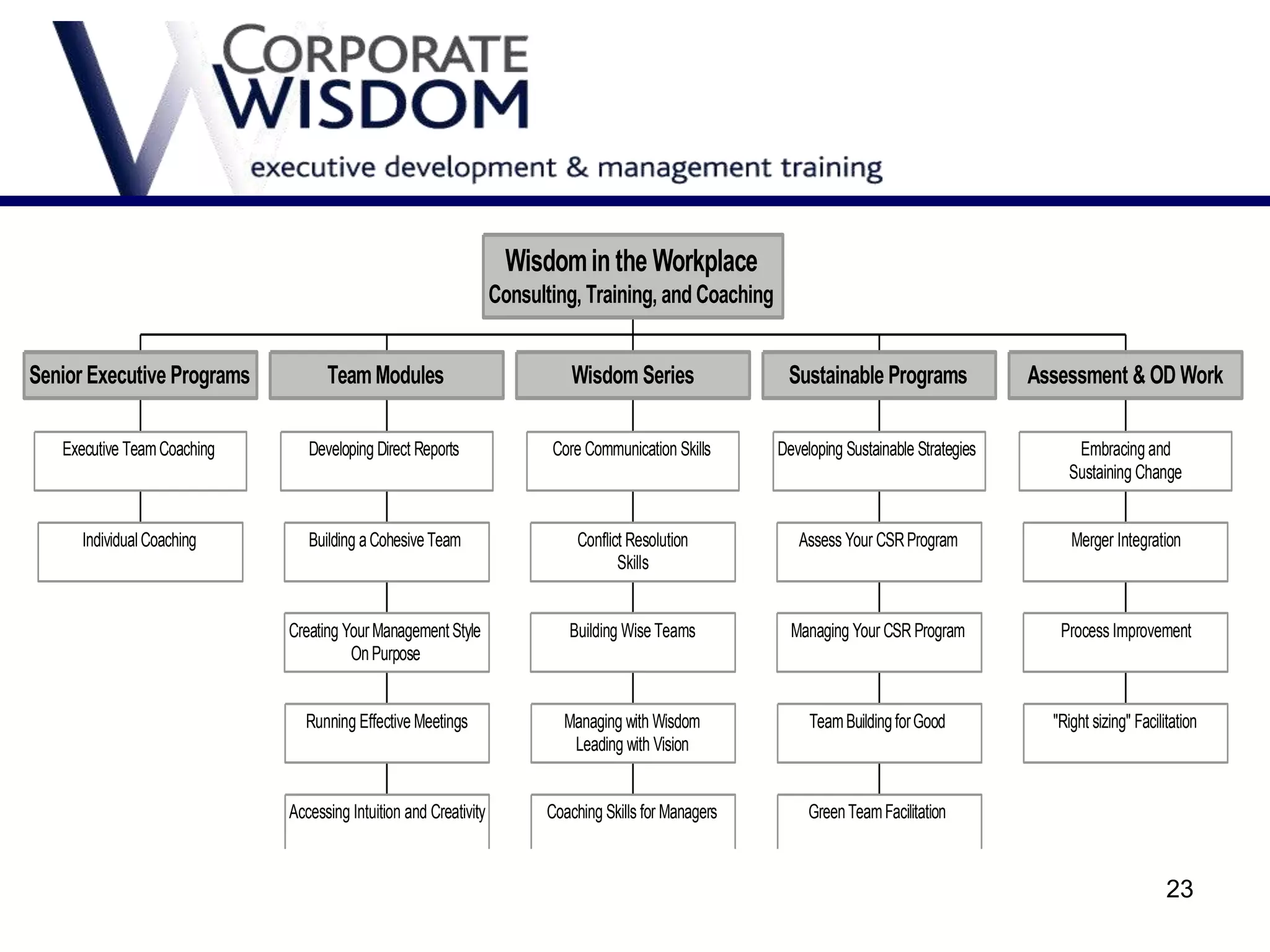
Wisdom in the Workplace
                                                                  Consulting, Training, and Coaching


Senior Executive Programs          Team Modules                             Wisdom Series               Sustainable Programs               Assessment & OD Work

   Executive Team Coaching      Developing Direct Reports                Core Communication Skills     Developing Sustainable Strategies        Embracing and
                                                                                                                                               Sustaining Change


      Individual Coaching       Building a Cohesive Team                     Conflict Resolution          Assess Your CSR Program               Merger Integration
                                                                                    Skills


                             Creating Your Management Style                Building Wise Teams           Managing Your CSR Program            Process Improvement
                                       On Purpose


                               Running Effective Meetings                  Managing with Wisdom             Team Building for Good           "Right sizing" Facilitation
                                                                            Leading with Vision


                             Accessing Intuition and Creativity         Coaching Skills for Managers        Green Team Facilitation


                                                                                                                                                                  23

Intuition: Leading Edge for You and Your Clients

  • 1.
    Intuition: Leading Edgefor You and Your Clients SBODN August 1, 2011 Rossella Derickson Rossella@Corporate-Wisdom.com www.Corporate-Wisdom.com
  • 2.
    Bio: Rossella Derickson,ICF Trained Coach Rossella Derickson, a biochemist, has 22 years experience leading sales, marketing, and project management teams with P&L responsibility. She is a founder and a principal in the company www.Corporate-Wisdom.com. Over the past 5 years, organizations with which she has worked include Cisco, Stanford University, Phoenix Technology, PARC, eGain, Formfactor, Morrison and Foester, Santa Clara County Executive Office, Applied BioSystems, Amgen, Kodak, and Hitachi. Rossella brings a centered style to help clients open up to deal with challenges. She brings clarity and problem solving approaches through tools learned through formal training and practical experience. Rossella has translated her experience into Wisdom in the Workplace training modules to support leadership and emotional intelligence development. She utilizes Kotter and Nadler change models, depending upon the organization’s need for vision or business alignment. She facilitates learning through webinar, video conferencing, telepresence and in person sessions. Rossella has launched customized off-sites and training for multinational companies in the U.S., Europe, and Asia. For 8 years, Rossella held the position of Director of the South Bay Organizational Development Network, SBODN.com – a forum for live and virtual events bringing thought leaders in OD, training, and coaching. Rossella holds a B.S. in Biochemistry from Rutgers University and is an ICF trained executive coach. She is a gifted intuitive, having studied at Esalen and Aikido with Robert Nadeau, a student of Aikido founder Morihei Ueshiba. Rossella is an author of "Awakening Social Responsibility, A Call to Action." 2
  • 3.
    When Do LeadersNeed Intuition? Ron Schultz, in Unconventional Wisdom, interviewed what he termed “twelve remarkable innovators.” In their own words, they explained how intuition can revolutionize decision-making. When is intuition most helpful to leaders?  when there is insufficient data, or not enough time to gather the data  when there is too much information, or the data is conflicting  when data seems to support several options equally
  • 4.
    Check-in: How intuitiveare you (on a good day or under pressure)? Intuition Defined - Comprehension without the use of reasoning. It sometimes comes in the form of symbols. Intuition is a “physical state.” Laura Day, author of Practical Intuition, states that the normal, waking cognitive “filters” are down. Then we use our rational mind to interpret the impression.
  • 5.
    Western - EasternConvergence Neural pathways Energy/ Life Force Brain Waves Consciousness Neurotransmitters Electromagnetic field
  • 6.
    How Does IntuitionManifest?  Mind perception - Ability to put all the information together without all the “facts,” quantum leap  Audio perception - Hearing the meta-messages when someone is speaking  Gut feeling - feeling in the body Exercise: Ancient Chinese divination tool: • Think of a dilemma. • Toss the coin. • What is your body/gut response?
  • 7.
    Gamma Insight Effect Insight Alpha Insight Effect  The aha moment–when an answer pops into our head seemingly out of the blue. happens in a small fold of tissue on the surface of the right hemisphere called the anterior superior temporal gyrus.  It is taxing to the brain so occurs when the brain is relaxed through daydreaming, showering, gym http://groups.psych.northwestern.edu/mbeeman/documents/CurrentDirxns_Kounios-Beeman_2009.pdf
  • 8.
    Engaging Your Intuition Intuitionis goal directed. It’s activated by a question asked consciously or unconsciously.  Unconscious question: (For example) Why does It always seem like it is my fault when I argue with my boss? Intuitive information sometimes comes in the form of symbols. Exercise: Your eye will be drawn to see what you need to see; to know what you need to know…. Am I on the right track with my career? My intuition guides me …
  • 9.
    Developing Core Beliefs Unstructured Structured How do we lose our natural open and intuitive state?
  • 10.
    The Hijacking Brain  Threat vs. Reward- Much of our motivation driving social behavior is governed by an overarching organizing principle - to minimize Neuroscience Research threat and maximize reward. David Rock, www.neuroleadership.org
  • 11.
    Hijacking Thoughts How manyof your 168 hours were lost this week? Hrs / week Hrs / week Being better than _______ Telling untruths ______ Being not as good as _______ Thinking about revenge ______ Being pessimistic _______ Thinking of enemies ______ Judging yourself _______ Thinking of lost opportunities ______ Pleasing friends _______ Thinking of resentments ______ Pleasing people at work _______ Trying to control others ______ Pleasing your family _______ Thinking about how unfair Regretting old failures _______ things are ______ Replaying old hurts _______ Worrying about what Replaying conversations _______ might happen ______ Exercise: What thoughts hijack you and your intuition?
  • 12.
    Shifting Hijacking Thoughts Label and Reappraise Stress (Boss communicates harshly) Hijacking Thought Negative Belief Brain/PFC Spin Examples of Negative Beliefs: I always do it wrong. No one listens to me. I don't belong. Learned Defense Reaction (Speak up, Don’t speak up, etc) Coaching: I can do it right. I listen to myself. I belong.
  • 13.
    Get Out ofYour Story Label and Re-Appraise  Labeling  Discuss Naming the feelings that have occurred and looking What thoughts "spin" in your at them from a distance mind and distract you? often allows the brain to relax and to feel a sense of Label the feeling control and therefore calm. associated with the thought. See it from a distance.  Re-Appraisal Looking at a difficult or Or - reappraise and find a threatening situation and new interpretation of the redefining it's meaning high level disturbance . allows the threat to reduce and new neurotransmitters to connect to future states Neuroscience Research that are more positive. David Rock, www.neuroleadership.org
  • 14.
    The Mind Set to Engage Intuition Being Curious Open Calm
  • 15.
    Mastering Your Mind Richard J. Davidson A Buddhist monk is fitted with electrodes in Richard Vilas Professor of Psychology and Davidson’s neuroscience lab. His best-known work Psychiatry Ph.D. 1976, Harvard University focuses on neuroplasticity, the capacity of the brain University of Wisconsin, Director, to develop and change throughout life, something Laboratory for Affective Neuroscience Western science once thought impossible. Director, Waisman Laboratory for Brain Imaging & Behavior
  • 16.
    Emotions – AWave? Lisa Feldman Barrett Barrett L F et al. Soc Cogn Affect Neurosci 2007;2:73-83
  • 17.
    Emotions- Awareness ofOthers  We can’t really know what’s going on until we stop running and connect first with ourselves and then with others.  Ordinary empathy is sympathizing with a friend.  Intuitive empathy is the capacity to energetically merge with others and see life (positively and negatively) through their eyes, and sense the world through their feelings. Dr. J.Orloff, M.D. Second Sight  It becomes difficult to distinguish these sensations from your own, sometimes throwing you off center.
  • 18.
    Heart and Mind CalmingBoth "Brains"  The mind “seems to be a non-stop talking machine with a constant barrage of endless thoughts, ideas, concepts, meanings, memories, plans, apprehensions, doubts, and repetitions.” David Hawkins, author of Power vs. Force, states most of us want anything rather than silence. Studies by HeartMath  The heart generates an electric field 40- 60X stronger than brain. It can be measured 8 feet away from body. Reflective Practice: Breathe deeply in a rhythmic fashion. Imagine you can breathe into your heart. Recall a positive experience that brings forth a positive emotion. www.Corporate-Wisdom.com 18
  • 19.
    Using Intuition toDecide on a Course of Action Think of a situation you are grappling with. Define the situation clearly. Think of 2 possible solutions. Take a deep breath. Close your eyes. RELAX. Imagine a jacket, and associate the jacket with one of the possible solutions to the situation you are grappling with. How does the jacket fit? How does it feel? Put on the second jacket. How does this one fit? Feel? What is your intuition telling you?
  • 20.
    Are You inthe Flow? High Anxiety/Fear Flow Boredom High Low Skills
  • 21.
    Follow the Flow  Being at the right place at the right time. Knowing what is next.  Being awake to possibilities without distraction.  Having a clear question and trusting the “effortless flow.” Quote by Oprah Winfrey: Find the flow and follow it. You can’t go wrong. Even if you’re in a situation where you are uncomfortable or out of place, don’t try to swim against the current. Change direction. Find the flow and follow it.
  • 22.
    Flow  Alignment – Google “The Energy Project”  Purpose is not something you do intellectually… It comes from the core of who you are and drives your success Intention: If I followed my deepest intuition I would…
  • 23.
    Wisdom in theWorkplace Consulting, Training, and Coaching Senior Executive Programs Team Modules Wisdom Series Sustainable Programs Assessment & OD Work Executive Team Coaching Developing Direct Reports Core Communication Skills Developing Sustainable Strategies Embracing and Sustaining Change Individual Coaching Building a Cohesive Team Conflict Resolution Assess Your CSR Program Merger Integration Skills Creating Your Management Style Building Wise Teams Managing Your CSR Program Process Improvement On Purpose Running Effective Meetings Managing with Wisdom Team Building for Good "Right sizing" Facilitation Leading with Vision Accessing Intuition and Creativity Coaching Skills for Managers Green Team Facilitation 23