Copyright 2021, JAIST Naoshi Uchihira.
AHFE HSSE 2021
Session 243: Creating Value in Teams, Organizations, Communities, and Societies II
Dialogue Tool for Value Creation
in Digital Transformation:
Roadmapping for Machine Learning Applications
1
July 29, 2021 15:00-16:30
Naoshi Uchihira
Japan Advanced Institute of Science
& Technology
uchihira@jaist.ac.jp
12 minutes
presentation
2
Outline
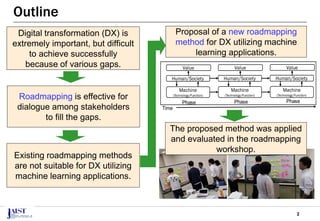
Digital transformation (DX) is
extremely important, but difficult
to achieve successfully
because of various gaps.
Roadmapping is effective for
dialogue among stakeholders
to fill the gaps.
Existing roadmapping methods
are not suitable for DX utilizing
machine learning applications.
Proposal of a new roadmapping
method for DX utilizing machine
learning applications.
Machine
(Technology/Function)
Human/Society
Value
Machine
(Technology/Function)
Human/Society
Value
Machine
(Technology/Function)
Human/Society
Value
Phase
Time
Phase Phase
The proposed method was applied
and evaluated in the roadmapping
workshop.
3
Digital Transformation
Chances
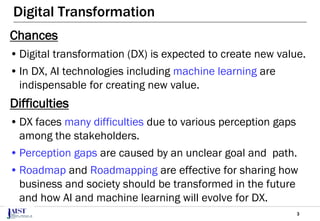
•Digital transformation (DX) is expected to create new value.
•In DX, AI technologies including machine learning are
indispensable for creating new value.
Difficulties
•DX faces many difficulties due to various perception gaps
among the stakeholders.
•Perception gaps are caused by an unclear goal and path.
•Roadmap and Roadmapping are effective for sharing how
business and society should be transformed in the future
and how AI and machine learning will evolve for DX.
4
Technology & Product/Service Roadmap
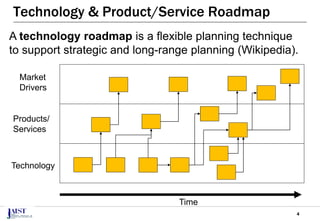
Technology
Products/
Services
Market
Drivers
Time
A technology roadmap is a flexible planning technique
to support strategic and long-range planning (Wikipedia).
5
Roadmapping as a Dialogue Tool
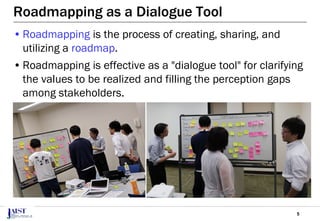
•Roadmapping is the process of creating, sharing, and
utilizing a roadmap.
•Roadmapping is effective as a "dialogue tool" for clarifying
the values to be realized and filling the perception gaps
among stakeholders.
6
Traditional Roadmapping
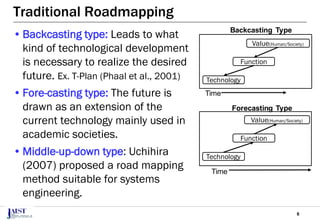
•Backcasting type: Leads to what
kind of technological development
is necessary to realize the desired
future. Ex. T-Plan (Phaal et al., 2001)
•Fore-casting type: The future is
drawn as an extension of the
current technology mainly used in
academic societies.
•Middle-up-down type: Uchihira
(2007) proposed a road mapping
method suitable for systems
engineering.
Backcasting Type
Technology
Function
Value(Human/Society)
Time
Forecasting Type
Technology
Function
Value(Human/Society)
Time
7
Roadmapping for Machine Learning Application Systems
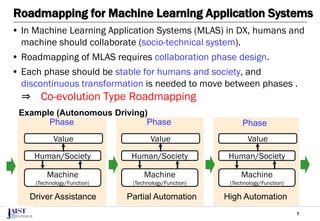
• In Machine Learning Application Systems (MLAS) in DX, humans and
machine should collaborate (socio-technical system).
• Roadmapping of MLAS requires collaboration phase design.
• Each phase should be stable for humans and society, and
discontinuous transformation is needed to move between phases .
⇒ Co-evolution Type Roadmapping
Example (Autonomous Driving)
Machine
(Technology/Function)
Human/Society
Value
Driver Assistance
Machine
(Technology/Function)
Human/Society
Value
Partial Automation
Machine
(Technology/Function)
Human/Society
Value
High Automation
Phase Phase Phase
8
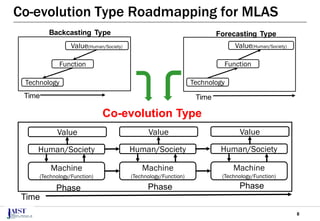
Co-evolution Type Roadmapping for MLAS
Co-evolution Type
Machine
(Technology/Function)
Human/Society
Value
Machine
(Technology/Function)
Human/Society
Value
Machine
(Technology/Function)
Human/Society
Value
Phase
Time
Phase Phase
Backcasting Type
Technology
Function
Value(Human/Society)
Time
Forecasting Type
Technology
Function
Value(Human/Society)
Time
9
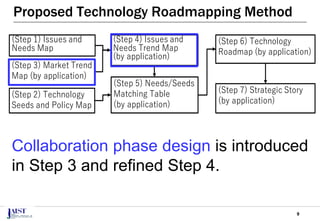
Proposed Technology Roadmapping Method
Collaboration phase design is introduced
in Step 3 and refined Step 4.
(Step 1) Issues and
Needs Map
(Step 2) Technology
Seeds and Policy Map
(Step 3) Market Trend
Map (by application)
(Step 4) Issues and
Needs Trend Map
(by application)
(Step 7) Strategic Story
(by application)
(Step 6) Technology
Roadmap (by application)
(Step 5) Needs/Seeds
Matching Table
(by application)
10
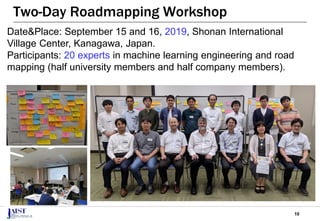
Two-Day Roadmapping Workshop
Date&Place: September 15 and 16, 2019, Shonan International
Village Center, Kanagawa, Japan.
Participants: 20 experts in machine learning engineering and road
mapping (half university members and half company members).
11
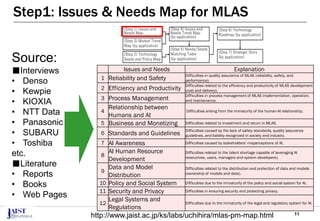
Step1: Issues & Needs Map for MLAS
Source:
■Interviews
• Denso
• Kewpie
• KIOXIA
• NTT Data
• Panasonic
• SUBARU
• Toshiba
etc.
■Literature
• Reports
• Books
• Web Pages
http://www.jaist.ac.jp/ks/labs/uchihira/mlas-pm-map.html
Issues and Needs Explanation
1 Reliability and Safety
Difficulties in quality assurance of MLAS (reliability, safety, and
performance).
2 Efficiency and Productivity
Difficulties related to the efficiency and productivity of MLAS development
(cost and delivery).
3 Process Management
Difficulties in process management of MLAS implementation, operation,
and maintenance.
4
Relationship between
Humans and AI
Difficulties arising from the immaturity of the human-AI relationship.
5 Business and Monetizing Difficulties related to investment and return in MLAS.
6 Standards and Guidelines
Difficulties caused by the lack of safety standards, quality assurance
guidelines, and liability recognized in society and industry.
7 AI Awareness Difficulties caused by stakeholders' misperceptions of AI.
8
AI Human Resource
Development
Difficulties related to the talent shortage capable of leveraging AI
(executives, users, managers and system developers).
9
Data and Model
Distribution
Difficulties related to the distribution and protection of data and models
(ownership of models and data).
10 Policy and Social System Difficulties due to the immaturity of the policy and social system for AI.
11 Security and Privacy Difficulties in ensuring security and protecting privacy.
12
Legal Systems and
Regulations
Difficulties due to the immaturity of the legal and regulatory system for AI.
(Step 1) Issues and
Needs Map
(Step 2) Technology
Seeds and Policy Map
(Step 3) Market Trend
Map (by application)
(Step 4) Issues and
Needs Trend Map
(by application)
(Step 7) Strategic Story
(by application)
(Step 6) Technology
Roadmap (by application)
(Step 5) Needs/Seeds
Matching Table
(by application)
12
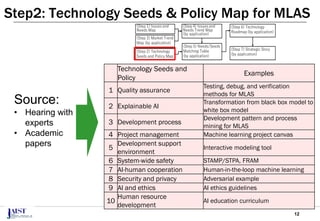
Step2: Technology Seeds & Policy Map for MLAS
Technology Seeds and
Policy
Examples
1 Quality assurance
Testing, debug, and verification
methods for MLAS
2 Explainable AI
Transformation from black box model to
white box model
3 Development process
Development pattern and process
mining for MLAS
4 Project management Machine learning project canvas
5
Development support
environment
Interactive modeling tool
6 System-wide safety STAMP/STPA, FRAM
7 AI-human cooperation Human-in-the-loop machine learning
8 Security and privacy Adversarial example
9 AI and ethics AI ethics guidelines
10
Human resource
development
AI education curriculum
Source:
• Hearing with
experts
• Academic
papers
(Step 1) Issues and
Needs Map
(Step 2) Technology
Seeds and Policy Map
(Step 3) Market Trend
Map (by application)
(Step 4) Issues and
Needs Trend Map
(by application)
(Step 7) Strategic Story
(by application)
(Step 6) Technology
Roadmap (by application)
(Step 5) Needs/Seeds
Matching Table
(by application)
13
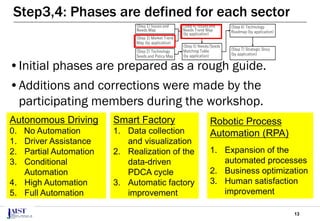
Step3,4: Phases are defined for each sector
•Initial phases are prepared as a rough guide.
•Additions and corrections were made by the
participating members during the workshop.
Autonomous Driving
0. No Automation
1. Driver Assistance
2. Partial Automation
3. Conditional
Automation
4. High Automation
5. Full Automation
Smart Factory
1. Data collection
and visualization
2. Realization of the
data-driven
PDCA cycle
3. Automatic factory
improvement
Robotic Process
Automation (RPA)
1. Expansion of the
automated processes
2. Business optimization
3. Human satisfaction
improvement
(Step 1) Issues and
Needs Map
(Step 2) Technology
Seeds and Policy Map
(Step 3) Market Trend
Map (by application)
(Step 4) Issues and
Needs Trend Map
(by application)
(Step 7) Strategic Story
(by application)
(Step 6) Technology
Roadmap (by application)
(Step 5) Needs/Seeds
Matching Table
(by application)
14
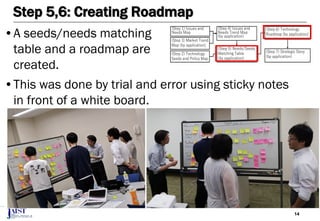
Step 5,6: Creating Roadmap
•A seeds/needs matching
table and a roadmap are
created.
•This was done by trial and error using sticky notes
in front of a white board.
(Step 1) Issues and
Needs Map
(Step 2) Technology
Seeds and Policy Map
(Step 3) Market Trend
Map (by application)
(Step 4) Issues and
Needs Trend Map
(by application)
(Step 7) Strategic Story
(by application)
(Step 6) Technology
Roadmap (by application)
(Step 5) Needs/Seeds
Matching Table
(by application)
15
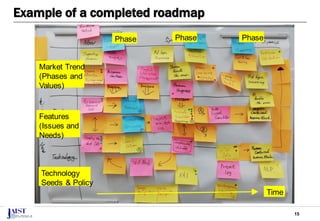
Example of a completed roadmap
Market Trend
(Phases and
Values)
Technology
Seeds & Policy
Features
(Issues and
Needs)
Phase Phase Phase
Time
16
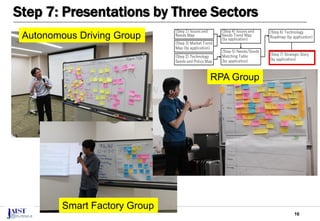
Step 7: Presentations by Three Sectors
Smart Factory Group
Autonomous Driving Group
RPA Group
(Step 1) Issues and
Needs Map
(Step 2) Technology
Seeds and Policy Map
(Step 3) Market Trend
Map (by application)
(Step 4) Issues and
Needs Trend Map
(by application)
(Step 7) Strategic Story
(by application)
(Step 6) Technology
Roadmap (by application)
(Step 5) Needs/Seeds
Matching Table
(by application)
17
Evaluation and Discussion (1)
Roadmapping as Dialogue Tool
The workshop functioned to promote the mutual
understanding and constructive discussions between
university researchers and company engineers, as
well as between engineers from different companies.
(Questionnaire Survey after Workshop)
“Roadmapping seems to be widely used in business,” “I
want to use it for my company's business planning,” “it was
helpful to understand how to grasp uncertainty,” and “the
three-layer structure of market trend, feature, and
technology is easy to understand.”
18
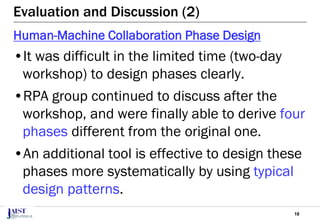
Evaluation and Discussion (2)
Human-Machine Collaboration Phase Design
•It was difficult in the limited time (two-day
workshop) to design phases clearly.
•RPA group continued to discuss after the
workshop, and were finally able to derive four
phases different from the original one.
•An additional tool is effective to design these
phases more systematically by using typical
design patterns.
19
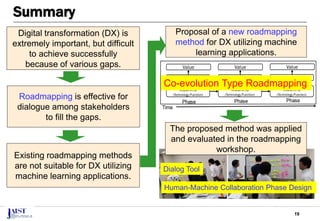
Summary
Digital transformation (DX) is
extremely important, but difficult
to achieve successfully
because of various gaps.
Roadmapping is effective for
dialogue among stakeholders
to fill the gaps.
Existing roadmapping methods
are not suitable for DX utilizing
machine learning applications.
Proposal of a new roadmapping
method for DX utilizing machine
learning applications.
Machine
(Technology/Function)
Human/Society
Value
Machine
(Technology/Function)
Human/Society
Value
Machine
(Technology/Function)
Human/Society
Value
Phase
Time
Phase Phase
The proposed method was applied
and evaluated in the roadmapping
workshop.
Co-evolution Type Roadmapping
Human-Machine Collaboration Phase Design
Dialog Tool
20
Thank you for your attention.
Japan Advanced Institute of
Science & Technology

Dialogue Tool for Value Creation in Digital Transformation: Roadmapping for Machine Learning Applications

  • 1.
    Copyright 2021, JAISTNaoshi Uchihira. AHFE HSSE 2021 Session 243: Creating Value in Teams, Organizations, Communities, and Societies II Dialogue Tool for Value Creation in Digital Transformation: Roadmapping for Machine Learning Applications 1 July 29, 2021 15:00-16:30 Naoshi Uchihira Japan Advanced Institute of Science & Technology uchihira@jaist.ac.jp 12 minutes presentation
  • 2.
    2 Outline Digital transformation (DX)is extremely important, but difficult to achieve successfully because of various gaps. Roadmapping is effective for dialogue among stakeholders to fill the gaps. Existing roadmapping methods are not suitable for DX utilizing machine learning applications. Proposal of a new roadmapping method for DX utilizing machine learning applications. Machine (Technology/Function) Human/Society Value Machine (Technology/Function) Human/Society Value Machine (Technology/Function) Human/Society Value Phase Time Phase Phase The proposed method was applied and evaluated in the roadmapping workshop.
  • 3.
    3 Digital Transformation Chances •Digital transformation(DX) is expected to create new value. •In DX, AI technologies including machine learning are indispensable for creating new value. Difficulties •DX faces many difficulties due to various perception gaps among the stakeholders. •Perception gaps are caused by an unclear goal and path. •Roadmap and Roadmapping are effective for sharing how business and society should be transformed in the future and how AI and machine learning will evolve for DX.
  • 4.
    4 Technology & Product/ServiceRoadmap Technology Products/ Services Market Drivers Time A technology roadmap is a flexible planning technique to support strategic and long-range planning (Wikipedia).
  • 5.
    5 Roadmapping as aDialogue Tool •Roadmapping is the process of creating, sharing, and utilizing a roadmap. •Roadmapping is effective as a "dialogue tool" for clarifying the values to be realized and filling the perception gaps among stakeholders.
  • 6.
    6 Traditional Roadmapping •Backcasting type:Leads to what kind of technological development is necessary to realize the desired future. Ex. T-Plan (Phaal et al., 2001) •Fore-casting type: The future is drawn as an extension of the current technology mainly used in academic societies. •Middle-up-down type: Uchihira (2007) proposed a road mapping method suitable for systems engineering. Backcasting Type Technology Function Value(Human/Society) Time Forecasting Type Technology Function Value(Human/Society) Time
  • 7.
    7 Roadmapping for MachineLearning Application Systems • In Machine Learning Application Systems (MLAS) in DX, humans and machine should collaborate (socio-technical system). • Roadmapping of MLAS requires collaboration phase design. • Each phase should be stable for humans and society, and discontinuous transformation is needed to move between phases . ⇒ Co-evolution Type Roadmapping Example (Autonomous Driving) Machine (Technology/Function) Human/Society Value Driver Assistance Machine (Technology/Function) Human/Society Value Partial Automation Machine (Technology/Function) Human/Society Value High Automation Phase Phase Phase
  • 8.
    8 Co-evolution Type Roadmappingfor MLAS Co-evolution Type Machine (Technology/Function) Human/Society Value Machine (Technology/Function) Human/Society Value Machine (Technology/Function) Human/Society Value Phase Time Phase Phase Backcasting Type Technology Function Value(Human/Society) Time Forecasting Type Technology Function Value(Human/Society) Time
  • 9.
    9 Proposed Technology RoadmappingMethod Collaboration phase design is introduced in Step 3 and refined Step 4. (Step 1) Issues and Needs Map (Step 2) Technology Seeds and Policy Map (Step 3) Market Trend Map (by application) (Step 4) Issues and Needs Trend Map (by application) (Step 7) Strategic Story (by application) (Step 6) Technology Roadmap (by application) (Step 5) Needs/Seeds Matching Table (by application)
  • 10.
    10 Two-Day Roadmapping Workshop Date&Place:September 15 and 16, 2019, Shonan International Village Center, Kanagawa, Japan. Participants: 20 experts in machine learning engineering and road mapping (half university members and half company members).
  • 11.
    11 Step1: Issues &Needs Map for MLAS Source: ■Interviews • Denso • Kewpie • KIOXIA • NTT Data • Panasonic • SUBARU • Toshiba etc. ■Literature • Reports • Books • Web Pages http://www.jaist.ac.jp/ks/labs/uchihira/mlas-pm-map.html Issues and Needs Explanation 1 Reliability and Safety Difficulties in quality assurance of MLAS (reliability, safety, and performance). 2 Efficiency and Productivity Difficulties related to the efficiency and productivity of MLAS development (cost and delivery). 3 Process Management Difficulties in process management of MLAS implementation, operation, and maintenance. 4 Relationship between Humans and AI Difficulties arising from the immaturity of the human-AI relationship. 5 Business and Monetizing Difficulties related to investment and return in MLAS. 6 Standards and Guidelines Difficulties caused by the lack of safety standards, quality assurance guidelines, and liability recognized in society and industry. 7 AI Awareness Difficulties caused by stakeholders' misperceptions of AI. 8 AI Human Resource Development Difficulties related to the talent shortage capable of leveraging AI (executives, users, managers and system developers). 9 Data and Model Distribution Difficulties related to the distribution and protection of data and models (ownership of models and data). 10 Policy and Social System Difficulties due to the immaturity of the policy and social system for AI. 11 Security and Privacy Difficulties in ensuring security and protecting privacy. 12 Legal Systems and Regulations Difficulties due to the immaturity of the legal and regulatory system for AI. (Step 1) Issues and Needs Map (Step 2) Technology Seeds and Policy Map (Step 3) Market Trend Map (by application) (Step 4) Issues and Needs Trend Map (by application) (Step 7) Strategic Story (by application) (Step 6) Technology Roadmap (by application) (Step 5) Needs/Seeds Matching Table (by application)
  • 12.
    12 Step2: Technology Seeds& Policy Map for MLAS Technology Seeds and Policy Examples 1 Quality assurance Testing, debug, and verification methods for MLAS 2 Explainable AI Transformation from black box model to white box model 3 Development process Development pattern and process mining for MLAS 4 Project management Machine learning project canvas 5 Development support environment Interactive modeling tool 6 System-wide safety STAMP/STPA, FRAM 7 AI-human cooperation Human-in-the-loop machine learning 8 Security and privacy Adversarial example 9 AI and ethics AI ethics guidelines 10 Human resource development AI education curriculum Source: • Hearing with experts • Academic papers (Step 1) Issues and Needs Map (Step 2) Technology Seeds and Policy Map (Step 3) Market Trend Map (by application) (Step 4) Issues and Needs Trend Map (by application) (Step 7) Strategic Story (by application) (Step 6) Technology Roadmap (by application) (Step 5) Needs/Seeds Matching Table (by application)
  • 13.
    13 Step3,4: Phases aredefined for each sector •Initial phases are prepared as a rough guide. •Additions and corrections were made by the participating members during the workshop. Autonomous Driving 0. No Automation 1. Driver Assistance 2. Partial Automation 3. Conditional Automation 4. High Automation 5. Full Automation Smart Factory 1. Data collection and visualization 2. Realization of the data-driven PDCA cycle 3. Automatic factory improvement Robotic Process Automation (RPA) 1. Expansion of the automated processes 2. Business optimization 3. Human satisfaction improvement (Step 1) Issues and Needs Map (Step 2) Technology Seeds and Policy Map (Step 3) Market Trend Map (by application) (Step 4) Issues and Needs Trend Map (by application) (Step 7) Strategic Story (by application) (Step 6) Technology Roadmap (by application) (Step 5) Needs/Seeds Matching Table (by application)
  • 14.
    14 Step 5,6: CreatingRoadmap •A seeds/needs matching table and a roadmap are created. •This was done by trial and error using sticky notes in front of a white board. (Step 1) Issues and Needs Map (Step 2) Technology Seeds and Policy Map (Step 3) Market Trend Map (by application) (Step 4) Issues and Needs Trend Map (by application) (Step 7) Strategic Story (by application) (Step 6) Technology Roadmap (by application) (Step 5) Needs/Seeds Matching Table (by application)
  • 15.
    15 Example of acompleted roadmap Market Trend (Phases and Values) Technology Seeds & Policy Features (Issues and Needs) Phase Phase Phase Time
  • 16.
    16 Step 7: Presentationsby Three Sectors Smart Factory Group Autonomous Driving Group RPA Group (Step 1) Issues and Needs Map (Step 2) Technology Seeds and Policy Map (Step 3) Market Trend Map (by application) (Step 4) Issues and Needs Trend Map (by application) (Step 7) Strategic Story (by application) (Step 6) Technology Roadmap (by application) (Step 5) Needs/Seeds Matching Table (by application)
  • 17.
    17 Evaluation and Discussion(1) Roadmapping as Dialogue Tool The workshop functioned to promote the mutual understanding and constructive discussions between university researchers and company engineers, as well as between engineers from different companies. (Questionnaire Survey after Workshop) “Roadmapping seems to be widely used in business,” “I want to use it for my company's business planning,” “it was helpful to understand how to grasp uncertainty,” and “the three-layer structure of market trend, feature, and technology is easy to understand.”
  • 18.
    18 Evaluation and Discussion(2) Human-Machine Collaboration Phase Design •It was difficult in the limited time (two-day workshop) to design phases clearly. •RPA group continued to discuss after the workshop, and were finally able to derive four phases different from the original one. •An additional tool is effective to design these phases more systematically by using typical design patterns.
  • 19.
    19 Summary Digital transformation (DX)is extremely important, but difficult to achieve successfully because of various gaps. Roadmapping is effective for dialogue among stakeholders to fill the gaps. Existing roadmapping methods are not suitable for DX utilizing machine learning applications. Proposal of a new roadmapping method for DX utilizing machine learning applications. Machine (Technology/Function) Human/Society Value Machine (Technology/Function) Human/Society Value Machine (Technology/Function) Human/Society Value Phase Time Phase Phase The proposed method was applied and evaluated in the roadmapping workshop. Co-evolution Type Roadmapping Human-Machine Collaboration Phase Design Dialog Tool
  • 20.
    20 Thank you foryour attention. Japan Advanced Institute of Science & Technology