1
PAPER RESUME PRAGMATICS COURSE
“THE MENTAL PROCESS OF SPEECH COMPREHENSION”
Submitted
as a Partial Fulfillment of the Requirements
for Pragmatics Course at the English Education of Postgraduate Program
By
Eko Mulyono
S200140053
POSTGRADUATE PROGRAM OF LANGUAGE STUDIES
MUHAMMADIYAH UNIVERSITY OF SURAKARTA
ACADEMIC YEAR 2014/2015
2
1. Introduction
Speech comprehension is a complex mental process, which plays a
significant part in our English study. Mental process itself means the
process how human study langauge. Based on the psycholinguistics theory
and taken English as its researching language, this paper tries to find out
the mental processes of speech comprehension. In comprehending the
meaning of utterances we face the following problems: How humans can
understand a word, phrase, clause, sentence, or discourse they hear? Or
how comprehension can be formed? Although listeners are typically in a
position correctly to identify the distal sources of their acts of
comprehension, through perception of productions of speech, it appears
that they need not always be in that position. Descartes makes the
following observation about the role of speech perception in
comprehension:
Words, as you well know, bear no resemblance to the things they
sigify, and yet they make us think of those things, frequently even
without our paying attention to the sound of the words or to their
syllables. Thus it may happen that we hear an utterance whose
meaning we understand perfectly well, but afterwards we cannot
say in what language it was spoken. . .But perhaps you will say that
our ears really cause us to perceive only the sound of the
words...and that it is ourn mind which, recollecting what the
words...signify, represent their meanings to us at the same time.
(Descartes, 1664/1985: 79)
In comprehending speech sounds, listeners work like detectives who
try to find a situation where a given type of clue might have been left by
any a number of criminals or where a given criminals might have been left
any of a number of different types of clue. (Foodor, Bever, and Garret in
Aitchison, 1998: 206). This paper firstly discusses the theoretical
foundations of speech comprehension, then continue to discussion about
The Mental Process Parts of Speech Comprehension such as Inner
Structure and Visual Structure, Proposition, Constituents as Psychological
3
Reality, Strategies Comprehending a Speech, Ambiguity, and Storage
Memory.
2. Discussion
A. Theoretical Foundations of Speech Comprehension
Generally, comprehension refers to “the mental processes by which
listeners take in the sounds uttered by speaker and use them to construct an
interpretation of what the speaker intended to convey” ( Clark and Clark,
1977: 43). Mental process (cognitive) connects the sequence events that
take place from speaker language to the ear of listener understand. How
comprehension (meaning the formation of sound) in a sentence we speak.
From the standpoint of psycholinguistics, there are two kinds of
comprehension (Clark & Clark 1977), namely: 1) comprehension related
to the understanding of the speech we hear, 2) comprehension related to
the actions we need to do after the speech we hear. After having
comprehension about what speech have to be done by speaker, the listener
determine whether there are actions that need to be done in accordance
with what is understood. Comprehension, however, does not generally end
in interpretation. Listeners usually put the interpretations they have built to
work accordingly. All in all, listener usually try to figure out what they are
supposed to do with a speech addressed to them and do it accordingly.
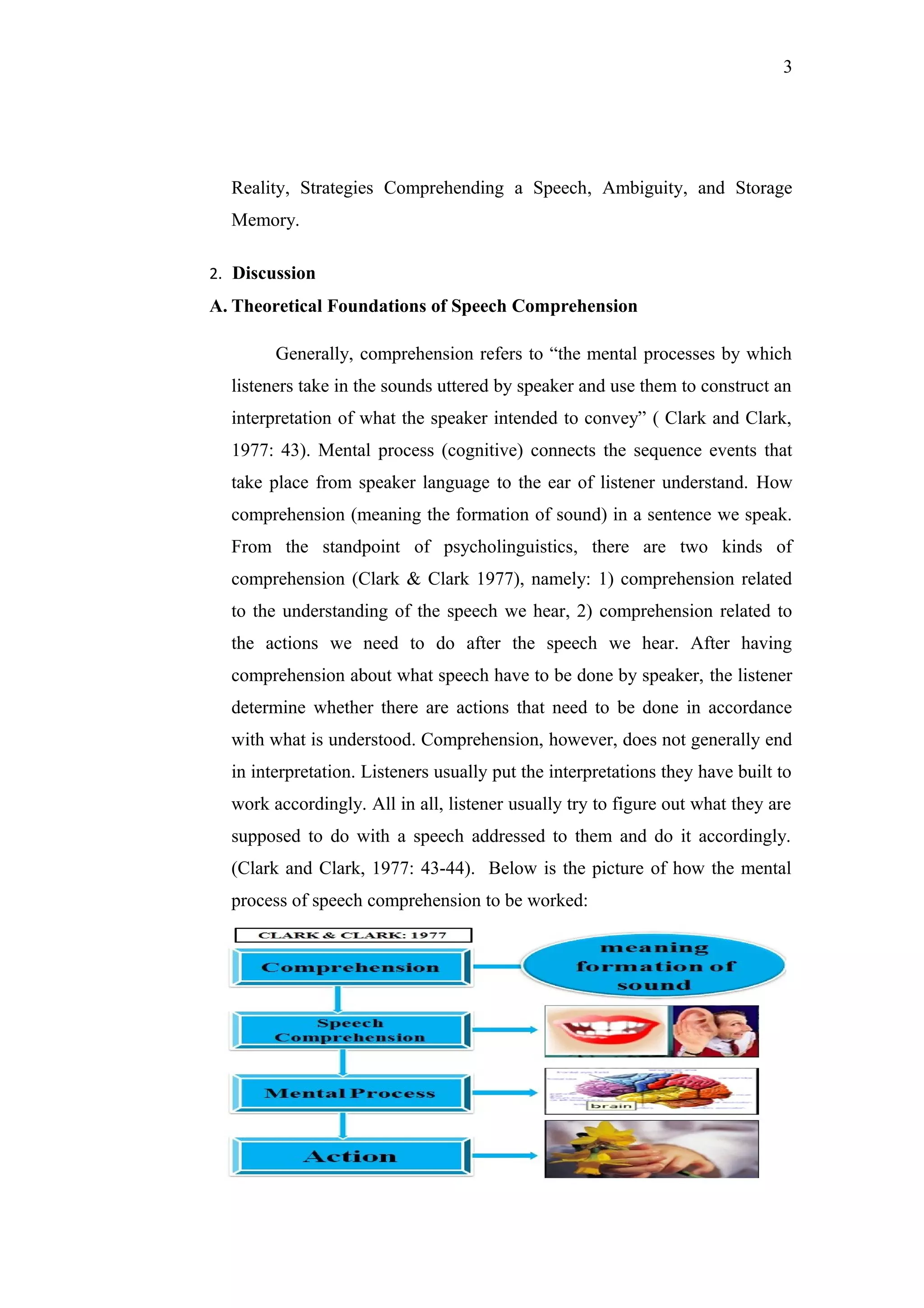
(Clark and Clark, 1977: 43-44). Below is the picture of how the mental
process of speech comprehension to be worked:
4
B. The Mental Process Parts of Speech Comprehension
Clark and Clark define comprehension itself as the mental process in
which the listener take the sound uttered by speaker and use it to interpret
what speaker have intended to convey. We usually take our ability to
comprehend speech.
To understand the meaning of an utterance (word, phrase, clause, sentence,
discourse), there are some basic things that we have known. These things
are as follows.
1) Inner Structure and Visual Structure
In many things of meaning of an utterance, can be understood from
the word that be in the words, or from the particular characteristics of each
word which used. Like in example:
(1) The old man still can play tennis
It can be understood from the sequence of the words that are heard or seen
by us. Whoever hear this sentence will give the same interpretation, that is,
there is a man, that old man, he from beginning until now play something,
and that something is tennis.
In the other case, it is not impossible that a sentence that seems simple has
a complex meaning. For example in this sentence:
(2) The man and the old woman still can play tennis
We are not sure that whether the man is also as old as the woman or
just the woman that old, and the man is not. This interpretation arises
5
because the adjective “old” can function as modifier of noun “woman”
only or the phrase of “man and woman”. If we use the tree diagram, the
phrase of man and old man will be different.
From the examples above it is appears that the meaning of a sentence
is not only determined by the surface of manifestation we hear or we see
but even primarily by underlying representation. In the other words, a
sentence is not only has the visual structure but also the inner structure.
2) Proposition
Proposition divided into two parts: (a) argument, that is the first things
discussed, and (b) predication, that is the statement made about the
argument. Because the argument can be “what” or “whoever”, and
predication also can be various, then the proposition is generally described
by formulate:
x {y,z} Which mean “the function of x on y and z”
Example : - The old clown stole my bike
Here, we have the following propositions:
a. someone stole the bike
b. someone is a clown
c. the clown is old
d. the bike is mine
e. time stating the past
Proposition
Argument Predication
6
Understanding about this proposition is very important for
comprehension because which we understand from a sentence is actually
those propositions – the fact that there is people, the people is clown, the
clown is old, the people stole the bike, the bike which stolen is mine, and
so on.
3) Constituents as Psychological Reality
In this section are discussed in detail is whether the right to the
distribution of sentence constituents have psychological reality or merely a
means by linguists to cut up a sentence? It turns out that the constituent is
not just cutting sentences that are arbitrator alone, but just a little mistake
in the word cuts will affect hearing and interfere with comprehension
because basically constituents have psychological foundation and powerful
syntax. It can take a look at the following three things;
1. Constituents is a conceptually coherent whole.
Example: The old Clown stole my bike.
Noun phrase in the old clown conceptual meaning intact because this
phrase can e replaced with other constituents which only consists of one
word, for example, Alex or her.
2. Cutting the group of words will affect our comprehension.
Example:
a. Rules / disease is indeed / difficult. The / students often less / can use
7
rules / this perfectly. rules / hardest / are custom rules. Differences / degree
of difficulty in / practice rules ....
b. The rules of this disease / is difficult //. The student / often less able to use
the / // this rule perfectly. Rule hardest / is / // custom rules. Differences in
the degree of difficulty / in practice the rules ....
3. stored in memory is not the words that regardless of the constituents, but
the unity of the meaning of each constituent. Example: The old Clown
stole my bike. Stored in memory we must clown with his aging attributes.
For bicycles, the ownership of the bike that will be kept, namely, that the
bike was mine.
4) Strategies Comprehending a Speech
The strategies used in comprehending speech, are:
1. Once we identify the first word of a constituent that we hear, the mental
process we will start looking for another word that is aligned with the first
word in the constituency. Example: if the first words we hear are people,
then we look for other words that could syntactically Air collocation with
the word, like the old, big, stupid, or that. Because the word is almost
always followed by something else to be a constituent.
2. After hearing the first word in a constituency, note whether the next
word end to the construction. If after the word came word, then we
conclude that the construction people are unlikely to form a constituent,
because word must form clause. So we expect the emergence of the clause
in order to be a good NP. For example, people are looking for you.
3. Once we hear a verb, look for the type of argument that is consistent
with the verb. If we hear the verb is a verb hit then we would expect the
presence of an argument, the object or creature in time. For example, he hit
the table.
8
5) Ambiguity
In these conversations sometimes we find sentences whose meaning is
more than one can be called ambiguous or equivocal
• Types of Ambiguity
a. Lexical ambiguity is ambiguity as lexical forms used.
b. Grammatical ambiguity is the ambiguity caused by the structure of the
sentence is used. In Indonesian when two noun phrases in a row as the
second noun describes the first noun.
• Theory of Ambiguity
The first theory is Garden Path Theory (GPT) according to Frazier theory
in Soenjono D. 1987: 2012, people construct meaning based on those
syntactic knowledge. We seem to walk in the garden through the trail, but
after knowing the way it wrong then we went back to look for another
way.
Another theory is the theory of the so-called Constraint Satisfaction
Theory. These theoretical models to follow the views of the correctionists
which states that the
initial processing units has a different associative.
• Non-Literal Sentence Processing
Metaphor is a word that expresses the equation something with something
else even though the two are not the same.
• Processing syntactically or Semantics
Our competence as a native syntax of our language is an intuitive
provision which leads us to accept, reject, doubt and ambiguity detect a
sentence. As native speakers, we also have a semantic intuition, both
universal and local.
6) Storage Memory
Here is the process of understanding the meaning of a word eg the
word pen.
9
a. First, we must find out whether the four sound is heard, / p / / e / / n / /
a /, is our language.
b. Secondly, we have to collect the features that are naturally attached to
the body, the physical form,
c. Third, we must compare with other objects that its features overlap with
the features of the word, eg pencil, chalk, markers, stabile and markers.
d. Fourth, choose between several objects which have all the requirements.
Furthermore, the process is done is a process of elimination: pencil fullfil
many requirements but not its physical form of ink, markers will also
fullfil many requirements, but the result is not the same writings.
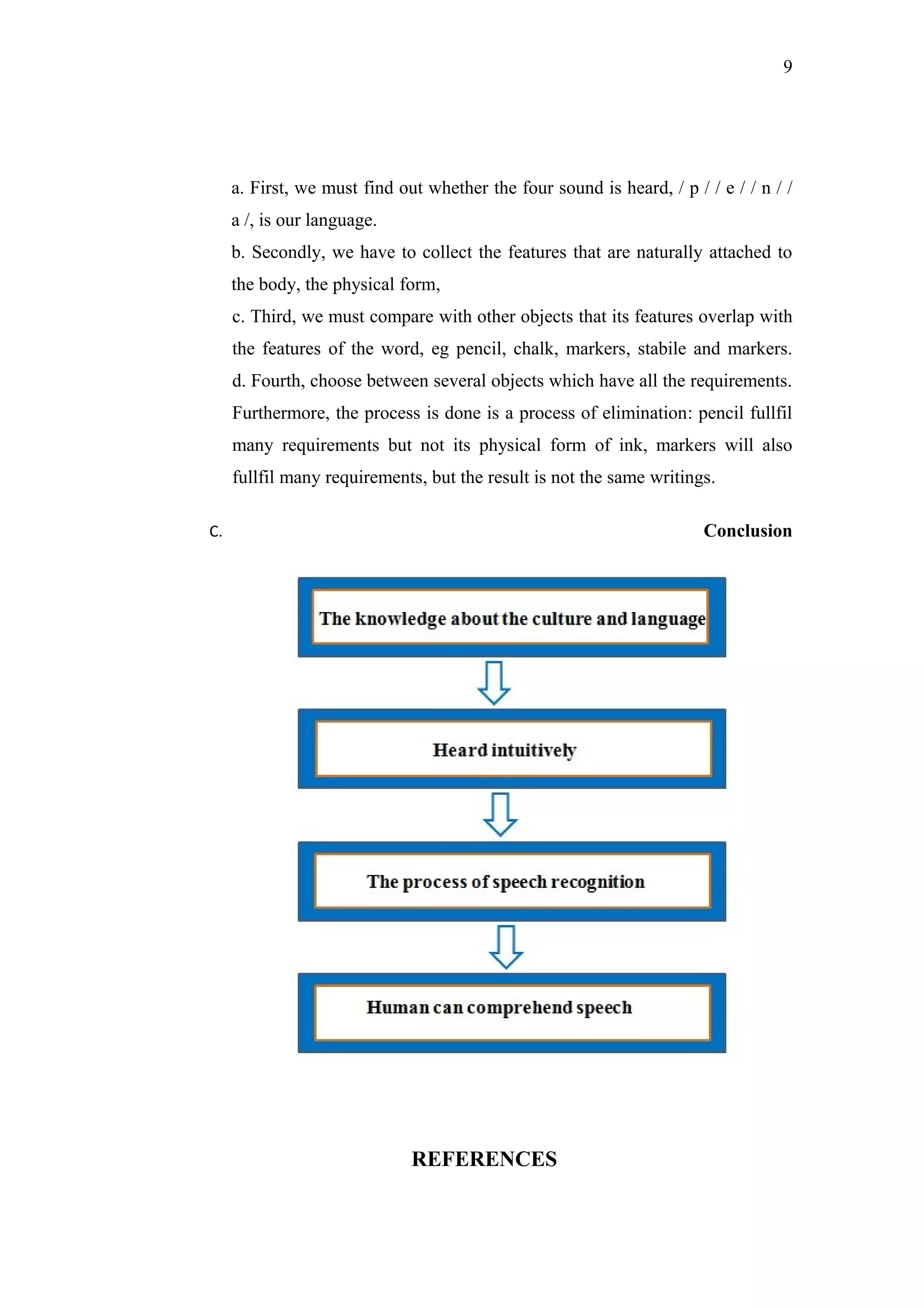
C. Conclusion
REFERENCES
10
Aitchison, Jean. 1998. The Articulate Mammal: an Introduction to
Psycholinguistics, London: Unwin Hima
Clark, Herbert H., Eve V. Clark. 1977. Psychology and Language: An
Introduction to Psycholinguistics. New York: Harcourt Brace
Jovanovich.Inc
Clark, Herbert H., Eve V. Clark. 1979. Psychology and Language: An
Introduction to Psycholinguistics. Lynn H. Waterhouse Language
Vol. 55, No. 436-439: Linguistic Society of America Article Stable
URL: http://www.jstor.org/stable/412600
Dardjowidjojo, Soenjono dan Unika Atma Jaya. 2012. PSIKOLINGUISTIK:
Pengantar Pemahaman Bahasa Manusia. Jakarta: Yayasan Obor
Indonesia.
Descartes, R. 1664/1985. ‘The World or Treatise on Light’, in J. Cottingham, R.
Stoothof, and D. Murdoch (trans. and eds.) The Philosophical
Writings of Descartes, vol. I, Cambridge: Cambridge University
Press: 79 98.
Fauziati, Endang. 2011. An Introduction Psycholinguistics. Surakarta: PT. Era
Pustaka Utama.
Retrieved from http://finaniswati.blogspot.com/2014/09/psikolinguistik-
pengertianmemahami.html, accessed on Saturday, 21th
March 2015
Retrieved from http://ikapunyatulisan.blogspot.com/2011/12/bagaimana-
manusia-memahami-ujaran.html, accessed on Saturday, 21th
March
2015
Retrieved from http://les-mana.blogspot.com/2013/11/bagaimana-manusia-
memahami-ujaran.html, accessed on Saturday, 21th
March 2015

The Mental Process of Speech Comprehension

  • 1.
    1 PAPER RESUME PRAGMATICSCOURSE “THE MENTAL PROCESS OF SPEECH COMPREHENSION” Submitted as a Partial Fulfillment of the Requirements for Pragmatics Course at the English Education of Postgraduate Program By Eko Mulyono S200140053 POSTGRADUATE PROGRAM OF LANGUAGE STUDIES MUHAMMADIYAH UNIVERSITY OF SURAKARTA ACADEMIC YEAR 2014/2015
  • 2.
    2 1. Introduction Speech comprehensionis a complex mental process, which plays a significant part in our English study. Mental process itself means the process how human study langauge. Based on the psycholinguistics theory and taken English as its researching language, this paper tries to find out the mental processes of speech comprehension. In comprehending the meaning of utterances we face the following problems: How humans can understand a word, phrase, clause, sentence, or discourse they hear? Or how comprehension can be formed? Although listeners are typically in a position correctly to identify the distal sources of their acts of comprehension, through perception of productions of speech, it appears that they need not always be in that position. Descartes makes the following observation about the role of speech perception in comprehension: Words, as you well know, bear no resemblance to the things they sigify, and yet they make us think of those things, frequently even without our paying attention to the sound of the words or to their syllables. Thus it may happen that we hear an utterance whose meaning we understand perfectly well, but afterwards we cannot say in what language it was spoken. . .But perhaps you will say that our ears really cause us to perceive only the sound of the words...and that it is ourn mind which, recollecting what the words...signify, represent their meanings to us at the same time. (Descartes, 1664/1985: 79) In comprehending speech sounds, listeners work like detectives who try to find a situation where a given type of clue might have been left by any a number of criminals or where a given criminals might have been left any of a number of different types of clue. (Foodor, Bever, and Garret in Aitchison, 1998: 206). This paper firstly discusses the theoretical foundations of speech comprehension, then continue to discussion about The Mental Process Parts of Speech Comprehension such as Inner Structure and Visual Structure, Proposition, Constituents as Psychological
  • 3.
    3 Reality, Strategies Comprehendinga Speech, Ambiguity, and Storage Memory. 2. Discussion A. Theoretical Foundations of Speech Comprehension Generally, comprehension refers to “the mental processes by which listeners take in the sounds uttered by speaker and use them to construct an interpretation of what the speaker intended to convey” ( Clark and Clark, 1977: 43). Mental process (cognitive) connects the sequence events that take place from speaker language to the ear of listener understand. How comprehension (meaning the formation of sound) in a sentence we speak. From the standpoint of psycholinguistics, there are two kinds of comprehension (Clark & Clark 1977), namely: 1) comprehension related to the understanding of the speech we hear, 2) comprehension related to the actions we need to do after the speech we hear. After having comprehension about what speech have to be done by speaker, the listener determine whether there are actions that need to be done in accordance with what is understood. Comprehension, however, does not generally end in interpretation. Listeners usually put the interpretations they have built to work accordingly. All in all, listener usually try to figure out what they are supposed to do with a speech addressed to them and do it accordingly. (Clark and Clark, 1977: 43-44). Below is the picture of how the mental process of speech comprehension to be worked:
  • 4.
    4 B. The MentalProcess Parts of Speech Comprehension Clark and Clark define comprehension itself as the mental process in which the listener take the sound uttered by speaker and use it to interpret what speaker have intended to convey. We usually take our ability to comprehend speech. To understand the meaning of an utterance (word, phrase, clause, sentence, discourse), there are some basic things that we have known. These things are as follows. 1) Inner Structure and Visual Structure In many things of meaning of an utterance, can be understood from the word that be in the words, or from the particular characteristics of each word which used. Like in example: (1) The old man still can play tennis It can be understood from the sequence of the words that are heard or seen by us. Whoever hear this sentence will give the same interpretation, that is, there is a man, that old man, he from beginning until now play something, and that something is tennis. In the other case, it is not impossible that a sentence that seems simple has a complex meaning. For example in this sentence: (2) The man and the old woman still can play tennis We are not sure that whether the man is also as old as the woman or just the woman that old, and the man is not. This interpretation arises
  • 5.
    5 because the adjective“old” can function as modifier of noun “woman” only or the phrase of “man and woman”. If we use the tree diagram, the phrase of man and old man will be different. From the examples above it is appears that the meaning of a sentence is not only determined by the surface of manifestation we hear or we see but even primarily by underlying representation. In the other words, a sentence is not only has the visual structure but also the inner structure. 2) Proposition Proposition divided into two parts: (a) argument, that is the first things discussed, and (b) predication, that is the statement made about the argument. Because the argument can be “what” or “whoever”, and predication also can be various, then the proposition is generally described by formulate: x {y,z} Which mean “the function of x on y and z” Example : - The old clown stole my bike Here, we have the following propositions: a. someone stole the bike b. someone is a clown c. the clown is old d. the bike is mine e. time stating the past Proposition Argument Predication
  • 6.
    6 Understanding about thisproposition is very important for comprehension because which we understand from a sentence is actually those propositions – the fact that there is people, the people is clown, the clown is old, the people stole the bike, the bike which stolen is mine, and so on. 3) Constituents as Psychological Reality In this section are discussed in detail is whether the right to the distribution of sentence constituents have psychological reality or merely a means by linguists to cut up a sentence? It turns out that the constituent is not just cutting sentences that are arbitrator alone, but just a little mistake in the word cuts will affect hearing and interfere with comprehension because basically constituents have psychological foundation and powerful syntax. It can take a look at the following three things; 1. Constituents is a conceptually coherent whole. Example: The old Clown stole my bike. Noun phrase in the old clown conceptual meaning intact because this phrase can e replaced with other constituents which only consists of one word, for example, Alex or her. 2. Cutting the group of words will affect our comprehension. Example: a. Rules / disease is indeed / difficult. The / students often less / can use
  • 7.
    7 rules / thisperfectly. rules / hardest / are custom rules. Differences / degree of difficulty in / practice rules .... b. The rules of this disease / is difficult //. The student / often less able to use the / // this rule perfectly. Rule hardest / is / // custom rules. Differences in the degree of difficulty / in practice the rules .... 3. stored in memory is not the words that regardless of the constituents, but the unity of the meaning of each constituent. Example: The old Clown stole my bike. Stored in memory we must clown with his aging attributes. For bicycles, the ownership of the bike that will be kept, namely, that the bike was mine. 4) Strategies Comprehending a Speech The strategies used in comprehending speech, are: 1. Once we identify the first word of a constituent that we hear, the mental process we will start looking for another word that is aligned with the first word in the constituency. Example: if the first words we hear are people, then we look for other words that could syntactically Air collocation with the word, like the old, big, stupid, or that. Because the word is almost always followed by something else to be a constituent. 2. After hearing the first word in a constituency, note whether the next word end to the construction. If after the word came word, then we conclude that the construction people are unlikely to form a constituent, because word must form clause. So we expect the emergence of the clause in order to be a good NP. For example, people are looking for you. 3. Once we hear a verb, look for the type of argument that is consistent with the verb. If we hear the verb is a verb hit then we would expect the presence of an argument, the object or creature in time. For example, he hit the table.
  • 8.
    8 5) Ambiguity In theseconversations sometimes we find sentences whose meaning is more than one can be called ambiguous or equivocal • Types of Ambiguity a. Lexical ambiguity is ambiguity as lexical forms used. b. Grammatical ambiguity is the ambiguity caused by the structure of the sentence is used. In Indonesian when two noun phrases in a row as the second noun describes the first noun. • Theory of Ambiguity The first theory is Garden Path Theory (GPT) according to Frazier theory in Soenjono D. 1987: 2012, people construct meaning based on those syntactic knowledge. We seem to walk in the garden through the trail, but after knowing the way it wrong then we went back to look for another way. Another theory is the theory of the so-called Constraint Satisfaction Theory. These theoretical models to follow the views of the correctionists which states that the initial processing units has a different associative. • Non-Literal Sentence Processing Metaphor is a word that expresses the equation something with something else even though the two are not the same. • Processing syntactically or Semantics Our competence as a native syntax of our language is an intuitive provision which leads us to accept, reject, doubt and ambiguity detect a sentence. As native speakers, we also have a semantic intuition, both universal and local. 6) Storage Memory Here is the process of understanding the meaning of a word eg the word pen.
  • 9.
    9 a. First, wemust find out whether the four sound is heard, / p / / e / / n / / a /, is our language. b. Secondly, we have to collect the features that are naturally attached to the body, the physical form, c. Third, we must compare with other objects that its features overlap with the features of the word, eg pencil, chalk, markers, stabile and markers. d. Fourth, choose between several objects which have all the requirements. Furthermore, the process is done is a process of elimination: pencil fullfil many requirements but not its physical form of ink, markers will also fullfil many requirements, but the result is not the same writings. C. Conclusion REFERENCES
  • 10.
    10 Aitchison, Jean. 1998.The Articulate Mammal: an Introduction to Psycholinguistics, London: Unwin Hima Clark, Herbert H., Eve V. Clark. 1977. Psychology and Language: An Introduction to Psycholinguistics. New York: Harcourt Brace Jovanovich.Inc Clark, Herbert H., Eve V. Clark. 1979. Psychology and Language: An Introduction to Psycholinguistics. Lynn H. Waterhouse Language Vol. 55, No. 436-439: Linguistic Society of America Article Stable URL: http://www.jstor.org/stable/412600 Dardjowidjojo, Soenjono dan Unika Atma Jaya. 2012. PSIKOLINGUISTIK: Pengantar Pemahaman Bahasa Manusia. Jakarta: Yayasan Obor Indonesia. Descartes, R. 1664/1985. ‘The World or Treatise on Light’, in J. Cottingham, R. Stoothof, and D. Murdoch (trans. and eds.) The Philosophical Writings of Descartes, vol. I, Cambridge: Cambridge University Press: 79 98. Fauziati, Endang. 2011. An Introduction Psycholinguistics. Surakarta: PT. Era Pustaka Utama. Retrieved from http://finaniswati.blogspot.com/2014/09/psikolinguistik- pengertianmemahami.html, accessed on Saturday, 21th March 2015 Retrieved from http://ikapunyatulisan.blogspot.com/2011/12/bagaimana- manusia-memahami-ujaran.html, accessed on Saturday, 21th March 2015 Retrieved from http://les-mana.blogspot.com/2013/11/bagaimana-manusia- memahami-ujaran.html, accessed on Saturday, 21th March 2015