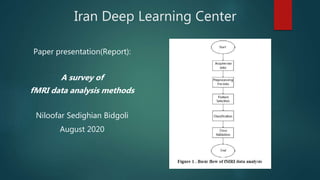
Iran Deep Learning Center
Paper presentation(Report):
A survey of
fMRI data analysis methods
Niloofar Sedighian Bidgoli
August 2020
What was covered:
 Functional magnetic resonance imaging (fMRI) data:
 is used to observe genuine or task induced brain activity networks
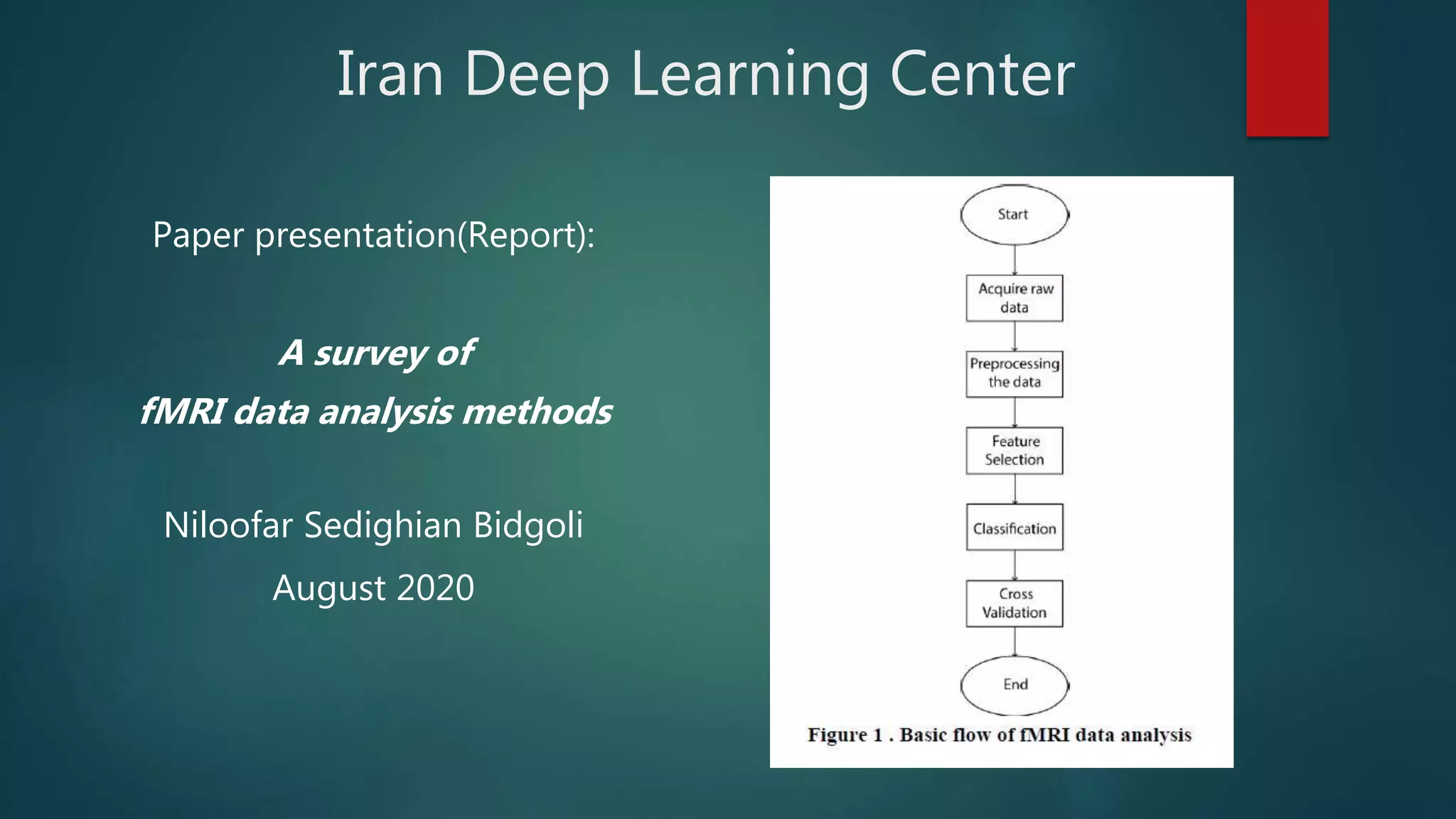
 The output of an fMRI scan is a series of raw images, meaning they contain errors
 Hence, some preprocessing on the data is required
 Realignment
 Coregistration
 Segmentation and Normalization
 Smoothing
 The concept of RESTING STATE FMRI
 The hypothesis is that task induced activation maps underestimate the size and number of
functionally connected areas
What was covered:
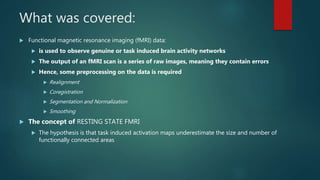
 DATA ANALYSIS TECHNIQUES
 Confirmatory: Problem > Data > Modeling > Analysis > Conclusion
 Exploratory: Problem > Data > Analysis > Modeling > Conclusion
 Bayesian: Problem > Data > Modeling > Prior Distribution > Analysis > Conclusion
 IMPORTANT PARAMETERS IN FMRI EXPERIMENTS
 Number of subjects
 Number of sessions per subject
 Repetition time
 Number of slices per subject
 FUNCTIONAL MRI DATA ANALYSIS TOOLS:
 FSL
 SPM
What was covered:
 FEATURE EXTRACTION METHODS: It is difficult to identify which fluctuations are related to
the brain activity
 blind signal separation methods such as ICA and PCA
 For fMRI data, spatial ICA (sICA)
 But before, temporal dimension of the data set may be optionally reduced using PCA
 Region of Interest (ROI) analysis
 Spectral clustering
 FISHER’S TRANSFORMATION
 In fMRI, the connectivity between ROIs is obtained using a Pearson’s correlation coefficient to get a
set of correlation matrices which then needs to be converted using Fisher transformation
 And last, machine learning phase

Paper presentation report

  • 1.
    Iran Deep LearningCenter Paper presentation(Report): A survey of fMRI data analysis methods Niloofar Sedighian Bidgoli August 2020
  • 2.
    What was covered: Functional magnetic resonance imaging (fMRI) data:  is used to observe genuine or task induced brain activity networks  The output of an fMRI scan is a series of raw images, meaning they contain errors  Hence, some preprocessing on the data is required  Realignment  Coregistration  Segmentation and Normalization  Smoothing  The concept of RESTING STATE FMRI  The hypothesis is that task induced activation maps underestimate the size and number of functionally connected areas
  • 3.
    What was covered: DATA ANALYSIS TECHNIQUES  Confirmatory: Problem > Data > Modeling > Analysis > Conclusion  Exploratory: Problem > Data > Analysis > Modeling > Conclusion  Bayesian: Problem > Data > Modeling > Prior Distribution > Analysis > Conclusion  IMPORTANT PARAMETERS IN FMRI EXPERIMENTS  Number of subjects  Number of sessions per subject  Repetition time  Number of slices per subject  FUNCTIONAL MRI DATA ANALYSIS TOOLS:  FSL  SPM
  • 4.
    What was covered: FEATURE EXTRACTION METHODS: It is difficult to identify which fluctuations are related to the brain activity  blind signal separation methods such as ICA and PCA  For fMRI data, spatial ICA (sICA)  But before, temporal dimension of the data set may be optionally reduced using PCA  Region of Interest (ROI) analysis  Spectral clustering  FISHER’S TRANSFORMATION  In fMRI, the connectivity between ROIs is obtained using a Pearson’s correlation coefficient to get a set of correlation matrices which then needs to be converted using Fisher transformation  And last, machine learning phase