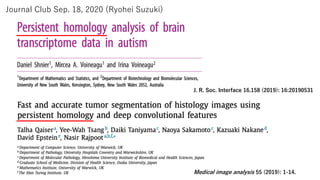
Journal Club Sep. 18, 2020 (Ryohei Suzuki)
J. R. Soc. Interface 16.158 (2019): 16:20190531
Medical image analysis 55 (2019): 1-14.
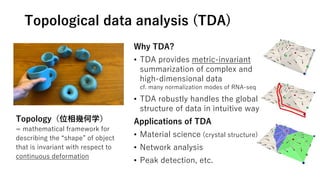
Topological data analysis (TDA)
Why TDA?
• TDA provides metric-invariant
summarization of complex and
high-dimensional data
cf. many normalization modes of RNA-seq
• TDA robustly handles the global
structure of data in intuitive way
Applications of TDA
• Material science (crystal structure)
• Network analysis
• Peak detection, etc.
Topology(位相幾何学)
= mathematical framework for
describing the “shape” of object
that is invariant with respect to
continuous deformation
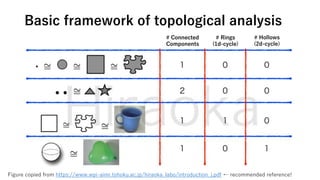
Basic framework of topological analysis
Figure copied from https://www.wpi-aimr.tohoku.ac.jp/hiraoka_labo/introduction_j.pdf ← recommended reference!
# Connected
Components
# Rings
(1d-cycle)
# Hollows
(2d-cycle)
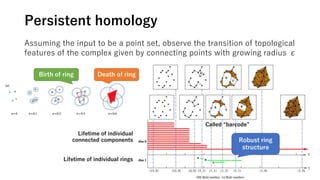
Persistent homology
Assuming the input to be a point set, observe the transition of topological
features of the complex given by connecting points with growing radius ε
Lifetime of individual
connected components
Lifetime of individual rings
Robust ring
structure
Called “barcode”
Birth of ring Death of ring
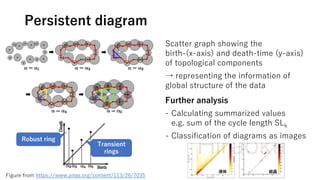
Persistent diagram
Scatter graph showing the
birth-(x-axis) and death-time (y-axis)
of topological components
→ representing the information of
global structure of the data
Further analysis
- Calculating summarized values
e.g. sum of the cycle length SLk
- Classification of diagrams as images
Figure from https://www.pnas.org/content/113/26/7035
Robust ring
Transient
rings
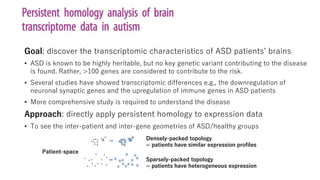
Goal: discover the transcriptomic characteristics of ASD patients’ brains
• ASD is known to be highly heritable, but no key genetic variant contributing to the disease
is found. Rather, >100 genes are considered to contribute to the risk.
• Several studies have showed transcriptomic differences e.g., the downregulation of
neuronal synaptic genes and the upregulation of immune genes in ASD patients
• More comprehensive study is required to understand the disease
Approach: directly apply persistent homology to expression data
• To see the inter-patient and inter-gene geometries of ASD/healthy groups
Patient-space
Densely-packed topology
= patients have similar expression profiles
Sparsely-packed topology
= patients have heterogeneous expression
Dataset and study overview
Datasets
• Dataset 1: microarray (9934 genes, 29 ASD / 29 control) [1], log2-transformed
• Dataset 2: RNA-seq (22399 genes, 82 ASD / 82 control) [2], RPKM & log2-transformed
Procedure
• Calculate the inter-sample and inter-gene
distance matrices for ASD/control expression
• Dissimilarity measure: 1-r (r=Pearson correlation)
• Compute the persistent diagrams
• Derive the summary values
• SDT0
= sum of death times of connected components.
• Euler characteristics = SL0 – SL1 + SL2
※SLk is sum of lifespan of connected components (k=0), rings (k=1), hollows (k=2).
[1] Voineagu et al., (2011) Nature 474, 380-384 [2] Parikshak et al., (2016) Nature 540, 423-427
Sample 1 Sample 2 Sample 3
Gene 1 0.01 0.52 …
Gene 2 0.25
Gene 3 …
Inter-sample
Inter-gene
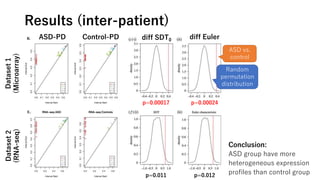
Results (inter-patient)
Dataset1
(Microarray)
Dataset2
(RNA-seq)
ASD-PD Control-PD diff SDT0 diff Euler
Random
permutation
distribution
ASD vs.
control
p=0.00017 p=0.00024
p=0.011 p=0.012
Conclusion:
ASD group have more
heterogeneous expression
profiles than control group
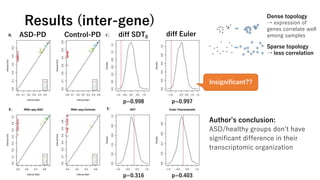
Results (inter-gene)
p=0.316 p=0.403
p=0.998 p=0.997
ASD-PD Control-PD diff SDT0 diff Euler
Author’s conclusion:
ASD/healthy groups don’t have
significant difference in their
transcriptomic organization
Insignificant??
Dense topology
→ expression of
genes correlate well
among samples
Sparse topology
→ less correlation
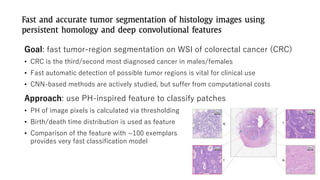
Goal: fast tumor-region segmentation on WSI of colorectal cancer (CRC)
• CRC is the third/second most diagnosed cancer in males/females
• Fast automatic detection of possible tumor regions is vital for clinical use
• CNN-based methods are actively studied, but suffer from computational costs
Approach: use PH-inspired feature to classify patches
• PH of image pixels is calculated via thresholding
• Birth/death time distribution is used as feature
• Comparison of the feature with ~100 exemplars
provides very fast classification model
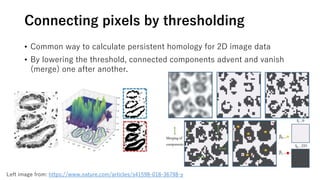
Connecting pixels by thresholding
• Common way to calculate persistent homology for 2D image data
• By lowering the threshold, connected components advent and vanish
(merge) one after another.
Left image from: https://www.nature.com/articles/s41598-018-36798-y
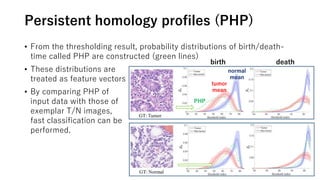
Persistent homology profiles (PHP)
• From the thresholding result, probability distributions of birth/death-
time called PHP are constructed (green lines)
• These distributions are
treated as feature vectors
• By comparing PHP of
input data with those of
exemplar T/N images,
fast classification can be
performed.
birth death
tumor
mean
normal
mean
PHP
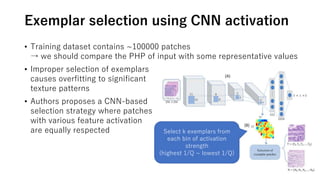
Exemplar selection using CNN activation
• Training dataset contains ~100000 patches
→ we should compare the PHP of input with some representative values
• Improper selection of exemplars
causes overfitting to significant
texture patterns
• Authors proposes a CNN-based
selection strategy where patches
with various feature activation
are equally respected Select k exemplars from
each bin of activation
strength
(highest 1/Q ~ lowest 1/Q)
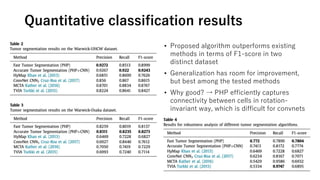
Quantitative classification results
• Proposed algorithm outperforms existing
methods in terms of F1-score in two
distinct dataset
• Generalization has room for improvement,
but best among the tested methods
• Why good? → PHP efficiently captures
connectivity between cells in rotation-
invariant way, which is difficult for convnets
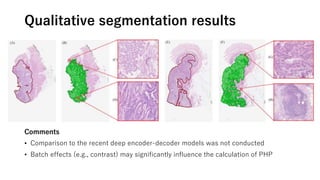
Qualitative segmentation results
Comments
• Comparison to the recent deep encoder-decoder models was not conducted
• Batch effects (e.g., contrast) may significantly influence the calculation of PHP
Reflection
• (+) Persistent homology provides unique information about the global
structure of the dataset, which is difficult to calculate in raw-data space,
which would be useful for very high-dimensional data with large noise
• (-) Persistent homology only provides highly summarized statistics,
discarding the information about contributions of individual data points,
e.g., which gene set is contributing in ASD patients.
• Combination with CNNs, which perform very good at discovering local
features, seems to be a promising idea for image analysis.

Paper memo: persistent homology on biological problems

  • 1.
    Journal Club Sep.18, 2020 (Ryohei Suzuki) J. R. Soc. Interface 16.158 (2019): 16:20190531 Medical image analysis 55 (2019): 1-14.
  • 2.
    Topological data analysis(TDA) Why TDA? • TDA provides metric-invariant summarization of complex and high-dimensional data cf. many normalization modes of RNA-seq • TDA robustly handles the global structure of data in intuitive way Applications of TDA • Material science (crystal structure) • Network analysis • Peak detection, etc. Topology(位相幾何学) = mathematical framework for describing the “shape” of object that is invariant with respect to continuous deformation
  • 3.
    Basic framework oftopological analysis Figure copied from https://www.wpi-aimr.tohoku.ac.jp/hiraoka_labo/introduction_j.pdf ← recommended reference! # Connected Components # Rings (1d-cycle) # Hollows (2d-cycle)
  • 4.
    Persistent homology Assuming theinput to be a point set, observe the transition of topological features of the complex given by connecting points with growing radius ε Lifetime of individual connected components Lifetime of individual rings Robust ring structure Called “barcode” Birth of ring Death of ring
  • 5.
    Persistent diagram Scatter graphshowing the birth-(x-axis) and death-time (y-axis) of topological components → representing the information of global structure of the data Further analysis - Calculating summarized values e.g. sum of the cycle length SLk - Classification of diagrams as images Figure from https://www.pnas.org/content/113/26/7035 Robust ring Transient rings
  • 6.
    Goal: discover thetranscriptomic characteristics of ASD patients’ brains • ASD is known to be highly heritable, but no key genetic variant contributing to the disease is found. Rather, >100 genes are considered to contribute to the risk. • Several studies have showed transcriptomic differences e.g., the downregulation of neuronal synaptic genes and the upregulation of immune genes in ASD patients • More comprehensive study is required to understand the disease Approach: directly apply persistent homology to expression data • To see the inter-patient and inter-gene geometries of ASD/healthy groups Patient-space Densely-packed topology = patients have similar expression profiles Sparsely-packed topology = patients have heterogeneous expression
  • 7.
    Dataset and studyoverview Datasets • Dataset 1: microarray (9934 genes, 29 ASD / 29 control) [1], log2-transformed • Dataset 2: RNA-seq (22399 genes, 82 ASD / 82 control) [2], RPKM & log2-transformed Procedure • Calculate the inter-sample and inter-gene distance matrices for ASD/control expression • Dissimilarity measure: 1-r (r=Pearson correlation) • Compute the persistent diagrams • Derive the summary values • SDT0 = sum of death times of connected components. • Euler characteristics = SL0 – SL1 + SL2 ※SLk is sum of lifespan of connected components (k=0), rings (k=1), hollows (k=2). [1] Voineagu et al., (2011) Nature 474, 380-384 [2] Parikshak et al., (2016) Nature 540, 423-427 Sample 1 Sample 2 Sample 3 Gene 1 0.01 0.52 … Gene 2 0.25 Gene 3 … Inter-sample Inter-gene
  • 8.
    Results (inter-patient) Dataset1 (Microarray) Dataset2 (RNA-seq) ASD-PD Control-PDdiff SDT0 diff Euler Random permutation distribution ASD vs. control p=0.00017 p=0.00024 p=0.011 p=0.012 Conclusion: ASD group have more heterogeneous expression profiles than control group
  • 9.
    Results (inter-gene) p=0.316 p=0.403 p=0.998p=0.997 ASD-PD Control-PD diff SDT0 diff Euler Author’s conclusion: ASD/healthy groups don’t have significant difference in their transcriptomic organization Insignificant?? Dense topology → expression of genes correlate well among samples Sparse topology → less correlation
  • 10.
    Goal: fast tumor-regionsegmentation on WSI of colorectal cancer (CRC) • CRC is the third/second most diagnosed cancer in males/females • Fast automatic detection of possible tumor regions is vital for clinical use • CNN-based methods are actively studied, but suffer from computational costs Approach: use PH-inspired feature to classify patches • PH of image pixels is calculated via thresholding • Birth/death time distribution is used as feature • Comparison of the feature with ~100 exemplars provides very fast classification model
  • 11.
    Connecting pixels bythresholding • Common way to calculate persistent homology for 2D image data • By lowering the threshold, connected components advent and vanish (merge) one after another. Left image from: https://www.nature.com/articles/s41598-018-36798-y
  • 12.
    Persistent homology profiles(PHP) • From the thresholding result, probability distributions of birth/death- time called PHP are constructed (green lines) • These distributions are treated as feature vectors • By comparing PHP of input data with those of exemplar T/N images, fast classification can be performed. birth death tumor mean normal mean PHP
  • 13.
    Exemplar selection usingCNN activation • Training dataset contains ~100000 patches → we should compare the PHP of input with some representative values • Improper selection of exemplars causes overfitting to significant texture patterns • Authors proposes a CNN-based selection strategy where patches with various feature activation are equally respected Select k exemplars from each bin of activation strength (highest 1/Q ~ lowest 1/Q)
  • 14.
    Quantitative classification results •Proposed algorithm outperforms existing methods in terms of F1-score in two distinct dataset • Generalization has room for improvement, but best among the tested methods • Why good? → PHP efficiently captures connectivity between cells in rotation- invariant way, which is difficult for convnets
  • 15.
    Qualitative segmentation results Comments •Comparison to the recent deep encoder-decoder models was not conducted • Batch effects (e.g., contrast) may significantly influence the calculation of PHP
  • 16.
    Reflection • (+) Persistenthomology provides unique information about the global structure of the dataset, which is difficult to calculate in raw-data space, which would be useful for very high-dimensional data with large noise • (-) Persistent homology only provides highly summarized statistics, discarding the information about contributions of individual data points, e.g., which gene set is contributing in ASD patients. • Combination with CNNs, which perform very good at discovering local features, seems to be a promising idea for image analysis.