PANORAMA
360
THE INSURANCE AND WEALTH
MANAGEMENT
TARGET MARKET AND PRODUCT
DEVELOPMENT METHODOLOGY
Version 3.0
THE DEFINITIVE REFERENCE FOR MANAGING INSURANCE AND WEALTH MANAGEMENT
TARGET MARKET AND PRODUCT DEVELOPMENT.
Panorama 360 - Target Market and Product Development Methodology
1
©Copyright – All rights reserved.
Panorama 360 is distributed and published by Insurance Frameworks Inc.
(www.InsuranceFrameworks.com).
Formerly, Panorama 360 was called Vista.
©1997, 2002, 2011, 2017
Version 0.0 published 1997, version 1.0 published 2002, version 2.0 published 2011, version 3.0
published 2017.
ISBN-13: 978-1544251073
ISBN-10: 1544251076
Panorama 360 - Target Market and Product Development Methodology
2
Table of Contents
1. INTRODUCTION................................................................................................... 3
1.1 TARGET MARKET METHODOLOGY.................................................................................. 3
1.2 MAKING SENSE OF TARGET MARKETS.............................................................................. 5
1.3 TWELVE PRINCIPLES OF TARGET MARKET AND VALUE OFFERING INTRODUCTION.................... 6
2. METHODOLOGY OUTLINE.....................................................................................8
2.1 GENERAL .................................................................................................................... 8
2.2 FIVE STAGES OF TARGET MARKET / VALUE OFFERING EVOLUTION ....................................... 8
2.3 LIFE CYCLE................................................................................................................... 9
2.4 DELIVERABLES GROUPS AND DELIVERABLES ........................................................................
2.5 GATING & APPROVAL .....................................................................................................
3. DETAILS OF THE FIVE STAGES OF EVOLUTION .....................................................12
3.1 OUTLINE .......................................................................................................................
3.2 OPPORTUNITY ASSESSMENT.............................................................................................
3.3 ENGINEERING ................................................................................................................
3.4 DEVELOPMENT...............................................................................................................
3.5 IMPLEMENTATION ..........................................................................................................
3.6 OPERATION...................................................................................................................
4. DELIVERABLE DETAILS ........................................................................................33
4.1 VALUE OFFERING CONCEPT..............................................................................................
4.2 MARKET RESEARCH ........................................................................................................
4.3 VALUE OFFERING DESIGN ................................................................................................
4.4 DISTRIBUTION................................................................................................................
4.5 COMMUNICATIONS PROGRAM .........................................................................................
4.6 PROCESS.......................................................................................................................
4.7 STRUCTURE ...................................................................................................................
4.8 FINANCIALS / BUSINESS PLANS .........................................................................................
4.9 QUALITY ASSURANCE ......................................................................................................
4.10 EDUCATION / TRAINING ..............................................................................................
4.11 ORGANIZATIONAL EFFECTIVENESS .................................................................................
4.12 PROJECT MANAGEMENT..............................................................................................
5. PROJECT MANAGERS NOTES...............................................................................74
5.1 PROJECT OBJECTIVE DOCUMENT.......................................................................................
5.2 STAGE FINAL REPORT......................................................................................................
5.3 EXECUTIVE DIRECTIVE .....................................................................................................
5.4 PROJECT MANAGER STAGE PLANNING WORKSHEET.............................................................
Panorama 360 - Target Market and Product Development Methodology
3
1. Introduction
1.1 Target Market Methodology
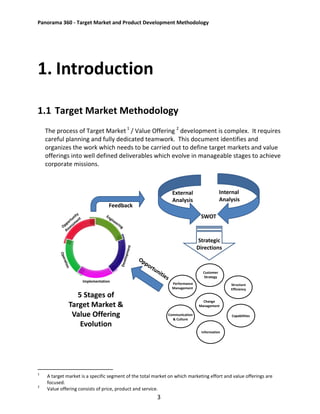
The process of Target Market 1
/ Value Offering 2
development is complex. It requires
careful planning and fully dedicated teamwork. This document identifies and
organizes the work which needs to be carried out to define target markets and value
offerings into well defined deliverables which evolve in manageable stages to achieve
corporate missions.
1
A target market is a specific segment of the total market on which marketing effort and value offerings are
focused.
2
Value offering consists of price, product and service.
Implementation
Customer
Strategy
Structure
Efficiency
Capabilities
Information
Communication
& Culture
Performance
Management
Change
Management
External
Analysis
Internal
Analysis
SWOT
Strategic
Directions
Feedback
5 Stages of
Target Market &
Value Offering
Evolution
Panorama 360 - Target Market and Product Development Methodology
4
The Five Stages of Target Market / Value Offering Evolution are closely related to the
Road Map Wheel as shown below. Customer Strategy identifies opportunities that
feed the Opportunity Assessment stage, while the building and operation of the
target market value offerings provides valuable feedback to strategic planning.
Development of target markets and value offerings must consider all of the topics
defined in the Roadmap Wheel, and this methodology accommodates this notion.
This methodology addresses all facets when defining target markets and value
offerings.
Building target markets and value offerings is incremental and evolutionary in
nature, with ideas moving from a high level understanding to specific courses of
action and then being refined and tuned based on actual experience. This
methodology is based on two fundamental concepts to implement this notion
effectively. The first is that target markets and value offerings develop through five
identifiable and manageable stages. The second concept is that there are clearly
discernible sets of deliverables3
. Each set is focused on a critical aspect of target
market / value offering definition and operation. Each set evolves through the five
stages as in Figure 1 below.
Implementation
5 Stages of
Target Market &
Value Offering
Evolution
Deliverable A
Deliverable B
Deliverable C
Deliverable D
Opportunity
Assessment
Engineering Development OperationImplementation
Figure 1
It must be emphasized, that while insurance value offerings share common
elements, each is unique, with its own set of special needs to fulfill. For this reason,
we have intentionally made the framework flexible. As a team member you should
3
A deliverable is a completed output such as a document, specification, or completed action which has been
specified as necessary to support achievement of the desired objective.
Panorama 360 - Target Market and Product Development Methodology
5
realize that in a given situation, good judgment may guide you to override the advice
provided in this manual.
1.2 Making Sense of Target Markets
The life cycle of delivering value offerings to target markets, from inception to
execution, is a complex process. It is our experience that mastery of this process is
critical to the success of most organizations. Key to understanding and managing
this process is the analysis of core skill sets by staff to perform critical functions in
chronological flow. For example, matching marketing value offering bundles to
customer needs and behaviors has become more challenging as competition grows,
tastes change, and a wider array of marketing tactics becomes available. Analytic
and systems support has become more important and feasible as databases,
computers, and expert systems improve. It is, and will continue to become more
difficult for a Target Market Director to be effective without having core
competencies available and a determination to use the processes and tools available
to her or him to be successful.
This methodology is provided to support the decision-making activities, from project
description through to objectives and goal setting, program formulation, and
resource support requirements, as well as implementation. It outlines varying levels
of activities, from cursory to intense. We emphasize that while the methodology is
most useful as a disciplined behavior guide, it can never be more important than
core skill sets of staff, some of which will require training or teaching. Critical skills
will include clear issue identification, understanding underlying factors for success,
asking the right questions, bounding the decisions appropriately, and defining
problems correctly, as well as market research, statistical analysis, rate
determination, legal, financial, process and systems development.
We have summarized a set of twelve guiding principles for successful Target Market
/ Value Offering development which apply whether new value offering introductions
follow a proactive strategy or reactive strategy to market conditions.
Panorama 360 - Target Market and Product Development Methodology
6
1.3 Twelve Principles of Target Market and Value
Offering Introduction
These principles have been determined from experienced consideration of why new
value offerings fail and are expressed to encourage appropriate positioning and
planning for success.
1. Team Work - Premier value offerings are created through a disciplined process,
by highly skilled and cooperative teams listening to customers, studying the
marketplace, innovating and testing, being prepared to take risks, and working
hard. Inculcating the process into the corporate culture should be fun. Simplify
and standardize work process wherever possible, and look to technology to
automate and integrate.
2. Target Market - The ability to segment markets and customers with different
needs is critical to creating sufficient demand to make the value offering
profitable.
3. Positioning - A well-positioned value offering is the result of management’s
understanding of customers’ perceptions as relates to price and value.
4. Environment - Marketplace response requires strategies and resources to wage
and survive competitive battles, regulatory changes, fluctuations in price, shifts in
consumer attitudes or taste, or competitive offerings that can quickly make a
value offering obsolete.
5. Business Plans - Successful value offering introductions require that selling,
distribution, advertising and promotion must be executed as per a business plan.
Plan on changing your business plan - the initial plan will require modifications in
response to changing requirements and market conditions.
6. Profitability - The organization requires a clear statement of return on
investment and key performance ratios for each target market and value offering.
This implies understanding the relationships between sales, margin, price, risk
and cost.
7. Value Offering Design - Successful value offerings are created based on customer
need rather than on capabilities of the organization. The value offering must
appear unique from the customer’s point of view. Commodity value offerings
tend to differentiate themselves as much on customer satisfaction as on quality.
Panorama 360 - Target Market and Product Development Methodology
7
8. Value Offering Delivery - The value offering must reliably meet its specifications
to be perceived as having a quality advantage over the alternatives available to
customers. Cost consciousness requires a disciplined review of each of the
components of the cost / value chain to confirm and enhance value to the buyer.
9. Company Capabilities - Synergy must exist among the company’s marketing,
underwriting, claims, actuarial, systems, and financial skills and experience for
the value offering to build on the organization’s distinctive competencies. Equip
the value offering team to enable them to succeed. Inter-organizational conflict
and poor management practices must be avoided for a customer-driven culture
to succeed.
10.Decision-making - Recommending and approving decisions must be done with
less than perfect information. Successful value offering introductions rely on
qualitative “feel”. Information has value to the extent that it causes the
organization to change a key decision it might make without the information.
11.Distribution Support - Channel members / brokers must be counseled, trained
and must also buy in to the value offering so as to be motivated to provide
requisite distribution intensity and support in advance of value offering
introduction.
12.Commitment - The organization that gains the promise of its team members to
persevere until they succeed develops a winning record in the marketplace.
Panorama 360 - Target Market and Product Development Methodology
8
2. Methodology Outline
2.1 General
This methodology is a set of guidelines to facilitate the planning and control of target
market / value offering projects. It is intended to provide a project track for people
who are skilled and experienced. It is not intended to substitute in any way for the
availability of appropriate skills. Nor is it a Project Management Methodology,
however those disciplines and skills should be used throughout the process.
This methodology will need to be tailored for your organization. We fully expect to
continually refine it based on the experience learned while using it. This will be
particularly true during the first couple of projects which use it.
2.2 Five Stages of Target Market / Value Offering
Evolution
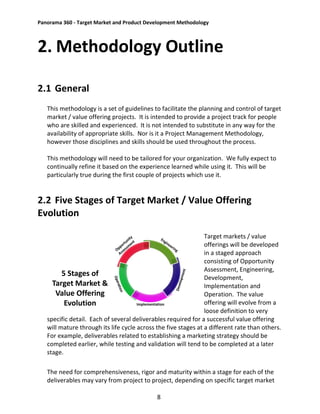
Target markets / value
offerings will be developed
in a staged approach
consisting of Opportunity
Assessment, Engineering,
Development,
Implementation and
Operation. The value
offering will evolve from a
loose definition to very
specific detail. Each of several deliverables required for a successful value offering
will mature through its life cycle across the five stages at a different rate than others.
For example, deliverables related to establishing a marketing strategy should be
completed earlier, while testing and validation will tend to be completed at a later
stage.
The need for comprehensiveness, rigor and maturity within a stage for each of the
deliverables may vary from project to project, depending on specific target market
Implementation
5 Stages of
Target Market &
Value Offering
Evolution
Panorama 360 - Target Market and Product Development Methodology
9
segment, value offering, and environmental factors. It is critical for management
and the Steering Committee to determine how each deliverable will mature for the
value offering.
The Deliverable Details section provides a detailed checklist of the recommended
evolution of deliverables through the stages of step-wise refinement for target
market and value offering projects.
2.3 Life Cycle
The development of each deliverable follows a process of step-wise refinement or
life cycle. In the early stage of the project, the deliverable is usually described in high
level terms without much detail. As the project moves forward from one stage to
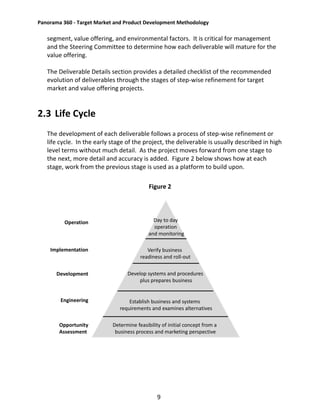
the next, more detail and accuracy is added. Figure 2 below shows how at each
stage, work from the previous stage is used as a platform to build upon.
Figure 2
Opportunity
Assessment
Engineering
Development
Operation
Implementation
Determine feasibility of initial concept from a
business process and marketing perspective
Establish business and systems
requirements and examines alternatives
Develop systems and procedures
plus prepares business
Verify business
readiness and roll-out
Day to day
operation
and monitoring
Panorama 360 - Target Market and Product Development Methodology
10
2.4 Deliverables Groups and Deliverables
A deliverables group is a family of related deliverables. This methodology identifies
twelve deliverable groups:
 Value Offering Concept;
 Market Research;
 Value Offering Design;
 Distribution;
 Communications Program;
 Process;
 Structure;
 Financial / Business Plans;
 Quality Assurance;
 Education / Training;
 Organizational Effectiveness;
 Project Management
Each deliverable group is explained in detail in Section Error! Reference source not
found., Deliverables Detail.
2.5 Gating & Approval
One of the major benefits of breaking deliverables into stages is to help management
contain risk. Before entering a new stage and as directed4
, approval is required by
the Steering Committee. Before a target market / value offering project can be
initiated a Project Objectives Document must be developed and approved. The
purpose of this document is to identify the specific objectives of the project and at a
very high level, the resources required5
.
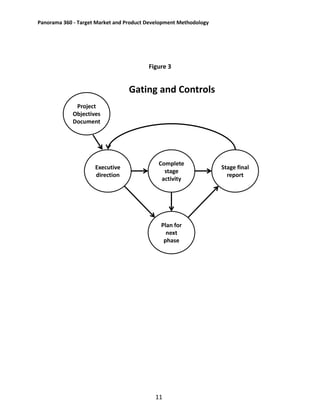
Figure 3 below, shows the approval process. The same process is repeated for each
stage of the project, from Opportunity Assessment to Operation. During the
execution of all project stages leading up to Operation, plans for the next stage will
be developed. At the end of a stage the Project Manager will present a Stage Final
Report6
to the Steering Committee. The Steering Committee will then provide
specific guidance in the form of an Executive Directive7
.
4
For very large projects, it may be necessary to have interim reviews of the project status. This will be
determined by the Steering Committee.
5
See Error! Reference source not found. Project Objectives Document.
6
See Error! Reference source not found. Stage Final Report.
7
See Error! Reference source not found. Executive Directive.
Panorama 360 - Target Market and Product Development Methodology
11
Figure 3
Project
Objectives
Document
Stage final
report
Complete
stage
activity
Executive
direction
Plan for
next
phase
Gating and Controls

Panorama 360 Product Development Methodology Sample

  • 1.
    PANORAMA 360 THE INSURANCE ANDWEALTH MANAGEMENT TARGET MARKET AND PRODUCT DEVELOPMENT METHODOLOGY Version 3.0 THE DEFINITIVE REFERENCE FOR MANAGING INSURANCE AND WEALTH MANAGEMENT TARGET MARKET AND PRODUCT DEVELOPMENT.
  • 2.
    Panorama 360 -Target Market and Product Development Methodology 1 ©Copyright – All rights reserved. Panorama 360 is distributed and published by Insurance Frameworks Inc. (www.InsuranceFrameworks.com). Formerly, Panorama 360 was called Vista. ©1997, 2002, 2011, 2017 Version 0.0 published 1997, version 1.0 published 2002, version 2.0 published 2011, version 3.0 published 2017. ISBN-13: 978-1544251073 ISBN-10: 1544251076
  • 3.
    Panorama 360 -Target Market and Product Development Methodology 2 Table of Contents 1. INTRODUCTION................................................................................................... 3 1.1 TARGET MARKET METHODOLOGY.................................................................................. 3 1.2 MAKING SENSE OF TARGET MARKETS.............................................................................. 5 1.3 TWELVE PRINCIPLES OF TARGET MARKET AND VALUE OFFERING INTRODUCTION.................... 6 2. METHODOLOGY OUTLINE.....................................................................................8 2.1 GENERAL .................................................................................................................... 8 2.2 FIVE STAGES OF TARGET MARKET / VALUE OFFERING EVOLUTION ....................................... 8 2.3 LIFE CYCLE................................................................................................................... 9 2.4 DELIVERABLES GROUPS AND DELIVERABLES ........................................................................ 2.5 GATING & APPROVAL ..................................................................................................... 3. DETAILS OF THE FIVE STAGES OF EVOLUTION .....................................................12 3.1 OUTLINE ....................................................................................................................... 3.2 OPPORTUNITY ASSESSMENT............................................................................................. 3.3 ENGINEERING ................................................................................................................ 3.4 DEVELOPMENT............................................................................................................... 3.5 IMPLEMENTATION .......................................................................................................... 3.6 OPERATION................................................................................................................... 4. DELIVERABLE DETAILS ........................................................................................33 4.1 VALUE OFFERING CONCEPT.............................................................................................. 4.2 MARKET RESEARCH ........................................................................................................ 4.3 VALUE OFFERING DESIGN ................................................................................................ 4.4 DISTRIBUTION................................................................................................................ 4.5 COMMUNICATIONS PROGRAM ......................................................................................... 4.6 PROCESS....................................................................................................................... 4.7 STRUCTURE ................................................................................................................... 4.8 FINANCIALS / BUSINESS PLANS ......................................................................................... 4.9 QUALITY ASSURANCE ...................................................................................................... 4.10 EDUCATION / TRAINING .............................................................................................. 4.11 ORGANIZATIONAL EFFECTIVENESS ................................................................................. 4.12 PROJECT MANAGEMENT.............................................................................................. 5. PROJECT MANAGERS NOTES...............................................................................74 5.1 PROJECT OBJECTIVE DOCUMENT....................................................................................... 5.2 STAGE FINAL REPORT...................................................................................................... 5.3 EXECUTIVE DIRECTIVE ..................................................................................................... 5.4 PROJECT MANAGER STAGE PLANNING WORKSHEET.............................................................
  • 4.
    Panorama 360 -Target Market and Product Development Methodology 3 1. Introduction 1.1 Target Market Methodology The process of Target Market 1 / Value Offering 2 development is complex. It requires careful planning and fully dedicated teamwork. This document identifies and organizes the work which needs to be carried out to define target markets and value offerings into well defined deliverables which evolve in manageable stages to achieve corporate missions. 1 A target market is a specific segment of the total market on which marketing effort and value offerings are focused. 2 Value offering consists of price, product and service. Implementation Customer Strategy Structure Efficiency Capabilities Information Communication & Culture Performance Management Change Management External Analysis Internal Analysis SWOT Strategic Directions Feedback 5 Stages of Target Market & Value Offering Evolution
  • 5.
    Panorama 360 -Target Market and Product Development Methodology 4 The Five Stages of Target Market / Value Offering Evolution are closely related to the Road Map Wheel as shown below. Customer Strategy identifies opportunities that feed the Opportunity Assessment stage, while the building and operation of the target market value offerings provides valuable feedback to strategic planning. Development of target markets and value offerings must consider all of the topics defined in the Roadmap Wheel, and this methodology accommodates this notion. This methodology addresses all facets when defining target markets and value offerings. Building target markets and value offerings is incremental and evolutionary in nature, with ideas moving from a high level understanding to specific courses of action and then being refined and tuned based on actual experience. This methodology is based on two fundamental concepts to implement this notion effectively. The first is that target markets and value offerings develop through five identifiable and manageable stages. The second concept is that there are clearly discernible sets of deliverables3 . Each set is focused on a critical aspect of target market / value offering definition and operation. Each set evolves through the five stages as in Figure 1 below. Implementation 5 Stages of Target Market & Value Offering Evolution Deliverable A Deliverable B Deliverable C Deliverable D Opportunity Assessment Engineering Development OperationImplementation Figure 1 It must be emphasized, that while insurance value offerings share common elements, each is unique, with its own set of special needs to fulfill. For this reason, we have intentionally made the framework flexible. As a team member you should 3 A deliverable is a completed output such as a document, specification, or completed action which has been specified as necessary to support achievement of the desired objective.
  • 6.
    Panorama 360 -Target Market and Product Development Methodology 5 realize that in a given situation, good judgment may guide you to override the advice provided in this manual. 1.2 Making Sense of Target Markets The life cycle of delivering value offerings to target markets, from inception to execution, is a complex process. It is our experience that mastery of this process is critical to the success of most organizations. Key to understanding and managing this process is the analysis of core skill sets by staff to perform critical functions in chronological flow. For example, matching marketing value offering bundles to customer needs and behaviors has become more challenging as competition grows, tastes change, and a wider array of marketing tactics becomes available. Analytic and systems support has become more important and feasible as databases, computers, and expert systems improve. It is, and will continue to become more difficult for a Target Market Director to be effective without having core competencies available and a determination to use the processes and tools available to her or him to be successful. This methodology is provided to support the decision-making activities, from project description through to objectives and goal setting, program formulation, and resource support requirements, as well as implementation. It outlines varying levels of activities, from cursory to intense. We emphasize that while the methodology is most useful as a disciplined behavior guide, it can never be more important than core skill sets of staff, some of which will require training or teaching. Critical skills will include clear issue identification, understanding underlying factors for success, asking the right questions, bounding the decisions appropriately, and defining problems correctly, as well as market research, statistical analysis, rate determination, legal, financial, process and systems development. We have summarized a set of twelve guiding principles for successful Target Market / Value Offering development which apply whether new value offering introductions follow a proactive strategy or reactive strategy to market conditions.
  • 7.
    Panorama 360 -Target Market and Product Development Methodology 6 1.3 Twelve Principles of Target Market and Value Offering Introduction These principles have been determined from experienced consideration of why new value offerings fail and are expressed to encourage appropriate positioning and planning for success. 1. Team Work - Premier value offerings are created through a disciplined process, by highly skilled and cooperative teams listening to customers, studying the marketplace, innovating and testing, being prepared to take risks, and working hard. Inculcating the process into the corporate culture should be fun. Simplify and standardize work process wherever possible, and look to technology to automate and integrate. 2. Target Market - The ability to segment markets and customers with different needs is critical to creating sufficient demand to make the value offering profitable. 3. Positioning - A well-positioned value offering is the result of management’s understanding of customers’ perceptions as relates to price and value. 4. Environment - Marketplace response requires strategies and resources to wage and survive competitive battles, regulatory changes, fluctuations in price, shifts in consumer attitudes or taste, or competitive offerings that can quickly make a value offering obsolete. 5. Business Plans - Successful value offering introductions require that selling, distribution, advertising and promotion must be executed as per a business plan. Plan on changing your business plan - the initial plan will require modifications in response to changing requirements and market conditions. 6. Profitability - The organization requires a clear statement of return on investment and key performance ratios for each target market and value offering. This implies understanding the relationships between sales, margin, price, risk and cost. 7. Value Offering Design - Successful value offerings are created based on customer need rather than on capabilities of the organization. The value offering must appear unique from the customer’s point of view. Commodity value offerings tend to differentiate themselves as much on customer satisfaction as on quality.
  • 8.
    Panorama 360 -Target Market and Product Development Methodology 7 8. Value Offering Delivery - The value offering must reliably meet its specifications to be perceived as having a quality advantage over the alternatives available to customers. Cost consciousness requires a disciplined review of each of the components of the cost / value chain to confirm and enhance value to the buyer. 9. Company Capabilities - Synergy must exist among the company’s marketing, underwriting, claims, actuarial, systems, and financial skills and experience for the value offering to build on the organization’s distinctive competencies. Equip the value offering team to enable them to succeed. Inter-organizational conflict and poor management practices must be avoided for a customer-driven culture to succeed. 10.Decision-making - Recommending and approving decisions must be done with less than perfect information. Successful value offering introductions rely on qualitative “feel”. Information has value to the extent that it causes the organization to change a key decision it might make without the information. 11.Distribution Support - Channel members / brokers must be counseled, trained and must also buy in to the value offering so as to be motivated to provide requisite distribution intensity and support in advance of value offering introduction. 12.Commitment - The organization that gains the promise of its team members to persevere until they succeed develops a winning record in the marketplace.
  • 9.
    Panorama 360 -Target Market and Product Development Methodology 8 2. Methodology Outline 2.1 General This methodology is a set of guidelines to facilitate the planning and control of target market / value offering projects. It is intended to provide a project track for people who are skilled and experienced. It is not intended to substitute in any way for the availability of appropriate skills. Nor is it a Project Management Methodology, however those disciplines and skills should be used throughout the process. This methodology will need to be tailored for your organization. We fully expect to continually refine it based on the experience learned while using it. This will be particularly true during the first couple of projects which use it. 2.2 Five Stages of Target Market / Value Offering Evolution Target markets / value offerings will be developed in a staged approach consisting of Opportunity Assessment, Engineering, Development, Implementation and Operation. The value offering will evolve from a loose definition to very specific detail. Each of several deliverables required for a successful value offering will mature through its life cycle across the five stages at a different rate than others. For example, deliverables related to establishing a marketing strategy should be completed earlier, while testing and validation will tend to be completed at a later stage. The need for comprehensiveness, rigor and maturity within a stage for each of the deliverables may vary from project to project, depending on specific target market Implementation 5 Stages of Target Market & Value Offering Evolution
  • 10.
    Panorama 360 -Target Market and Product Development Methodology 9 segment, value offering, and environmental factors. It is critical for management and the Steering Committee to determine how each deliverable will mature for the value offering. The Deliverable Details section provides a detailed checklist of the recommended evolution of deliverables through the stages of step-wise refinement for target market and value offering projects. 2.3 Life Cycle The development of each deliverable follows a process of step-wise refinement or life cycle. In the early stage of the project, the deliverable is usually described in high level terms without much detail. As the project moves forward from one stage to the next, more detail and accuracy is added. Figure 2 below shows how at each stage, work from the previous stage is used as a platform to build upon. Figure 2 Opportunity Assessment Engineering Development Operation Implementation Determine feasibility of initial concept from a business process and marketing perspective Establish business and systems requirements and examines alternatives Develop systems and procedures plus prepares business Verify business readiness and roll-out Day to day operation and monitoring
  • 11.
    Panorama 360 -Target Market and Product Development Methodology 10 2.4 Deliverables Groups and Deliverables A deliverables group is a family of related deliverables. This methodology identifies twelve deliverable groups:  Value Offering Concept;  Market Research;  Value Offering Design;  Distribution;  Communications Program;  Process;  Structure;  Financial / Business Plans;  Quality Assurance;  Education / Training;  Organizational Effectiveness;  Project Management Each deliverable group is explained in detail in Section Error! Reference source not found., Deliverables Detail. 2.5 Gating & Approval One of the major benefits of breaking deliverables into stages is to help management contain risk. Before entering a new stage and as directed4 , approval is required by the Steering Committee. Before a target market / value offering project can be initiated a Project Objectives Document must be developed and approved. The purpose of this document is to identify the specific objectives of the project and at a very high level, the resources required5 . Figure 3 below, shows the approval process. The same process is repeated for each stage of the project, from Opportunity Assessment to Operation. During the execution of all project stages leading up to Operation, plans for the next stage will be developed. At the end of a stage the Project Manager will present a Stage Final Report6 to the Steering Committee. The Steering Committee will then provide specific guidance in the form of an Executive Directive7 . 4 For very large projects, it may be necessary to have interim reviews of the project status. This will be determined by the Steering Committee. 5 See Error! Reference source not found. Project Objectives Document. 6 See Error! Reference source not found. Stage Final Report. 7 See Error! Reference source not found. Executive Directive.
  • 12.
    Panorama 360 -Target Market and Product Development Methodology 11 Figure 3 Project Objectives Document Stage final report Complete stage activity Executive direction Plan for next phase Gating and Controls