PANORAMA
360
THE INSURANCE AND WEALTH
MANAGEMENT
BUSINESS PROCESS MODELS
Version 4.0
Preface by
President and Chief Operating Officer of an Insurance Company
Chair of OMG’s BPMN MIWG
Retired Senior Director, Oracle Insurance Business Unit
THE DEFINITIVE REFERENCE TO DESIGN, DEVELOP, IMPLEMENT AND TRANSFORM
BUSINESS PROCESSES IN THE INSURANCE AND WEALTH MANAGEMENT INDUSTRY.
Panorama 360 Insurance and Wealth Management Business Process Models
1
©Copyright – All rights reserved.
Panorama 360 is distributed and published by Insurance Frameworks Inc.
(www.InsuranceFrameworks.com).
Formerly, Panorama 360 was called Vista.
©1997, 2002, 2011, 2017
Version 0.0 published 1997, version 1.0 published 2002, version 2.0 published 2011, version 3.0
published 2017.
ISBN-13: 978-1546536918
ISBN-10: 1546536914
Panorama 360 Insurance and Wealth Management Business Process Models
2
Table of Contents
Preface ........................................................................................................................5
Leveraging the Enterprise Model .................................................................................7
Using the Enterprise Model to Create Process Models ....................................................................9
What is Panorama 360 Enterprise Business Architecture Framework?...........................................10
Panorama 360 Functional Decomposition.....................................................................................12
Panorama 360 - Basic Principles ...................................................................................................14
Insurance and Wealth Management Value Chain..........................................................................15
Insurance and Wealth Management – Business Capabilities..........................................................17
Introduction to Panorama 360 Business Process Models............................................18
Industry Business Context Diagram ..............................................................................................21
Business Questions ......................................................................................................................22
Customer Knowledge Management ......................................................................................................................
Customer Service Management.............................................................................................................................
Product Management ............................................................................................................................................
New Business Management...................................................................................................................................
Contract Issuance Management ............................................................................................................................
Contract Change Management..............................................................................................................................
Renewal Management...........................................................................................................................................
Termination Management .....................................................................................................................................
Reinstatement Management .................................................................................................................................
Reinsurance Management .....................................................................................................................................
Manage Life Cycle Management............................................................................................................................
Distribution Channel Management........................................................................................................................
Service Channel Management ...............................................................................................................................
Benefit/Claim Management...................................................................................................................................
Business Process Models ...........................................................................................60
Identify Markets Processes...........................................................................................................61
Research Market Process.......................................................................................................................................
Develop Markets Process.......................................................................................................................................
Develop Buying Behaviour Process........................................................................................................................
Develop Customer Service Strategy Process..........................................................................................................
Develop Promotional Campaigns Process..............................................................................................................
Develop Products Processes.........................................................................................................89
Assess Product Opportunity Process .....................................................................................................................
Engineer Products and Services Concepts Process ................................................................................................
Engineer Products and Services Components Process ..........................................................................................
Engineer Products and Services Support Process ..................................................................................................
Develop Product and Services Process ..................................................................................................................
Develop Product and Services Support Process.....................................................................................................
Manage Operations of Products and Services Process..........................................................................................
Panorama 360 Insurance and Wealth Management Business Process Models
3
Contract Management Context Diagram.....................................................................................126
Market Products Processes ........................................................................................................127
Obtain Prospects Process.......................................................................................................................................
Cross-sell and Up-sell Products Processes .............................................................................................................
Cross-sell and Up-sell Products Process - Based on Statistics...........................................................................
Cross-sell and Up-sell Products - Based on Customer Information...................................................................
Cross Sell and Up Sell Products - Based on New Product Introduction.............................................................
Cross-sell and Up-sell Products - Based on Contract Status..............................................................................
Cross Sell and Up Sell Products – Based on Customer Contact Programs ........................................................
Perform Sales Campaigns Process .........................................................................................................................
Sell Products Process..................................................................................................................160
Sell New Business Process......................................................................................................................................
Administer Contracts Processes..................................................................................................211
Contract Renewal Process......................................................................................................................................
Contract Change Process .......................................................................................................................................
Issue Contract Process ...........................................................................................................................................
Cancellation Process ..............................................................................................................................................
Perform Reinstatement Process ............................................................................................................................
Manage Contract Life Cycle Process ......................................................................................................................
Service Customers Processes......................................................................................................357
Identify Customer Needs Process ..........................................................................................................................
Provide Information to Customers Process ...........................................................................................................
Manage Customer Relationship Process................................................................................................................
Benefit/Claims Management Context Diagram ...........................................................................374
Manage Benefits /Claims Process...............................................................................................375
Administer Contract Benefit/Claims ......................................................................................................................
Manage Distribution Channels Processes....................................................................................403
Develop Distribution Channels Process .................................................................................................................
Manage Distributor Process...................................................................................................................................
Manage Distributor Compensation Process ..........................................................................................................
Service Distribution Channels Process ...................................................................................................................
Manage Service Providers Processes ..........................................................................................425
Develop Service Channels Process.........................................................................................................................
Manage Service Channels Process .........................................................................................................................
Manage Service Channel Compensation Process ..................................................................................................
Conclusion...............................................................................................................440
Panorama 360 Insurance and Wealth Management Business Process Models
4
Other books in the Panorama 360 Insurance and Wealth Management Suite:
o Panorama 360 Enterprise Business Architecture Framework
o Panorama 360 Enterprise Information Model
o Panorama 360 Merger and Acquisition Methodology
o Panorama 360 Market Segmentation and Product Development
Methodology
o Panorama 360 Project Delivery Maturity Assessment Methodology
For more information, contact us at Info@InsuranceFrameworks.com
Panorama 360 Insurance and Wealth Management Business Process Models
5
Preface
“Panorama 360 is a reference framework that has been integrated at La
Capitale General Insurance and its subsidiaries for over 8 years, both in our
projects, architectural approaches and various analyses.
Whether it is used to organize and analyze business processes, prepare
projects, perform requirements modeling or for our ROI activities, this
reference framework provides a reliable source of information. When
accessing the 75 major insurance business functions, which are skillfully
identified and concisely described, we obtain a clear scope definition of the
targeted business domains, highlighting the context and therefore
facilitating decisions. The richness found in Panorama 360 is based on the
fact that the 500 documented business functions are focused on the
insurance industry.
Now integrated into our business activities, the Panorama 360 insurance
reference framework ensures greater velocity and more particularly in
validating that all business areas and services in our companies are
addressed. Used in concert with our official project management,
architecture and business analysis methodologies, Panorama 360 ensures
consistency in our practices, offering a value proposition centered on
business.”
Constance Lemieux, C.Dir., President and Chief Operating Officer
Property and Casualty Insurance Sector of La Capitale
“Panorama 360 Insurance and Wealth Management creates a common
language and information structure for organizations to capture and
communicate their business process architecture. This comprehensive
framework acts as catalyst and accelerator for visualizing, innovating,
transforming and/or improving how things get done within an
organization.”
Denis Gagné, Chair of OMG’s BPMN MIWG and CEO & CTO Trisotech
Panorama 360 Insurance and Wealth Management Business Process Models
6
“Panorama 360 represents a comprehensive and easy to use reference
architecture model for the insurance and wealth management industry.
From new product introduction to process re-engineering, these end-to-end
models can be used to accelerate change often required to survive in a
highly competitive environment.”
Paul Dolbec, Retired Senior Director, Oracle Insurance Business Unit
Panorama 360 Insurance and Wealth Management Business Process Models
7
Leveraging the Enterprise
Model
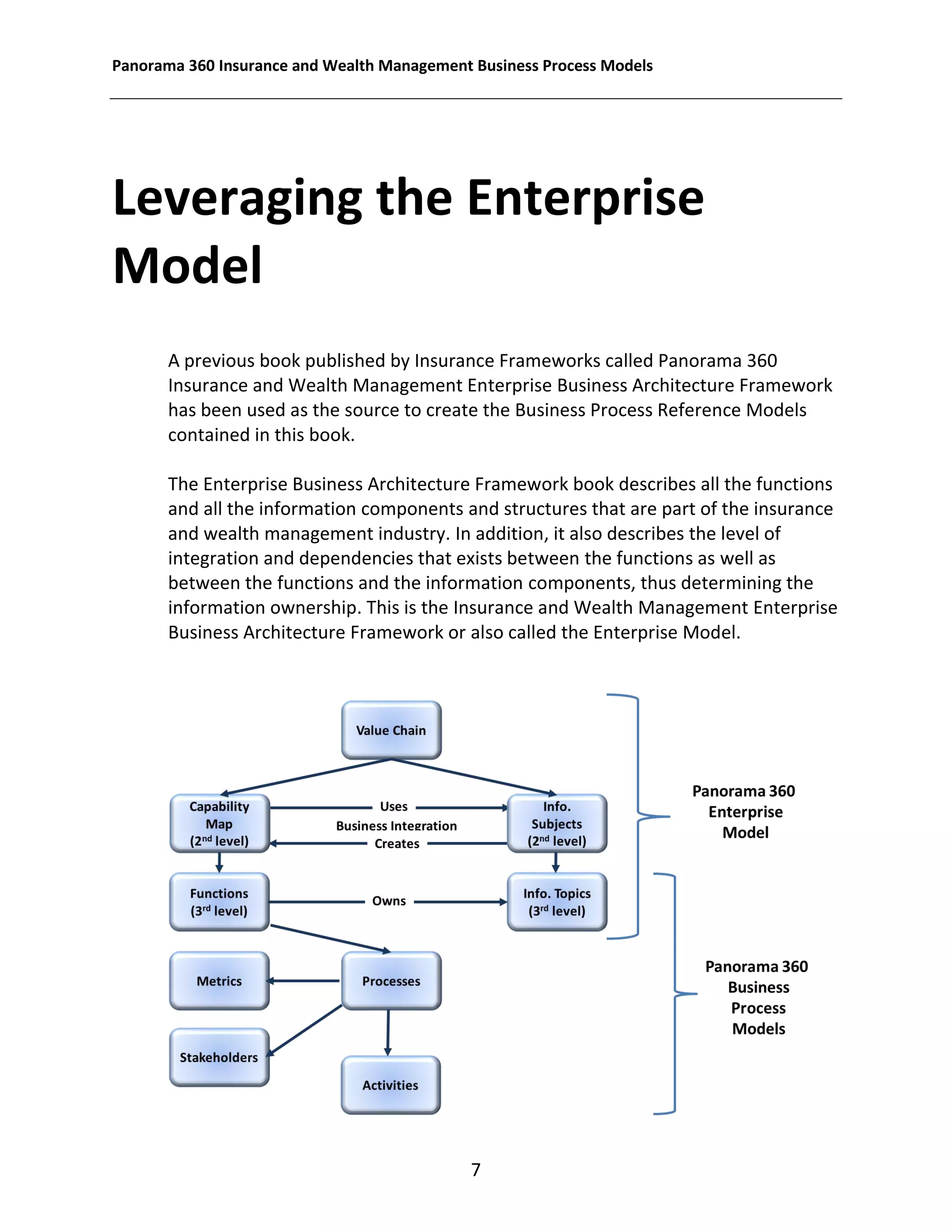
A previous book published by Insurance Frameworks called Panorama 360
Insurance and Wealth Management Enterprise Business Architecture Framework
has been used as the source to create the Business Process Reference Models
contained in this book.
The Enterprise Business Architecture Framework book describes all the functions
and all the information components and structures that are part of the insurance
and wealth management industry. In addition, it also describes the level of
integration and dependencies that exists between the functions as well as
between the functions and the information components, thus determining the
information ownership. This is the Insurance and Wealth Management Enterprise
Business Architecture Framework or also called the Enterprise Model.
Panorama 360 Insurance and Wealth Management Business Process Models
8
The business functions that are described in the Panorama 360 Enterprise
Business Architecture Framework book are leveraged and used to define the
business process models that are contained in this book.
This Panorama 360 Insurance and Wealth Management Business Process
Reference Models book contains:
o Industry Value Chain
o Capability Map
o Business Processes Reference Models
o Key Activities found in each process
This book is complete in itself to create business processes for insurance and
wealth management organizations. Any content that we used from the
Enterprise Business Architecture Framework book has been copied in this book.
Forget the white page syndrome. The process models that are described in this
book are the definitive reference when defining business processes, developing
business requirements or transitioning to a new business model. This book also
includes a significant number of activities that are performed within the different
processes. Using them will help design business processes and business
requirements in a much more complete and efficient manner.
This book also includes several questions that need to be answered when
defining processes or business requirements. It can equally be a great tool to
train employees on the different processes found in the insurance and wealth
management industry.
Panorama 360 Insurance and Wealth Management Business Process Models
9
Using the Enterprise Model to Create Process
Models
An enterprise model is like a box of interlocking blocks where one can find
components that can be assembled and connected to become part of a structure.
Such a box would have a number of smaller blocks that, when assembled
together, can represent buildings or any objects that can be made with these
blocks.
An enterprise model acts in the same way. They are the functional and
information components that can be found in an organization, just like
interlocking blocks or parts of a puzzle. When assembled together in a specific
sequence, they become processes.
This book contains the core business processes that can be found in the
insurance and wealth management industry. This includes any insurance
company, wealth management organizations, banks, brokers, mutual funds
organizations, etc…
To create the processes in this book, we used the business functions that are
found in our previous book, Panorama 360 Enterprise Business Architecture
Framework. The Enterprise Business Architecture Framework book describes all
the functions and information component structures that are found in the
insurance and wealth management industry.
This Panorama 360 Business Process Reference Models book is a practical
approach to defining processes in the insurance and wealth management
industry, although it could also be used for banks. Most products offered in the
insurance industry are also offered in banks. This book provides examples of
processes and activities that are at the core of the industry value chain.
If you are interested in the information models that are associated with the
business functions found in this Panorama 360 Business Process Reference
Models book, please refer to the Panorama 360 Enterprise Business Architecture
Framework book. Each function is described with the information components
that are associated to each of them.
Panorama 360 Insurance and Wealth Management Business Process Models
10
What is Panorama 360 Enterprise Business
Architecture Framework?
Panorama 360 Enterprise Business Architecture Framework is a knowledge
framework to plan and design organizations, processes, and technology – a
documented knowledge base containing business function definitions,
information components and structures, as well as organizational aspects
covering the full breadth of business managed in an Insurance and Wealth
Management enterprise. It is a practical reference model for use in business
process, management information, and information technology planning, design,
development, implementation, including on-going management. These functions
are now used in this book to define the processes.
Panorama 360 can be tailored to a particular organization or project requirement
and permits the enterprise to capture and leverage its own processes and
organization knowledge.
Panorama 360’s knowledge base is a result of more than 50 years of industry
related expertise, 10 years of direct modeling effort, and represents the best
practice approaches found around the world. Panorama 360 encompasses such
concepts as: segmenting target markets, improving product development
process, managing customer relationships, cross-selling products, maximizing
distribution channel effectiveness, measuring business success, and supporting
business functions with appropriate technology.
The models have been successfully applied in several organizations in the Life,
Health, Wealth, Group, Property & Casualty, Mutual Funds, Securities Brokerage
industries and even in banking.
The models in the Enterprise Business Architecture Framework book represent
the first three levels of a functional decomposition. The first three levels are:
 Business Domains (11 domains)
 Major Functions (70+ major functions)
 Business Functions (500+ business functions) and their capabilities
Panorama 360 Insurance and Wealth Management Business Process Models
11
A significant number of the business functions found in the Enterprise Business
Architecture Framework are used throughout the definition of the business
processes in this Panorama 360 Business Process Reference Models book.
Panorama 360 Insurance and Wealth Management Business Process Models
12
Insurance and Wealth Management
Value Chain
The following diagram represents the Insurance and Wealth Management
industry value chain.
The value chain components that are covered in this book are:
 Identify Markets
 Develop Products
 Market Products
 Sell Products
 Administer Contracts (also called Policies)
 Service Customers
 Manage Benefits/Claims
 Manage Distribution Channels
 Manage Service Providers
The business processes in each of the above value chain components are
described in this book.
Identify
Markets
Develop
Products
Market
Products
Sell
Products
Service
Customers
Manage
Claims/
Benefits
Administer
Contracts
Insurance and Wealth Management Value Chain
Manage DistributionChannels
Manage Service Providers
Manage Technology
Manage Knowledge andRules
Manage Collectibles andPayables
Manage Company
Manage Investments
Manage Human Resources
Panorama 360 Insurance and Wealth Management Business Process Models
13
Regarding the following two value chain components, they are addressed as part
of the processes and their functions and activities are included in different
process flows.
 Manage Collectibles and Payables
 Manage Investments
The functions within the Manage Investments value chain component will be
used for products that are sold to customers with an investment element.
Panorama 360 Insurance and Wealth Management Business Process Models
14
Insurance and Wealth Management – Business
Capabilities
The following chart represents the business capabilities for the Insurance and
Wealth Management industry. Each company may put more or less emphasis on
certain capabilities depending on how they want to differentiate themselves or
where they need to improve the business in order to meet their corporate
objectives.
Business Management
Business
Planning
Business
Portfolio
Mgmt
Risks
Mgmt
Taxation
Mgmt
Business
Event
Accntng
Books of
Account
Mgmt
Perfor-
Mance
Assessmt
Solvency
Assessmt
Business
Auditing
Perfor-
rmance
Repor-
ting
Customer Care
Customer Prospecting
Customer Information
Mgmt
Customer Needs
Identification
Customer Service Mgmt
Customer Relationship
Mgmt
Marketing
Markets Researching
Market Development
Buying Behaviour
Development
Promotional Campaign
Mgmt
Customer Service
Strategy Definition
Public Relations Mgmt
Corporate
Communication Mgmt
Distribution and Sales
Distribution Channel
Development
Distributor Mgmt
Distributor
Compensation Mgmt
Sales Campaign Mgmt
Distribution Channel
Servicing
Sales Performing
Sold Products Services
and Management
Excess Risk Alleviation
Contract Issuance
Sold Contract Life Cycle
Mgmt
Benefit Settlement
Administration
Contract Benefit
Administration
Product Development and Management
Product
Opportunity
Assessment
Products and
Services
Concept
Engineering
Products and
Services
Component
Engineering
Products and
Services
Support
Products and
Services
Development
Products and
Services
Support
Development
Operations of
Products and
Services
Mgmt
Service Channel Management
Service Channel
Development
Service Channel Mgmt
Service Channel
Compensation Mgmt
Service Channel
Operations Mgmt
Money Management
Billing
Account
Maintenance
Monies Due
Collection
Banking
Mgmt
Accounts
Receivable
Maintenance
Monies
Disbursement
Accounts
Payable
Mgmt
Money
Market
Mgmt
Corporate
Cash Flow
Mgmt
Asset Management
Investment
Policy/Stra-
tegy
Planning
Asset/
Liability
Spread
Mgmt
Portfolio
Perfor-
mance
Mgmt
Hedging
Mgmt
Investment
Portfolio
Mgmt
Security
Instrument
Trading
Mgmt
Security
Issue
Profiles
Mgmt
Asset
Inventory
Mgmt
Income
Producing
Real Estate
Mgmt
Organization Management
Organization
Development
Payroll
Processing
Travel and
Expense Mgmt
Premise
Maintenance
Supply Mgmt
Office Services
Providing
Infrastructure development and Management
Business Rules
Mgmt
Corporate
Body of
Knowledge
Mgmt
Business
Engineering
Workflow
Mgmt
Document
Mgmt
Projects and
Portfolios
Mgmt
Information
Technology
Mgmt
Panorama 360 Insurance and Wealth Management Business Process Models
15
Introduction to Panorama 360
Business Process Models
This book should be used as a reference. It reflects the business processes found
within:
 Marketing Management
 Product Management
 Distribution Management
 Sales Management
o New Sales
o Up-selling and Cross-selling
 Service Provider Management
 Client Management
 Contract Administration
 Benefits/Claims Management
These process models are meant to be referenced and serve as mind triggers
during process definitions and business requirements. It also covers a significant
number of activities that are performed within the different processes being
addressed. The models in this book address all the product types in the insurance
and wealth management industry. This includes:
 Protection products (Life, car, business, health, home, etc…)
 Investment products (Mutual funds, guaranteed investments, stocks, etc…)
 Loans products (Mortgage, personal loans, etc…)
 Fee for services
These models may need to be tailored to your specific situations as they may
cover broader business aspects than what is required by your organizations. They
are meant to be a representation of good practices in insurance and wealth
management. Using them should help you design business processes and
Panorama 360 Insurance and Wealth Management Business Process Models
16
business requirements for your organization in a much more complete and
efficient manner.
The business processes represented in this book may reflect exactly the sequence
of your processes but may also need to be tailored to reflect your reality. The
sequence may need to be changed to be an exact representation of what you
want your processes to become. This is normal as the sequence within processes
may be different from company to company. However, the functional
components that are used should be very similar from company to company.
The major functions that are used from the Panorama 360 Enterprise Business
Architecture Framework to define the business processes in this book are
represented by the shaded boxes in the following chart. All these major functions
are then exploded into business functions and then sequenced into processes
with activities within each the processes. All the non-shaded boxes are not
included in this book as they were not needed to describe the processes in this
book.
All the business function definitions that are in this book are copied directly from
the Panorama 360 Enterprise Business Architecture Framework. You may need to
add or subtract details to reflect your own company situation.
The numbering system used to describe the major functions and business
functions in this book is the same as what is found in the Panorama 360
Enterprise Business Architecture Framework book. For the sake of consistency
between the two books, since the business processes in this book are using the
functions found in the Enterprise Business Architecture Framework book, we
used the same numbers in both books.
For those interested in getting more information on the non-shaded major
functions found in the following chart, including the business functions that are
within those major functions, they are described in the Panorama 360 Enterprise
Business Architecture Framework book.
Panorama 360 Insurance and Wealth Management Business Process Models
17
The shaded boxes in the following chart represent the major business functions
that are used in the business processes described in this book. All the business
functions and activities comprised within these major functions are used to
describe the business processes in this book.
9.0 Business Management
9.1
Plan the
Business
9.2
Manage
Business
Portfolio
9.3
Manage
Risks
9.4
Manage
Taxation
9.5
Account
Business
Events
9.6
Manage
Books of
Account
9.7
Assess
Perfor-
mance
9.8
Assess
Solvency
9.9
Audit
the
Business
9.10
Report
Perfor-
mance
5.0 Customer Care
5.1 Identify Customers
5.2 Maintain
Customer Information
5.3 Identify
Customer Needs
5.4 Provide
Customer Service
5.5 Manage
Customer Relationship
1.0 Marketing
1.1 Research Markets
1.2 Develop Markets
1.3 Develop Buying
Behaviour
1.5 Manage
Promotional Campaigns
1.4 Define Customer
Service Strategy
1.6 Manage Public
Relations
1.7 Manage Corporate
Communication
3.0 Distribution and Sales
3.1 Develop
Distribution Channels
3.2 Manage Distributors
3.3 Manage Distributor
Compensation
3.5 Perform Sales
Campaigns
3.4 Service
Distribution Channels
3.6 Perform Sales
6.0 Sold Products Services
and Management
6.1 Alleviate Excess Risk
6.2 Issue Contract
6.3 Manage Sold
Contract Life Cycle
6.5 Administer
Benefit Settlement
6.4 Administer
Contract Benefit
2.0 Product Development and Management
2.1 Assess
Product
Opportunity
2.2 Engineer
Products and
Services
Concepts
2.3 Engineer
Products and
Services
Components
2.4 Engineer
Products and
Services
Support
2.5 Develop
Products and
Services
2.6 Develop
Products and
Services
Support
2.7 Manage
Operations of
Products and
Services
4.0 Service Channel Management
4.1 Develop Service
Channels
4.2 Manage Service
Channels
4.3 Manage Service
Channel Compensation
4.4 Manage Service
Channel Operations
7.0 Money Management
7.1 Maintain
Billing
Accounts
7.2 Collect
Monies Due
7.3 Manage
Banking
7.4 Maintain
Accounts
Receivable
7.5 Disburse
Monies
7.6 Manage
Accounts
Payable
7.7 Manage
Money
Market
7.8 Manage
Corporate
Cash Flow
8.0 Asset Management
8.1 Plan
Investment
Policy /
Strategy
8.2 Manage
Asset/
Liability
Spread
8.3 Measure
Portfolio
Perfor-
mance
8.4 Manage
Hedging
8.5 Manage
Investment
Portfolio
8.6 Manage
Security
Instrument
Trading
8.7 Maintain
Security
Issue
Profiles
8.8 Maintain
Asset
Inventory
8.9 Manage
Income
Producing
Real Estate
11.0 Organization Management
11.1 Develop the
Organization
11.2 Process
Payroll
11.3 Manage
Travel and
Expenses
11.4 Maintain
Premises
11.5 Manage
Supplies
11.6 Provide
Office Services
10.0 Infrastructure development and Management
10.1 Maintain
Business Rules
10.2 Manage
Corporate
Body of
Knowledge
10.3 Engineer
the Business
10.4 Manage
Workflow
10.5 Manage
Documents
10.6 Manage
Projects and
Portfolios
10.7 Manage
Information
Technology
Panorama 360 Insurance and Wealth Management Business Process Models
18
Industry Business Context Diagram
The following diagram represents the major external entities that have a role to
play in any insurance and wealth management organization. Depending on the
lines of business that are being addressed, the external parties may vary. This is
not meant to be an exhaustive list but represents a common list of external
stakeholders that would be involved in the processes. More detailed context
diagrams related to Contract Management and Benefit/Claims Management are
also contained in this book.
Business Context
(External Business Partners)
Distributor
Servicing
Channel
Customer
Customer
Intermediary
Benefit
Claimant
Party
with
Interest
Reinsurers
Investor
Bank
Rating
Agency
Industry
Association
Competitor
Sales
Promotion
Agency
Supplier
Media
Employee
Stakeholders Regulator Government Auditor The Market
Insurance
and
Wealth
Management
Panorama 360 Insurance and Wealth Management Business Process Models
19
Business Questions
When defining business processes or business requirements, interviewing
management may need to take place to understand their business vision and
objectives. This section is meant to serve as mind triggers during process and
business requirement definitions while interviewing management.
The following sections outline a series of questions to assist business analysts
during these sessions. The questions are structured into major functional areas
that are recognized throughout the organizational life cycle. These questions are
not meant to be exhaustive and do not cover all the types of functions found in
an insurance company. They are guidelines to assist in defining a complete set of
questions. You can add your own questions to this list.
The areas that are covered in these questions are:
 Customer Knowledge Management
 Customer Service Management
 Product Management
 New Business Management
 Contract Issuance Management
 Contract Change Management
 Renewal Management
 Termination Management
 Reinstatement Management
 Reinsurance Management
 Life Cycle Management
 Distribution Channel Management
 Service Channel Management
 Benefit/Claims Management
In the following Sections, questions about each topic are being addressed.
Panorama 360 Insurance and Wealth Management Business Process Models
20
Identify Markets Processes
The following processes refer to the ability to identify markets to target.
The overall process is subdivided into 5 major processes that are described
individually. These processes are:
 Research Market
 Develop Markets
 Develop Buying Behaviour
 Develop Customer Service Strategy
 Develop Promotional Campaign
For your information, we have published a book called Panorama 360 Target
Market and Product Development Methodology which outlines a detailed
deliverable based approach to segmenting markets and developing financial
products.
Panorama 360 Insurance and Wealth Management Business Process Models
21
Research Market Process
Research Markets
From many sources, on different subject matters, and from various angles, gather
information about markets which are the target of the organization. With this
information on hand, assess the viability and macro-opportunities offered by the
observed environments.
Among the functions that would be included under this, are consolidations of
consumer profiles, gathering of external consumer data, and assessment of the
political environment.
1.1.1
Identify
Potential
Markets
Research Markets
1.1.6
Assess
Business
Climate
1.1.5
Assess Social
Environment
1.1.4
Assess
Political
Environment
1.1.9
Analyze
Market
Information
1.1.8
Determine
Sales Cycle
1.1.7
Determine
Customer
Value Chain
1.1.3
Integrate
External
Consumer
Data
1.1.2
Consolidate
Internal
Consumer
Profile
Panorama 360 Insurance and Wealth Management Business Process Models
22
1.1.1 Identify Potential Markets
Gather relevant information about the various markets which may be of interest
in order to expand the organization. The information related to these markets
could be high level impressions based on trends, population growth, evolution of
economy and perceived readiness to do business.
The suggested activities are:
 Seek knowledge from experts
 Gather knowledge from market studies
 Identify potential markets
1.1.2 Consolidate Internal Consumer Profile
Gather relevant information, available internally, on customer profiles,
purchasing behaviour, complaint profiles, consumes requests, previous focus
groups, customer satisfaction surveys, profitability assessments which could be
useful to perform the research of potential new markets in line with the
corporate objectives and directions.
The suggested activities are:
 Gather internal information about:
o Customer profiles
o Purchasing behavior
o Complaints
o Customer requests
o Customer satisfaction surveys
o Portfolio profitability
 Plan focus groups
 Review previous focus groups
1.1.3 Integrate External Consumer Data
Gather relevant information, available through external sources, on consumer
needs, consumer purchasing behaviour based on consumer profiles by revenue,
by regions, by distribution channels, etc... , current sales volumes and
Panorama 360 Insurance and Wealth Management Business Process Models
23
profitability, which will provide indicators as to where the market is, where it
seems to be going, how and where it is growing, and what consumers expect.
The suggested activities are:
 Gather information from external sources about:
o Consumer needs
o Consumer purchasing behavior
o Market segmentation data
o Sales volumes if products already being offered
o Profitability if products already being offered
o Growth expectation
1.1.4 Assess Political Environment
Gather information on the political environment, how supportive the
government is towards certain products or ways of doing business, how the
government s to legislate certain fiscal aspects as well as social benefits, and
what is the likelihood that this may change in the future. Assess the existing
regulatory environment and how it supports the products and services that are
part of the offering.
The suggested activities are:
 Gather information from external sources about:
o Regulations
o Legislations
o Fiscal aspects present and potential future
1.1.5 Assess Social Environment
Gather information on the social fiber of the market, how prepared is the
population to accept new products and services or variations of products, new or
improved ways of doing business, what is the openness to savings and
investment as opposed to insurance/protection, what others initiatives have
been attempted in the past and how well received were they.
Panorama 360 Insurance and Wealth Management Business Process Models
24
The suggested activities are:
 Gather information about:
o Social environment
o Readiness level to accept product changes or new products
o Saving trends and attitude
o Investment trends and attitude
o Results from product changes or new products attempted by the
market
1.1.6 Assess Business Climate
Gather information on how current businesses operate in the market, what is the
penetration level, what taxation aspects do they have to face, who are the
potential competitors, how is the climate expected to change or to stay similar.
Identify potential and non-traditional competitors as well as substitute or
alternate products.
The suggested activities are:
 Gather information about:
o Business climate
o Job situation
o Unemployment situation
o Taxation situation
o Market competition
o Other similar products on the market
1.1.7 Determine Customer Value Chain
Based on what is known of the targeted markets, identify the full spectrum of
financial services that will meet consumer expectations and the network of
distribution and service delivery that will be required. Which stages of the
customer value chain will tend to pull the attention and stimulate the needs?
The suggested activities are:
 Determine full portfolio of products and services to meet customer
expectations
Panorama 360 Insurance and Wealth Management Business Process Models
25
 Determine the distribution channels required
 Determine service levels to meet
 Determine what are the elements that will make a difference
 Determine how to stimulate the needs
1.1.8 Determine Sales Cycle
Based on the markets that are targeted, determine the sales cycle that will be
required to develop prospects and book new business. Depending on the culture
or other social aspects and the products and services, the sales cycle will be
longer or shorter, through local associates or direct, easy or difficult, emotional
or analytical, pull or push, etc…
The suggested activities are:
 Determine the potential sales cycle
 Determine the potential access network to market
 Determine the potential distribution requirements
1.1.9 Analyze Market Information
Based on the above-mentioned information, generate analyses, models,
simulations and profiles to paint a picture relative to the potential markets, new
or enhanced products, population segments, in order to form a base to decide
which areas or markets the organization could develop.
The suggested activities are:
 Generate analyses
 Generate projection models
 Simulate different scenarios for
o Potential markets
o Type of products
o Potential sales volume
o Which market segment to go after
The following Sections cover each process in the Table of Contents in much more details.

Panorama 360 Business Process Models Sample

  • 1.
    PANORAMA 360 THE INSURANCE ANDWEALTH MANAGEMENT BUSINESS PROCESS MODELS Version 4.0 Preface by President and Chief Operating Officer of an Insurance Company Chair of OMG’s BPMN MIWG Retired Senior Director, Oracle Insurance Business Unit THE DEFINITIVE REFERENCE TO DESIGN, DEVELOP, IMPLEMENT AND TRANSFORM BUSINESS PROCESSES IN THE INSURANCE AND WEALTH MANAGEMENT INDUSTRY.
  • 2.
    Panorama 360 Insuranceand Wealth Management Business Process Models 1 ©Copyright – All rights reserved. Panorama 360 is distributed and published by Insurance Frameworks Inc. (www.InsuranceFrameworks.com). Formerly, Panorama 360 was called Vista. ©1997, 2002, 2011, 2017 Version 0.0 published 1997, version 1.0 published 2002, version 2.0 published 2011, version 3.0 published 2017. ISBN-13: 978-1546536918 ISBN-10: 1546536914
  • 3.
    Panorama 360 Insuranceand Wealth Management Business Process Models 2 Table of Contents Preface ........................................................................................................................5 Leveraging the Enterprise Model .................................................................................7 Using the Enterprise Model to Create Process Models ....................................................................9 What is Panorama 360 Enterprise Business Architecture Framework?...........................................10 Panorama 360 Functional Decomposition.....................................................................................12 Panorama 360 - Basic Principles ...................................................................................................14 Insurance and Wealth Management Value Chain..........................................................................15 Insurance and Wealth Management – Business Capabilities..........................................................17 Introduction to Panorama 360 Business Process Models............................................18 Industry Business Context Diagram ..............................................................................................21 Business Questions ......................................................................................................................22 Customer Knowledge Management ...................................................................................................................... Customer Service Management............................................................................................................................. Product Management ............................................................................................................................................ New Business Management................................................................................................................................... Contract Issuance Management ............................................................................................................................ Contract Change Management.............................................................................................................................. Renewal Management........................................................................................................................................... Termination Management ..................................................................................................................................... Reinstatement Management ................................................................................................................................. Reinsurance Management ..................................................................................................................................... Manage Life Cycle Management............................................................................................................................ Distribution Channel Management........................................................................................................................ Service Channel Management ............................................................................................................................... Benefit/Claim Management................................................................................................................................... Business Process Models ...........................................................................................60 Identify Markets Processes...........................................................................................................61 Research Market Process....................................................................................................................................... Develop Markets Process....................................................................................................................................... Develop Buying Behaviour Process........................................................................................................................ Develop Customer Service Strategy Process.......................................................................................................... Develop Promotional Campaigns Process.............................................................................................................. Develop Products Processes.........................................................................................................89 Assess Product Opportunity Process ..................................................................................................................... Engineer Products and Services Concepts Process ................................................................................................ Engineer Products and Services Components Process .......................................................................................... Engineer Products and Services Support Process .................................................................................................. Develop Product and Services Process .................................................................................................................. Develop Product and Services Support Process..................................................................................................... Manage Operations of Products and Services Process..........................................................................................
  • 4.
    Panorama 360 Insuranceand Wealth Management Business Process Models 3 Contract Management Context Diagram.....................................................................................126 Market Products Processes ........................................................................................................127 Obtain Prospects Process....................................................................................................................................... Cross-sell and Up-sell Products Processes ............................................................................................................. Cross-sell and Up-sell Products Process - Based on Statistics........................................................................... Cross-sell and Up-sell Products - Based on Customer Information................................................................... Cross Sell and Up Sell Products - Based on New Product Introduction............................................................. Cross-sell and Up-sell Products - Based on Contract Status.............................................................................. Cross Sell and Up Sell Products – Based on Customer Contact Programs ........................................................ Perform Sales Campaigns Process ......................................................................................................................... Sell Products Process..................................................................................................................160 Sell New Business Process...................................................................................................................................... Administer Contracts Processes..................................................................................................211 Contract Renewal Process...................................................................................................................................... Contract Change Process ....................................................................................................................................... Issue Contract Process ........................................................................................................................................... Cancellation Process .............................................................................................................................................. Perform Reinstatement Process ............................................................................................................................ Manage Contract Life Cycle Process ...................................................................................................................... Service Customers Processes......................................................................................................357 Identify Customer Needs Process .......................................................................................................................... Provide Information to Customers Process ........................................................................................................... Manage Customer Relationship Process................................................................................................................ Benefit/Claims Management Context Diagram ...........................................................................374 Manage Benefits /Claims Process...............................................................................................375 Administer Contract Benefit/Claims ...................................................................................................................... Manage Distribution Channels Processes....................................................................................403 Develop Distribution Channels Process ................................................................................................................. Manage Distributor Process................................................................................................................................... Manage Distributor Compensation Process .......................................................................................................... Service Distribution Channels Process ................................................................................................................... Manage Service Providers Processes ..........................................................................................425 Develop Service Channels Process......................................................................................................................... Manage Service Channels Process ......................................................................................................................... Manage Service Channel Compensation Process .................................................................................................. Conclusion...............................................................................................................440
  • 5.
    Panorama 360 Insuranceand Wealth Management Business Process Models 4 Other books in the Panorama 360 Insurance and Wealth Management Suite: o Panorama 360 Enterprise Business Architecture Framework o Panorama 360 Enterprise Information Model o Panorama 360 Merger and Acquisition Methodology o Panorama 360 Market Segmentation and Product Development Methodology o Panorama 360 Project Delivery Maturity Assessment Methodology For more information, contact us at Info@InsuranceFrameworks.com
  • 6.
    Panorama 360 Insuranceand Wealth Management Business Process Models 5 Preface “Panorama 360 is a reference framework that has been integrated at La Capitale General Insurance and its subsidiaries for over 8 years, both in our projects, architectural approaches and various analyses. Whether it is used to organize and analyze business processes, prepare projects, perform requirements modeling or for our ROI activities, this reference framework provides a reliable source of information. When accessing the 75 major insurance business functions, which are skillfully identified and concisely described, we obtain a clear scope definition of the targeted business domains, highlighting the context and therefore facilitating decisions. The richness found in Panorama 360 is based on the fact that the 500 documented business functions are focused on the insurance industry. Now integrated into our business activities, the Panorama 360 insurance reference framework ensures greater velocity and more particularly in validating that all business areas and services in our companies are addressed. Used in concert with our official project management, architecture and business analysis methodologies, Panorama 360 ensures consistency in our practices, offering a value proposition centered on business.” Constance Lemieux, C.Dir., President and Chief Operating Officer Property and Casualty Insurance Sector of La Capitale “Panorama 360 Insurance and Wealth Management creates a common language and information structure for organizations to capture and communicate their business process architecture. This comprehensive framework acts as catalyst and accelerator for visualizing, innovating, transforming and/or improving how things get done within an organization.” Denis Gagné, Chair of OMG’s BPMN MIWG and CEO & CTO Trisotech
  • 7.
    Panorama 360 Insuranceand Wealth Management Business Process Models 6 “Panorama 360 represents a comprehensive and easy to use reference architecture model for the insurance and wealth management industry. From new product introduction to process re-engineering, these end-to-end models can be used to accelerate change often required to survive in a highly competitive environment.” Paul Dolbec, Retired Senior Director, Oracle Insurance Business Unit
  • 8.
    Panorama 360 Insuranceand Wealth Management Business Process Models 7 Leveraging the Enterprise Model A previous book published by Insurance Frameworks called Panorama 360 Insurance and Wealth Management Enterprise Business Architecture Framework has been used as the source to create the Business Process Reference Models contained in this book. The Enterprise Business Architecture Framework book describes all the functions and all the information components and structures that are part of the insurance and wealth management industry. In addition, it also describes the level of integration and dependencies that exists between the functions as well as between the functions and the information components, thus determining the information ownership. This is the Insurance and Wealth Management Enterprise Business Architecture Framework or also called the Enterprise Model.
  • 9.
    Panorama 360 Insuranceand Wealth Management Business Process Models 8 The business functions that are described in the Panorama 360 Enterprise Business Architecture Framework book are leveraged and used to define the business process models that are contained in this book. This Panorama 360 Insurance and Wealth Management Business Process Reference Models book contains: o Industry Value Chain o Capability Map o Business Processes Reference Models o Key Activities found in each process This book is complete in itself to create business processes for insurance and wealth management organizations. Any content that we used from the Enterprise Business Architecture Framework book has been copied in this book. Forget the white page syndrome. The process models that are described in this book are the definitive reference when defining business processes, developing business requirements or transitioning to a new business model. This book also includes a significant number of activities that are performed within the different processes. Using them will help design business processes and business requirements in a much more complete and efficient manner. This book also includes several questions that need to be answered when defining processes or business requirements. It can equally be a great tool to train employees on the different processes found in the insurance and wealth management industry.
  • 10.
    Panorama 360 Insuranceand Wealth Management Business Process Models 9 Using the Enterprise Model to Create Process Models An enterprise model is like a box of interlocking blocks where one can find components that can be assembled and connected to become part of a structure. Such a box would have a number of smaller blocks that, when assembled together, can represent buildings or any objects that can be made with these blocks. An enterprise model acts in the same way. They are the functional and information components that can be found in an organization, just like interlocking blocks or parts of a puzzle. When assembled together in a specific sequence, they become processes. This book contains the core business processes that can be found in the insurance and wealth management industry. This includes any insurance company, wealth management organizations, banks, brokers, mutual funds organizations, etc… To create the processes in this book, we used the business functions that are found in our previous book, Panorama 360 Enterprise Business Architecture Framework. The Enterprise Business Architecture Framework book describes all the functions and information component structures that are found in the insurance and wealth management industry. This Panorama 360 Business Process Reference Models book is a practical approach to defining processes in the insurance and wealth management industry, although it could also be used for banks. Most products offered in the insurance industry are also offered in banks. This book provides examples of processes and activities that are at the core of the industry value chain. If you are interested in the information models that are associated with the business functions found in this Panorama 360 Business Process Reference Models book, please refer to the Panorama 360 Enterprise Business Architecture Framework book. Each function is described with the information components that are associated to each of them.
  • 11.
    Panorama 360 Insuranceand Wealth Management Business Process Models 10 What is Panorama 360 Enterprise Business Architecture Framework? Panorama 360 Enterprise Business Architecture Framework is a knowledge framework to plan and design organizations, processes, and technology – a documented knowledge base containing business function definitions, information components and structures, as well as organizational aspects covering the full breadth of business managed in an Insurance and Wealth Management enterprise. It is a practical reference model for use in business process, management information, and information technology planning, design, development, implementation, including on-going management. These functions are now used in this book to define the processes. Panorama 360 can be tailored to a particular organization or project requirement and permits the enterprise to capture and leverage its own processes and organization knowledge. Panorama 360’s knowledge base is a result of more than 50 years of industry related expertise, 10 years of direct modeling effort, and represents the best practice approaches found around the world. Panorama 360 encompasses such concepts as: segmenting target markets, improving product development process, managing customer relationships, cross-selling products, maximizing distribution channel effectiveness, measuring business success, and supporting business functions with appropriate technology. The models have been successfully applied in several organizations in the Life, Health, Wealth, Group, Property & Casualty, Mutual Funds, Securities Brokerage industries and even in banking. The models in the Enterprise Business Architecture Framework book represent the first three levels of a functional decomposition. The first three levels are:  Business Domains (11 domains)  Major Functions (70+ major functions)  Business Functions (500+ business functions) and their capabilities
  • 12.
    Panorama 360 Insuranceand Wealth Management Business Process Models 11 A significant number of the business functions found in the Enterprise Business Architecture Framework are used throughout the definition of the business processes in this Panorama 360 Business Process Reference Models book.
  • 13.
    Panorama 360 Insuranceand Wealth Management Business Process Models 12 Insurance and Wealth Management Value Chain The following diagram represents the Insurance and Wealth Management industry value chain. The value chain components that are covered in this book are:  Identify Markets  Develop Products  Market Products  Sell Products  Administer Contracts (also called Policies)  Service Customers  Manage Benefits/Claims  Manage Distribution Channels  Manage Service Providers The business processes in each of the above value chain components are described in this book. Identify Markets Develop Products Market Products Sell Products Service Customers Manage Claims/ Benefits Administer Contracts Insurance and Wealth Management Value Chain Manage DistributionChannels Manage Service Providers Manage Technology Manage Knowledge andRules Manage Collectibles andPayables Manage Company Manage Investments Manage Human Resources
  • 14.
    Panorama 360 Insuranceand Wealth Management Business Process Models 13 Regarding the following two value chain components, they are addressed as part of the processes and their functions and activities are included in different process flows.  Manage Collectibles and Payables  Manage Investments The functions within the Manage Investments value chain component will be used for products that are sold to customers with an investment element.
  • 15.
    Panorama 360 Insuranceand Wealth Management Business Process Models 14 Insurance and Wealth Management – Business Capabilities The following chart represents the business capabilities for the Insurance and Wealth Management industry. Each company may put more or less emphasis on certain capabilities depending on how they want to differentiate themselves or where they need to improve the business in order to meet their corporate objectives. Business Management Business Planning Business Portfolio Mgmt Risks Mgmt Taxation Mgmt Business Event Accntng Books of Account Mgmt Perfor- Mance Assessmt Solvency Assessmt Business Auditing Perfor- rmance Repor- ting Customer Care Customer Prospecting Customer Information Mgmt Customer Needs Identification Customer Service Mgmt Customer Relationship Mgmt Marketing Markets Researching Market Development Buying Behaviour Development Promotional Campaign Mgmt Customer Service Strategy Definition Public Relations Mgmt Corporate Communication Mgmt Distribution and Sales Distribution Channel Development Distributor Mgmt Distributor Compensation Mgmt Sales Campaign Mgmt Distribution Channel Servicing Sales Performing Sold Products Services and Management Excess Risk Alleviation Contract Issuance Sold Contract Life Cycle Mgmt Benefit Settlement Administration Contract Benefit Administration Product Development and Management Product Opportunity Assessment Products and Services Concept Engineering Products and Services Component Engineering Products and Services Support Products and Services Development Products and Services Support Development Operations of Products and Services Mgmt Service Channel Management Service Channel Development Service Channel Mgmt Service Channel Compensation Mgmt Service Channel Operations Mgmt Money Management Billing Account Maintenance Monies Due Collection Banking Mgmt Accounts Receivable Maintenance Monies Disbursement Accounts Payable Mgmt Money Market Mgmt Corporate Cash Flow Mgmt Asset Management Investment Policy/Stra- tegy Planning Asset/ Liability Spread Mgmt Portfolio Perfor- mance Mgmt Hedging Mgmt Investment Portfolio Mgmt Security Instrument Trading Mgmt Security Issue Profiles Mgmt Asset Inventory Mgmt Income Producing Real Estate Mgmt Organization Management Organization Development Payroll Processing Travel and Expense Mgmt Premise Maintenance Supply Mgmt Office Services Providing Infrastructure development and Management Business Rules Mgmt Corporate Body of Knowledge Mgmt Business Engineering Workflow Mgmt Document Mgmt Projects and Portfolios Mgmt Information Technology Mgmt
  • 16.
    Panorama 360 Insuranceand Wealth Management Business Process Models 15 Introduction to Panorama 360 Business Process Models This book should be used as a reference. It reflects the business processes found within:  Marketing Management  Product Management  Distribution Management  Sales Management o New Sales o Up-selling and Cross-selling  Service Provider Management  Client Management  Contract Administration  Benefits/Claims Management These process models are meant to be referenced and serve as mind triggers during process definitions and business requirements. It also covers a significant number of activities that are performed within the different processes being addressed. The models in this book address all the product types in the insurance and wealth management industry. This includes:  Protection products (Life, car, business, health, home, etc…)  Investment products (Mutual funds, guaranteed investments, stocks, etc…)  Loans products (Mortgage, personal loans, etc…)  Fee for services These models may need to be tailored to your specific situations as they may cover broader business aspects than what is required by your organizations. They are meant to be a representation of good practices in insurance and wealth management. Using them should help you design business processes and
  • 17.
    Panorama 360 Insuranceand Wealth Management Business Process Models 16 business requirements for your organization in a much more complete and efficient manner. The business processes represented in this book may reflect exactly the sequence of your processes but may also need to be tailored to reflect your reality. The sequence may need to be changed to be an exact representation of what you want your processes to become. This is normal as the sequence within processes may be different from company to company. However, the functional components that are used should be very similar from company to company. The major functions that are used from the Panorama 360 Enterprise Business Architecture Framework to define the business processes in this book are represented by the shaded boxes in the following chart. All these major functions are then exploded into business functions and then sequenced into processes with activities within each the processes. All the non-shaded boxes are not included in this book as they were not needed to describe the processes in this book. All the business function definitions that are in this book are copied directly from the Panorama 360 Enterprise Business Architecture Framework. You may need to add or subtract details to reflect your own company situation. The numbering system used to describe the major functions and business functions in this book is the same as what is found in the Panorama 360 Enterprise Business Architecture Framework book. For the sake of consistency between the two books, since the business processes in this book are using the functions found in the Enterprise Business Architecture Framework book, we used the same numbers in both books. For those interested in getting more information on the non-shaded major functions found in the following chart, including the business functions that are within those major functions, they are described in the Panorama 360 Enterprise Business Architecture Framework book.
  • 18.
    Panorama 360 Insuranceand Wealth Management Business Process Models 17 The shaded boxes in the following chart represent the major business functions that are used in the business processes described in this book. All the business functions and activities comprised within these major functions are used to describe the business processes in this book. 9.0 Business Management 9.1 Plan the Business 9.2 Manage Business Portfolio 9.3 Manage Risks 9.4 Manage Taxation 9.5 Account Business Events 9.6 Manage Books of Account 9.7 Assess Perfor- mance 9.8 Assess Solvency 9.9 Audit the Business 9.10 Report Perfor- mance 5.0 Customer Care 5.1 Identify Customers 5.2 Maintain Customer Information 5.3 Identify Customer Needs 5.4 Provide Customer Service 5.5 Manage Customer Relationship 1.0 Marketing 1.1 Research Markets 1.2 Develop Markets 1.3 Develop Buying Behaviour 1.5 Manage Promotional Campaigns 1.4 Define Customer Service Strategy 1.6 Manage Public Relations 1.7 Manage Corporate Communication 3.0 Distribution and Sales 3.1 Develop Distribution Channels 3.2 Manage Distributors 3.3 Manage Distributor Compensation 3.5 Perform Sales Campaigns 3.4 Service Distribution Channels 3.6 Perform Sales 6.0 Sold Products Services and Management 6.1 Alleviate Excess Risk 6.2 Issue Contract 6.3 Manage Sold Contract Life Cycle 6.5 Administer Benefit Settlement 6.4 Administer Contract Benefit 2.0 Product Development and Management 2.1 Assess Product Opportunity 2.2 Engineer Products and Services Concepts 2.3 Engineer Products and Services Components 2.4 Engineer Products and Services Support 2.5 Develop Products and Services 2.6 Develop Products and Services Support 2.7 Manage Operations of Products and Services 4.0 Service Channel Management 4.1 Develop Service Channels 4.2 Manage Service Channels 4.3 Manage Service Channel Compensation 4.4 Manage Service Channel Operations 7.0 Money Management 7.1 Maintain Billing Accounts 7.2 Collect Monies Due 7.3 Manage Banking 7.4 Maintain Accounts Receivable 7.5 Disburse Monies 7.6 Manage Accounts Payable 7.7 Manage Money Market 7.8 Manage Corporate Cash Flow 8.0 Asset Management 8.1 Plan Investment Policy / Strategy 8.2 Manage Asset/ Liability Spread 8.3 Measure Portfolio Perfor- mance 8.4 Manage Hedging 8.5 Manage Investment Portfolio 8.6 Manage Security Instrument Trading 8.7 Maintain Security Issue Profiles 8.8 Maintain Asset Inventory 8.9 Manage Income Producing Real Estate 11.0 Organization Management 11.1 Develop the Organization 11.2 Process Payroll 11.3 Manage Travel and Expenses 11.4 Maintain Premises 11.5 Manage Supplies 11.6 Provide Office Services 10.0 Infrastructure development and Management 10.1 Maintain Business Rules 10.2 Manage Corporate Body of Knowledge 10.3 Engineer the Business 10.4 Manage Workflow 10.5 Manage Documents 10.6 Manage Projects and Portfolios 10.7 Manage Information Technology
  • 19.
    Panorama 360 Insuranceand Wealth Management Business Process Models 18 Industry Business Context Diagram The following diagram represents the major external entities that have a role to play in any insurance and wealth management organization. Depending on the lines of business that are being addressed, the external parties may vary. This is not meant to be an exhaustive list but represents a common list of external stakeholders that would be involved in the processes. More detailed context diagrams related to Contract Management and Benefit/Claims Management are also contained in this book. Business Context (External Business Partners) Distributor Servicing Channel Customer Customer Intermediary Benefit Claimant Party with Interest Reinsurers Investor Bank Rating Agency Industry Association Competitor Sales Promotion Agency Supplier Media Employee Stakeholders Regulator Government Auditor The Market Insurance and Wealth Management
  • 20.
    Panorama 360 Insuranceand Wealth Management Business Process Models 19 Business Questions When defining business processes or business requirements, interviewing management may need to take place to understand their business vision and objectives. This section is meant to serve as mind triggers during process and business requirement definitions while interviewing management. The following sections outline a series of questions to assist business analysts during these sessions. The questions are structured into major functional areas that are recognized throughout the organizational life cycle. These questions are not meant to be exhaustive and do not cover all the types of functions found in an insurance company. They are guidelines to assist in defining a complete set of questions. You can add your own questions to this list. The areas that are covered in these questions are:  Customer Knowledge Management  Customer Service Management  Product Management  New Business Management  Contract Issuance Management  Contract Change Management  Renewal Management  Termination Management  Reinstatement Management  Reinsurance Management  Life Cycle Management  Distribution Channel Management  Service Channel Management  Benefit/Claims Management In the following Sections, questions about each topic are being addressed.
  • 21.
    Panorama 360 Insuranceand Wealth Management Business Process Models 20 Identify Markets Processes The following processes refer to the ability to identify markets to target. The overall process is subdivided into 5 major processes that are described individually. These processes are:  Research Market  Develop Markets  Develop Buying Behaviour  Develop Customer Service Strategy  Develop Promotional Campaign For your information, we have published a book called Panorama 360 Target Market and Product Development Methodology which outlines a detailed deliverable based approach to segmenting markets and developing financial products.
  • 22.
    Panorama 360 Insuranceand Wealth Management Business Process Models 21 Research Market Process Research Markets From many sources, on different subject matters, and from various angles, gather information about markets which are the target of the organization. With this information on hand, assess the viability and macro-opportunities offered by the observed environments. Among the functions that would be included under this, are consolidations of consumer profiles, gathering of external consumer data, and assessment of the political environment. 1.1.1 Identify Potential Markets Research Markets 1.1.6 Assess Business Climate 1.1.5 Assess Social Environment 1.1.4 Assess Political Environment 1.1.9 Analyze Market Information 1.1.8 Determine Sales Cycle 1.1.7 Determine Customer Value Chain 1.1.3 Integrate External Consumer Data 1.1.2 Consolidate Internal Consumer Profile
  • 23.
    Panorama 360 Insuranceand Wealth Management Business Process Models 22 1.1.1 Identify Potential Markets Gather relevant information about the various markets which may be of interest in order to expand the organization. The information related to these markets could be high level impressions based on trends, population growth, evolution of economy and perceived readiness to do business. The suggested activities are:  Seek knowledge from experts  Gather knowledge from market studies  Identify potential markets 1.1.2 Consolidate Internal Consumer Profile Gather relevant information, available internally, on customer profiles, purchasing behaviour, complaint profiles, consumes requests, previous focus groups, customer satisfaction surveys, profitability assessments which could be useful to perform the research of potential new markets in line with the corporate objectives and directions. The suggested activities are:  Gather internal information about: o Customer profiles o Purchasing behavior o Complaints o Customer requests o Customer satisfaction surveys o Portfolio profitability  Plan focus groups  Review previous focus groups 1.1.3 Integrate External Consumer Data Gather relevant information, available through external sources, on consumer needs, consumer purchasing behaviour based on consumer profiles by revenue, by regions, by distribution channels, etc... , current sales volumes and
  • 24.
    Panorama 360 Insuranceand Wealth Management Business Process Models 23 profitability, which will provide indicators as to where the market is, where it seems to be going, how and where it is growing, and what consumers expect. The suggested activities are:  Gather information from external sources about: o Consumer needs o Consumer purchasing behavior o Market segmentation data o Sales volumes if products already being offered o Profitability if products already being offered o Growth expectation 1.1.4 Assess Political Environment Gather information on the political environment, how supportive the government is towards certain products or ways of doing business, how the government s to legislate certain fiscal aspects as well as social benefits, and what is the likelihood that this may change in the future. Assess the existing regulatory environment and how it supports the products and services that are part of the offering. The suggested activities are:  Gather information from external sources about: o Regulations o Legislations o Fiscal aspects present and potential future 1.1.5 Assess Social Environment Gather information on the social fiber of the market, how prepared is the population to accept new products and services or variations of products, new or improved ways of doing business, what is the openness to savings and investment as opposed to insurance/protection, what others initiatives have been attempted in the past and how well received were they.
  • 25.
    Panorama 360 Insuranceand Wealth Management Business Process Models 24 The suggested activities are:  Gather information about: o Social environment o Readiness level to accept product changes or new products o Saving trends and attitude o Investment trends and attitude o Results from product changes or new products attempted by the market 1.1.6 Assess Business Climate Gather information on how current businesses operate in the market, what is the penetration level, what taxation aspects do they have to face, who are the potential competitors, how is the climate expected to change or to stay similar. Identify potential and non-traditional competitors as well as substitute or alternate products. The suggested activities are:  Gather information about: o Business climate o Job situation o Unemployment situation o Taxation situation o Market competition o Other similar products on the market 1.1.7 Determine Customer Value Chain Based on what is known of the targeted markets, identify the full spectrum of financial services that will meet consumer expectations and the network of distribution and service delivery that will be required. Which stages of the customer value chain will tend to pull the attention and stimulate the needs? The suggested activities are:  Determine full portfolio of products and services to meet customer expectations
  • 26.
    Panorama 360 Insuranceand Wealth Management Business Process Models 25  Determine the distribution channels required  Determine service levels to meet  Determine what are the elements that will make a difference  Determine how to stimulate the needs 1.1.8 Determine Sales Cycle Based on the markets that are targeted, determine the sales cycle that will be required to develop prospects and book new business. Depending on the culture or other social aspects and the products and services, the sales cycle will be longer or shorter, through local associates or direct, easy or difficult, emotional or analytical, pull or push, etc… The suggested activities are:  Determine the potential sales cycle  Determine the potential access network to market  Determine the potential distribution requirements 1.1.9 Analyze Market Information Based on the above-mentioned information, generate analyses, models, simulations and profiles to paint a picture relative to the potential markets, new or enhanced products, population segments, in order to form a base to decide which areas or markets the organization could develop. The suggested activities are:  Generate analyses  Generate projection models  Simulate different scenarios for o Potential markets o Type of products o Potential sales volume o Which market segment to go after The following Sections cover each process in the Table of Contents in much more details.