www.InsuranceFrameworks.com
© Insurance Frameworks
www.InsuranceFrameworks.com
© Insurance Frameworks
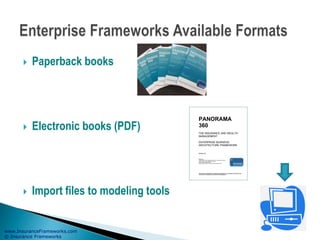
 Paperback books
 Electronic books (PDF)
 Import files to modeling tools
PANORAMA
360
THE INSURANCE AND WEALTH
MANAGEMENT
ENTERPRISE BUSINESS
ARCHITECTURE FRAMEWORK
Version 4.0
Preface by
President and Chief Operating Officer of an Insurance Company
Chief Architect of an Insurance Company
Chair of OMG’s BPMN MIWG
Retired Senior Director, Oracle Insurance Business Unit
THE DEFINITIVE REFERENCE FOR MANAGING ORGANIZATIONS, BUSINESS PROCESSES AND
TECHNOLOGY IN INSURANCE AND WEALTH MANAGEMENT.
www.InsuranceFrameworks.com
© Insurance Frameworks
Panorama 360
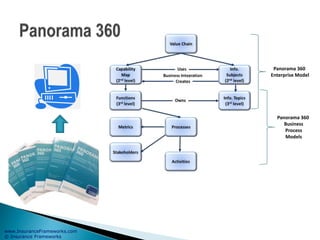
Enterprise Model
Panorama 360
Business
Process
Models
www.InsuranceFrameworks.com
© Insurance Frameworks
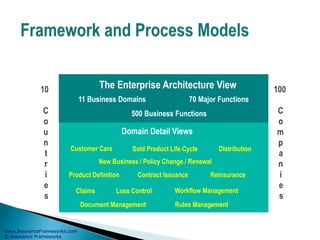
The Enterprise Architecture View
11 Business Domains
500 Business Functions
70 Major Functions
Customer Care Distribution
Product Definition
Sold Product Life Cycle
Rules ManagementDocument Management
Workflow Management
New Business / Policy Change / Renewal
Contract Issuance Reinsurance
Domain Detail Views
Loss ControlClaims
10
C
o
u
n
t
r
i
e
s
100
C
o
m
p
a
n
i
e
s
The Enterprise Architecture ViewThe Enterprise Architecture View
11 Business Domains
500 Business Functions
70 Major Functions
Customer Care Distribution
Product Definition
Sold Product Life Cycle
Rules ManagementDocument Management
Workflow Management
New Business / Policy Change / Renewal
Contract Issuance Reinsurance
Domain Detail Views
Loss ControlClaims
C
o
u
n
t
r
i
e
s
C
o
m
p
a
n
i
e
s
www.InsuranceFrameworks.com
© Insurance Frameworks
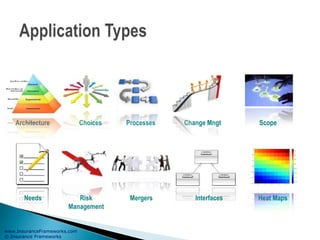
Choices Processes
Mergers
Change MngtArchitecture
Needs Risk
Management
Scope
Interfaces Heat Maps
www.InsuranceFrameworks.com
© Insurance Frameworks
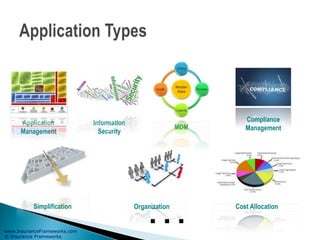
Information
Security
MDM
Application
Management
Compliance
Management
… Cost AllocationOrganizationSimplification
www.InsuranceFrameworks.com
© Insurance Frameworks
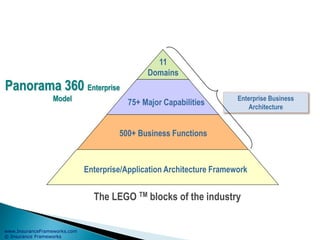
Enterprise Business
Architecture
Panorama 360 Enterprise
Model
The LEGO TM blocks of the industry
11
Domains
75+ Major Capabilities
500+ Business Functions
Enterprise/Application Architecture Framework
www.InsuranceFrameworks.com
© Insurance Frameworks
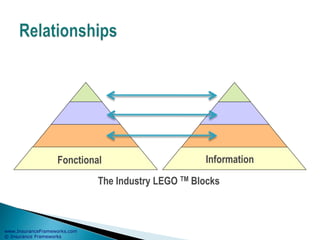
Fonctional Information
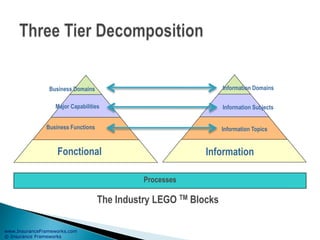
The Industry LEGO TM Blocks
www.InsuranceFrameworks.com
© Insurance Frameworks
Fonctional Information
The Industry LEGO TM Blocks
Business Domains
Major Capabilities
Business Functions
Information Domains
Information Subjects
Information Topics
Processes
www.InsuranceFrameworks.com
© Insurance Frameworks
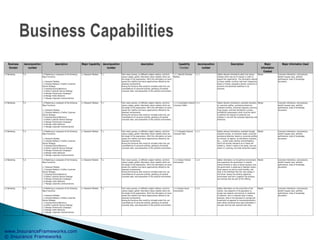
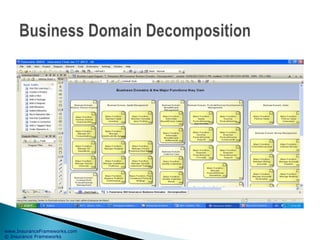
Business
Domain
decomposition
number
description Major Capability decomposition
number
description Capability
Function
decomposition
number
Description Major
Information
Created
Major Information Used
1.0 Marketing 1.0 1.0 Marketing is composed of the following
Major Functions:
1.1 Research Markets
1.2 Develop Markets1.4 Define Customer
Service Strategy
1.3 Develop Buying Behaviour
1.4 Define Customer Service Strategy
1.5 Manage Promotional Campaigns
1.6 Manage Public Relations
1.7 Manage Corporate Communications
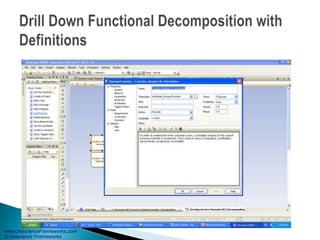
1.1 Research Markets 1.1 From many sources, on different subject matters, and from
various angles, gather information about markets which are
the target of the organization. With this information on hand,
assess the viability and macro-opportunities offered by the
observed environments.
Among the functions that would be included under this, are
consolidations of consumer profiles, gathering of external
consumer data, and assessment of the political environment...
1.1.1 Identify Potential
Markets
1.1.1 Gather relevant information about the various
markets which may be of interest in order to
expand the organization. The information related
to these markets could be high level impressions
based on trends, population growth, evolution of
economy and perceived readiness to do
business.
Market Customer information, sold products,
benefit request case, portfolio
performance, body of knowledge,
documents
1.0 Marketing 1.0 1.0 Marketing is composed of the following
Major Functions:
1.1 Research Markets
1.2 Develop Markets1.4 Define Customer
Service Strategy
1.3 Develop Buying Behaviour
1.4 Define Customer Service Strategy
1.5 Manage Promotional Campaigns
1.6 Manage Public Relations
1.7 Manage Corporate Communications
1.1 Research Markets 1.1 From many sources, on different subject matters, and from
various angles, gather information about markets which are
the target of the organization. With this information on hand,
assess the viability and macro-opportunities offered by the
observed environments.
Among the functions that would be included under this, are
consolidations of consumer profiles, gathering of external
consumer data, and assessment of the political environment...
1.1.2 Consolidate Internal
Consumer Profile
1.1.2 Gather relevant information, available internally,
on customer profiles, purchasing behaviour,
complaint profiles, consumers requests, previous
focus groups, customer satisfaction surveys,
profitability assessments which could be useful
to perform the research of potential new
markets in line with the corporate objectives and
directions.
Market Customer information, sold products,
benefit request case, portfolio
performance, body of knowledge,
documents
1.0 Marketing 1.0 1.0 Marketing is composed of the following
Major Functions:
1.1 Research Markets
1.2 Develop Markets1.4 Define Customer
Service Strategy
1.3 Develop Buying Behaviour
1.4 Define Customer Service Strategy
1.5 Manage Promotional Campaigns
1.6 Manage Public Relations
1.7 Manage Corporate Communications
1.1 Research Markets 1.1 From many sources, on different subject matters, and from
various angles, gather information about markets which are
the target of the organization. With this information on hand,
assess the viability and macro-opportunities offered by the
observed environments.
Among the functions that would be included under this, are
consolidations of consumer profiles, gathering of external
consumer data, and assessment of the political environment...
1.1.3 Integrate External
Consumer Data
1.1.3 Gather relevant information, available through
external sources, on consumer needs, consumer
purchasing behaviour based on consumer profiles
by revenue, by regions, by distribution channels,
etc..., current sales volumes and profitability,
which will provide indicators as to where the
market is, where it seems to be going, how and
where it is growing, and what consumers expect.
Market Customer information, sold products,
benefit request case, portfolio
performance, body of knowledge,
documents
1.0 Marketing 1.0 1.0 Marketing is composed of the following
Major Functions:
1.1 Research Markets
1.2 Develop Markets1.4 Define Customer
Service Strategy
1.3 Develop Buying Behaviour
1.4 Define Customer Service Strategy
1.5 Manage Promotional Campaigns
1.6 Manage Public Relations
1.7 Manage Corporate Communications
1.1 Research Markets 1.1 From many sources, on different subject matters, and from
various angles, gather information about markets which are
the target of the organization. With this information on hand,
assess the viability and macro-opportunities offered by the
observed environments.
Among the functions that would be included under this, are
consolidations of consumer profiles, gathering of external
consumer data, and assessment of the political environment...
1.1.4 Assess Political
Environment
1.1.4 Gather information on the political environment,
how supportive the government is towards
certain products or ways of doing business, how
the government is preparing to legislate certain
fiscal aspects as well as social benefits, and
what is the likelihood that this may change in
the future. Assess the existing regulatory
environment and how it supports the products
and services that are part of the offering.
Market Customer information, sold products,
benefit request case, portfolio
performance, body of knowledge,
documents
1.0 Marketing 1.0 1.0 Marketing is composed of the following
Major Functions:
1.1 Research Markets
1.2 Develop Markets1.4 Define Customer
Service Strategy
1.3 Develop Buying Behaviour
1.4 Define Customer Service Strategy
1.5 Manage Promotional Campaigns
1.6 Manage Public Relations
1.7 Manage Corporate Communications
1.1 Research Markets 1.1 From many sources, on different subject matters, and from
various angles, gather information about markets which are
the target of the organization. With this information on hand,
assess the viability and macro-opportunities offered by the
observed environments.
Among the functions that would be included under this, are
consolidations of consumer profiles, gathering of external
consumer data, and assessment of the political environment...
1.1.5 Assess Social
Environment
1.1.5 Gather information on the social fibre of the
market, how prepared is the population to
accept new products and services or variations
of products, new or improved ways of doing
business, what is the openness to savings and
investment as opposed to insurance/protection,
what others initiatives have been attempted in
the past and how well received were they.
Market Customer information, sold products,
benefit request case, portfolio
performance, body of knowledge,
documents
www.InsuranceFrameworks.com
© Insurance Frameworks
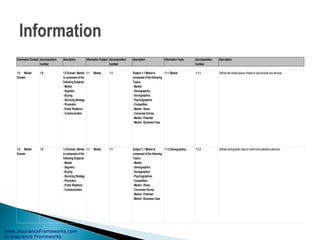
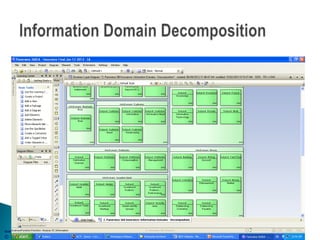
Information Domain decomposition
number
description Information Subject decomposition
number
description Information Topic decomposition
number
Description
1.0 Market
Domain
1.0 1.0 Domain: Market
is composed of the
following Subjects:
- Market
- Segment
- Buying
- Servicing Strategy
- Promotion
- Public Relations
- Communication
1.1 Market 1.1 Subject 1.1 Market is
composed of the following
Topics:
- Market
- Demographics
- Sociographics
- Psychographics
- Competition
- Market - Share
- Consumer Survey
- Market - Potential
- Market - Business Case
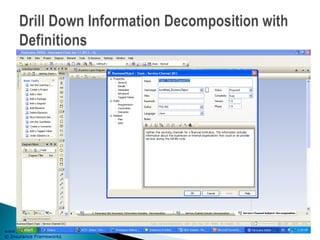
1.1.1 Market 1.1.1 Defines the marketplaces chosento sellproducts and services.
1.0 Market
Domain
1.0 1.0 Domain: Market
is composed of the
following Subjects:
- Market
- Segment
- Buying
- Servicing Strategy
- Promotion
- Public Relations
- Communication
1.1 Market 1.1 Subject 1.1 Market is
composed of the following
Topics:
- Market
- Demographics
- Sociographics
- Psychographics
- Competition
- Market - Share
- Consumer Survey
- Market - Potential
- Market - Business Case
1.1.2 Demographics 1.1.2 Defines demographic data ofcurrentand potentialcustomers.
www.InsuranceFrameworks.com
© Insurance Frameworks
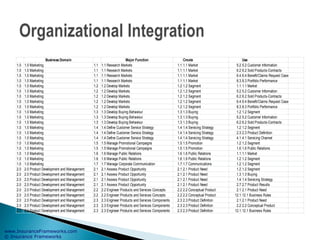
Business Domain Major Function Create Use
1.0 1.0 Marketing 1.1 1.1 Research Markets 1.1 1.1 Market 5.2 5.2 Customer Information
1.0 1.0 Marketing 1.1 1.1 Research Markets 1.1 1.1 Market 6.2 6.2 Sold Products-Contracts
1.0 1.0 Marketing 1.1 1.1 Research Markets 1.1 1.1 Market 6.4 6.4 Benefit/Claims Request Case
1.0 1.0 Marketing 1.1 1.1 Research Markets 1.1 1.1 Market 8.3 8.3 Portfolio Performance
1.0 1.0 Marketing 1.2 1.2 Develop Markets 1.2 1.2 Segment 1.1 1.1 Market
1.0 1.0 Marketing 1.2 1.2 Develop Markets 1.2 1.2 Segment 5.2 5.2 Customer Information
1.0 1.0 Marketing 1.2 1.2 Develop Markets 1.2 1.2 Segment 6.2 6.2 Sold Products-Contracts
1.0 1.0 Marketing 1.2 1.2 Develop Markets 1.2 1.2 Segment 6.4 6.4 Benefit/Claims Request Case
1.0 1.0 Marketing 1.2 1.2 Develop Markets 1.2 1.2 Segment 8.3 8.3 Portfolio Performance
1.0 1.0 Marketing 1.3 1.3 Develop Buying Behaviour 1.3 1.3 Buying 1.2 1.2 Segment
1.0 1.0 Marketing 1.3 1.3 Develop Buying Behaviour 1.3 1.3 Buying 5.2 5.2 Customer Information
1.0 1.0 Marketing 1.3 1.3 Develop Buying Behaviour 1.3 1.3 Buying 6.2 6.2 Sold Products-Contracts
1.0 1.0 Marketing 1.4 1.4 Define Customer Service Strategy 1.4 1.4 Servicing Strategy 1.2 1.2 Segment
1.0 1.0 Marketing 1.4 1.4 Define Customer Service Strategy 1.4 1.4 Servicing Strategy 2.3 2.3 Product Definition
1.0 1.0 Marketing 1.4 1.4 Define Customer Service Strategy 1.4 1.4 Servicing Strategy 4.1 4.1 Servicing Channel
1.0 1.0 Marketing 1.5 1.5 Manage Promotional Campaigns 1.5 1.5 Promotion 1.2 1.2 Segment
1.0 1.0 Marketing 1.5 1.5 Manage Promotional Campaigns 1.5 1.5 Promotion 1.6 1.6 Public Relations
1.0 1.0 Marketing 1.6 1.6 Manage Public Relations 1.6 1.6 Public Relations 1.1 1.1 Market
1.0 1.0 Marketing 1.6 1.6 Manage Public Relations 1.6 1.6 Public Relations 1.2 1.2 Segment
1.0 1.0 Marketing 1.7 1.7 Manage Corporate Communication 1.7 1.7 Communications 1.2 1.2 Segment
2.0 2.0 Product Development and Management 2.1 2.1 Assess Product Opportunity 2.1 2.1 Product Need 1.2 1.2 Segment
2.0 2.0 Product Development and Management 2.1 2.1 Assess Product Opportunity 2.1 2.1 Product Need 1.3 1.3 Buying
2.0 2.0 Product Development and Management 2.1 2.1 Assess Product Opportunity 2.1 2.1 Product Need 1.4 1.4 Servicing Strategy
2.0 2.0 Product Development and Management 2.1 2.1 Assess Product Opportunity 2.1 2.1 Product Need 2.7 2.7 Product Results
2.0 2.0 Product Development and Management 2.2 2.2 Engineer Products and Services Concepts 2.2 2.2 Conceptual Product 2.1 2.1 Product Need
2.0 2.0 Product Development and Management 2.2 2.2 Engineer Products and Services Concepts 2.2 2.2 Conceptual Product 12.1 12.1 Business Rules
2.0 2.0 Product Development and Management 2.3 2.3 Engineer Products and Services Components 2.3 2.3 Product Definition 2.1 2.1 Product Need
2.0 2.0 Product Development and Management 2.3 2.3 Engineer Products and Services Components 2.3 2.3 Product Definition 2.2 2.2 Conceptual Product
2.0 2.0 Product Development and Management 2.3 2.3 Engineer Products and Services Components 2.3 2.3 Product Definition 12.1 12.1 Business Rules
www.InsuranceFrameworks.com
© Insurance Frameworks
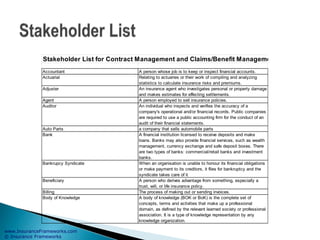
Stakeholder List for Contract Management and Claims/Benefit Management
Accountant A person whose job is to keep or inspect financial accounts.
Actuarial Relating to actuaries or their work of compiling and analyzing
statistics to calculate insurance risks and premiums.
Adjuster An insurance agent who investigates personal or property damage
and makes estimates for effecting settlements.
Agent A person employed to sell insurance policies.
Auditor An individual who inspects and verifies the accuracy of a
company's operational and/or financial records. Public companies
are required to use a public accounting firm for the conduct of an
audit of their financial statements.
Auto Parts a company that sells automobile parts
Bank A financial institution licensed to receive deposits and make
loans. Banks may also provide financial services, such as wealth
management, currency exchange and safe deposit boxes. There
are two types of banks: commercial/retail banks and investment
banks.
Bankrupcy Syndicate When an organisation is unable to honour its financial obligations
or make payment to its creditors, it files for bankruptcy and the
syndicate takes care of it
Beneficiary A person who derives advantage from something, especially a
trust, will, or life insurance policy.
Billing The process of making out or sending invoices.
Body of Knowledge A body of knowledge (BOK or BoK) is the complete set of
concepts, terms and activities that make up a professional
domain, as defined by the relevant learned society or professional
association. It is a type of knowledge representation by any
knowledge organization.
www.InsuranceFrameworks.com
© Insurance Frameworks
www.InsuranceFrameworks.com
© Insurance Frameworks
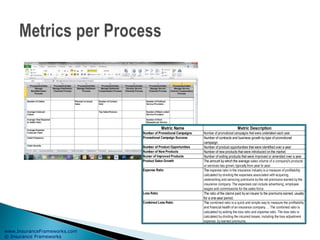
Metric Name Metric Description
Number of Promotional Campaigns Number of promotional campaigns that were undertaken each year.
Promotional Campaign Success Number of contracts and business growth by type of promotional
campaign
Number of Product Opportunities Number of product opportunities that were identified over a year
Number of New Products Number of new products that were introduced on the market
Numer of Improved Products Number of exiting products that were improved or amended over a year
Product Sales Growth The amount by which the average sales volume of a company's products
or services has grown, typically from year to year.
Expense Ratio The expense ratio in the insurance industry is a measure of profitability
calculated by dividing the expenses associated with acquiring,
underwriting and servicing premiums by the net premiums earned by the
insurance company. The expenses can include advertising, employee
wages and commissions for the sales force.
Loss Ratio The ratio of the claims paid by an insurer to the premiums earned, usually
for a one-year period.
Combined Loss Ratio The combined ratio is a quick and simple way to measure the profitability
and financial health of an insurance company. ... The combined ratio is
calculated by adding the loss ratio and expense ratio. The loss ratio is
calculated by dividing the incurred losses, including the loss adjustment
expense, by earned premiums.
www.InsuranceFrameworks.com
© Insurance Frameworks
www.InsuranceFrameworks.com
© Insurance Frameworks
www.InsuranceFrameworks.com
© Insurance Frameworks
www.InsuranceFrameworks.com
© Insurance Frameworks
www.InsuranceFrameworks.com
© Insurance Frameworks
www.InsuranceFrameworks.com
© Insurance Frameworks
www.InsuranceFrameworks.com
© Insurance Frameworks
www.InsuranceFrameworks.com
© Insurance Frameworks
www.InsuranceFrameworks.com
© Insurance Frameworks
www.InsuranceFrameworks.com
© Insurance Frameworks
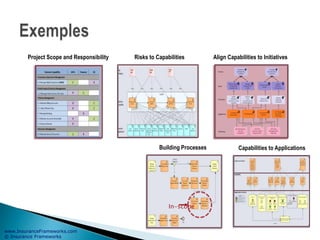
Project Scope and Responsibility Align Capabilities to Initiatives
In-scope
Building Processes Capabilities to Applications
Risks to Capabilities
www.InsuranceFrameworks.com
© Insurance Frameworks
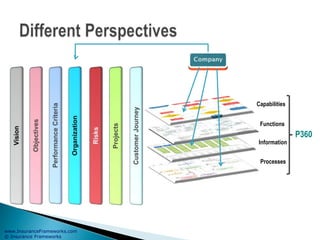
P360
Capabilities
Functions
Processes
Information
www.InsuranceFrameworks.com
© Insurance Frameworks
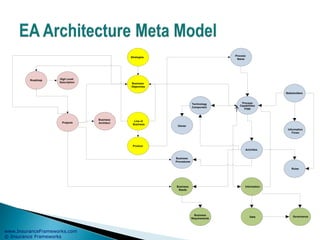
Process
Name
Process
Capabilities
P360
Roadmap
Projects
Business
Architect
High Level
Description
Information
Procedures
Business
Line of
Business
Business
Needs
Business
Requirements
Activities
Stakeholders
Technology
Component
Data Governance
Product
Information
Flows
Business
Objectives
Roles
Owner
Strategies
www.InsuranceFrameworks.com
© Insurance Frameworks
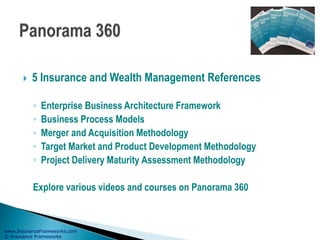
 5 Insurance and Wealth Management References
◦ Enterprise Business Architecture Framework
◦ Business Process Models
◦ Merger and Acquisition Methodology
◦ Target Market and Product Development Methodology
◦ Project Delivery Maturity Assessment Methodology
Explore various videos and courses on Panorama 360
www.InsuranceFrameworks.com
© Insurance Frameworks
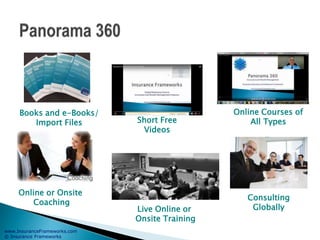
Books and e-Books/
Import Files Short Free
Videos
Online Courses of
All Types
Online or Onsite
Coaching
Live Online or
Onsite Training
Consulting
Globally
www.InsuranceFrameworks.com
© Insurance Frameworks
www.InsuranceFrameworks.com

Panorama 360 import file

  • 2.
  • 3.
    www.InsuranceFrameworks.com © Insurance Frameworks Paperback books  Electronic books (PDF)  Import files to modeling tools PANORAMA 360 THE INSURANCE AND WEALTH MANAGEMENT ENTERPRISE BUSINESS ARCHITECTURE FRAMEWORK Version 4.0 Preface by President and Chief Operating Officer of an Insurance Company Chief Architect of an Insurance Company Chair of OMG’s BPMN MIWG Retired Senior Director, Oracle Insurance Business Unit THE DEFINITIVE REFERENCE FOR MANAGING ORGANIZATIONS, BUSINESS PROCESSES AND TECHNOLOGY IN INSURANCE AND WEALTH MANAGEMENT.
  • 4.
    www.InsuranceFrameworks.com © Insurance Frameworks Panorama360 Enterprise Model Panorama 360 Business Process Models
  • 5.
    www.InsuranceFrameworks.com © Insurance Frameworks TheEnterprise Architecture View 11 Business Domains 500 Business Functions 70 Major Functions Customer Care Distribution Product Definition Sold Product Life Cycle Rules ManagementDocument Management Workflow Management New Business / Policy Change / Renewal Contract Issuance Reinsurance Domain Detail Views Loss ControlClaims 10 C o u n t r i e s 100 C o m p a n i e s The Enterprise Architecture ViewThe Enterprise Architecture View 11 Business Domains 500 Business Functions 70 Major Functions Customer Care Distribution Product Definition Sold Product Life Cycle Rules ManagementDocument Management Workflow Management New Business / Policy Change / Renewal Contract Issuance Reinsurance Domain Detail Views Loss ControlClaims C o u n t r i e s C o m p a n i e s
  • 6.
    www.InsuranceFrameworks.com © Insurance Frameworks ChoicesProcesses Mergers Change MngtArchitecture Needs Risk Management Scope Interfaces Heat Maps
  • 7.
  • 8.
    www.InsuranceFrameworks.com © Insurance Frameworks EnterpriseBusiness Architecture Panorama 360 Enterprise Model The LEGO TM blocks of the industry 11 Domains 75+ Major Capabilities 500+ Business Functions Enterprise/Application Architecture Framework
  • 9.
  • 10.
    www.InsuranceFrameworks.com © Insurance Frameworks FonctionalInformation The Industry LEGO TM Blocks Business Domains Major Capabilities Business Functions Information Domains Information Subjects Information Topics Processes
  • 11.
    www.InsuranceFrameworks.com © Insurance Frameworks Business Domain decomposition number descriptionMajor Capability decomposition number description Capability Function decomposition number Description Major Information Created Major Information Used 1.0 Marketing 1.0 1.0 Marketing is composed of the following Major Functions: 1.1 Research Markets 1.2 Develop Markets1.4 Define Customer Service Strategy 1.3 Develop Buying Behaviour 1.4 Define Customer Service Strategy 1.5 Manage Promotional Campaigns 1.6 Manage Public Relations 1.7 Manage Corporate Communications 1.1 Research Markets 1.1 From many sources, on different subject matters, and from various angles, gather information about markets which are the target of the organization. With this information on hand, assess the viability and macro-opportunities offered by the observed environments. Among the functions that would be included under this, are consolidations of consumer profiles, gathering of external consumer data, and assessment of the political environment... 1.1.1 Identify Potential Markets 1.1.1 Gather relevant information about the various markets which may be of interest in order to expand the organization. The information related to these markets could be high level impressions based on trends, population growth, evolution of economy and perceived readiness to do business. Market Customer information, sold products, benefit request case, portfolio performance, body of knowledge, documents 1.0 Marketing 1.0 1.0 Marketing is composed of the following Major Functions: 1.1 Research Markets 1.2 Develop Markets1.4 Define Customer Service Strategy 1.3 Develop Buying Behaviour 1.4 Define Customer Service Strategy 1.5 Manage Promotional Campaigns 1.6 Manage Public Relations 1.7 Manage Corporate Communications 1.1 Research Markets 1.1 From many sources, on different subject matters, and from various angles, gather information about markets which are the target of the organization. With this information on hand, assess the viability and macro-opportunities offered by the observed environments. Among the functions that would be included under this, are consolidations of consumer profiles, gathering of external consumer data, and assessment of the political environment... 1.1.2 Consolidate Internal Consumer Profile 1.1.2 Gather relevant information, available internally, on customer profiles, purchasing behaviour, complaint profiles, consumers requests, previous focus groups, customer satisfaction surveys, profitability assessments which could be useful to perform the research of potential new markets in line with the corporate objectives and directions. Market Customer information, sold products, benefit request case, portfolio performance, body of knowledge, documents 1.0 Marketing 1.0 1.0 Marketing is composed of the following Major Functions: 1.1 Research Markets 1.2 Develop Markets1.4 Define Customer Service Strategy 1.3 Develop Buying Behaviour 1.4 Define Customer Service Strategy 1.5 Manage Promotional Campaigns 1.6 Manage Public Relations 1.7 Manage Corporate Communications 1.1 Research Markets 1.1 From many sources, on different subject matters, and from various angles, gather information about markets which are the target of the organization. With this information on hand, assess the viability and macro-opportunities offered by the observed environments. Among the functions that would be included under this, are consolidations of consumer profiles, gathering of external consumer data, and assessment of the political environment... 1.1.3 Integrate External Consumer Data 1.1.3 Gather relevant information, available through external sources, on consumer needs, consumer purchasing behaviour based on consumer profiles by revenue, by regions, by distribution channels, etc..., current sales volumes and profitability, which will provide indicators as to where the market is, where it seems to be going, how and where it is growing, and what consumers expect. Market Customer information, sold products, benefit request case, portfolio performance, body of knowledge, documents 1.0 Marketing 1.0 1.0 Marketing is composed of the following Major Functions: 1.1 Research Markets 1.2 Develop Markets1.4 Define Customer Service Strategy 1.3 Develop Buying Behaviour 1.4 Define Customer Service Strategy 1.5 Manage Promotional Campaigns 1.6 Manage Public Relations 1.7 Manage Corporate Communications 1.1 Research Markets 1.1 From many sources, on different subject matters, and from various angles, gather information about markets which are the target of the organization. With this information on hand, assess the viability and macro-opportunities offered by the observed environments. Among the functions that would be included under this, are consolidations of consumer profiles, gathering of external consumer data, and assessment of the political environment... 1.1.4 Assess Political Environment 1.1.4 Gather information on the political environment, how supportive the government is towards certain products or ways of doing business, how the government is preparing to legislate certain fiscal aspects as well as social benefits, and what is the likelihood that this may change in the future. Assess the existing regulatory environment and how it supports the products and services that are part of the offering. Market Customer information, sold products, benefit request case, portfolio performance, body of knowledge, documents 1.0 Marketing 1.0 1.0 Marketing is composed of the following Major Functions: 1.1 Research Markets 1.2 Develop Markets1.4 Define Customer Service Strategy 1.3 Develop Buying Behaviour 1.4 Define Customer Service Strategy 1.5 Manage Promotional Campaigns 1.6 Manage Public Relations 1.7 Manage Corporate Communications 1.1 Research Markets 1.1 From many sources, on different subject matters, and from various angles, gather information about markets which are the target of the organization. With this information on hand, assess the viability and macro-opportunities offered by the observed environments. Among the functions that would be included under this, are consolidations of consumer profiles, gathering of external consumer data, and assessment of the political environment... 1.1.5 Assess Social Environment 1.1.5 Gather information on the social fibre of the market, how prepared is the population to accept new products and services or variations of products, new or improved ways of doing business, what is the openness to savings and investment as opposed to insurance/protection, what others initiatives have been attempted in the past and how well received were they. Market Customer information, sold products, benefit request case, portfolio performance, body of knowledge, documents
  • 12.
    www.InsuranceFrameworks.com © Insurance Frameworks InformationDomain decomposition number description Information Subject decomposition number description Information Topic decomposition number Description 1.0 Market Domain 1.0 1.0 Domain: Market is composed of the following Subjects: - Market - Segment - Buying - Servicing Strategy - Promotion - Public Relations - Communication 1.1 Market 1.1 Subject 1.1 Market is composed of the following Topics: - Market - Demographics - Sociographics - Psychographics - Competition - Market - Share - Consumer Survey - Market - Potential - Market - Business Case 1.1.1 Market 1.1.1 Defines the marketplaces chosento sellproducts and services. 1.0 Market Domain 1.0 1.0 Domain: Market is composed of the following Subjects: - Market - Segment - Buying - Servicing Strategy - Promotion - Public Relations - Communication 1.1 Market 1.1 Subject 1.1 Market is composed of the following Topics: - Market - Demographics - Sociographics - Psychographics - Competition - Market - Share - Consumer Survey - Market - Potential - Market - Business Case 1.1.2 Demographics 1.1.2 Defines demographic data ofcurrentand potentialcustomers.
  • 13.
    www.InsuranceFrameworks.com © Insurance Frameworks BusinessDomain Major Function Create Use 1.0 1.0 Marketing 1.1 1.1 Research Markets 1.1 1.1 Market 5.2 5.2 Customer Information 1.0 1.0 Marketing 1.1 1.1 Research Markets 1.1 1.1 Market 6.2 6.2 Sold Products-Contracts 1.0 1.0 Marketing 1.1 1.1 Research Markets 1.1 1.1 Market 6.4 6.4 Benefit/Claims Request Case 1.0 1.0 Marketing 1.1 1.1 Research Markets 1.1 1.1 Market 8.3 8.3 Portfolio Performance 1.0 1.0 Marketing 1.2 1.2 Develop Markets 1.2 1.2 Segment 1.1 1.1 Market 1.0 1.0 Marketing 1.2 1.2 Develop Markets 1.2 1.2 Segment 5.2 5.2 Customer Information 1.0 1.0 Marketing 1.2 1.2 Develop Markets 1.2 1.2 Segment 6.2 6.2 Sold Products-Contracts 1.0 1.0 Marketing 1.2 1.2 Develop Markets 1.2 1.2 Segment 6.4 6.4 Benefit/Claims Request Case 1.0 1.0 Marketing 1.2 1.2 Develop Markets 1.2 1.2 Segment 8.3 8.3 Portfolio Performance 1.0 1.0 Marketing 1.3 1.3 Develop Buying Behaviour 1.3 1.3 Buying 1.2 1.2 Segment 1.0 1.0 Marketing 1.3 1.3 Develop Buying Behaviour 1.3 1.3 Buying 5.2 5.2 Customer Information 1.0 1.0 Marketing 1.3 1.3 Develop Buying Behaviour 1.3 1.3 Buying 6.2 6.2 Sold Products-Contracts 1.0 1.0 Marketing 1.4 1.4 Define Customer Service Strategy 1.4 1.4 Servicing Strategy 1.2 1.2 Segment 1.0 1.0 Marketing 1.4 1.4 Define Customer Service Strategy 1.4 1.4 Servicing Strategy 2.3 2.3 Product Definition 1.0 1.0 Marketing 1.4 1.4 Define Customer Service Strategy 1.4 1.4 Servicing Strategy 4.1 4.1 Servicing Channel 1.0 1.0 Marketing 1.5 1.5 Manage Promotional Campaigns 1.5 1.5 Promotion 1.2 1.2 Segment 1.0 1.0 Marketing 1.5 1.5 Manage Promotional Campaigns 1.5 1.5 Promotion 1.6 1.6 Public Relations 1.0 1.0 Marketing 1.6 1.6 Manage Public Relations 1.6 1.6 Public Relations 1.1 1.1 Market 1.0 1.0 Marketing 1.6 1.6 Manage Public Relations 1.6 1.6 Public Relations 1.2 1.2 Segment 1.0 1.0 Marketing 1.7 1.7 Manage Corporate Communication 1.7 1.7 Communications 1.2 1.2 Segment 2.0 2.0 Product Development and Management 2.1 2.1 Assess Product Opportunity 2.1 2.1 Product Need 1.2 1.2 Segment 2.0 2.0 Product Development and Management 2.1 2.1 Assess Product Opportunity 2.1 2.1 Product Need 1.3 1.3 Buying 2.0 2.0 Product Development and Management 2.1 2.1 Assess Product Opportunity 2.1 2.1 Product Need 1.4 1.4 Servicing Strategy 2.0 2.0 Product Development and Management 2.1 2.1 Assess Product Opportunity 2.1 2.1 Product Need 2.7 2.7 Product Results 2.0 2.0 Product Development and Management 2.2 2.2 Engineer Products and Services Concepts 2.2 2.2 Conceptual Product 2.1 2.1 Product Need 2.0 2.0 Product Development and Management 2.2 2.2 Engineer Products and Services Concepts 2.2 2.2 Conceptual Product 12.1 12.1 Business Rules 2.0 2.0 Product Development and Management 2.3 2.3 Engineer Products and Services Components 2.3 2.3 Product Definition 2.1 2.1 Product Need 2.0 2.0 Product Development and Management 2.3 2.3 Engineer Products and Services Components 2.3 2.3 Product Definition 2.2 2.2 Conceptual Product 2.0 2.0 Product Development and Management 2.3 2.3 Engineer Products and Services Components 2.3 2.3 Product Definition 12.1 12.1 Business Rules
  • 14.
    www.InsuranceFrameworks.com © Insurance Frameworks StakeholderList for Contract Management and Claims/Benefit Management Accountant A person whose job is to keep or inspect financial accounts. Actuarial Relating to actuaries or their work of compiling and analyzing statistics to calculate insurance risks and premiums. Adjuster An insurance agent who investigates personal or property damage and makes estimates for effecting settlements. Agent A person employed to sell insurance policies. Auditor An individual who inspects and verifies the accuracy of a company's operational and/or financial records. Public companies are required to use a public accounting firm for the conduct of an audit of their financial statements. Auto Parts a company that sells automobile parts Bank A financial institution licensed to receive deposits and make loans. Banks may also provide financial services, such as wealth management, currency exchange and safe deposit boxes. There are two types of banks: commercial/retail banks and investment banks. Bankrupcy Syndicate When an organisation is unable to honour its financial obligations or make payment to its creditors, it files for bankruptcy and the syndicate takes care of it Beneficiary A person who derives advantage from something, especially a trust, will, or life insurance policy. Billing The process of making out or sending invoices. Body of Knowledge A body of knowledge (BOK or BoK) is the complete set of concepts, terms and activities that make up a professional domain, as defined by the relevant learned society or professional association. It is a type of knowledge representation by any knowledge organization.
  • 15.
  • 16.
    www.InsuranceFrameworks.com © Insurance Frameworks MetricName Metric Description Number of Promotional Campaigns Number of promotional campaigns that were undertaken each year. Promotional Campaign Success Number of contracts and business growth by type of promotional campaign Number of Product Opportunities Number of product opportunities that were identified over a year Number of New Products Number of new products that were introduced on the market Numer of Improved Products Number of exiting products that were improved or amended over a year Product Sales Growth The amount by which the average sales volume of a company's products or services has grown, typically from year to year. Expense Ratio The expense ratio in the insurance industry is a measure of profitability calculated by dividing the expenses associated with acquiring, underwriting and servicing premiums by the net premiums earned by the insurance company. The expenses can include advertising, employee wages and commissions for the sales force. Loss Ratio The ratio of the claims paid by an insurer to the premiums earned, usually for a one-year period. Combined Loss Ratio The combined ratio is a quick and simple way to measure the profitability and financial health of an insurance company. ... The combined ratio is calculated by adding the loss ratio and expense ratio. The loss ratio is calculated by dividing the incurred losses, including the loss adjustment expense, by earned premiums.
  • 17.
  • 18.
  • 19.
  • 20.
  • 21.
  • 22.
  • 23.
  • 24.
  • 25.
  • 26.
    www.InsuranceFrameworks.com © Insurance Frameworks ProjectScope and Responsibility Align Capabilities to Initiatives In-scope Building Processes Capabilities to Applications Risks to Capabilities
  • 27.
  • 28.
    www.InsuranceFrameworks.com © Insurance Frameworks Process Name Process Capabilities P360 Roadmap Projects Business Architect HighLevel Description Information Procedures Business Line of Business Business Needs Business Requirements Activities Stakeholders Technology Component Data Governance Product Information Flows Business Objectives Roles Owner Strategies
  • 29.
    www.InsuranceFrameworks.com © Insurance Frameworks 5 Insurance and Wealth Management References ◦ Enterprise Business Architecture Framework ◦ Business Process Models ◦ Merger and Acquisition Methodology ◦ Target Market and Product Development Methodology ◦ Project Delivery Maturity Assessment Methodology Explore various videos and courses on Panorama 360
  • 30.
    www.InsuranceFrameworks.com © Insurance Frameworks Booksand e-Books/ Import Files Short Free Videos Online Courses of All Types Online or Onsite Coaching Live Online or Onsite Training Consulting Globally
  • 31.