Sales & Operation Planning Process
Prepared By:
Dipesh Kashinath Pabrekar
Sales & Operations Planning – S&OP Definition
A process to develop tactical plans that provide management the ability
to strategically direct its businesses to achieve continuous basis by
integrating customer-focused marketing plans for new and existing
competitive advantage on products with the management of the supply
chain. The process brings together all the plans for the business (sales,
marketing, development, manufacturing, sourcing, and financial) into one
integrated set of plans.
Demand & Supply Challenges
Poor
coordination of
demand &
supply
Lack of
documented
processes/ SOP’s
Breakdown in
communication
due to lack of
quality and
availability of
data
Lack of
leadership in
getting
agreement on
S&OP Plans
Lack the right
metrics to drive
value or to
determine same
Challenges
Need for S&OP
Supply interruptions, on
time delivery issue, lower
profits and/ or loss of sale
Excessive on hand
inventories & obsolescence
Absence of teamwork &
shared risk management
among internal functions
Material/product
shortages- increased
expediting
Unacceptable lead timesPoor collaboration among
the stakeholders-
internal/external (finger-
pointing)
Ineffective utilization of
resources, and /or lack or
resources when needed
Bottlenecks and constraints
management on the supply
side
To Manage
Objective of S&OP
Supports and measures the business plan
Ensures that the strategic plans are realistic before being
passed to tactical planning
Enables the organization to effectively manage changes to
plans
Provides for the effective management of finished goods
inventories and order backlog to support customer service
Enables performance measurement to identify when actual
performance has deviated from the plan
Enables the organization to be focused, aligned, and
engaged.
Major Attributes of S&OP
Connects business planning to tactical planning.
Balances supply and demand at the product family level
Enables in a better understanding of the customer and market
opportunities and company capabilities
Involves sales, marketing, manufacturing, logistics, finance, and
other departments
S&OP is a demand- and strategy-driven process
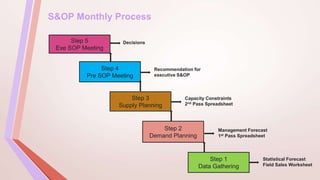
S&OP Monthly Process
Step 5
Exe SOP Meeting
Step 4
Pre SOP Meeting
Step 3
Supply Planning
Step 2
Demand Planning
Step 1
Data Gathering
Statistical Forecast
Field Sales Worksheet
Management Forecast
1st Pass Spreadsheet
Capacity Constraints
2nd Pass Spreadsheet
Recommendation for
executive S&OP
Decisions
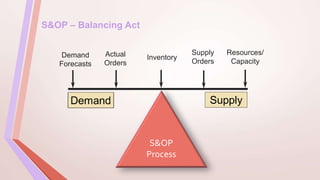
S&OP – Balancing Act
S&OP
Process
Supply
Demand
Forecasts
Actual
Orders
Inventory
Supply
Orders
Resources/
Capacity
Pillars of Successful S&OP
S&OPTieredPlanning
Integratedsub
process
Leadership
Accountability
DeepAnalysis
PerformanceMatrix
GridsandGraphs
Continuous Improvement
Benefits of S&OP
 Ideas for process improvement come from the S&OP team participants – hence more
realistic
 S&OP enables continuous monitoring, feedback, and sharing of improvement ideas
 Once S&OP teams see their ideas are heard, they will continually seek ways to
improve their own performance
 Encourages employees to take ownership and reinforces team working, thereby
improving level of motivation
 Establishes operational plans consistent with the business plan
 Continually updates the production, financial, and sales plan
 Provides for cross-functional planning
 Establishes regular meetings with senior executives to resolve demand versus supply
trade-offs
 Checks availability of resources to validate the production plan
 Increases teamwork and collaborative skills
Thank you

Sales & Operation planning process

  • 1.
    Sales & OperationPlanning Process Prepared By: Dipesh Kashinath Pabrekar
  • 2.
    Sales & OperationsPlanning – S&OP Definition A process to develop tactical plans that provide management the ability to strategically direct its businesses to achieve continuous basis by integrating customer-focused marketing plans for new and existing competitive advantage on products with the management of the supply chain. The process brings together all the plans for the business (sales, marketing, development, manufacturing, sourcing, and financial) into one integrated set of plans.
  • 3.
    Demand & SupplyChallenges Poor coordination of demand & supply Lack of documented processes/ SOP’s Breakdown in communication due to lack of quality and availability of data Lack of leadership in getting agreement on S&OP Plans Lack the right metrics to drive value or to determine same Challenges
  • 4.
    Need for S&OP Supplyinterruptions, on time delivery issue, lower profits and/ or loss of sale Excessive on hand inventories & obsolescence Absence of teamwork & shared risk management among internal functions Material/product shortages- increased expediting Unacceptable lead timesPoor collaboration among the stakeholders- internal/external (finger- pointing) Ineffective utilization of resources, and /or lack or resources when needed Bottlenecks and constraints management on the supply side To Manage
  • 5.
    Objective of S&OP Supportsand measures the business plan Ensures that the strategic plans are realistic before being passed to tactical planning Enables the organization to effectively manage changes to plans Provides for the effective management of finished goods inventories and order backlog to support customer service Enables performance measurement to identify when actual performance has deviated from the plan Enables the organization to be focused, aligned, and engaged.
  • 6.
    Major Attributes ofS&OP Connects business planning to tactical planning. Balances supply and demand at the product family level Enables in a better understanding of the customer and market opportunities and company capabilities Involves sales, marketing, manufacturing, logistics, finance, and other departments S&OP is a demand- and strategy-driven process
  • 7.
    S&OP Monthly Process Step5 Exe SOP Meeting Step 4 Pre SOP Meeting Step 3 Supply Planning Step 2 Demand Planning Step 1 Data Gathering Statistical Forecast Field Sales Worksheet Management Forecast 1st Pass Spreadsheet Capacity Constraints 2nd Pass Spreadsheet Recommendation for executive S&OP Decisions
  • 8.
    S&OP – BalancingAct S&OP Process Supply Demand Forecasts Actual Orders Inventory Supply Orders Resources/ Capacity
  • 9.
    Pillars of SuccessfulS&OP S&OPTieredPlanning Integratedsub process Leadership Accountability DeepAnalysis PerformanceMatrix GridsandGraphs Continuous Improvement
  • 10.
    Benefits of S&OP Ideas for process improvement come from the S&OP team participants – hence more realistic  S&OP enables continuous monitoring, feedback, and sharing of improvement ideas  Once S&OP teams see their ideas are heard, they will continually seek ways to improve their own performance  Encourages employees to take ownership and reinforces team working, thereby improving level of motivation  Establishes operational plans consistent with the business plan  Continually updates the production, financial, and sales plan  Provides for cross-functional planning  Establishes regular meetings with senior executives to resolve demand versus supply trade-offs  Checks availability of resources to validate the production plan  Increases teamwork and collaborative skills
  • 11.