PANORAMA
360
THE INSURANCE AND WEALTH
MANAGEMENT
MERGER AND ACQUISISION
METHODOLOGY
Version 3.0
THE DEFINITIVE REFERENCE FOR MANAGING INSURANCE AND
WEALTH MANAGEMENT MERGERS AND ACQUISITIONS.
Panorama 360 - Merger and Acquisition Methodology
1
©Copyright – All rights reserved.
Panorama 360 is distributed and published by Insurance Frameworks Inc.
(www.InsuranceFrameworks.com).
Formerly, Panorama 360 was called Vista.
©1997, 2002, 2011, 2017
Version 0.0 published 1997, version 1.0 published 2002, version 2.0 published 2011, version 3.0
published 2017.
ISBN-13: 978-1544103693
ISBN-10: 1544103697
Panorama 360 - Merger and Acquisition Methodology
2
Table of Contents
INTRODUCTION ..................................................................................................3
APPROACH .........................................................................................................4
1.0 Marketing................................................................................................ 7
2.0 Product Development and Management.................................................12
3.0 Distribution and Sales .............................................................................16
4.0 Alliance Service Channels........................................................................21
5.0 Customer Care.........................................................................................25
6.0 Sold Product Services and Management..................................................29
7.0 Money Management...............................................................................34
8.0 Asset Management .................................................................................38
9.0 Business Management ............................................................................42
10.0 Infrastructure Development and Management .......................................46
11.0 Organization Management......................................................................51
CONCLUSION....................................................................................................54
Panorama 360 - Merger and Acquisition Methodology
3
Introduction
The financial services industry is consolidating constantly. Each year,
several companies enter into merger and acquisition agreements in order
to grow and gain infrastructure efficiencies and to acquire new clients.
Unfortunately, a number of these mergers and acquisitions do not deliver
the expected cost savings or revenue synergies.
Many merger initiatives drag on endlessly. There is often insufficient
understanding of what is being merged or purchased. The plan to align the
two organizations is often superficial. The subsequent steps and
accountabilities to ensure that benefits are delivered are not specified.
Cultures clash over processes and information technology. These factors
can make the difference between success and failure. A structured and
focused management approach to planning merger projects contributes to
success in building a thriving new business entity.
In order to manage a successful merger project, a multi-disciplinary project
team needs to actively participate throughout the project. This team is
responsible for managing change.
Depending on the vision, the business objectives and the nature of the
agreement between the two companies, a number of areas within the
acquired organization need to be adjusted in order to integrate it with the
acquiring organization. To achieve a successful merger and acquisition
project, it is important to thoroughly scope the project, identifying all the
activities that need to happen.
Panorama 360 - Merger and Acquisition Methodology
4
Approach
To support merger and acquisition projects, a project checklist has been
developed to support the project team during the planning phase. This
approach can is used by any organization operating in the Financial
Services industry value chain, either in preparation for an acquisition or as
a result of a merger agreement. Users of this approach can be insurance
companies, bank, credit unions, brokers, investment advisors, fund
managers, etc…
More than 300 merger and acquisition oriented questions have been
developed using the Panorama 360 – Insurance and Wealth Management
Enterprise Business Architecture Framework book.
This list of questions should be used as a checklist to provide guidance to
the merger team members. By answering the questions, the team
members will identify areas within the company that will be impacted.
Subsequently, these identified areas of change will need to be analyzed
and the magnitude of the change assessed and quantified, which will then
form the base for the enterprise wide project plan.
Each merger project is unique and new challenges may be identified from
project to project. Consequently, the list of questions will evolve and this
document should be updated when new questions are identified. This will
allow subsequent project team to take advantage of the accumulated
knowledge in this discipline if other mergers take place.
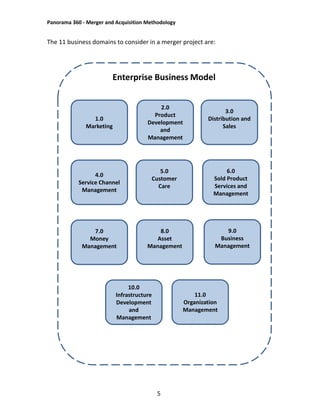
This document is divided in 11 sections. Each section is a business domain
within the organization that needs to be managed by the executive
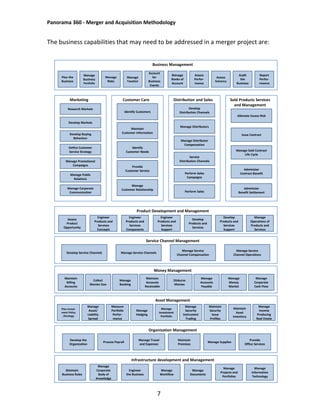
management of the company. Each business domain is subdivided into 75
business capabilities.
Each business domain and business capabilities are taken directly from the
Panorama 360 Insurance and Wealth Management Enterprise Business
Architecture Framework which is a comprehensive book that can be
purchased separately in paperback or in e-book version on the Internet.
Panorama 360 - Merger and Acquisition Methodology
5
The 11 business domains to consider in a merger project are:
1.0
Marketing
Enterprise Business Model
6.0
Sold Product
Services and
Management
5.0
Customer
Care
4.0
Service Channel
Management
9.0
Business
Management
8.0
Asset
Management
7.0
Money
Management
11.0
Organization
Management
3.0
Distribution and
Sales
2.0
Product
Development
and
Management
10.0
Infrastructure
Development
and
Management
Panorama 360 - Merger and Acquisition Methodology
6
The list of questions is not organized according to the organization
structure but into functional domains that are part of the Insurance and
Wealth Management value chain. Each functional domain is then
subdivided into major functions that that could be impacted during a
merger and acquisition.
For each major function, a number of questions have been developed
from best practices. By answering these questions, the project team will
identify the impacts from the merger project on the organization, which
should become part of a master plan to integrate totally or partially the
companies.
For the purpose of this document, the term “merger” will signify any
merger, acquisition, portfolio acquisition or partnership between two or
more companies.
Panorama 360 - Merger and Acquisition Methodology
7
The business capabilities that may need to be addressed in a merger project are:
Business Management
Plan the
Business
Manage
Business
Portfolio
Manage
Risks
Manage
Taxation
Account
for
Business
Events
Manage
Books of
Account
Assess
Perfor-
mance
Assess
Solvency
Audit
the
Business
Report
Perfor-
rmance
Customer Care
Identify Customers
Maintain
Customer Information
Identify
Customer Needs
Provide
Customer Service
Manage
Customer Relationship
Marketing
Research Markets
Develop Markets
Develop Buying
Behaviour
Manage Promotional
Campaigns
Define Customer
Service Strategy
Manage Public
Relations
Manage Corporate
Communication
Distribution and Sales
Develop
Distribution Channels
Manage Distributors
Manage Distributor
Compensation
Perform Sales
Campaigns
Service
Distribution Channels
Perform Sales
Sold Products Services
and Management
Alleviate Excess Risk
Issue Contract
Manage Sold Contract
Life Cycle
Administer
Benefit Settlement
Administer
Contract Benefit
Product Development and Management
Assess
Product
Opportunity
Engineer
Products and
Services
Concepts
Engineer
Products and
Services
Components
Engineer
Products and
Services
Support
Develop
Products and
Services
Develop
Products and
Services
Support
Manage
Operations of
Products and
Services
Service Channel Management
Develop Service Channels Manage Service Channels
Manage Service
Channel Compensation
Manage Service
Channel Operations
Money Management
Maintain
Billing
Accounts
Collect
Monies Due
Manage
Banking
Maintain
Accounts
Receivable
Disburse
Monies
Manage
Accounts
Payable
Manage
Money
Market
Manage
Corporate
Cash Flow
Asset Management
Plan Invest-
ment Policy
/Strategy
Manage
Asset/
Liability
Spread
Measure
Portfolio
Perfor-
mance
Manage
Hedging
Manage
Investment
Portfolio
Manage
Security
Instrument
Trading
Maintain
Security
Issue
Profiles
Maintain
Asset
Inventory
Manage
Income
Producing
Real Estate
Organization Management
Develop the
Organization
Process Payroll
Manage Travel
and Expenses
Maintain
Premises
Manage Supplies
Provide
Office Services
Infrastructure development and Management
Maintain
Business Rules
Manage
Corporate
Body of
Knowledge
Engineer
the Business
Manage
Workflow
Manage
Documents
Manage
Projects and
Portfolios
Manage
Information
Technology

Panorama 360 Merger and Acquisition Methodology

  • 1.
    PANORAMA 360 THE INSURANCE ANDWEALTH MANAGEMENT MERGER AND ACQUISISION METHODOLOGY Version 3.0 THE DEFINITIVE REFERENCE FOR MANAGING INSURANCE AND WEALTH MANAGEMENT MERGERS AND ACQUISITIONS.
  • 2.
    Panorama 360 -Merger and Acquisition Methodology 1 ©Copyright – All rights reserved. Panorama 360 is distributed and published by Insurance Frameworks Inc. (www.InsuranceFrameworks.com). Formerly, Panorama 360 was called Vista. ©1997, 2002, 2011, 2017 Version 0.0 published 1997, version 1.0 published 2002, version 2.0 published 2011, version 3.0 published 2017. ISBN-13: 978-1544103693 ISBN-10: 1544103697
  • 3.
    Panorama 360 -Merger and Acquisition Methodology 2 Table of Contents INTRODUCTION ..................................................................................................3 APPROACH .........................................................................................................4 1.0 Marketing................................................................................................ 7 2.0 Product Development and Management.................................................12 3.0 Distribution and Sales .............................................................................16 4.0 Alliance Service Channels........................................................................21 5.0 Customer Care.........................................................................................25 6.0 Sold Product Services and Management..................................................29 7.0 Money Management...............................................................................34 8.0 Asset Management .................................................................................38 9.0 Business Management ............................................................................42 10.0 Infrastructure Development and Management .......................................46 11.0 Organization Management......................................................................51 CONCLUSION....................................................................................................54
  • 4.
    Panorama 360 -Merger and Acquisition Methodology 3 Introduction The financial services industry is consolidating constantly. Each year, several companies enter into merger and acquisition agreements in order to grow and gain infrastructure efficiencies and to acquire new clients. Unfortunately, a number of these mergers and acquisitions do not deliver the expected cost savings or revenue synergies. Many merger initiatives drag on endlessly. There is often insufficient understanding of what is being merged or purchased. The plan to align the two organizations is often superficial. The subsequent steps and accountabilities to ensure that benefits are delivered are not specified. Cultures clash over processes and information technology. These factors can make the difference between success and failure. A structured and focused management approach to planning merger projects contributes to success in building a thriving new business entity. In order to manage a successful merger project, a multi-disciplinary project team needs to actively participate throughout the project. This team is responsible for managing change. Depending on the vision, the business objectives and the nature of the agreement between the two companies, a number of areas within the acquired organization need to be adjusted in order to integrate it with the acquiring organization. To achieve a successful merger and acquisition project, it is important to thoroughly scope the project, identifying all the activities that need to happen.
  • 5.
    Panorama 360 -Merger and Acquisition Methodology 4 Approach To support merger and acquisition projects, a project checklist has been developed to support the project team during the planning phase. This approach can is used by any organization operating in the Financial Services industry value chain, either in preparation for an acquisition or as a result of a merger agreement. Users of this approach can be insurance companies, bank, credit unions, brokers, investment advisors, fund managers, etc… More than 300 merger and acquisition oriented questions have been developed using the Panorama 360 – Insurance and Wealth Management Enterprise Business Architecture Framework book. This list of questions should be used as a checklist to provide guidance to the merger team members. By answering the questions, the team members will identify areas within the company that will be impacted. Subsequently, these identified areas of change will need to be analyzed and the magnitude of the change assessed and quantified, which will then form the base for the enterprise wide project plan. Each merger project is unique and new challenges may be identified from project to project. Consequently, the list of questions will evolve and this document should be updated when new questions are identified. This will allow subsequent project team to take advantage of the accumulated knowledge in this discipline if other mergers take place. This document is divided in 11 sections. Each section is a business domain within the organization that needs to be managed by the executive management of the company. Each business domain is subdivided into 75 business capabilities. Each business domain and business capabilities are taken directly from the Panorama 360 Insurance and Wealth Management Enterprise Business Architecture Framework which is a comprehensive book that can be purchased separately in paperback or in e-book version on the Internet.
  • 6.
    Panorama 360 -Merger and Acquisition Methodology 5 The 11 business domains to consider in a merger project are: 1.0 Marketing Enterprise Business Model 6.0 Sold Product Services and Management 5.0 Customer Care 4.0 Service Channel Management 9.0 Business Management 8.0 Asset Management 7.0 Money Management 11.0 Organization Management 3.0 Distribution and Sales 2.0 Product Development and Management 10.0 Infrastructure Development and Management
  • 7.
    Panorama 360 -Merger and Acquisition Methodology 6 The list of questions is not organized according to the organization structure but into functional domains that are part of the Insurance and Wealth Management value chain. Each functional domain is then subdivided into major functions that that could be impacted during a merger and acquisition. For each major function, a number of questions have been developed from best practices. By answering these questions, the project team will identify the impacts from the merger project on the organization, which should become part of a master plan to integrate totally or partially the companies. For the purpose of this document, the term “merger” will signify any merger, acquisition, portfolio acquisition or partnership between two or more companies.
  • 8.
    Panorama 360 -Merger and Acquisition Methodology 7 The business capabilities that may need to be addressed in a merger project are: Business Management Plan the Business Manage Business Portfolio Manage Risks Manage Taxation Account for Business Events Manage Books of Account Assess Perfor- mance Assess Solvency Audit the Business Report Perfor- rmance Customer Care Identify Customers Maintain Customer Information Identify Customer Needs Provide Customer Service Manage Customer Relationship Marketing Research Markets Develop Markets Develop Buying Behaviour Manage Promotional Campaigns Define Customer Service Strategy Manage Public Relations Manage Corporate Communication Distribution and Sales Develop Distribution Channels Manage Distributors Manage Distributor Compensation Perform Sales Campaigns Service Distribution Channels Perform Sales Sold Products Services and Management Alleviate Excess Risk Issue Contract Manage Sold Contract Life Cycle Administer Benefit Settlement Administer Contract Benefit Product Development and Management Assess Product Opportunity Engineer Products and Services Concepts Engineer Products and Services Components Engineer Products and Services Support Develop Products and Services Develop Products and Services Support Manage Operations of Products and Services Service Channel Management Develop Service Channels Manage Service Channels Manage Service Channel Compensation Manage Service Channel Operations Money Management Maintain Billing Accounts Collect Monies Due Manage Banking Maintain Accounts Receivable Disburse Monies Manage Accounts Payable Manage Money Market Manage Corporate Cash Flow Asset Management Plan Invest- ment Policy /Strategy Manage Asset/ Liability Spread Measure Portfolio Perfor- mance Manage Hedging Manage Investment Portfolio Manage Security Instrument Trading Maintain Security Issue Profiles Maintain Asset Inventory Manage Income Producing Real Estate Organization Management Develop the Organization Process Payroll Manage Travel and Expenses Maintain Premises Manage Supplies Provide Office Services Infrastructure development and Management Maintain Business Rules Manage Corporate Body of Knowledge Engineer the Business Manage Workflow Manage Documents Manage Projects and Portfolios Manage Information Technology