I D C            W O R K B O O K


Optimizing Marketing and Sales Lead
Management With Marketing Automation
September 2008
Adapted from: CMO Advisory Services Best Practices Series: Marketing’s Lead Management Process, by
Michael Gerard, IDC #204760

Sponsored by Marketo

At many B-to-B vendors, the sales and marketing departments are not well aligned, especially around
their respective lead management processes. Specifically, companies are challenged in the areas of
lead definition, data collection, lead qualification / lead scoring, sales handoff, lead nurturing and
performance measurement.
This IDC Workbook explores the challenges related to lead management processes and how
marketing automation software can help alleviate these challenges by supporting process integration
and data flow. This Workbook also discusses approaches to sales and marketing automation and
provides sales and marketing departments with a question set for selecting sales and marketing
technologies and vendors.

Common Failures in the Lead Management Process

At typical companies, approximately half of the marketing budget is allocated for demand generation
initiatives as events, direct marketing and Web advertising. Approximately one-third of that total
demand generation investment is earmarked to directly support the sales force in the form of market
development funds, sales training and tools, and other channel marketing activities. Consequently,
the integration of marketing and sales is critical, yet nevertheless such alignment remains a challenge
for many companies. For example, at some companies, marketing sends responses to sales without
any cleaning or qualification, essentially giving sales permission to ignore marketing due to the low
quality of leads.

Companies looking to address the key points of failure need to examine the main stages of a
successful lead management process:

    Lead definition. Devising a common definition of a lead based on an agreed upon taxonomy with
    marketing and sales. This common definition is the foundation for an effective lead management
    process, without which the organization will be unable to identify and nurture prospects with the
    greatest potential, leading to lost opportunities and continued misalignment with sales.
    Regardless, the majority of organizations today continue to operate without a global definition of a
    lead.

    Data collection and cleansing. Sales and marketing need to collect the data that is most important
    for their relative functions. Data collection and cleansing are also essential to ensuring database
    integrity for customers and leads. Although clean data continues to elude even the largest
    marketing organizations today, recent IDC research indicates that this is an area earmarked for


IDC 699
improvement: For example, over one-third of B-to-B tech marketers intend to significantly
    increase their investment in improved customer (and prospect) database management in 2009.

    Lead qualification and scoring. The need for qualifying leads accurately and applying a scoring
    methodology that facilitates more effective lead management based on both demographics and
    lead behavioral and engagement characteristics is critical. Sales and marketing must capitalize
    their resources by investing the most time and attention to those leads that are most likely to be
    converted into customers. The cost associated with poor lead qualification? According to IDC
    research, among BtoB tech marketers, there is a poor return on investment on the over $20
    billion per year they spend on demand generation efforts, not to mention the over $100 billion
    they spend per year on sales resources.

    Sales handoff. Marketing and sales need to improve how they communicate and collaborate with
    each other (e.g., defining lead definitions and setting expectations for lead quality and quantity)
    as well as tracking lead handoffs even after they go to sales. At some companies, there is no
    follow-up once a lead is handed off to sales, a situation which serves to further disconnect
    marketing from sales. IDC research indicates that approximately 25% of sales' time is spent on
    unproductive prospecting, even as 60–70% of sales representatives ignore marketing leads.

    Lead nurturing. The process of lead nurturing—or interacting appropriately with those prospects
    who are not ready to purchase by maintaining a relevant and informative dialogue—is critical for
    marketing and sales. It is important to differentiate among the various leads as part of the
    nurturing strategy to ensure that the inclusion of a lead as part of a marketing event or initiative is
    appropriate based upon the prospect's needs. Differentiation should be based in part on what
    stage the lead is in within the company's qualification process (e.g., BANT is a common part of
    companies' qualifying processes—Budget, Authority [to buy], Need and Timing). With less than
    25% of companies having a formal lead nurturing process, this remains an opportunity for
    differentiation by best-in-class marketers. Marketing automation provides significant benefit to
    aiding this process execution.

    Performance management. Gauging lead management efficiency and effectiveness to identify
    and refine investment priorities and applicable processes and technologies is an area that can
    result in significant payback. Do you wish you could better understand and demonstrate how all
    your marketing activities impact pipeline and revenue? How about understanding how much you
    could improve the ROI of your marketing programs if you knew how each program is influencing
    pipeline and revenue, and could adjust budgets accordingly?

Obviously, the overall process of lead management is a complex one, and while there is no universal
blueprint for lead management, there are best practices that marketers can follow.

Aligning Sales and Marketing with Automation

In order to better align sales and marketing—and thereby mitigate the numerous points of failure—
sales and marketing departments are increasingly turning to marketing automation software. While
sales departments have already invested heavily in developing and deploying CRM systems and
processes, marketing has yet to approach lead management with the same rigor.

This can be achieved through collaboration with sales in the lead management process, with the end
goal of optimizing revenue, profit and market share.

Marketing automation software includes a variety of functions that can help marketing better align
with sales. When applied to the lead management process, such software streamlines the data-
collection process; provides a repository for lead generation data; increases the potential for resolving
data quality issues; facilitates the sharing of lead generation data; enables lead nurturing throughout


                                                     2                                            ©2008 IDC
the marketing and sales lead management process; and supports the tracking of lead generation
data. In addition, such software includes the ability to qualify, score and route leads; and analyze
metrics and generate reports for performance management. In effect, marketing automation software
can address the most common failure points that exist within marketing’s lead management
processes.

Improving Lead Management Through Process-Driven Technology

By implementing marketing automation technology, marketing can vastly improve the execution and
governance of its lead management processes and align more closely with the sales department.
Marketing automation technology can allow marketers to automate and measure various processes
and activities related to demand generation campaigns with the goal of generating the highest quality
sales leads. Additionally, marketers have the freedom to execute campaigns with less manual effort,
allowing more time to focus on the strategic and creative activities that improve marketing ROI.

Leveraging Marketing Automation for Lead Management
Is Marketing Automation Right for your Organization?
The ability to leverage technology for automating marketing's lead management process has
historically been limited by a marketing organization's inability to develop, implement and govern
related processes, budgetary restraints, and lack of marketing and sales alignment.
In today's environment, the following factors have significantly improved companies' access and
ability to leverage marketing automation for lead management:

    Many marketing organizations at larger companies have established a marketing operations
    function to apply greater process rigor across the organization; and lead management remains a
    top priority for process improvement. In fact, 44% of companies surveyed in IDC's recent Tech
    Marketing Benchmarks study indicate that their top marketing-related IT focus for 2008–2009 will
    be their lead management system.

    Marketing organizations are applying a greater percentage of their investment towards
    automating the processes that have been created during the past couple of years. Based upon
    IDC's recent Tech Marketing Benchmarks study, approximately 2% of marketing investment is
    allocated for marketing applications software; and IDC recommends 3–4%.

    Marketing automation technology has become significantly more accessible for companies as a
    result of newer technologies and delivery models (e.g., software as a service or SaaS).

    Alignment between marketing and sales has increased in the past decade, including initial work
    around defining lead definition, qualification, and routing processes.

Implementing Marketing Automation for Lead Management: A Worksheet

The key to successfully deploying marketing automation software for lead management is to first
ensure that a process is established by sales and marketing—what and how information is collected,
how leads are defined, etc. It is not necessary to have the entire lead management process targeted
for automation; organizations can select a single area to automate and then add functionality over
time. However, it is necessary that both sales and marketing should also set expectations for how
and where information should ideally flow to best enhance sales and marketing processes—
marketing can then make informed decisions about a marketing automation vendor.

In addition, any technology evaluation should include whenever possible the participation of all
principal stakeholders from marketing and sales, as well as from finance and IT if appropriate.


©2008 IDC                                          3
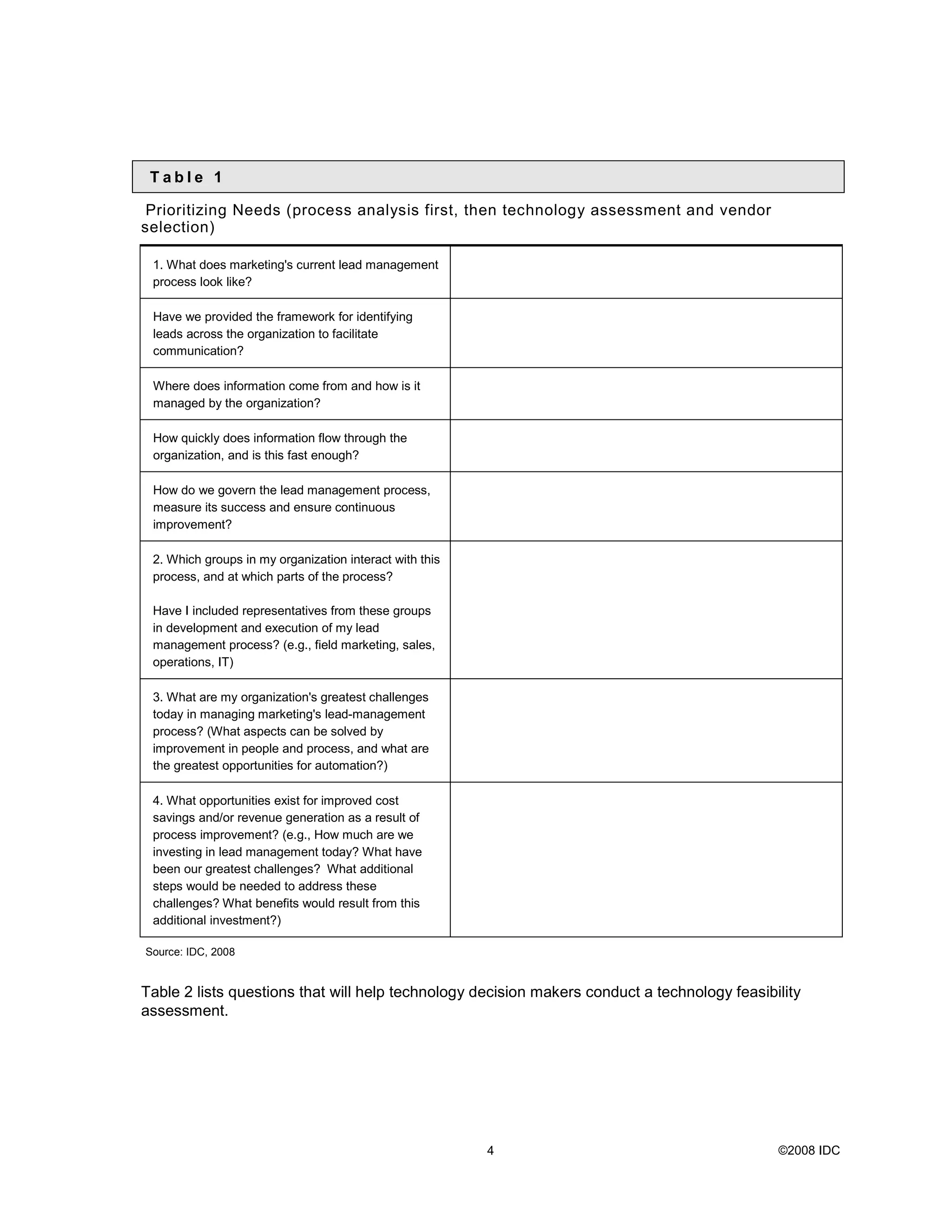
Table 1

 Prioritizing Needs (process analysis first, then technology assessment and vendor
selection)

 1. What does marketing's current lead management
 process look like?

 Have we provided the framework for identifying
 leads across the organization to facilitate
 communication?

 Where does information come from and how is it
 managed by the organization?

 How quickly does information flow through the
 organization, and is this fast enough?

 How do we govern the lead management process,
 measure its success and ensure continuous
 improvement?

 2. Which groups in my organization interact with this
 process, and at which parts of the process?

 Have I included representatives from these groups
 in development and execution of my lead
 management process? (e.g., field marketing, sales,
 operations, IT)

 3. What are my organization's greatest challenges
 today in managing marketing's lead-management
 process? (What aspects can be solved by
 improvement in people and process, and what are
 the greatest opportunities for automation?)

 4. What opportunities exist for improved cost
 savings and/or revenue generation as a result of
 process improvement? (e.g., How much are we
 investing in lead management today? What have
 been our greatest challenges? What additional
 steps would be needed to address these
 challenges? What benefits would result from this
 additional investment?)

Source: IDC, 2008


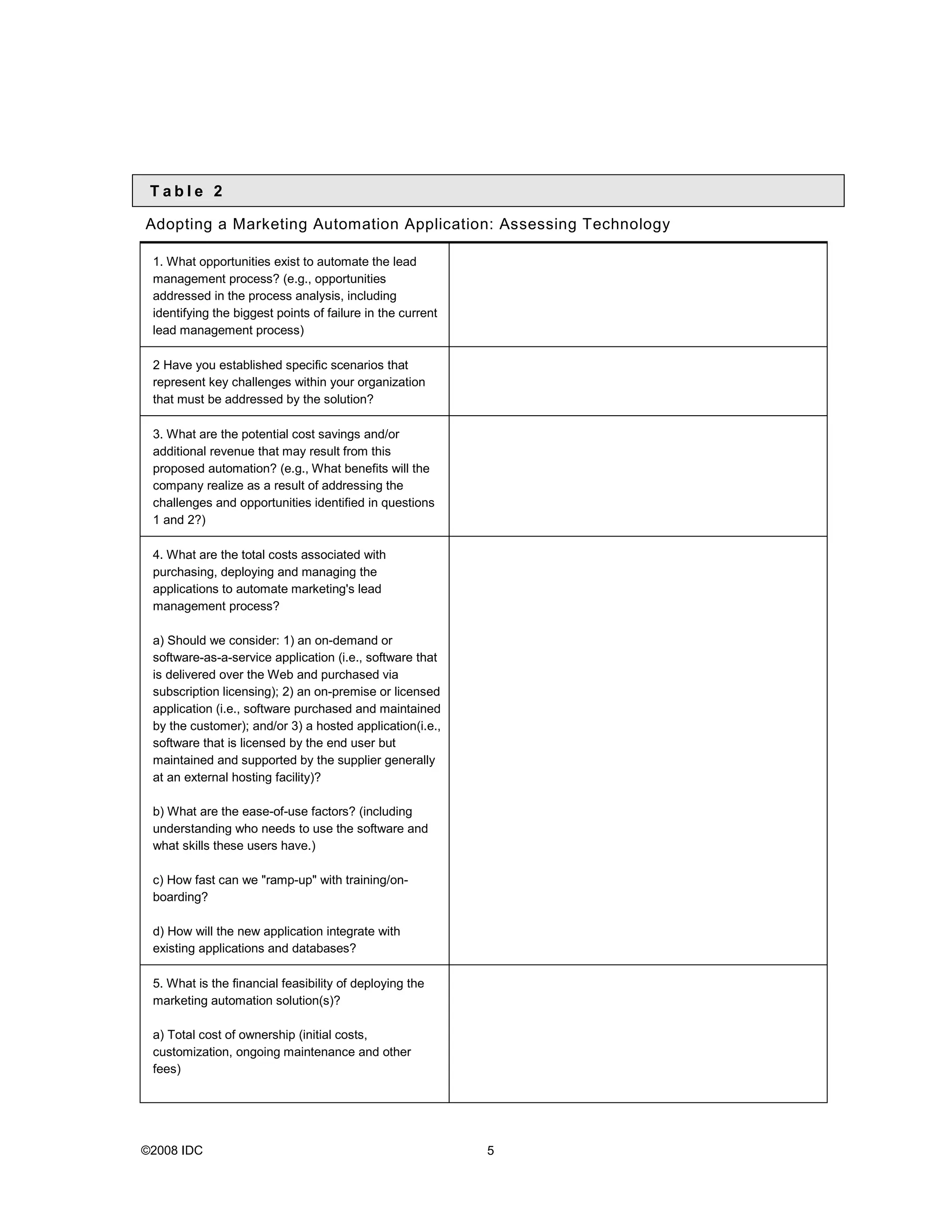
Table 2 lists questions that will help technology decision makers conduct a technology feasibility
assessment.


                                                         4                                    ©2008 IDC
Table 2

Adopting a Marketing Automation Application: Assessing Technology

 1. What opportunities exist to automate the lead
 management process? (e.g., opportunities
 addressed in the process analysis, including
 identifying the biggest points of failure in the current
 lead management process)

 2 Have you established specific scenarios that
 represent key challenges within your organization
 that must be addressed by the solution?

 3. What are the potential cost savings and/or
 additional revenue that may result from this
 proposed automation? (e.g., What benefits will the
 company realize as a result of addressing the
 challenges and opportunities identified in questions
 1 and 2?)

 4. What are the total costs associated with
 purchasing, deploying and managing the
 applications to automate marketing's lead
 management process?

 a) Should we consider: 1) an on-demand or
 software-as-a-service application (i.e., software that
 is delivered over the Web and purchased via
 subscription licensing); 2) an on-premise or licensed
 application (i.e., software purchased and maintained
 by the customer); and/or 3) a hosted application(i.e.,
 software that is licensed by the end user but
 maintained and supported by the supplier generally
 at an external hosting facility)?

 b) What are the ease-of-use factors? (including
 understanding who needs to use the software and
 what skills these users have.)

 c) How fast can we "ramp-up" with training/on-
 boarding?

 d) How will the new application integrate with
 existing applications and databases?

 5. What is the financial feasibility of deploying the
 marketing automation solution(s)?

 a) Total cost of ownership (initial costs,
 customization, ongoing maintenance and other
 fees)


©2008 IDC                                                   5
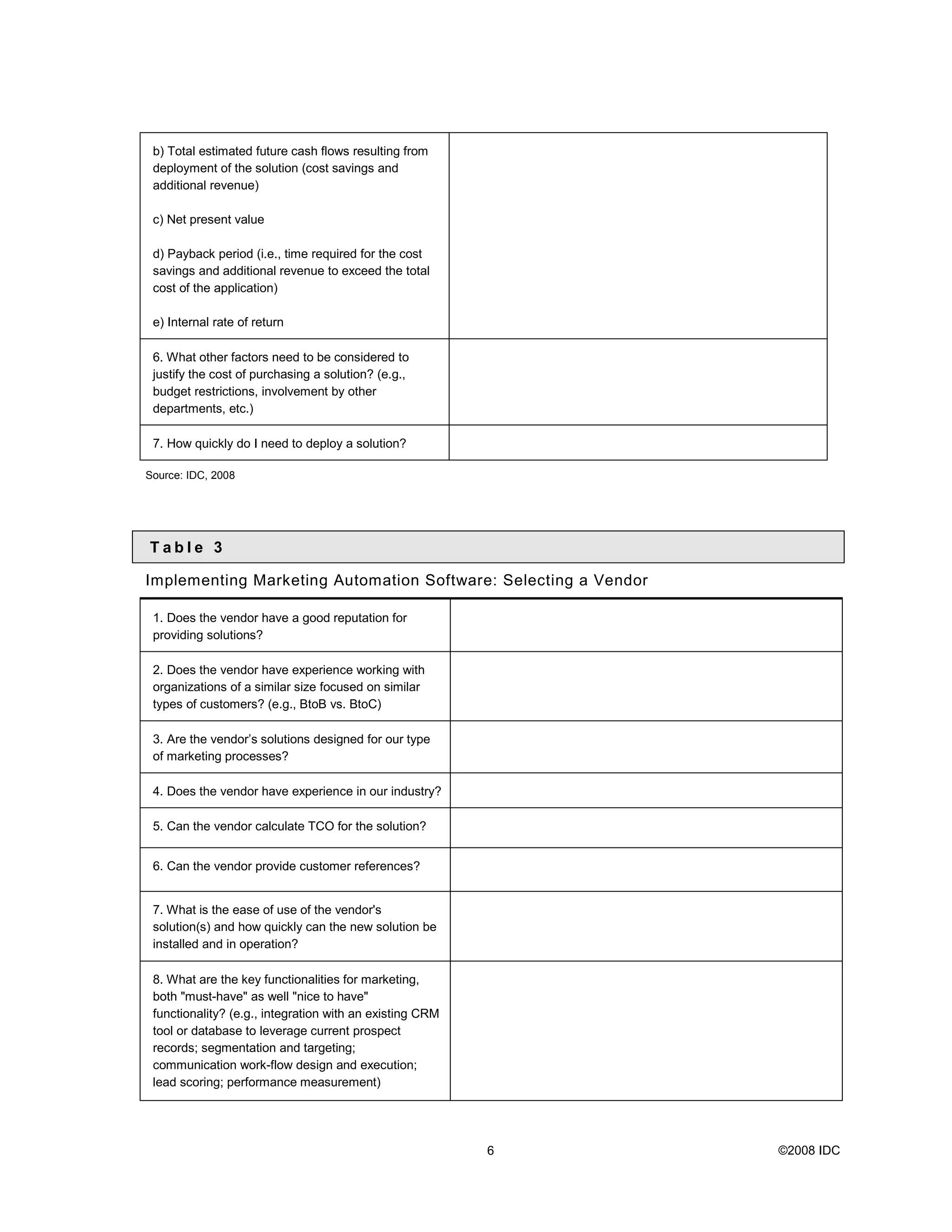
b) Total estimated future cash flows resulting from
 deployment of the solution (cost savings and
 additional revenue)

 c) Net present value

 d) Payback period (i.e., time required for the cost
 savings and additional revenue to exceed the total
 cost of the application)

 e) Internal rate of return

 6. What other factors need to be considered to
 justify the cost of purchasing a solution? (e.g.,
 budget restrictions, involvement by other
 departments, etc.)

 7. How quickly do I need to deploy a solution?

Source: IDC, 2008


Table 3

Implementing Marketing Automation Software: Selecting a Vendor

 1. Does the vendor have a good reputation for
 providing solutions?

 2. Does the vendor have experience working with
 organizations of a similar size focused on similar
 types of customers? (e.g., BtoB vs. BtoC)

 3. Are the vendor’s solutions designed for our type
 of marketing processes?

 4. Does the vendor have experience in our industry?

 5. Can the vendor calculate TCO for the solution?


 6. Can the vendor provide customer references?


 7. What is the ease of use of the vendor's
 solution(s) and how quickly can the new solution be
 installed and in operation?

 8. What are the key functionalities for marketing,
 both "must-have" as well "nice to have"
 functionality? (e.g., integration with an existing CRM
 tool or database to leverage current prospect
 records; segmentation and targeting;
 communication work-flow design and execution;
 lead scoring; performance measurement)


                                                          6      ©2008 IDC
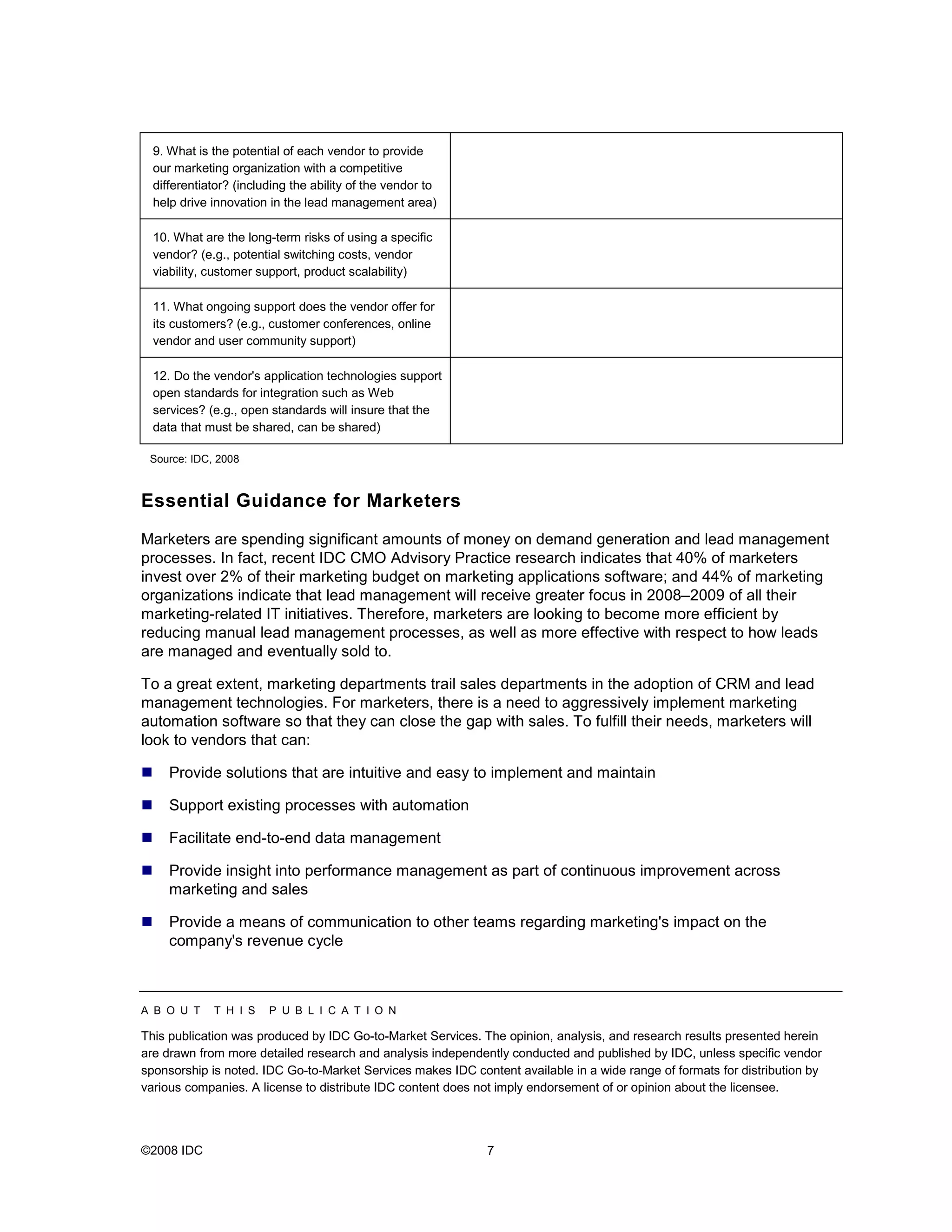
9. What is the potential of each vendor to provide
  our marketing organization with a competitive
  differentiator? (including the ability of the vendor to
  help drive innovation in the lead management area)

  10. What are the long-term risks of using a specific
  vendor? (e.g., potential switching costs, vendor
  viability, customer support, product scalability)

  11. What ongoing support does the vendor offer for
  its customers? (e.g., customer conferences, online
  vendor and user community support)

  12. Do the vendor's application technologies support
  open standards for integration such as Web
  services? (e.g., open standards will insure that the
  data that must be shared, can be shared)

 Source: IDC, 2008


Essential Guidance for Marketers

Marketers are spending significant amounts of money on demand generation and lead management
processes. In fact, recent IDC CMO Advisory Practice research indicates that 40% of marketers
invest over 2% of their marketing budget on marketing applications software; and 44% of marketing
organizations indicate that lead management will receive greater focus in 2008–2009 of all their
marketing-related IT initiatives. Therefore, marketers are looking to become more efficient by
reducing manual lead management processes, as well as more effective with respect to how leads
are managed and eventually sold to.

To a great extent, marketing departments trail sales departments in the adoption of CRM and lead
management technologies. For marketers, there is a need to aggressively implement marketing
automation software so that they can close the gap with sales. To fulfill their needs, marketers will
look to vendors that can:

     Provide solutions that are intuitive and easy to implement and maintain

     Support existing processes with automation

     Facilitate end-to-end data management

     Provide insight into performance management as part of continuous improvement across
     marketing and sales

     Provide a means of communication to other teams regarding marketing's impact on the
     company's revenue cycle


A B O U T    T H I S    P U B L I C A T I O N

This publication was produced by IDC Go-to-Market Services. The opinion, analysis, and research results presented herein
are drawn from more detailed research and analysis independently conducted and published by IDC, unless specific vendor
sponsorship is noted. IDC Go-to-Market Services makes IDC content available in a wide range of formats for distribution by
various companies. A license to distribute IDC content does not imply endorsement of or opinion about the licensee.


©2008 IDC                                                     7
C O P Y R I G H T    A N D    R E S T R I C T I O N S

Any IDC information or reference to IDC that is to be used in advertising, press releases, or promotional materials requires
prior written approval from IDC. For permission requests, contact the GMS information line at 508-988-7610 or gms@idc.com.
Translation and/or localization of this document requires an additional license from IDC.
For more information on IDC, visit www.idc.com. For more information on IDC GMS, visit www.idc.com/gms.

Global Headquarters: 5 Speen Street Framingham, MA 01701 USA P.508.872.8200 F.508.935.4015 www.idc.com


                                                             8                                                    ©2008 IDC

Idc marketing-automation-workbook

  • 1.
    I D C W O R K B O O K Optimizing Marketing and Sales Lead Management With Marketing Automation September 2008 Adapted from: CMO Advisory Services Best Practices Series: Marketing’s Lead Management Process, by Michael Gerard, IDC #204760 Sponsored by Marketo At many B-to-B vendors, the sales and marketing departments are not well aligned, especially around their respective lead management processes. Specifically, companies are challenged in the areas of lead definition, data collection, lead qualification / lead scoring, sales handoff, lead nurturing and performance measurement. This IDC Workbook explores the challenges related to lead management processes and how marketing automation software can help alleviate these challenges by supporting process integration and data flow. This Workbook also discusses approaches to sales and marketing automation and provides sales and marketing departments with a question set for selecting sales and marketing technologies and vendors. Common Failures in the Lead Management Process At typical companies, approximately half of the marketing budget is allocated for demand generation initiatives as events, direct marketing and Web advertising. Approximately one-third of that total demand generation investment is earmarked to directly support the sales force in the form of market development funds, sales training and tools, and other channel marketing activities. Consequently, the integration of marketing and sales is critical, yet nevertheless such alignment remains a challenge for many companies. For example, at some companies, marketing sends responses to sales without any cleaning or qualification, essentially giving sales permission to ignore marketing due to the low quality of leads. Companies looking to address the key points of failure need to examine the main stages of a successful lead management process: Lead definition. Devising a common definition of a lead based on an agreed upon taxonomy with marketing and sales. This common definition is the foundation for an effective lead management process, without which the organization will be unable to identify and nurture prospects with the greatest potential, leading to lost opportunities and continued misalignment with sales. Regardless, the majority of organizations today continue to operate without a global definition of a lead. Data collection and cleansing. Sales and marketing need to collect the data that is most important for their relative functions. Data collection and cleansing are also essential to ensuring database integrity for customers and leads. Although clean data continues to elude even the largest marketing organizations today, recent IDC research indicates that this is an area earmarked for IDC 699
  • 2.
    improvement: For example,over one-third of B-to-B tech marketers intend to significantly increase their investment in improved customer (and prospect) database management in 2009. Lead qualification and scoring. The need for qualifying leads accurately and applying a scoring methodology that facilitates more effective lead management based on both demographics and lead behavioral and engagement characteristics is critical. Sales and marketing must capitalize their resources by investing the most time and attention to those leads that are most likely to be converted into customers. The cost associated with poor lead qualification? According to IDC research, among BtoB tech marketers, there is a poor return on investment on the over $20 billion per year they spend on demand generation efforts, not to mention the over $100 billion they spend per year on sales resources. Sales handoff. Marketing and sales need to improve how they communicate and collaborate with each other (e.g., defining lead definitions and setting expectations for lead quality and quantity) as well as tracking lead handoffs even after they go to sales. At some companies, there is no follow-up once a lead is handed off to sales, a situation which serves to further disconnect marketing from sales. IDC research indicates that approximately 25% of sales' time is spent on unproductive prospecting, even as 60–70% of sales representatives ignore marketing leads. Lead nurturing. The process of lead nurturing—or interacting appropriately with those prospects who are not ready to purchase by maintaining a relevant and informative dialogue—is critical for marketing and sales. It is important to differentiate among the various leads as part of the nurturing strategy to ensure that the inclusion of a lead as part of a marketing event or initiative is appropriate based upon the prospect's needs. Differentiation should be based in part on what stage the lead is in within the company's qualification process (e.g., BANT is a common part of companies' qualifying processes—Budget, Authority [to buy], Need and Timing). With less than 25% of companies having a formal lead nurturing process, this remains an opportunity for differentiation by best-in-class marketers. Marketing automation provides significant benefit to aiding this process execution. Performance management. Gauging lead management efficiency and effectiveness to identify and refine investment priorities and applicable processes and technologies is an area that can result in significant payback. Do you wish you could better understand and demonstrate how all your marketing activities impact pipeline and revenue? How about understanding how much you could improve the ROI of your marketing programs if you knew how each program is influencing pipeline and revenue, and could adjust budgets accordingly? Obviously, the overall process of lead management is a complex one, and while there is no universal blueprint for lead management, there are best practices that marketers can follow. Aligning Sales and Marketing with Automation In order to better align sales and marketing—and thereby mitigate the numerous points of failure— sales and marketing departments are increasingly turning to marketing automation software. While sales departments have already invested heavily in developing and deploying CRM systems and processes, marketing has yet to approach lead management with the same rigor. This can be achieved through collaboration with sales in the lead management process, with the end goal of optimizing revenue, profit and market share. Marketing automation software includes a variety of functions that can help marketing better align with sales. When applied to the lead management process, such software streamlines the data- collection process; provides a repository for lead generation data; increases the potential for resolving data quality issues; facilitates the sharing of lead generation data; enables lead nurturing throughout 2 ©2008 IDC
  • 3.
    the marketing andsales lead management process; and supports the tracking of lead generation data. In addition, such software includes the ability to qualify, score and route leads; and analyze metrics and generate reports for performance management. In effect, marketing automation software can address the most common failure points that exist within marketing’s lead management processes. Improving Lead Management Through Process-Driven Technology By implementing marketing automation technology, marketing can vastly improve the execution and governance of its lead management processes and align more closely with the sales department. Marketing automation technology can allow marketers to automate and measure various processes and activities related to demand generation campaigns with the goal of generating the highest quality sales leads. Additionally, marketers have the freedom to execute campaigns with less manual effort, allowing more time to focus on the strategic and creative activities that improve marketing ROI. Leveraging Marketing Automation for Lead Management Is Marketing Automation Right for your Organization? The ability to leverage technology for automating marketing's lead management process has historically been limited by a marketing organization's inability to develop, implement and govern related processes, budgetary restraints, and lack of marketing and sales alignment. In today's environment, the following factors have significantly improved companies' access and ability to leverage marketing automation for lead management: Many marketing organizations at larger companies have established a marketing operations function to apply greater process rigor across the organization; and lead management remains a top priority for process improvement. In fact, 44% of companies surveyed in IDC's recent Tech Marketing Benchmarks study indicate that their top marketing-related IT focus for 2008–2009 will be their lead management system. Marketing organizations are applying a greater percentage of their investment towards automating the processes that have been created during the past couple of years. Based upon IDC's recent Tech Marketing Benchmarks study, approximately 2% of marketing investment is allocated for marketing applications software; and IDC recommends 3–4%. Marketing automation technology has become significantly more accessible for companies as a result of newer technologies and delivery models (e.g., software as a service or SaaS). Alignment between marketing and sales has increased in the past decade, including initial work around defining lead definition, qualification, and routing processes. Implementing Marketing Automation for Lead Management: A Worksheet The key to successfully deploying marketing automation software for lead management is to first ensure that a process is established by sales and marketing—what and how information is collected, how leads are defined, etc. It is not necessary to have the entire lead management process targeted for automation; organizations can select a single area to automate and then add functionality over time. However, it is necessary that both sales and marketing should also set expectations for how and where information should ideally flow to best enhance sales and marketing processes— marketing can then make informed decisions about a marketing automation vendor. In addition, any technology evaluation should include whenever possible the participation of all principal stakeholders from marketing and sales, as well as from finance and IT if appropriate. ©2008 IDC 3
  • 4.
    Table 1 PrioritizingNeeds (process analysis first, then technology assessment and vendor selection) 1. What does marketing's current lead management process look like? Have we provided the framework for identifying leads across the organization to facilitate communication? Where does information come from and how is it managed by the organization? How quickly does information flow through the organization, and is this fast enough? How do we govern the lead management process, measure its success and ensure continuous improvement? 2. Which groups in my organization interact with this process, and at which parts of the process? Have I included representatives from these groups in development and execution of my lead management process? (e.g., field marketing, sales, operations, IT) 3. What are my organization's greatest challenges today in managing marketing's lead-management process? (What aspects can be solved by improvement in people and process, and what are the greatest opportunities for automation?) 4. What opportunities exist for improved cost savings and/or revenue generation as a result of process improvement? (e.g., How much are we investing in lead management today? What have been our greatest challenges? What additional steps would be needed to address these challenges? What benefits would result from this additional investment?) Source: IDC, 2008 Table 2 lists questions that will help technology decision makers conduct a technology feasibility assessment. 4 ©2008 IDC
  • 5.
    Table 2 Adopting aMarketing Automation Application: Assessing Technology 1. What opportunities exist to automate the lead management process? (e.g., opportunities addressed in the process analysis, including identifying the biggest points of failure in the current lead management process) 2 Have you established specific scenarios that represent key challenges within your organization that must be addressed by the solution? 3. What are the potential cost savings and/or additional revenue that may result from this proposed automation? (e.g., What benefits will the company realize as a result of addressing the challenges and opportunities identified in questions 1 and 2?) 4. What are the total costs associated with purchasing, deploying and managing the applications to automate marketing's lead management process? a) Should we consider: 1) an on-demand or software-as-a-service application (i.e., software that is delivered over the Web and purchased via subscription licensing); 2) an on-premise or licensed application (i.e., software purchased and maintained by the customer); and/or 3) a hosted application(i.e., software that is licensed by the end user but maintained and supported by the supplier generally at an external hosting facility)? b) What are the ease-of-use factors? (including understanding who needs to use the software and what skills these users have.) c) How fast can we "ramp-up" with training/on- boarding? d) How will the new application integrate with existing applications and databases? 5. What is the financial feasibility of deploying the marketing automation solution(s)? a) Total cost of ownership (initial costs, customization, ongoing maintenance and other fees) ©2008 IDC 5
  • 6.
    b) Total estimatedfuture cash flows resulting from deployment of the solution (cost savings and additional revenue) c) Net present value d) Payback period (i.e., time required for the cost savings and additional revenue to exceed the total cost of the application) e) Internal rate of return 6. What other factors need to be considered to justify the cost of purchasing a solution? (e.g., budget restrictions, involvement by other departments, etc.) 7. How quickly do I need to deploy a solution? Source: IDC, 2008 Table 3 Implementing Marketing Automation Software: Selecting a Vendor 1. Does the vendor have a good reputation for providing solutions? 2. Does the vendor have experience working with organizations of a similar size focused on similar types of customers? (e.g., BtoB vs. BtoC) 3. Are the vendor’s solutions designed for our type of marketing processes? 4. Does the vendor have experience in our industry? 5. Can the vendor calculate TCO for the solution? 6. Can the vendor provide customer references? 7. What is the ease of use of the vendor's solution(s) and how quickly can the new solution be installed and in operation? 8. What are the key functionalities for marketing, both "must-have" as well "nice to have" functionality? (e.g., integration with an existing CRM tool or database to leverage current prospect records; segmentation and targeting; communication work-flow design and execution; lead scoring; performance measurement) 6 ©2008 IDC
  • 7.
    9. What isthe potential of each vendor to provide our marketing organization with a competitive differentiator? (including the ability of the vendor to help drive innovation in the lead management area) 10. What are the long-term risks of using a specific vendor? (e.g., potential switching costs, vendor viability, customer support, product scalability) 11. What ongoing support does the vendor offer for its customers? (e.g., customer conferences, online vendor and user community support) 12. Do the vendor's application technologies support open standards for integration such as Web services? (e.g., open standards will insure that the data that must be shared, can be shared) Source: IDC, 2008 Essential Guidance for Marketers Marketers are spending significant amounts of money on demand generation and lead management processes. In fact, recent IDC CMO Advisory Practice research indicates that 40% of marketers invest over 2% of their marketing budget on marketing applications software; and 44% of marketing organizations indicate that lead management will receive greater focus in 2008–2009 of all their marketing-related IT initiatives. Therefore, marketers are looking to become more efficient by reducing manual lead management processes, as well as more effective with respect to how leads are managed and eventually sold to. To a great extent, marketing departments trail sales departments in the adoption of CRM and lead management technologies. For marketers, there is a need to aggressively implement marketing automation software so that they can close the gap with sales. To fulfill their needs, marketers will look to vendors that can: Provide solutions that are intuitive and easy to implement and maintain Support existing processes with automation Facilitate end-to-end data management Provide insight into performance management as part of continuous improvement across marketing and sales Provide a means of communication to other teams regarding marketing's impact on the company's revenue cycle A B O U T T H I S P U B L I C A T I O N This publication was produced by IDC Go-to-Market Services. The opinion, analysis, and research results presented herein are drawn from more detailed research and analysis independently conducted and published by IDC, unless specific vendor sponsorship is noted. IDC Go-to-Market Services makes IDC content available in a wide range of formats for distribution by various companies. A license to distribute IDC content does not imply endorsement of or opinion about the licensee. ©2008 IDC 7
  • 8.
    C O PY R I G H T A N D R E S T R I C T I O N S Any IDC information or reference to IDC that is to be used in advertising, press releases, or promotional materials requires prior written approval from IDC. For permission requests, contact the GMS information line at 508-988-7610 or gms@idc.com. Translation and/or localization of this document requires an additional license from IDC. For more information on IDC, visit www.idc.com. For more information on IDC GMS, visit www.idc.com/gms. Global Headquarters: 5 Speen Street Framingham, MA 01701 USA P.508.872.8200 F.508.935.4015 www.idc.com 8 ©2008 IDC