DISORDERS OF THOUGHT
PREPARED BY:
MISFA KHATUN
INTRODUCTION
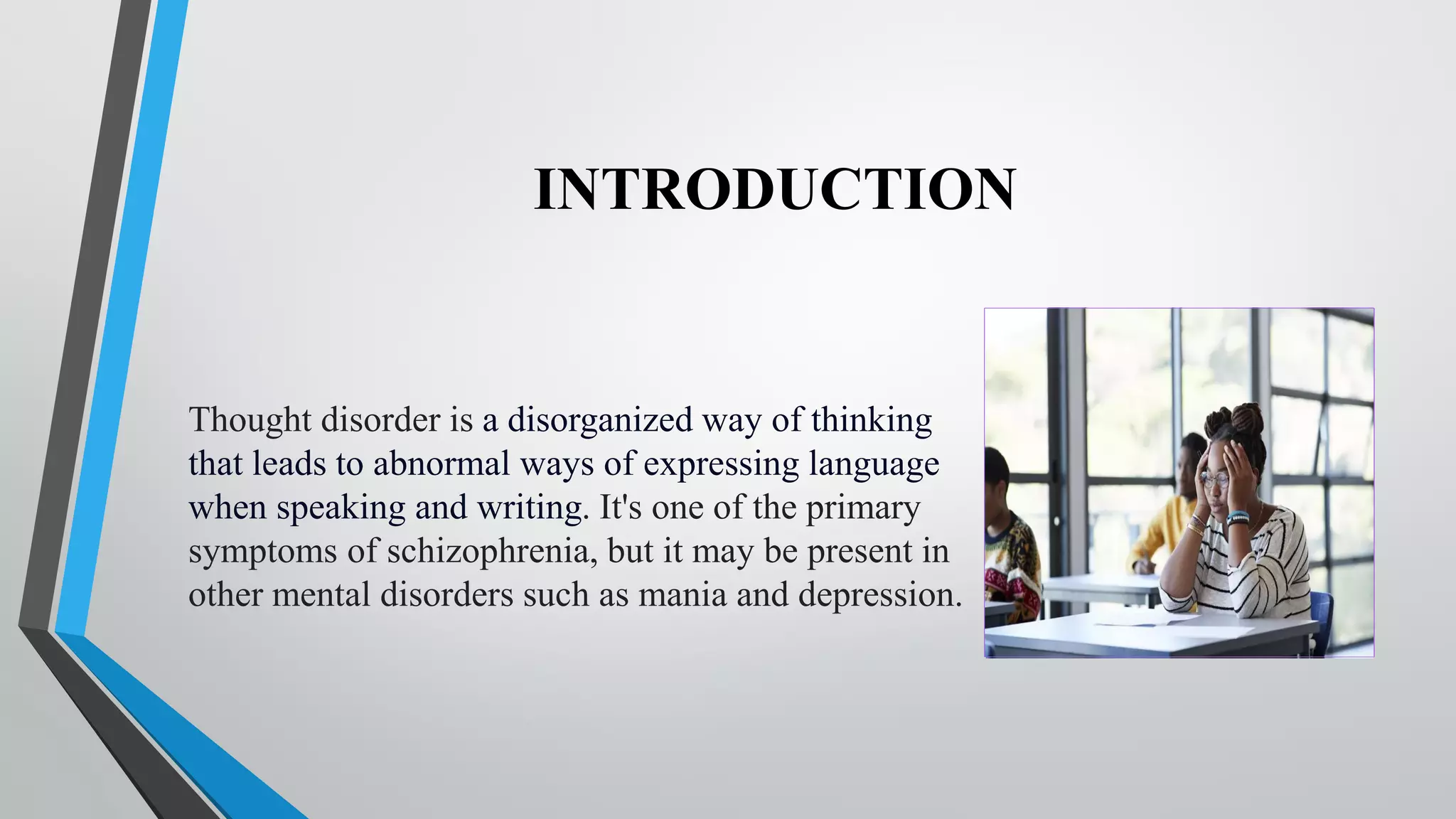
Thought disorder is a disorganized way of thinking
that leads to abnormal ways of expressing language
when speaking and writing. It's one of the primary
symptoms of schizophrenia, but it may be present in
other mental disorders such as mania and depression.
TYPES OF THOUGHT DISORDER
Some of the many different types of thought disorders include:
• Alogia: This thought disorder is characterized by poverty of speech and is commonly seen in
people with schizophrenia or dementia. Responses are often abrupt and incomplete.
• Blocking: People with thought disorders may stop speaking mid-sentence and pause for an
extended period. When they resume speaking, it is often on an entirely different topic.
• Circumstantial thinking: This type of disorganized thinking involves including a lot of
unnecessary detail that is often indirect or even unrelated to the main point of the
conversation.
• Clanging or Clang Association: This involves using words based on their sounds rather than
their meaning. This includes rhyming words or puns.
Contd…
• Derailment: A person with derailment talks in chains of only semi-related ideas. Their ideas
often fall further and further from the topic of conversation . For example, a person with
derailment thought disorder might jump from talking about Rabbits to the hair on their head
to your sweater.
• Echolalia: This involves repeating back the speech of other speakers. They may often repeat
sounds or words that they hear from others. For example, instead of answering a question ,
person may repeat the question.
• Neologism: This involves coining new words spontaneously. These words are meaningless
and unrecognizable but incorporated into speech.
• Perseveration: Leads to repetition of ideas and words.
Contd…
• Distractible Speech: A person with distractible speech thought disorder has trouble
maintaining a topic. They shift quickly between topics and get distracted by internal and
external stimuli. It’s commonly seen in people with mania. For example, someday exhibiting
distractible speech might abruptly ask where you got your hat mid-sentence while telling you
about a recent vacation
• Tangentiality: This type of disordered thought involves moving from one idea to another.
The ideas are connected superficially but never get to the main point.
• Word salad: This involves a mixture of random words and phrases that are
unintelligible. Also known as Incoherence.
CAUSE OF THOUGHT DISORDER
The exact causes of thought disorders are not known. However, it is believed that a number of
variables may play a contributing role including –
• genetics,
• brain abnormalities,
• environmental factors.
Disorganized thought can be seen in a number of mental health conditions, including
schizophrenia. In the case of schizophrenia, some research has suggested that the condition is
linked to abnormalities in the brain's semantic system.
SYMPTOMS OF THOUGHT DISORDER
Symptoms can become indicative of a thought disorder depending on their frequency, severity,
and the impairment that they cause. Symptoms associated with a thought disorder can include:
• An inability to stay on topic
• Lack of speech
• Rapid, pressured speech
• Incoherence
• Illogical speech
• Wandering train of thought
Contd…
Other symptoms that can be associated with thought disorders include:
• Delusions,
• Hallucinations,
• Poor judgment,
• Changes in movement,
• Irritability,
• Lack of emotion,
• Lack of expression,
• Paranoia.
DIGNOSIS OF THOUGHT DIUSORDERS
Thought disorders are diagnosed by a healthcare professional. A diagnosis usually involves
asking people open-ended questions and then assessing their verbal responses.
Several assessment tools can be utilized to measure thought disorders, including:
• The Rorschach inkblot test: The Rorschach inkblot test is a projective test in which people
are shown a series of ambiguous inkblots. Mental health professionals can then use a scoring
system when interpreting verbal responses to the inkblots to look for signs of disordered
thinking.
Contd…
• The Thought Disorder Index (TDI): This assessment involves a health professional
engaging in a conversation with the individual that is recorded and then transcribed. The TDI
(also known as the Delta index) is then used to evaluate the exchange, including looking at 23
different areas that may indicate a thought disturbance.
• Scale for the Assessment of Thought, Language, and Communication (TLC): One of the
most widely used thought disorder assessments. It involves making observations and giving
them a severity rating based on definitions of different aspects of thought disorders.
TREATMENT MODALITIES OF
THOUGHT DISORDERS
Treatments are available that can help people manage the symptoms of thought disorders. Some
treatment strategies that may be used are discussed below.
Medications:
Medications may sometimes be prescribed to help treat symptoms associated with
schizophrenia or psychotic disorders. Such medications may include antipsychotics,
antidepressants, and mood stabilizers.
Contd…
Psychotherapy:
Therapy may be useful for helping people who are also experiencing symptoms of
delusional or distorted thoughts. Types of therapy that might be utilized depending on
the individual's symptoms include:
• Cognitive-behavioral therapy (CBT) can help people identify and change distorted
thoughts.
• Family therapy can help families learn what they can do to support their loved one
who has a thought disorder.
• Group therapy can be a useful treatment for practicing skills and finding support.
Contd…
Coping:
In addition to therapy and medications, people with thought disorders can also benefit from
life skills training and social support:
• Social skills training: Because problems with disorganized thinking affect communication, it
can create challenges in relationships. Learning and practicing social skills can help people
with thought disorders find ways to improve their communication abilities in ways that
benefit their relationships.
• Social support: Social support is also essential for people who have disorders that impact
thought organization. Family therapy and support groups may be helpful for both people who
have this condition as well as family members and other loved ones.
• Stress management: Relaxation techniques may also be helpful since stress can sometimes
worsen the symptoms of conditions such as schizophrenia.

DISORDERS OF THOUGHT

  • 1.
  • 2.
    INTRODUCTION Thought disorder isa disorganized way of thinking that leads to abnormal ways of expressing language when speaking and writing. It's one of the primary symptoms of schizophrenia, but it may be present in other mental disorders such as mania and depression.
  • 3.
    TYPES OF THOUGHTDISORDER Some of the many different types of thought disorders include: • Alogia: This thought disorder is characterized by poverty of speech and is commonly seen in people with schizophrenia or dementia. Responses are often abrupt and incomplete. • Blocking: People with thought disorders may stop speaking mid-sentence and pause for an extended period. When they resume speaking, it is often on an entirely different topic. • Circumstantial thinking: This type of disorganized thinking involves including a lot of unnecessary detail that is often indirect or even unrelated to the main point of the conversation. • Clanging or Clang Association: This involves using words based on their sounds rather than their meaning. This includes rhyming words or puns.
  • 4.
    Contd… • Derailment: Aperson with derailment talks in chains of only semi-related ideas. Their ideas often fall further and further from the topic of conversation . For example, a person with derailment thought disorder might jump from talking about Rabbits to the hair on their head to your sweater. • Echolalia: This involves repeating back the speech of other speakers. They may often repeat sounds or words that they hear from others. For example, instead of answering a question , person may repeat the question. • Neologism: This involves coining new words spontaneously. These words are meaningless and unrecognizable but incorporated into speech. • Perseveration: Leads to repetition of ideas and words.
  • 5.
    Contd… • Distractible Speech:A person with distractible speech thought disorder has trouble maintaining a topic. They shift quickly between topics and get distracted by internal and external stimuli. It’s commonly seen in people with mania. For example, someday exhibiting distractible speech might abruptly ask where you got your hat mid-sentence while telling you about a recent vacation • Tangentiality: This type of disordered thought involves moving from one idea to another. The ideas are connected superficially but never get to the main point. • Word salad: This involves a mixture of random words and phrases that are unintelligible. Also known as Incoherence.
  • 6.
    CAUSE OF THOUGHTDISORDER The exact causes of thought disorders are not known. However, it is believed that a number of variables may play a contributing role including – • genetics, • brain abnormalities, • environmental factors. Disorganized thought can be seen in a number of mental health conditions, including schizophrenia. In the case of schizophrenia, some research has suggested that the condition is linked to abnormalities in the brain's semantic system.
  • 7.
    SYMPTOMS OF THOUGHTDISORDER Symptoms can become indicative of a thought disorder depending on their frequency, severity, and the impairment that they cause. Symptoms associated with a thought disorder can include: • An inability to stay on topic • Lack of speech • Rapid, pressured speech • Incoherence • Illogical speech • Wandering train of thought
  • 8.
    Contd… Other symptoms thatcan be associated with thought disorders include: • Delusions, • Hallucinations, • Poor judgment, • Changes in movement, • Irritability, • Lack of emotion, • Lack of expression, • Paranoia.
  • 9.
    DIGNOSIS OF THOUGHTDIUSORDERS Thought disorders are diagnosed by a healthcare professional. A diagnosis usually involves asking people open-ended questions and then assessing their verbal responses. Several assessment tools can be utilized to measure thought disorders, including: • The Rorschach inkblot test: The Rorschach inkblot test is a projective test in which people are shown a series of ambiguous inkblots. Mental health professionals can then use a scoring system when interpreting verbal responses to the inkblots to look for signs of disordered thinking.
  • 10.
    Contd… • The ThoughtDisorder Index (TDI): This assessment involves a health professional engaging in a conversation with the individual that is recorded and then transcribed. The TDI (also known as the Delta index) is then used to evaluate the exchange, including looking at 23 different areas that may indicate a thought disturbance. • Scale for the Assessment of Thought, Language, and Communication (TLC): One of the most widely used thought disorder assessments. It involves making observations and giving them a severity rating based on definitions of different aspects of thought disorders.
  • 11.
    TREATMENT MODALITIES OF THOUGHTDISORDERS Treatments are available that can help people manage the symptoms of thought disorders. Some treatment strategies that may be used are discussed below. Medications: Medications may sometimes be prescribed to help treat symptoms associated with schizophrenia or psychotic disorders. Such medications may include antipsychotics, antidepressants, and mood stabilizers.
  • 12.
    Contd… Psychotherapy: Therapy may beuseful for helping people who are also experiencing symptoms of delusional or distorted thoughts. Types of therapy that might be utilized depending on the individual's symptoms include: • Cognitive-behavioral therapy (CBT) can help people identify and change distorted thoughts. • Family therapy can help families learn what they can do to support their loved one who has a thought disorder. • Group therapy can be a useful treatment for practicing skills and finding support.
  • 13.
    Contd… Coping: In addition totherapy and medications, people with thought disorders can also benefit from life skills training and social support: • Social skills training: Because problems with disorganized thinking affect communication, it can create challenges in relationships. Learning and practicing social skills can help people with thought disorders find ways to improve their communication abilities in ways that benefit their relationships. • Social support: Social support is also essential for people who have disorders that impact thought organization. Family therapy and support groups may be helpful for both people who have this condition as well as family members and other loved ones. • Stress management: Relaxation techniques may also be helpful since stress can sometimes worsen the symptoms of conditions such as schizophrenia.