






KANGAROO
MOTHER
CARE
Definition
Kangaroo Mother Care (KMC) is a
special way of caring of low birth weight
babies.
It fosters their health and well being by
promoting
 Effective thermal control,
 Breastfeeding,
 Infection prevention and
 Bonding.
Components of KMC
1. Skin-to-skin contact - Early,
continuous and prolonged skin-to skin
contact
2. Exclusive breast feeding - Promotes
lactation and facilitates feeding, provides
adequate nutrition
3. Early discharge and follow up care-
desired weight gain helps in early
discharge and regular follow up care to
identify problems for early intervention
Pre-requisites of KMC
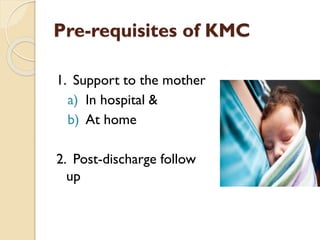
1. Support to the mother
a) In hospital &
b) At home
2. Post-discharge follow
up
Benefits of KMC
1. Breast feeding- Increased breast
feeding rates and Increased duration
of breast feeding
2. Thermal control- Effective thermal
control, Equivalent to conventional
incubator care
Cont..
3. Early discharge-
Better weight gain -
Early discharge
4. Lesser morbidity-
Regular breathing,
Decreased episodes
of apnea, Protection
from nosocomial
infections
Cont..
5. Other benefits
◦ Stronger bonding
◦ Deep satisfaction for mother
◦ More confident parents
◦ No need for special care
Requirements for KMC
Implementation
 Training - Nurses, physicians and other
staff
 Educational material - Information
sheets, posters and video films on KMC
 Furniture - Semi-reclining easy chairs,
Beds with adjustable back rest
Eligibility criteria: Baby
1. Birth weight >1800 gm: Start at
birth
2. Birth weight 1200-1800 gm:
Hemodynamically stable
3. Birth weight <1200 gm:
Hemodynamically stable
4. KMC can be initiated for the stable
babies, who are on IV fluid therapy,
tube feeding or oxygen therapy.
Eligibility criteria: Mother
1. Willingness of mother
2. General health & nutrition (free from
serious illness)
3. Hygiene (daily bath, change of clothes
daily, short finger nails)
4. Supportive family and community
Preparing for KMC
1. Counseling
 Explain benefits of KMC
 Demonstrate procedure to mother
 Ensure family support
 KMC support group (interaction with
mother already practicing KMC for their
baby)
 Discuss about the procedure to the
husband or any other family member
Cont..
2. Mother’s clothing
 Front-open, light dress as per the local
culture
3. Baby’s clothing
 Cap, socks, nappy and front-open
sleeveless shirt.
KMC Procedure
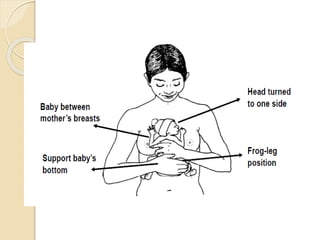
1. Kangaroo positioning
1. Place baby between the mother’s
breasts in an upright position
2. Head turned to one side and slightly
extended
3. Hips flexed and abducted in a “frog”
position; arms flexed
4. Baby’s abdomen at mother’s epigastrium
5. Support baby’s bottom
2. Monitoring during KMC
Check for,
❑ Neck position - neither too flexed nor
too extended
❑ Clear airway
❑ Regular breathing
❑ Color and temperature of skin
❑ Hands and feet for warmth
3. Feeding
 Help mother to breastfeed her baby
during KMC
 Holding baby near the breast, during
kangaroo positioning stimulates milk
production
4. Privacy
 KMC unavoidably requires
some exposure on the
part of the mother.
 Privacy should be
maintained to avoid
unnecessary exposure on
the part of the mother
which makes her nervous
or uncomfortable.
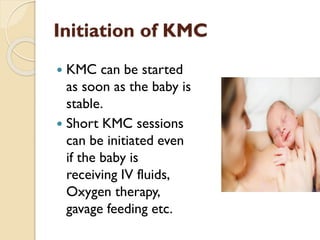
Initiation of KMC
 KMC can be started
as soon as the baby is
stable.
 Short KMC sessions
can be initiated even
if the baby is
receiving IV fluids,
Oxygen therapy,
gavage feeding etc.
Duration of Kangaroo Mother
Care
1. Skin-to-skin contact should start gradually
in the nursery
2. Transit from conventional care to longer
KMC
3. Sessions that last less than one hour
should be avoided because frequent
handling may be stressful for the baby.
4. Continue KMC to post-natal ward and
home
5. Increase duration up to 24 hours a day,
interrupted only for changing diapers.
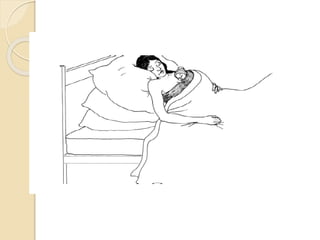
KMC during sleep and resting
Resting
 Reclining or semi-recumbent position
 Adjustable bed
 Several pillows on an ordinary bed
 Easy reclining chair
Sleep
 Supporting garment restraint for baby
 Mother can provide KMC in reclining or semi-
recumbent position 15’-30’ from above the
ground
Criteria for transfer
From nursery to ward
1. Stable baby
2. Gaining weight
3. Mother confident of looking after the
baby
Discharge criteria
1. Baby is well with no evidence of
infection
2. Feeding well (exclusively breast milk)
3. Gaining weight (15-20 gm/kg/day)
4. Maintaining body temperature (in room
temperature)
5. Mother confident of taking care of the
baby
6. Follow-up visits ensured
Discontinuation of KMC
1. Post-conception age reaches 40 weeks
2. Weight ~ 2500 gm
3. Baby uncomfortable
4. Wriggling out
5. Pulls limbs out
6. Cries vigrously
Post-discharge follow up
1. Once or twice a week till 37-40 wks /
2.5-3 kg
2. Thereafter, once in 2-4 wks till 3 months
Post conceptional age
3. Subsequently, every 1-2 months during
first year
4. More frequent visits if baby is not
growing well

Kangaroo mother care

  • 1.
  • 2.
    Definition Kangaroo Mother Care(KMC) is a special way of caring of low birth weight babies. It fosters their health and well being by promoting  Effective thermal control,  Breastfeeding,  Infection prevention and  Bonding.
  • 3.
    Components of KMC 1.Skin-to-skin contact - Early, continuous and prolonged skin-to skin contact 2. Exclusive breast feeding - Promotes lactation and facilitates feeding, provides adequate nutrition 3. Early discharge and follow up care- desired weight gain helps in early discharge and regular follow up care to identify problems for early intervention
  • 4.
    Pre-requisites of KMC 1.Support to the mother a) In hospital & b) At home 2. Post-discharge follow up
  • 5.
    Benefits of KMC 1.Breast feeding- Increased breast feeding rates and Increased duration of breast feeding 2. Thermal control- Effective thermal control, Equivalent to conventional incubator care
  • 6.
    Cont.. 3. Early discharge- Betterweight gain - Early discharge 4. Lesser morbidity- Regular breathing, Decreased episodes of apnea, Protection from nosocomial infections
  • 7.
    Cont.. 5. Other benefits ◦Stronger bonding ◦ Deep satisfaction for mother ◦ More confident parents ◦ No need for special care
  • 8.
    Requirements for KMC Implementation Training - Nurses, physicians and other staff  Educational material - Information sheets, posters and video films on KMC  Furniture - Semi-reclining easy chairs, Beds with adjustable back rest
  • 9.
    Eligibility criteria: Baby 1.Birth weight >1800 gm: Start at birth 2. Birth weight 1200-1800 gm: Hemodynamically stable 3. Birth weight <1200 gm: Hemodynamically stable 4. KMC can be initiated for the stable babies, who are on IV fluid therapy, tube feeding or oxygen therapy.
  • 10.
    Eligibility criteria: Mother 1.Willingness of mother 2. General health & nutrition (free from serious illness) 3. Hygiene (daily bath, change of clothes daily, short finger nails) 4. Supportive family and community
  • 11.
    Preparing for KMC 1.Counseling  Explain benefits of KMC  Demonstrate procedure to mother  Ensure family support  KMC support group (interaction with mother already practicing KMC for their baby)  Discuss about the procedure to the husband or any other family member
  • 12.
    Cont.. 2. Mother’s clothing Front-open, light dress as per the local culture 3. Baby’s clothing  Cap, socks, nappy and front-open sleeveless shirt.
  • 13.
  • 14.
    1. Kangaroo positioning 1.Place baby between the mother’s breasts in an upright position 2. Head turned to one side and slightly extended 3. Hips flexed and abducted in a “frog” position; arms flexed 4. Baby’s abdomen at mother’s epigastrium 5. Support baby’s bottom
  • 16.
    2. Monitoring duringKMC Check for, ❑ Neck position - neither too flexed nor too extended ❑ Clear airway ❑ Regular breathing ❑ Color and temperature of skin ❑ Hands and feet for warmth
  • 17.
    3. Feeding  Helpmother to breastfeed her baby during KMC  Holding baby near the breast, during kangaroo positioning stimulates milk production
  • 18.
    4. Privacy  KMCunavoidably requires some exposure on the part of the mother.  Privacy should be maintained to avoid unnecessary exposure on the part of the mother which makes her nervous or uncomfortable.
  • 19.
    Initiation of KMC KMC can be started as soon as the baby is stable.  Short KMC sessions can be initiated even if the baby is receiving IV fluids, Oxygen therapy, gavage feeding etc.
  • 20.
    Duration of KangarooMother Care 1. Skin-to-skin contact should start gradually in the nursery 2. Transit from conventional care to longer KMC 3. Sessions that last less than one hour should be avoided because frequent handling may be stressful for the baby. 4. Continue KMC to post-natal ward and home 5. Increase duration up to 24 hours a day, interrupted only for changing diapers.
  • 21.
    KMC during sleepand resting Resting  Reclining or semi-recumbent position  Adjustable bed  Several pillows on an ordinary bed  Easy reclining chair Sleep  Supporting garment restraint for baby  Mother can provide KMC in reclining or semi- recumbent position 15’-30’ from above the ground
  • 23.
    Criteria for transfer Fromnursery to ward 1. Stable baby 2. Gaining weight 3. Mother confident of looking after the baby
  • 24.
    Discharge criteria 1. Babyis well with no evidence of infection 2. Feeding well (exclusively breast milk) 3. Gaining weight (15-20 gm/kg/day) 4. Maintaining body temperature (in room temperature) 5. Mother confident of taking care of the baby 6. Follow-up visits ensured
  • 25.
    Discontinuation of KMC 1.Post-conception age reaches 40 weeks 2. Weight ~ 2500 gm 3. Baby uncomfortable 4. Wriggling out 5. Pulls limbs out 6. Cries vigrously
  • 26.
    Post-discharge follow up 1.Once or twice a week till 37-40 wks / 2.5-3 kg 2. Thereafter, once in 2-4 wks till 3 months Post conceptional age 3. Subsequently, every 1-2 months during first year 4. More frequent visits if baby is not growing well