Nutritional requirements,
feeding of infants and
nutritional assessment
By Ayichew A.
october 6/2021 BY:Ayichew A. 1
Objectives
At the end of this lecture the students should be able
to:
Describe the nutritional requirement of infants
and children
Identify common problems encountered during
feeding of infants
Explain methods used for assessing nutritional
status of children
2
october 6/2021
Infants feeding
Options of infants feeding
1. Mother breast milk (first choice)
2. Commercial infant formulas
3. Feeding by wet nurse/grandmothers
4. Home prepared formulas
ayichewalemu741@gmail.com 4
2/27/2024
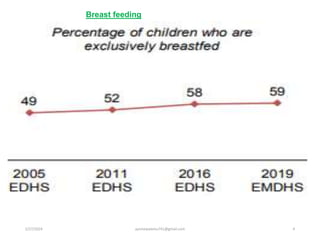
Breast feeding
Breast feeding
 Initiated as soon as after
birth as possible unless
problems occurred.
•Maintains normal
metabolism during
transition
•Promotes maternal-infant
bonding
Provides ideal food for
healthy growth and
development of all infants.
•8-12 times feeding per
24 hours) or more.
5
october
6/2021
BY:Ayichew A.
Colostrum
First milk (yellowish & thick fluid )
Rich in Vitamins (A, D, E ,K)
Has less fat and more protein
It is produced for the first 3 to 4 days after
birth.
Full of antibodies, it functions like child's first
immunization.
High levels of immunoglobulins (IgA, G, M)
Natural laxative: helps the infant move their
bowels and get rid of the meconium.
october 6/2021 BY:Ayichew A. 6
Breast feeding..
Transitional breast milk(2nd) replaces
colostrum on 4 days to 10-14 days after birth.
Mature breast milk(3rd) is produced 2 weeks after the
baby is delivered , appears thin and has more fat and
protein.
Fore milk ( milk produced at the beginning of the
feed)
 It is watery and satisfies babies thirst
After the foremilk is let down, new thick and fattier
milk is formed (hind milk ) helps the breastfed infant to
grow quickly
october 6/2021 BY:Ayichew A. 7
Physiology of breast feeding
BF requires the presence
of reflexes /maternal and
infant/
oReflexes of the baby
A. rooting reflex: w/n the
nipple of the breast touches
the lips / cheeks/ of the
baby the baby turns his
head towards the touch, and
opens and shuts his/her
mouth (tongue
extrusion reflex )
B. sucking reflex: the baby
milks the breast by pressing
the nipple with his tongue
against his/her hard palate
C/ swallowing reflex : after
the milk is in the mouth, it
is swallowed by a
coordinated reflex.
october 6/2021
8
BY:Ayichew A.
Reflexes of the mother
oProlactin reflex
Suckling impulse to anterior pituitary gland
 increase secretion of prolactin hormone 
prolactin to alveolus of the breast  increase
milk production in the breasts
october 6/2021 9
BY:Ayichew A.
Conti…
Letdown reflex
Sucking (cry of a baby)  impulse to posterior pituitary
gland  increase in secretion of the oxytocin hormone 
oxytocin to myoepithelial cells of the breast  milk ejection
The let-down reflex is triggered not only
by suckling at the breast but also by thinking of the baby or
by the sound of a baby crying.
Mothers should be informed that the production of oxytocin
during suckling may cause uterine contractions and may
cause afterpains during breastfeeding
october 6/2021 10
BY:Ayichew A.
Optimal feeding of infants
Exclusive breastfeeding(EBF) for the 1st six months,
followed by an introduction of complementary foods
drawn from the local diet at about six months.
BF should be sustained well into or beyond the 2nd year
of life with increasing amounts of complementary foods.
If Breast milk is not available an alternative infant
formula should be used
october 6/2021
11
BY:Ayichew A.
Golden rules for breast feeding
BF 1st 30minutes
Correct positioning of the baby
Bedding in :encourage the mother and the baby to be
in one bed
Feeding on demand ((sucking motions, sucking on
hands, or putting the fist to the chin, crying) but the
mother should awaken the infant who may spent most
of the day sleeping.
october 6/2021
12
BY:Ayichew A.
Golden rule…
Informe the mother on the importance of
hygiene/cleansing her hands b/c touching the breasts
Breasts should be well emptied to avoid problems
/i.e. breast engorgement
If problems arise, she should seek; advice and
continue breastfeeding .
october 6/2021
13
BY:Ayichew A.
Good positioning during suckling
Mother should be sitting
comfortably relaxed
 Neck straight or bent slightly back
 Body is turned towards the mother
 Body is close to the mother
 Baby facing the breast with nose
opposite the nipple.
 Whole body is supported
october 6/2021
14
BY:Ayichew A.
Signs of good position…
Then touch the baby's lips with her
nipple.
Wait until baby opens mouth
wide.
Attach the baby to the breast.
Move the baby quickly to the breast
with the baby's lower lip well below the
nipple.
october 6/2021 BY:Ayichew A. 15
Signs of good attachment (mouth to
breast)
1. The baby’s chin touching breast
2. Lower lip turned out ward
3. Mouth wide open
4. More areola visible above than below the
mouth of the baby.
october 6/2021 16
BY:Ayichew A.
Signs of milk transfer
Sustained suck/swallow pattern with
occasional pauses
Audible swallowing
Relaxed arms and hands
Moist mouth
Satisfied after feeding (nipple out,
playing with nipple ,sleepy)
Jeanette
Panchula
-
BSW,
RN,
PHN,
IBCLC
-
Solano
County
Health
and
Social
Services
october 6/2021 BY:Ayichew A. 17
october 6/2021 BY:Ayichew A. 18
Benefits of breast feeding
Easy to digest and nutrients are well
absorbed.
Contains enough fluids for the first 6 months
of life no water is given
Makes a special relationship between
mother and baby that leads to better
psychomotor and social development.
october 6/2021 19
BY:Ayichew A.
Benefits of breast feeding…
An efficient contraceptive method during
the first 6 months if breast-feeding is
exclusive and frequent.
Reduces the risk of post-partum
hemorrhage.
october 6/2021
20
BY:Ayichew A.
Factors affecting breast feeding
Neonatal problem
Pre maturity
Asphyxia
Congenital abnormality
 E.G. Cleft lip
Maternal problem
Local inflammation e.g. mastitis
Psychological unready ness due
to anxiety or stress, maternal
illness, pain etc.
Breast CA
Chronic infection like HIV
Maternal drug intake may affect
the infant(anti
Ca,psychotic,deppresant
october 6/2021
21
BY:Ayichew A.
Factors affecting breast feeding
Sore nipples
Expose nipples to air between feedings.
Allow breast milk to dry on nipples.
Vitamin E may help to heal sore nipples.
Engorgement
Apply warm compresses or encourage the mother to
take a warm shower prior to having the baby latch on.
Warmth encourages some of the milk to be released,
allowing the breast to soften and making it easier for
the infant to latch on.
october 6/2021 BY:Ayichew A. 22
Limitations of BF
Transmission of infections like HIV
Contains low vitamin D (intake should be 200
IU/day drop, starting at 2 mo. of age for all
breast-fed infants)
 Iron content of human milk is low(iron
supplement1mg/kg at 4-6 months)
Low content of vitamin K (parenteral
administration of 1 mg of vitamin K1 for term and
0.5mg for preterm IM at birth is recommended for all
infants).
october 6/2021 BY:Ayichew A.
23
Commercial infant Formula milk
For the mother who does not desire to, or
cannot, breast-feed(contra indication of breast
milk) , commercially prepared formulas are
available for bottle-feeding (cup feeding).
These formulas are designed to imitate
human milk.
It is important to feed the baby when he or
she displays signs of hunger (sucking
motions, sucking on hands, or putting the fist
to the chin, crying).
october 6/2021 BY:Ayichew A. 24
Commercial infant Formula milk
Infant should be fed until full.
To prevent overfeeding, healthy bottle-fed
infants should be allowed to self-regulate the
amount of formula ingested per feeding.
When the baby is satiated, he or she might fall
asleep, spit out the nipple or formula, play with
the nipple, or lie quietly, only sucking once in a
while
october 6/2021 BY:Ayichew A. 25
Preparation and storage of bottles and
formula
Wash nipples and bottles or cups in hot soapy water
and rinse well
After mixing concentrate or powdered formula, store
tightly covered in refrigerator for up to 48 hours.
Do not add cereal to the formula in the bottle.
Do not sweeten formula with honey.
Warm formula by placing bottle in a container of hot
water.
october 6/2021 BY:Ayichew A. 26
Weaning (Progressing to Solid
Foods)
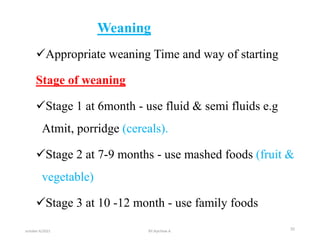
An introduction of solid food(complementary
food) to the infant other than breast milk or
formula milk after the 1st 6 months .
Appropriate weaning Time and way of starting
october 6/2021 27
BY:Ayichew A.
Weaning (Progressing to Solid Foods)
After 6 months of age, infants usually require the
nutrients available in solid foods in addition to their breast
milk or formula.
Several factors contribute to the appropriate timing of
solid food introduction.
Introducing solid food with a spoon prior to 4 to 6 months
of age will result in extrusion of the tongue reflex.
The parent may think that the infant does not want the
food and is spitting it out intentionally, but this is not the
case; the infant simply must be mature enough to eat with
a spoon (absence of extrusion reflex).
october 6/2021 BY:Ayichew A.
28
Weaning…
 Enzymes to appropriately digest food other than
breast milk and formula are not present in sufficient
quantities until the age of 4 to 6 months.
Before the introduction of solid foods and the cup, the
infant should be able to sit supported in a high chair.
Solids should be fed with a spoon, with the infant in an
upright position.
october 6/2021 BY:Ayichew A. 29
Weaning
Appropriate weaning Time and way of starting
Stage of weaning
Stage 1 at 6month - use fluid & semi fluids e.g
Atmit, porridge (cereals).
Stage 2 at 7-9 months - use mashed foods (fruit &
vegetable)
Stage 3 at 10 -12 month - use family foods
october 6/2021 30
BY:Ayichew A.
Weaning…
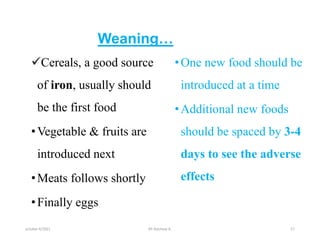
Cereals, a good source
of iron, usually should
be the first food
•Vegetable & fruits are
introduced next
•Meats follows shortly
•Finally eggs
•One new food should be
introduced at a time
•Additional new foods
should be spaced by 3-4
days to see the adverse
effects
31
october 6/2021 BY:Ayichew A.
Weaning…
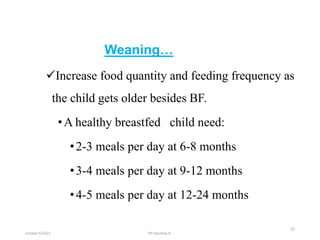
Increase food quantity and feeding frequency as
the child gets older besides BF.
•A healthy breastfed child need:
•2-3 meals per day at 6-8 months
•3-4 meals per day at 9-12 months
•4-5 meals per day at 12-24 months
october 6/2021
32
BY:Ayichew A.
Weaning…
Feed infants directly and assist older children when
they feed themselves
If they refuse, experiment with different food
combinations, tastes, textures and methods.
Feed slowly and patiently.
Do not force
october 6/2021 33
BY:Ayichew A.
Weaning…
Practice good hygiene and proper handling of
foods
Wash caregivers’ and children’s hands before and
after food preparation and feeding.
Serve foods immediately after preparation
Use clean utensils to prepare and serve food
october 6/2021 34
BY:Ayichew A.
Nutrients (balanced diet)
 Macronutrients
•Type of food required in
large amounts in the diet
•Includes :-
oCarbohydrates
oFats
 Proteins like Meat,
fish, eggs, and
milk(complete)
 Beans, grains, and
nuts(incomplete)
Micronutrients
•Vitamins and minerals
needed by the body in
very small amounts.
october 6/2021 BY:Ayichew A. 35
Energy
Calorie – used to measure
energy in foods.
•1 kilocalorie= 1,000
calories
•1 Calorie (Cal)(upper
case) =1000 calories
(cal)(lower case)
•1 gram of CHO= 4 Kcal
•Water = 0 Calories per
gram
•1 gram of Protein = 4 Kcal
•1 gram of fat = 9 Kcal
•1 gram of alcohol = 7 Kcal
october 6/2021 BY:Ayichew A. 36
Daily caloric requirement
Holliday—segar formula for calculating the
daily requirement of calories
Up to 10 kg: 100kcal/kg/day
11-20 kg :1000 kcal+50 kcal/kg for each kg
above 10 kg.
Above 20 kg: 1500 kcal + 20 kcal/kg for
each kg above 20 kg.
Sources of caloric supply
• carbohydrate 50 - 55 %
• fat 30-35%
• protein 10-15%
Calorie and Protein Requirements of Children
(ICMR Recommendations)
october 6/2021 BY:Ayichew A. 38
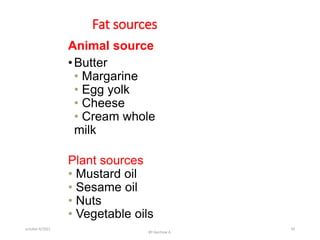
Fat sources
Animal source
•Butter
• Margarine
• Egg yolk
• Cheese
• Cream whole
milk
Plant sources
• Mustard oil
• Sesame oil
• Nuts
• Vegetable oils
october 6/2021
BY:Ayichew A.
39
Functions of Fats
• Insulation—provides warmth
• Absorption of fat-soluble vitamins
• Act as a vehicle for absorption for vitamins A,
D,
E and K
• Source of essential fatty acids
• Protein sparing effect—when fats and proteins
are taken in adequate quantities, the amount
of proteins utilized for calorie production is
reduced
• Condensed form of energy—1 g will provide 9
kcal
october 6/2021 BY:Ayichew A. 40
VITAMINS
october 6/2021 BY:Ayichew A. 41
VITAMINS
Generally, cannot be synthesized by the
body and must therefore be supplied in
the diet.
Vitamins are classified into two groups:
1. Fat-soluble—vitamins A, D, E and K
Dissolved in fats and stored in the body
Taking large doses(excess) can be toxic
2. Water-soluble—vitamins B and C
october 6/2021 BY:Ayichew A. 42
Vitamins..
Metabolism, growth and development
Helps the body use CHO, proteins, and
fats
Body cannot break them down to release
energy
october 6/2021 BY:Ayichew A. 43
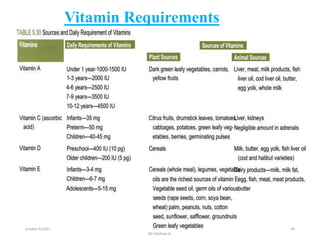
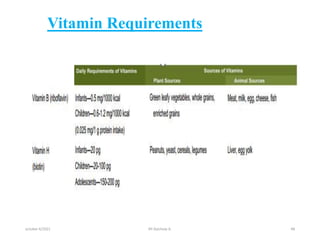
Vitamin Requirements
october 6/2021
BY:Ayichew A.
44
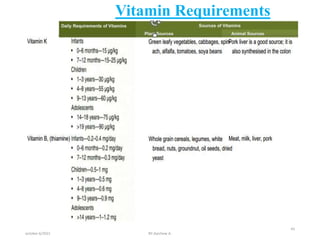
Vitamin Requirements
october 6/2021 BY:Ayichew A.
45
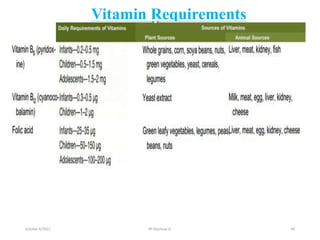
Vitamin Requirements
october 6/2021 BY:Ayichew A. 46
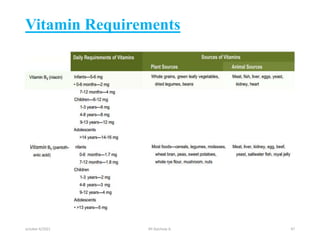
Vitamin Requirements
october 6/2021 BY:Ayichew A. 47
Vitamin Requirements
october 6/2021 BY:Ayichew A. 48
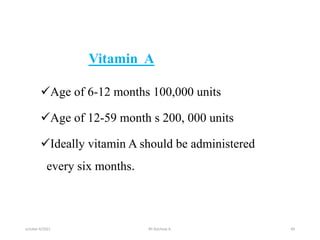
Vitamin A
Age of 6-12 months 100,000 units
Age of 12-59 month s 200, 000 units
Ideally vitamin A should be administered
every six months.
october 6/2021 BY:Ayichew A. 49
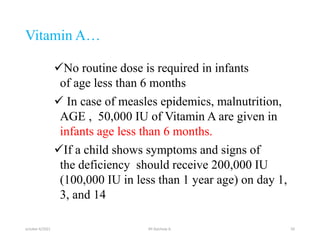
Vitamin A…
No routine dose is required in infants
of age less than 6 months
 In case of measles epidemics, malnutrition,
AGE , 50,000 IU of Vitamin A are given in
infants age less than 6 months.
If a child shows symptoms and signs of
the deficiency should receive 200,000 IU
(100,000 IU in less than 1 year age) on day 1,
3, and 14
october 6/2021 BY:Ayichew A. 50
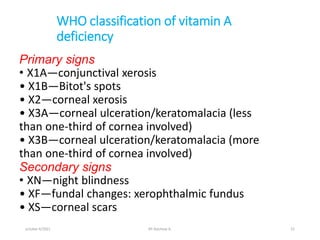
WHO classification of vitamin A
deficiency
Primary signs
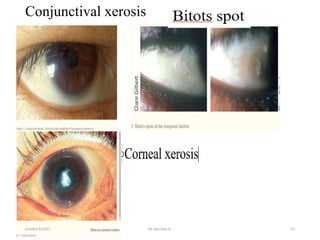
• X1A—conjunctival xerosis
• X1B—Bitot's spots
• X2—corneal xerosis
• X3A—corneal ulceration/keratomalacia (less
than one-third of cornea involved)
• X3B—corneal ulceration/keratomalacia (more
than one-third of cornea involved)
Secondary signs
• XN—night blindness
• XF—fundal changes: xerophthalmic fundus
• XS—corneal scars
october 6/2021 BY:Ayichew A. 51
Conjunctival xerosis
october 6/2021 BY:Ayichew A. 52
Vitamin B 12 (Cyanocobalamin)
Sources
It is a vitamin that is synthesised by
microorganisms and naturaly is not found
in plants.
The children are dependent on the animal
sources (liver, kidneys and meat).
Strict vegans who do not consume milk or
milk products
are prone to develop its deficiency.
october 6/2021 BY:Ayichew A. 53
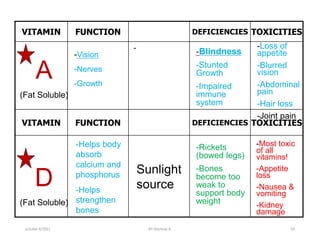
VITAMIN FUNCTION DEFICIENCIES TOXICITIES
Sunlight
source
A
(Fat Soluble)
D
(Fat Soluble)
-Vision
-Nerves
-Growth
-
-Blindness
-Stunted
Growth
-Impaired
immune
system
-Loss of
appetite
-Blurred
vision
-Abdominal
pain
-Hair loss
-Joint pain
-Helps body
absorb
calcium and
phosphorus
-Helps
strengthen
bones
-Rickets
(bowed legs)
-Bones
become too
weak to
support body
weight
-Most toxic
of all
vitamins!
-Appetite
loss
-Nausea &
vomiting
-Kidney
damage
october 6/2021 BY:Ayichew A. 54
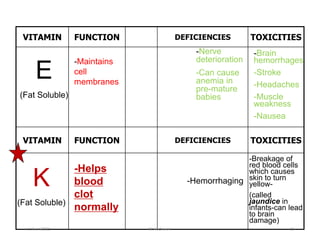
VITAMIN FUNCTION DEFICIENCIES TOXICITIES
E
(Fat Soluble)
K
(Fat Soluble)
-Maintains
cell
membranes
-Nerve
deterioration
-Can cause
anemia in
pre-mature
babies
-Brain
hemorrhages
-Stroke
-Headaches
-Muscle
weakness
-Nausea
-Helps
blood
clot
normally
-Hemorrhaging
-Breakage of
red blood cells
which causes
skin to turn
yellow-
(called
jaundice in
infants-can lead
to brain
damage)
october 6/2021 BY:Ayichew A. 55
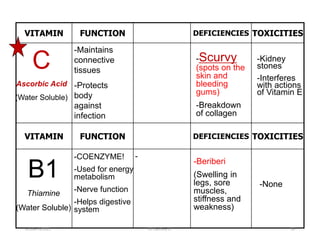
VITAMIN FUNCTION DEFICIENCIES TOXICITIES
C
Ascorbic Acid
(Water Soluble)
-Maintains
connective
tissues
-Protects
body
against
infection
-Scurvy
(spots on the
skin and
bleeding
gums)
-Breakdown
of collagen
-Kidney
stones
-Interferes
with actions
of Vitamin E
-COENZYME!
-Used for energy
metabolism
-Nerve function
-Helps digestive
system
-
-Beriberi
(Swelling in
legs, sore
muscles,
stiffness and
weakness)
-None
B1
Thiamine
(Water Soluble)
october 6/2021 BY:Ayichew A. 56
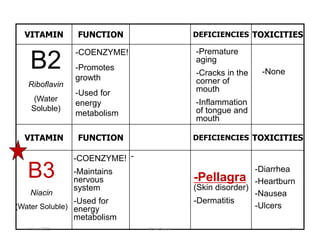
VITAMIN FUNCTION DEFICIENCIES TOXICITIES
B2
Riboflavin
(Water
Soluble)
-COENZYME!
-Promotes
growth
-Used for
energy
metabolism
-Premature
aging
-Cracks in the
corner of
mouth
-Inflammation
of tongue and
mouth
-None
-COENZYME!
-Maintains
nervous
system
-Used for
energy
metabolism
-
-Pellagra
(Skin disorder)
-Dermatitis
-Diarrhea
-Heartburn
-Nausea
-Ulcers
B3
Niacin
(Water Soluble)
october 6/2021 BY:Ayichew A. 57
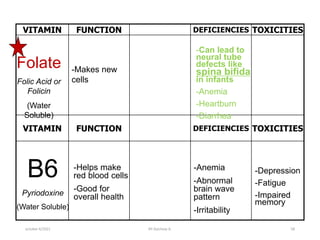
VITAMIN FUNCTION DEFICIENCIES TOXICITIES
Folate
Folic Acid or
Folicin
(Water
Soluble)
-Makes new
cells
-Can lead to
neural tube
defects like
spina bifida
in infants
-Anemia
-Heartburn
-Diarrhea
-Helps make
red blood cells
-Good for
overall health
-Anemia
-Abnormal
brain wave
pattern
-Irritability
-Depression
-Fatigue
-Impaired
memory
B6
Pyriodoxine
(Water Soluble)
october 6/2021 BY:Ayichew A. 58
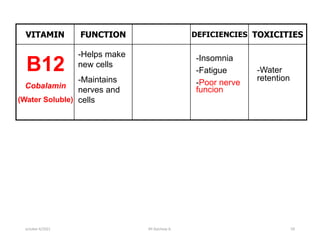
VITAMIN FUNCTION DEFICIENCIES TOXICITIES
B12
Cobalamin
(Water Soluble)
-Helps make
new cells
-Maintains
nerves and
cells
-Insomnia
-Fatigue
-Poor nerve
funcion
-Water
retention
october 6/2021 BY:Ayichew A. 59
MINERALS
october 6/2021 BY:Ayichew A. 60
october 6/2021 BY:Ayichew A. 61
Minerals
october 6/2021 BY:Ayichew A. 62
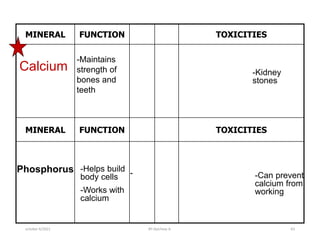
MINERAL FUNCTION TOXICITIES
Calcium
-Maintains
strength of
bones and
teeth
-Kidney
stones
-Helps build
body cells
-Works with
calcium
- -Can prevent
calcium from
working
Phosphorus
october 6/2021 BY:Ayichew A. 63
MINERAL FUNCTION TOXICITIES
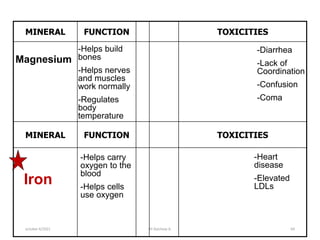
Magnesium
-Helps build
bones
-Helps nerves
and muscles
work normally
-Regulates
body
temperature
-Diarrhea
-Lack of
Coordination
-Confusion
-Coma
-Helps carry
oxygen to the
blood
-Helps cells
use oxygen
-Heart
disease
-Elevated
LDLs
Iron
october 6/2021 BY:Ayichew A. 64
MINERAL FUNCTION TOXICITIES
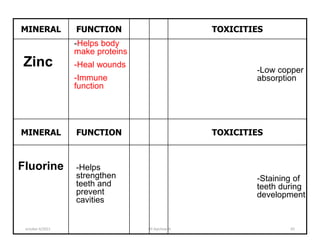
Zinc
-Helps body
make proteins
-Heal wounds
-Immune
function
-Low copper
absorption
-Helps
strengthen
teeth and
prevent
cavities
-Staining of
teeth during
development
Fluorine
october 6/2021 BY:Ayichew A. 65
MINERAL FUNCTION TOXICITIES
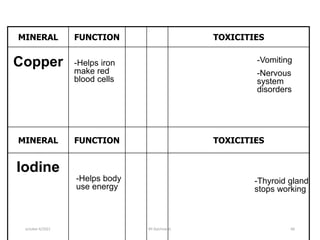
Copper -Helps iron
make red
blood cells
-Vomiting
-Nervous
system
disorders
-Helps body
use energy
-Thyroid gland
stops working
Iodine
october 6/2021 BY:Ayichew A. 66
MINERAL FUNCTION TOXICITIES
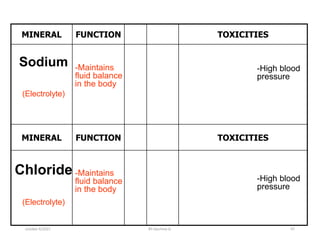
Sodium
(Electrolyte)
-Maintains
fluid balance
in the body
-High blood
pressure
-Maintains
fluid balance
in the body
-High blood
pressure
Chloride
(Electrolyte)
october 6/2021 BY:Ayichew A. 67
MINERAL FUNCTION TOXICITIES
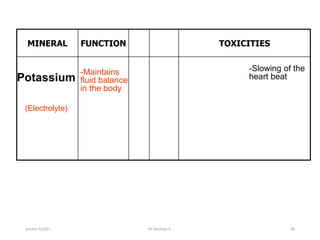
Potassium
(Electrolyte)
-Maintains
fluid balance
in the body
-Slowing of the
heart beat
october 6/2021 BY:Ayichew A. 68
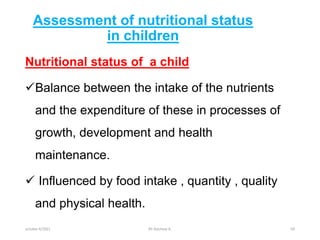
Assessment of nutritional status
in children
Nutritional status of a child
Balance between the intake of the nutrients
and the expenditure of these in processes of
growth, development and health
maintenance.
 Influenced by food intake , quantity , quality
and physical health.
october 6/2021 BY:Ayichew A. 69
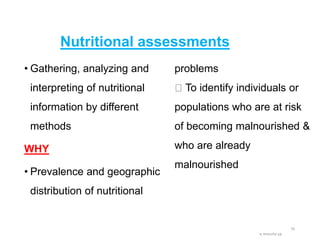
Nutritional assessments
• Gathering, analyzing and
interpreting of nutritional
information by different
methods
WHY
• Prevalence and geographic
distribution of nutritional
problems
To identify individuals or
populations who are at risk
of becoming malnourished &
who are already
malnourished
BY:Ayichew
A.
70
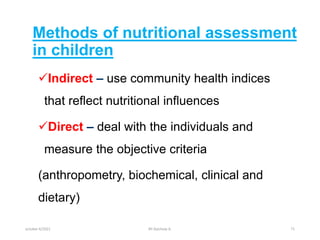
Methods of nutritional assessment
in children
Indirect – use community health indices
that reflect nutritional influences
Direct – deal with the individuals and
measure the objective criteria
(anthropometry, biochemical, clinical and
dietary)
october 6/2021 BY:Ayichew A. 71
Indirect methods of nutritional
assessment
 Ecological variables(rainfall, temperature, war )
 Economic factors(different resource availability)
 Vital health statistics (number of birth, number
of death , divorce)
october 6/2021 BY:Ayichew A. 72
Direct methods
Anthropometry measurement
Height
Weight
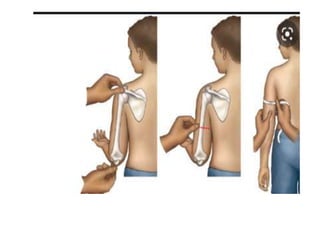
Mid Upper-arm circumference
Head circumference
Hip/waist ratio
Skin fold thickness
october 6/2021
BY:Ayichew A.
73
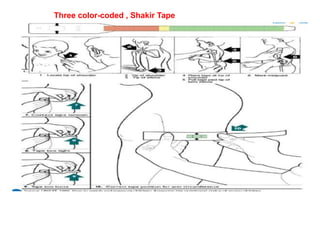
Three color-coded , Shakir Tape
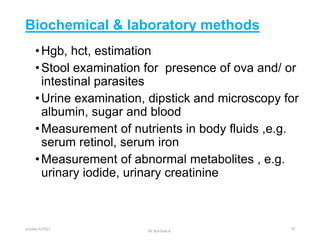
Biochemical & laboratory methods
•Hgb, hct, estimation
•Stool examination for presence of ova and/ or
intestinal parasites
•Urine examination, dipstick and microscopy for
albumin, sugar and blood
•Measurement of nutrients in body fluids ,e.g.
serum retinol, serum iron
•Measurement of abnormal metabolites , e.g.
urinary iodide, urinary creatinine
october 6/2021
BY:Ayichew A.
79
Biochemical & laboratory methods
• Advantages
Useful in detecting early changes in body
metabolism and nutrition
precise , accurate .
Useful to validate data obtained from dietary
methods
Limitations
Time consuming and expensive
Cannot be applied on large scale
october 6/2021 BY:Ayichew A. 80
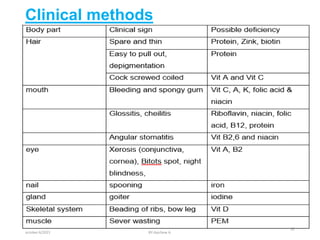
Clinical methods
•Utilizes a number of physical signs (specific
and non-specific) that are known to be
associated with malnutrition and deficiency of
vitamins and other micro-nutrients.
•General clinical examination with special
attention to organs like hair, angles of mouth,
gums, nails, skin, eyes, tongue, muscles,
bones & thyroid gland.
october 6/2021 BY:Ayichew A. 81
Clinical methods
october 6/2021 BY:Ayichew A.
82
Dietary intake method
•Assessment of food consumption through
dietary surveys.
•It provides information about dietary intake
patterns, specific foods consumed and
estimated nutrient intakes.
•Reviewing dietary data may suggest risk
factors for chronic diseases and help to
prevent them.
october 6/2021 BY:Ayichew A. 84
Reference
 Nelson text book of pediatrics 21th edition
 Essentials of pediatrics nursing 2nd edition
 Current diagnosis and treatment of
pediatrics 19th edition
october 6/2021 BY:Ayichew A. 85

3_Nutritional_requirements_and_assessment_in_children_for_3rd_year.ppt

  • 1.
    Nutritional requirements, feeding ofinfants and nutritional assessment By Ayichew A. october 6/2021 BY:Ayichew A. 1
  • 2.
    Objectives At the endof this lecture the students should be able to: Describe the nutritional requirement of infants and children Identify common problems encountered during feeding of infants Explain methods used for assessing nutritional status of children 2 october 6/2021
  • 3.
    Infants feeding Options ofinfants feeding 1. Mother breast milk (first choice) 2. Commercial infant formulas 3. Feeding by wet nurse/grandmothers 4. Home prepared formulas
  • 4.
  • 5.
    Breast feeding  Initiatedas soon as after birth as possible unless problems occurred. •Maintains normal metabolism during transition •Promotes maternal-infant bonding Provides ideal food for healthy growth and development of all infants. •8-12 times feeding per 24 hours) or more. 5 october 6/2021 BY:Ayichew A.
  • 6.
    Colostrum First milk (yellowish& thick fluid ) Rich in Vitamins (A, D, E ,K) Has less fat and more protein It is produced for the first 3 to 4 days after birth. Full of antibodies, it functions like child's first immunization. High levels of immunoglobulins (IgA, G, M) Natural laxative: helps the infant move their bowels and get rid of the meconium. october 6/2021 BY:Ayichew A. 6
  • 7.
    Breast feeding.. Transitional breastmilk(2nd) replaces colostrum on 4 days to 10-14 days after birth. Mature breast milk(3rd) is produced 2 weeks after the baby is delivered , appears thin and has more fat and protein. Fore milk ( milk produced at the beginning of the feed)  It is watery and satisfies babies thirst After the foremilk is let down, new thick and fattier milk is formed (hind milk ) helps the breastfed infant to grow quickly october 6/2021 BY:Ayichew A. 7
  • 8.
    Physiology of breastfeeding BF requires the presence of reflexes /maternal and infant/ oReflexes of the baby A. rooting reflex: w/n the nipple of the breast touches the lips / cheeks/ of the baby the baby turns his head towards the touch, and opens and shuts his/her mouth (tongue extrusion reflex ) B. sucking reflex: the baby milks the breast by pressing the nipple with his tongue against his/her hard palate C/ swallowing reflex : after the milk is in the mouth, it is swallowed by a coordinated reflex. october 6/2021 8 BY:Ayichew A.
  • 9.
    Reflexes of themother oProlactin reflex Suckling impulse to anterior pituitary gland  increase secretion of prolactin hormone  prolactin to alveolus of the breast  increase milk production in the breasts october 6/2021 9 BY:Ayichew A.
  • 10.
    Conti… Letdown reflex Sucking (cryof a baby)  impulse to posterior pituitary gland  increase in secretion of the oxytocin hormone  oxytocin to myoepithelial cells of the breast  milk ejection The let-down reflex is triggered not only by suckling at the breast but also by thinking of the baby or by the sound of a baby crying. Mothers should be informed that the production of oxytocin during suckling may cause uterine contractions and may cause afterpains during breastfeeding october 6/2021 10 BY:Ayichew A.
  • 11.
    Optimal feeding ofinfants Exclusive breastfeeding(EBF) for the 1st six months, followed by an introduction of complementary foods drawn from the local diet at about six months. BF should be sustained well into or beyond the 2nd year of life with increasing amounts of complementary foods. If Breast milk is not available an alternative infant formula should be used october 6/2021 11 BY:Ayichew A.
  • 12.
    Golden rules forbreast feeding BF 1st 30minutes Correct positioning of the baby Bedding in :encourage the mother and the baby to be in one bed Feeding on demand ((sucking motions, sucking on hands, or putting the fist to the chin, crying) but the mother should awaken the infant who may spent most of the day sleeping. october 6/2021 12 BY:Ayichew A.
  • 13.
    Golden rule… Informe themother on the importance of hygiene/cleansing her hands b/c touching the breasts Breasts should be well emptied to avoid problems /i.e. breast engorgement If problems arise, she should seek; advice and continue breastfeeding . october 6/2021 13 BY:Ayichew A.
  • 14.
    Good positioning duringsuckling Mother should be sitting comfortably relaxed  Neck straight or bent slightly back  Body is turned towards the mother  Body is close to the mother  Baby facing the breast with nose opposite the nipple.  Whole body is supported october 6/2021 14 BY:Ayichew A.
  • 15.
    Signs of goodposition… Then touch the baby's lips with her nipple. Wait until baby opens mouth wide. Attach the baby to the breast. Move the baby quickly to the breast with the baby's lower lip well below the nipple. october 6/2021 BY:Ayichew A. 15
  • 16.
    Signs of goodattachment (mouth to breast) 1. The baby’s chin touching breast 2. Lower lip turned out ward 3. Mouth wide open 4. More areola visible above than below the mouth of the baby. october 6/2021 16 BY:Ayichew A.
  • 17.
    Signs of milktransfer Sustained suck/swallow pattern with occasional pauses Audible swallowing Relaxed arms and hands Moist mouth Satisfied after feeding (nipple out, playing with nipple ,sleepy) Jeanette Panchula - BSW, RN, PHN, IBCLC - Solano County Health and Social Services october 6/2021 BY:Ayichew A. 17
  • 18.
  • 19.
    Benefits of breastfeeding Easy to digest and nutrients are well absorbed. Contains enough fluids for the first 6 months of life no water is given Makes a special relationship between mother and baby that leads to better psychomotor and social development. october 6/2021 19 BY:Ayichew A.
  • 20.
    Benefits of breastfeeding… An efficient contraceptive method during the first 6 months if breast-feeding is exclusive and frequent. Reduces the risk of post-partum hemorrhage. october 6/2021 20 BY:Ayichew A.
  • 21.
    Factors affecting breastfeeding Neonatal problem Pre maturity Asphyxia Congenital abnormality  E.G. Cleft lip Maternal problem Local inflammation e.g. mastitis Psychological unready ness due to anxiety or stress, maternal illness, pain etc. Breast CA Chronic infection like HIV Maternal drug intake may affect the infant(anti Ca,psychotic,deppresant october 6/2021 21 BY:Ayichew A.
  • 22.
    Factors affecting breastfeeding Sore nipples Expose nipples to air between feedings. Allow breast milk to dry on nipples. Vitamin E may help to heal sore nipples. Engorgement Apply warm compresses or encourage the mother to take a warm shower prior to having the baby latch on. Warmth encourages some of the milk to be released, allowing the breast to soften and making it easier for the infant to latch on. october 6/2021 BY:Ayichew A. 22
  • 23.
    Limitations of BF Transmissionof infections like HIV Contains low vitamin D (intake should be 200 IU/day drop, starting at 2 mo. of age for all breast-fed infants)  Iron content of human milk is low(iron supplement1mg/kg at 4-6 months) Low content of vitamin K (parenteral administration of 1 mg of vitamin K1 for term and 0.5mg for preterm IM at birth is recommended for all infants). october 6/2021 BY:Ayichew A. 23
  • 24.
    Commercial infant Formulamilk For the mother who does not desire to, or cannot, breast-feed(contra indication of breast milk) , commercially prepared formulas are available for bottle-feeding (cup feeding). These formulas are designed to imitate human milk. It is important to feed the baby when he or she displays signs of hunger (sucking motions, sucking on hands, or putting the fist to the chin, crying). october 6/2021 BY:Ayichew A. 24
  • 25.
    Commercial infant Formulamilk Infant should be fed until full. To prevent overfeeding, healthy bottle-fed infants should be allowed to self-regulate the amount of formula ingested per feeding. When the baby is satiated, he or she might fall asleep, spit out the nipple or formula, play with the nipple, or lie quietly, only sucking once in a while october 6/2021 BY:Ayichew A. 25
  • 26.
    Preparation and storageof bottles and formula Wash nipples and bottles or cups in hot soapy water and rinse well After mixing concentrate or powdered formula, store tightly covered in refrigerator for up to 48 hours. Do not add cereal to the formula in the bottle. Do not sweeten formula with honey. Warm formula by placing bottle in a container of hot water. october 6/2021 BY:Ayichew A. 26
  • 27.
    Weaning (Progressing toSolid Foods) An introduction of solid food(complementary food) to the infant other than breast milk or formula milk after the 1st 6 months . Appropriate weaning Time and way of starting october 6/2021 27 BY:Ayichew A.
  • 28.
    Weaning (Progressing toSolid Foods) After 6 months of age, infants usually require the nutrients available in solid foods in addition to their breast milk or formula. Several factors contribute to the appropriate timing of solid food introduction. Introducing solid food with a spoon prior to 4 to 6 months of age will result in extrusion of the tongue reflex. The parent may think that the infant does not want the food and is spitting it out intentionally, but this is not the case; the infant simply must be mature enough to eat with a spoon (absence of extrusion reflex). october 6/2021 BY:Ayichew A. 28
  • 29.
    Weaning…  Enzymes toappropriately digest food other than breast milk and formula are not present in sufficient quantities until the age of 4 to 6 months. Before the introduction of solid foods and the cup, the infant should be able to sit supported in a high chair. Solids should be fed with a spoon, with the infant in an upright position. october 6/2021 BY:Ayichew A. 29
  • 30.
    Weaning Appropriate weaning Timeand way of starting Stage of weaning Stage 1 at 6month - use fluid & semi fluids e.g Atmit, porridge (cereals). Stage 2 at 7-9 months - use mashed foods (fruit & vegetable) Stage 3 at 10 -12 month - use family foods october 6/2021 30 BY:Ayichew A.
  • 31.
    Weaning… Cereals, a goodsource of iron, usually should be the first food •Vegetable & fruits are introduced next •Meats follows shortly •Finally eggs •One new food should be introduced at a time •Additional new foods should be spaced by 3-4 days to see the adverse effects 31 october 6/2021 BY:Ayichew A.
  • 32.
    Weaning… Increase food quantityand feeding frequency as the child gets older besides BF. •A healthy breastfed child need: •2-3 meals per day at 6-8 months •3-4 meals per day at 9-12 months •4-5 meals per day at 12-24 months october 6/2021 32 BY:Ayichew A.
  • 33.
    Weaning… Feed infants directlyand assist older children when they feed themselves If they refuse, experiment with different food combinations, tastes, textures and methods. Feed slowly and patiently. Do not force october 6/2021 33 BY:Ayichew A.
  • 34.
    Weaning… Practice good hygieneand proper handling of foods Wash caregivers’ and children’s hands before and after food preparation and feeding. Serve foods immediately after preparation Use clean utensils to prepare and serve food october 6/2021 34 BY:Ayichew A.
  • 35.
    Nutrients (balanced diet) Macronutrients •Type of food required in large amounts in the diet •Includes :- oCarbohydrates oFats  Proteins like Meat, fish, eggs, and milk(complete)  Beans, grains, and nuts(incomplete) Micronutrients •Vitamins and minerals needed by the body in very small amounts. october 6/2021 BY:Ayichew A. 35
  • 36.
    Energy Calorie – usedto measure energy in foods. •1 kilocalorie= 1,000 calories •1 Calorie (Cal)(upper case) =1000 calories (cal)(lower case) •1 gram of CHO= 4 Kcal •Water = 0 Calories per gram •1 gram of Protein = 4 Kcal •1 gram of fat = 9 Kcal •1 gram of alcohol = 7 Kcal october 6/2021 BY:Ayichew A. 36
  • 37.
    Daily caloric requirement Holliday—segarformula for calculating the daily requirement of calories Up to 10 kg: 100kcal/kg/day 11-20 kg :1000 kcal+50 kcal/kg for each kg above 10 kg. Above 20 kg: 1500 kcal + 20 kcal/kg for each kg above 20 kg. Sources of caloric supply • carbohydrate 50 - 55 % • fat 30-35% • protein 10-15%
  • 38.
    Calorie and ProteinRequirements of Children (ICMR Recommendations) october 6/2021 BY:Ayichew A. 38
  • 39.
    Fat sources Animal source •Butter •Margarine • Egg yolk • Cheese • Cream whole milk Plant sources • Mustard oil • Sesame oil • Nuts • Vegetable oils october 6/2021 BY:Ayichew A. 39
  • 40.
    Functions of Fats •Insulation—provides warmth • Absorption of fat-soluble vitamins • Act as a vehicle for absorption for vitamins A, D, E and K • Source of essential fatty acids • Protein sparing effect—when fats and proteins are taken in adequate quantities, the amount of proteins utilized for calorie production is reduced • Condensed form of energy—1 g will provide 9 kcal october 6/2021 BY:Ayichew A. 40
  • 41.
  • 42.
    VITAMINS Generally, cannot besynthesized by the body and must therefore be supplied in the diet. Vitamins are classified into two groups: 1. Fat-soluble—vitamins A, D, E and K Dissolved in fats and stored in the body Taking large doses(excess) can be toxic 2. Water-soluble—vitamins B and C october 6/2021 BY:Ayichew A. 42
  • 43.
    Vitamins.. Metabolism, growth anddevelopment Helps the body use CHO, proteins, and fats Body cannot break them down to release energy october 6/2021 BY:Ayichew A. 43
  • 44.
  • 45.
  • 46.
  • 47.
  • 48.
  • 49.
    Vitamin A Age of6-12 months 100,000 units Age of 12-59 month s 200, 000 units Ideally vitamin A should be administered every six months. october 6/2021 BY:Ayichew A. 49
  • 50.
    Vitamin A… No routinedose is required in infants of age less than 6 months  In case of measles epidemics, malnutrition, AGE , 50,000 IU of Vitamin A are given in infants age less than 6 months. If a child shows symptoms and signs of the deficiency should receive 200,000 IU (100,000 IU in less than 1 year age) on day 1, 3, and 14 october 6/2021 BY:Ayichew A. 50
  • 51.
    WHO classification ofvitamin A deficiency Primary signs • X1A—conjunctival xerosis • X1B—Bitot's spots • X2—corneal xerosis • X3A—corneal ulceration/keratomalacia (less than one-third of cornea involved) • X3B—corneal ulceration/keratomalacia (more than one-third of cornea involved) Secondary signs • XN—night blindness • XF—fundal changes: xerophthalmic fundus • XS—corneal scars october 6/2021 BY:Ayichew A. 51
  • 52.
  • 53.
    Vitamin B 12(Cyanocobalamin) Sources It is a vitamin that is synthesised by microorganisms and naturaly is not found in plants. The children are dependent on the animal sources (liver, kidneys and meat). Strict vegans who do not consume milk or milk products are prone to develop its deficiency. october 6/2021 BY:Ayichew A. 53
  • 54.
    VITAMIN FUNCTION DEFICIENCIESTOXICITIES VITAMIN FUNCTION DEFICIENCIES TOXICITIES Sunlight source A (Fat Soluble) D (Fat Soluble) -Vision -Nerves -Growth - -Blindness -Stunted Growth -Impaired immune system -Loss of appetite -Blurred vision -Abdominal pain -Hair loss -Joint pain -Helps body absorb calcium and phosphorus -Helps strengthen bones -Rickets (bowed legs) -Bones become too weak to support body weight -Most toxic of all vitamins! -Appetite loss -Nausea & vomiting -Kidney damage october 6/2021 BY:Ayichew A. 54
  • 55.
    VITAMIN FUNCTION DEFICIENCIESTOXICITIES VITAMIN FUNCTION DEFICIENCIES TOXICITIES E (Fat Soluble) K (Fat Soluble) -Maintains cell membranes -Nerve deterioration -Can cause anemia in pre-mature babies -Brain hemorrhages -Stroke -Headaches -Muscle weakness -Nausea -Helps blood clot normally -Hemorrhaging -Breakage of red blood cells which causes skin to turn yellow- (called jaundice in infants-can lead to brain damage) october 6/2021 BY:Ayichew A. 55
  • 56.
    VITAMIN FUNCTION DEFICIENCIESTOXICITIES VITAMIN FUNCTION DEFICIENCIES TOXICITIES C Ascorbic Acid (Water Soluble) -Maintains connective tissues -Protects body against infection -Scurvy (spots on the skin and bleeding gums) -Breakdown of collagen -Kidney stones -Interferes with actions of Vitamin E -COENZYME! -Used for energy metabolism -Nerve function -Helps digestive system - -Beriberi (Swelling in legs, sore muscles, stiffness and weakness) -None B1 Thiamine (Water Soluble) october 6/2021 BY:Ayichew A. 56
  • 57.
    VITAMIN FUNCTION DEFICIENCIESTOXICITIES VITAMIN FUNCTION DEFICIENCIES TOXICITIES B2 Riboflavin (Water Soluble) -COENZYME! -Promotes growth -Used for energy metabolism -Premature aging -Cracks in the corner of mouth -Inflammation of tongue and mouth -None -COENZYME! -Maintains nervous system -Used for energy metabolism - -Pellagra (Skin disorder) -Dermatitis -Diarrhea -Heartburn -Nausea -Ulcers B3 Niacin (Water Soluble) october 6/2021 BY:Ayichew A. 57
  • 58.
    VITAMIN FUNCTION DEFICIENCIESTOXICITIES VITAMIN FUNCTION DEFICIENCIES TOXICITIES Folate Folic Acid or Folicin (Water Soluble) -Makes new cells -Can lead to neural tube defects like spina bifida in infants -Anemia -Heartburn -Diarrhea -Helps make red blood cells -Good for overall health -Anemia -Abnormal brain wave pattern -Irritability -Depression -Fatigue -Impaired memory B6 Pyriodoxine (Water Soluble) october 6/2021 BY:Ayichew A. 58
  • 59.
    VITAMIN FUNCTION DEFICIENCIESTOXICITIES B12 Cobalamin (Water Soluble) -Helps make new cells -Maintains nerves and cells -Insomnia -Fatigue -Poor nerve funcion -Water retention october 6/2021 BY:Ayichew A. 59
  • 60.
  • 61.
  • 62.
  • 63.
    MINERAL FUNCTION TOXICITIES MINERALFUNCTION TOXICITIES Calcium -Maintains strength of bones and teeth -Kidney stones -Helps build body cells -Works with calcium - -Can prevent calcium from working Phosphorus october 6/2021 BY:Ayichew A. 63
  • 64.
    MINERAL FUNCTION TOXICITIES MINERALFUNCTION TOXICITIES Magnesium -Helps build bones -Helps nerves and muscles work normally -Regulates body temperature -Diarrhea -Lack of Coordination -Confusion -Coma -Helps carry oxygen to the blood -Helps cells use oxygen -Heart disease -Elevated LDLs Iron october 6/2021 BY:Ayichew A. 64
  • 65.
    MINERAL FUNCTION TOXICITIES MINERALFUNCTION TOXICITIES Zinc -Helps body make proteins -Heal wounds -Immune function -Low copper absorption -Helps strengthen teeth and prevent cavities -Staining of teeth during development Fluorine october 6/2021 BY:Ayichew A. 65
  • 66.
    MINERAL FUNCTION TOXICITIES MINERALFUNCTION TOXICITIES Copper -Helps iron make red blood cells -Vomiting -Nervous system disorders -Helps body use energy -Thyroid gland stops working Iodine october 6/2021 BY:Ayichew A. 66
  • 67.
    MINERAL FUNCTION TOXICITIES MINERALFUNCTION TOXICITIES Sodium (Electrolyte) -Maintains fluid balance in the body -High blood pressure -Maintains fluid balance in the body -High blood pressure Chloride (Electrolyte) october 6/2021 BY:Ayichew A. 67
  • 68.
    MINERAL FUNCTION TOXICITIES Potassium (Electrolyte) -Maintains fluidbalance in the body -Slowing of the heart beat october 6/2021 BY:Ayichew A. 68
  • 69.
    Assessment of nutritionalstatus in children Nutritional status of a child Balance between the intake of the nutrients and the expenditure of these in processes of growth, development and health maintenance.  Influenced by food intake , quantity , quality and physical health. october 6/2021 BY:Ayichew A. 69
  • 70.
    Nutritional assessments • Gathering,analyzing and interpreting of nutritional information by different methods WHY • Prevalence and geographic distribution of nutritional problems To identify individuals or populations who are at risk of becoming malnourished & who are already malnourished BY:Ayichew A. 70
  • 71.
    Methods of nutritionalassessment in children Indirect – use community health indices that reflect nutritional influences Direct – deal with the individuals and measure the objective criteria (anthropometry, biochemical, clinical and dietary) october 6/2021 BY:Ayichew A. 71
  • 72.
    Indirect methods ofnutritional assessment  Ecological variables(rainfall, temperature, war )  Economic factors(different resource availability)  Vital health statistics (number of birth, number of death , divorce) october 6/2021 BY:Ayichew A. 72
  • 73.
    Direct methods Anthropometry measurement Height Weight MidUpper-arm circumference Head circumference Hip/waist ratio Skin fold thickness october 6/2021 BY:Ayichew A. 73
  • 75.
  • 79.
    Biochemical & laboratorymethods •Hgb, hct, estimation •Stool examination for presence of ova and/ or intestinal parasites •Urine examination, dipstick and microscopy for albumin, sugar and blood •Measurement of nutrients in body fluids ,e.g. serum retinol, serum iron •Measurement of abnormal metabolites , e.g. urinary iodide, urinary creatinine october 6/2021 BY:Ayichew A. 79
  • 80.
    Biochemical & laboratorymethods • Advantages Useful in detecting early changes in body metabolism and nutrition precise , accurate . Useful to validate data obtained from dietary methods Limitations Time consuming and expensive Cannot be applied on large scale october 6/2021 BY:Ayichew A. 80
  • 81.
    Clinical methods •Utilizes anumber of physical signs (specific and non-specific) that are known to be associated with malnutrition and deficiency of vitamins and other micro-nutrients. •General clinical examination with special attention to organs like hair, angles of mouth, gums, nails, skin, eyes, tongue, muscles, bones & thyroid gland. october 6/2021 BY:Ayichew A. 81
  • 82.
  • 84.
    Dietary intake method •Assessmentof food consumption through dietary surveys. •It provides information about dietary intake patterns, specific foods consumed and estimated nutrient intakes. •Reviewing dietary data may suggest risk factors for chronic diseases and help to prevent them. october 6/2021 BY:Ayichew A. 84
  • 85.
    Reference  Nelson textbook of pediatrics 21th edition  Essentials of pediatrics nursing 2nd edition  Current diagnosis and treatment of pediatrics 19th edition october 6/2021 BY:Ayichew A. 85