
Pakistan Studies, Lesson No:3, Babur By  Zafar Iqbal, M.Sc,M.A.Pol.Science
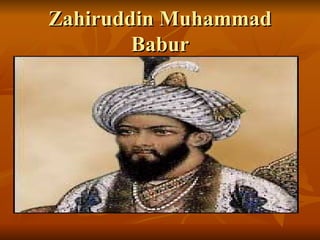
Babur - The First Mughal Emperor [1526-30] Introduction Zahiruddin Muhammad Babur founded the Mughal Empire in India after defeating Ibrahim Lodhi in the Battle of Panipat in 1526
Zahiruddin Muhammad Babur
Barber's Kingdom Map
Early Invasion At the age of 14, Babur ascended the throne of the Central Asian kingdom of Farghana. His greatest ambition was to rule Samarkand. He fought many battles in the pursuit of this goal, winning and losing his kingdom many times in the process. In 1504, he schemed into what is now Afghanistan and conquered Kabul.
Better Position in Panipat His position in Central Asia was precarious at best. In order to consolidate his rule, he invaded India five times, crossing the River Indus each time. The fifth expedition resulted in his encounter with Ibrahim Lodhi in the first battle of Panipat in April 1526
Babur's army   Babur's army  was better equipped than Lodhi's; he had guns while the sultan relied on elephants
Babur's innovations   The most successful of  Babur's innovations  was the introduction of gunpowder, which had never been used before in the Sub-continent. This combined with Babur's newer tactics gave him a greater advantage.
Babur's strategy  Babur's strategy won the war and Ibrahim Lodhi died fighting.
Babur's victory at Panipat  Panipat was merely the  beginning of the Mughal  rule. Akbar laid its real foundation in 1556. At the time of the battle of Panipat, the political power in India was shared by the Afghans and the Rajputs. After Panipat, the Hindu princes united under Rana Sanga, the Raja of Mewar, resulting in a sizable force. Babur's army showed signs of panic at the size of the huge opposing army. To prevent his forces retreat, Babur tried to instill confidence in his soldiers by breaking all his drinking cups and vessels, and vowed never to drink again if he won. His soldiers took heart, and when the armies met in the battle at Kanwaha, near Agra on March 16, 1527, Babur was able to win decisively. Kanwaha confirmed and completed Babur's victory at Panipat. Babur thus became the king of Central India.

Pakistan Studies, Lesson 3, Babur

  • 1.
    Pakistan Studies, LessonNo:3, Babur By Zafar Iqbal, M.Sc,M.A.Pol.Science
  • 2.
    Babur - TheFirst Mughal Emperor [1526-30] Introduction Zahiruddin Muhammad Babur founded the Mughal Empire in India after defeating Ibrahim Lodhi in the Battle of Panipat in 1526
  • 3.
  • 4.
  • 5.
    Early Invasion Atthe age of 14, Babur ascended the throne of the Central Asian kingdom of Farghana. His greatest ambition was to rule Samarkand. He fought many battles in the pursuit of this goal, winning and losing his kingdom many times in the process. In 1504, he schemed into what is now Afghanistan and conquered Kabul.
  • 6.
    Better Position inPanipat His position in Central Asia was precarious at best. In order to consolidate his rule, he invaded India five times, crossing the River Indus each time. The fifth expedition resulted in his encounter with Ibrahim Lodhi in the first battle of Panipat in April 1526
  • 7.
    Babur's army Babur's army was better equipped than Lodhi's; he had guns while the sultan relied on elephants
  • 8.
    Babur's innovations The most successful of Babur's innovations was the introduction of gunpowder, which had never been used before in the Sub-continent. This combined with Babur's newer tactics gave him a greater advantage.
  • 9.
    Babur's strategy Babur's strategy won the war and Ibrahim Lodhi died fighting.
  • 10.
    Babur's victory atPanipat Panipat was merely the beginning of the Mughal rule. Akbar laid its real foundation in 1556. At the time of the battle of Panipat, the political power in India was shared by the Afghans and the Rajputs. After Panipat, the Hindu princes united under Rana Sanga, the Raja of Mewar, resulting in a sizable force. Babur's army showed signs of panic at the size of the huge opposing army. To prevent his forces retreat, Babur tried to instill confidence in his soldiers by breaking all his drinking cups and vessels, and vowed never to drink again if he won. His soldiers took heart, and when the armies met in the battle at Kanwaha, near Agra on March 16, 1527, Babur was able to win decisively. Kanwaha confirmed and completed Babur's victory at Panipat. Babur thus became the king of Central India.